My work for HERA LHC and ILC Tuesday
- Slides: 29
My work for HERA, LHC and ILC. Tuesday seminar November 27, 2007 Tomáš Laštovička
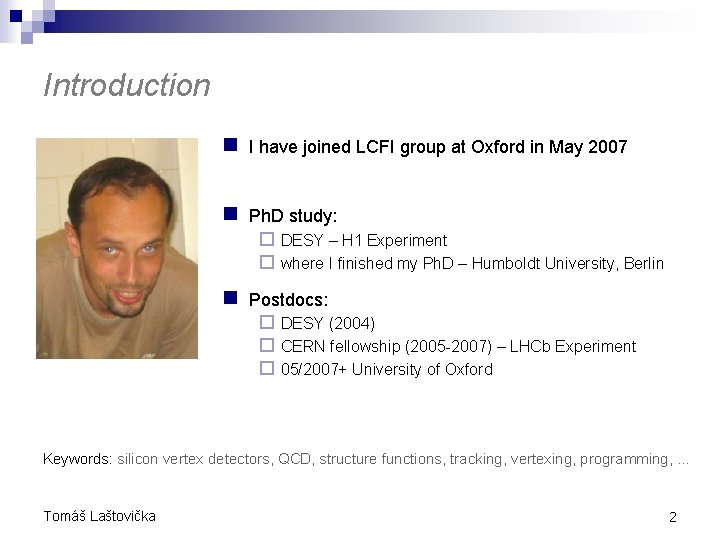
Introduction n I have joined LCFI group at Oxford in May 2007 n Ph. D study: ¨ DESY – H 1 Experiment ¨ where I finished my Ph. D – Humboldt University, Berlin n Postdocs: ¨ DESY (2004) ¨ CERN fellowship (2005 -2007) – LHCb Experiment ¨ 05/2007+ University of Oxford Keywords: silicon vertex detectors, QCD, structure functions, tracking, vertexing, programming, … Tomáš Laštovička 2
DESY and the H 1 Experiment ( ? – 2004 ) Tomáš Laštovička 3
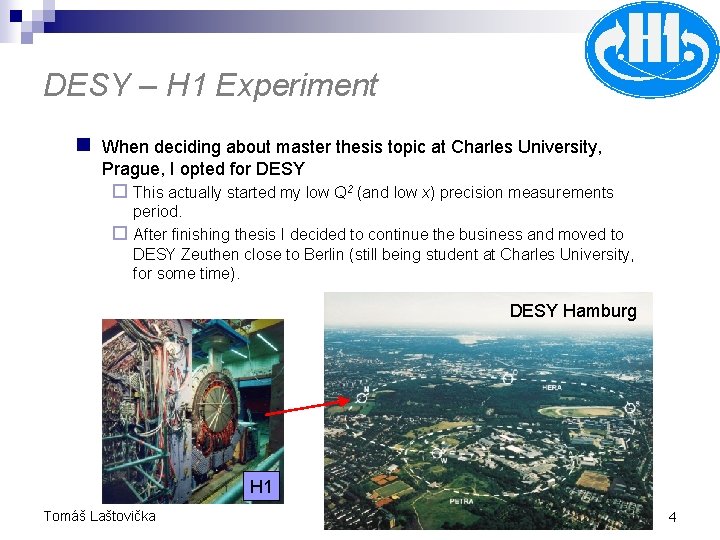
DESY – H 1 Experiment n When deciding about master thesis topic at Charles University, Prague, I opted for DESY ¨ This actually started my low Q 2 (and low x) precision measurements ¨ period. After finishing thesis I decided to continue the business and moved to DESY Zeuthen close to Berlin (still being student at Charles University, for some time). DESY Hamburg H 1 Tomáš Laštovička 4
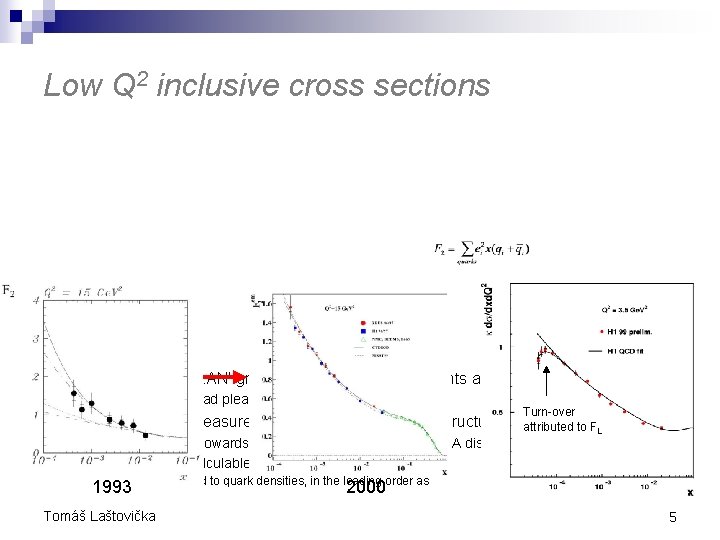
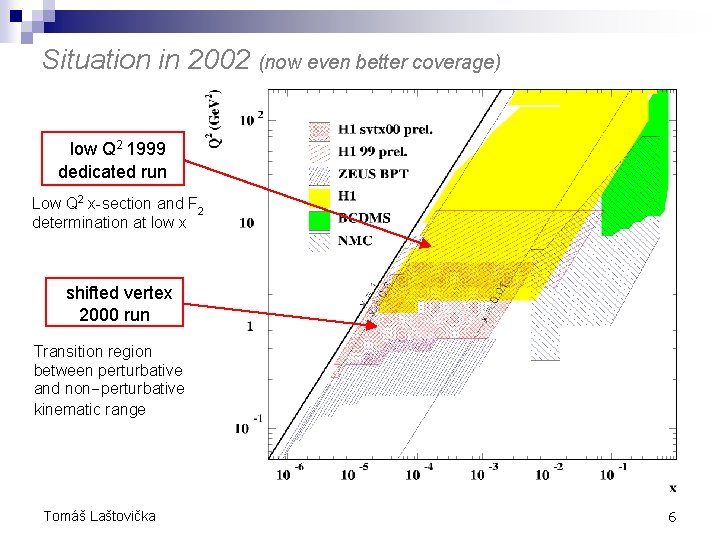
Low Q 2 inclusive cross sections n Member of ‘ELAN’ group – Inclusive Measurements and QCD fits ¨ …which I had pleasure to convene in 2002 -2005. Turn-over n Focused on measurements of F 2 and FL proton structure functions attributed to FL ¨ Steep rise towards low Bjorken x is one of few HERA discoveries ¨ F 2 is not calculable from the first principles 1993 n Related to quark densities, in the leading 2000 order as Tomáš Laštovička 5
Situation in 2002 (now even better coverage) low Q 2 1999 dedicated run Low Q 2 x-section and F 2 determination at low x shifted vertex 2000 run Transition region between perturbative and non-perturbative kinematic range Tomáš Laštovička 6
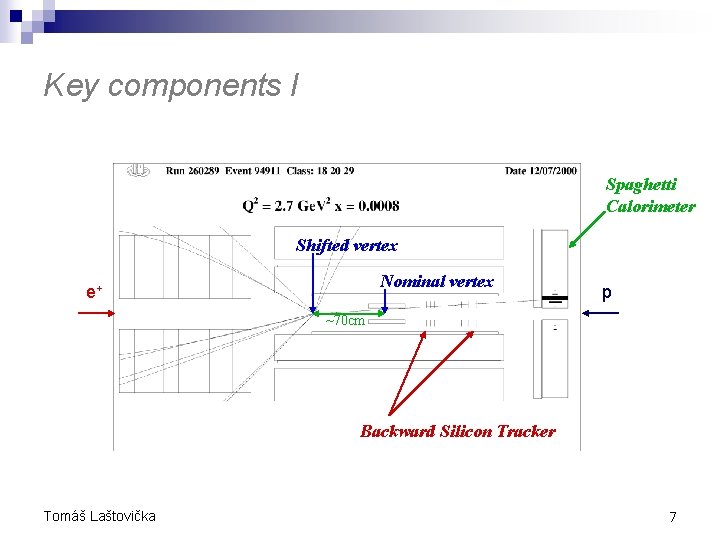
Key components I Spaghetti Calorimeter Shifted vertex Nominal vertex e+ p ~70 cm Backward Silicon Tracker Tomáš Laštovička 7
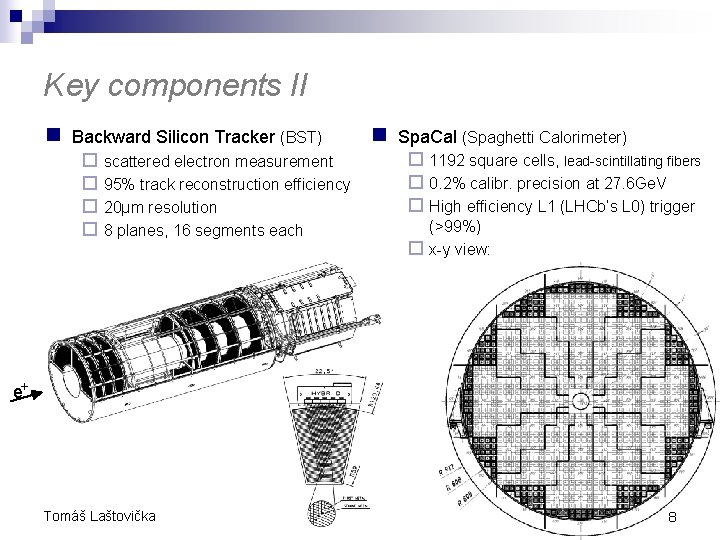
Key components II n Backward Silicon Tracker (BST) ¨ scattered electron measurement ¨ 95% track reconstruction efficiency ¨ 20μm resolution ¨ 8 planes, 16 segments each n Spa. Cal (Spaghetti Calorimeter) ¨ 1192 square cells, lead-scintillating fibers ¨ 0. 2% calibr. precision at 27. 6 Ge. V ¨ High efficiency L 1 (LHCb’s L 0) trigger ¨ (>99%) x-y view: e+ Tomáš Laštovička 8
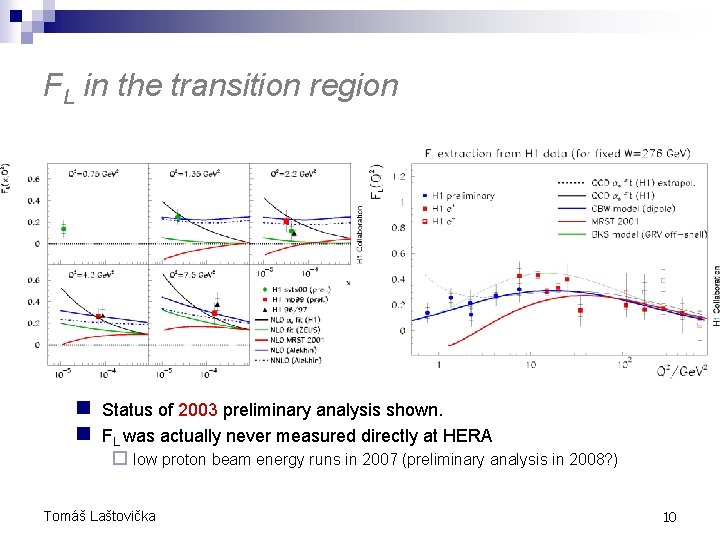
Analyses n >95% of analysis time was devoted to understanding and description of detector components ¨ Detector calibration (Spa. Cal - electron, LAr - hadrons) ¨ Alignment (BST, Spa. Cal, BDC) ¨ Efficiency (BST) – quite a challenge ¨… n It was literally “pushing the limits” style of analysis ¨ leading to some novel approaches, e. g. n F 2 measurement from ISR events without measuring the scattered electron n FL determination at Q 2 ~ 1 Ge. V 2 and below (next slide) - this region is too nonperturbative even for F 2, not mentioning FL Tomáš Laštovička 9
FL in the transition region n Status of 2003 preliminary analysis shown. n FL was actually never measured directly at HERA ¨ low proton beam energy runs in 2007 (preliminary analysis in 2008? ) Tomáš Laštovička 10
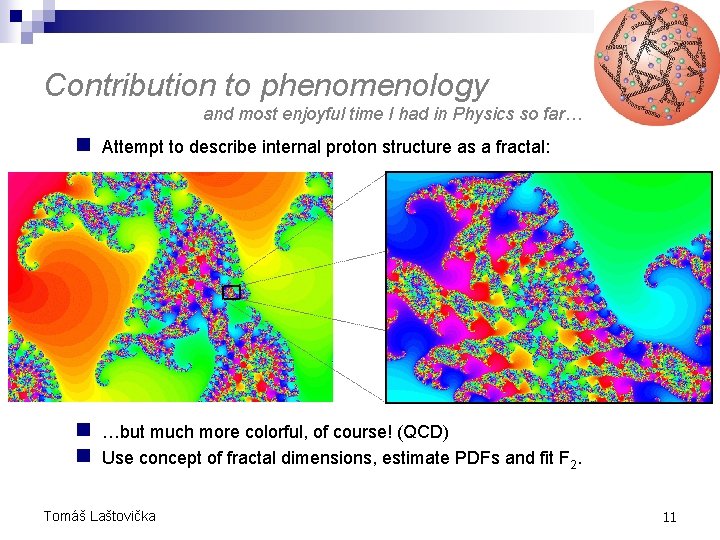
Contribution to phenomenology and most enjoyful time I had in Physics so far… n Attempt to describe internal proton structure as a fractal: n …but much more colorful, of course! (QCD) n Use concept of fractal dimensions, estimate PDFs and fit F 2. Tomáš Laštovička 11
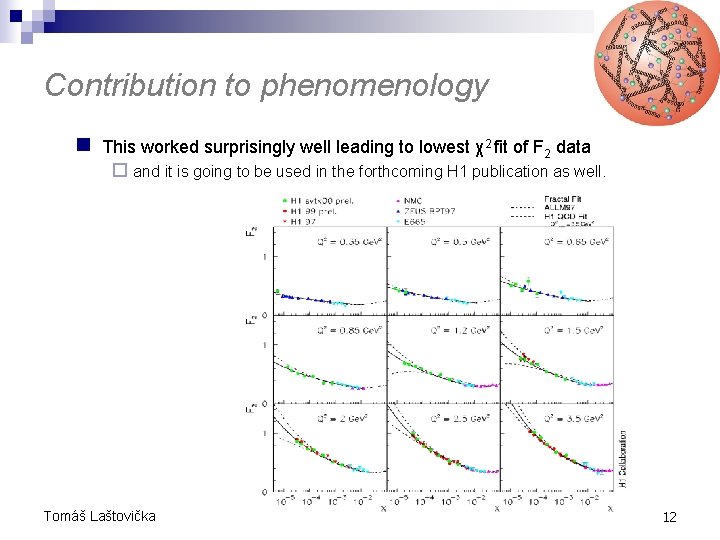
Contribution to phenomenology n This worked surprisingly well leading to lowest χ2 fit of F 2 data ¨ and it is going to be used in the forthcoming H 1 publication as well. Tomáš Laštovička 12
CERN and the LHCb Experiment ( 2005 – 2007 ) Tomáš Laštovička 13
CERN fellowship n In 2004 I was awarded CERN research fellow position ¨ and joined the LHCb Experiment in February 2005 n I started with ¨ Metrology/Alignment of VELO (Vertex Locator) telescope ¨ VELO-only fast simulations (rest of LHCb subdetectors not simulated) n Then I directed myself more into VELO-only reconstruction of generic tracks/vertices and its applications ¨ Generic pattern recognition – Pat. Velo. Generic class ¨ and Generic Vertex finding and reconstruction ¨ Applications: n alignment issues, open velo, luminosity measurements, test-beam data, … Tomáš Laštovička 14
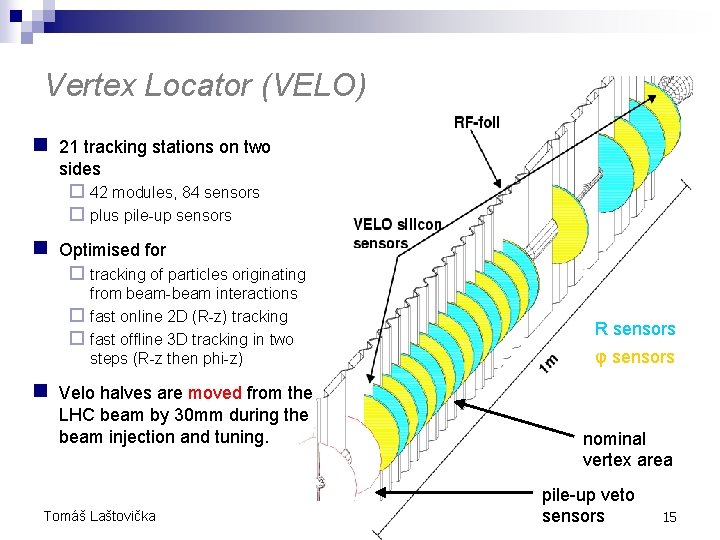
Vertex Locator (VELO) n 21 tracking stations on two sides ¨ 42 modules, 84 sensors ¨ plus pile-up sensors n Optimised for ¨ tracking of particles originating ¨ ¨ from beam-beam interactions fast online 2 D (R-z) tracking fast offline 3 D tracking in two steps (R-z then phi-z) R sensors φ sensors n Velo halves are moved from the LHC beam by 30 mm during the beam injection and tuning. Tomáš Laštovička nominal vertex area pile-up veto sensors 15
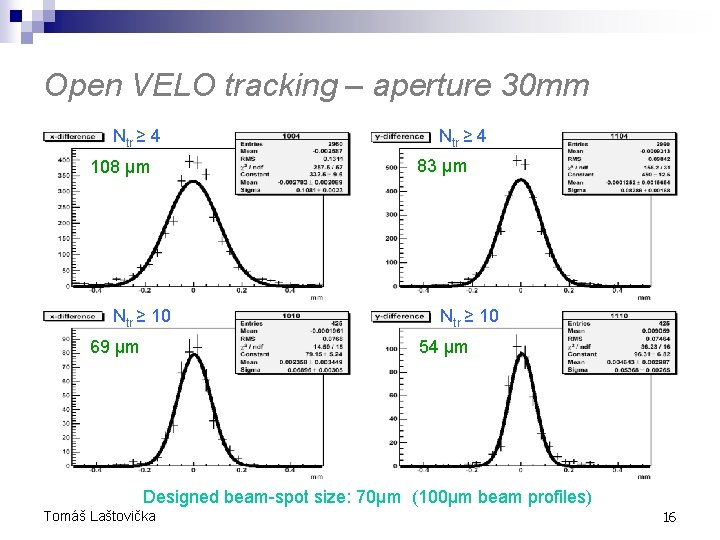
Open VELO tracking – aperture 30 mm Ntr ≥ 4 108 μm Ntr ≥ 10 Ntr ≥ 4 83 μm Ntr ≥ 10 54 μm 69 μm Designed beam-spot size: 70μm (100μm beam profiles) Tomáš Laštovička 16
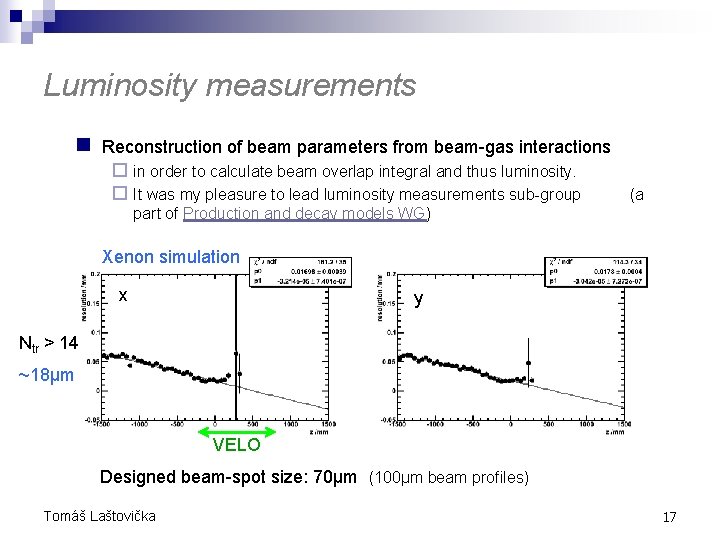
Luminosity measurements n Reconstruction of beam parameters from beam-gas interactions ¨ in order to calculate beam overlap integral and thus luminosity. ¨ It was my pleasure to lead luminosity measurements sub-group (a part of Production and decay models WG) Xenon simulation x y Ntr > 14 ~18μm VELO Designed beam-spot size: 70μm (100μm beam profiles) Tomáš Laštovička 17
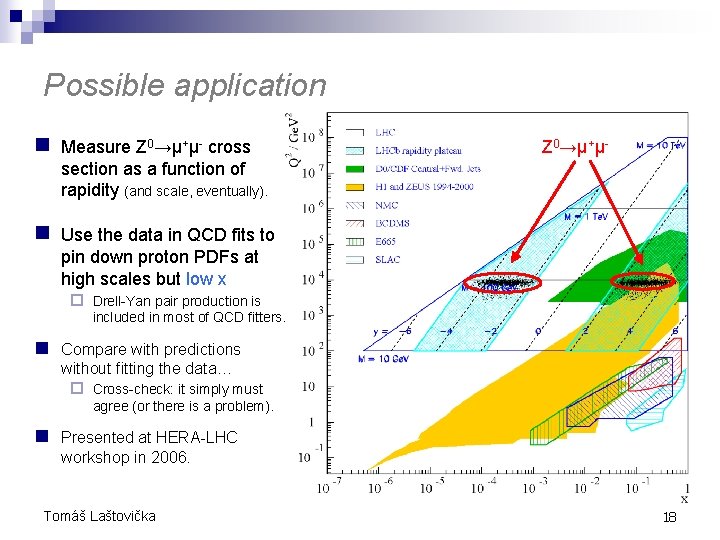
Possible application n Measure Z 0→µ+µ- cross Z 0→µ+µ- section as a function of rapidity (and scale, eventually). n Use the data in QCD fits to pin down proton PDFs at high scales but low x ¨ Drell-Yan pair production is included in most of QCD fitters. n Compare with predictions without fitting the data… ¨ Cross-check: it simply must agree (or there is a problem). n Presented at HERA-LHC workshop in 2006. Tomáš Laštovička 18
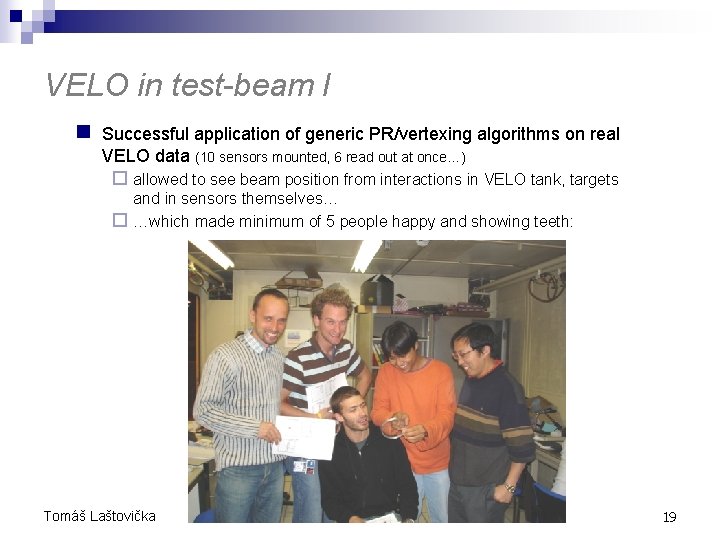
VELO in test-beam I n Successful application of generic PR/vertexing algorithms on real VELO data (10 sensors mounted, 6 read out at once…) ¨ allowed to see beam position from interactions in VELO tank, targets ¨ and in sensors themselves… …which made minimum of 5 people happy and showing teeth: Tomáš Laštovička 19
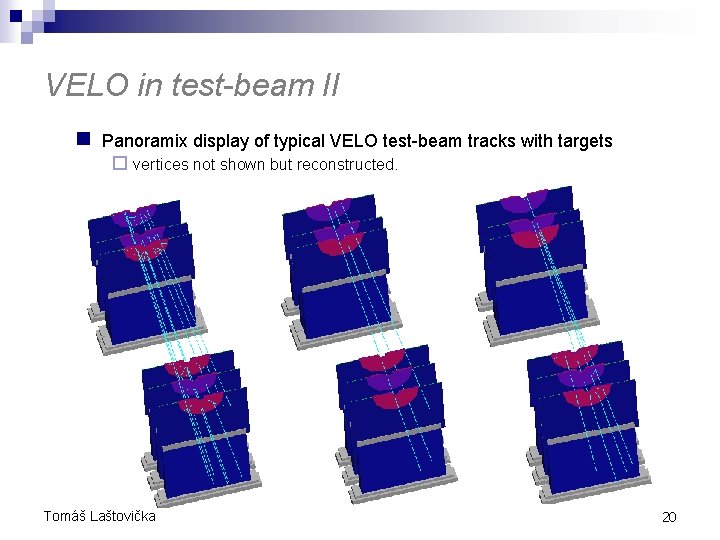
VELO in test-beam II n Panoramix display of typical VELO test-beam tracks with targets ¨ vertices not shown but reconstructed. Tomáš Laštovička 20
University of Oxford – LCFI group (ILC) ( May 2005 till now ) Tomáš Laštovička 21
LCFI = Linear Collider Flavour Identification I am involved in: n Physics Higgs self-coupling: ZHH channel SUSY: sbottom Decay Analysis n Technical tasks Kalman Filter for Vertex Fitting Jet Tagging Algorithms (NNs, Boosted Decision Trees) Tomáš Laštovička 22
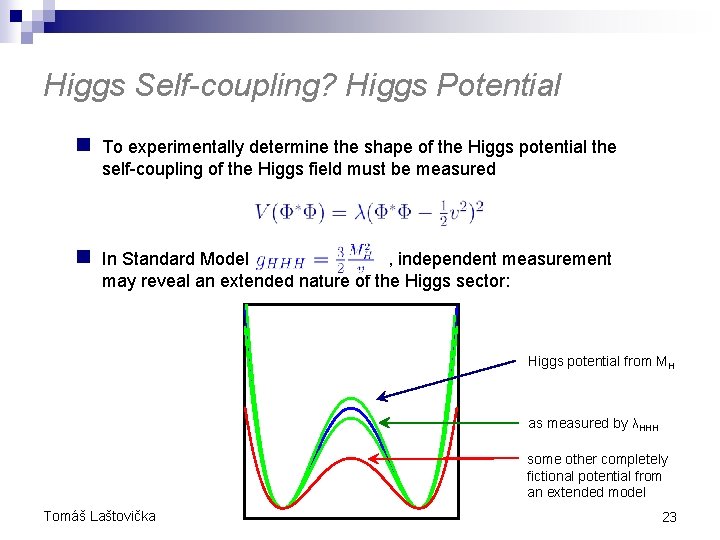
Higgs Self-coupling? Higgs Potential n To experimentally determine the shape of the Higgs potential the self-coupling of the Higgs field must be measured n In Standard Model , independent measurement may reveal an extended nature of the Higgs sector: Higgs potential from MH as measured by λHHH some other completely fictional potential from an extended model Tomáš Laštovička 23
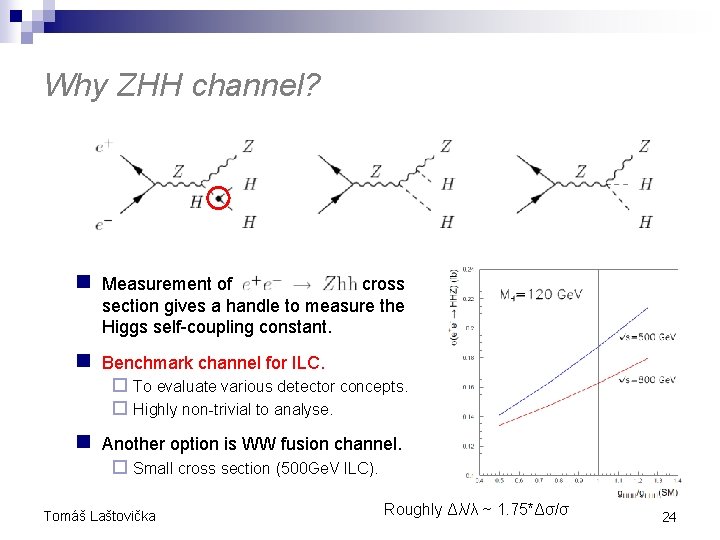
Why ZHH channel? n Measurement of cross section gives a handle to measure the Higgs self-coupling constant. n Benchmark channel for ILC. ¨ To evaluate various detector concepts. ¨ Highly non-trivial to analyse. n Another option is WW fusion channel. ¨ Small cross section (500 Ge. V ILC). Tomáš Laštovička Roughly Δλ/λ ~ 1. 75*Δσ/σ 24
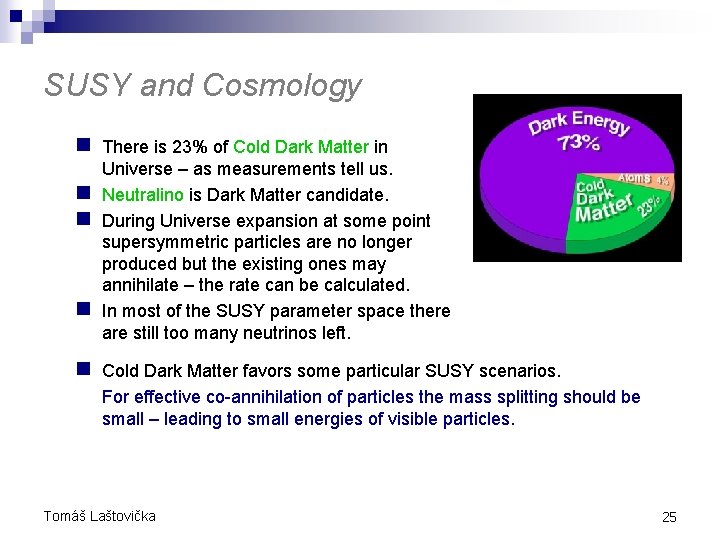
SUSY and Cosmology n There is 23% of Cold Dark Matter in n Universe – as measurements tell us. Neutralino is Dark Matter candidate. During Universe expansion at some point supersymmetric particles are no longer produced but the existing ones may annihilate – the rate can be calculated. In most of the SUSY parameter space there are still too many neutrinos left. n Cold Dark Matter favors some particular SUSY scenarios. For effective co-annihilation of particles the mass splitting should be small – leading to small energies of visible particles. Tomáš Laštovička 25
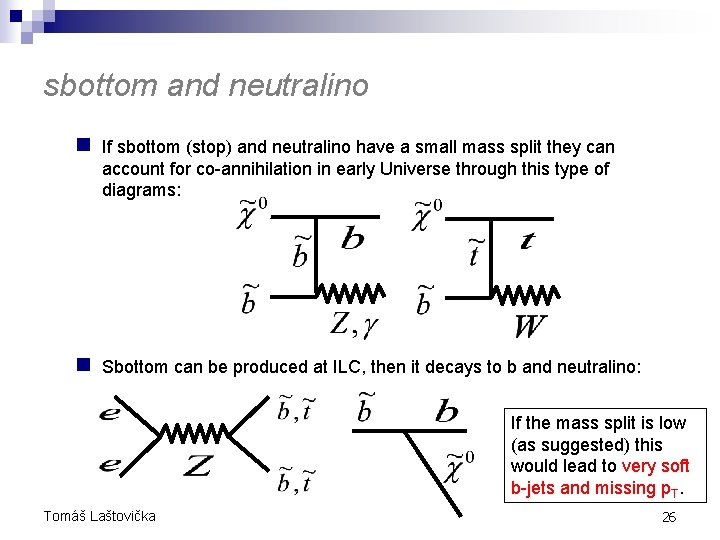
sbottom and neutralino n If sbottom (stop) and neutralino have a small mass split they can account for co-annihilation in early Universe through this type of diagrams: n Sbottom can be produced at ILC, then it decays to b and neutralino: If the mass split is low (as suggested) this would lead to very soft b-jets and missing p. T. Tomáš Laštovička 26
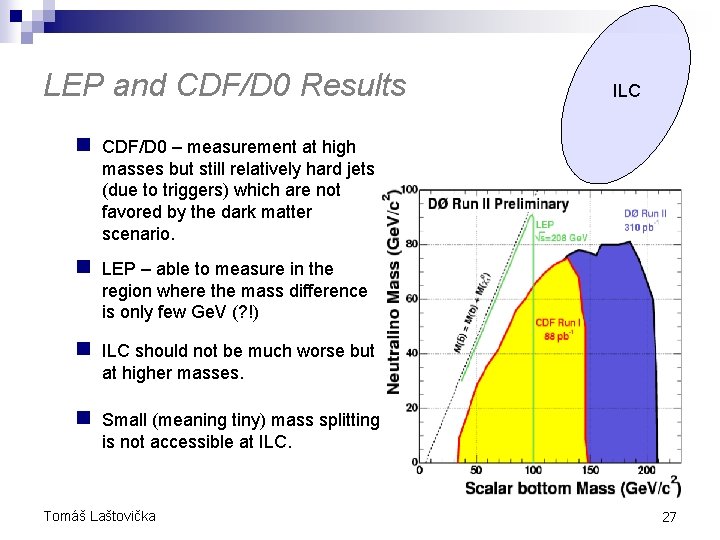
LEP and CDF/D 0 Results ILC n CDF/D 0 – measurement at high masses but still relatively hard jets (due to triggers) which are not favored by the dark matter scenario. n LEP – able to measure in the region where the mass difference is only few Ge. V (? !) n ILC should not be much worse but at higher masses. n Small (meaning tiny) mass splitting is not accessible at ILC. Tomáš Laštovička 27
Conclusions ? Tomáš Laštovička 28
Thank you for attention… Tomáš Laštovička 29