Multitasking and Preemption CS 161 Lecture 3 232020


- Slides: 32
Multitasking and Preemption CS 161: Lecture 3 2/3/2020
Multitasking • A user-level execution context consists of: • A virtual address space (pointed to by %cr 3) • The next instruction to execute (pointed to by %rip) • A stack (pointed to by %rsp) • Other register state (e. g. , %rax, %rbx, %r 8) • Multitasking allows multiple contexts to run atop a single processor • Divide time into slices • At the beginning of a slice, pick a task (i. e. , a context) to run • Run the task until: • It voluntarily yields the CPU • It is interrupted (e. g. , because its time slice expires) and must involuntarily release the CPU
Vectoring Control To The Kernel • Kernel code only executes in response to external stimuli • Asynchronous interrupts (e. g. , timer interrupt, NIC interrupt (because a packet arrived)) • Synchronous exceptions (e. g. , dividing by zero, dereferencing a null pointer, attempting to write a read-only page) • Synchronous traps (e. g. , system calls via syscall, debugging traps via int 3) • During boot, the kernel must configure the processor to invoke the appropriate kernel code when exceptions, traps, and interrupts occur Partially a lie: Kernel threads!
Handling A System Call • Part 0: The swapgs instruction • Part I: Invoking the Kernel’s System Call Handler • Part II: Completing the Context Switch • Part III: Executing Kernel Code • Part IV: Returning to User-mode
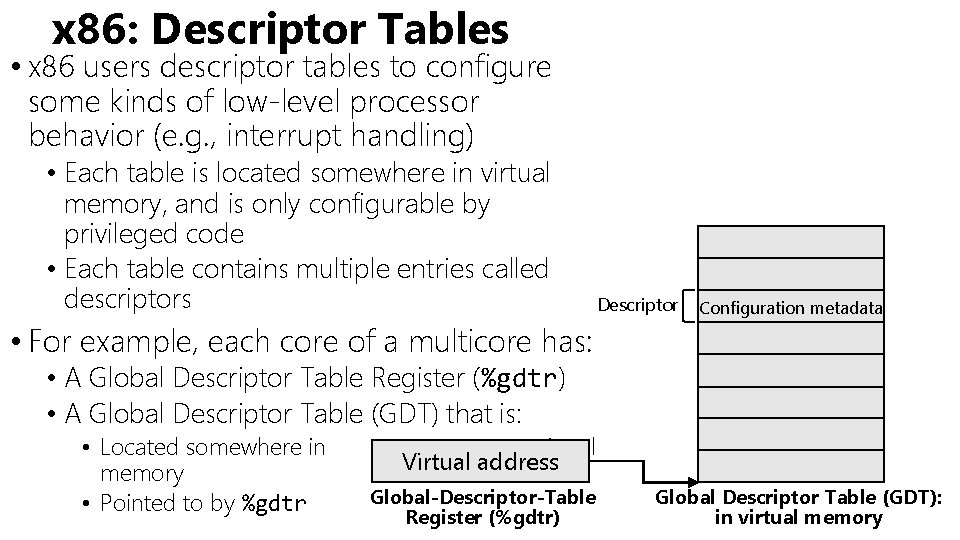
x 86: Descriptor Tables • x 86 users descriptor tables to configure some kinds of low-level processor behavior (e. g. , interrupt handling) • Each table is located somewhere in virtual memory, and is only configurable by privileged code • Each table contains multiple entries called descriptors • For example, each core of a multicore has: Descriptor Configuration metadata • A Global Descriptor Table Register (%gdtr) • A Global Descriptor Table (GDT) that is: • Located somewhere in memory • Pointed to by %gdtr virtual Virtual address Global-Descriptor-Table Register (%gdtr) Global Descriptor Table (GDT): in virtual memory
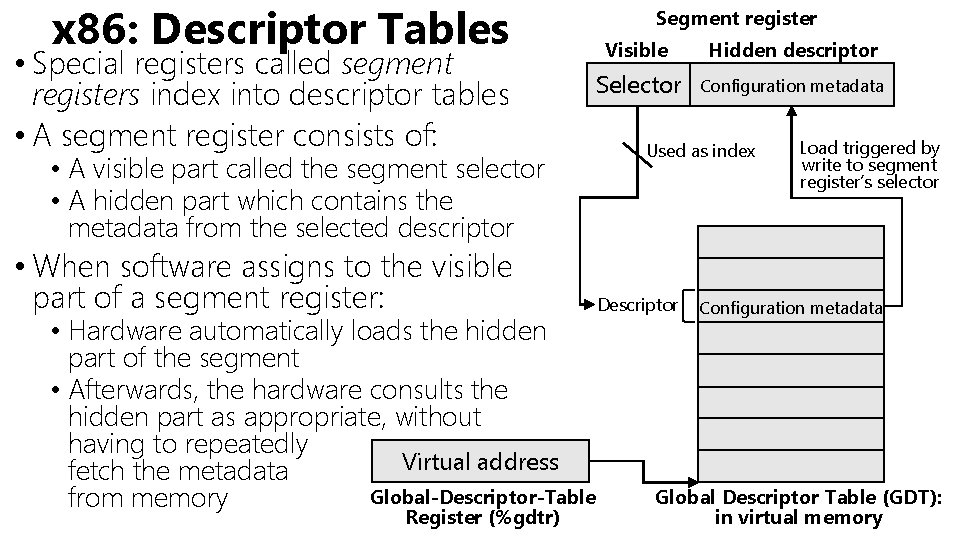
x 86: Descriptor Tables • Special registers called segment registers index into descriptor tables • A segment register consists of: Segment register Visible Hidden descriptor Selector Configuration metadata • A visible part called the segment selector • A hidden part which contains the metadata from the selected descriptor • When software assigns to the visible part of a segment register: • Hardware automatically loads the hidden part of the segment • Afterwards, the hardware consults the hidden part as appropriate, without having to repeatedly Virtual address fetch the metadata Global-Descriptor-Table from memory Register (%gdtr) Used as index Descriptor Load triggered by write to segment register’s selector Configuration metadata Global Descriptor Table (GDT): in virtual memory
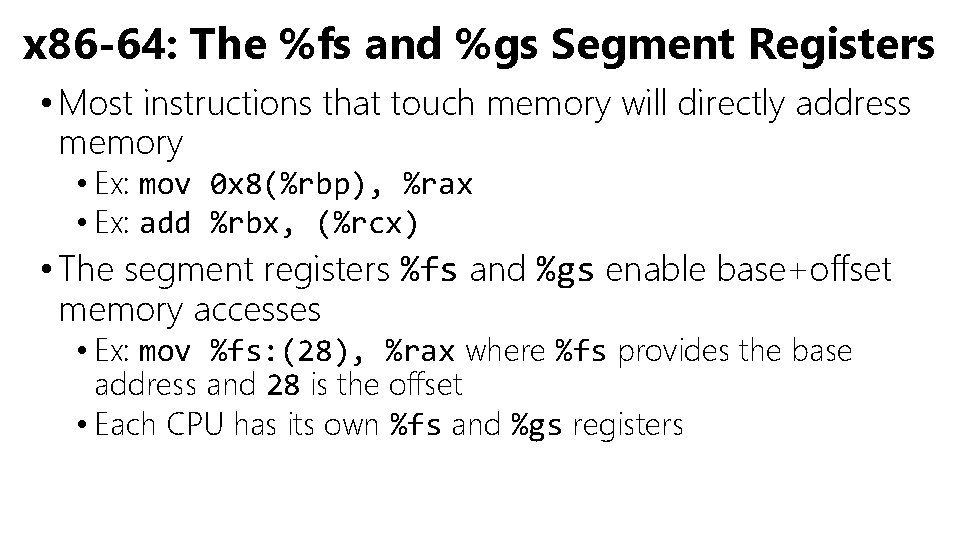
x 86 -64: The %fs and %gs Segment Registers • Most instructions that touch memory will directly address memory • Ex: mov 0 x 8(%rbp), %rax • Ex: add %rbx, (%rcx) • The segment registers %fs and %gs enable base+offset memory accesses • Ex: mov %fs: (28), %rax where %fs provides the base address and 28 is the offset • Each CPU has its own %fs and %gs registers
x 86 -64: The Structure of %fs and %gs • Visible part: Contains a segment selector that can be directly read or written via normal register instructions like mov and pop • Hidden part: Contains the base address that’s used in address calculations like mov %fs: (28), %rax [This nonsense is mostly a historical artifact of how 32 -bit x 86 used to work. ]
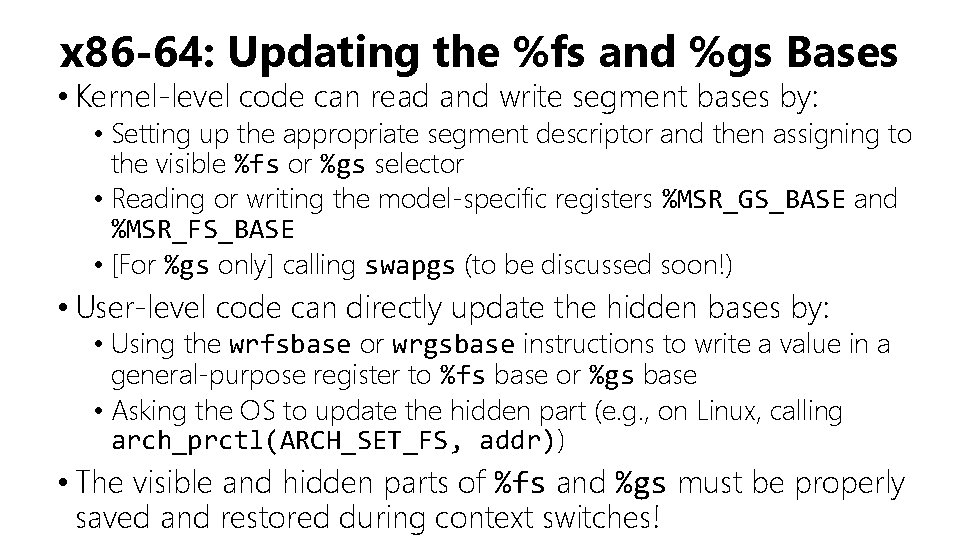
x 86 -64: Updating the %fs and %gs Bases • Kernel-level code can read and write segment bases by: • Setting up the appropriate segment descriptor and then assigning to the visible %fs or %gs selector • Reading or writing the model-specific registers %MSR_GS_BASE and %MSR_FS_BASE • [For %gs only] calling swapgs (to be discussed soon!) • User-level code can directly update the hidden bases by: • Using the wrfsbase or wrgsbase instructions to write a value in a general-purpose register to %fs base or %gs base • Asking the OS to update the hidden part (e. g. , on Linux, calling arch_prctl(ARCH_SET_FS, addr)) • The visible and hidden parts of %fs and %gs must be properly saved and restored during context switches!
Example: Using %fs to Implement User-level Stack Canaries
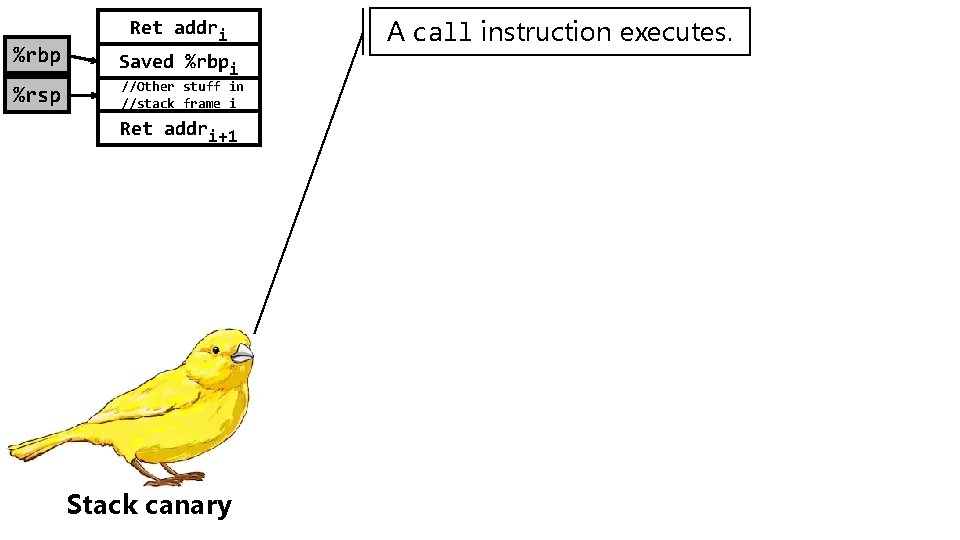
%rbp %rsp Ret addri Saved %rbpi //Other stuff in //stack frame i Ret addri+1 Stack canary A call instruction executes.
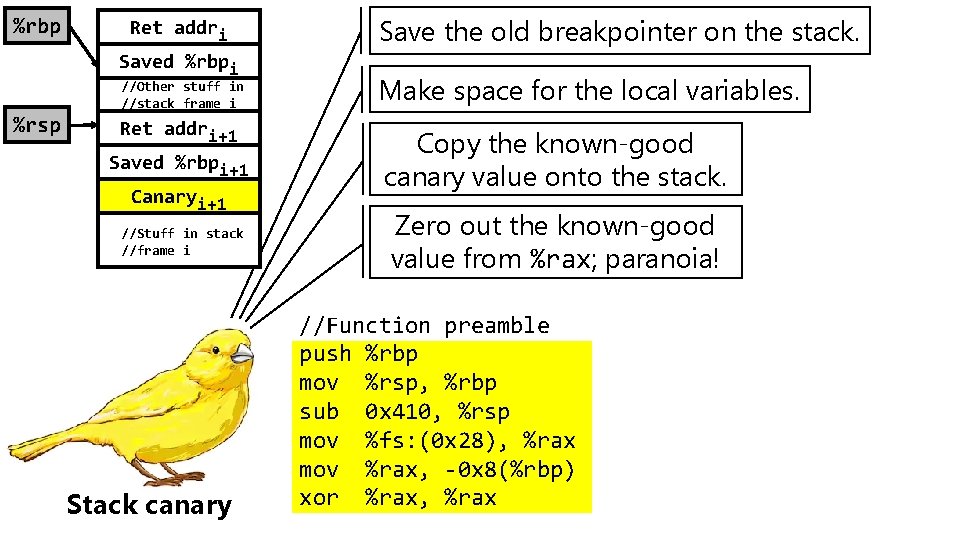
%rbp Ret addri Saved %rbpi //Other stuff in //stack frame i %rsp Ret addri+1 Saved %rbpi+1 Canaryi+1 //Stuff in stack //frame ixcxxcc Stack canary Save the old breakpointer on the stack. Make space for the local variables. Copy the known-good canary value onto the stack. Zero out the known-good value from %rax; paranoia! //Function preamble push %rbp mov %rsp, %rbp sub 0 x 410, %rsp mov %fs: (0 x 28), %rax mov %rax, -0 x 8(%rbp) xor %rax, %rax
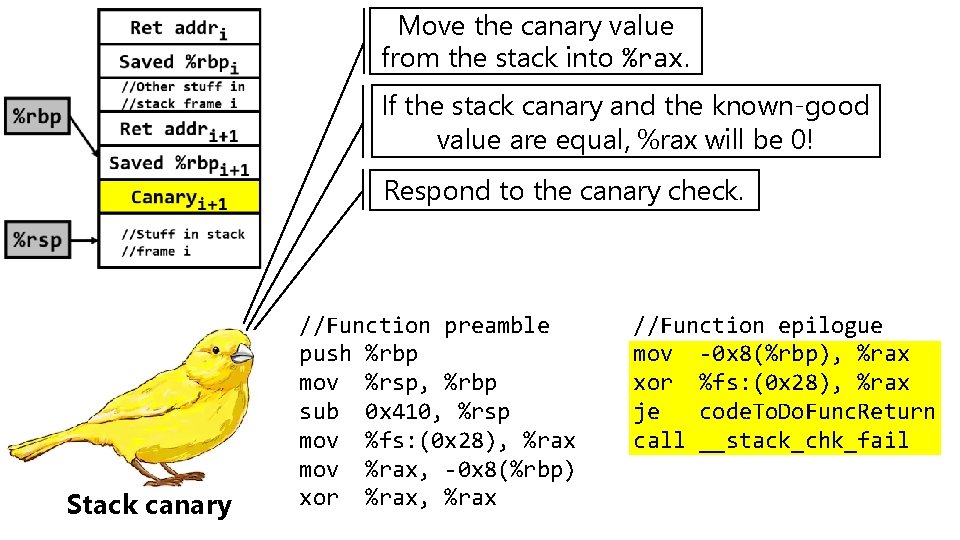
Move the canary value from the stack into %rax. If the stack canary and the known-good value are equal, %rax will be 0! Respond to the canary check. Stack canary //Function preamble push %rbp mov %rsp, %rbp sub 0 x 410, %rsp mov %fs: (0 x 28), %rax mov %rax, -0 x 8(%rbp) xor %rax, %rax //Function epilogue mov -0 x 8(%rbp), %rax xor %fs: (0 x 28), %rax je code. To. Do. Func. Return call __stack_chk_fail
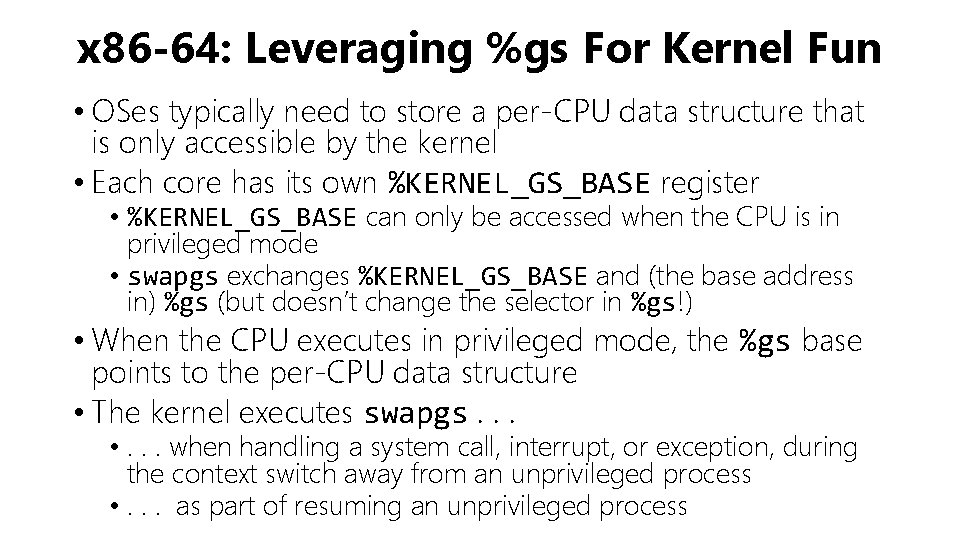
x 86 -64: Leveraging %gs For Kernel Fun • OSes typically need to store a per-CPU data structure that is only accessible by the kernel • Each core has its own %KERNEL_GS_BASE register • %KERNEL_GS_BASE can only be accessed when the CPU is in privileged mode • swapgs exchanges %KERNEL_GS_BASE and (the base address in) %gs (but doesn’t change the selector in %gs!) • When the CPU executes in privileged mode, the %gs base points to the per-CPU data structure • The kernel executes swapgs. . . • . . . when handling a system call, interrupt, or exception, during the context switch away from an unprivileged process • . . . as part of resuming an unprivileged process
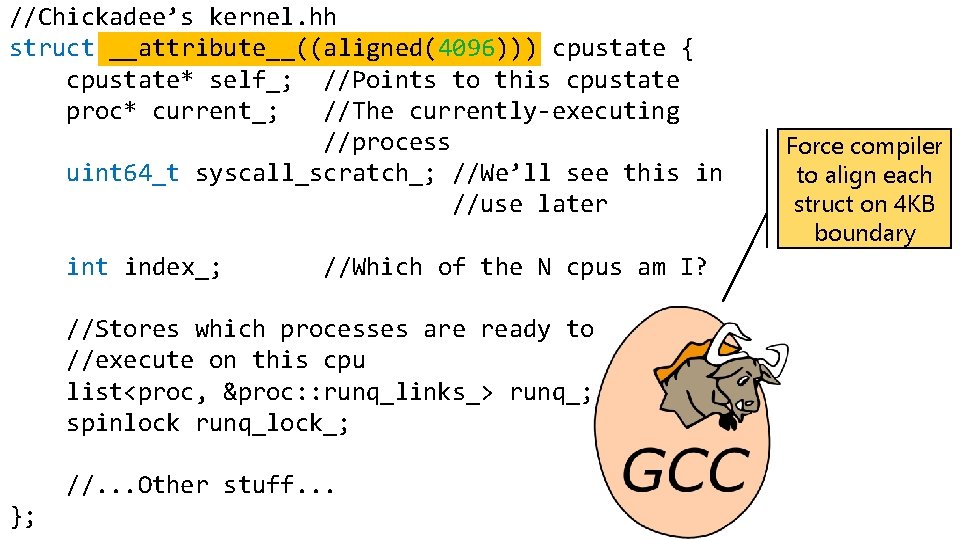
//Chickadee’s kernel. hh struct __attribute__((aligned(4096))) cpustate { cpustate* self_; //Points to this cpustate proc* current_; //The currently-executing //process uint 64_t syscall_scratch_; //We’ll see this in //use later int index_; //Which of the N cpus am I? //Stores which processes are ready to //execute on this cpu list<proc, &proc: : runq_links_> runq_; spinlock runq_lock_; //. . . Other stuff. . . }; Force compiler to align each struct on 4 KB boundary
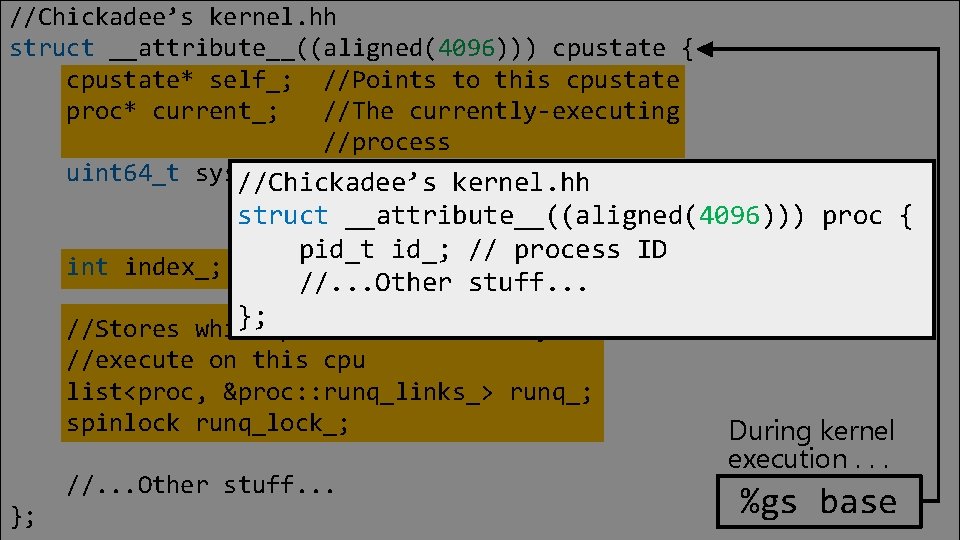
//Chickadee’s kernel. hh struct __attribute__((aligned(4096))) cpustate { cpustate* self_; //Points to this cpustate proc* current_; //The currently-executing //process uint 64_t syscall_scratch_; see this in //Chickadee’s //We’ll kernel. hh //use later struct __attribute__((aligned(4096))) proc { int index_; pid_t id_; // process ID //Which of the N cpus am I? //. . . Other stuff. . . }; processes are ready to //Stores which //execute on this cpu list<proc, &proc: : runq_links_> runq_; spinlock runq_lock_; //. . . Other stuff. . . }; During kernel execution. . . %gs base
Handling A System Call • Part 0: The swapgs instruction • Part I: Invoking the Kernel’s System Call Handler • Part II: Completing the Context Switch • Part III: Executing Kernel Code • Part IV: Returning to User-mode
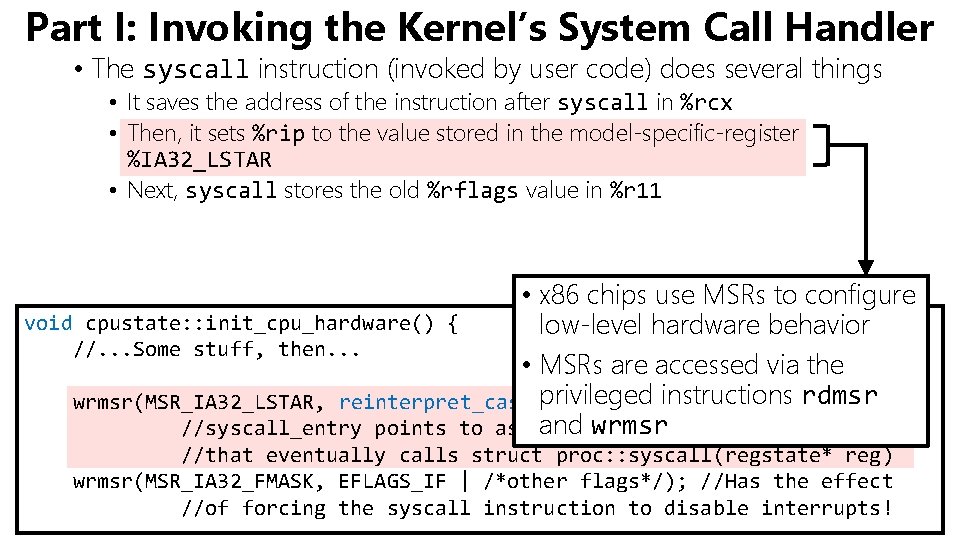
Part I: Invoking the Kernel’s System Call Handler • The syscall instruction (invoked by user code) does several things • It saves the address of the instruction after syscall in %rcx • Then, it sets %rip to the value stored in the model-specific-register %IA 32_LSTAR • Next, syscall stores the old %rflags value in %r 11 • x 86 chips use MSRs to configure void cpustate: : init_cpu_hardware() { low-level hardware behavior //. . . Some stuff, then. . . • MSRs are accessed via the privileged instructions rdmsr wrmsr(MSR_IA 32_LSTAR, reinterpret_cast<uint 64_t>(syscall_entry)); and wrmsr //syscall_entry points to assembly code in k-exception. S //that eventually calls struct proc: : syscall(regstate* reg) wrmsr(MSR_IA 32_FMASK, EFLAGS_IF | /*other flags*/); //Has the effect //of forcing the syscall instruction to disable interrupts!
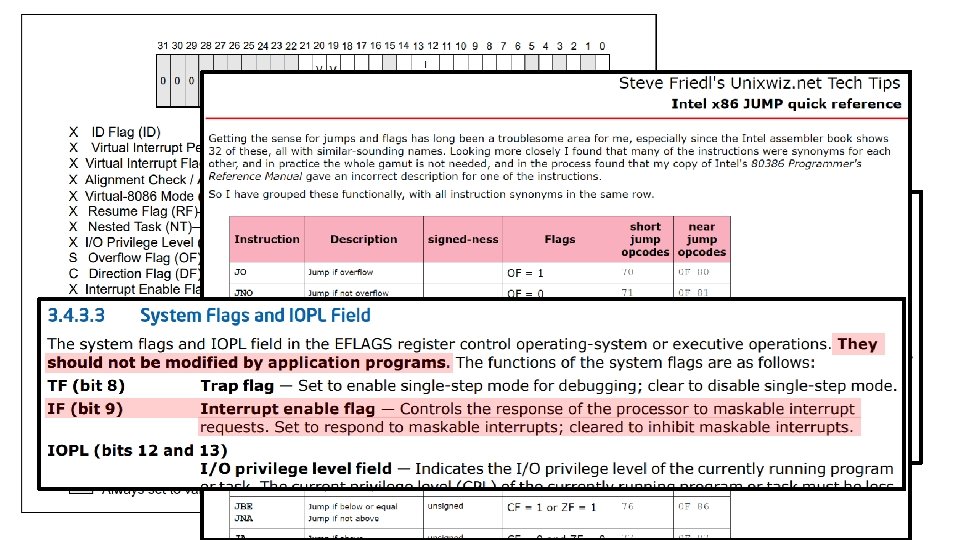
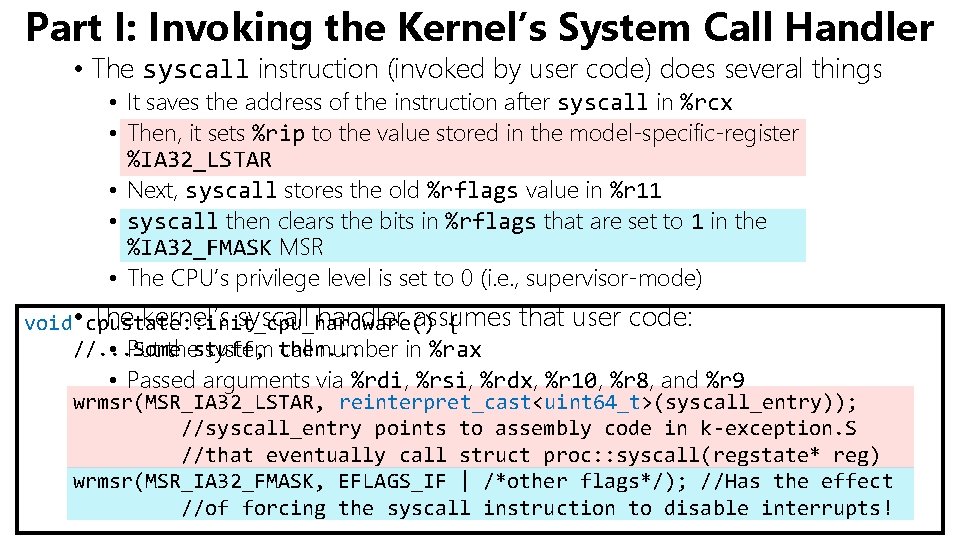
Part I: Invoking the Kernel’s System Call Handler • The syscall instruction (invoked by user code) does several things • It saves the address of the instruction after syscall in %rcx • Then, it sets %rip to the value stored in the model-specific-register %IA 32_LSTAR • Next, syscall stores the old %rflags value in %r 11 • syscall then clears the bits in %rflags that are set to 1 in the %IA 32_FMASK MSR • The CPU’s privilege level is set to 0 (i. e. , supervisor-mode) The kernel’s syscall handler assumes void • cpustate: : init_cpu_hardware() { //. . . Some • Put thestuff, system then. . . call number in %rax that user code: • Passed arguments via %rdi, %rsi, %rdx, %r 10, %r 8, and %r 9 wrmsr(MSR_IA 32_LSTAR, reinterpret_cast<uint 64_t>(syscall_entry)); //syscall_entry points to assembly code in k-exception. S //that eventually call struct proc: : syscall(regstate* reg) wrmsr(MSR_IA 32_FMASK, EFLAGS_IF | /*other flags*/); //Has the effect //of forcing the syscall instruction to disable interrupts!
Handling A System Call • Part 0: The swapgs instruction • Part I: Invoking the Kernel’s System Call Handler • Part II: Completing the Context Switch • Part III: Executing Kernel Code • Part IV: Returning to User-mode
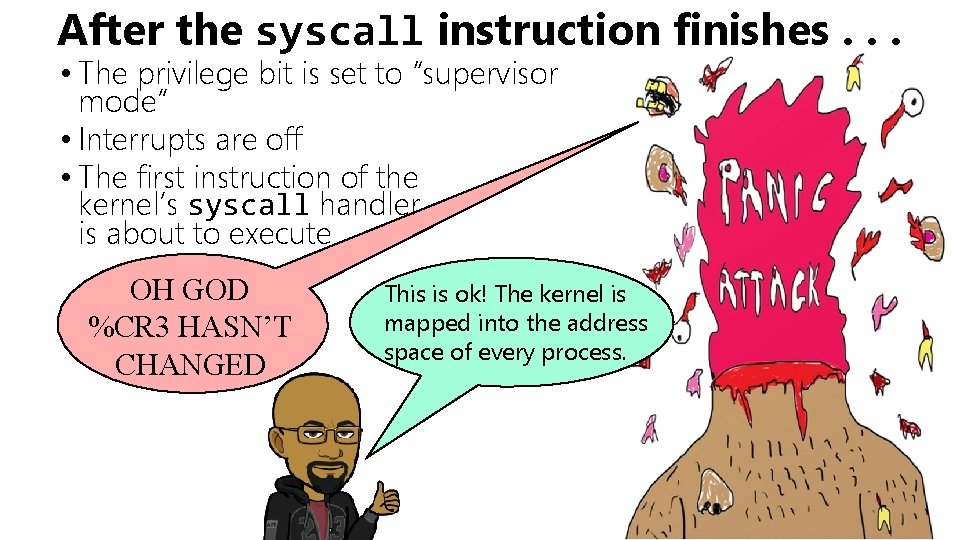
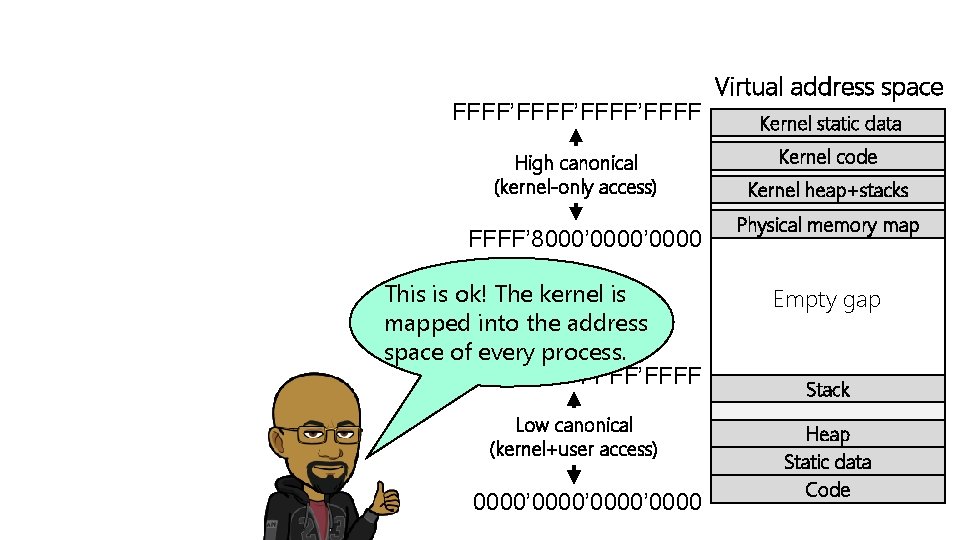
After the syscall instruction finishes. . . • The privilege bit is set to “supervisor mode” • Interrupts are off • The first instruction of the kernel’s syscall handler is about to execute OH GOD %CR 3 HASN’T CHANGED This is ok! The kernel is mapped into the address space of every process.
FFFF’FFFF’FFFF High canonical (kernel-only access) FFFF’ 8000’ 0000 This is ok! The kernel is mapped into the address space of every process. 0000’ 7 FFF’FFFF Low canonical (kernel+user access) 0000’ 0000 Virtual address space Kernel static data Kernel code Kernel heap+stacks Physical memory map Empty gap Stack Heap Static data Code
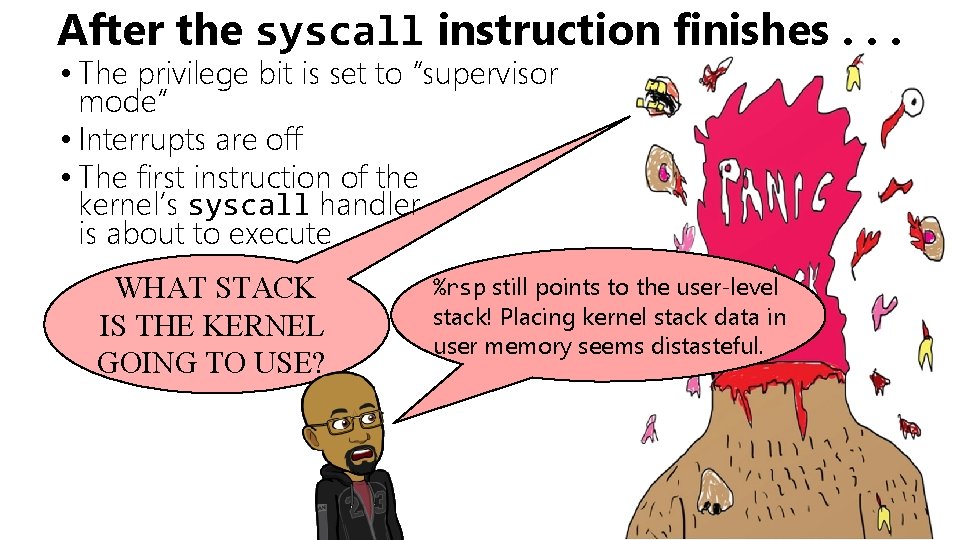
After the syscall instruction finishes. . . • The privilege bit is set to “supervisor mode” • Interrupts are off • The first instruction of the kernel’s syscall handler is about to execute WHAT STACK IS THE KERNEL GOING TO USE? %rsp still points to the user-level stack! Placing kernel stack data in user memory seems distasteful.
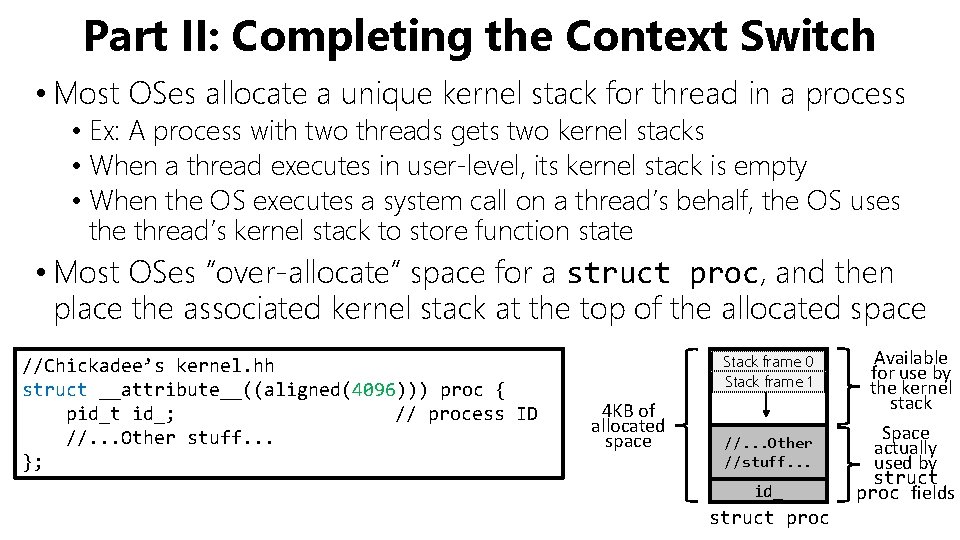
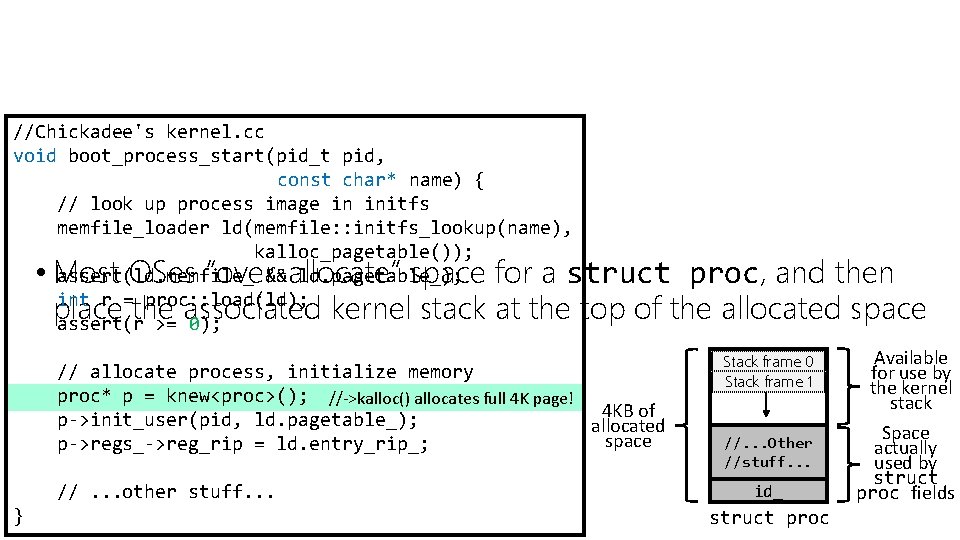
Part II: Completing the Context Switch • Most OSes allocate a unique kernel stack for thread in a process • Ex: A process with two threads gets two kernel stacks • When a thread executes in user-level, its kernel stack is empty • When the OS executes a system call on a thread’s behalf, the OS uses the thread’s kernel stack to store function state • Most OSes “over-allocate” space for a struct proc, and then place the associated kernel stack at the top of the allocated space //Chickadee’s kernel. hh struct __attribute__((aligned(4096))) proc { pid_t id_; // process ID //. . . Other stuff. . . }; Stack frame 0 Stack frame 1 4 KB of allocated space //. . . Other //stuff. . . id_ struct proc Available for use by the kernel stack Space actually used by struct proc fields
• Most OSes allocate a unique kernel stack for thread in a process //Chickadee's kernel. cc • Ex: A process with two threads gets two kernel stacks void boot_process_start(pid_t pid, • When a thread executes in user-level, its kernel stack is empty const char* name) { OS executes system call on a thread’s behalf, the OS // • When look upthe process image in a initfs memfile_loader the thread’sld(memfile: : initfs_lookup(name), kernel stack to store function state kalloc_pagetable()); assert(ld. memfile_ && ld. pagetable_); int r = proc: : load(ld); assert(r >= 0); uses • Most OSes “over-allocate” space for a struct proc, and then place the associated kernel stack at the top of the allocated space // allocate process, initialize memory proc* p = knew<proc>(); //->kalloc() allocates full 4 K page! 4 KB of p->init_user(pid, ld. pagetable_); allocated space p->regs_->reg_rip = ld. entry_rip_; //. . . other stuff. . . } Stack frame 0 Stack frame 1 //. . . Other //stuff. . . id_ struct proc Available for use by the kernel stack Space actually used by struct proc fields
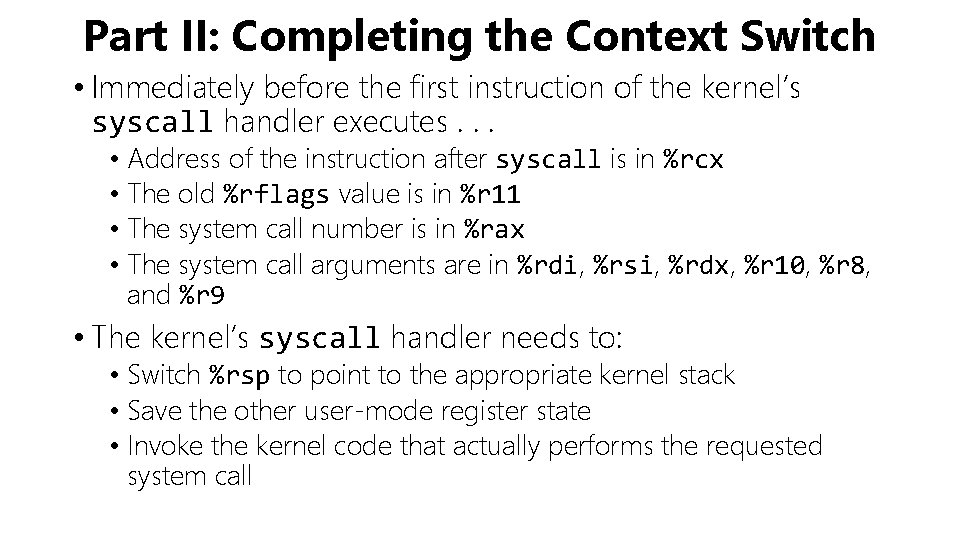
Part II: Completing the Context Switch • Immediately before the first instruction of the kernel’s syscall handler executes. . . • Address of the instruction after syscall is in %rcx • The old %rflags value is in %r 11 • The system call number is in %rax • The system call arguments are in %rdi, %rsi, %rdx, %r 10, %r 8, and %r 9 • The kernel’s syscall handler needs to: • Switch %rsp to point to the appropriate kernel stack • Save the other user-mode register state • Invoke the kernel code that actually performs the requested system call
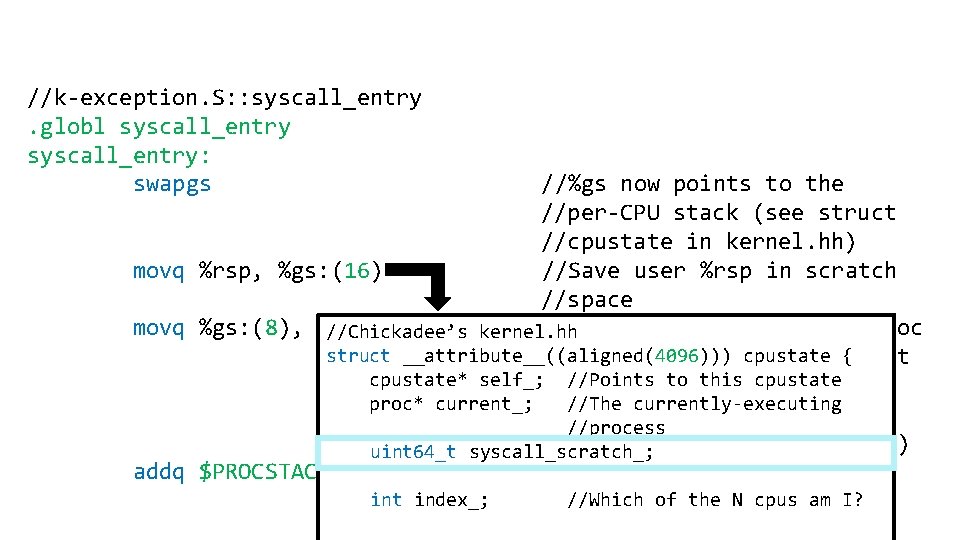
//k-exception. S: : syscall_entry. globl syscall_entry: swapgs //%gs now points to the //per-CPU stack (see struct //cpustate in kernel. hh) movq %rsp, %gs: (16) //Save user %rsp in scratch //space movq %gs: (8), %rsp //Set %rsp to the struct proc //Chickadee’s kernel. hh struct __attribute__((aligned(4096))) cpustate //for the process which{ just cpustate* self_; //invoked //Points to this cpustate the system call proc* current_; //The currently-executing //(%gs: (8) is the field //process //cpustate: : proc * current_) uint 64_t syscall_scratch_; addq $PROCSTACK_SIZE, %rsp //Now %rsp points to the int index_; //Which of the kernel N cpus am I? //appropriate stack!
Handling A System Call • Part 0: The swapgs instruction • Part I: Invoking the Kernel’s System Call Handler • Part II: Completing the Context Switch • Part III: Executing Kernel Code • Part IV: Returning to User-mode
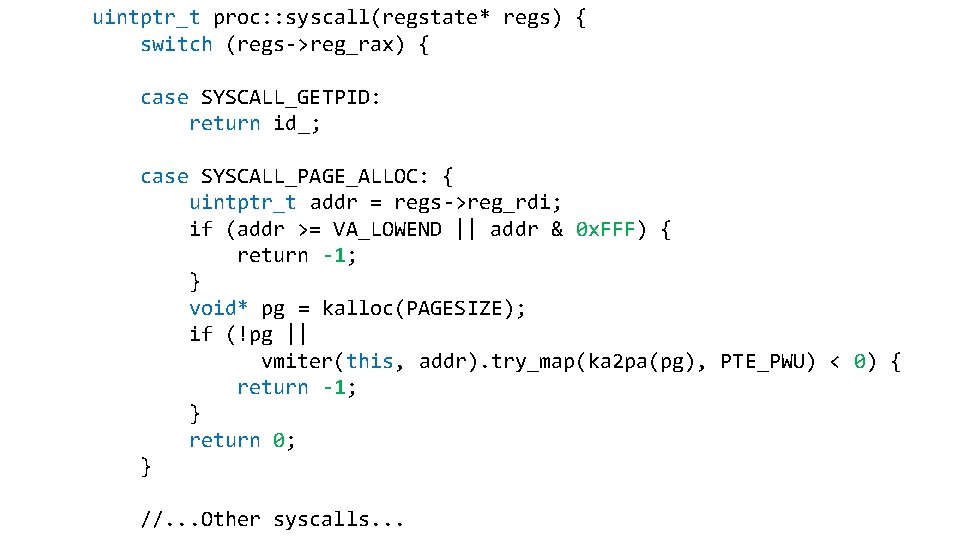
uintptr_t proc: : syscall(regstate* regs) { switch (regs->reg_rax) { case SYSCALL_GETPID: return id_; case SYSCALL_PAGE_ALLOC: { uintptr_t addr = regs->reg_rdi; if (addr >= VA_LOWEND || addr & 0 x. FFF) { return -1; } void* pg = kalloc(PAGESIZE); if (!pg || vmiter(this, addr). try_map(ka 2 pa(pg), PTE_PWU) < 0) { return -1; } return 0; } //. . . Other syscalls. . .
Handling A System Call • Part 0: The swapgs instruction • Part I: Invoking the Kernel’s System Call Handler • Part II: Completing the Context Switch • Part III: Executing Kernel Code • Part IV: Returning to User-mode
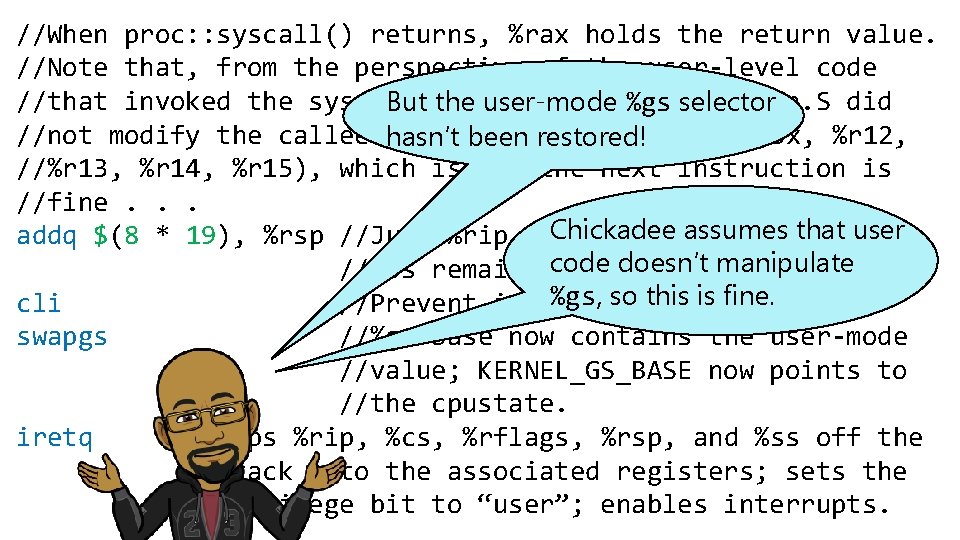
//When proc: : syscall() returns, %rax holds the return value. //Note that, from the perspective of the user-level code //that invoked the syscall k-exception. S did But instruction, the user-mode %gs selector //not modify the callee-saved registers (%rbp, %rbx, %r 12, hasn’t been restored! //%r 13, %r 14, %r 15), which is why the next instruction is //fine. . . Chickadee assumes that and user addq $(8 * 19), %rsp //Just %rip, %cs, %rflags, %rsp, code manipulate //%ss remain on thedoesn’t stack. %gs, so this is fine. cli //Prevent interrupts after swapgs! swapgs //%gs base now contains the user-mode //value; KERNEL_GS_BASE now points to //the cpustate. iretq //Pops %rip, %cs, %rflags, %rsp, and %ss off the //stack into the associated registers; sets the //privilege bit to “user”; enables interrupts.