multimedia systems Lecture 5 Color in Image and

- Slides: 25
multimedia systems Lecture 5: Color in Image and Video
Fundamentals of Multimedia, Chapter 4 Color Science Light and Spectra � • Light is an electromagnetic wave. Its color is � characterized by the wavelength content of the light. (a) Laser light consists of a single wavelength: e. g. , a ◦ ruby laser produces a bright, scarlet-red beam. (b) Most light sources produce contributions over many ◦ wavelengths. (c) However, humans cannot detect all light, just ◦ contributions that fall in the “visible wavelengths”. (d) Short wavelengths produce a blue sensation, long ◦ wavelengths produce a red one. 2
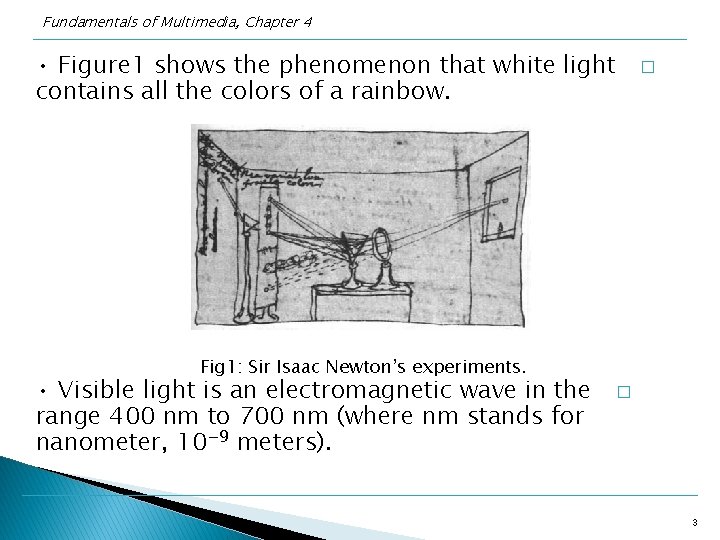
Fundamentals of Multimedia, Chapter 4 • Figure 1 shows the phenomenon that white light contains all the colors of a rainbow. � Fig 1: Sir Isaac Newton’s experiments. • Visible light is an electromagnetic wave in the range 400 nm to 700 nm (where nm stands for nanometer, 10− 9 meters). � 3
Fundamentals of Multimedia, Chapter 4 Human Vision � � • The eye works like a camera, with the lens focusing an image onto the retina. The human eye can distinguish about 10 million different colors • The retina consists of an array of rods and three kinds of cones. • The rods come into play when light levels are low and produce an image in shades of gray (“all cats are gray at night!”). � � • For higher light levels, the cones each produce a signal. � Because of their differing pigments, the three kinds of cones are most sensitive to red (R), green (G), and blue (B) light. 4
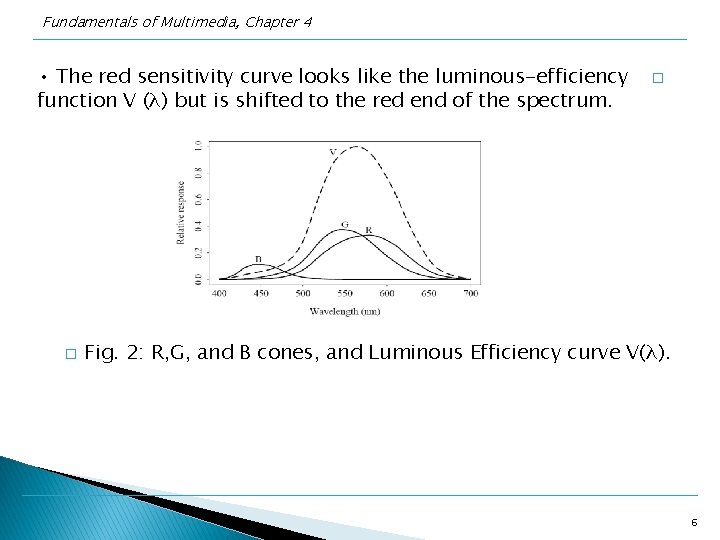
Fundamentals of Multimedia, Chapter 4 Spectral Sensitivity of the Eye • The eye is most sensitive to light in the middle of the visible spectrum. • The sensitivity of our receptors is also a function of wavelength � � • The Blue receptor sensitivity is not shown to scale because it is much smaller than the curves for Red or Green. – Statistically, Blue is the favourite color of humans, regardless of nationality � � ◦ Fig. 2 shows the overall sensitivity as a dashed line — this important curve is called the luminous-efficiency function. – It is usually denoted V (λ) and is formed as the sum of the response ◦ curves for Red, Green, and Blue. ◦ 5
Fundamentals of Multimedia, Chapter 4 • The red sensitivity curve looks like the luminous-efficiency function V (λ) but is shifted to the red end of the spectrum. � � Fig. 2: R, G, and B cones, and Luminous Efficiency curve V(λ). 6
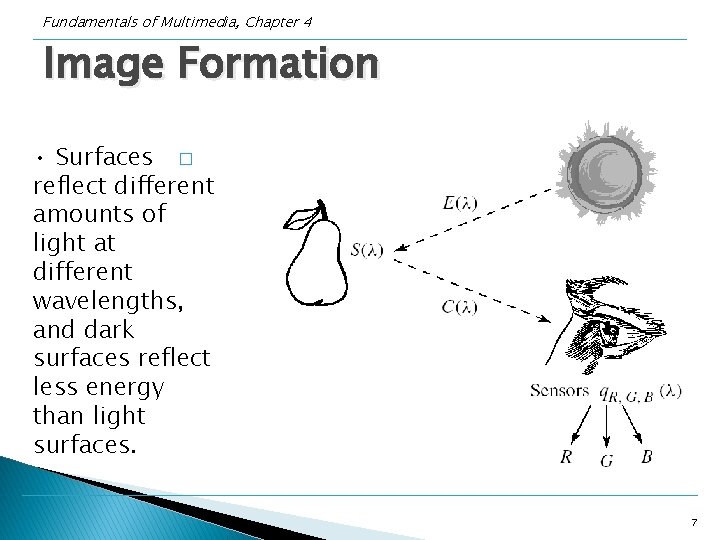
Fundamentals of Multimedia, Chapter 4 Image Formation • Surfaces � reflect different amounts of light at different wavelengths, and dark surfaces reflect less energy than light surfaces. 7
Fundamentals of Multimedia, Chapter 4 Camera Systems • Camera systems are made in a similar fashion; • Analog signals are converted to digital, � truncated to integers, and stored. If the precision used is 8 -bit, then the maximum value for any of R, G, B is 255, and the minimum is 0. � • However, the light entering the eye of the � computer user is that which is emitted by the screen—the screen is essentially a self-luminous source. Therefore we need to know the light E(λ) entering the eye. Li & Drew 8
Fundamentals of Multimedia, Chapter 4 Color Coordinate Schemes • Schemes include: � a) CMY — Cyan (C), Magenta (M) and Yellow (Y) color model; ◦ b) HSL — Hue, Saturation and Lightness; ◦ c) HSV — Hue, Saturation and Value; ◦ d) HSI — Hue, Saturation and Intensity; ◦ e) HCI — C=Chroma; ◦ f) HVC — V=Value; ◦ g) HSD — D=Darkness. ◦ Li & Drew 9
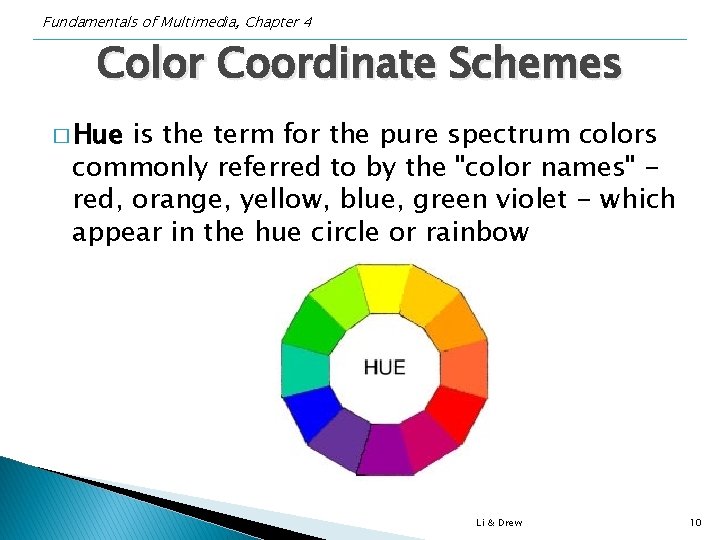
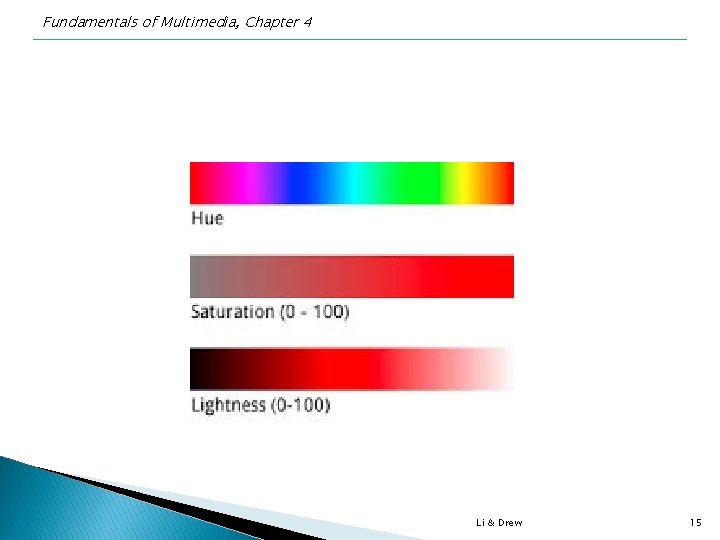
Fundamentals of Multimedia, Chapter 4 Color Coordinate Schemes � Hue is the term for the pure spectrum colors commonly referred to by the "color names" red, orange, yellow, blue, green violet - which appear in the hue circle or rainbow Li & Drew 10
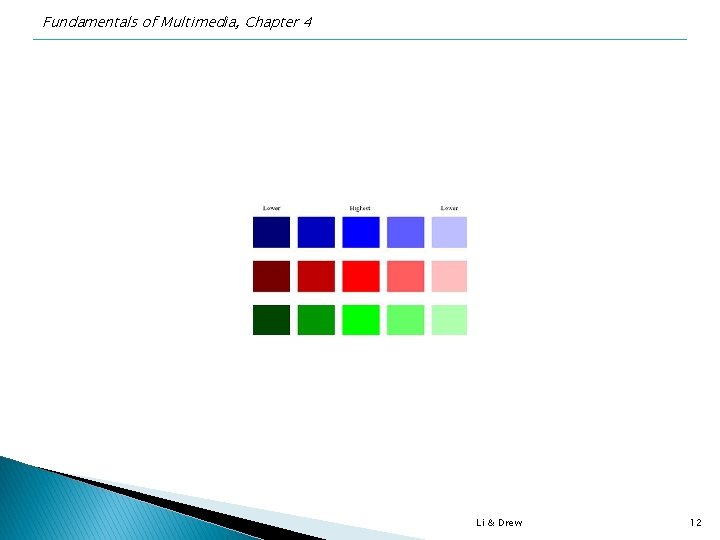
Fundamentals of Multimedia, Chapter 4 Color Coordinate Schemes � Saturation is a color term commonly used by (digital / analog) imaging experts. -Saturation is usually one property of three when used to determine a certain color and measured as percentage value. -Saturation defines a range from pure color (100%) to gray (0%) at a constant lightness level. A pure color is fully saturated. Li & Drew 11
Fundamentals of Multimedia, Chapter 4 Li & Drew 12
Fundamentals of Multimedia, Chapter 4 Color Coordinate Schemes � Value is defined as the relative lightness or darkness of a color. Li & Drew 13
Fundamentals of Multimedia, Chapter 4 Color Coordinate Schemes � Lightness is a color term commonly used by (digital / analog) imaging experts. Lightness is usually one property of three when used to determine a certain color and measured as percentage value. Lightness defines a range from dark (0%) to fully illuminated (100%). Any original hue has the average lightness level of 50%. � Darkness, the polar opposite to brightness, is understood to be an absence of visible light. It is also the appearance of black in a colored space. Li & Drew 14
Fundamentals of Multimedia, Chapter 4 Li & Drew 15
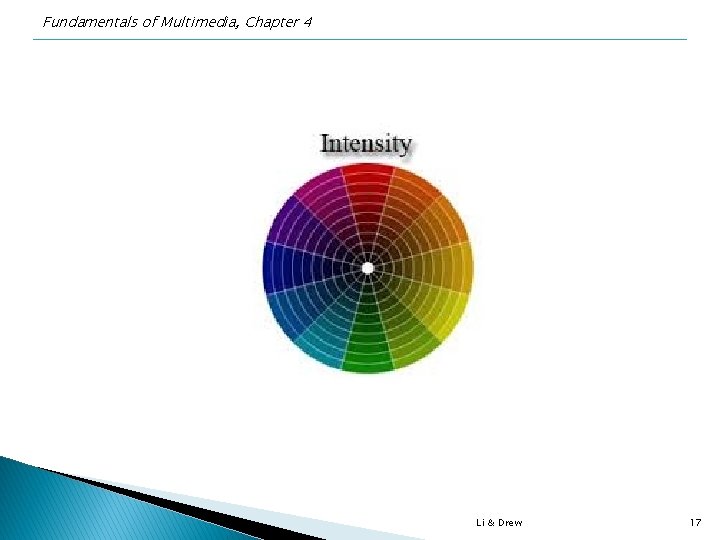
Fundamentals of Multimedia, Chapter 4 Color Coordinate Schemes � Intensity: In general, intensity is a synonym for magnitude, degree or strength. It can therefore be used in conjunction with any color property. Nevertheless, it carries special meaning in certain contexts. -For painters the meaning of intensity is equivalent to the meaning of saturation. -For physicists intensity refers to different aspects of radiation. When speaking of light, the intensity can mean the number of photons a light source emits Li & Drew 16
Fundamentals of Multimedia, Chapter 4 Li & Drew 17
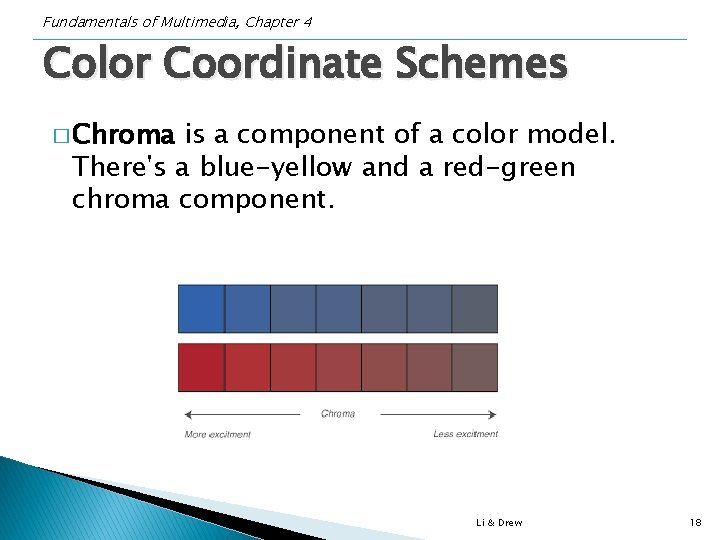
Fundamentals of Multimedia, Chapter 4 Color Coordinate Schemes � Chroma is a component of a color model. There's a blue-yellow and a red-green chroma component. Li & Drew 18
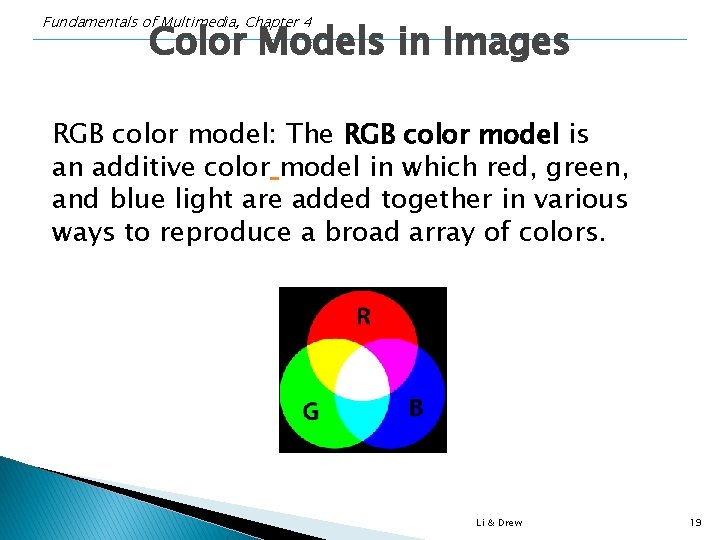
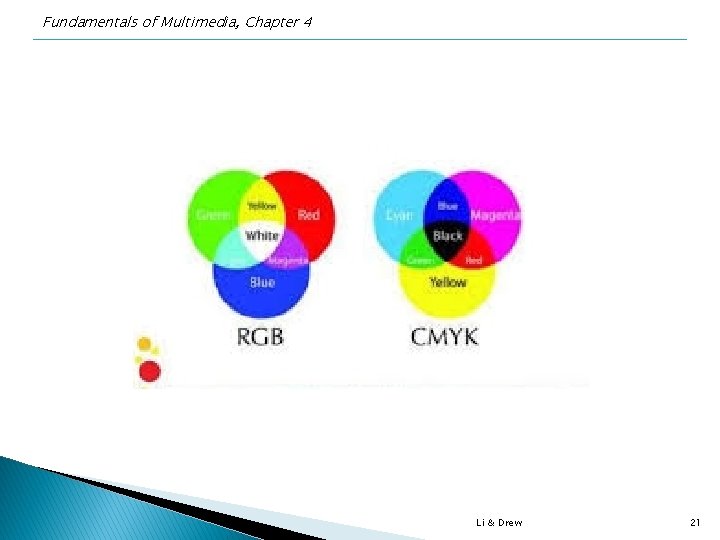
Fundamentals of Multimedia, Chapter 4 Color Models in Images RGB color model: The RGB color model is an additive color model in which red, green, and blue light are added together in various ways to reproduce a broad array of colors. Li & Drew 19
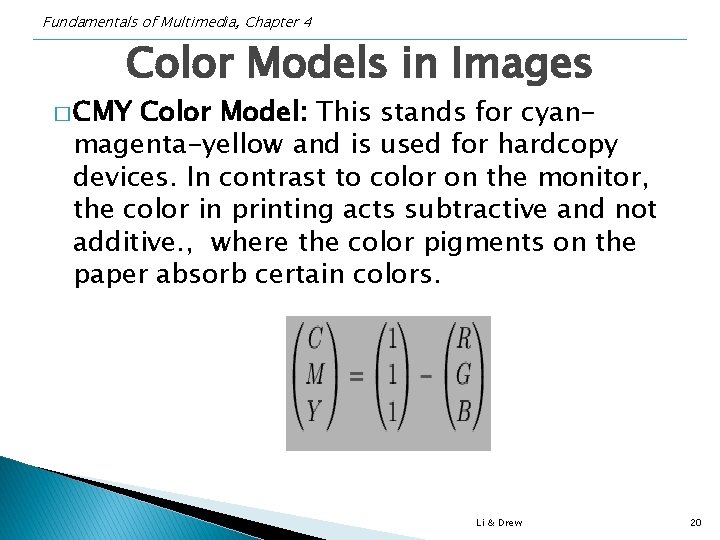
Fundamentals of Multimedia, Chapter 4 Color Models in Images � CMY Color Model: This stands for cyanmagenta-yellow and is used for hardcopy devices. In contrast to color on the monitor, the color in printing acts subtractive and not additive. , where the color pigments on the paper absorb certain colors. Li & Drew 20
Fundamentals of Multimedia, Chapter 4 Li & Drew 21
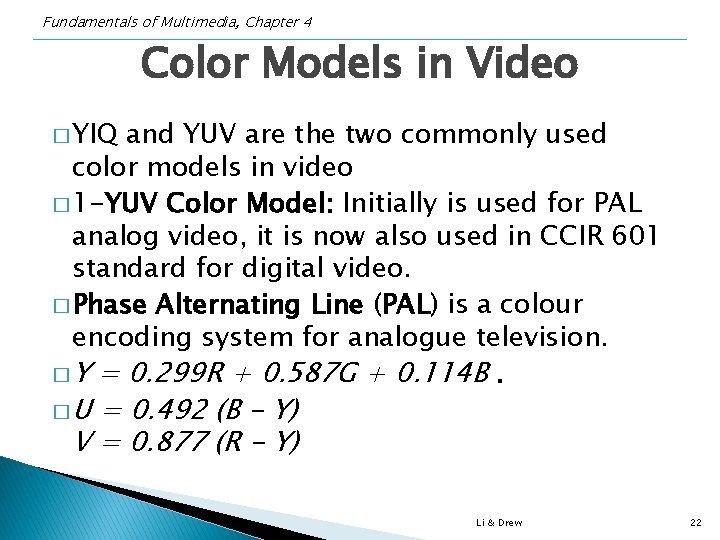
Fundamentals of Multimedia, Chapter 4 Color Models in Video � YIQ and YUV are the two commonly used color models in video � 1 -YUV Color Model: Initially is used for PAL analog video, it is now also used in CCIR 601 standard for digital video. � Phase Alternating Line (PAL) is a colour encoding system for analogue television. � Y = 0. 299 R + 0. 587 G + 0. 114 B. �U = 0. 492 (B - Y) V = 0. 877 (R - Y) Li & Drew 22
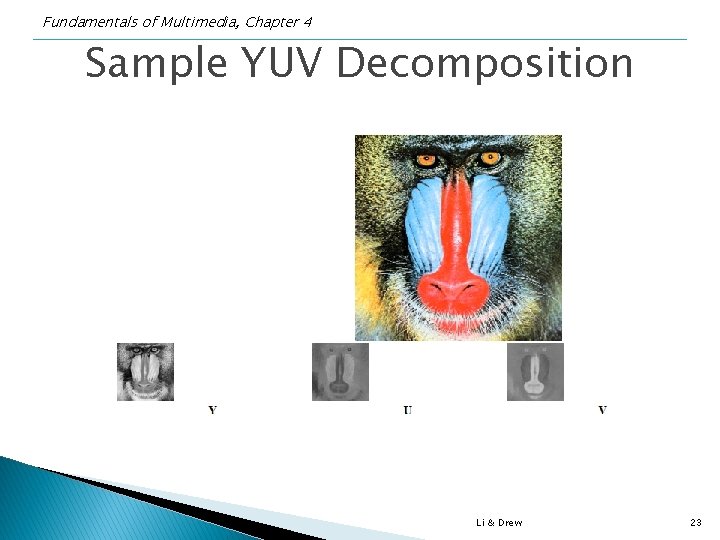
Fundamentals of Multimedia, Chapter 4 Sample YUV Decomposition Li & Drew 23
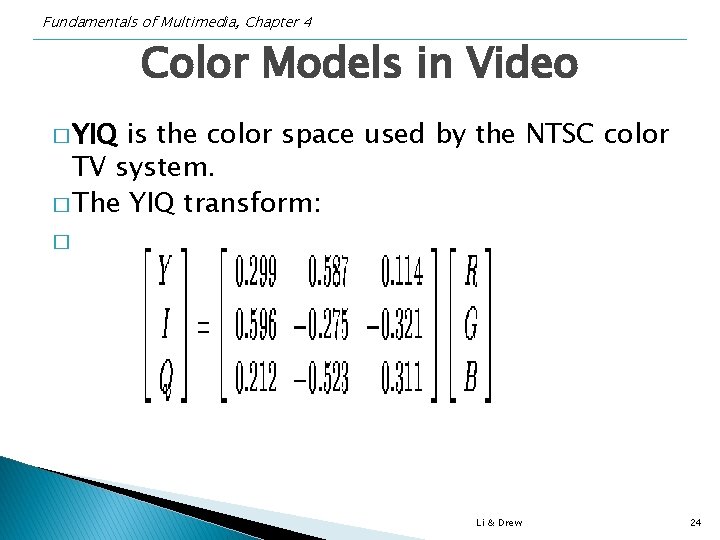
Fundamentals of Multimedia, Chapter 4 Color Models in Video � YIQ is the color space used by the NTSC color TV system. � The YIQ transform: � Li & Drew 24
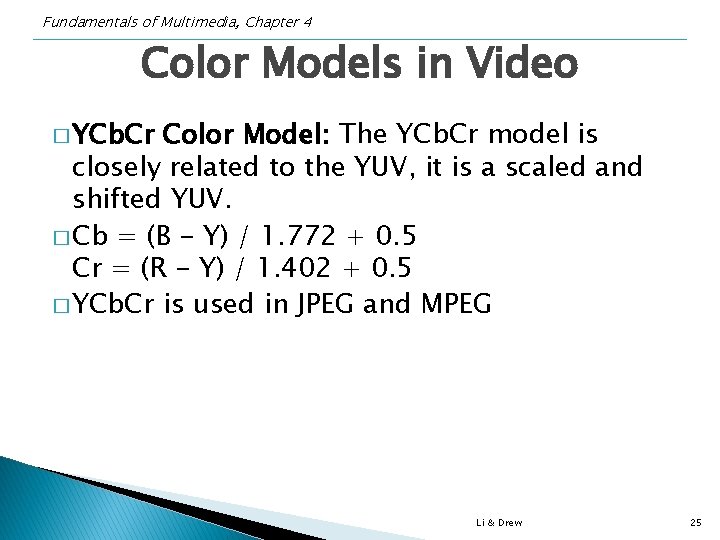
Fundamentals of Multimedia, Chapter 4 Color Models in Video � YCb. Cr Color Model: The YCb. Cr model is closely related to the YUV, it is a scaled and shifted YUV. � Cb = (B - Y) / 1. 772 + 0. 5 Cr = (R - Y) / 1. 402 + 0. 5 � YCb. Cr is used in JPEG and MPEG Li & Drew 25