Motor Speech Disorders Samantha Shune Ph D CCCSLP

- Slides: 30
Motor Speech Disorders Samantha Shune, Ph. D, CCC-SLP sshune@uoregon. edu
Preview n Brief introduction to motor speech disorders n Brief neuroanatomy primer n Video samples
INTRODUCTION
Neurogenic Communication Disorders Neurogenic communication disorders can be defined as impairments in speaking, listening, reading, and writing skills that result from damage in different parts of the nervous system. n These impairments include: n Aphasia n Cognitive-Communication Disorders n Motor Speech Disorders n n Dysarthria
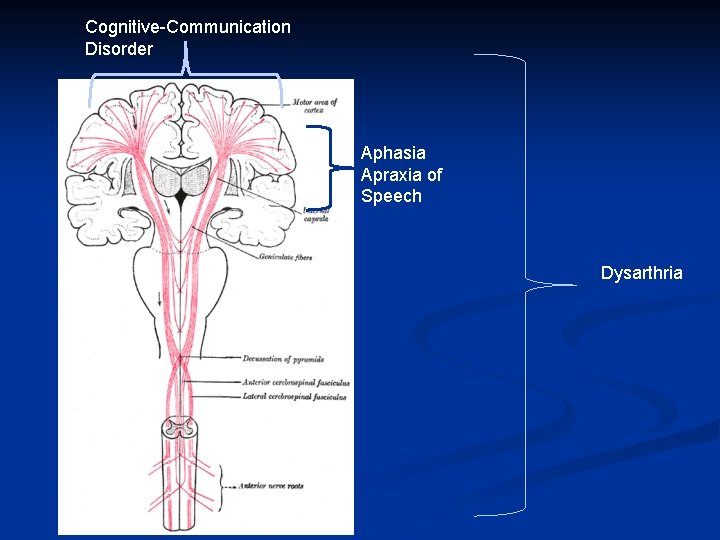
Cognitive-Communication Disorder Aphasia Apraxia of Speech Dysarthria
Motor Speech Disorders n Motor speech disorders can be defined as disorders of speech resulting from neurologic impairments affecting the: Motor planning, n Motor programming, or n Neuromuscular execution of speech n n Dysarthria and apraxia of speech
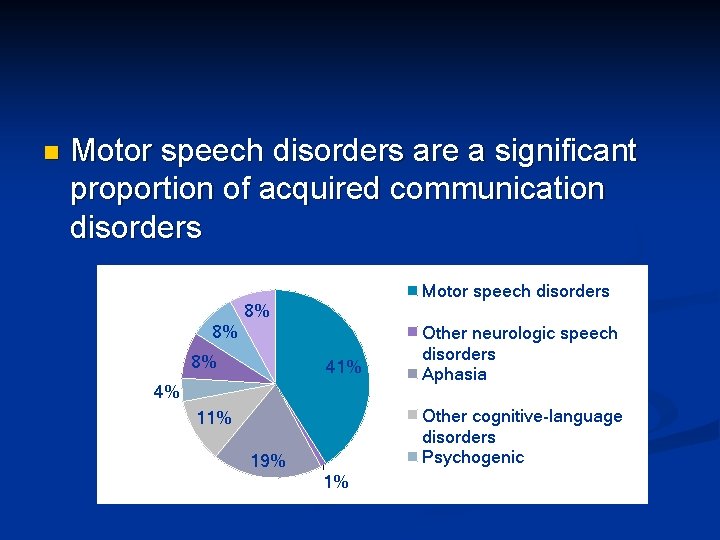
n Motor speech disorders are a significant proportion of acquired communication disorders 8% Motor speech disorders 8% 8% 41% 4% Other neurologic speech disorders Aphasia Other cognitive-language disorders Psychogenic 11% 19% 1%
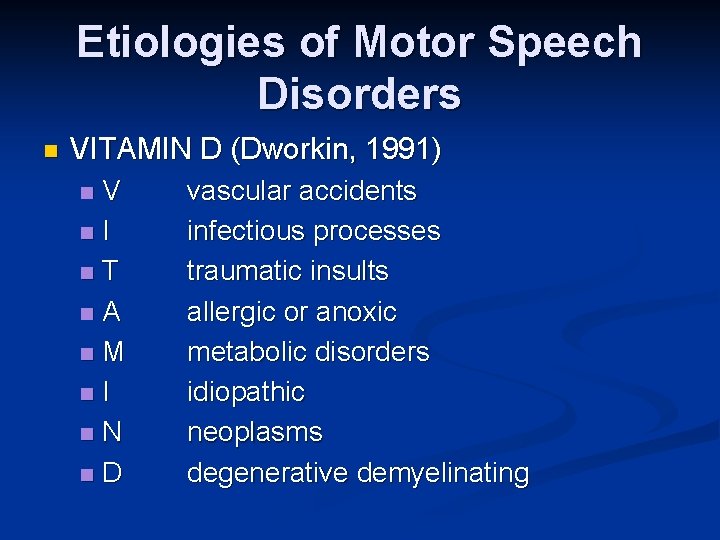
Etiologies of Motor Speech Disorders n VITAMIN D (Dworkin, 1991) V n. I n. T n. A n. M n. I n. N n. D n vascular accidents infectious processes traumatic insults allergic or anoxic metabolic disorders idiopathic neoplasms degenerative demyelinating
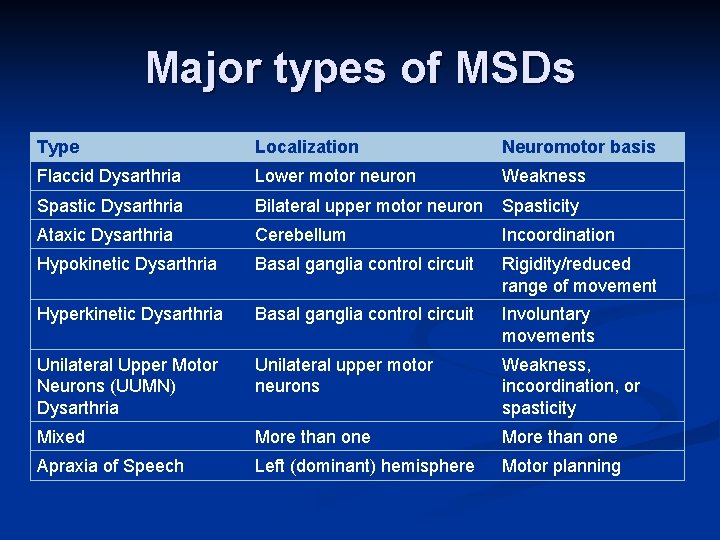
Major types of MSDs Type Localization Neuromotor basis Flaccid Dysarthria Lower motor neuron Weakness Spastic Dysarthria Bilateral upper motor neuron Spasticity Ataxic Dysarthria Cerebellum Incoordination Hypokinetic Dysarthria Basal ganglia control circuit Rigidity/reduced range of movement Hyperkinetic Dysarthria Basal ganglia control circuit Involuntary movements Unilateral Upper Motor Neurons (UUMN) Dysarthria Unilateral upper motor neurons Weakness, incoordination, or spasticity Mixed More than one Apraxia of Speech Left (dominant) hemisphere Motor planning
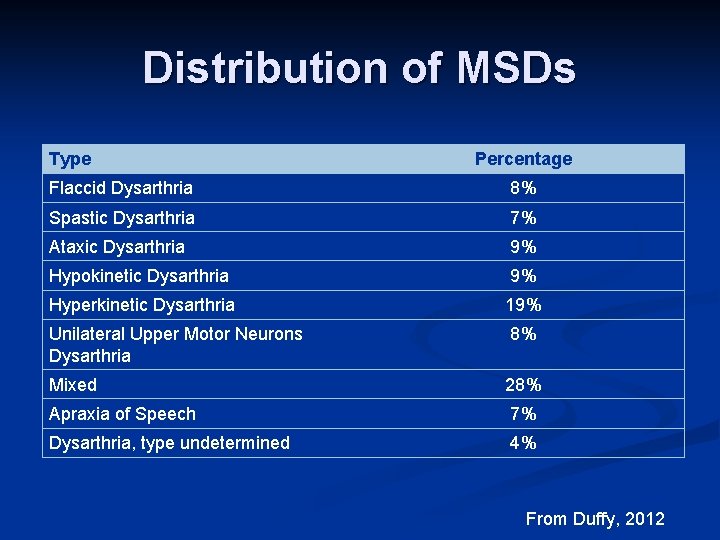
Distribution of MSDs Type Percentage Flaccid Dysarthria 8% Spastic Dysarthria 7% Ataxic Dysarthria 9% Hypokinetic Dysarthria 9% Hyperkinetic Dysarthria 19% Unilateral Upper Motor Neurons Dysarthria 8% Mixed 28% Apraxia of Speech 7% Dysarthria, type undetermined 4% From Duffy, 2012
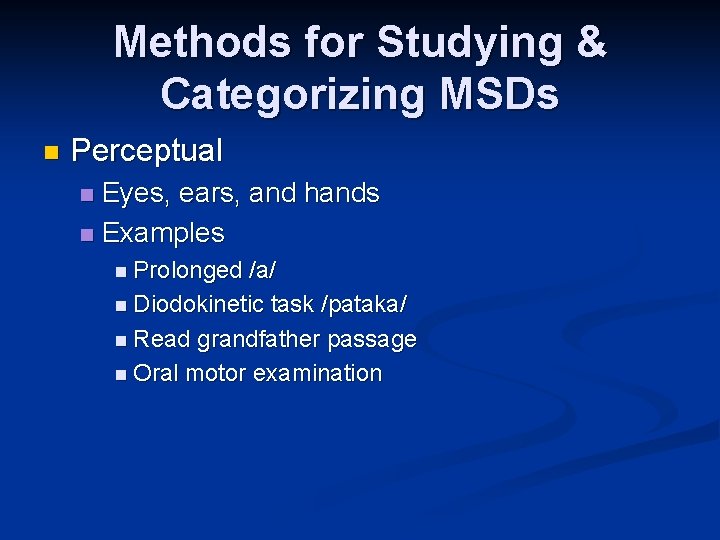
Methods for Studying & Categorizing MSDs n Perceptual Eyes, ears, and hands n Examples n n Prolonged /a/ n Diodokinetic task /pataka/ n Read grandfather passage n Oral motor examination
Methods for Studying & Categorizing MSDs n Instrumental n Acoustic methods n Same data as perceptual = speech signal n Provides quantification, description, and confirmation of human (clinical) perception
Methods for Studying & Categorizing MSDs n Instrumental n Physiologic methods n Study of movements of speech structures, air flow and air pressure, muscle contraction, nervous system, CNS and PNS activities in relationship to biomechanical activity and CNS activity during speech planning and execution. n Ex. n Electromyography and aerodynamic measures
Methods for Studying & Categorizing MSDs n Instrumental n Visual imaging methods n Allows visualization of upper aerodigestive tract during speech n Ex. n Videofluoroscopy n Nasoendoscopy n Videostroboscopy
(RE)VISITING NEUROANATOMY
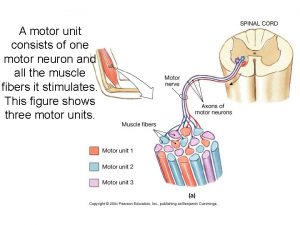
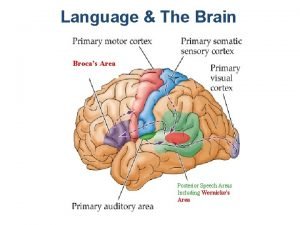
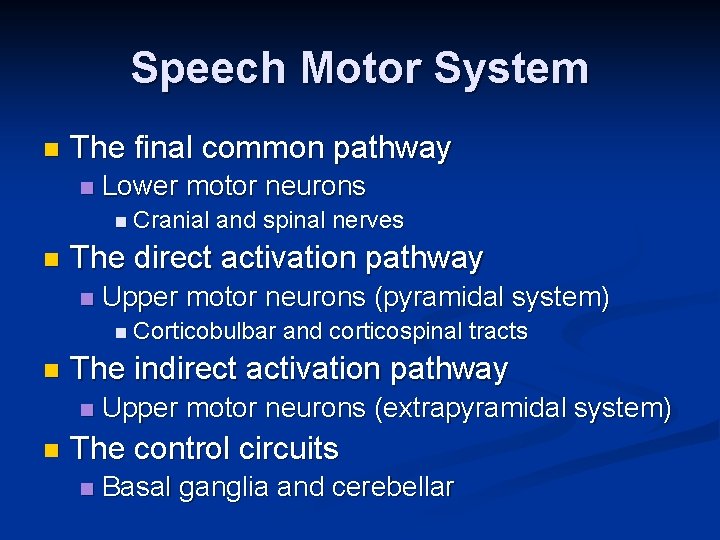
Speech Motor System n The final common pathway n Lower motor neurons n Cranial n and spinal nerves The direct activation pathway n Upper motor neurons (pyramidal system) n Corticobulbar n The indirect activation pathway n n and corticospinal tracts Upper motor neurons (extrapyramidal system) The control circuits n Basal ganglia and cerebellar
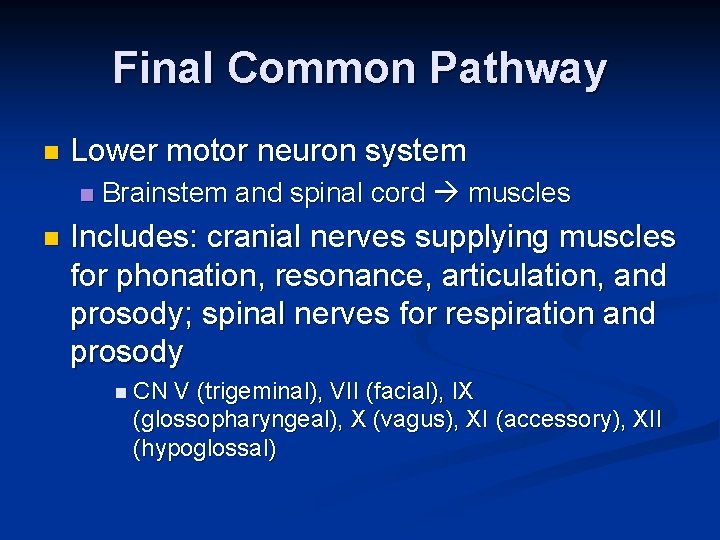
Final Common Pathway n Lower motor neuron system n n Brainstem and spinal cord muscles Includes: cranial nerves supplying muscles for phonation, resonance, articulation, and prosody; spinal nerves for respiration and prosody n CN V (trigeminal), VII (facial), IX (glossopharyngeal), X (vagus), XI (accessory), XII (hypoglossal)
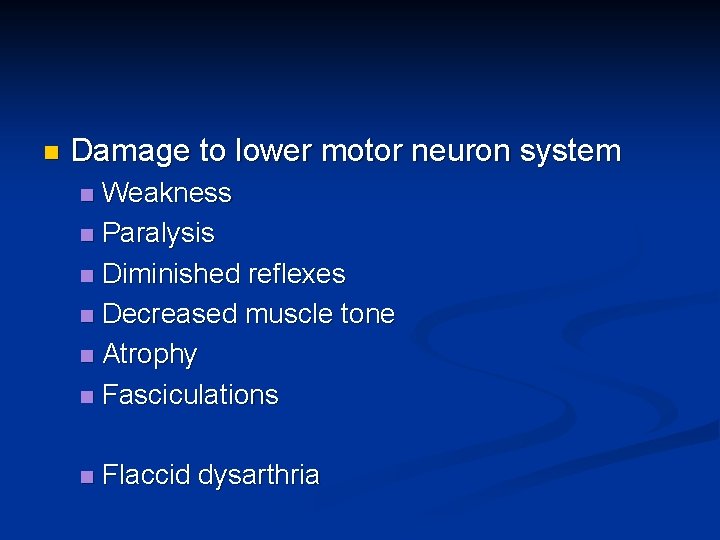
n Damage to lower motor neuron system Weakness n Paralysis n Diminished reflexes n Decreased muscle tone n Atrophy n Fasciculations n n Flaccid dysarthria
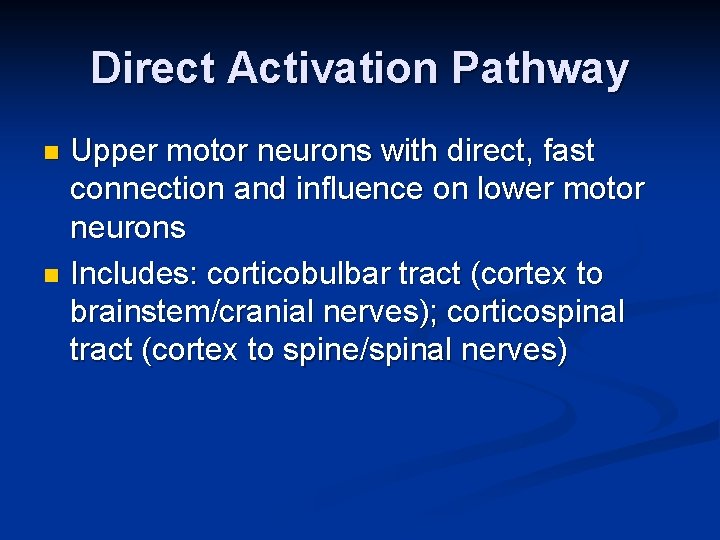
Direct Activation Pathway Upper motor neurons with direct, fast connection and influence on lower motor neurons n Includes: corticobulbar tract (cortex to brainstem/cranial nerves); corticospinal tract (cortex to spine/spinal nerves) n
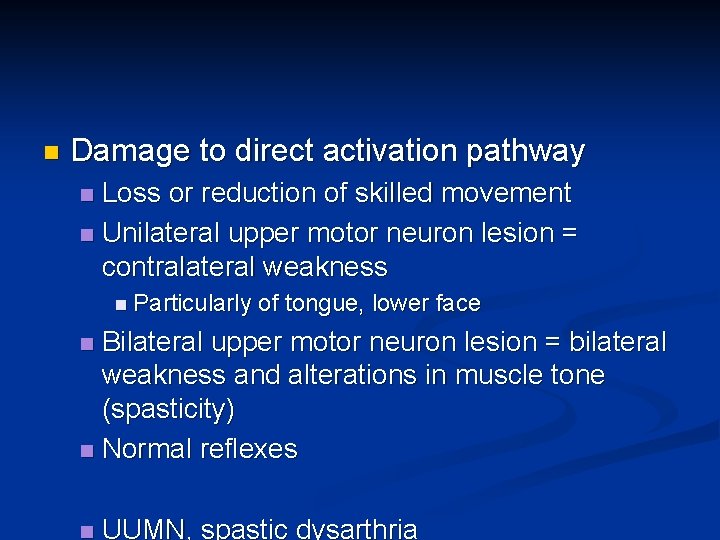
n Damage to direct activation pathway Loss or reduction of skilled movement n Unilateral upper motor neuron lesion = contralateral weakness n n Particularly of tongue, lower face Bilateral upper motor neuron lesion = bilateral weakness and alterations in muscle tone (spasticity) n Normal reflexes n n UUMN, spastic dysarthria
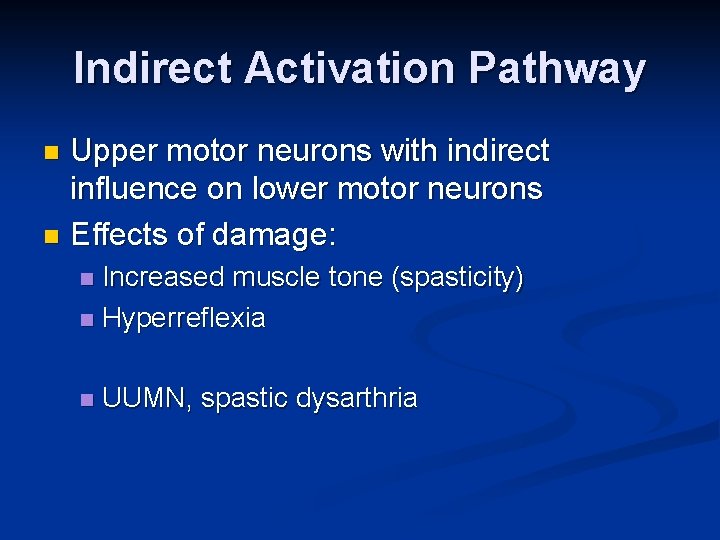
Indirect Activation Pathway Upper motor neurons with indirect influence on lower motor neurons n Effects of damage: n Increased muscle tone (spasticity) n Hyperreflexia n n UUMN, spastic dysarthria
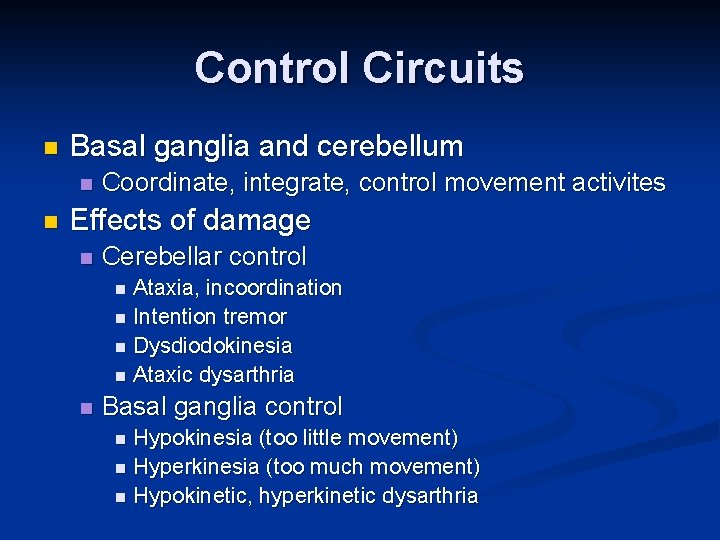
Control Circuits n Basal ganglia and cerebellum n n Coordinate, integrate, control movement activites Effects of damage n Cerebellar control Ataxia, incoordination n Intention tremor n Dysdiodokinesia n Ataxic dysarthria n n Basal ganglia control Hypokinesia (too little movement) n Hyperkinesia (too much movement) n Hypokinetic, hyperkinetic dysarthria n
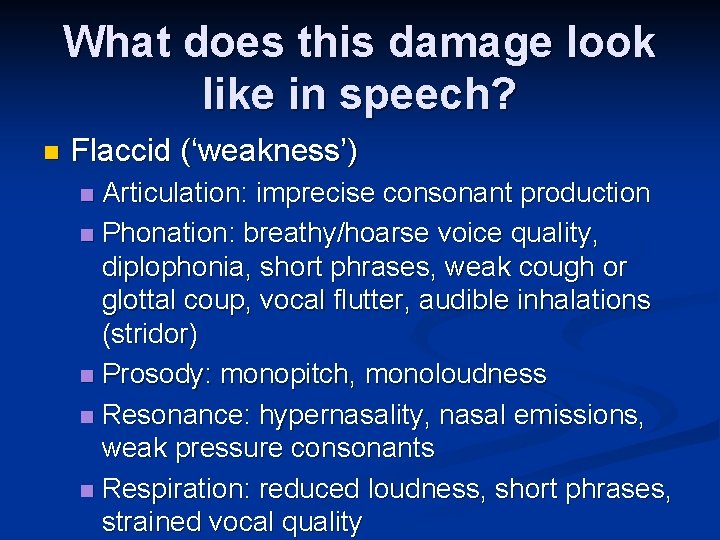
What does this damage look like in speech? n Flaccid (‘weakness’) Articulation: imprecise consonant production n Phonation: breathy/hoarse voice quality, diplophonia, short phrases, weak cough or glottal coup, vocal flutter, audible inhalations (stridor) n Prosody: monopitch, monoloudness n Resonance: hypernasality, nasal emissions, weak pressure consonants n Respiration: reduced loudness, short phrases, strained vocal quality n
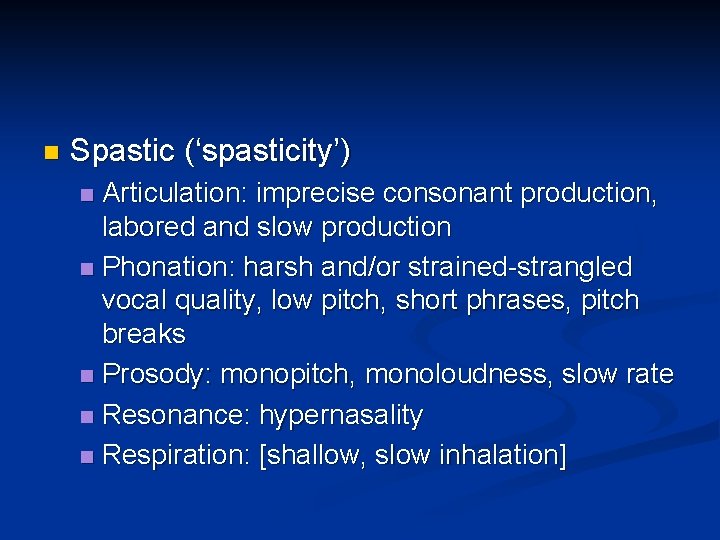
n Spastic (‘spasticity’) Articulation: imprecise consonant production, labored and slow production n Phonation: harsh and/or strained-strangled vocal quality, low pitch, short phrases, pitch breaks n Prosody: monopitch, monoloudness, slow rate n Resonance: hypernasality n Respiration: [shallow, slow inhalation] n
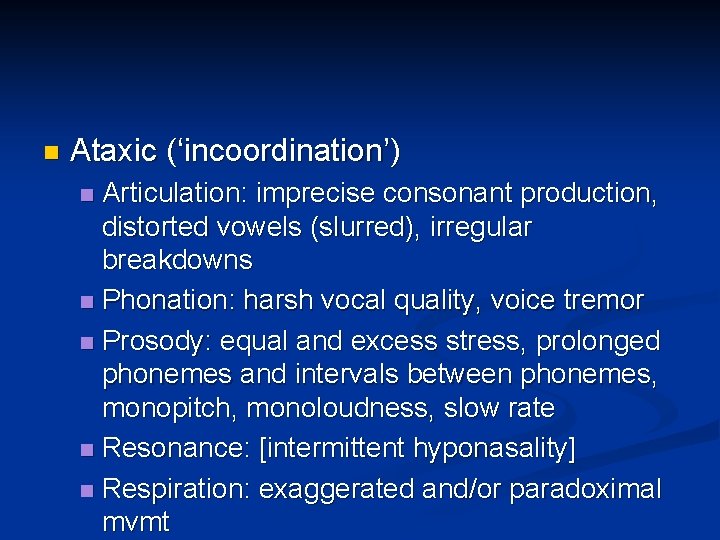
n Ataxic (‘incoordination’) Articulation: imprecise consonant production, distorted vowels (slurred), irregular breakdowns n Phonation: harsh vocal quality, voice tremor n Prosody: equal and excess stress, prolonged phonemes and intervals between phonemes, monopitch, monoloudness, slow rate n Resonance: [intermittent hyponasality] n Respiration: exaggerated and/or paradoximal mvmt n
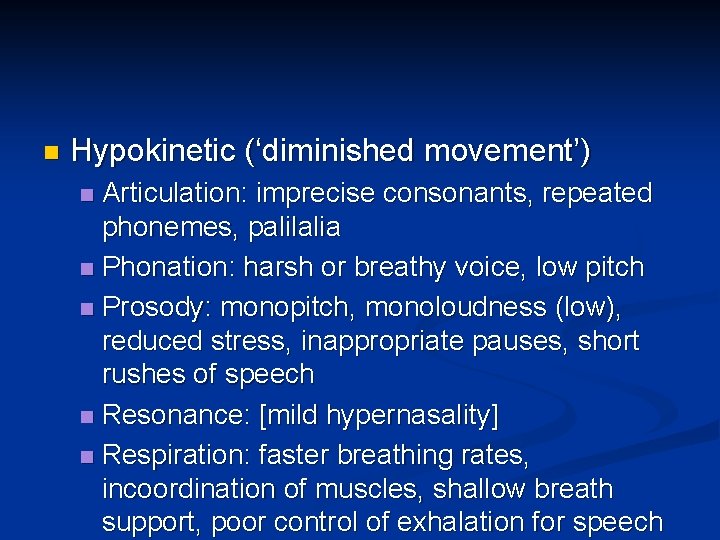
n Hypokinetic (‘diminished movement’) Articulation: imprecise consonants, repeated phonemes, palilalia n Phonation: harsh or breathy voice, low pitch n Prosody: monopitch, monoloudness (low), reduced stress, inappropriate pauses, short rushes of speech n Resonance: [mild hypernasality] n Respiration: faster breathing rates, incoordination of muscles, shallow breath support, poor control of exhalation for speech n
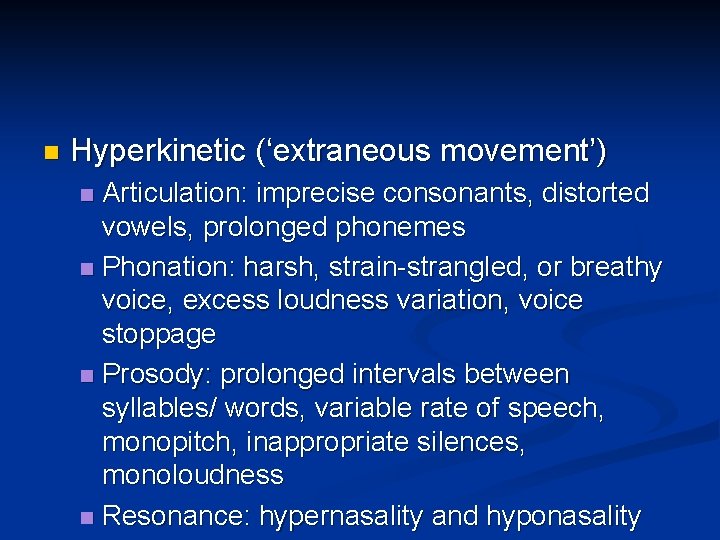
n Hyperkinetic (‘extraneous movement’) Articulation: imprecise consonants, distorted vowels, prolonged phonemes n Phonation: harsh, strain-strangled, or breathy voice, excess loudness variation, voice stoppage n Prosody: prolonged intervals between syllables/ words, variable rate of speech, monopitch, inappropriate silences, monoloudness n Resonance: hypernasality and hyponasality n
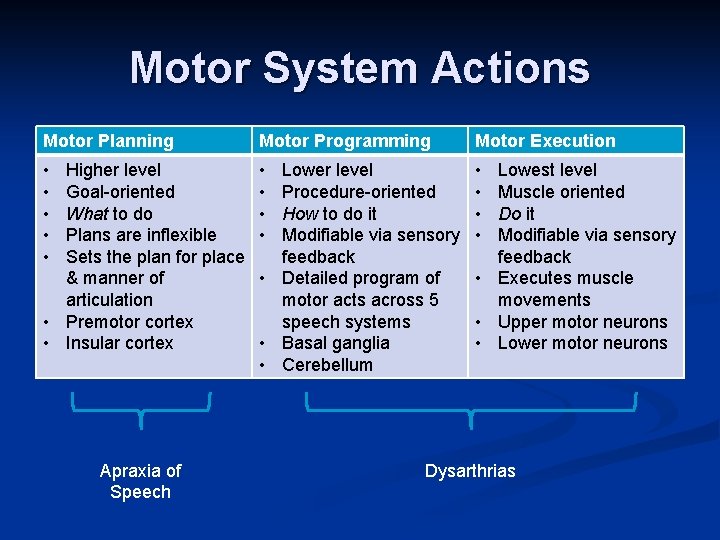
Motor System Actions Motor Planning Motor Programming Motor Execution • • • • Higher level Goal-oriented What to do Plans are inflexible Sets the plan for place & manner of articulation • Premotor cortex • Insular cortex Apraxia of Speech Lower level Procedure-oriented How to do it Modifiable via sensory feedback • Detailed program of motor acts across 5 speech systems • Basal ganglia • Cerebellum Lowest level Muscle oriented Do it Modifiable via sensory feedback • Executes muscle movements • Upper motor neurons • Lower motor neurons Dysarthrias
VIDEO/AUDIO SAMPLES
Questions/comments?