Urologic Care of a Multiple Sclerosis Patient Population








- Slides: 13
Urologic Care of a Multiple Sclerosis Patient Population: Single Provider Experience Samantha Raffee MD FPMRS Fellow
Introduction • Multiple sclerosis (MS) is a demyelinating neurologic condition affecting approximately 2 million people worldwide • Lower urinary tract dysfunction is common with rates between 50 -90% • The etiology of lower urinary tract symptoms in MS is VARIABLE • One Treatment does not fit all! • Significant burden to patient and health system • Prior studies have found a barrier to urologic care being a referral to urology • If lower urinary tract symptoms are recognized and a urological referral is made, little is known regarding the outcomes of these patients within a urology practice
Introduction • Typical Urologic Work-up For a Multiple Sclerosis Patient at Henry Ford • History and Physical Exam • Assessment of • • Urinalysis Voiding Diary Video Urodynamic Testing Renal Imaging
Introduction • What Is Urodynamic Testing? • Testing performed as an outpatient in the urology office to assess bladder and urethral function • • Bladder storage/Compliance Overactivity Voiding Pressure Incontinence Urethra/Sphincter Function Pelvic floor muscles Video: ureteral reflux, bladder architecture, bladder neck • Invasive – catheters required!
Objective • To evaluate the MS population of a single provider to gain a better understanding of • • • Patient Characteristics Urodynamic Findings Treatment Outcomes Follow-up Patterns Potential Areas to Improve the Quality of Care Provided
Methods • IRB approved retrospective chart review • Database created of all patients with a diagnosis of multiple sclerosis for a single provider • • • January 2013 -December 2017 Demographics Urodynamic findings Treatment outcomes Quality of life questionnaires
Results POPULATION DEMOGRAPHICS Number of Patients Mean age No. Sex (%) Female Male No. Race (%) Caucasian African American Other Median Year of MS Diagnosis Type of MS (%) Relapsing Remitting Primary Progressive Secondary Progressive (not specified) Not Specified 147 53 123 (83. 7) 24 (16. 3) 69 (46. 9) 74 (50. 3) 4 (2. 7) 2002 72 (49. 0) 18 (12. 2) 22 (15. 0) 3 (2. 0) 32 (21. 8)
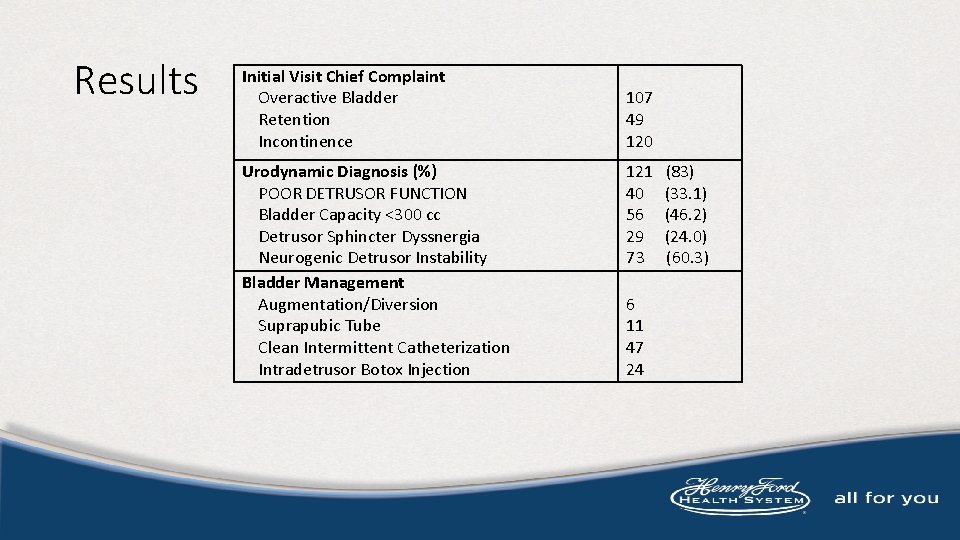
Results Initial Visit Chief Complaint Overactive Bladder Retention Incontinence Urodynamic Diagnosis (%) POOR DETRUSOR FUNCTION Bladder Capacity <300 cc Detrusor Sphincter Dyssnergia Neurogenic Detrusor Instability Bladder Management Augmentation/Diversion Suprapubic Tube Clean Intermittent Catheterization Intradetrusor Botox Injection 107 49 120 121 (83) 40 (33. 1) 56 (46. 2) 29 (24. 0) 73 (60. 3) 6 11 47 24
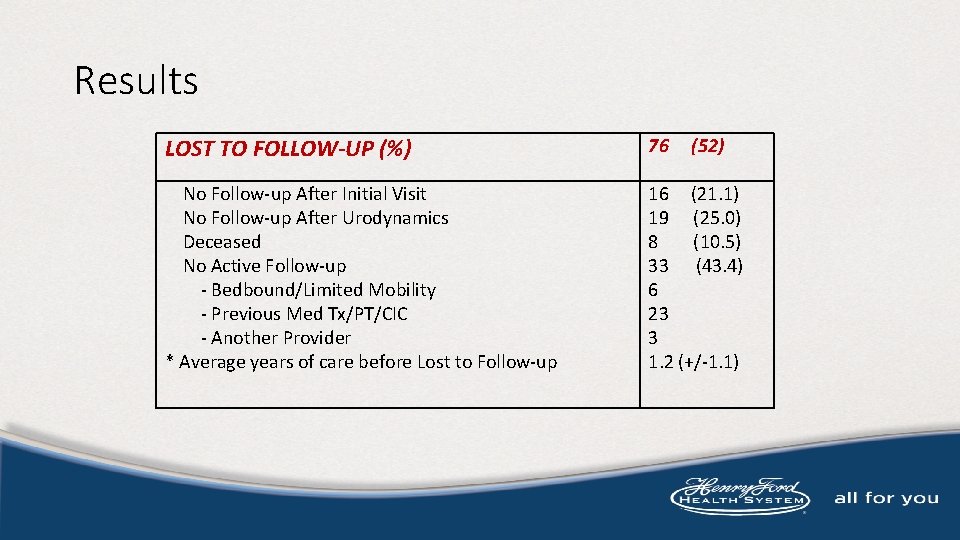
Results LOST TO FOLLOW-UP (%) 76 No Follow-up After Initial Visit No Follow-up After Urodynamics Deceased No Active Follow-up - Bedbound/Limited Mobility - Previous Med Tx/PT/CIC - Another Provider * Average years of care before Lost to Follow-up 16 (21. 1) 19 (25. 0) 8 (10. 5) 33 (43. 4) 6 23 3 1. 2 (+/-1. 1) (52)
Results n i t n e SYMPTOM SCORES FOR ACTIVE PTS WITH OVERACTIVE BLADDER m e v o Botox r Non-Botox p m I r Mean ± SD P-Value o f e f y i t Change in AUA-SS -8. 6 ± 10. 1 0. 004 * 2. 3 ± 7. 0 0. 217 i L n f u o t r y t o i l p a Change in AUA-SS QOL u -2. 1 ± 2. 0 0. 001 * -0. 1 ± 1. 6 0. 876 Op Q Change in M-ISI -8. 8 ± 8. 1 <0. 001 * 1. 9 ± 10. 3 0. 493 Change in M-ISI Bother -1. 8 ± 3. 0 0. 037 * 0. 2 ± 2. 8 0. 782
Conclusion • Even after a urologic referral is made, this review shows a large number of patients can be lost to follow-up • Given the improvement in quality of life that can be achieved with appropriate treatment, it is important to provide patients with education regarding the effects of MS on their urinary system at their initial visit • A treatment pathway, patient navigator and multidisciplinary approach could be helpful to improve patient outcomes
Future Directions • Continued database development • Better understanding of patient barriers to follow-up with urology • Further assessment of patient satisfaction after treatment is initiated • Assessment of urodynamic findings as predictors of treatment success • Collaboration with other centers providing care for large populations of MS patients
References • 1. Brucker, BM, et al. “Barriers experienced by Patients with Multiple Sclerosis in Seeking Care for Lower Urinary Tract Symptoms. ” Neurourology and Urodynamics. vol. 36, no. 4, April. 2017, pp. 1208 -1213. doi 10. 1002 /nau. 23101 • 2. Tornic, J, Panicker, JN. “The Management of Lower Urinary Tract Dysfunction in Multiple Sclerosis”. Current Neurology and Neuroscience Reports, vol. 18, no. 8, June 2018, doi: 10. 1007/s 11910 -018 -0857 -z. • 3. Tubaro, A, et al. “The Treatment of Lower Urinary Tract Symptoms in Patients with Multiple Sclerosis: A systematic Review. ” Current Urology Reports, vol. 13, no. 5, October 2012, pp. 335 -342. , doi: 10. 1007/s 11934012 -0266 -9.