
Chapter 18 Gastrointestinal and Urologic Emergencies Introduction Abdominal
Chapter 18 Gastrointestinal and Urologic Emergencies
Introduction • Abdominal pain is a common complaint. – The cause of abdominal pain is often difficult to determine. • As an EMT: – You do not need to determine the exact cause. – You should be able to recognize a lifethreatening problem and act.

Anatomy and Physiology (1 of 2) • The abdominal cavity contains the gastrointestinal system, genital system, and urinary system. • Made up of solid and hollow organs • Injury to a solid organ cause shock and bleeding. • Breach of a hollow organ causes its contents to leak and contaminate the abdominal cavity.
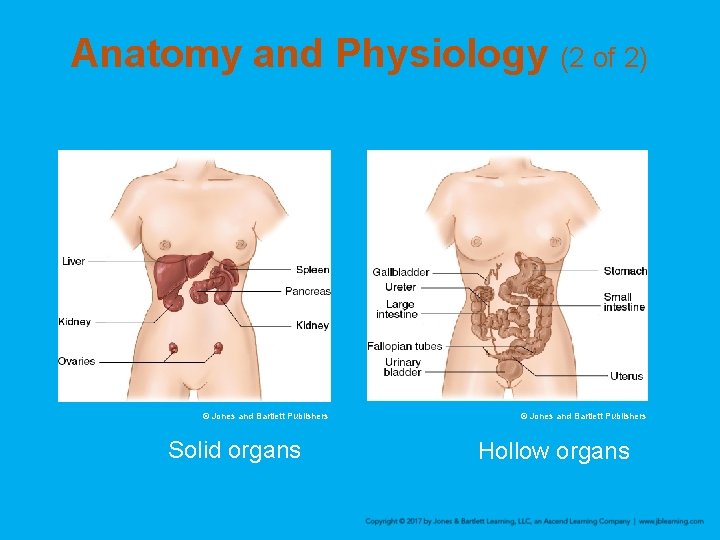
Anatomy and Physiology (2 of 2) © Jones and Bartlett Publishers Solid organs © Jones and Bartlett Publishers Hollow organs

The Gastrointestinal System (1 of 4) • Responsible for digestion process • Digestion begins when food is chewed. – Saliva breaks down food. • The stomach is the main digestive organ.

The Gastrointestinal System (2 of 4) • The liver assists in digestion. – Secretes bile – Filters toxic substances – Creates glucose stores • The gallbladder is a reservoir for bile.
The Gastrointestinal System (3 of 4) • Small intestine: – Duodenum – Jejunum – Ileum
The Gastrointestinal System (4 of 4) • Colon (large intestine) – Food that is not broken down comes here. – Water is absorbed. – Stool is formed. • Spleen – Located in the abdomen but has no digestive function
The Genital System • The abdominal space also holds reproductive organs.
The Urinary System (1 of 2) • Controls discharge of waste materials filtered from blood by kidneys • Two kidneys, one on each side of the body • Ureters join each kidney to the bladder. • The bladder is located behind the pubic symphysis. • The bladder empties urine outside the body through the urethra.

The Urinary System (2 of 2) • Male urinary system © Jones and Bartlett Publishers

Pathophysiology (1 of 3) • The abdominal cavity and organs are lined by peritoneum. – Parietal peritoneum: lines the walls of the abdominal cavity – Visceral peritoneum: covers organs • Foreign material such as blood, pus, or bile can irritate the peritoneum.
Pathophysiology (2 of 3) • “Acute abdomen” refers to sudden onset of abdominal pain. – Often associated with severe, progressive problems • Peritonitis – Inflammation of peritoneum – Can cause ileus
Pathophysiology (3 of 3) • Diverticulitis • Cholecystitis • Acute appendicitis
Abdominal Pain (1 of 2) • Two types of nerves supply the peritoneum: – Parietal peritoneum: supplied by same nerves that supply the skin of the abdomen – Visceral peritoneum: supplied by autonomic nervous system • Produces referred pain
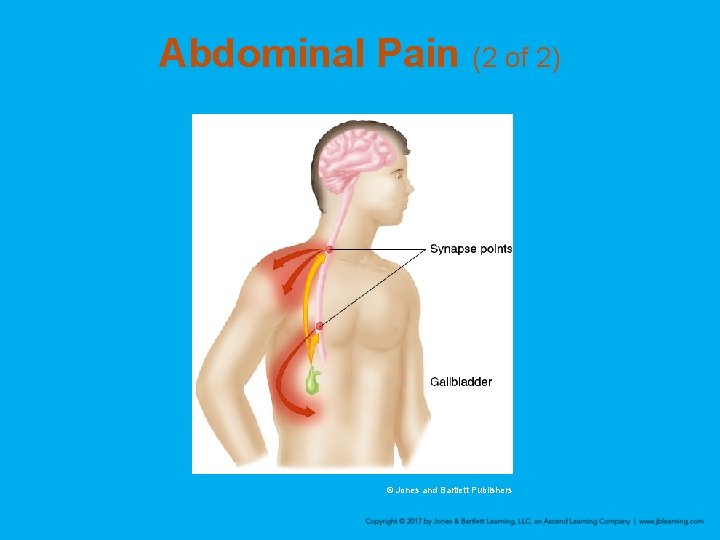
Abdominal Pain (2 of 2) © Jones and Bartlett Publishers
Causes of Acute Abdomen (1 of 5) • Ulcers – Protective layer of mucus lining erodes, allowing acid to eat into an organ • Gallstones – May form and block the gallbladder’s outlet, leading to cholecystitis
Causes of Acute Abdomen (2 of 5) • Pancreatitis – Inflammation of the pancreas • Appendicitis – Inflammation or infection in the appendix • Gastrointestinal hemorrhage – Symptom of another disease – May be acute or chronic
Causes of Acute Abdomen (3 of 5) • Esophagitis – Lining of the esophagus becomes inflamed by infection or acids from the stomach. – Gastroesophageal reflux disease (GERD) • Esophageal varices – Pressure within blood vessels surrounding esophagus increases
Causes of Acute Abdomen (4 of 5) • Mallory-Weiss syndrome – Junction between the esophagus and the stomach tears, causing severe bleeding • Gastroenteritis – Infection from bacterial or viral organisms or caused by noninfectious conditions
Causes of Acute Abdomen (5 of 5) • Diverticulitis – Fecal matter becomes caught in the colon walls, causing inflammation and infection • Hemorrhoids – Created by swelling and inflammation of blood vessels surrounding the rectum
Urinary System • Cystitis (bladder infection) is common. – Also called urinary tract infection (UTI)
Kidneys (1 of 2) • Play a major role in maintaining homeostasis • When the kidneys fail, uremia results. • Kidney stones can grow over time and cause blockage.
Kidneys (2 of 2) • Acute kidney failure – Sudden decrease in kidney function – Reversible with prompt diagnosis and treatment • Chronic kidney failure – Progressive and irreversible damage – Eventually dialysis is required.
Female Reproductive Organs • Gynecologic problems are a common cause of acute abdominal pain. • Lower quadrant pain may relate to the ovaries, fallopian tubes, or uterus.
Other Organ Systems (1 of 3) • The aorta lies immediately behind the peritoneum. – Weak areas can result in abdominal aortic aneurysm (AAA). – Can be difficult to detect – Use extreme caution when assessing or detecting AAA. • Pneumonia can cause ileus and abdominal pain.
Other Organ Systems (2 of 3) • Hernia – Protrusion of an organ through an opening into a body cavity where it does not belong – May not always produce a noticeable mass or lump – Strangulation is a serious medical emergency.
Other Organ Systems (3 of 3) • Serious hernia signs and symptoms: – A formerly reducible mass that is no longer reducible – Pain at the hernia site – Tenderness when the hernia is palpated – Red or blue skin discoloration

Scene Size-up • Scene safety – Consider gown and disposable protective covers for shoes. • Mechanism of injury/nature of illness – May be the result of violence – Use assessment results to develop an early index of suspicion for life threats
Primary Assessment • Airway and breathing – Abdominal pain may cause shallow, inadequate respirations. • Circulation – Ask about blood in vomit or black, tarry stools. – Check pulses in both arms. • Transport decision – Immediate transport is warranted if there are signs of significant illness.
History Taking • SAMPLE history – Nausea and vomiting – Change in bowel habits and urination – Weight loss – Belching or flatulence – Pain – Other signs/symptoms – Concurrent chest pain
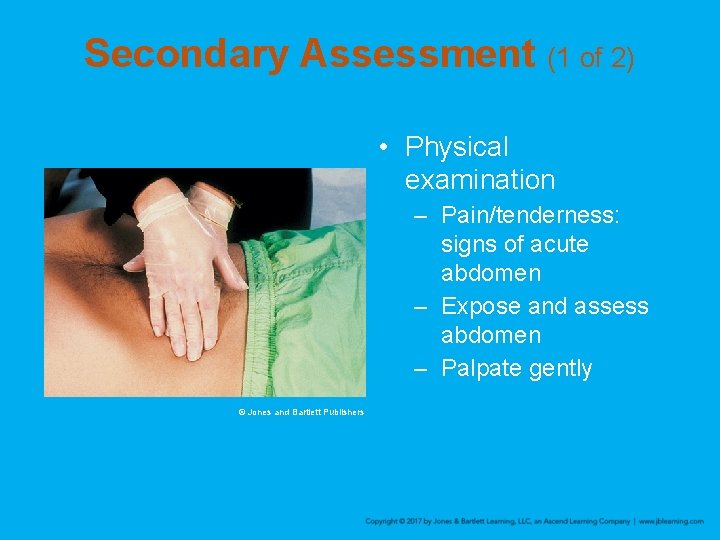
Secondary Assessment (1 of 2) • Physical examination – Pain/tenderness: signs of acute abdomen – Expose and assess abdomen – Palpate gently © Jones and Bartlett Publishers
Secondary Assessment (2 of 2) • Vital signs – Check the respiratory rate and pulse rate.
Reassessment • Frequent reassessment is important. • Assess the effects of interventions, including treatment for shock and emotional support. • Transport the patient in the most comfortable position.
Emergency Medical Care • You cannot treat causes of acute abdomen. – Take steps to provide comfort and lessen the effects of shock. • Treat the patient for shock even when obvious signs are not apparent. • Low-flow oxygen may decrease nausea and anxiety. • After completing patient care, clean the ambulance, equipment, and hands.
Dialysis Emergencies (1 of 2) • Dialysis is the only definitive treatment for chronic kidney failure. – Dialysis filters blood, cleans it of toxins, and returns it to the body. – If the patient misses dialysis treatment, pulmonary edema can occur. • Some services transport patients to and from dialysis centers.
Dialysis Emergencies (2 of 2) • A dialysis machine functions much like normal kidneys. • Adverse effects of dialysis: – Hypotension – Muscle cramps – Nausea and vomiting – Hemorrhage or infection at the access site • Management
Review 1. The ______ lies in the retroperitoneal space. A. liver B. pancreas C. stomach D. small intestine
Review Answer: B Rationale: The pancreas, kidneys, and ovaries lie in the retroperitoneal space, which is behind the peritoneum, and are often the cause of acute abdominal pain. The liver, stomach, and small intestine are all found within the true (anterior) abdomen.
Review (1 of 2) 1. The ______ lies in the retroperitoneal space. A. liver Rationale: The liver is found in the anterior abdomen. B. pancreas Rationale: Correct answer
Review (2 of 2) 1. The ______ lies in the retroperitoneal space. C. stomach Rationale: The stomach is found in the anterior abdomen. D. small intestine Rationale: The small intestine is found in the anterior abdomen.
Review 2. Which of the following is a hollow organ? A. Liver B. Kidney C. Spleen D. Gallbladder
Review Answer: D Rationale: The gallbladder is a hollow organ that concentrates and stores bile, which is produced by the liver. Other hollow organs include the stomach and intestines. The liver, spleen, and kidney are all solid organs.
Review 2. Which of the following is a hollow organ? A. Liver Rationale: The liver is a solid organ. B. Kidney Rationale: The kidney is a solid organ. C. Spleen Rationale: The spleen is a solid organ. D. Gallbladder Rationale: Correct answer
Review 3. A 34 -year-old woman with a recent history of pelvic inflammatory disease presents with acute severe abdominal pain. Her abdomen is distended and diffusely tender to palpation. Based on these findings, you should suspect: A. B. C. D. peritonitis. pancreatitis. appendicitis. cholecystitis.
Review Answer: A Rationale: Peritonitis—an inflammation of the thin membrane that lines the abdominal cavity— typically presents with acute abdominal pain. Causes of peritonitis include infection and blunt or penetrating abdominal trauma. The pain caused by peritonitis is typically diffuse (widespread), whereas appendicitis, pancreatitis, and cholecystitis (inflammation of the gallbladder) typically present with pain that is localized to a particular area.
Review (1 of 2) 3. A 34 -year-old woman with a recent history of pelvic inflammatory disease presents with acute severe abdominal pain. Her abdomen is distended and diffusely tender to palpation. Based on these findings, you should suspect: A. peritonitis. Rationale: Correct answer B. pancreatitis. Rationale: Pancreatitis is usually a localized pain (in one specific area).
Review (2 of 2) 3. A 34 -year-old woman with a recent history of pelvic inflammatory disease presents with acute severe abdominal pain. Her abdomen is distended and diffusely tender to palpation. Based on these findings, you should suspect: C. appendicitis. Rationale: Appendicitis is usually a localized pain (in one specific area). D. cholecystitis. Rationale: Cholecystitis is usually a localized pain (in one specific area).
Review 4. MOST patients with an acute abdomen present with: A. dyspnea. B. diarrhea. C. hypotension. D. tachycardia.
Review Answer: D Rationale: Tachycardia (heart rate > 100 beats/min) is commonly seen in patients with an acute abdomen; it is usually the result of severe pain. Hypotension is not seen in all patients with an acute abdomen; if the patient is hypotensive, you should suspect internal bleeding or a severe infection (sepsis). Many patients with an acute abdomen have increased respirations (tachypnea); however, dyspnea (a feeling of shortness of breath) is not common.
Review (1 of 2) 4. MOST patients with an acute abdomen present with: A. dyspnea. Rationale: Some patients may have increased respirations, but they typically do not have difficulty breathing. B. diarrhea. Rationale: Diarrhea may be a symptom of some abdominal problems but not in most patients.
Review (2 of 2) 4. MOST patients with an acute abdomen present with: C. hypotension. Rationale: Hypotension is not seen in most patients; when it is present, shock should be suspected. D. tachycardia. Rationale: Correct answer
Review 5. Which of the following signs or symptoms would you be the LEAST likely to find in a patient with an acute abdomen? A. Rapid, shallow breathing B. Soft, nondistended abdomen C. Tachycardia and restlessness D. Constipation or diarrhea
Review Answer: B Rationale: Signs and symptoms of an acute abdomen include, but are not limited to, rapid and shallow breathing, a tense and distended abdomen, tachycardia, restlessness, and constipation or diarrhea.
Review (1 of 2) 5. Which of the following signs or symptoms would you be the LEAST likely to find in a patient with an acute abdomen? A. Rapid, shallow breathing Rationale: This is a common sign of an acute abdomen. B. Soft, nondistended abdomen Rationale: Correct answer
Review (2 of 2) 5. Which of the following signs or symptoms would you be the LEAST likely to find in a patient with an acute abdomen? C. Tachycardia and restlessness Rationale: These are common signs of an acute abdomen. D. Constipation or diarrhea Rationale: These are common signs of an acute abdomen.
Review 6. A condition in which a person experiences a loss of appetite is called: A. ileus. B. colic. C. emesis. D. anorexia.
Review Answer: D Rationale: Anorexia is defined as a loss of appetite. It is a nonspecific symptom but is often associated with gastrointestinal diseases and abdominal pain. Ileus is the paralysis of the muscular contractions that normally propel material through the intestine. Colic is a severe, intermittent cramping pain. Emesis is the proper medical term for vomiting.
Review (1 of 2) 6. A condition in which a person experiences a loss of appetite is called: A. ileus. Rationale: Ileus is the paralysis of the muscular contractions that normally propel material through the intestine. B. colic. Rationale: Colic is a severe, intermittent cramping pain.
Review (2 of 2) 6. A condition in which a person experiences a loss of appetite is called: C. emesis. Rationale: Emesis is also known as vomiting. D. anorexia. Rationale: Correct answer
Review 7. The medical term for inflammation of the urinary bladder is: A. cystitis. B. nephritis. C. cholecystitis. D. diverticulitis.
Review Answer: A Rationale: Cystitis is the medical term for inflammation of the urinary bladder. Nephritis is inflammation of the kidney. Cholecystitis is inflammation of the gallbladder. Diverticulitis is a condition in which small pouches in the colon (large intestine) become inflamed.
Review (1 of 2) 7. The medical term for inflammation of the urinary bladder is: A. cystitis. Rationale: Correct answer B. nephritis. Rationale: Nephritis is the inflammation of the kidney.
Review (2 of 2) 7. The medical term for inflammation of the urinary bladder is: C. cholecystitis. Rationale: Cholecystitis is the inflammation of the gallbladder. D. diverticulitis. Rationale: Diverticulitis is the inflammation of part of the large intestine.
Review 8. If a hernia is incarcerated and the contents are so greatly compressed that circulation is compromised, the hernia is said to be: A. reducible. B. ruptured. C. strangulated. D. congenital.
Review Answer: C Rationale: A strangulated hernia occurs when a hernia is incarcerated and compressed by the surrounding tissues. It is a serious medical emergency and requires immediate surgery to repair the hernia, remove the dead tissue, and return oxygen to the tissues. When the mass can be placed back into the body, it is considered reducible. Hernias are not at risk of rupturing. A congenital hernia is one that is present at birth and is usually found around the umbilicus.
Review (1 of 2) 8. If a hernia is incarcerated and the contents are so greatly compressed that circulation is compromised, the hernia is said to be: A. reduced. Rationale: This is a mass or lump that will disappear back into the body cavity in which it belongs. B. ruptured. Rationale: This is a mass or lump that bursts from internal pressure.
Review (2 of 2) 8. If a hernia is incarcerated and the contents are so greatly compressed that circulation is compromised, the hernia is said to be: C. strangulated. Rationale: Correct answer D. hypoxemic. Rationale: This is a decrease in arterial oxygen levels.
Review 9. A 70 -year-old man presents with an acute onset of severe, tearing abdominal pain that radiates to his back. His BP is 88/66 mm Hg, pulse rate is 120 beats/min, and respirations are 26 breaths/min. Treatment for this patient should include: A. B. C. D. rapid transport to the hospital. firm palpation of the abdomen. placing him in a sitting position. oxygen at 4 L/min via nasal cannula.
Review Answer: A Rationale: Severe, tearing abdominal pain that radiates to the back is typical of an abdominal aortic aneurysm (AAA); it commonly occurs in older patients—especially those with hypertension. Treatment includes high-flow oxygen and rapid transport. If the patient has signs of shock, place him or her supine. Do not vigorously palpate the patient’s abdomen; doing so may cause the aneurysm to rupture.
Review (1 of 2) 9. A 70 -year-old man presents with an acute onset of severe, tearing abdominal pain that radiates to his back. His BP is 88/66 mm Hg, pulse rate is 120 beats/min, and respirations are 26 breaths/min. Treatment for this patient should include: A. rapid transport to the hospital. Rationale: Correct answer B. firm palpation of the abdomen. Rationale: A firm or vigorous palpation is contraindicated in patients with severe and sudden-onset abdominal pain.
Review (2 of 2) 9. A 70 -year-old man presents with an acute onset of severe, tearing abdominal pain that radiates to his back. His BP is 88/66 mm Hg, pulse rate is 120 beats/min, and respirations are 26 breaths/min. Treatment for this patient should include: C. placing him in a sitting position. Rationale: Hypotension is treated by elevating the patient’s legs into the shock position. D. oxygen at 4 L/min via nasal cannula. Rationale: High-flow oxygen is indicated in the treatment of shock.
Review 10. In which position do most patients with acute abdominal pain prefer to be transported? A. Sitting, with their head elevated 45° B. Supine, with their legs elevated 12 inches C. On their side, with their knees flexed D. In Fowler’s position, with their legs straight
Review Answer: C Rationale: Most patients with acute abdominal pain prefer to lie on their side with their knees flexed (and usually drawn up into their abdomen). This position takes pressure off the abdominal muscles and may afford them pain relief. The other positions do not allow the pressure to be relieved and may cause further discomfort.
Review (1 of 2) 10. In which position do most patients with acute abdominal pain prefer to be transported? A. Sitting, with the head elevated 45° Rationale: This is also known as semi. Fowler’s position. B. Supine, with their legs elevated 12 inches Rationale: This position will not relieve pressure from the abdomen.
Review (2 of 2) 10. In which position do most patients with acute abdominal pain prefer to be transported? C. On their side, with their knees flexed Rationale: Correct answer D. In Fowler’s position, with their legs straight Rationale: This is when the patient is sitting straight up.
- Slides: 76