Mori music and Kaupapa Mori This lecture Kaupapa







- Slides: 45
Māori music and Kaupapa Māori
This lecture • Kaupapa Māori • Some thematic concerns in Kaupapa Māori music • Some music: Moana Maniapoto, Dean Hapeta, Maisey Rika, Tiki Taane • Strategies used
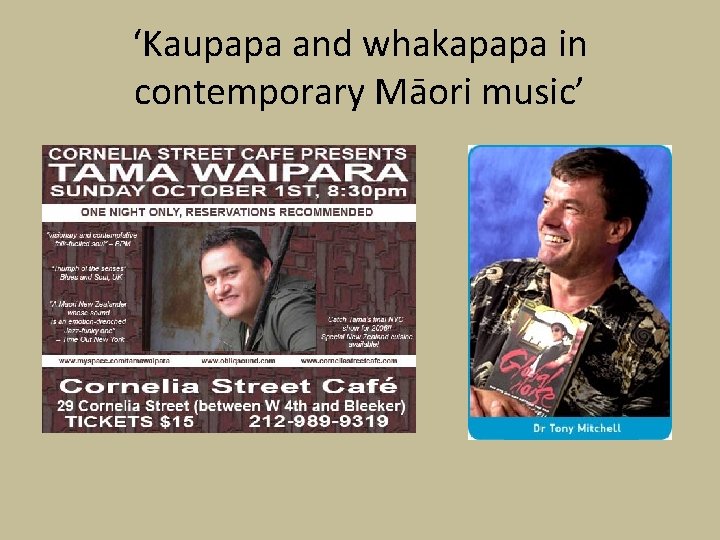
‘Kaupapa and whakapapa in contemporary Māori music’
“While [Māori] musical forms may have shifted, and have certainly been influenced by non. Māori elements, kaupapa – a plan or set of principles used as a basis for action, also translated as theme, strategy or subject matter – is an important way of accessing and expressing Māori philosophies and ideologies”. (Mitchell and Waipara, 2011, p. 10).
http: //www. rangaha “… in some settings ‘kaupapa Māori’ is used as a political tool u. co. nz/methodology /59/ by Māori to make space for activities and enterprises initiated and controlled by Māori. Similarly, kaupapa Māori is also used to mean values and principles found within mātauranga Māori. These two themes are coming to a new articulation in contemporary thinking. ” Charles Royal
Some themes in Kaupapa Māori music • Revisioning history • The use/promotion of te reo • A call to resistance/action • Tikanga and “observation of traditional protocols” (M&W p. 112) • Māori worldviews (Mitchell and Waipara discuss importance of land/whenua) • The importance of a sense of Māori identity
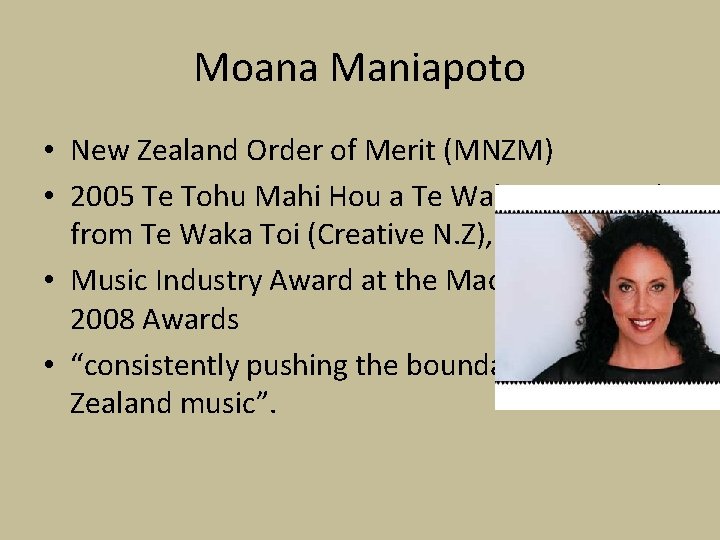
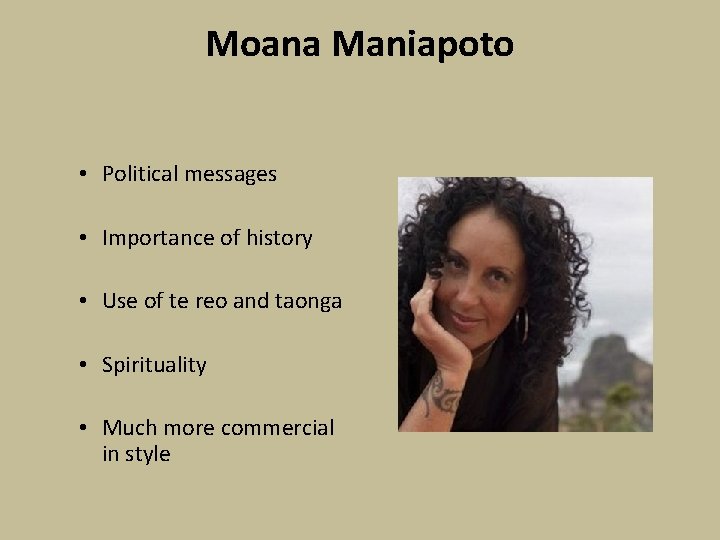
Moana Maniapoto • New Zealand Order of Merit (MNZM) • 2005 Te Tohu Mahi Hou a Te Waka Toi Award from Te Waka Toi (Creative N. Z), • Music Industry Award at the Maori Waiata 2008 Awards • “consistently pushing the boundaries of New Zealand music”.
"All I have really tried to do is make a difference in terms of Maori reclaiming our selfdetermination and also encourage Maori and Pakeha to value the culture. "
• “There’s a third wave of colonisation which is knowledge based, image and design based, where companies want to create a point of difference in the market, so they look for things that are exotic. We’ve seen hakas and mokos used by big companies around the world – I’m very proud of Maori elders and young Maori who have challenged those companies and said ‘this is not on’, because they’re so used to getting away with it. ”
‘A. E. I. O. U. Akona’ • “an anthem of language preservation and cultural renaissance” • “using the pronunciation of these vowel sounds as a basis for the promotion of awareness about te reo Māori, the song is unashamedly literal, speaking directly to the need to delve further into historical awareness as a means of reinvigorating the future”. (Mitchell and Waipara)
• http: //www. youtube. com/watch? v=wzn 0 JV 0 E 5 ko • https: //www. youtube. com/watch? v=pc. CSykej Uz 4 • https: //www. youtube. com/watch? v=Uf_Ck 9 Kn. PY
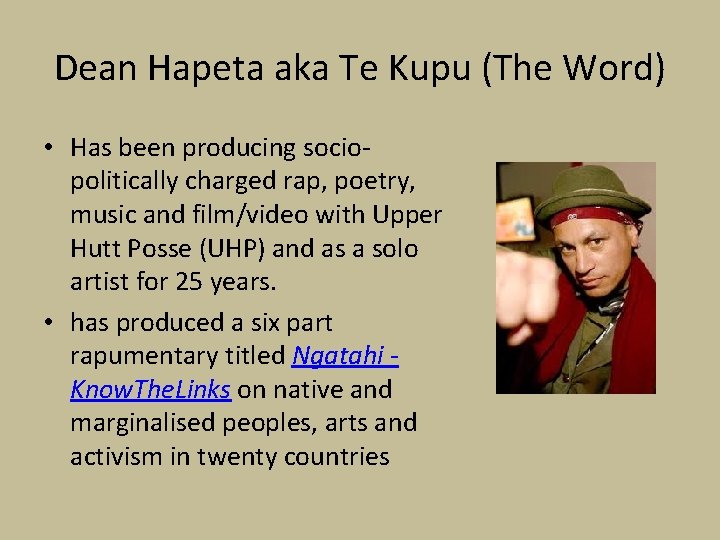
Dean Hapeta aka Te Kupu (The Word) • Has been producing sociopolitically charged rap, poetry, music and film/video with Upper Hutt Posse (UHP) and as a solo artist for 25 years. • has produced a six part rapumentary titled Ngatahi Know. The. Links on native and marginalised peoples, arts and activism in twenty countries
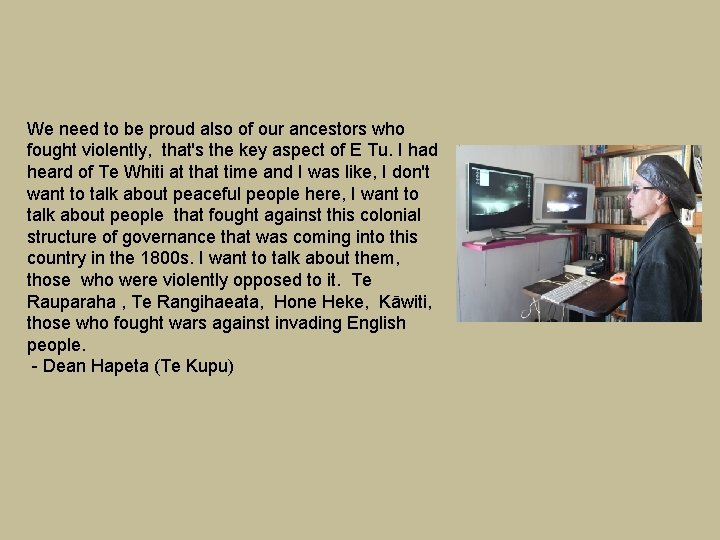
We need to be proud also of our ancestors who fought violently, that's the key aspect of E Tu. I had heard of Te Whiti at that time and I was like, I don't want to talk about peaceful people here, I want to talk about people that fought against this colonial structure of governance that was coming into this country in the 1800 s. I want to talk about them, those who were violently opposed to it. Te Rauparaha , Te Rangihaeata, Hone Heke, Kāwiti, those who fought wars against invading English people. - Dean Hapeta (Te Kupu)
Danny Bailey writes… • When Dean Hapeta recounts the history of Maori warriors through rhymes in “E Tu, ” he is actively challenging the more widely-held perspective, which would see the same events he describes through colonizing, British eyes. By celebrating the Maori victories rather than focusing on the British defeats, “E Tu” is an active revision of Maori history through Maori eyes …
• By celebrating the tactical efforts of Kawiti and depicting the war efforts of Maori as heroic rather than tragic (as it might be when viewed from the opposing perspective), Hapeta celebrates the underrepresented side of the history that becomes heritage for Maori people. • He explicitly calls for a revisionist approach to such history, imploring his Maori audience, “You gotta learn the history to know where you truly are/learn it somehow, this ignorance has gone too far”.
• http: //www. youtube. com/watch? v=GOu. JVg. Tt Zk. Y
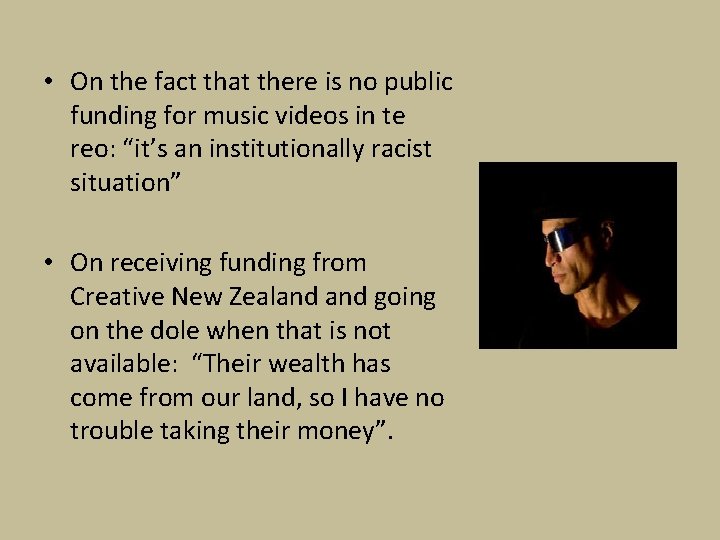
• On the fact that there is no public funding for music videos in te reo: “it’s an institutionally racist situation” • On receiving funding from Creative New Zealand going on the dole when that is not available: “Their wealth has come from our land, so I have no trouble taking their money”.
Danny Bailey again … “By releasing songs in both English and te reo formats – the most extensive releases being Ko Te Matakahi Kupu and Legacy, as well as a remix album – Hapeta has the added advantage of reaching two different audiences. But because the statistical percentage of those who are fluent in te reo is such a proportionately small number to those who are in English, creating an album in te reo serves more of a creative and sociopolitical purpose. …
… If anything, producing politically active Maori hip-hop in English would evince the irony inherent in using the language of the colonizer to protest on behalf of the colonized. Thus rapping in te reo embodies a wholly Maori perspective, while the English version functions more as a way for Hapeta to have his voice heard over a wider audience. ”
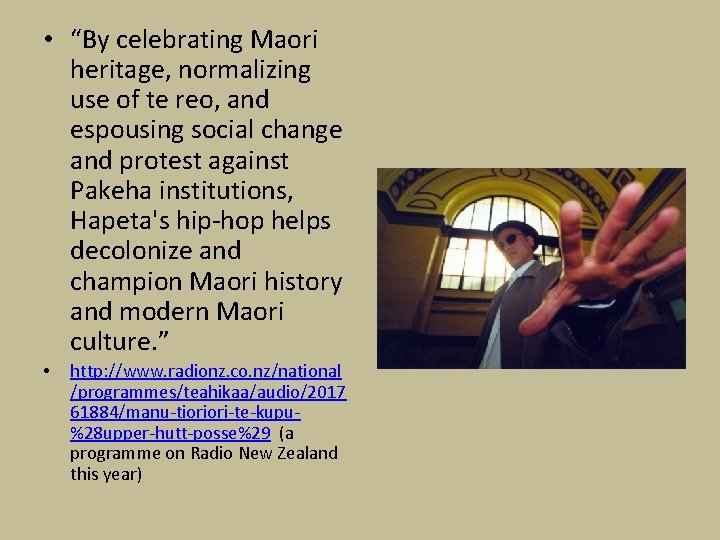
• “By celebrating Maori heritage, normalizing use of te reo, and espousing social change and protest against Pakeha institutions, Hapeta's hip-hop helps decolonize and champion Maori history and modern Maori culture. ” • http: //www. radionz. co. nz/national /programmes/teahikaa/audio/2017 61884/manu-tioriori-te-kupu%28 upper-hutt-posse%29 (a programme on Radio New Zealand this year)
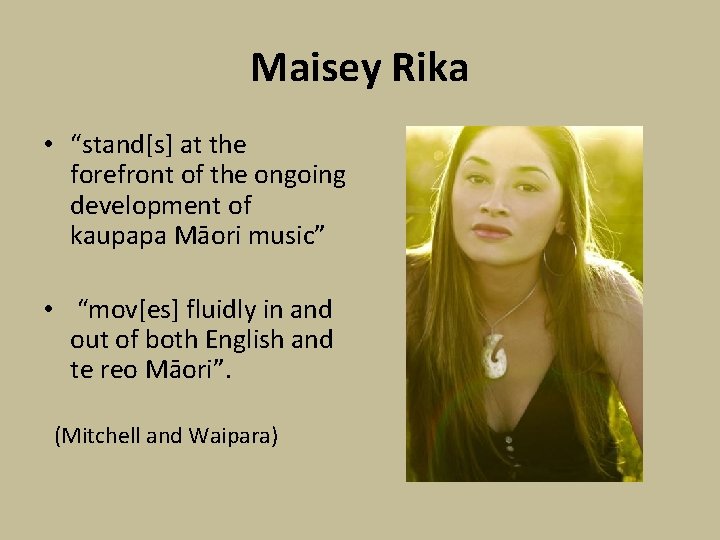
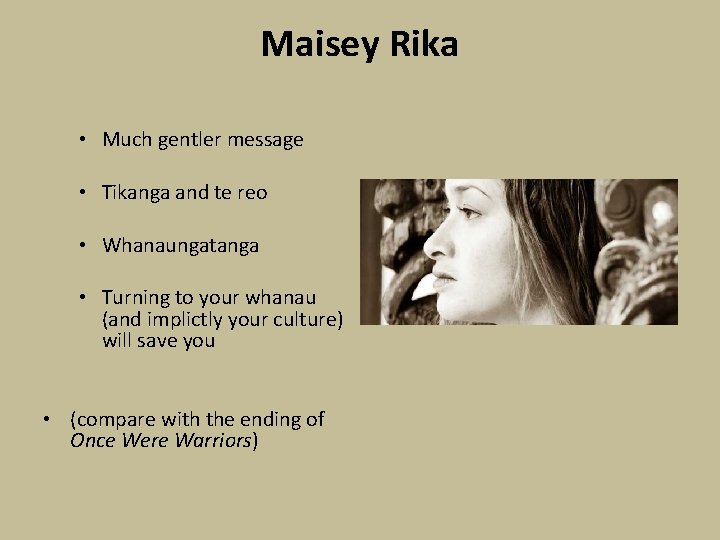
Maisey Rika • “stand[s] at the forefront of the ongoing development of kaupapa Māori music” • “mov[es] fluidly in and out of both English and te reo Māori”. (Mitchell and Waipara)
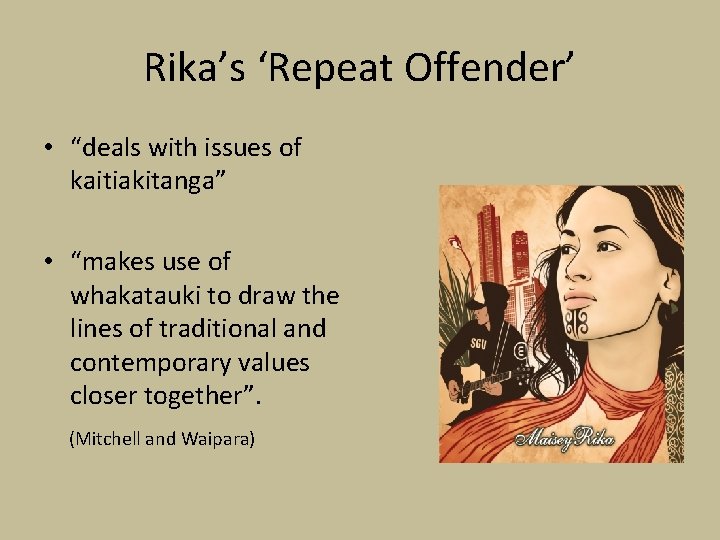
Rika’s ‘Repeat Offender’ • “deals with issues of kaitiakitanga” • “makes use of whakatauki to draw the lines of traditional and contemporary values closer together”. (Mitchell and Waipara)
Maisey Rika’s Game of Life • “she addresses those • https: //www. youtube. c lost descendants of om/watch? v=k. YHf. RTKK chiefs and warriors who 3 c. M shuffle on the streets of our cities and towns while noting "I see it in our kids, the remnants of the leaders were".
• This is the best song ever. It is the breaking point of our naivete, that point before we hit irreversible destruction, the peak of tolerance. Maisey and JJ are brilliant beyond measure. And most importantly this song tells me, "To know where you're going, you have to know where you come from. " Otherwise, we're lost, like the young man in the vid. Let love save us before we hit rock bottom. Thank you Maisey and JJ! Cheers. • you should always like being a maori ! you should love being a maori ! • I fucking shit myself when she did the karakia! Im in my room and its darks and the volumes loud! I love this song!! • churr mean maori mean, proud to be maori, represent hard. • This song just made me break into tears. . . I too can "see the light that shines through" ALL Maori youth and it is truly heart breaking to see so many choosing a dark path. Miss Rika your are an inspiration
• powerful. This is why i am proud to be maori our language, our artists, our country, our culture, our identity. . . nowhere else has what we do. . we are percieved by alot of others and our own too as angry, rapists, hardcore drinkers, women beaters its a shame, but even more than that its a shame we are the only race who gets shit for it when this happens all over the world. this beautiful lady reminds me that we are a beautiful people and i am proud no matter what people think. • I AM MAORI. . . And people who have the Natural Ability to make this grown mans heart well up with emotion - Just as Maisey; are true gifts to us from God. You make me EVER PROUDER to be MAORI. Thank-you Maisey
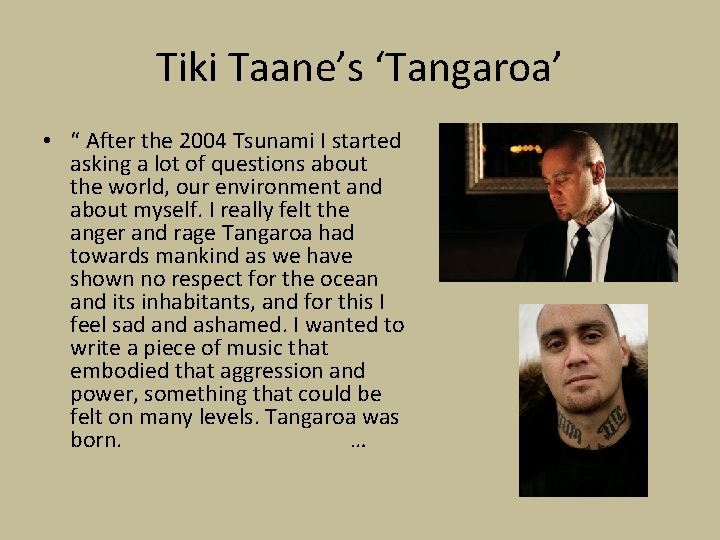
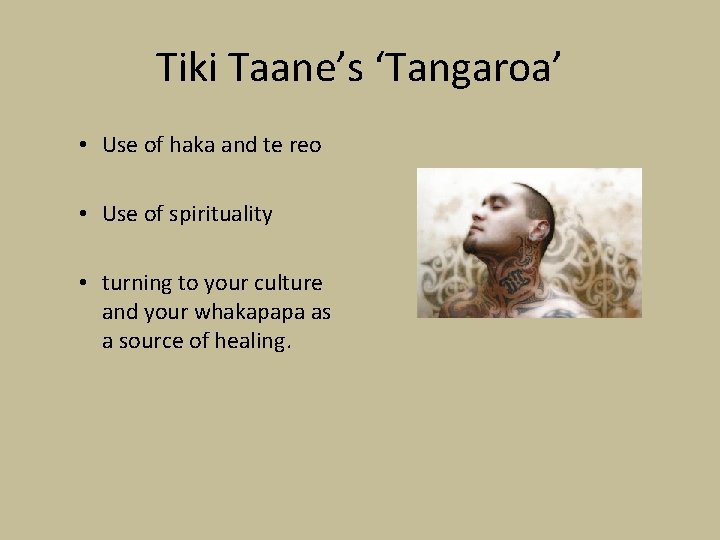
Tiki Taane’s ‘Tangaroa’ • “ After the 2004 Tsunami I started asking a lot of questions about the world, our environment and about myself. I really felt the anger and rage Tangaroa had towards mankind as we have shown no respect for the ocean and its inhabitants, and for this I feel sad and ashamed. I wanted to write a piece of music that embodied that aggression and power, something that could be felt on many levels. Tangaroa was born. …
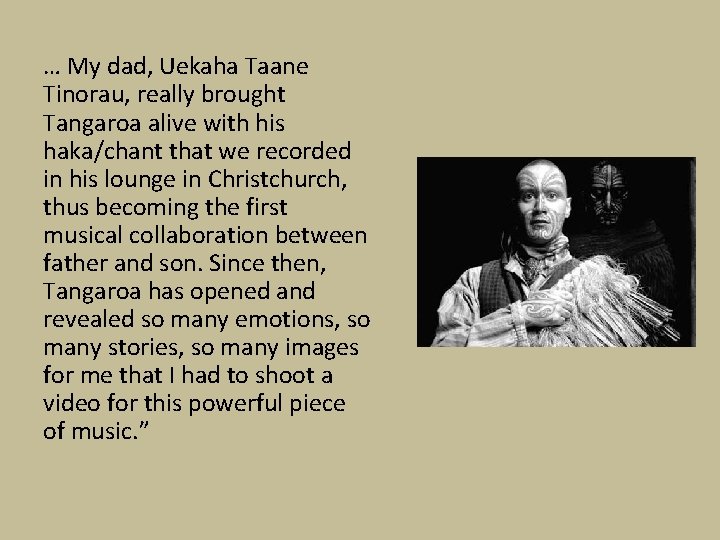
… My dad, Uekaha Taane Tinorau, really brought Tangaroa alive with his haka/chant that we recorded in his lounge in Christchurch, thus becoming the first musical collaboration between father and son. Since then, Tangaroa has opened and revealed so many emotions, so many stories, so many images for me that I had to shoot a video for this powerful piece of music. ”
But also, on youtube … • “Hey its Tiki here. The drugs, shots of the city, and the spinning out effect represents my struggle and all the things that have been oppressing me. My journey to the ocean is me wanting to ask for some answers and help in dealing with these issues. This is when my gandmother appears and encourages me to listen to Tangaroa - god of the sea, and to not be scared of looking deeper into my ancestry. Perhaps watch again & really look at the signs - also at the end - the words say it all”.
• http: //www. youtube. com/watch? v=JNDi. Fx. Y 6 n -k • For info on the kaupapa of Tangaroa: https: //www. facebook. com/note. php? note_id= 409441252312
Some strategies for using music to convey Kaupapa Māori • “… in some settings ‘kaupapa Māori’ is used as a political tool by Māori to make space for activities and enterprises initiated and controlled by Māori. • Similarly, kaupapa Māori is also used to mean values and principles found within mātauranga Māori. • These two themes are coming to a new articulation in contemporary thinking. ” (Charles Royal)
SO … For our purposes, we can think of these as: • music which is (overtly) political • music which comes from and promotes te ao Māori. I would argue that this also can be political. Both can be seen as contributing to decolonisation.
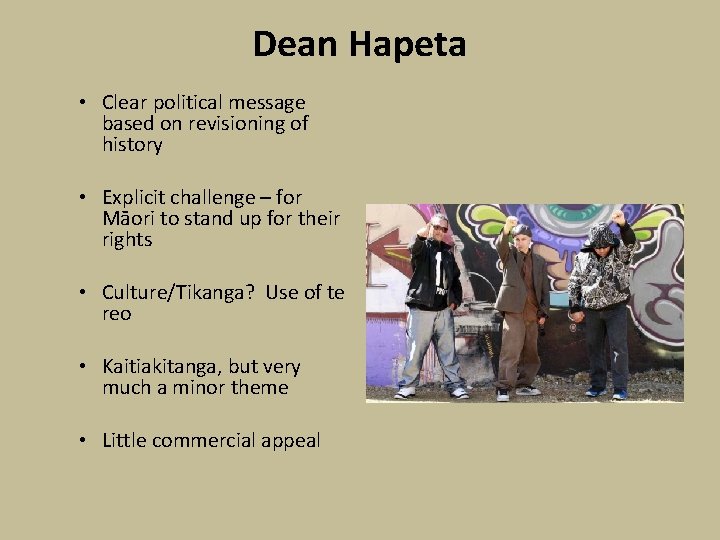
Dean Hapeta • Clear political message based on revisioning of history • Explicit challenge – for Māori to stand up for their rights • Culture/Tikanga? Use of te reo • Kaitiakitanga, but very much a minor theme • Little commercial appeal
Bailey on Hapeta • “the fact that reviewers have acknowledged his relative obscurity suggests that his blunt activism and unflinchingly aggressive attitudes towards Pakeha institutions has hurt any efforts to make his statements widely heard”.
Moana Maniapoto • Political messages • Importance of history • Use of te reo and taonga • Spirituality • Much more commercial in style
But … • Reviewer of Moana Maniapoto’s album Toru: “it will largely go unheard because it is predominantly in te reo, which will stall it at most radio”. • She travels to sing to people who don’t necessarily understand what she is singing about because she cannot make enough money to live on in this country.
Maisey Rika • Much gentler message • Tikanga and te reo • Whanaungatanga • Turning to your whanau (and implictly your culture) will save you • (compare with the ending of Once Were Warriors)
Tiki Taane’s ‘Tangaroa’ • Use of haka and te reo • Use of spirituality • turning to your culture and your whakapapa as a source of healing.
Ria Hall’s They Came Marching • https: //www. youtube. com/watch? v=t. Y_IRSkh Qgs • “an anthem of resistance, resilience and hope”. • Based on the Battle of Pukehina (Gate Pā) in Tauranga 150 years ago on April 29 th 1864.
• Iharaera Henare I love how even though the lyric incorporate the reality of warfare but not from the perspective of a fallen victim but instead the honourific voice of a generation • Conez Wilson-Muraahi Mean!! now I can sing along with you. . . or try to anyway, very uplifting and proud to be Maori because of beautiful people like you! AWESOME!!!
• http: //www. youtube. com/watch? v=Jy_qs. Vbx W 00
Poi E • https: //www. youtube. com/watch? v=DQLUyg. S 0 IAQ