Modern Auditing Assurance Services and the Integrity of
- Slides: 25
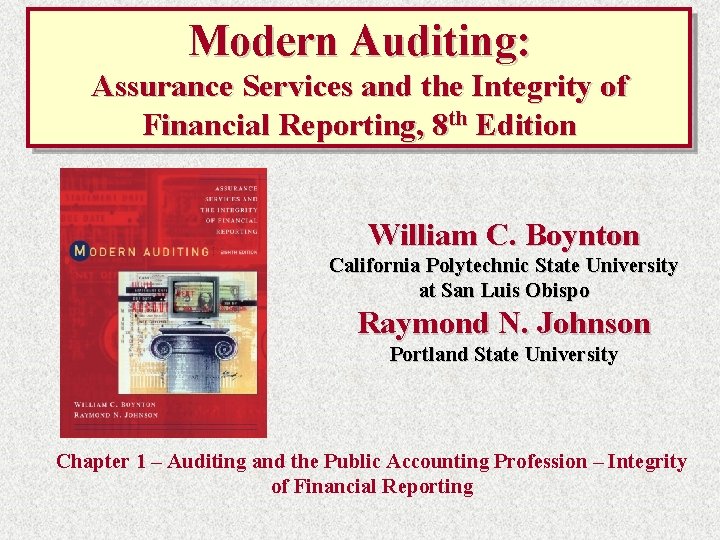
Modern Auditing: Assurance Services and the Integrity of Financial Reporting, 8 th Edition William C. Boynton California Polytechnic State University at San Luis Obispo Raymond N. Johnson Portland State University Chapter 1 – Auditing and the Public Accounting Profession – Integrity of Financial Reporting
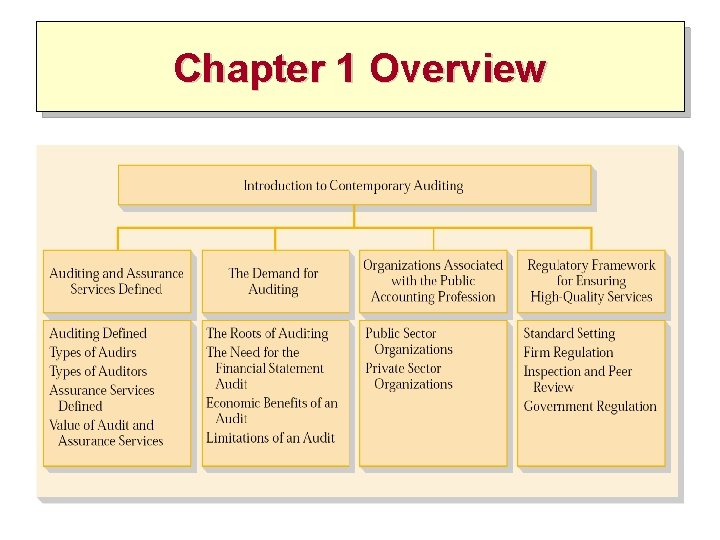
Chapter 1 Overview
Auditing Defined • Systematic process • Objectively obtaining and evaluating evidence • Assertions about economic actions and events • Degree of correspondence
Auditing Defined (cont. ) • Established criteria • Communicating the results • Interested users
Comparative Summary of Types of Audits
Types of Auditors • Independent Auditors • Internal Auditors • Government Auditors
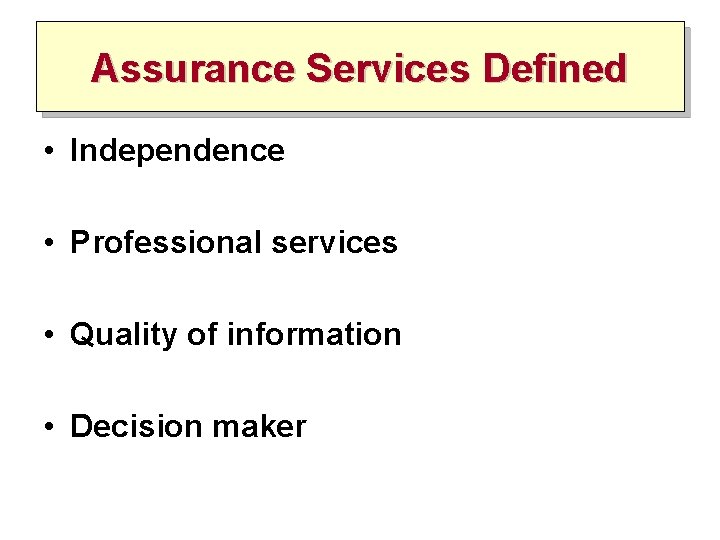
Assurance Services Defined • Independence • Professional services • Quality of information • Decision maker
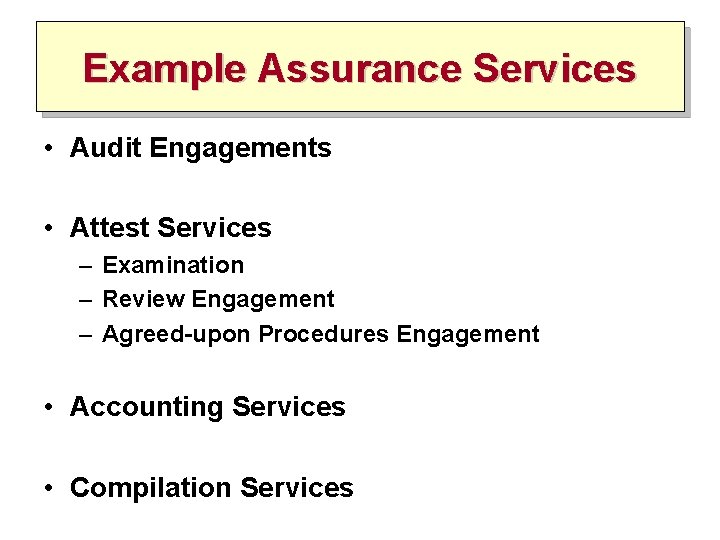
Example Assurance Services • Audit Engagements • Attest Services – Examination – Review Engagement – Agreed-upon Procedures Engagement • Accounting Services • Compilation Services
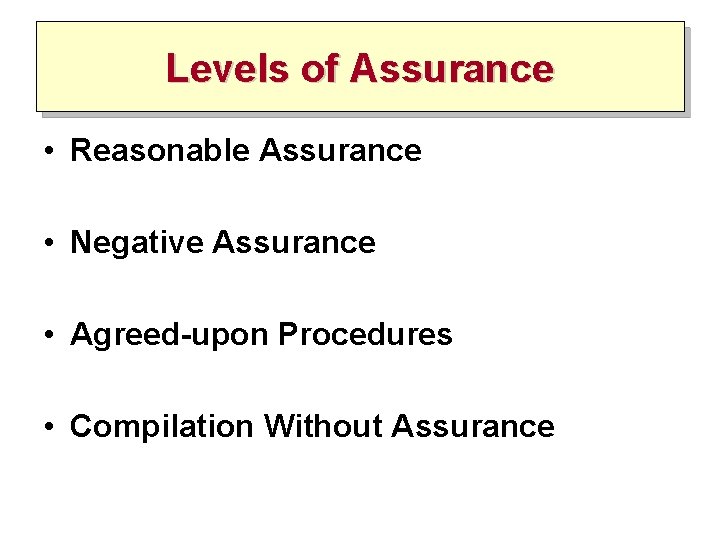
Levels of Assurance • Reasonable Assurance • Negative Assurance • Agreed-upon Procedures • Compilation Without Assurance
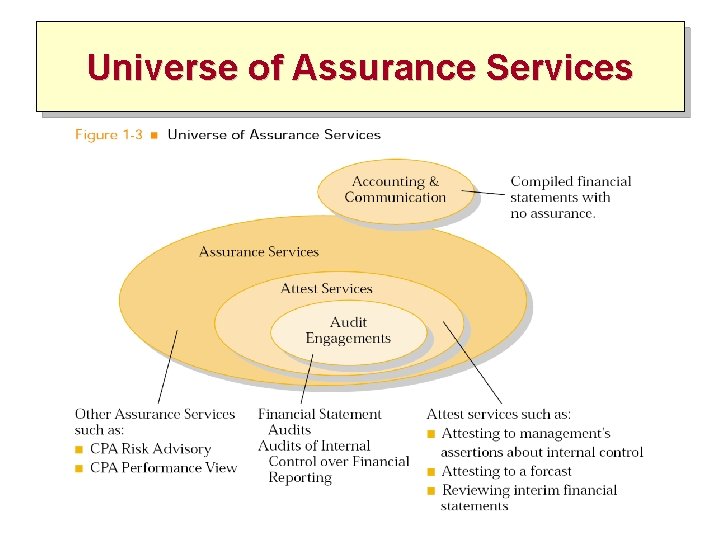
Universe of Assurance Services
The Accountant’s Value Chain
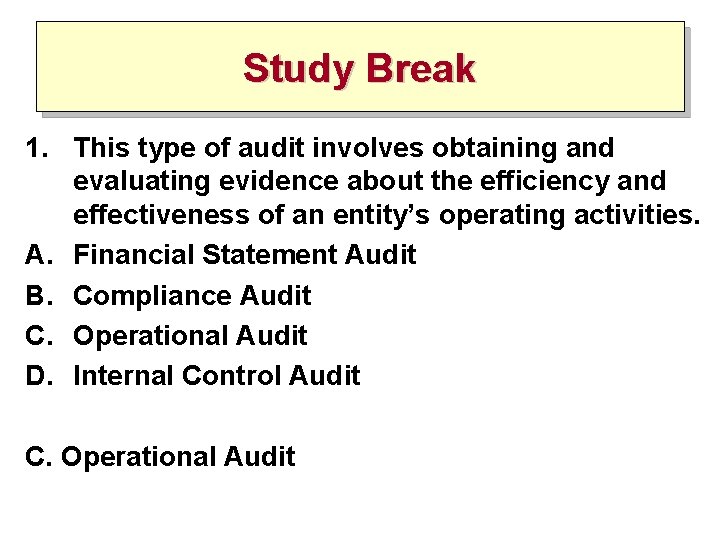
Study Break 1. This type of audit involves obtaining and evaluating evidence about the efficiency and effectiveness of an entity’s operating activities. A. Financial Statement Audit B. Compliance Audit C. Operational Audit D. Internal Control Audit C. Operational Audit
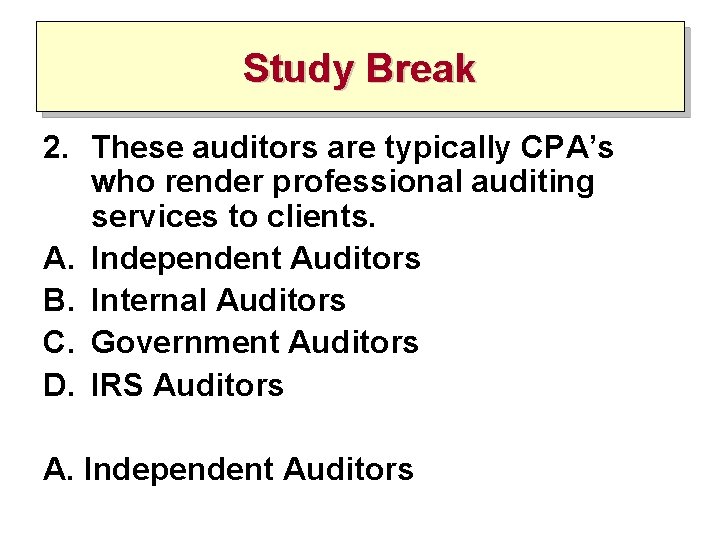
Study Break 2. These auditors are typically CPA’s who render professional auditing services to clients. A. Independent Auditors B. Internal Auditors C. Government Auditors D. IRS Auditors A. Independent Auditors
The Roots of Auditing • British influence and migration • Stock market crash • Legislation of the 1930’s • Important changes in the 1940’s
The Roots of Auditing • Scrutiny of 1980’s lead to changes • Increasing amount of consulting in 1990’s • Growing numbers of earnings restatements • Sarbanes-Oxley Act of 2002
Need for Financial Statement Audits • Conflict of Interest • Consequence • Complexity • Remoteness
Economic Benefits of an Audit • Access to Capital Markets • Lower Cost of Capital • Deterrent to Inefficiency and Fraud • Control and Operational Improvements
Limitations of a Financial Statement Audit • Economic Limitations – Reasonable Cost – Reasonable Length of Time • Accounting Framework Limitations – Alternative Accounting Principles – Accounting Estimates
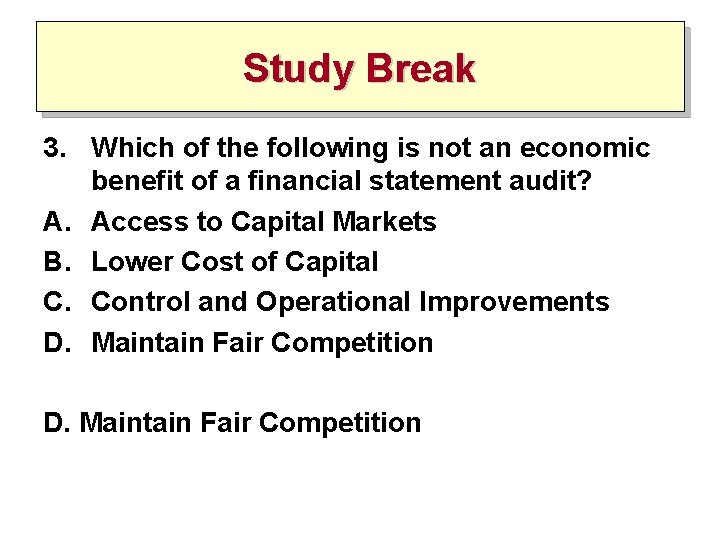
Study Break 3. Which of the following is not an economic benefit of a financial statement audit? A. Access to Capital Markets B. Lower Cost of Capital C. Control and Operational Improvements D. Maintain Fair Competition
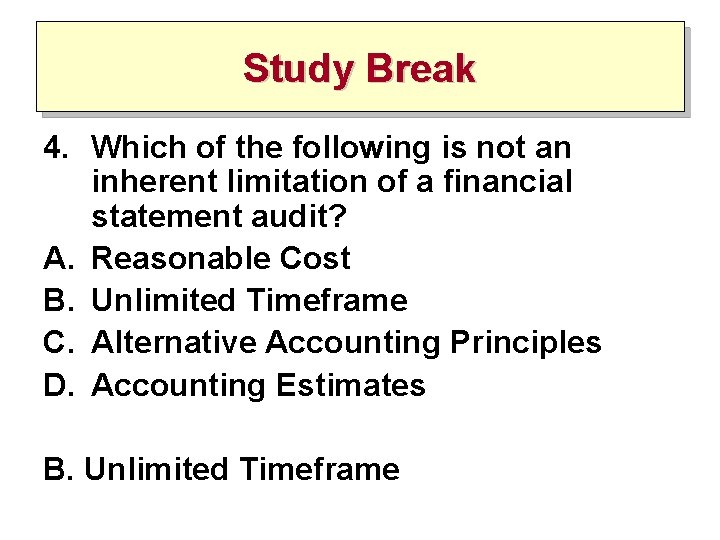
Study Break 4. Which of the following is not an inherent limitation of a financial statement audit? A. Reasonable Cost B. Unlimited Timeframe C. Alternative Accounting Principles D. Accounting Estimates B. Unlimited Timeframe
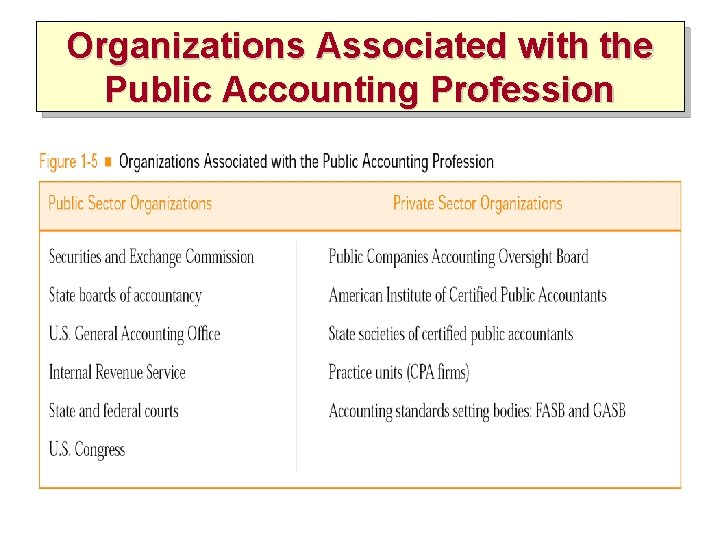
Organizations Associated with the Public Accounting Profession
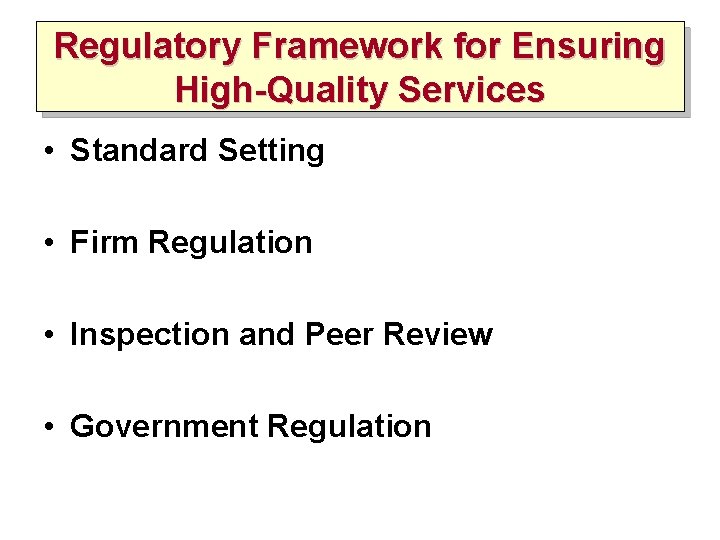
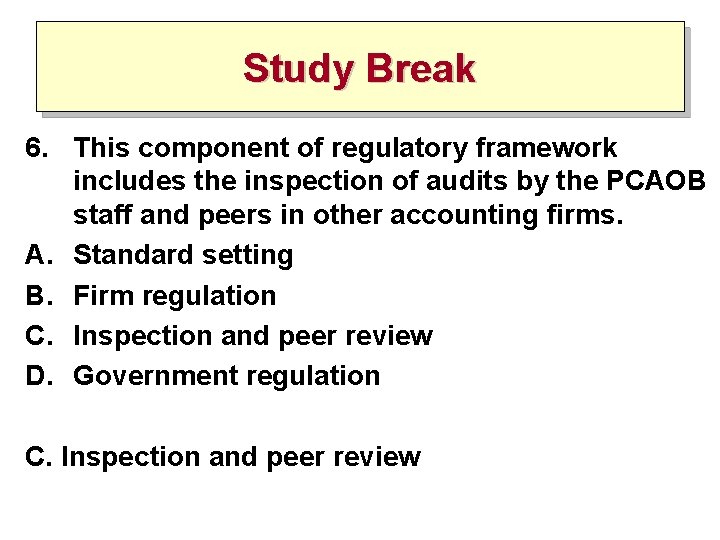
Regulatory Framework for Ensuring High-Quality Services • Standard Setting • Firm Regulation • Inspection and Peer Review • Government Regulation
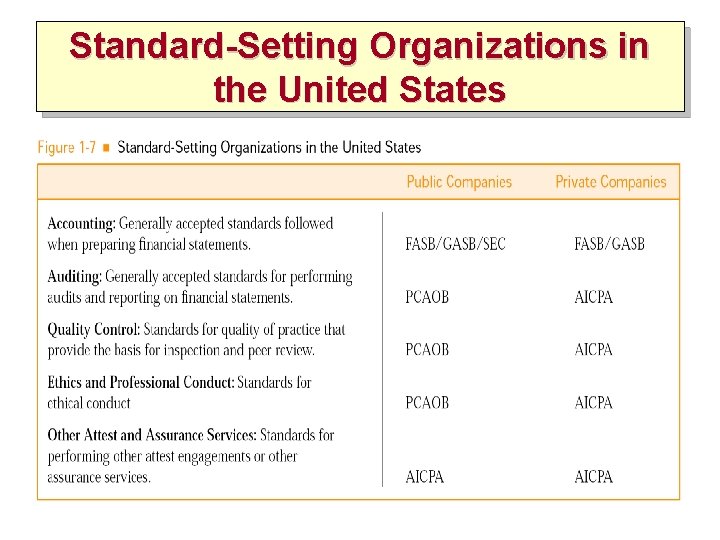
Standard-Setting Organizations in the United States
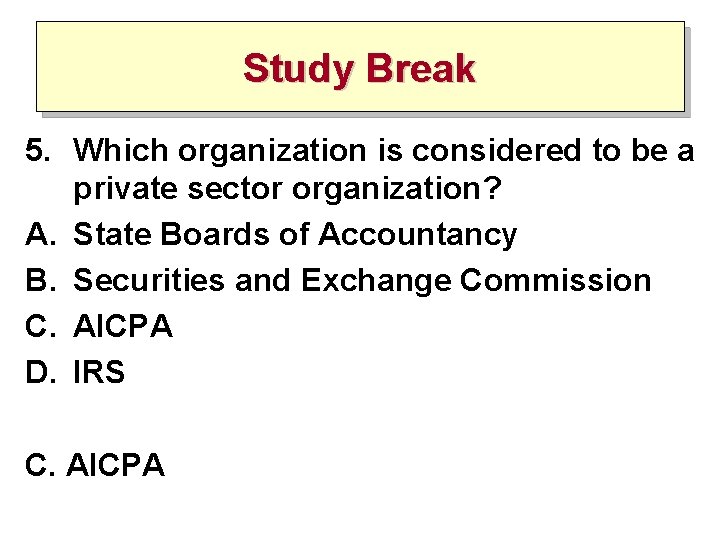
Study Break 5. Which organization is considered to be a private sector organization? A. State Boards of Accountancy B. Securities and Exchange Commission C. AICPA D. IRS C. AICPA
Study Break 6. This component of regulatory framework includes the inspection of audits by the PCAOB staff and peers in other accounting firms. A. Standard setting B. Firm regulation C. Inspection and peer review D. Government regulation C. Inspection and peer review