Ministry of East African Community Affairs 1212020 KEY
- Slides: 31
Ministry of East African Community Affairs 12/1/2020 KEY ACHIEVEMENTS FOR THE SECTOR IN THE NRM MANIFESTO BY Maganda. Julius Wandera(Hon) Minister of State, EAC 1
Layout i. Introduction ii. Pillars of Integration iii. Achievements iv. Challenges/threats v. Wayforward 12/1/2020 2
Introduction • The Summit of the East African Community (EAC) Heads of State agreed to appoint Ministers solely responsible for East African Community affairs, resident in the Partner States’ Capitals as a means of expediting the regional integration process towards the East African Community Political Federation. • It is from this background that the Ministry of East African Community Affairs (MEACA) was created, in accordance with Article 8(3) of the Treaty for the establishment of the East African Community. • The Ministry was created with a mandate to “steer Uganda’s regional integration agenda in accordance with the objectives of the Treaty for establishment of East African Community. ” MEACA became a fully-fledged Ministry with its own Vote and Accounting Officer in 2007. 12/1/2020 3
• I wish to inform you that Article 8 of the Treaty establishing the East African Community (EAC) provides for Ministries responsible for EAC Affairs whose mandate is to coordinate and act as a focal point on all East African Community matters. As a Ministry, we have ensured that the aspirations of the NRM Manifesto (2016 -2021) in Chapter 17, towards attainment of International and Regional cooperation, that is beneficial to Uganda, has to a great extent been realised through the EAC. 12/1/2020 4
Ministry Vision, Mission, Mandate: • Vision: Our vision is to have a “prosperous people in a secure federated East Africa. ” • Mission: The Ministry exists “to ensure that Ugandans participate in and benefit from the East African Community integration. ” • Mandate: The mandate to “steer Uganda’s regional integration agenda in accordance with the objectives of the Treaty for Establishment of East African Community. ” 12/1/2020 5
Ministry Strategic Objectives • In pursuance of the Ministry’s Vision, and in line with the Mission and Mandate, the Strategic objectives of the Ministry over the medium term are to; 1) Strengthen MEACA to provide Strategic leadership, guidance and support for EA integration 2) Coordinate and ensure compliance and implementation of EAC Policies, Laws, Decisions, Directives and Programmes. 3) Enhance public awareness and public participation in EAC regional integration. 4) Build and strengthen the capacity of MEACA to provide strategic leadership, guidance and support for EAC integration in Uganda 12/1/2020 6
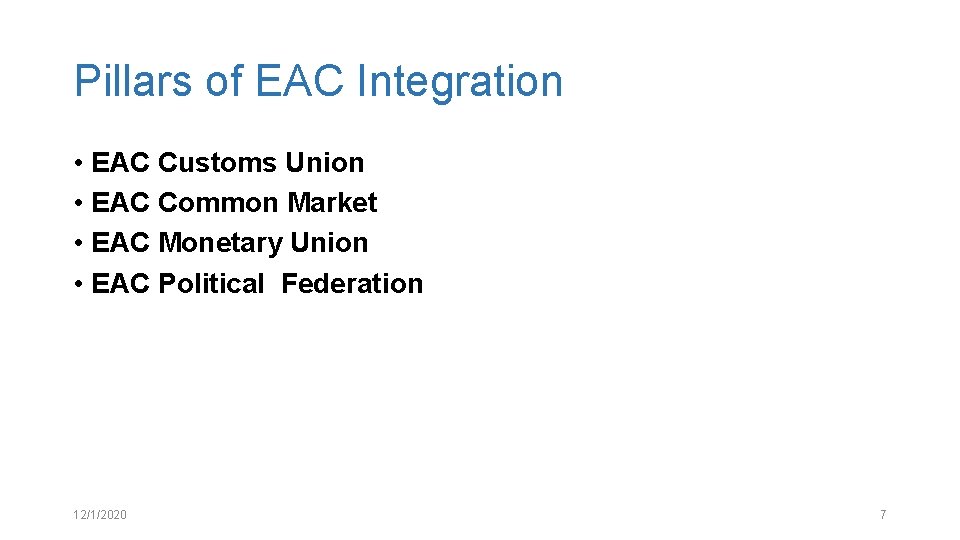
Pillars of EAC Integration • EAC Customs Union • EAC Common Market • EAC Monetary Union • EAC Political Federation 12/1/2020 7
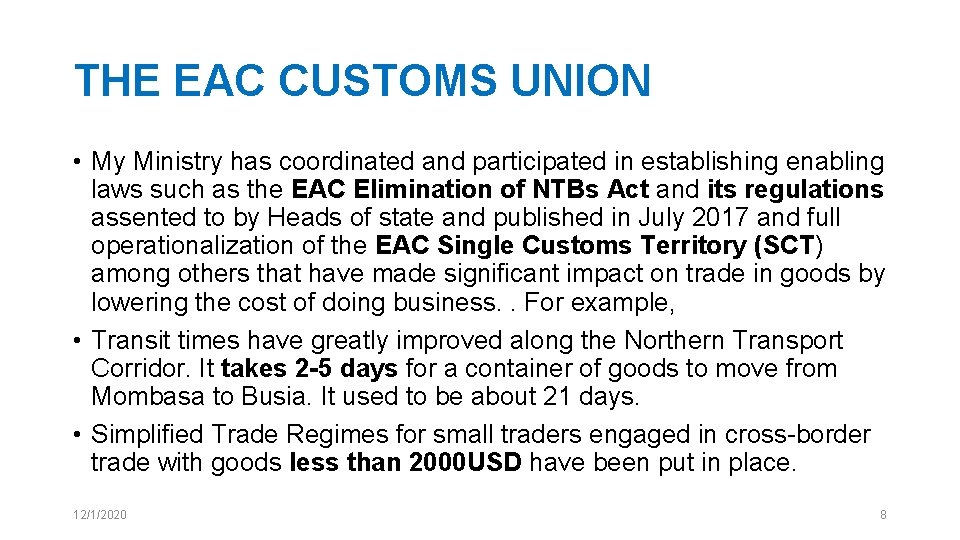
THE EAC CUSTOMS UNION • My Ministry has coordinated and participated in establishing enabling laws such as the EAC Elimination of NTBs Act and its regulations assented to by Heads of state and published in July 2017 and full operationalization of the EAC Single Customs Territory (SCT) among others that have made significant impact on trade in goods by lowering the cost of doing business. . For example, • Transit times have greatly improved along the Northern Transport Corridor. It takes 2 -5 days for a container of goods to move from Mombasa to Busia. It used to be about 21 days. • Simplified Trade Regimes for small traders engaged in cross-border trade with goods less than 2000 USD have been put in place. 12/1/2020 8
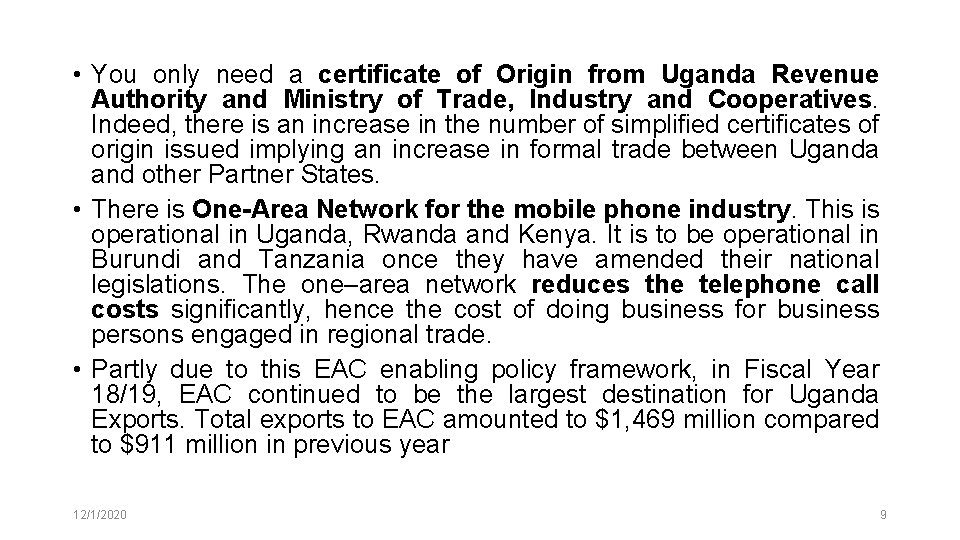
• You only need a certificate of Origin from Uganda Revenue Authority and Ministry of Trade, Industry and Cooperatives. Indeed, there is an increase in the number of simplified certificates of origin issued implying an increase in formal trade between Uganda and other Partner States. • There is One-Area Network for the mobile phone industry. This is operational in Uganda, Rwanda and Kenya. It is to be operational in Burundi and Tanzania once they have amended their national legislations. The one–area network reduces the telephone call costs significantly, hence the cost of doing business for business persons engaged in regional trade. • Partly due to this EAC enabling policy framework, in Fiscal Year 18/19, EAC continued to be the largest destination for Uganda Exports. Total exports to EAC amounted to $1, 469 million compared to $911 million in previous year 12/1/2020 9
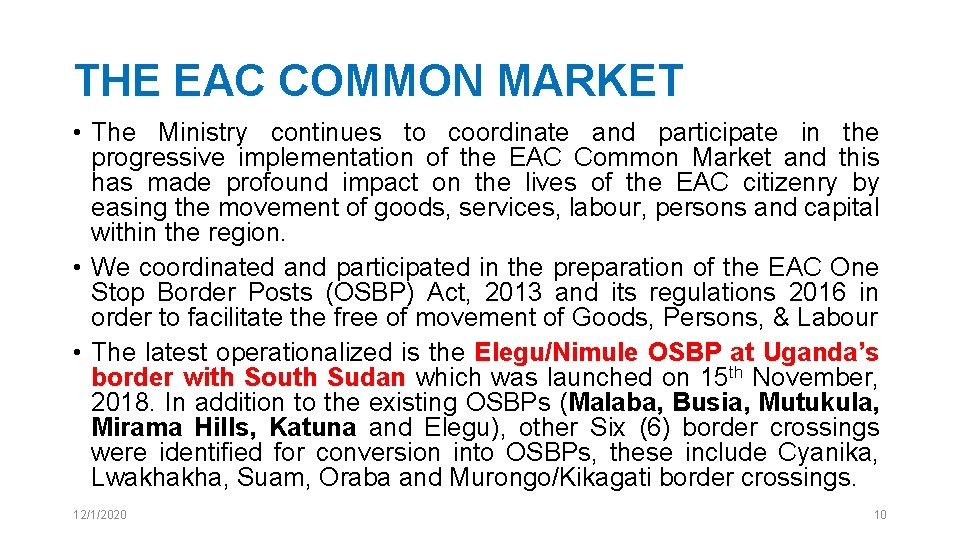
THE EAC COMMON MARKET • The Ministry continues to coordinate and participate in the progressive implementation of the EAC Common Market and this has made profound impact on the lives of the EAC citizenry by easing the movement of goods, services, labour, persons and capital within the region. • We coordinated and participated in the preparation of the EAC One Stop Border Posts (OSBP) Act, 2013 and its regulations 2016 in order to facilitate the free of movement of Goods, Persons, & Labour • The latest operationalized is the Elegu/Nimule OSBP at Uganda’s border with South Sudan which was launched on 15 th November, 2018. In addition to the existing OSBPs (Malaba, Busia, Mutukula, Mirama Hills, Katuna and Elegu), other Six (6) border crossings were identified for conversion into OSBPs, these include Cyanika, Lwakhakha, Suam, Oraba and Murongo/Kikagati border crossings. 12/1/2020 10
• OSBPs have boosted trade by cutting the time taken to clear goods between the Partner States. • Available information indicates that the conversion of Malaba and Busia Border into an OSBP has resulted into substantial time saving for cargo processing from 24 hrs to 4 hrs only leading to substantial cost savings. • We participated in negotiations to ensure that the Endagamuntu or National IDs can be used as Travel Documents to Kenya, Rwanda. • Gratis student passes fees for student have been abolished • there are no work permit fees for professionals who want to work across borders. • A number of professional groupings have finalized the signing of Mutual Recognition Agreements (MRAs). These include; Engineers, Architects, Surveyors, and Accountants. • There is now an identity as an EAC citizen because the New EAC-Passport issued by all Partner States except Republic of South Sudan is now an international travel document. • So far as at 13 th May 2020, the number of EA- e passport issued are: Ordinary Passports EA e-Passports, 259, 361, Service EA e-Passports are 188, Diplomatic EA e-Passports are at 480. This is out of the 1, 000 estimated number of people targeted to change Passports from Machine Readable to e-passports 12/1/2020 11
THE EAC MONETARY UNION My ministry coordinated and participated in negotiations to sign the Protocol for the establishment of the East African Monetary Union on 30 th November 2013, setting out the process and convergence criteria for attainment of a Monetary Union in the EAC region over a period of 10 years. The Protocol provides for the establishment of four institutions to support the Monetary Union. These are; i. The East African Monetary Institute (EAMI); ii. The East African Statistics Bureau; iii. The East African Surveillance, Compliance and Enforcement Commission, and iv. The East African Financial Services Commission. 12/1/2020 12
EAC Political Federation • Pursuant to the 17 th Summit Decision which adopted Political Confederation as a transitional model to Political Federation, and the subsequent 20 th Summit guidance, the EAC is currently engaged in the drafting of the EAC Confederation Constitution. • In the same spirit, the constituted team of experts from Partner States, has so far finalized with a situational analysis and National Consultations on the envisaged constitutional arrangement commenced in August 2019. • It is noteworthy that Uganda is represented by both Hon. Dr. Justice Benjamin Odoki (retired CJ of Uganda) and prof. Murindwa Rutanga (Lecturer Makerere University). • In the same respect, country consultations on thematic areas of the draft constitution was launched here in Uganda on 18 th November, 2019 by his excellence the President of Uganda. 12/1/2020 13
Manifesto Commitments 1. Pursuing a policy of commercial diplomacy to protect trade and investment. The NRM continues championing Uganda’s constructive contribution to regional and international economic development, peace and security, particularly through the EAC. 2. Fast-tracking implementation of national key infrastructure projects to enhance the country’s competitiveness while at the same time preparing to eventually fit into the EAC convergence criteria. 3. The Northern Corridor Integration Projects are critical to Uganda as they will facilitate trade between the country and the region. NRM will, therefore, remain committed to the full implementation of these projects basing on earnings from some of the country’s resources such as oil and gas, as well as minerals. 4. NRM will continue to pursue the engagement with other EAC member states to pursue and attain the realisation of an EAC Political Federation. 14 12/1/2020
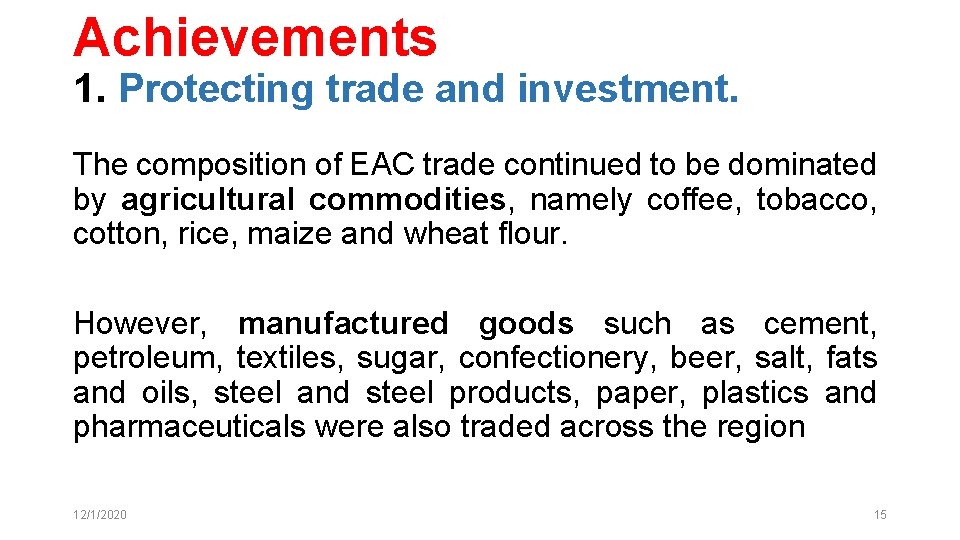
Achievements 1. Protecting trade and investment. The composition of EAC trade continued to be dominated by agricultural commodities, namely coffee, tobacco, cotton, rice, maize and wheat flour. However, manufactured goods such as cement, petroleum, textiles, sugar, confectionery, beer, salt, fats and oils, steel and steel products, paper, plastics and pharmaceuticals were also traded across the region 12/1/2020 15
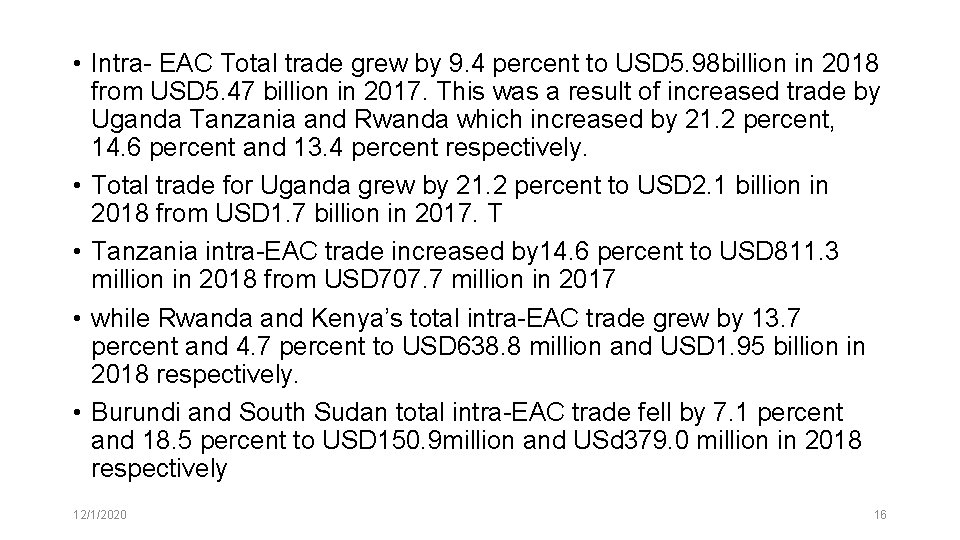
• Intra- EAC Total trade grew by 9. 4 percent to USD 5. 98 billion in 2018 from USD 5. 47 billion in 2017. This was a result of increased trade by Uganda Tanzania and Rwanda which increased by 21. 2 percent, 14. 6 percent and 13. 4 percent respectively. • Total trade for Uganda grew by 21. 2 percent to USD 2. 1 billion in 2018 from USD 1. 7 billion in 2017. T • Tanzania intra-EAC trade increased by 14. 6 percent to USD 811. 3 million in 2018 from USD 707. 7 million in 2017 • while Rwanda and Kenya’s total intra-EAC trade grew by 13. 7 percent and 4. 7 percent to USD 638. 8 million and USD 1. 95 billion in 2018 respectively. • Burundi and South Sudan total intra-EAC trade fell by 7. 1 percent and 18. 5 percent to USD 150. 9 million and USd 379. 0 million in 2018 respectively 12/1/2020 16
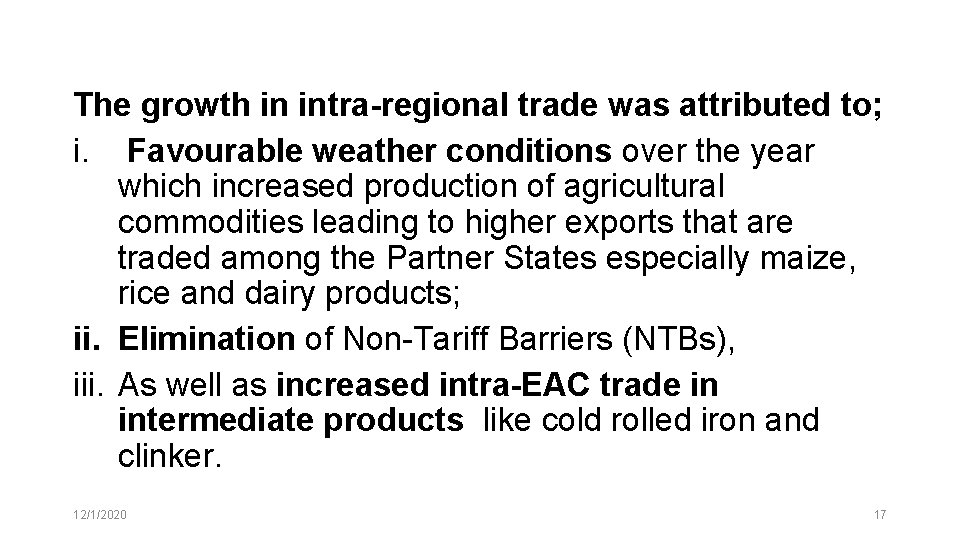
The growth in intra-regional trade was attributed to; i. Favourable weather conditions over the year which increased production of agricultural commodities leading to higher exports that are traded among the Partner States especially maize, rice and dairy products; ii. Elimination of Non-Tariff Barriers (NTBs), iii. As well as increased intra-EAC trade in intermediate products like cold rolled iron and clinker. 12/1/2020 17
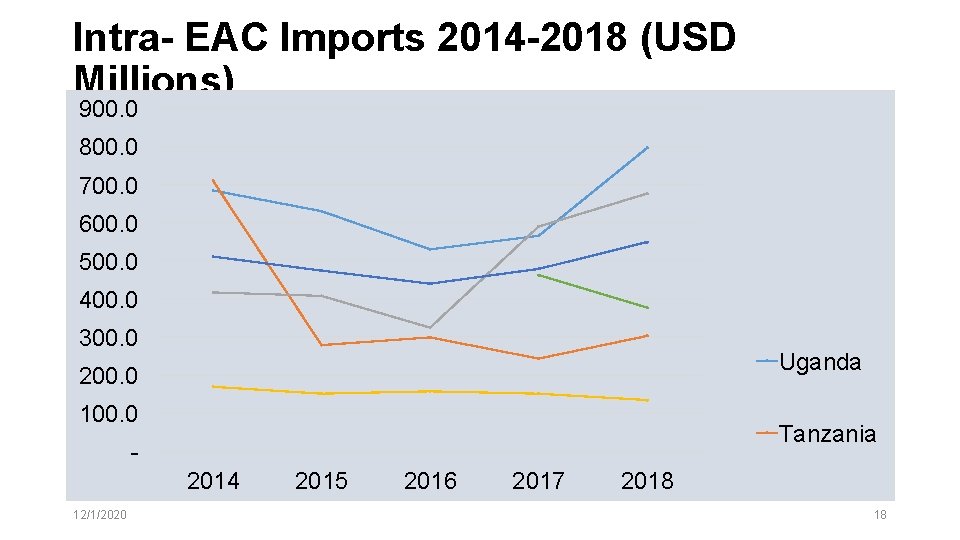
Intra- EAC Imports 2014 -2018 (USD Millions) 900. 0 800. 0 700. 0 600. 0 500. 0 400. 0 300. 0 Uganda 200. 0 100. 0 Tanzania 2014 12/1/2020 2015 2016 2017 2018 18
Intra-EAC imports • Total intra-EAC imports grew by 13. 9 percent to USD 2. 84 billion in 2018 from USD 2. 49 billion in 2017. • Notably, imports into Uganda, Tanzania, Kenya and Rwanda grew by 40. 8 percent, 24. 5 percent, 14. 7 percent and 14. 7 percent respectively. • However, imports into Burundi and South Sudan decreased by 11. 1 percent and 18. 5 percent respectively in 2018. 12/1/2020 19
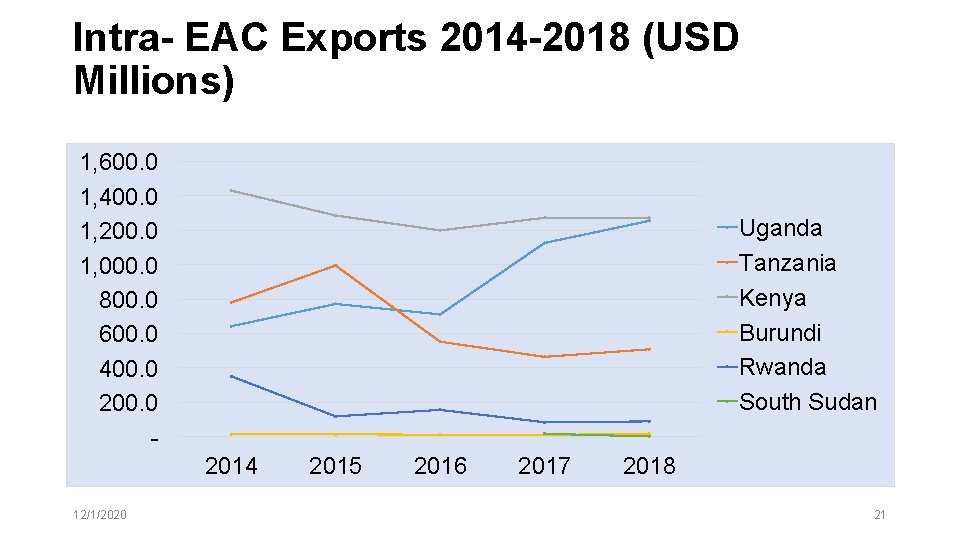
Intra -EAC Exports • Intra-regional exports grew by 5. 6 percent to USD 3. 2 billion in 2018 from US$ 2. 9 billion in 2017. • Noticeably, exports from all partner states grew with the exception of South Sudan during the year. • Burundi experienced the highest growth in exports during the year with exporting growing by 44. 3 percent to USD 16. 6 million in 2018 from USD 11. 5 million in 2017. • Exports from Uganda grew by 11. 4 percent to USD 1. 25 billion in 2018 from USD 1. 13 billion in 2017 12/1/2020 20
Intra- EAC Exports 2014 -2018 (USD Millions) 1, 600. 0 1, 400. 0 1, 200. 0 1, 000. 0 800. 0 600. 0 400. 0 200. 0 - Uganda Tanzania Kenya Burundi Rwanda South Sudan 2014 12/1/2020 2015 2016 2017 2018 21
Challenges to Intra- EAC Trade Despite the growth in intra-EAC trade, the growth was slower (at a rate of 6. 2 percent) than the African Average which stands at about 20 percent. The slower than expected growth in intra-EAC exports was attributed to the following challenges: a. Similarity in the commodities produced in the EAC. As such, agricultural and industrial products across the region are homogenous with little scope for intra-EAC trade. b. Continued use of ‘Stay of Application’ to import commodities resulting in a restriction in intra-EAC of commodities that were imported under that arrangement. These include rice and sugar c. Prevalence of NTBs and other measures of equivalent effect that affected trade and trade facilitation in the region. d. Growing competition from goods produced outside the region. Particularly from South Africa, Egypt , the Far East and Brazil e. Restriction on intra-EAC trade of 20 percent on commodities that benefitted from remission or were produced in Export Processing Zones. 12/1/2020 22
Policy Recommendation to Enhance EAC Trade 1. Mitigate Supply Side constraints to increase industrial production and increase agricultural output to meet regional demand support export promotion. 2. Increase investment in production of goods that constitute a large percentage of imports into the region and where the region has potential to produce. These include petroleum, edible oils, motors, medicaments, fertilizers, apparels and leather 3. Identify and mitigate Non- Tariff Barriers to trade facilitation that may be leading companies to establish manufacturing concerns in each country. 4. Reduce or eliminate ‘Stay of Application’ on the CET to increase intra-EAC trade in key commodities. 5. Review the CET to increase protection on commodities that are produced in sufficient quantities, quality or have the potential to create employment. 6. Commence the process of capture of statistics on trade in services 12/1/2020 23
2. Implementation of national key infrastructure projects I. EAC MOBILE LAB PROJECT • We coordinated and participated in negotiations to sign a 3 -year financing and project implementation agreement with the Government of the Federal Republic of Germany through the German Development Bank Group (Kf. W) to support the establishment and operationalization of the “EAC Regional Network of Public Health Reference Laboratories for Communicable Diseases” Project. • The project has installed nine (9) mobile laboratories in all the Partner States. Out of the nine modular designed mobile laboratories, Uganda has already received two (02) on. • The Laboratories are to complement Partner States efforts to prepare, rapidly respond and protect the region from health security threats including pandemics such as COVID 19. The function of officially handing over the East African Community, mobile lab equipment, and the laboratory consumables to the Chairperson of our National Task Force is expected to take place in June 2020. 12/1/2020 24
II. EAC ROAD TRANSPORT INFRASTRUCTURE • My Ministry has participated in regional negotiations that realized projects such as the Ntungamo – Mirama Hills/Kakitumba road (37 km) which has been constructed to link to Mirama Hills OSBP and ease connectivity to the Rwanda Market • A dual carriage bridge with a 1 Km road stretching from the bridge to the interior links Uganda to Kenya at the Malaba Border Post is complete. This will ease the flow of exports and imports between the Kenyan seaport of Mombasa and the hinterland. The dual carriage bridge will replace the current single carriage bridge built in 1961 as a link between the two East African countries. 12/1/2020 25
• The four-lane toll Entebbe–Kampala Expressway is complete and links Entebbe International Airport to the country’s capital city of Kampala and the rest of the Central Transport Corridor. • The Kapchorwa - Swam (78 km) road linking Uganda to Kenya is under construction having been commissioned in August, 2018 • The Funding Agreement between Af. DB and EAC for the feasibility studies and detailed designs of the Masaka – Mutukula and Mutukula - Kyaka/ Bugene – Kasulo. Kumunazi was signed on 13 th November, 2017. The procurement process of the project study consultancy is underway. 12/1/2020 26
• The bill for establishment of these four EAMU Institutions have been developed and are in various approval processes i. e. i. The East African Monetary Institute (EAMI) bill was passed by EALA, and assented to by all the EAC Heads of State on 1 st February 2019. ii. The East African Statistics Bureau (EASB) bill was considered and passed by EALA, awaiting assent by the EAC Heads of State. iii. The East African Surveillance, Compliance and Enforcement Commission (EASCEC) bill has been submitted to the EAC Sectoral Council on Legal and Judicial Affairs (SCLJA) before its submission to EAC Council of Ministers and thereafter to EALA. iv. The bill for the establishment of the East African Financial Services Commission (EAFSC) is still being developed. Ultimate result: Envisaged in 2024, is the introduction of a common currency to replace the national currencies of Partner States 12/1/2020 27
Challenges i. Slow pace of harmonization of national sectoral laws to align them with the ratified EAC Protocols and frameworks; ii. Slow pace of mainstreaming of EAC programmes into the plans & budgets of the different sectors at national level. iii. Member States are for either historical, political or economic reasons, generally, Members Of More Than One Regional Economic Community i. e COMESA, EAC, ECCAS, ECOWAS, IGAD and SADC. This leads to combinations of overlapping memberships to the regional economic communities in the continent. iv. Trade disputes and mistrust among member states threaten to scuttle efforts to integrate the East African Community into a single economic and political bloc. Hardline positions taken by the member states on various issues affecting the region has watered down provisions in the Treaty, which provides for peaceful settlement of disputes. Chapter six of the EAC Treaty lays down the fundamental principles designed to govern the achievement of the goals of the regional bloc by partner states. These include mutual trust, political will and sovereign equality. 12/1/2020 28
Wayforward • Drafting the EAC Political Confederation Constitution; The Ministry will continue to coordinate the EAC Constitutional experts throughout the process of drafting of the East African Confederation Constitution, closely guided H. E. Yoweri Kaguta Museveni. • Fast-tracking the development of the Crude Oil Pipeline and the Oil refinery. The 4 th EAC Heads of State Summit on Infrastructure Development and Financing, held in Uganda in February 2018, approved two (2) major EAC flagship in the Republic of Uganda. They include development of the Crude Oil Pipeline from Hoima in Uganda to Tanga Port in Tanzania and the development of an Oil Refinery in Hoima. These projects need to be fast-tracked. • Fast-tracking the development of the Crude Oil Pipeline and the Oil refinery. The 4 th EAC Heads of State Summit on Infrastructure Development and Financing, held in Uganda in February 2018, approved two (2) major EAC flagship in the Republic of Uganda. They include development of the Crude Oil Pipeline from Hoima in Uganda to Tanga Port in Tanzania and the development of an Oil Refinery in Hoima. These projects are being fast-tracked • The East African Community plans to undertake a comprehensive review of the Treaty that created and governs the bloc, to accommodate emerging dynamics including admission of new members. 12/1/2020 29
• Fast-tracking the development of the Road infrastructure projects approved by the EAC Heads of State Retreat on Infrastructure Development. The 4 th EAC Heads of State Retreat on Infrastructure Development and Financing, the following EAC infrastructure projects were prioritized on the Uganda side, • the Jinja – Kampala Highway (76. 8 Km), • the Southern By-Pass (17. 7 Km), • the Kampala – Mpigi Highway (30 Km), and • the Masaka, Mutukula – Kyaka 12/1/2020 30
Asanteni Sana For God and My Country 12/1/2020 31