
Financial Exploitation Gina Vincent Community Affairs Specialist FDIC











- Slides: 64
Financial Exploitation Gina Vincent Community Affairs Specialist FDIC gvincent@fdic. gov
Objectives • Recognize and reduce the risk of financial exploitation • Guard against identity theft • Plan for unexpected loss of the ability to manage your finances Money Smart for Older Adults 2
Objectives (cont. ) • Prepare financially for disasters • Find other helpful resources on managing money and reporting financial exploitation Money Smart for Older Adults 3
Why are older adults and individuals with disabilities at risk? • Have regular income and accumulated assets • Are trusting and polite • Are lonely and socially isolated • Are vulnerable due to grief from the loss of a spouse, family member, friend, or pet Money Smart for Older Adults 4
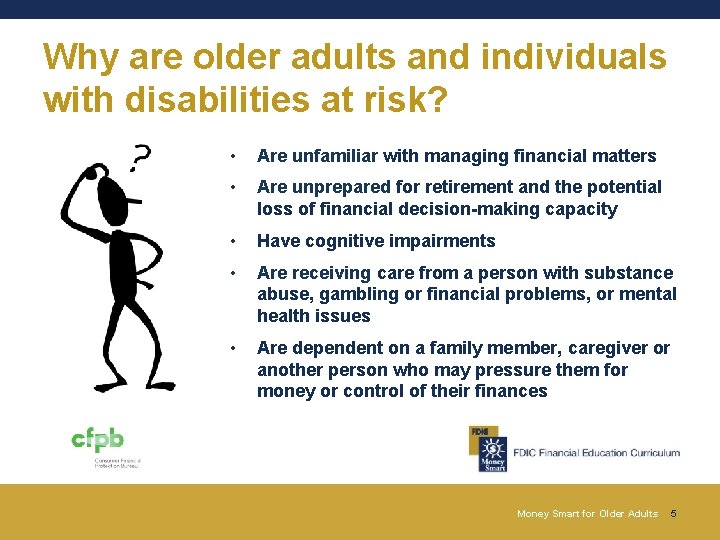
Why are older adults and individuals with disabilities at risk? • Are unfamiliar with managing financial matters • Are unprepared for retirement and the potential loss of financial decision-making capacity • Have cognitive impairments • Are receiving care from a person with substance abuse, gambling or financial problems, or mental health issues • Are dependent on a family member, caregiver or another person who may pressure them for money or control of their finances Money Smart for Older Adults 5
Examples of Financial Exploitation • Financial power of attorney (POA) or fiduciary abuse • Theft of money or property by caregivers and in-home helpers • Investment fraud • Lottery and sweepstakes scams Money Smart for Older Adults 6
Examples of Financial Exploitation (cont. ) • Telephone scams • Computer/Internet scams • Identity theft • Reverse mortgage proceeds fraud • Contractor fraud and home improvement scams Money Smart for Older Adults 7
Who Could Be an Abuser? • • Family members and caregivers Friends, neighbors or acquaintances Telephone and mail scams Financial advisers Internet scams Home repair contractors Medicare scam operators Others Money Smart for Older Adults 8
Why isn’t Exploitation Reported? • Shame and embarrassment • Loyalty to a family member or caregiver • Fear of retaliation or not being believed • Dependence on the abuser • Denial • Self-blame • Lack of awareness Money Smart for Older Adults 9
Who Can Help? Adult Protective Services Find contact information at www. eldercare. gov or call 1 -800 -677 -1116 Federal Trade Commission (FTC) For cases of identity theft, contact the FTC at www. ftc. gov/idtheft or call 1 -877 -IDTHEFT (438 -4338) Money Smart for Older Adults 10
Who Can Help? (cont. ) Federal Deposit Insurance Corporation For concerns about an FDIC-supervised financial institution, complete a customer assistance form at: www 2. fdic. gov/starsmail/index. asp Or call: 1 -877 -ASK-FDIC Police Call 911 if the situation is threatening or the person is in danger. If you believe a crime has been committed, file a police report. Money Smart for Older Adults 11
What is a Power of Attorney? A legal document that allows someone else to handle your finances on your behalf • Appoints a substitute decision-maker if you are unable to act on your own • Avoids the need for a court-appointed guardian • Is relatively inexpensive; using a lawyer is advisable Money Smart for Older Adults 12
Power of Attorney: Risks • Pressure to grant more authority than you wish • Misuse of your funds • Unauthorized actions – gifts, changes to beneficiaries Money Smart for Older Adults 13
Power of Attorney: • Durable – remains effective even if maker becomes physically or mentally incapacitated • Talk to an attorney for help in making a POA that is appropriate for your circumstances Money Smart for Older Adults 14
Power of Attorney: Safeguards • Trust but verify. • Avoid appointing anyone with substance abuse, gambling, or who mismanages money. • Tell others about your POA. • If needed, change, cancel, or revoke the POA. • Avoid appointing hired caregivers/helpers. • Beware of new “best friends” who offer to manage your money. Money Smart for Older Adults 15
Tip: Plan Ahead! A durable power of attorney is a very important tool in planning for financial incapacity due to Alzheimer’s disease, another form of dementia, or other health problems. Money Smart for Older Adults 16
Power of Attorney: If You Are a Victim Report financial exploitation immediately to Adult Protective Services or your local law enforcement agency. Money Smart for Older Adults 17
Abuse by Caregivers and In-Home Helpers Family members and caregivers are common perpetrators of elder financial exploitation. Money Smart for Older Adults 18
Caregiver: Safeguards • Secure your valuables, such as jewelry • Secure private financial documents (checks, financial statements, credit cards, etc. ) • Require receipts for purchases • Monitor bank accounts and telephone bills • Consider setting up: Automatic bill pay systems Transaction alerts Money Smart for Older Adults 19
Caregiver: Safeguards (cont. ) • Do not let hired caregivers/helpers open your mail, pay your bills, manage your finances. • Never promise money or assets after you die in exchange for care now. • Never lend money or personal property. • Don’t put persons other than your spouse/life-partner on the title to your home. Money Smart for Older Adults 20
Investments: Fraud and Abuse • Misleading senior certifications/designations • Ponzi schemes • Promissory notes • Unscrupulous financial advisers • Affinity fraud • Internet fraud – the “Dot-Con” • Inappropriate or fraudulent annuities Money Smart for Older Adults 21
Investments: Safeguards • Check out the financial adviser. • Don’t base your trust on appearances or the sound of a voice. • Take time to understand your choices. • Say “no” to pressure. Money Smart for Older Adults 22
Investments: Safeguards (cont. ) • Be wary of salespeople who prey on fears or promise returns that seem “too good to be true. ” • Ask for a written explanation. • Shop around and get a second opinion. • Say “no” to financial advisers who tell you to leave everything in their care. Money Smart for Older Adults 23
Investment: Safeguards (cont. ) • Stay in charge of your money or enlist a trusted third party. • Make checks payable to a company or financial institution, never an individual. • Retain and maintain account statements and confirmations. • Document all conversations with financial advisers. Money Smart for Older Adults 24
Investments: Pointers • Have at least six-months living expenses readily available before you invest. • Understand your investment. Attend classes, seminars, or check business references in the library. • Be aware that some “free seminars” are marketing techniques. • Understand the risks. • Make sure your financial adviser understands your objectives and risk tolerance. Money Smart for Older Adults 25
Lottery and Sweepstakes Scams “You have won…” • Telephone calls, emails, or letters regarding lotteries, drawings, or sweepstakes • Requests for upfront processing fees or taxes • Authentic looking claims checks • Sweepstakes recovery calls Money Smart for Older Adults 26
Telephone Scams “Hello, Grandpa. I’m in trouble. Please don’t tell Mom. ” Money Smart for Older Adults 27
Tips for Avoiding Telephone Scams • Never “pay to play. ” • You cannot win a contest you didn’t enter. • Be suspicious of pressure to wire funds or send prepaid cards. • Pay attention to warnings from your financial institution. • If the caller claims an emergency, check it out at a number you know to be valid. • Be wary of requests for secrecy. Money Smart for Older Adults 28
Computer/Internet Scams • Phishing Authentic looking emails, text messages, and Web pages to trick unsuspecting users into revealing personal financial information • Spoofing Email address disguised to look like that of someone you know Money Smart for Older Adults 29
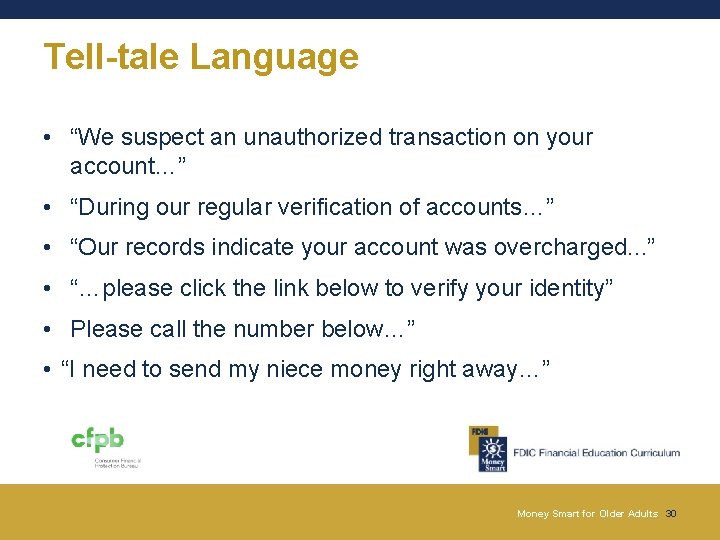
Tell-tale Language • “We suspect an unauthorized transaction on your account…” • “During our regular verification of accounts…” • “Our records indicate your account was overcharged. . . ” • “…please click the link below to verify your identity” • Please call the number below…” • “I need to send my niece money right away…” Money Smart for Older Adults 30
Computer/Internet: Safeguards • Use trusted security software and make sure it is updated frequently. • Do not email financial information or account numbers. • Be cautious about opening attachments and downloading files, regardless of the source. • Use passwords that are hard to guess. • Shut down your PC when not using it. Money Smart for Older Adults 31
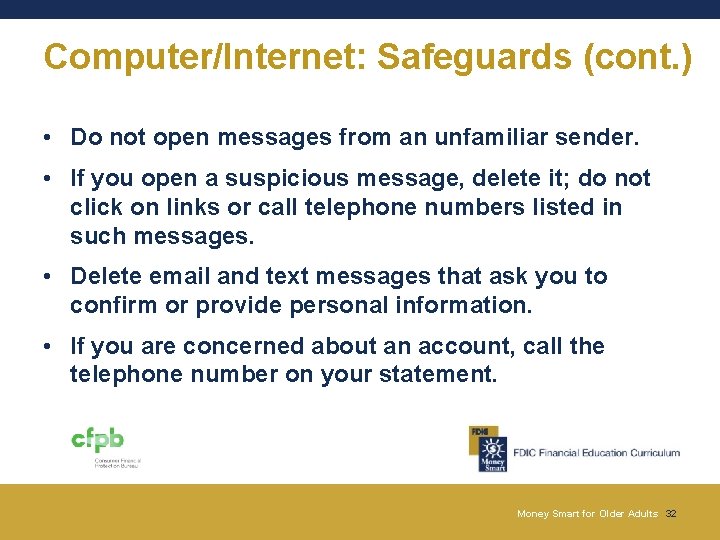
Computer/Internet: Safeguards (cont. ) • Do not open messages from an unfamiliar sender. • If you open a suspicious message, delete it; do not click on links or call telephone numbers listed in such messages. • Delete email and text messages that ask you to confirm or provide personal information. • If you are concerned about an account, call the telephone number on your statement. Money Smart for Older Adults 32
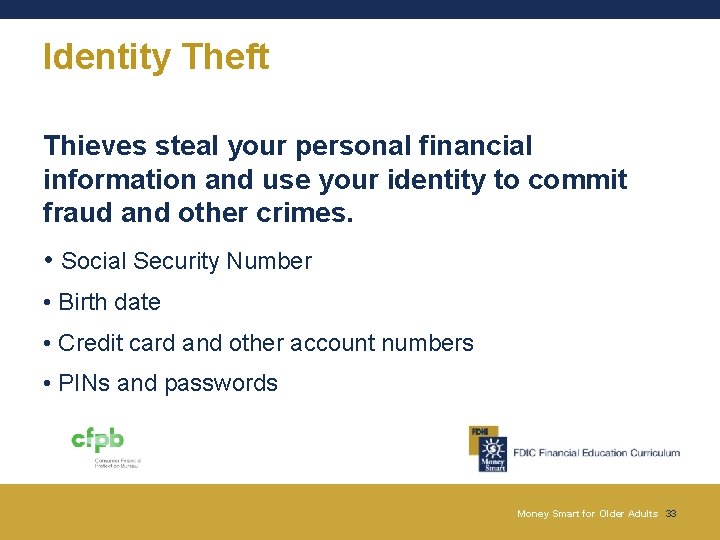
Identity Theft Thieves steal your personal financial information and use your identity to commit fraud and other crimes. • Social Security Number • Birth date • Credit card and other account numbers • PINs and passwords Money Smart for Older Adults 33
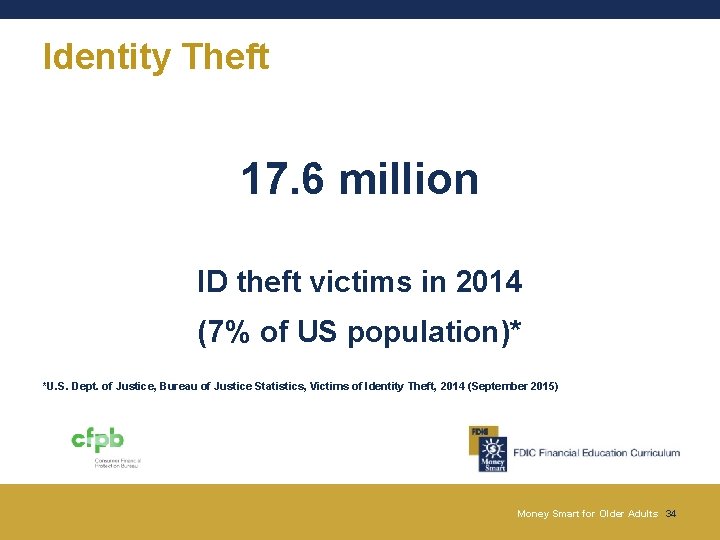
Identity Theft 17. 6 million ID theft victims in 2014 (7% of US population)* *U. S. Dept. of Justice, Bureau of Justice Statistics, Victims of Identity Theft, 2014 (September 2015) Money Smart for Older Adults 34
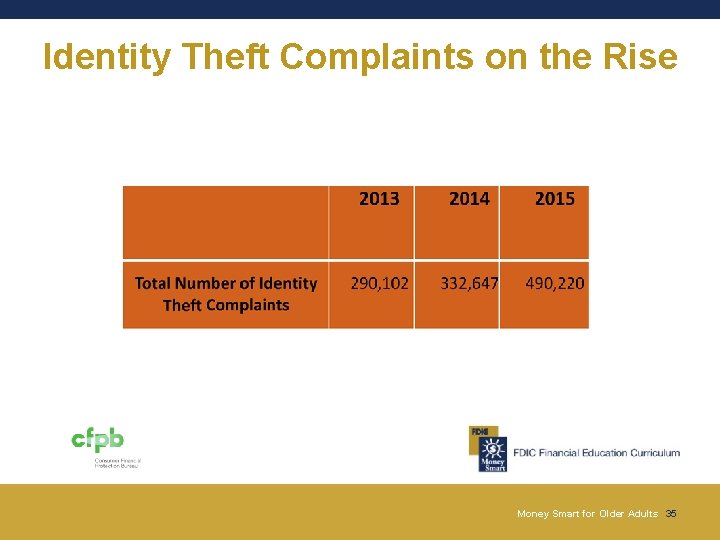
Identity Theft Complaints on the Rise Money Smart for Older Adults 35
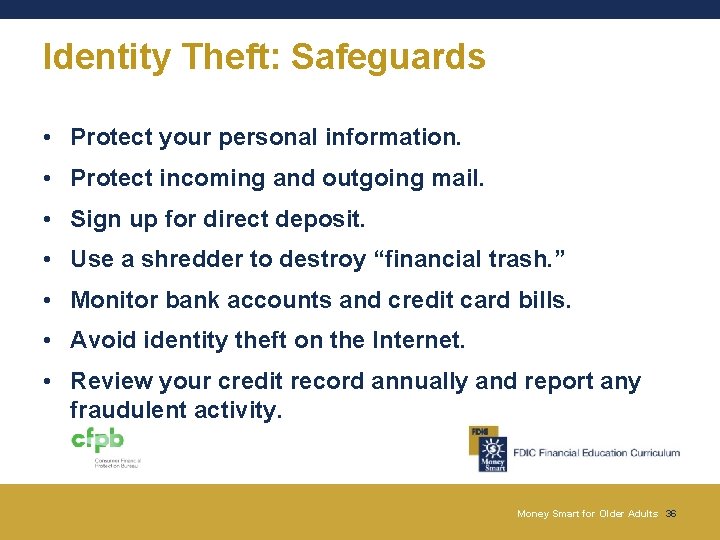
Identity Theft: Safeguards • Protect your personal information. • Protect incoming and outgoing mail. • Sign up for direct deposit. • Use a shredder to destroy “financial trash. ” • Monitor bank accounts and credit card bills. • Avoid identity theft on the Internet. • Review your credit record annually and report any fraudulent activity. Money Smart for Older Adults 36
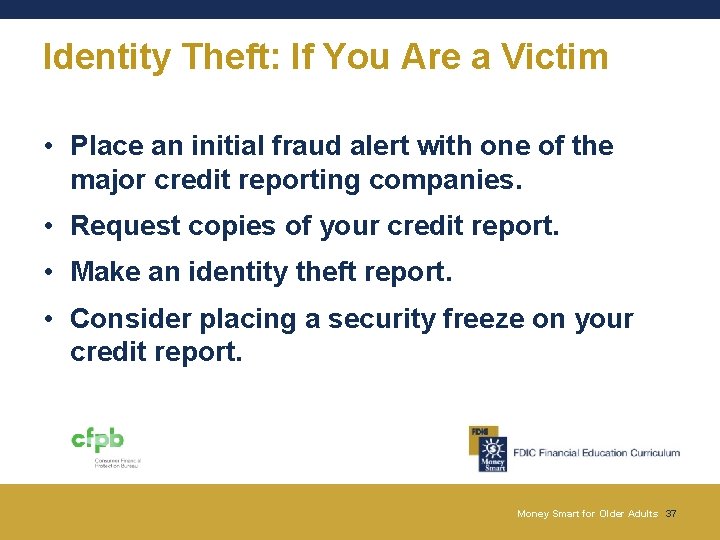
Identity Theft: If You Are a Victim • Place an initial fraud alert with one of the major credit reporting companies. • Request copies of your credit report. • Make an identity theft report. • Consider placing a security freeze on your credit report. Money Smart for Older Adults 37
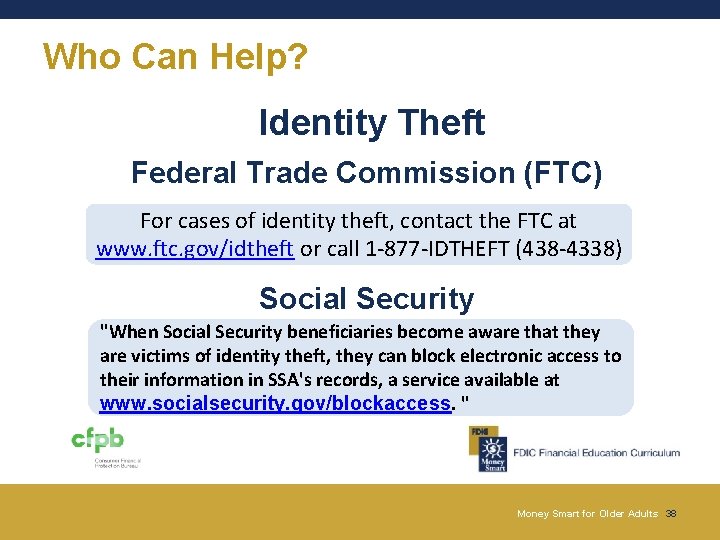
Who Can Help? Identity Theft Federal Trade Commission (FTC) For cases of identity theft, contact the FTC at www. ftc. gov/idtheft or call 1 -877 -IDTHEFT (438 -4338) Social Security "When Social Security beneficiaries become aware that they are victims of identity theft, they can block electronic access to their information in SSA's records, a service available at www. socialsecurity. gov/blockaccess. " Money Smart for Older Adults 38
Medical Identity Theft: What It Is Someone steals your personal information — such as your name and Medicare number — and uses it to get medical treatment, prescription drugs, surgery or other services and then bills Medicare for it. Money Smart for Older Adults 39
Medical Identity Theft: Risks • It is costly to correct. • You could be denied a service or equipment. • It can affect your medical and insurance records – change your blood type or record a diagnosis for a disease you don’t have. • You could receive wrong, perhaps harmful, treatment. Money Smart for Older Adults 40
Medical Identity Theft: Warning Signs • A bill for services you did not receive. • Contact from a collection agency for money you do not owe. • Notification from insurance company that you have reached your limit for medical benefits. • Denial of insurance for a medical condition you don’t have. Money Smart for Older Adults 41
Medical Identity Theft: Safeguards • Protect your Medicare and insurance cards. • Review Medicare Summary Notices (MSN), insurance Explanation of Benefits (EOB) statements, and medical bills. • Be careful about sharing personal information. • Beware of offers for free equipment, services or goods in exchange for your Medicare number. • Shred papers with your medical identity and destroy prescription labels before throwing in the trash. Money Smart for Older Adults 42
Medical Identity Theft: How to Respond • Obtain your medical file. • Write to your health plan or provider for correction. • Report your concerns to your Senior Medicare Patrol. To find your state SMP contact, visit www. smpresource. org Money Smart for Older Adults 43
Planning for the Unexpected Preparing for future health problems or disasters • Gives you control. • Relieves stress of decision-making for you and family members or caretakers. • Saves money and helps avoid financial setbacks. • Allows time to gather information and compare options. Money Smart for Older Adults 44
Preparing for Future Health Problems • Prepare a Plan: review income and expenses. • Make sure trusted family members know where to find necessary documents. • Set up direct deposit for income and benefit checks. • Consider automatic payment of important recurring bills. Money Smart for Older Adults 45
Preparing for Future Health Problems (cont. ) • Consider a Durable Power of Attorney. • Make sure you are properly insured. • Maintain a healthy lifestyle. Money Smart for Older Adults 46
Receiving Social Security Benefits Social Security and Supplemental Security Income (SSI) • Direct Deposit • Direct Express® Debit Card Money Smart for Older Adults 47
Preparing Financially for a Disaster What you may need: • Forms of identification Driver’s license or government-issued ID Insurance cards Social Security card Passport Birth certificate Money Smart for Older Adults 48
Other Items You May Need • Checkbook (blank checks and deposit slips to last at least a month) • ATM cards, debit cards, credit cards • Cash • Phone numbers for financial services providers • Important account numbers • Key to safety deposit box Money Smart for Older Adults 49
Protecting Your Documents • Make backup copies of important documents. • Make an electronic image for easy storage. • Give a copy to loved ones or tell them where to find documents in an emergency. • Store backups at a distance from home in case disaster affects entire community. • Make a record of all credit/debit cards with the account and contact numbers to report lost/stolen cards. Money Smart for Older Adults 50
What to Keep; Where to Keep It • Safety deposit box Birth certificate and originals of important contracts • Home, preferably in fireproof safe Passport, medical care directives, will • Seal important documents in airtight, waterproof bags or containers • Prepare emergency evacuation bag(s) Money Smart for Older Adults 51
What Else to Consider • Arrange for automatic bill payment from your bank account. • Sign up for Internet banking services. • Review your insurance coverage. Money Smart for Older Adults 52
Additional resources Answers for many questions can be found at: ASK CFPB www. consumerfinance. gov/askcfpb/ You can also contact the FDIC at: communityaffairs@fdic. gov Money Smart for Older Adults 53
Reverse Mortgages Allow homeowners 62 and older to borrow against equity in their homes • Monthly interest charges are added to loan amount. • Available as a line of credit, in regular monthly installments, or as a lump sum. • Repayable when you no longer live in the home. • Must maintain the home and pay property taxes and insurance. Money Smart for Older Adults 54
Reverse Mortgage: Scams • Family members pressure a homeowner to get a reverse mortgage so they can “borrow” the money. • Scammer requires borrower to sign a Power of Attorney or otherwise sign over proceeds. • Brokers pressure borrowers to purchase other financial products. Money Smart for Older Adults 55
Mortgage Assistance Relief Scam • Beware of anyone who promises you can stay in your home or who asks for a lot of money to help you. • Scammers might promise guaranteed or immediate relief from foreclosure, and might charge you very high fees for few or no services. Money Smart for Older Adults 56
Contractor/Home Improvement Fraud Many homeowners are targeted by scam artists who use high pressure tactics to sell unneeded and overpriced contracts for "home improvements" Money Smart for Older Adults 57
Contractor/Home Improvement Fraud • Small firm or individual, often going door-to-door • Promises for quick work at below market prices • Substandard, unnecessary, or damaging work • Pressures to pay through threats or intimidation • Possibly impersonation of government officials Money Smart for Older Adults 58
Avoiding Contractor Fraud: Tips • Verify the identity of anyone claiming to be a government employee. • Obtain written bids from local contractors. • Avoid contractors who approach you. • Check for licenses and complaints. • Check references. • Require a clearly written contract. • Don’t pay in advance; never pay cash. Money Smart for Older Adults 59
Avoiding Contractor Fraud: Tips (cont. ) • Don’t provide personal financial information. • If you need a loan, don’t let the contractor steer you to a lender. • Withhold final payment until you are satisfied and all required inspections are completed. Read Home Sweet Home Improvement available at the FTC website, www. ftc. gov. or by phoning 1‑ 877‑FTC‑HELP (382 -4357). Money Smart for Older Adults 60
Scams that Target Veterans Benefits • Pension Benefit Filing Scam Marketing of financial and estate planning services to help veterans qualify Charging substantial fees to help veterans file • Lump-sum Payment for Future Benefits For information on VA benefits, visit www. va. gov or call 1 -800 -827 -1000. Money Smart for Older Adults 61
Avoiding VA Pension Filing Scams • Know that VA must accredit individuals who help you prepare and file a claim. • Check accreditation at www. va. gov/ogc/apps/accreditation/index. asp. • Never pay a fee for help in filing your initial claim. • Avoid attorneys or claims agents who try to market investments in connection with your claim. • Be aware that shifting assets into certain types of investments may affect your Medicaid/Medicare benefits. Money Smart for Older Adults 62
Avoiding Lump-Sum Payment Scams • Be aware that these arrangements are very costly. • Say no to arrangements that allow the lump-sum payment provider access to your account. • Remember that VA benefits cannot be garnished by a creditor. • Seek advice of a trusted financial expert. Money Smart for Older Adults 63
Conclusion You learned about: • Types of financial exploitation • Tips for recognizing scams • Strategies for avoiding identity theft, including medical identity theft • How to prepare financially for future health problems and disasters Money Smart for Older Adults 64