MAWG Operations Seminar CAP Form 5 and 91












- Slides: 50
MAWG Operations Seminar CAP Form 5 and 91 Evaluations: Tips for Safe, Successful Flying Major Alan R. Bugos, CFII MAWG DOV MAWG Standardization and Evaluation
Presentation Agenda • • • MAWG Standardization & Evaluation Staff MAWG Instructor & Check Pilots… who’s who? Where to get information NHQ Stan/Eval website Form 5 Preparation The Check Ride - Form 5, Form 91, Instrument and Cadet Orientation Tips for Check Ride Success MAWG Read. File Information MAWG Stats - Mentoring program Questions and Answers CAPR 60 -1 Updates (Appendix)
MAWG Standardization & Evaluation Staff Maj Alan Bugos MAWG DOV Maj Mark Jacobs MAWG DOVA Lt. Col Don Desfosse MAWG DOVA Our Goal: To provide safe, effective, and efficient, standardized guidance to those who fly in the Civil Air Patrol
MAWG IP, CP, and MCP Staff Nelson, Tim (413) 537 -1173 walter. nelson@the-spa. com (781) 910 -8145 abugos@gmail. com (617) 571 -0222 suro. ghatak@gmail. com (978) 244 -0661 ddesfosse@juno. com (781) 771 -0835 mj. cfi@verizon. net (508) 740 -0250 tfinbar@comcast. net Shafner, Richard (Dick) Instructor Pilot, Check Pilot, Mission Check Pilot, Check Pilot Evaluator, G 1000 Check Pilot (508) 527 -4338 rshafner@gmail. com Herren, Loren Instructor Pilot, Check Pilot 508 -326 -8656 loren. herren@bridgew. edu Holler, Jim Instructor Pilot, Check Pilot, G 1000 Check Pilot, Mission Check Pilot 508 -737 -6319 jimholler@comcast. net Bugos, Alan Ghatak, Suro Desfosse, Donald J Jacobs, Mark Sullivan, Timothy Mission Check Pilot Instructor Pilot, Check Pilot, Mission Check Pilot, Check Pilot Evaluator, G 1000 Check Pilot Instructor Pilot, Check Pilot, Mission Check Pilot, Check Pilot Evaluator, G 1000 Check Pilot Instructor Pilot, G 1000 Instructor Pilot
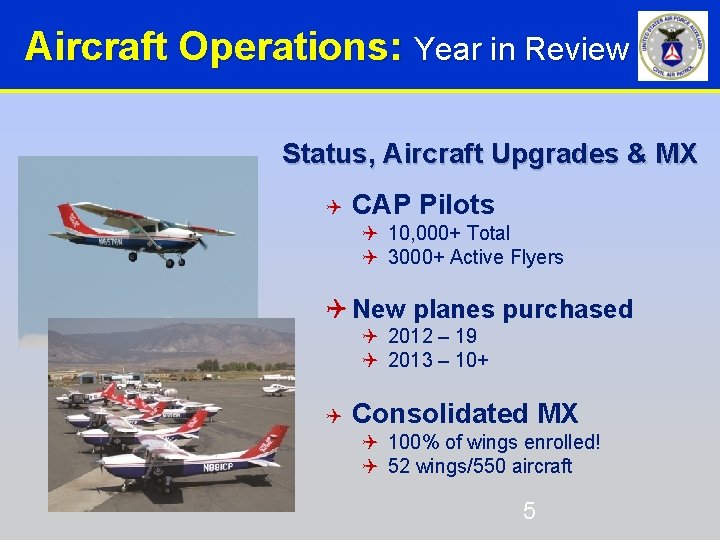
Aircraft Operations: Year in Review Status, Aircraft Upgrades & MX CAP Pilots 10, 000+ Total 3000+ Active Flyers New planes purchased 2012 – 19 2013 – 10+ Consolidated MX 100% of wings enrolled! 52 wings/550 aircraft 5
CAPF 5 Pilot Flight Evaluations • CAPF 5 Pilot Flight Evaluations: - Measured using FAA & CAP standards Provide Trend Data Enhance Safety through Compliance • Purpose of Ground Eval Portion - Test s pilot’s knowledge of rules, documentation, local ops and emergency procedures. • Purpose of Flight Eval Portion - Tests pilot’s ability to perform specific flight maneuvers and fly the aircraft safely.
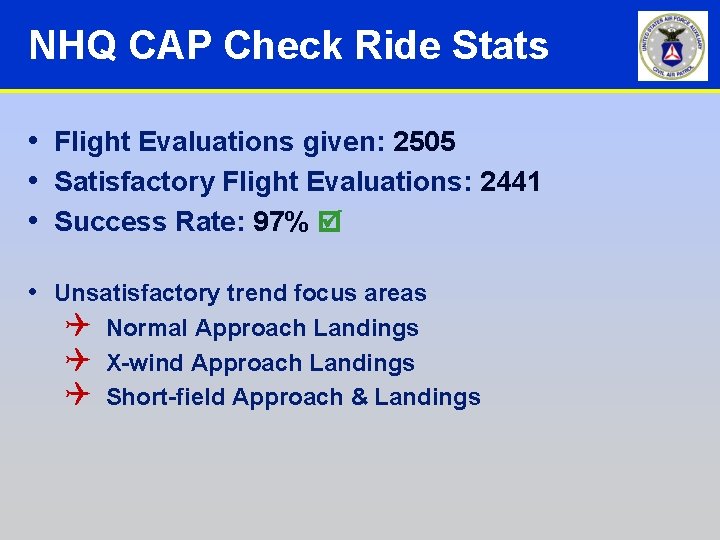
NHQ CAP Check Ride Stats • Flight Evaluations given: 2505 • Satisfactory Flight Evaluations: 2441 • Success Rate: 97% • Unsatisfactory trend focus areas Normal Approach Landings X-wind Approach Landings Short-field Approach & Landings
Check Ride Failure Trends Normal Approaches and Landings X-wind Approaches and Landings Short-field Approach & Landing Vigilance, Risk Management & Judgement Steep Turns Maneuvering During Slow Flight Use of Checklist Non-Precision Approach Intercept & Tracking of Courses Short-field Takeoff & Climb Precision Approach Power-On Stalls Pilotage & Dead Reckoning Aircraft Systems Certificates & Documents Power-Off Stalls Normal Takeoff & Climb Cross-country Flight Planning Local Procedures Annual Online Written Exam 0 2 4 6 8 10 12
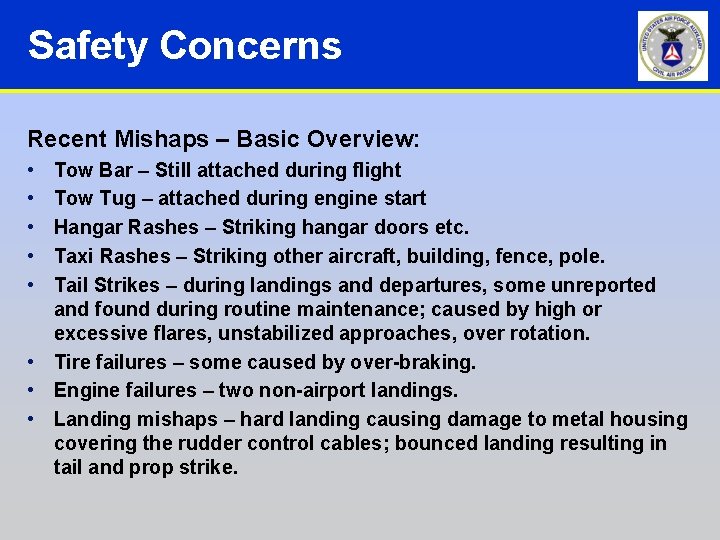
Safety Concerns Recent Mishaps – Basic Overview: • • • Tow Bar – Still attached during flight Tow Tug – attached during engine start Hangar Rashes – Striking hangar doors etc. Taxi Rashes – Striking other aircraft, building, fence, pole. Tail Strikes – during landings and departures, some unreported and found during routine maintenance; caused by high or excessive flares, unstabilized approaches, over rotation. • Tire failures – some caused by over-braking. • Engine failures – two non-airport landings. • Landing mishaps – hard landing causing damage to metal housing covering the rudder control cables; bounced landing resulting in tail and prop strike.
Stan/Eval Information Hot News Tip of the Month Aircraft Ops CAPR 60 -1 Info Stan/Eval Familiarization Training Glider Info Special Ops FAA Info Weather Safety http: //www. capmembers. com/emergency_services/aircraft_ops__staneval/
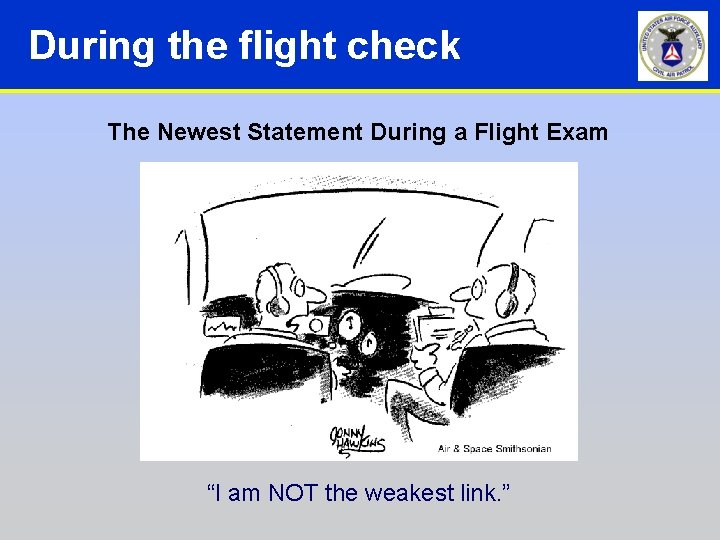
During the flight check The Newest Statement During a Flight Exam “I am NOT the weakest link. ”
Checkride Emphasis • • • Pilot Safety, Responsibility, and Judgment Attitude toward the Checkride Overall preparation, especially paperwork! Overall proficiency for required tasks Emergency Procedures Crew/Cockpit Resource Management Takeoffs and Landings Ground Operations: Taxiing, etc. You are flying to the FAA PTS for your ratings exercised…
Check Ride Tips and Hints • Safety First! • Other FAA rules/restrictions may be in effect (TFR) • Review expectations and review the check ride plan of • • • action before taking to the sky You are flying to the PTS (standards) of your certificates Use the checklist – for all phases of flight We are here to help you learn and improve WINGS, BFR, IPC, and other proficiency (let us know) If you are rusty with specific flight tasks, please get proficiency prior to the check ride; it is not meant to be instructional
Other Tips and Hints • New and Existing CAP Pilots: Get some time in the airplane for attempting a new Form 5! - Even though it’s just a Cessna 172, most CAP aircraft are equipped well beyond a standard C-172 “I’m a multi-engine ATP with 10, 000 hours and I should be able to pass the checkride. ” • Make sure you review local procedures - MAWG READ File
Be Prepared for Emergencies!
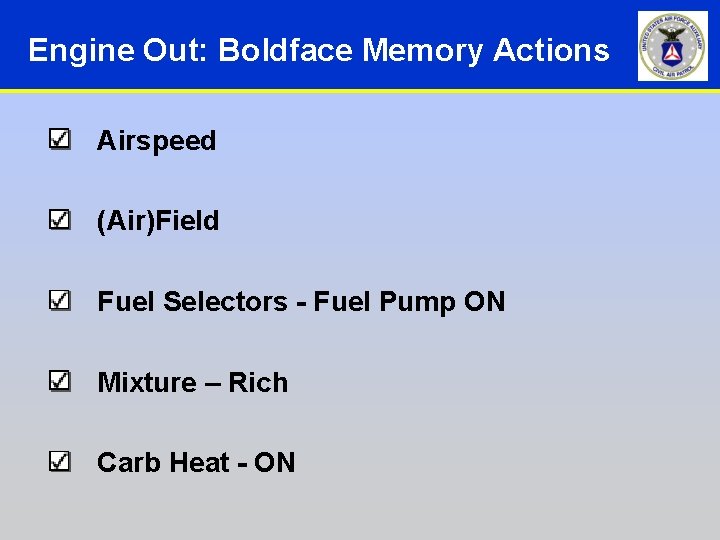
Engine Out: Boldface Memory Actions Airspeed (Air)Field Fuel Selectors - Fuel Pump ON Mixture – Rich Carb Heat - ON
Did you check the weather? DUAT, Flight Service, FAA Approved Weather source?
Checkride Preparation • • • Review MAWG Read. File Review CAPR 60 -1, etc. Check Weather, Call FRO Review and Complete Operations Risk Matrix Complete Weight and Balance Wear proper CAP uniforms Bring current charts or EFB Bring a hood for Instrument work Bring flashlights and other necessary items appropriate for the flight • Bring your best flying game, show us how you shine!
Know your aircraft! • Take the time to review aircraft specific data • • • prior to every flight Remember many CAP aircraft have STCs Calculate performance data for each and every flight Review critical airspeed for the aircraft Review emergency procedures Read and Study the POH once a year Don’t copy your Aircraft Questionnaires year after year
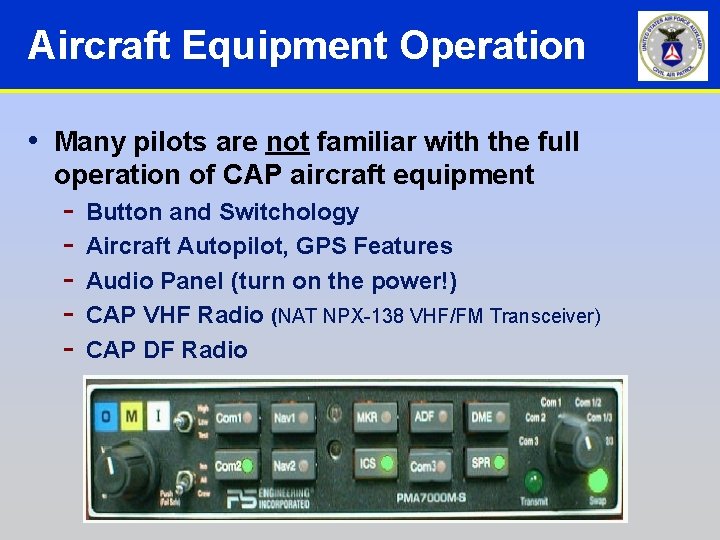
Aircraft Equipment Operation • Many pilots are not familiar with the full operation of CAP aircraft equipment - Button and Switchology Aircraft Autopilot, GPS Features Audio Panel (turn on the power!) CAP VHF Radio (NAT NPX-138 VHF/FM Transceiver) CAP DF Radio
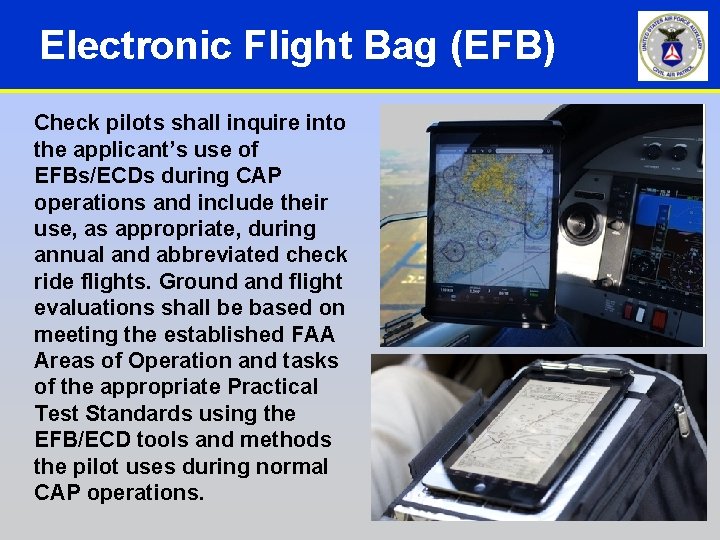
Electronic Flight Bag (EFB) Check pilots shall inquire into the applicant’s use of EFBs/ECDs during CAP operations and include their use, as appropriate, during annual and abbreviated check ride flights. Ground and flight evaluations shall be based on meeting the established FAA Areas of Operation and tasks of the appropriate Practical Test Standards using the EFB/ECD tools and methods the pilot uses during normal CAP operations.
6 Minutes, 38 Seconds!!
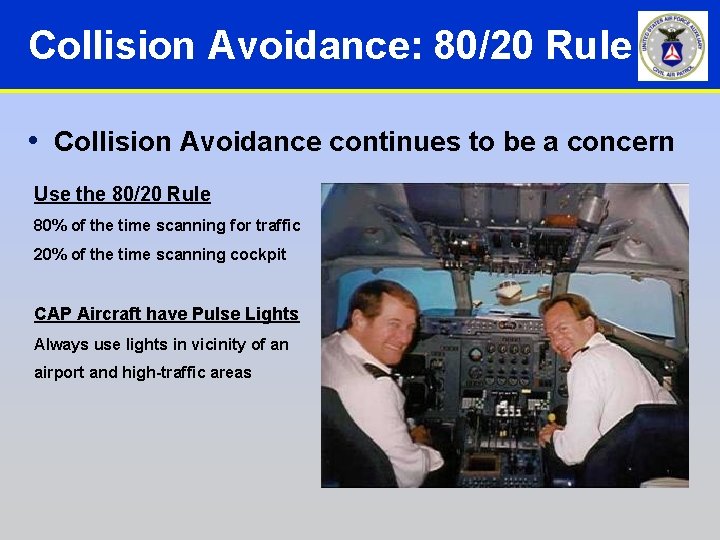
Collision Avoidance: 80/20 Rule • Collision Avoidance continues to be a concern Use the 80/20 Rule 80% of the time scanning for traffic 20% of the time scanning cockpit CAP Aircraft have Pulse Lights Always use lights in vicinity of an airport and high-traffic areas
Landing Proficiency • Several CAP check ride failures a year due to • • landing errors Crosswind landing proficiency generally a problem Strive for stabilized approaches Hard landings, airspeed control, locked brakes Issues with night landings, short and soft field landings
Ground Operations • Within CAP and Civil Aviation: - • • Significant number of runway incursions, prop strikes, ground incidents Pre-flight Inspection Communication with Ground Control Taxi diagrams and procedures Issues: complacency, lack of attention to taxi process
Other Checkrides • Form 91 Checkrides - Looking for CRM and Mission Pilot Proficiencies GPS work and radio coordination Safety working with a crew on-board • CO Checkrides - Looking to verify a pilot can do simple demonstration with cadets and follow CO Syllabus Making sure cadets are safe and having fun • IFR Checkrides - Plan for extra time in the air Review of basic instrument procedures, approaches and handling emergencies
New Aircraft Flight Time Log
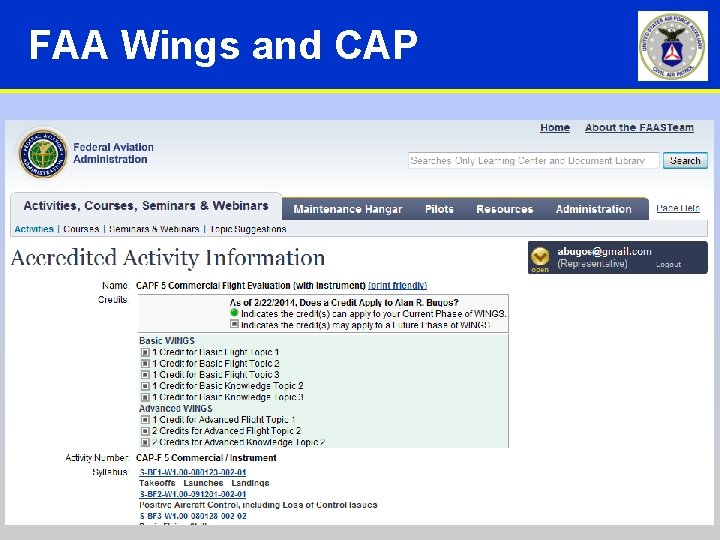
FAA Wings and CAP
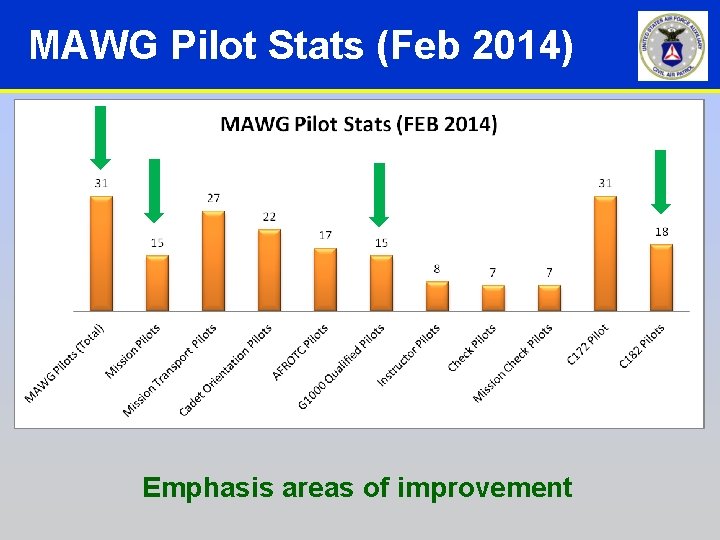
MAWG Pilot Stats (Feb 2014) Emphasis areas of improvement
MAWG Pilot Mentoring • Proven Fact: What has worked best in the past is for senior MAWG pilots to encourage and “actively” mentor existing or new incoming pilots to progress along the way to additional mission abilities and proficiencies… • Open Discussion – How can MAWG increase it pilot population with qualified mission capabilities and retain pilots overall? Thoughts and comments?
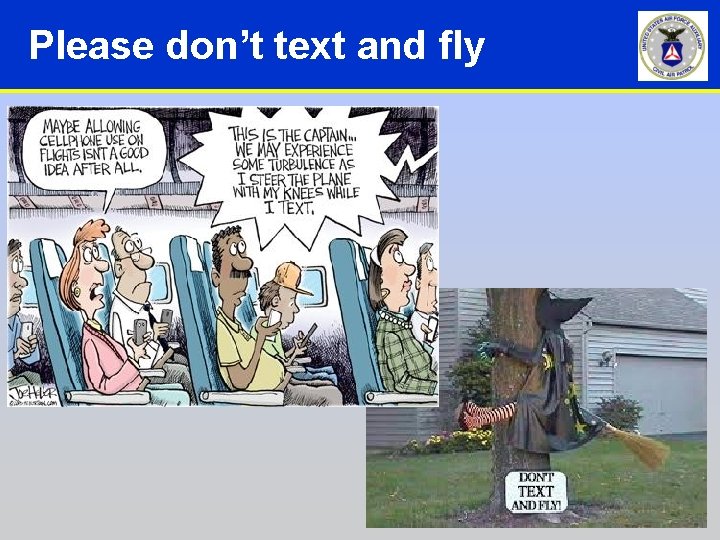
Please don’t text and fly
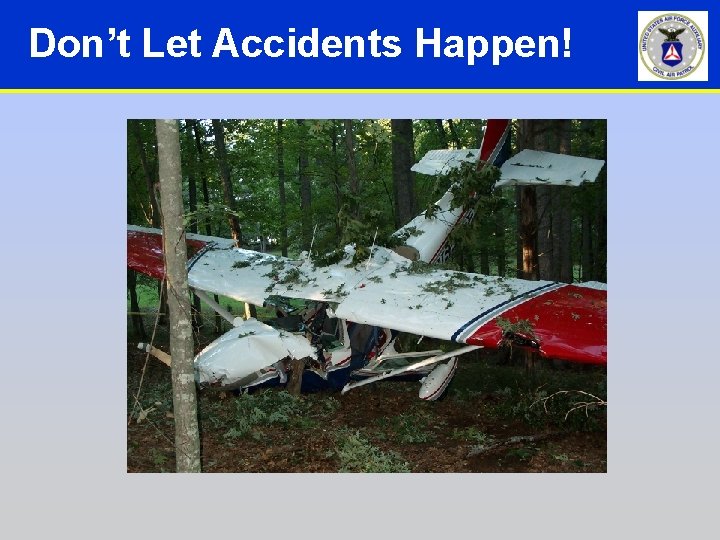
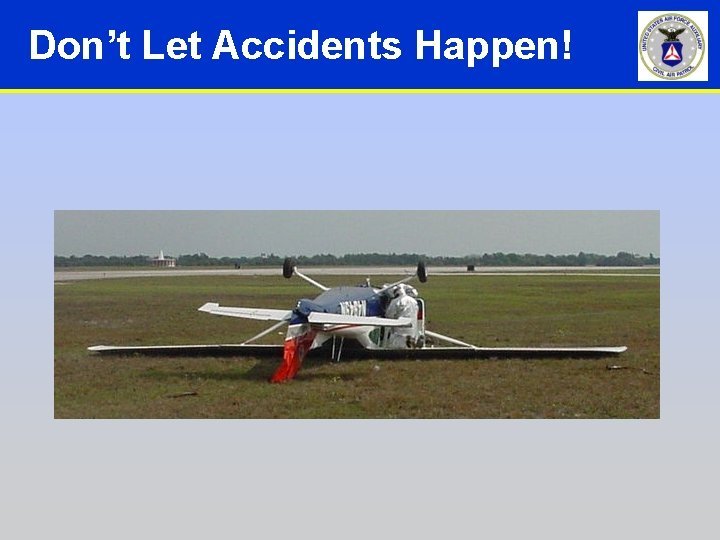
Don’t Let Accidents Happen!
Don’t Let Accidents Happen!
Fly Safe!! Thank you for listening! Questions and Answers
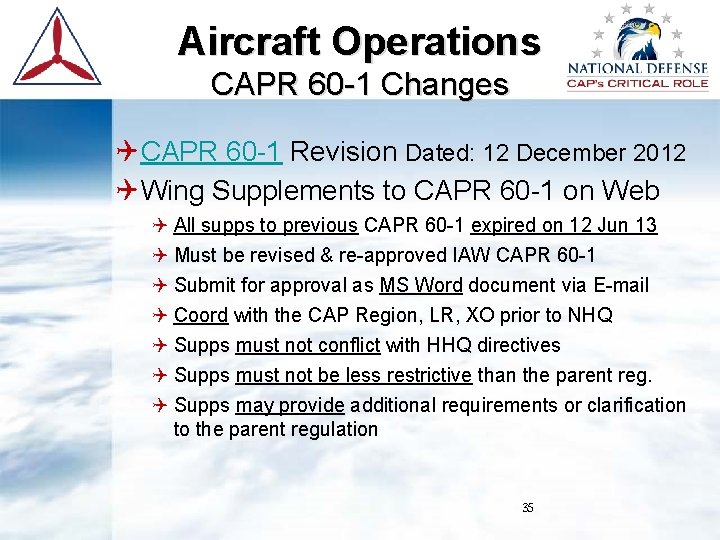
Aircraft Operations CAPR 60 -1 Changes CAPR 60 -1 Revision Dated: 12 December 2012 Wing Supplements to CAPR 60 -1 on Web All supps to previous CAPR 60 -1 expired on 12 Jun 13 Must be revised & re-approved IAW CAPR 60 -1 Submit for approval as MS Word document via E-mail Coord with the CAP Region, LR, XO prior to NHQ Supps must not conflict with HHQ directives Supps must not be less restrictive than the parent reg. Supps may provide additional requirements or clarification to the parent regulation 35
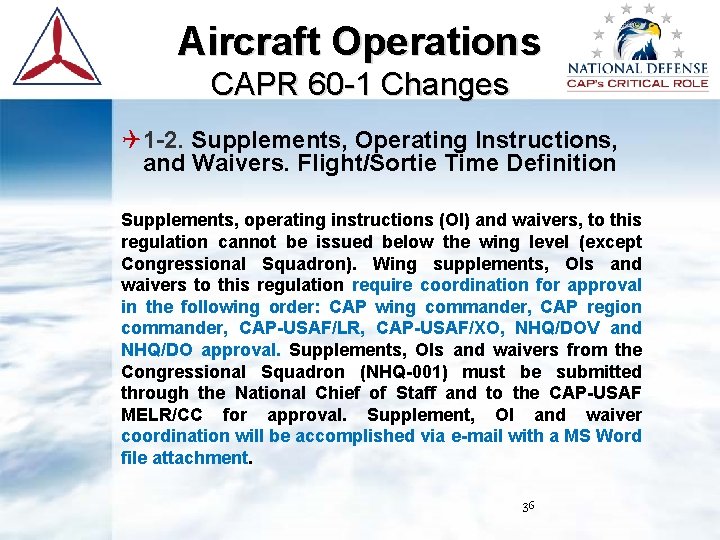
Aircraft Operations CAPR 60 -1 Changes 1 -2. Supplements, Operating Instructions, and Waivers. Flight/Sortie Time Definition Supplements, operating instructions (OI) and waivers, to this regulation cannot be issued below the wing level (except Congressional Squadron). Wing supplements, OIs and waivers to this regulation require coordination for approval in the following order: CAP wing commander, CAP region commander, CAP-USAF/LR, CAP-USAF/XO, NHQ/DOV and NHQ/DO approval. Supplements, OIs and waivers from the Congressional Squadron (NHQ-001) must be submitted through the National Chief of Staff and to the CAP-USAF MELR/CC for approval. Supplement, OI and waiver coordination will be accomplished via e-mail with a MS Word file attachment. 36
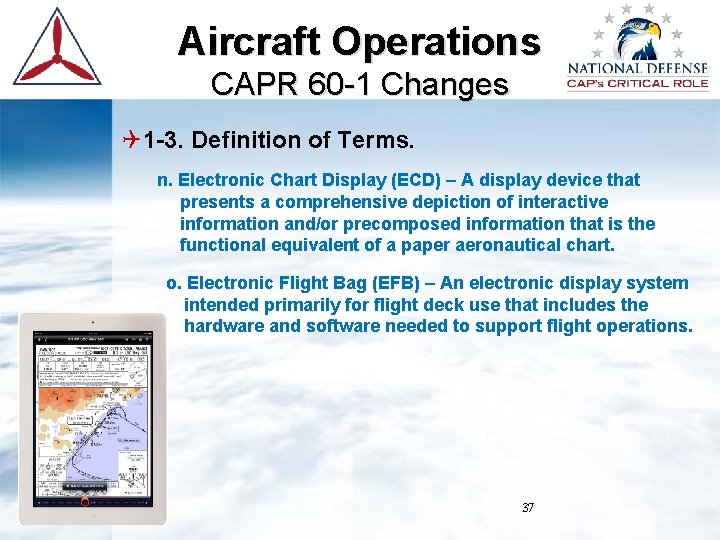
Aircraft Operations CAPR 60 -1 Changes 1 -3. Definition of Terms. n. Electronic Chart Display (ECD) – A display device that presents a comprehensive depiction of interactive information and/or precomposed information that is the functional equivalent of a paper aeronautical chart. o. Electronic Flight Bag (EFB) – An electronic display system intended primarily for flight deck use that includes the hardware and software needed to support flight operations. 37
Aircraft Operations CAPR 60 -1 Changes 1 -3. Definition of Terms. q. Flight / Sortie - A flight/sortie begins when the aircraft begins to move forward on takeoff. It ends after airborne flight when the aircraft returns to the surface and any of the following conditions occur: (1) The engine is stopped, or any engine on a multiengine aircraft, [except as required on CAPF 5 evaluations]. (2) A change is made in the crew which enplanes or deplanes a crewmember. A single flight may include multiple take-offs and landings. (3) The last landing on a cadet's first solo flight. (4) The glider comes to rest after landing. 38
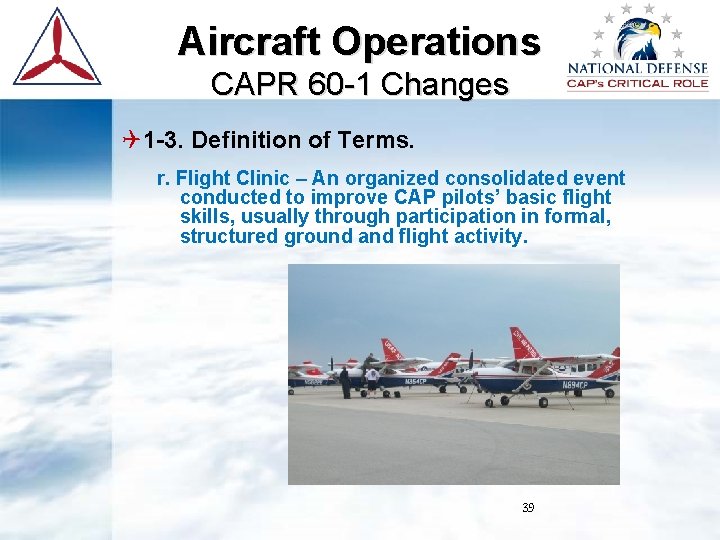
Aircraft Operations CAPR 60 -1 Changes 1 -3. Definition of Terms. r. Flight Clinic – An organized consolidated event conducted to improve CAP pilots’ basic flight skills, usually through participation in formal, structured ground and flight activity. 39
Aircraft Operations CAPR 60 -1 Changes Checklists (2 -1, n) n. Use of manufacturer's checklist or NHQ CAP approved checklist(s) is mandatory in all CAP aircraft. All new checklists and checklist modifications require coordination for NHQ CAP approval in the following order: The respective CAP wing maintenance officer, CAP wing commander, CAP-USAF/LR, CAP-USAF/XO, NHQ/DOV and NHQ/DO approval. Coordination will be accomplished via e-mail with a MS Word file attachment. The pilot in command has the final responsibility… Note: NHQ approved checklists are located online at: http: //capmembers. com 40
Aircraft Operations CAPR 60 -1 Changes 2 -1. Basic Rules. h. All occupants shall wear seat belts and shoulder harnesses (if available) during takeoff and landing. All occupants shall wear safety restraints during all other phases of flight unless such wear interferes with crew member duties. The pilot operating the aircraft will wear lap belts and shoulder harness at all times. 41
Aircraft Operations CAPR 60 -1 Changes 2 -2. Operation Limits. a. A FAA flight plan must be filed and activated for every flight of a CAP aircraft beyond 50 nautical miles distance from point of origin. Those flights that are part of a supervised mission may be exempted from this requirement by the mission incident commander (IC) contingent upon alternate flight following procedures (see paragraph 2 -5 e). (1) Flight Plans. Use three-letter, three-/fourdigit call sign “CAP ####” in the Aircraft Identification block in FAA flight plans in lieu of the aircraft registration “N” number. Include the aircraft tail number in the Remarks section of the flight plan. 42
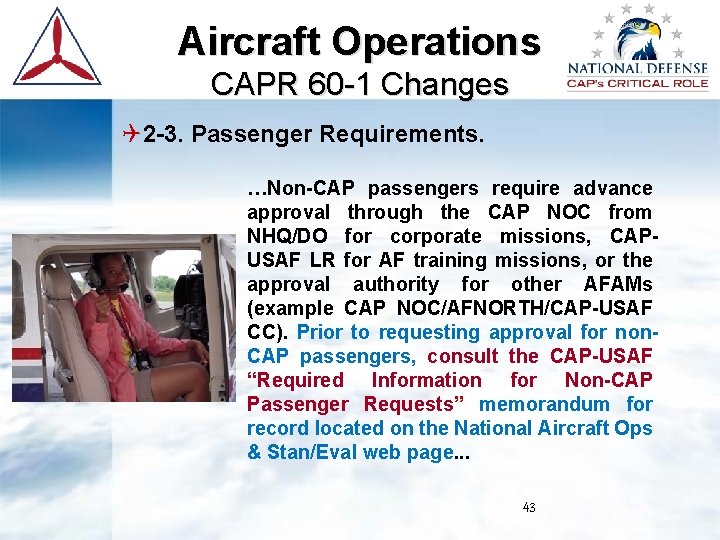
Aircraft Operations CAPR 60 -1 Changes 2 -3. Passenger Requirements. …Non-CAP passengers require advance approval through the CAP NOC from NHQ/DO for corporate missions, CAPUSAF LR for AF training missions, or the approval authority for other AFAMs (example CAP NOC/AFNORTH/CAP-USAF CC). Prior to requesting approval for non. CAP passengers, consult the CAP-USAF “Required Information for Non-CAP Passenger Requests” memorandum for record located on the National Aircraft Ops & Stan/Eval web page. . . 43
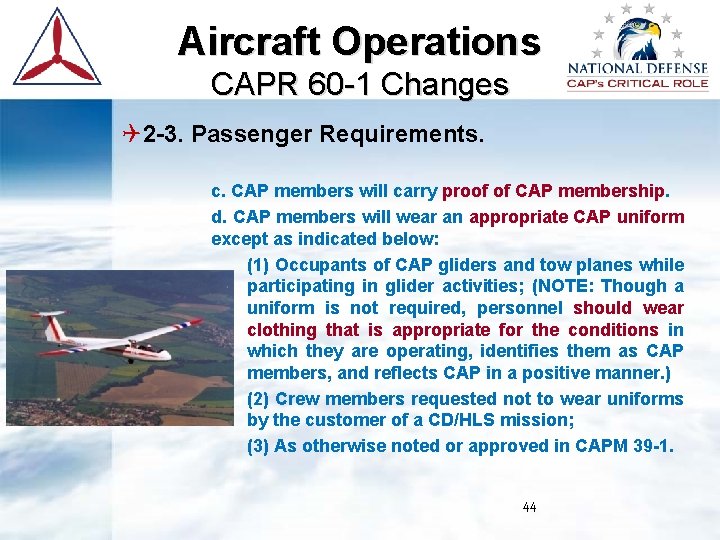
Aircraft Operations CAPR 60 -1 Changes 2 -3. Passenger Requirements. c. CAP members will carry proof of CAP membership. d. CAP members will wear an appropriate CAP uniform except as indicated below: (1) Occupants of CAP gliders and tow planes while participating in glider activities; (NOTE: Though a uniform is not required, personnel should wear clothing that is appropriate for the conditions in which they are operating, identifies them as CAP members, and reflects CAP in a positive manner. ) (2) Crew members requested not to wear uniforms by the customer of a CD/HLS mission; (3) As otherwise noted or approved in CAPM 39 -1. 44
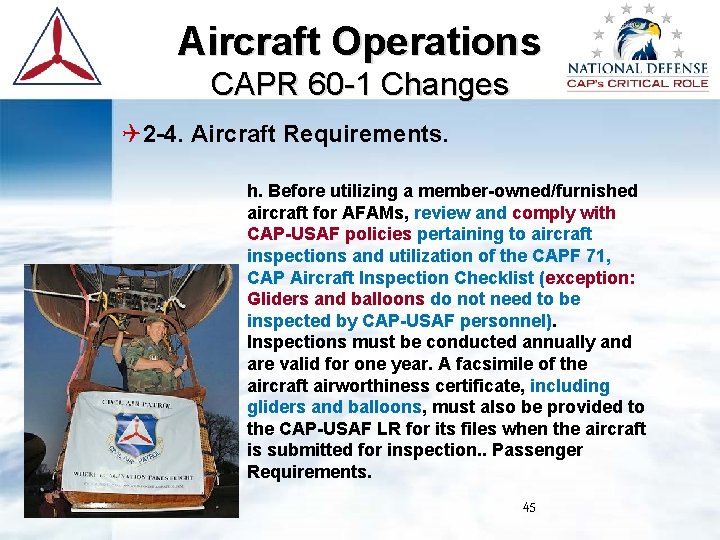
Aircraft Operations CAPR 60 -1 Changes 2 -4. Aircraft Requirements. h. Before utilizing a member-owned/furnished aircraft for AFAMs, review and comply with CAP-USAF policies pertaining to aircraft inspections and utilization of the CAPF 71, CAP Aircraft Inspection Checklist (exception: Gliders and balloons do not need to be inspected by CAP-USAF personnel). Inspections must be conducted annually and are valid for one year. A facsimile of the aircraft airworthiness certificate, including gliders and balloons, must also be provided to the CAP-USAF LR for its files when the aircraft is submitted for inspection. . Passenger Requirements. 45
Aircraft Operations CAPR 60 -1 Changes 2 -5. Flight Release. f. Flight activities involving multiple orientation flights at the same location, and on the same day, may be released on CAPF 99 without passenger, flight time and estimated landing time information, in lieu of prior e. Flight release, provided each participating aircraft and PIC combination is identified in advance and that someone on the ground at the activity site tracks aircraft occupants and flight times for reporting back to the FRO for later entry as e. Flight releases. 46
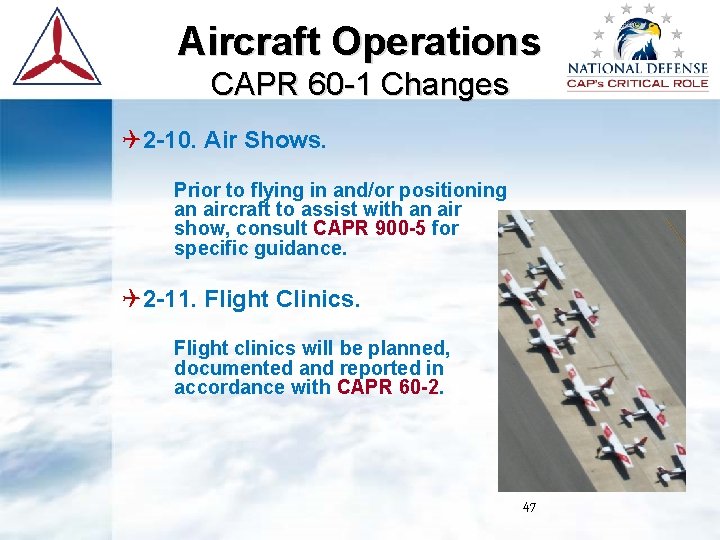
Aircraft Operations CAPR 60 -1 Changes 2 -10. Air Shows. Prior to flying in and/or positioning an aircraft to assist with an air show, consult CAPR 900 -5 for specific guidance. 2 -11. Flight Clinics. Flight clinics will be planned, documented and reported in accordance with CAPR 60 -2. 47
Aircraft Operations CAPR 60 -1 Changes 3 -2. CAPF 5 Administration. c. Check pilots should inquire into the applicant’s use of EFBs/ECDs and include their use during all annual and abbreviated flight evaluations, as appropriate. Additional guidance for crewmembers is available on: http: //www. capmembers. com/emergency_services/ai rcraft_ops__staneval/ d. Complete all CAPF 5 check rides with a check pilot different from the CAP instructor recommending the check ride. 48
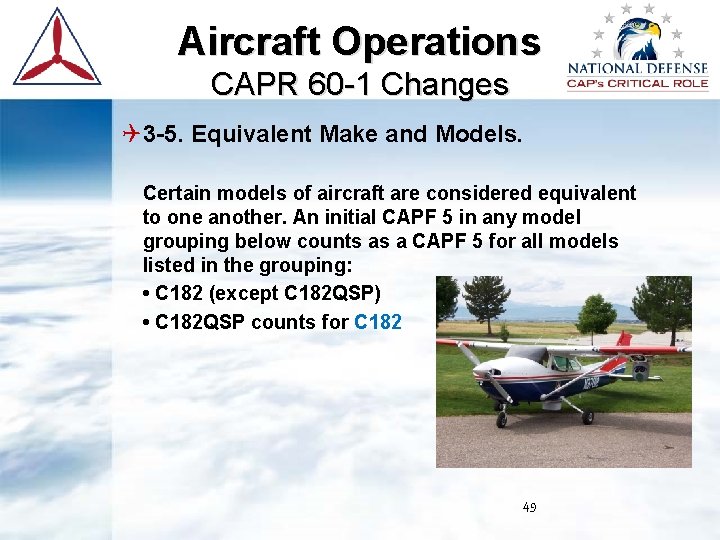
Aircraft Operations CAPR 60 -1 Changes 3 -5. Equivalent Make and Models. Certain models of aircraft are considered equivalent to one another. An initial CAPF 5 in any model grouping below counts as a CAPF 5 for all models listed in the grouping: • C 182 (except C 182 QSP) • C 182 QSP counts for C 182 49
Aircraft Operations CAPR 60 -1 Changes 3 -6. Airplane Qualifications. (4) G 1000 Equipped Airplanes. CAP uses the CAP in-house G 1000 transition syllabus to train members. . . (a)For members with no previous G 1000 experience by completing the CAP in-house G 1000 transition syllabus for VFR operations. (e) There will be a 180 day grace period from the date of this regulation during which all Cessna factory trained G 1000 instructor/check pilots must complete the CAP G 1000 Instructor Course (ground school only). After that time, the CAP G 1000 transition syllabus will be the primary training course for CAP pilots. (f) Members who have previously completed the Cessna factory course or any other course in accordance with paragraph 36 a 4(c), above, and are currently G 1000 qualified will not be required to take this course, but are encouraged to do so as continuing education. 50