Mathematics education in the early years Sue Gifford


- Slides: 59
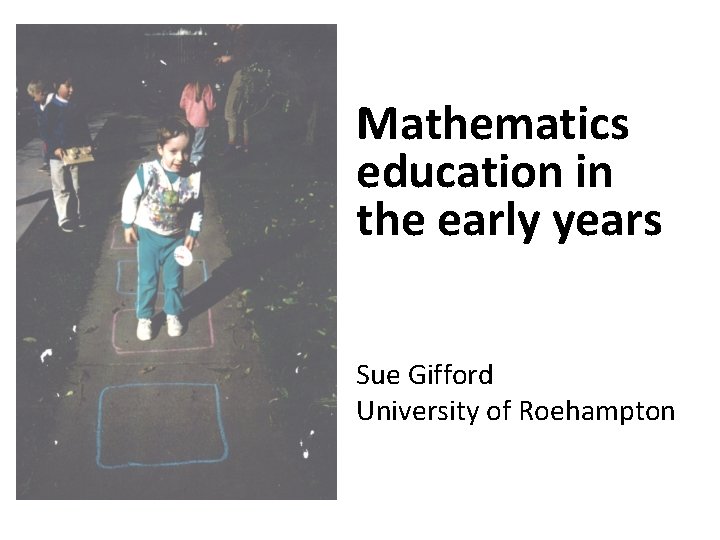
Mathematics education in the early years Sue Gifford University of Roehampton
What are the issues? The curriculum • content • pedagogy • assessment: baseline & EYFS profile • dislocation between EYFS & primary The workforce Need for: • professional development • centralised guidance • diverse settings, eg playgroups, childminders
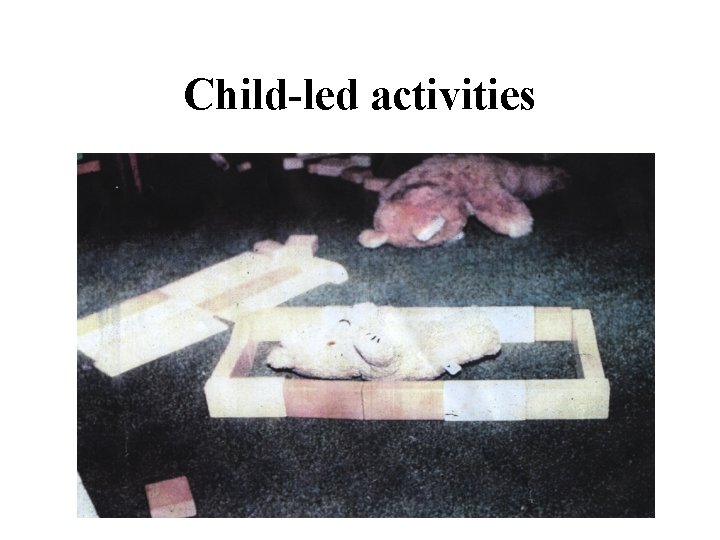
What research tells us What predicts maths success? in the early years: • parents’ education and home learning • a balance of adult and child-led activities • early number sense at primary school: • mathematical reasoning • a growth mindset
Parents • More information directly to parents on how to develop their children’s maths skills. • Early years settings to work with parents to support children’s development. • A national ‘positive about maths’ drive to draw in parents as well as early years staff.
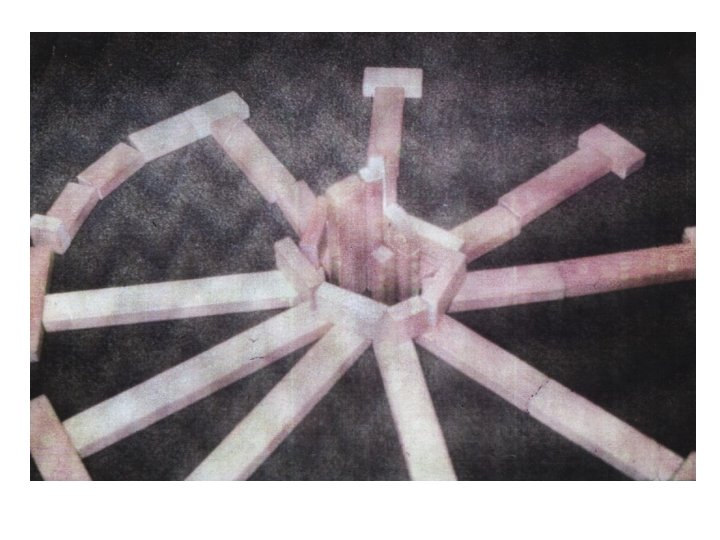
Child-led activities
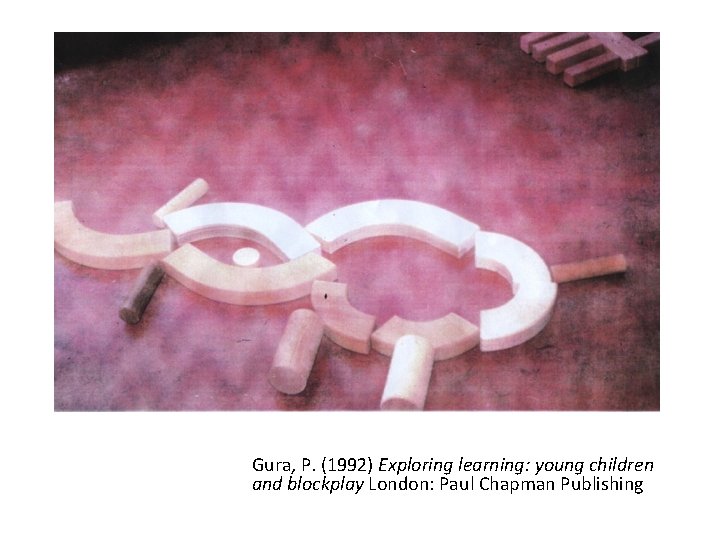
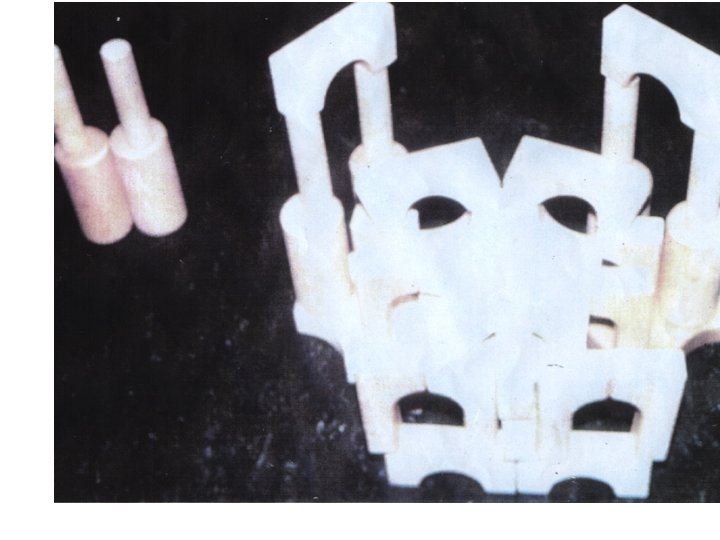
Gura, P. (1992) Exploring learning: young children and blockplay London: Paul Chapman Publishing
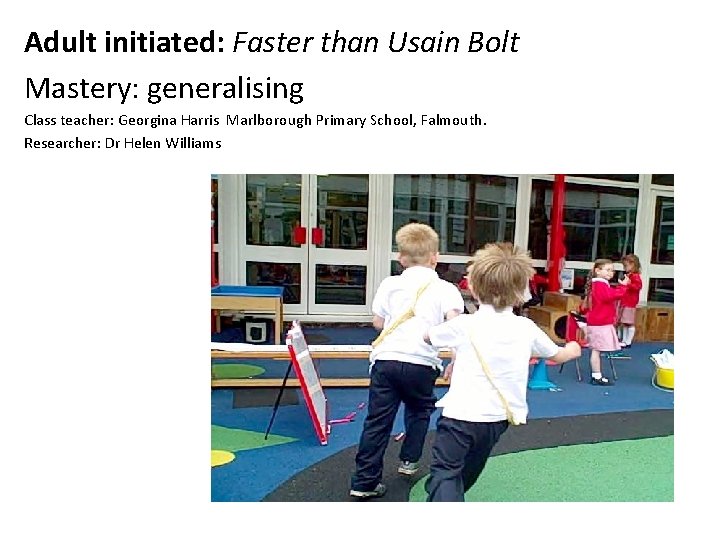
Adult initiated: Faster than Usain Bolt Mastery: generalising Class teacher: Georgina Harris Marlborough Primary School, Falmouth. Researcher: Dr Helen Williams
Pre-school number knowledge helps later achievement. (TIMSS) Pre- schools that helped children to understand early number concepts led to better outcomes in mathematics at 11. (EPPSE)
APPG: Number Sense should be a Prime Area in the EYFS The government should increase the focus of maths and numeracy in the early years curriculum, by including number sense as a prime area of development – alongside: • communication and language • physical development • personal, social and emotional development.
The Numbers Goal Children count reliably with numbers from one to 20, place them in order and say which number is one more or one less than a given number. Using quantities and objects, they add and subtract two single-digit numbers and count on or back to find the answer. They solve problems, including doubling, halving and sharing. (Df. E, 2012)
Children need to meet the Early Learning Goals to achieve a Good Level of Development If reception children do not achieve this, it can affect their teachers’ pay and careers.
Dislocation between reception year and Y 1 There is confusion about expectations among teachers and heads leading to inconsistency in practice and approach… potentially isolating reception teachers from their other colleagues…critical impact on pupils. ‘Early Learning Goal 11: Numbers’ focuses on a counting based approach to calculation. This is in contrast to research suggesting knowledge of composition of number is the critical factor in successful calculation and future attainment in maths, and that counting is a strategy relied on disproportionally by low attainers. It also conflicts with the most effective teaching of maths in key stage 1 where pupils are taught subtraction by complementary addition (being able to partition numbers), leading teachers to have to teach pupils to avoid previously learnt approaches. Teaching Schools Council: Effective primary teaching practice 2016 p 44 http: //tscouncil. org. uk/resources/effective-primary-teaching-practice-2016/
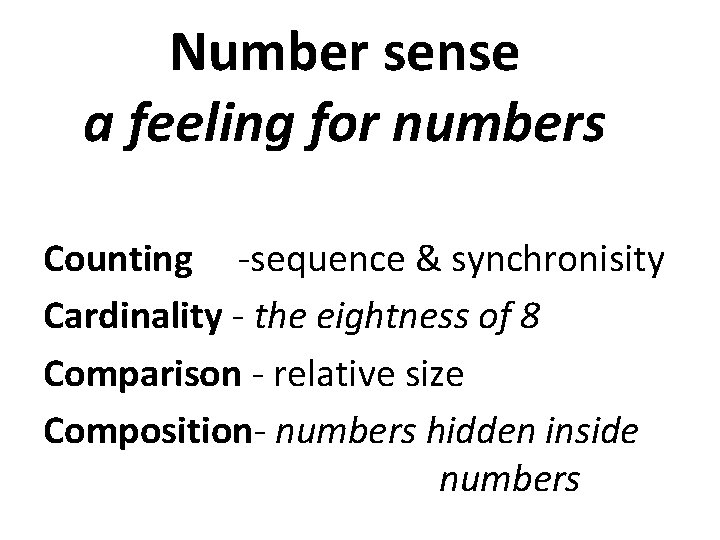
Number sense a feeling for numbers Counting -sequence & synchronisity Cardinality - the eightness of 8 Comparison - relative size Composition- numbers hidden inside numbers
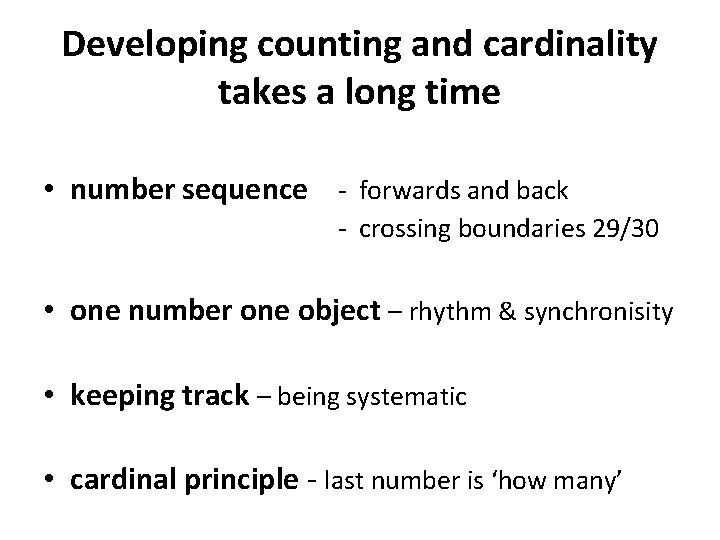
Developing counting and cardinality takes a long time • number sequence - forwards and back - crossing boundaries 29/30 • one number one object – rhythm & synchronisity • keeping track – being systematic • cardinal principle - last number is ‘how many’
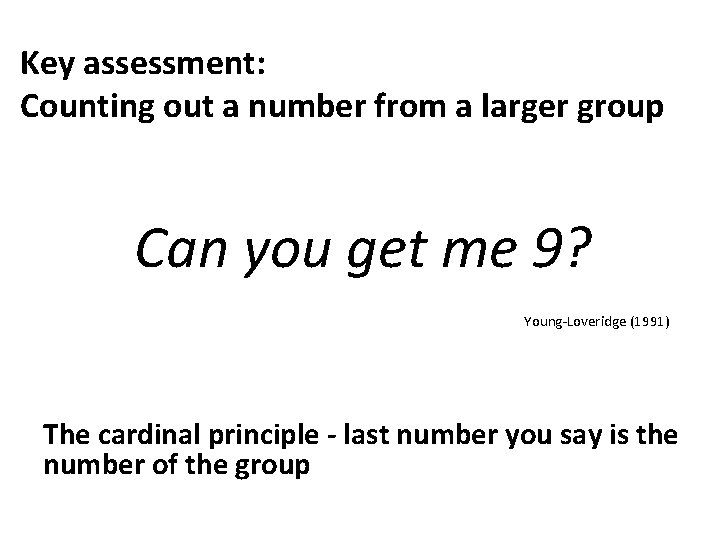
Key assessment: Counting out a number from a larger group Can you get me 9? Young-Loveridge (1991) The cardinal principle - last number you say is the number of the group
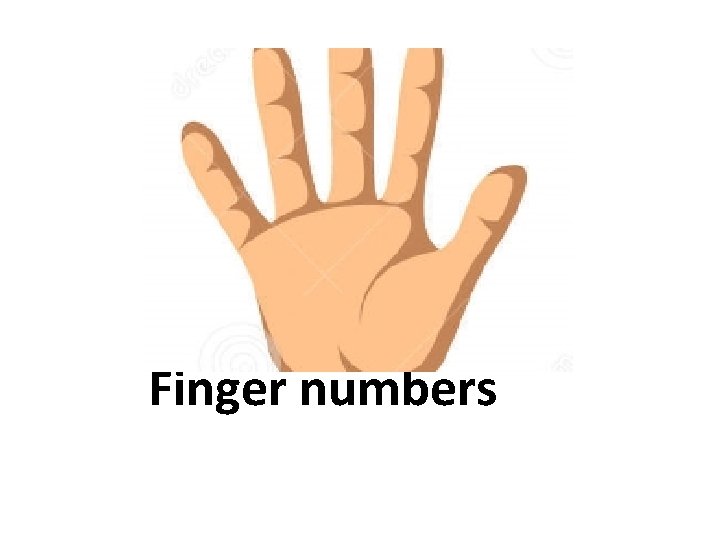
Finger numbers
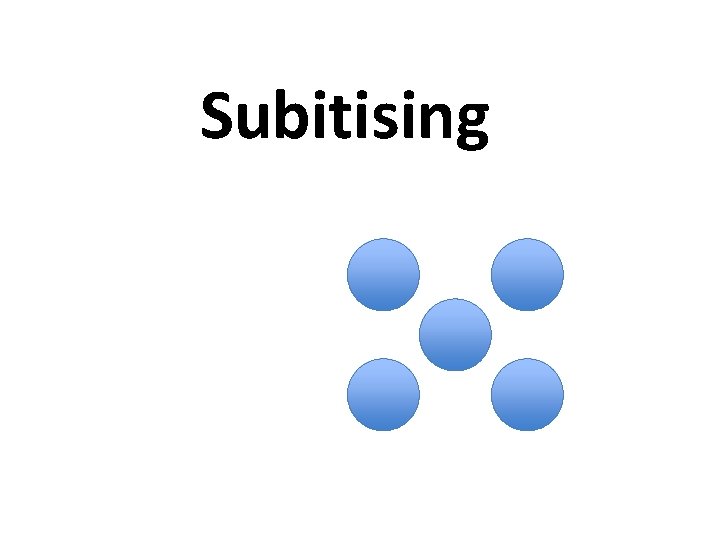
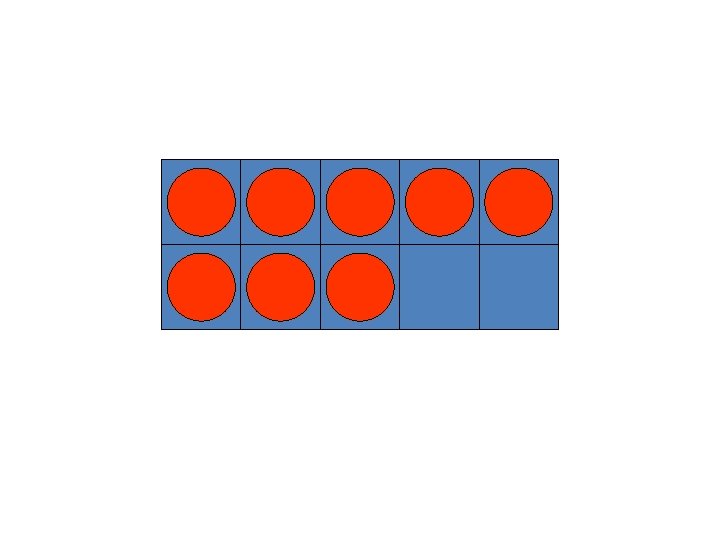
Subitising
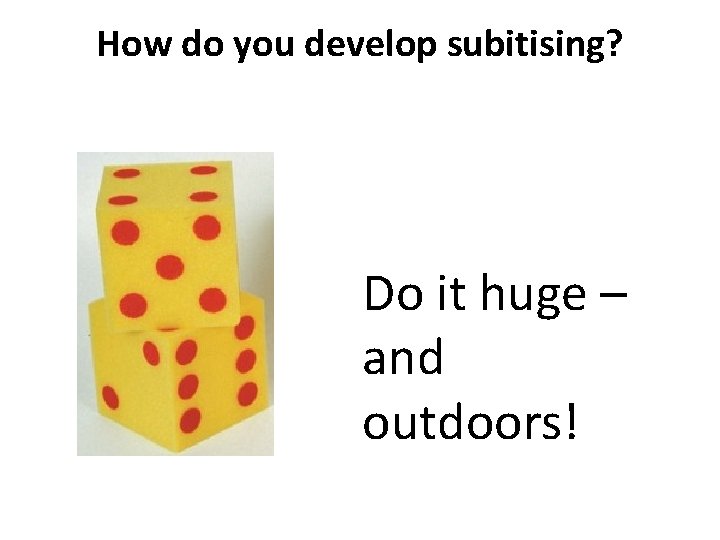
How do you develop subitising? Do it huge – and outdoors!
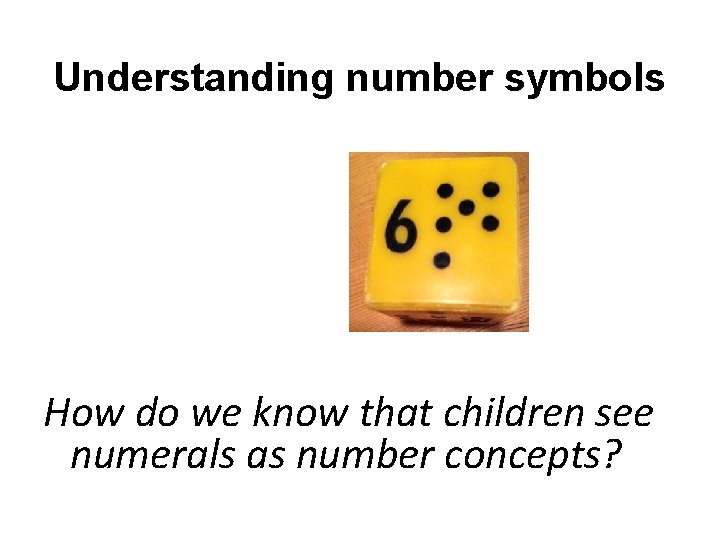
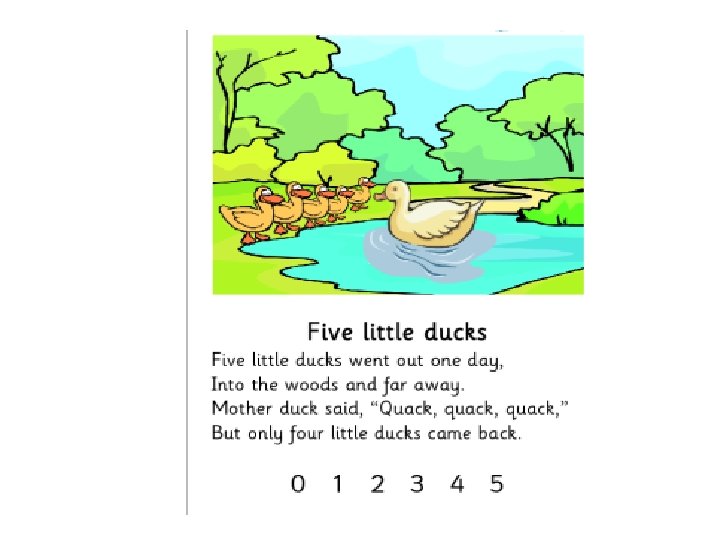
Understanding number symbols How do we know that children see numerals as number concepts?
When do children see everyday numerals with cardinal meanings? (referring to a number of things)
When do children see everyday numerals with cardinal meanings? (referring to a number of things)
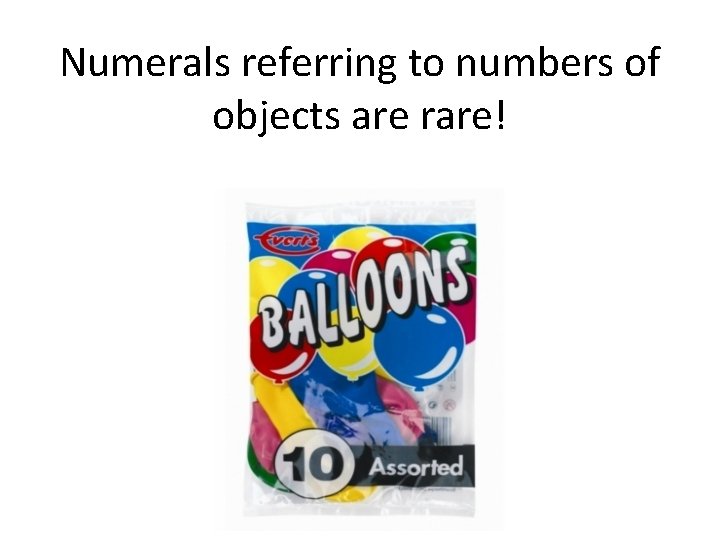
Numerals referring to numbers of objects are rare!
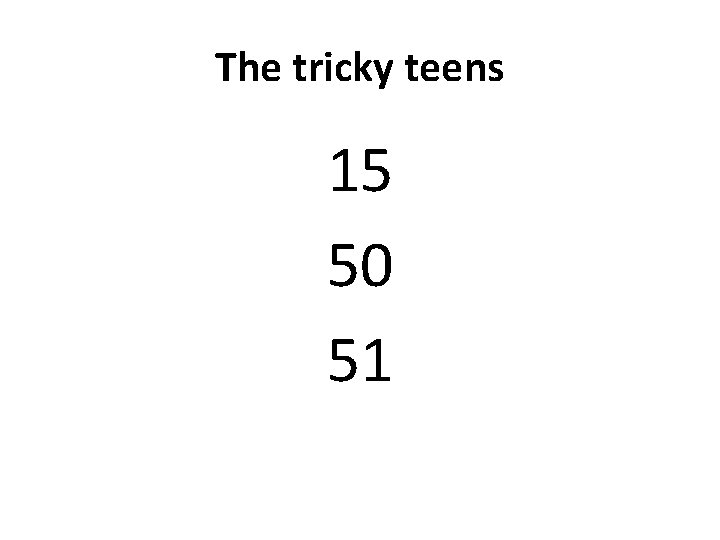
The tricky teens 15 50 51
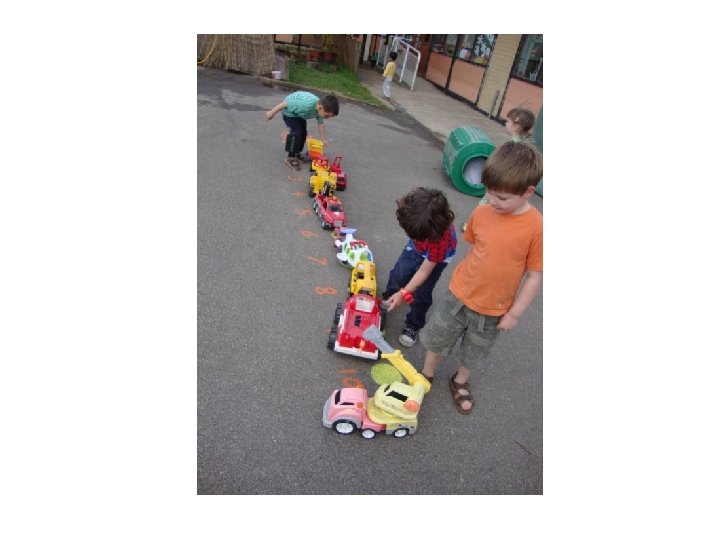
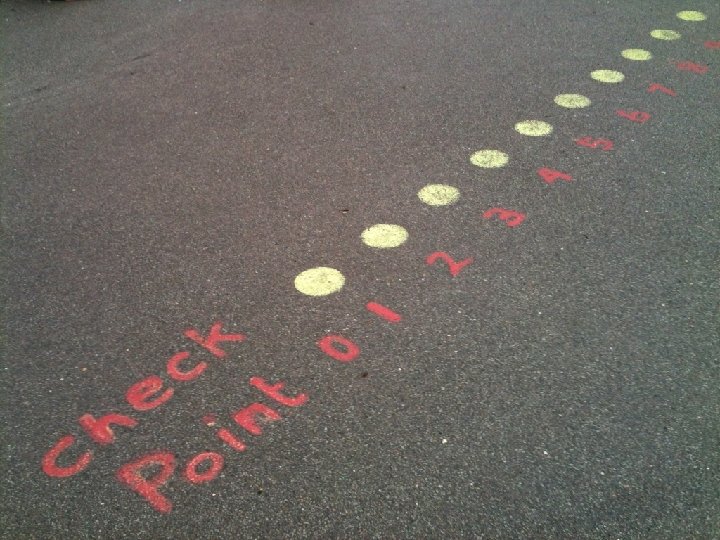
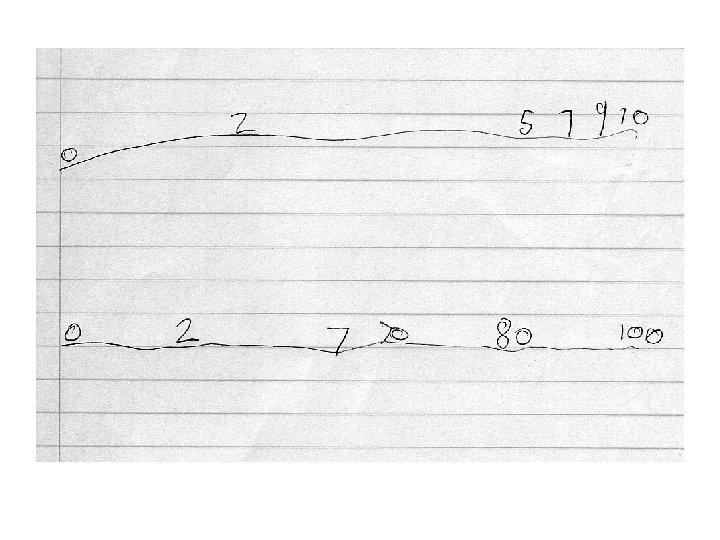
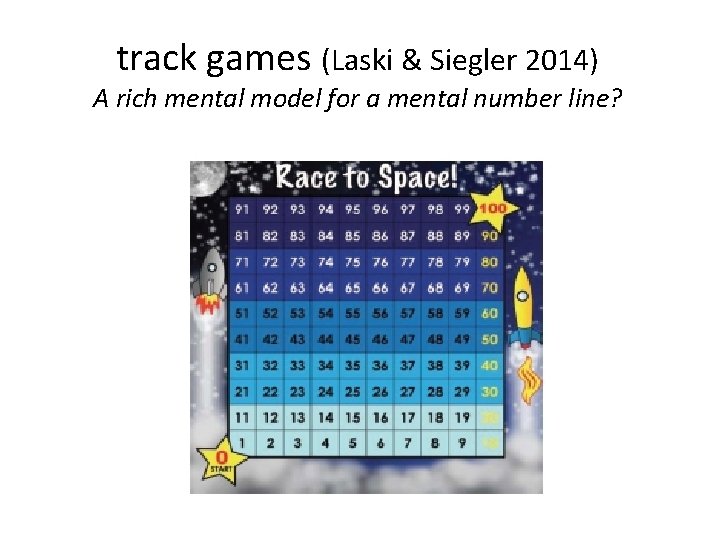
track games (Laski & Siegler 2014) A rich mental model for a mental number line?
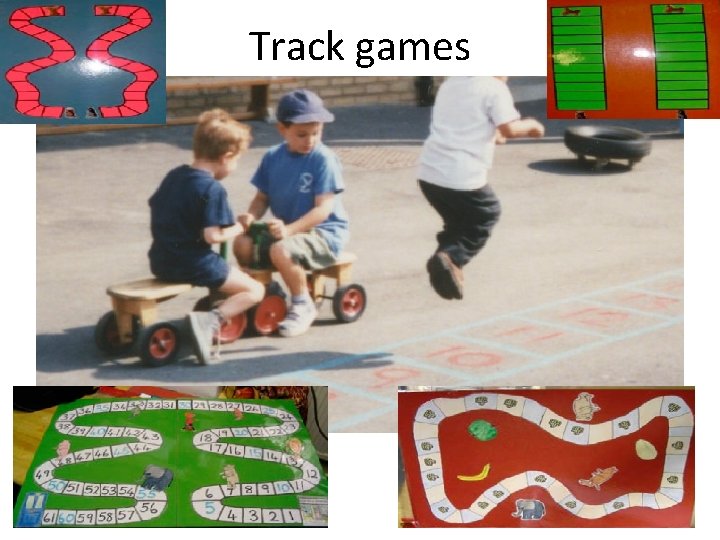
Track games
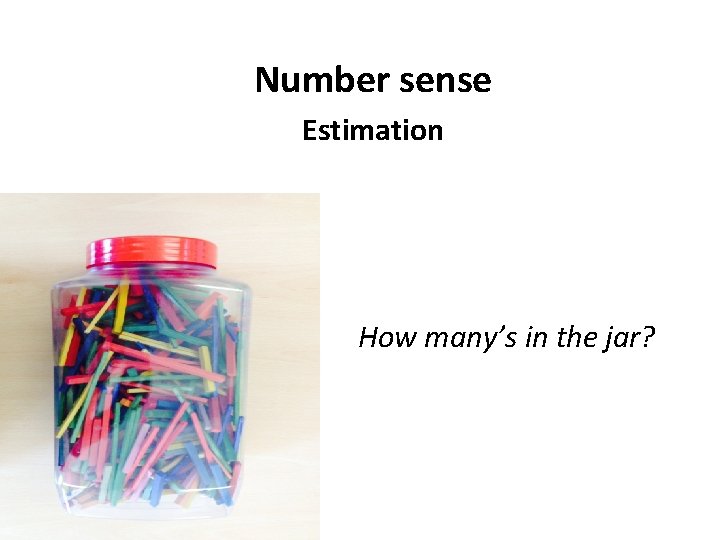
Number sense Estimation How many’s in the jar?
How do young children learn number sense? • routines – snacktime, tidying up • games –tracks, skittles, hidden numbers • number rhymes & books – fingers & symbols • problem solving eg sharing • playfulness- eg making mistakes • ‘sustained shared thinking’ with adults NRICH
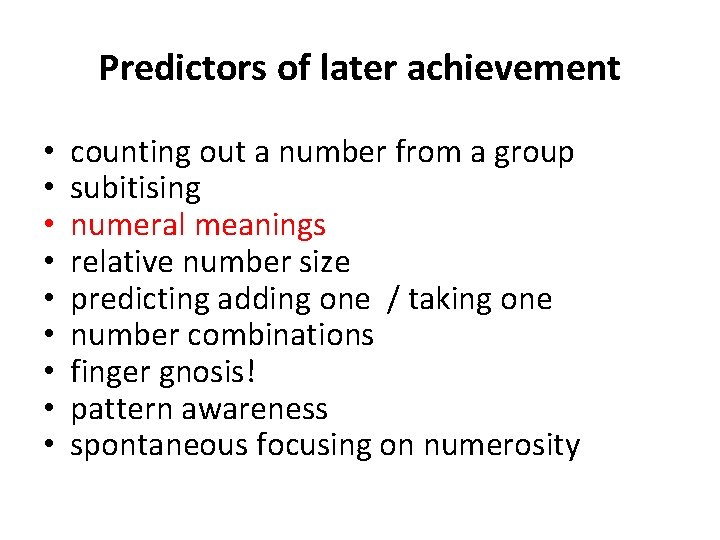
Predictors of later achievement • • • counting out a number from a group subitising numeral meanings relative number size predicting adding one / taking one number combinations finger gnosis! pattern awareness spontaneous focusing on numerosity
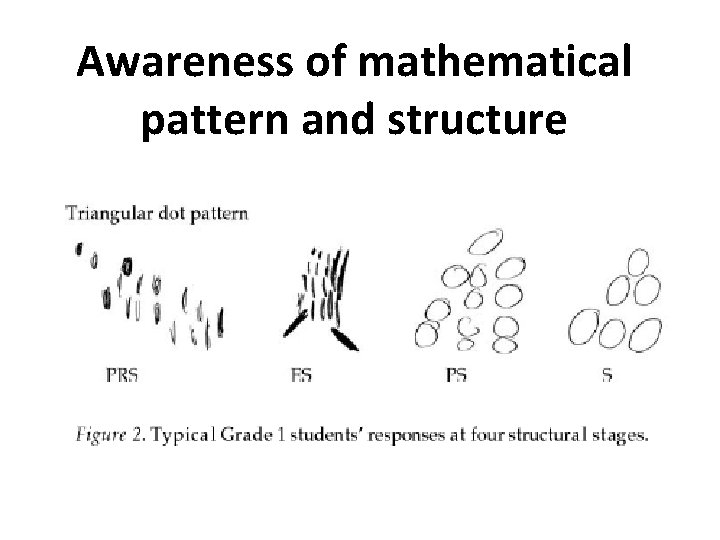
Awareness of mathematical pattern and structure
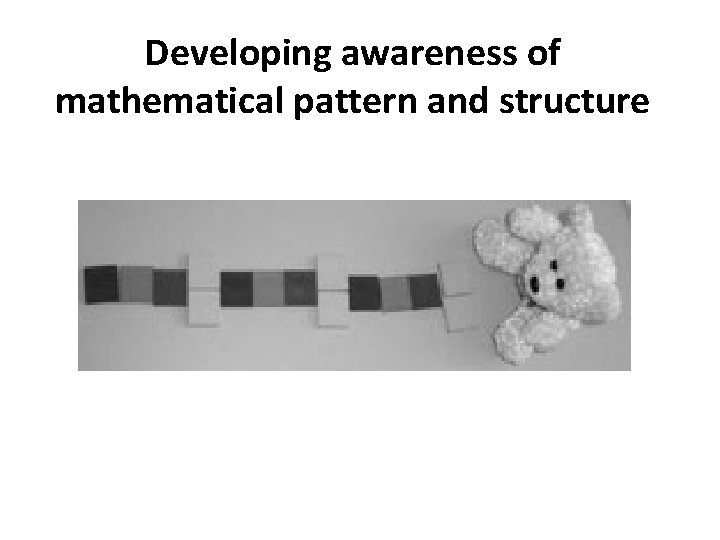
Developing awareness of mathematical pattern and structure
Teaching pattern awareness • • • copy draw /when hidden continue create own /make with other materials repair explain
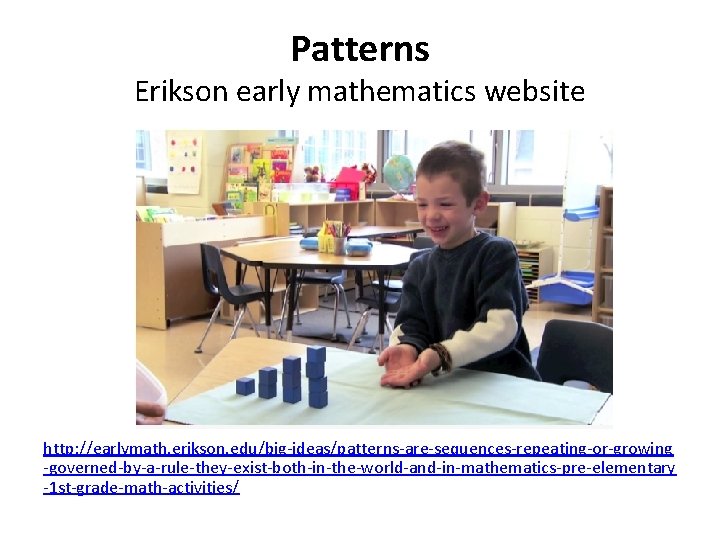
Patterns Erikson early mathematics website http: //earlymath. erikson. edu/big-ideas/patterns-are-sequences-repeating-or-growing -governed-by-a-rule-they-exist-both-in-the-world-and-in-mathematics-pre-elementary -1 st-grade-math-activities/
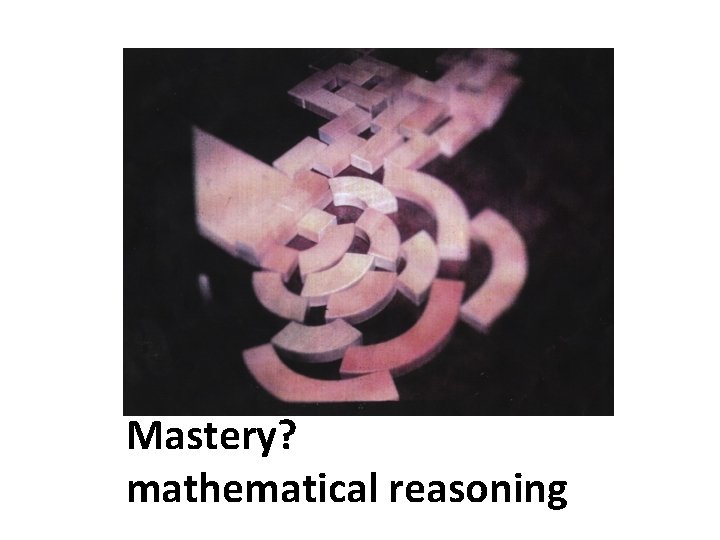
Mastery? mathematical reasoning
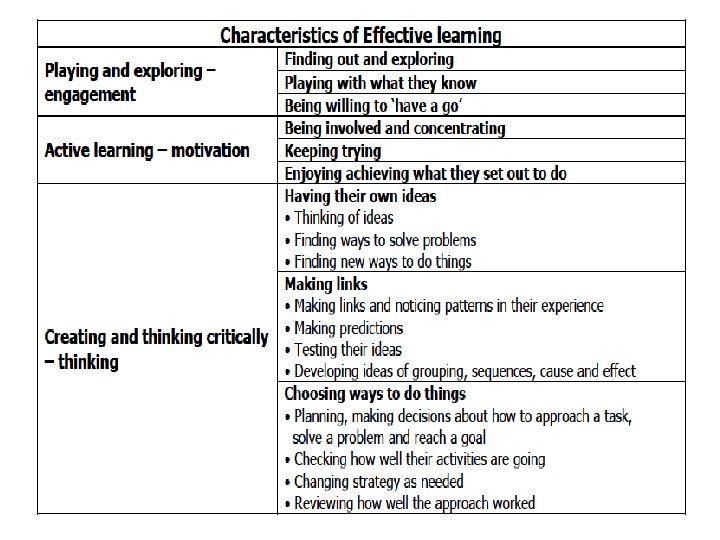
Developing mastery The Characteristics of Effective Mathematical Learning Reception teachers must report on these- how do they do this for maths?
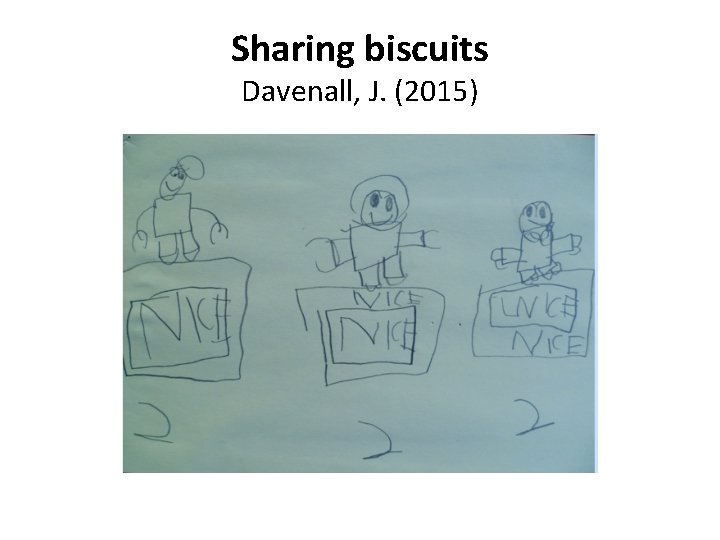
Sharing biscuits Davenall, J. (2015)
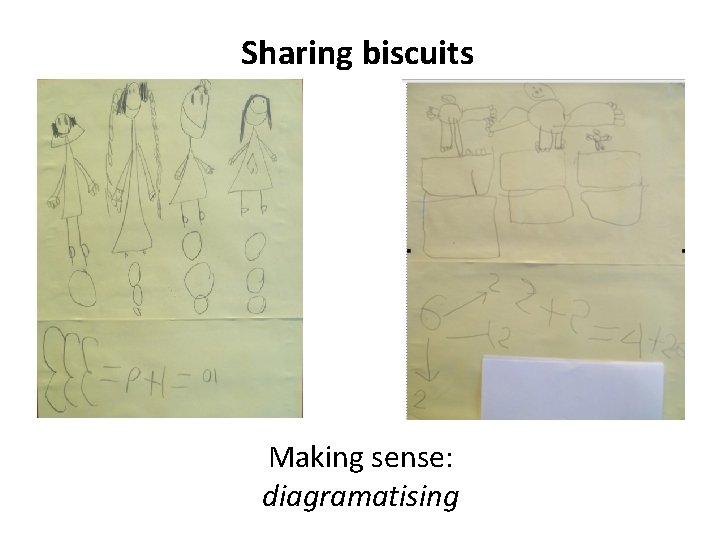
Sharing biscuits Making sense: diagramatising
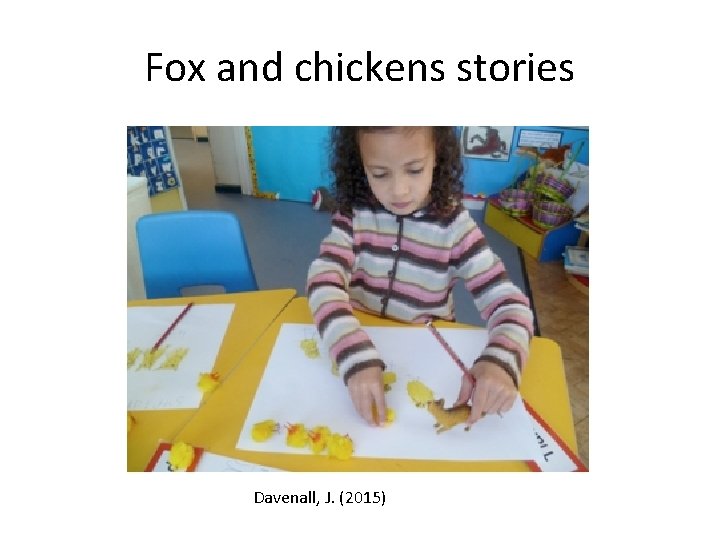
Fox and chickens stories Davenall, J. (2015)
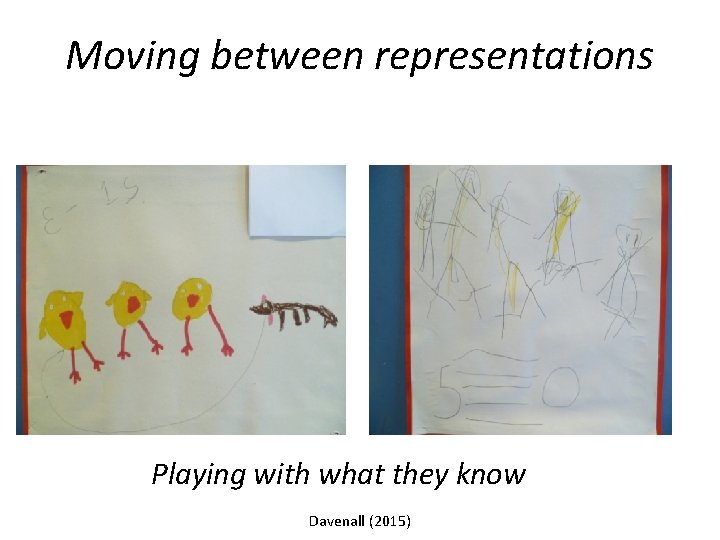
Moving between representations Playing with what they know Davenall (2015)
Early algebraization the route to Mastery ? • pattern and functions • equivalence and equations • generalisation
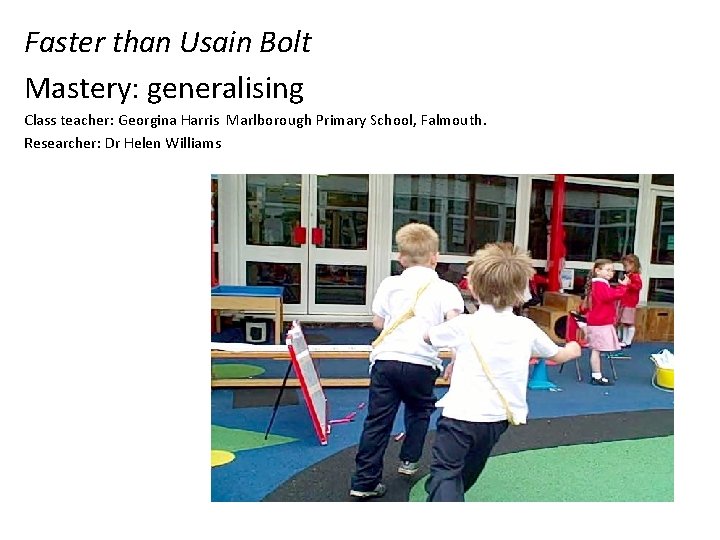
Faster than Usain Bolt Mastery: generalising Class teacher: Georgina Harris Marlborough Primary School, Falmouth. Researcher: Dr Helen Williams
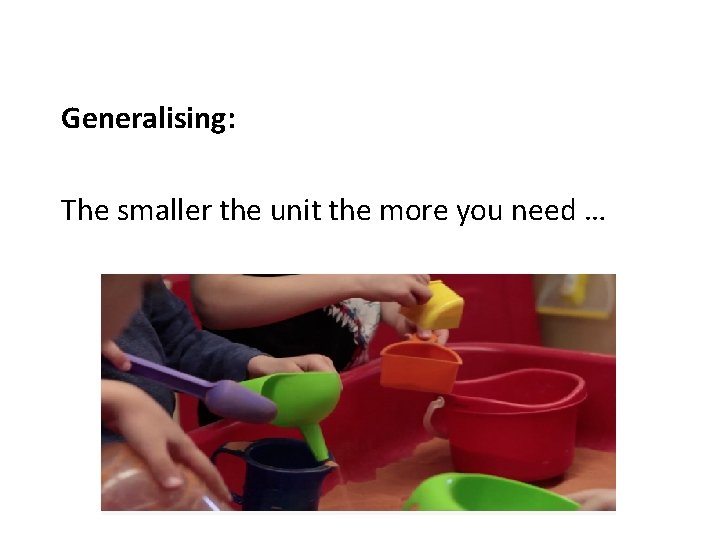
Generalising: The smaller the unit the more you need …
Workforce education • All early years practitioners, both new entrants and the existing workforce, should be trained in children’s mathematical development. • The government should extend its Maths Hubs programme to include pre-schools. • The government must provide more guidance for practitioners on the use of effective approaches and resources.
Workforce diversity: child minders, preschools, children’s centres, nurseries, reception classes Early Childhood Mathematics Group representatives: ACME Action for Children ATM/MA primary committee Df. E Early Education National Numeracy NAMA NCETM NCB NDNA NRICH Of. STED PACEY PSLA TACTYC Universities of Oxford, Leicester, Roehampton Eastwood Children’s Centre, Primary schools: Netley, St John’s Angel Town, Ravenswood, Ridgeway
Workforce qualifications Level 3 EY practitioners: GCSE required If GCSE is normative, where do the bottom 30% work? Are functional skills appropriate for EY practitioners? Does ITE sufficiently cover early maths learning? Where do practitioners learn about early maths?
ACME recommendations • review Numbers goal for EYFS • greater focus on mathematical thinking • develop clear guidance: – progression map of big ideas – online support with exemplification • develop and disseminate pedagogy • prioritise professional development for EY staff: – survey needs – familiarise with learning trajectories – engage with parents, carers and families
Foundation Years Mathematical Resources website Top Ten lists eg: • websites • professional books • picture books • number rhymes • ideas for babies and toddlers http: //www. foundationyears. org. uk/mathemati cal-resources/
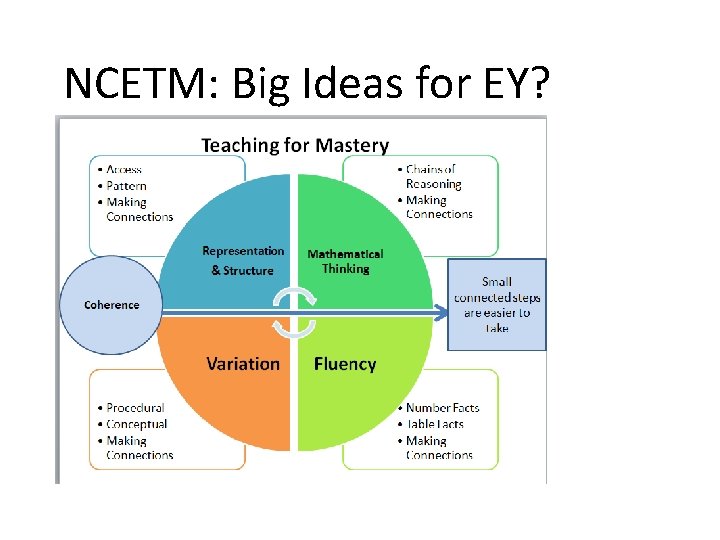
NCETM: Big Ideas for EY?
The way forward? Primary assessment consultation: implications for accountability. This will cover key issues, including the best starting point to measure the progress that children make in primary school, and the role and operation of teacher assessment. Whilst we take time to consult on assessment arrangements, the Early Years Foundation Stage Profile will remain in place for the 2017 to 2018 academic year. BEIS Green paper: improved pre-school education to reduce the divergence of achievement which opens up before school (p 21) https: //beisgovuk. citizenspace. com/strategy/industrialstrategy/supporting_documents/buildingourindustrialstrategygreenpa per. pdf? And?
References All Party Parliamentary Group Maths and numeracy in the early years http: //www. nationalnumeracy. org. uk/sites/default/files/media/appg_paper_-_eys. pdf Davenall, J. (2015) Developing Number Through Tidying Up http: //nrich. maths. org/11528 Emerson, J. , and P. Babtie. 2010. The dyscalculia assessment: Emerson House Mathematics London: Continuum. Effective Pre-School, Primary and Secondary Education project (EPPSE) http: //www. ioe. ac. uk/EPPSE_What_influences_English_and_Mathematics_attainment_at_age_11_Research_Bite. pdf Gersten, R. , Jordan, N. C. , & Flojo, J. R. (2005). Early identification and interventions for students with mathematics difficulties. Journal of Learning Disabilities, 38, 293– 304. Gifford, S. (2005) Teaching mathematics to 3 – 5 s: developing learning in the Foundation Stage Maidenhead: Open University Press Gifford, S. (2014) ‘A good foundation for number learning for five year olds: an evaluation of the English Early Learning ‘Numbers’ Goal in the light of research’. Research in Mathematics Education 16 (3) 219 -233 Griffiths, R. , Back, J. & Gifford, S. (2016) Making numbers: using manipulatives to teach arithmetic. Oxford: Oxford University Press Laski, E. V. & Siegler, R. S. (2014) Learning from number board games: you learn what you encode Developmental Psychology 50 (3) 853 -864 Office for Standards in Education. (2013). Mathematics in school inspection January 2013 information pack for training https: //www. whatdotheyknow. com/request/additional_guidance_for_inspecto Office for Standards in Education. (2015) Teaching and play in the early years: a balancing act? https: //www. gov. uk/government/publications/teaching-and-play-in-the-early-years-a-balancing-act Rittle-Johnson, B. , Fyfe, E. R. , Hofer, K. G. , Farran, D. C. (2016) Early math trajectories: low income children’s trajectory mathematics knowledge from ages 4 to 11, Child Development DOI: 10. 1111/cdev. 12662 Siraj-Blatchford, I. , Sylva, K. , Muttock, S. , Gilden, R. and Bell, D. (2002) Researching Effective Pedagogy in the Early Years, (REPEY) Research Report 356. London: Department of Education and Skills. www. 327 matters. org/Docs/RR 356. pdf Teaching Schools Council (2016) Effective primary teaching practice http: //tscouncil. org. uk/resources/effective-primary-teachingpractice-2016/ Trundley, R. (2008). The value of two. Mathematics Teaching, 211, 17– 21 http: //nrich. maths. org/11527 Young-Loveridge, J. (1991). The development of children’s number concepts from ages five to nine. Hamilton: University of Waikato.