MATHCMSC 456 UPDATED COURSE INFO Instructor Gorjan Alagic
- Slides: 27
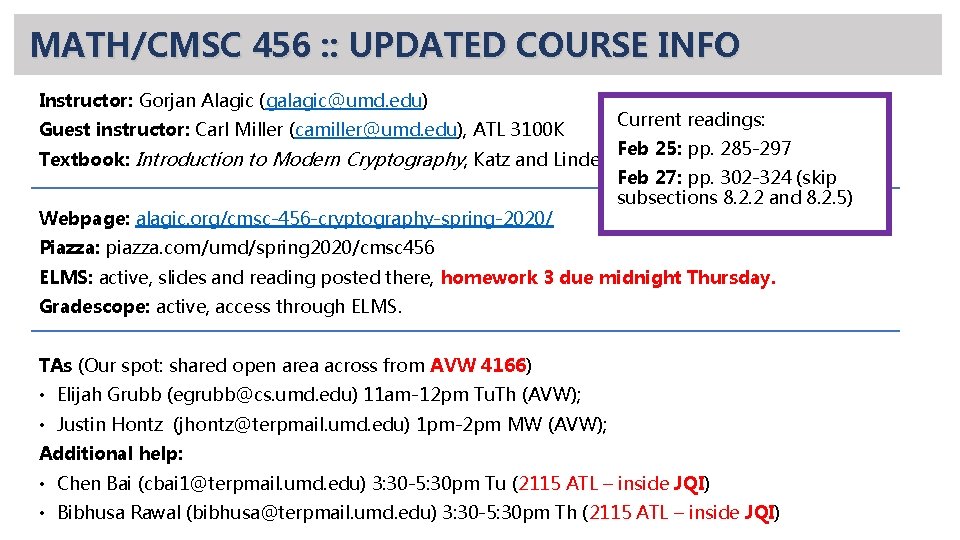
MATH/CMSC 456 : : UPDATED COURSE INFO Instructor: Gorjan Alagic (galagic@umd. edu) Guest instructor: Carl Miller (camiller@umd. edu), ATL 3100 K Textbook: Introduction to Modern Cryptography, Katz and Lindell; Webpage: alagic. org/cmsc-456 -cryptography-spring-2020/ Current readings: Feb 25: pp. 285 -297 Feb 27: pp. 302 -324 (skip subsections 8. 2. 2 and 8. 2. 5) Piazza: piazza. com/umd/spring 2020/cmsc 456 ELMS: active, slides and reading posted there, homework 3 due midnight Thursday. Gradescope: active, access through ELMS. TAs (Our spot: shared open area across from AVW 4166) • Elijah Grubb (egrubb@cs. umd. edu) 11 am-12 pm Tu. Th (AVW); • Justin Hontz (jhontz@terpmail. umd. edu) 1 pm-2 pm MW (AVW); Additional help: • Chen Bai (cbai 1@terpmail. umd. edu) 3: 30 -5: 30 pm Tu (2115 ATL – inside JQI) • Bibhusa Rawal (bibhusa@terpmail. umd. edu) 3: 30 -5: 30 pm Th (2115 ATL – inside JQI)
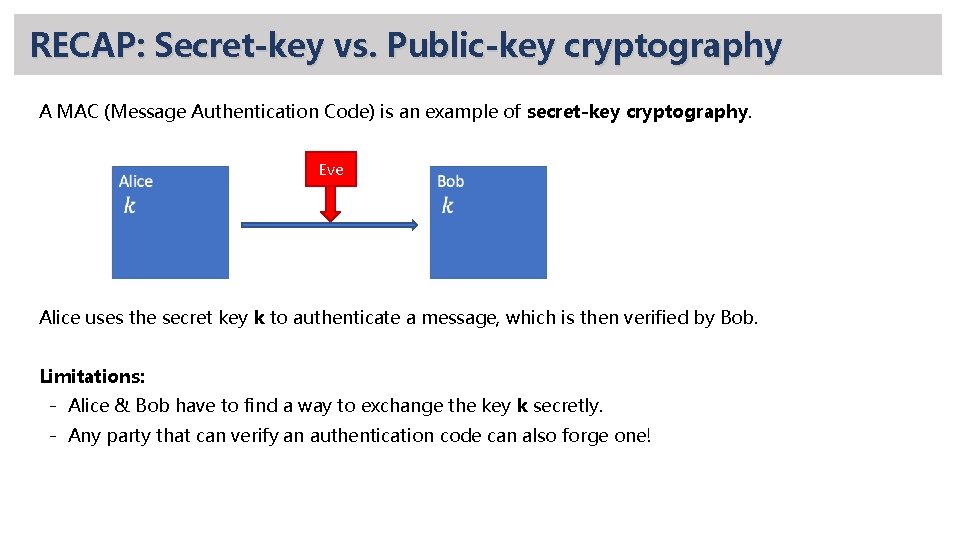
RECAP: Secret-key vs. Public-key cryptography A MAC (Message Authentication Code) is an example of secret-key cryptography. Eve Alice uses the secret key k to authenticate a message, which is then verified by Bob. Limitations: - Alice & Bob have to find a way to exchange the key k secretly. - Any party that can verify an authentication code can also forge one!
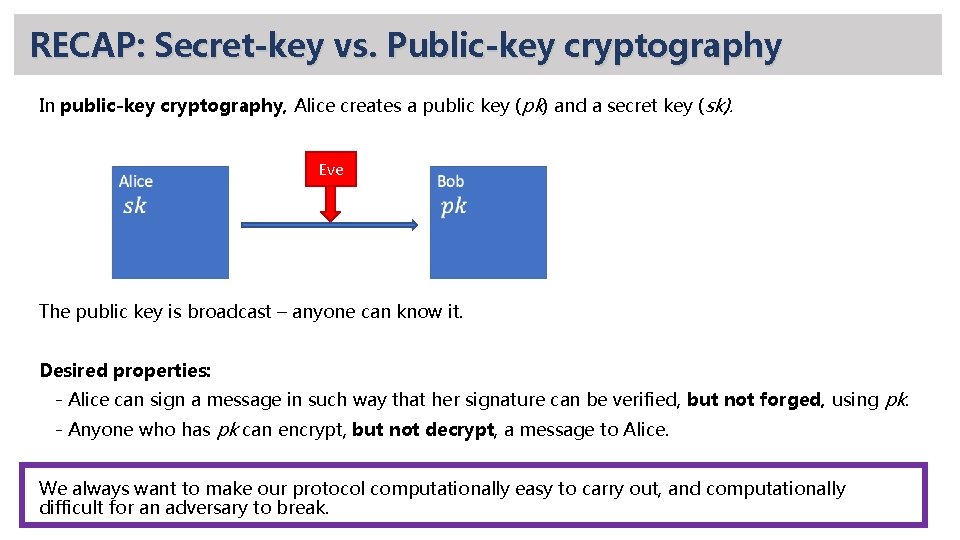
RECAP: Secret-key vs. Public-key cryptography In public-key cryptography, Alice creates a public key (pk) and a secret key (sk). Eve The public key is broadcast – anyone can know it. Desired properties: - Alice can sign a message in such way that her signature can be verified, but not forged, using pk. - Anyone who has pk can encrypt, but not decrypt, a message to Alice. We always want to make our protocol computationally easy to carry out, and computationally difficult for an adversary to break.
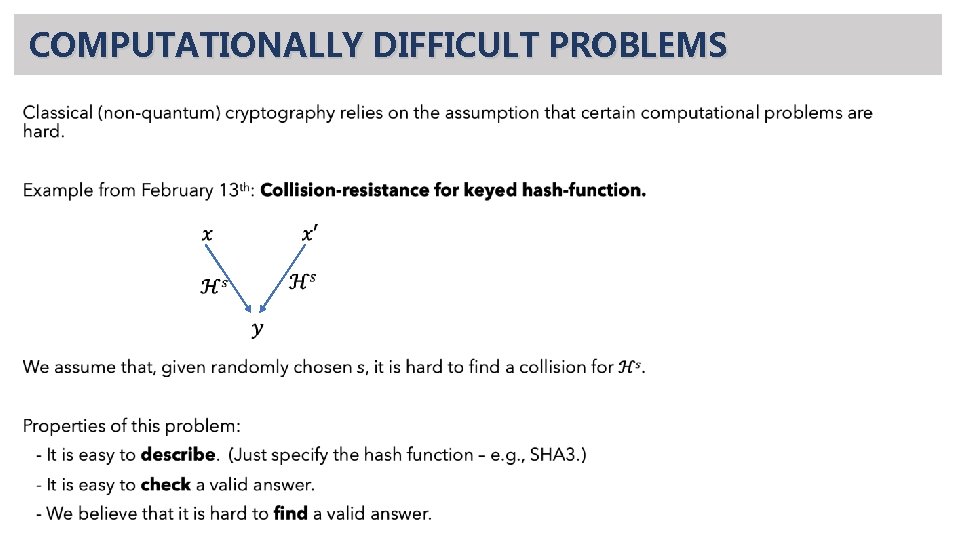
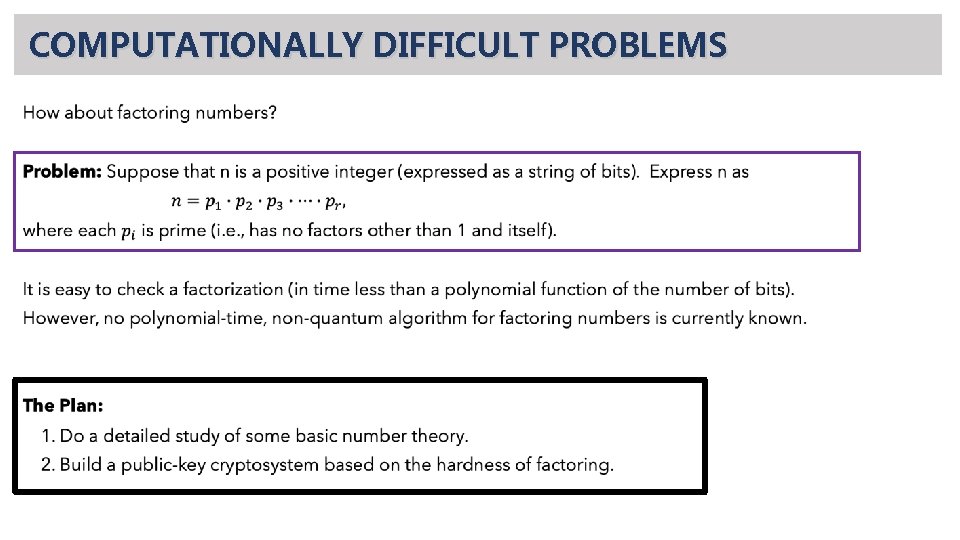
COMPUTATIONALLY DIFFICULT PROBLEMS •
COMPUTATIONALLY DIFFICULT PROBLEMS •
MODULAR ARITHMETIC: Notation & Examples
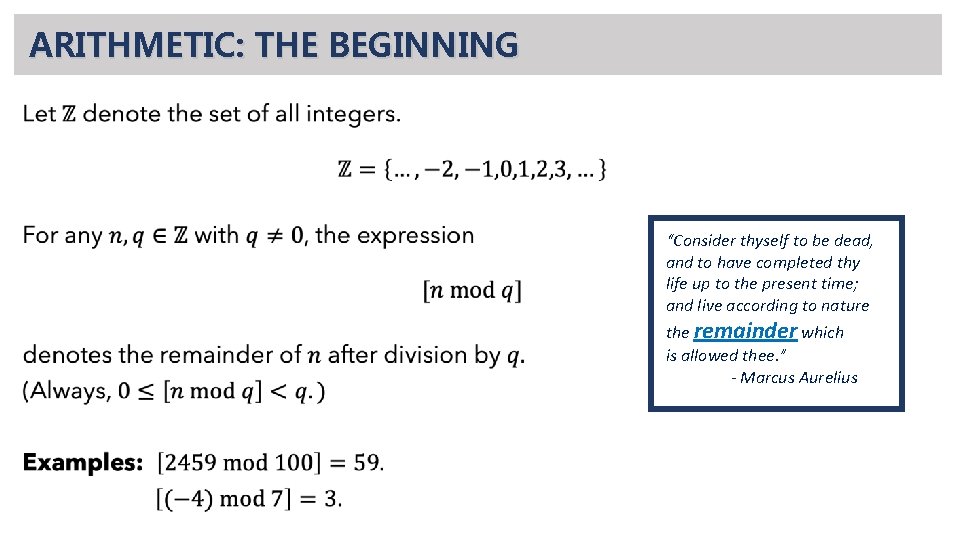
ARITHMETIC: THE BEGINNING • “Consider thyself to be dead, and to have completed thy life up to the present time; and live according to nature the remainder which is allowed thee. ” - Marcus Aurelius
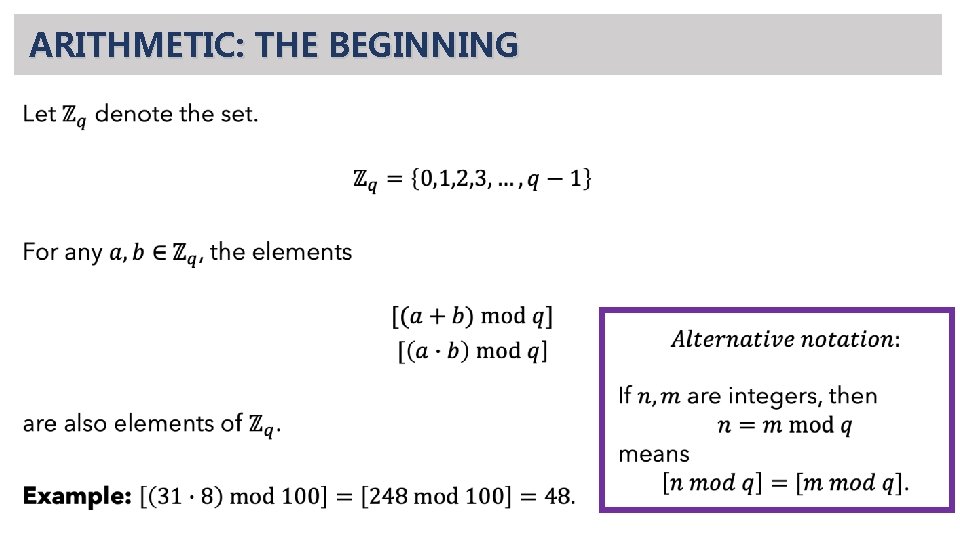
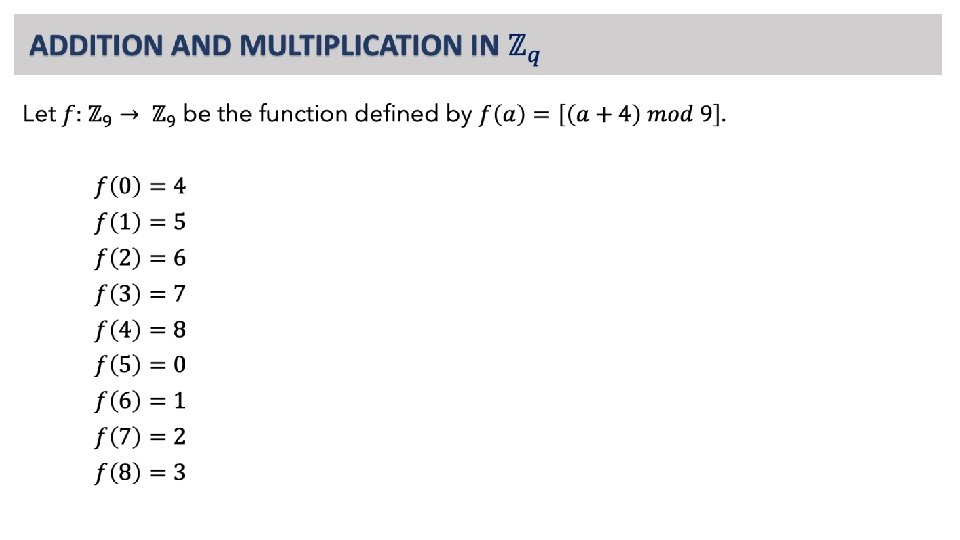
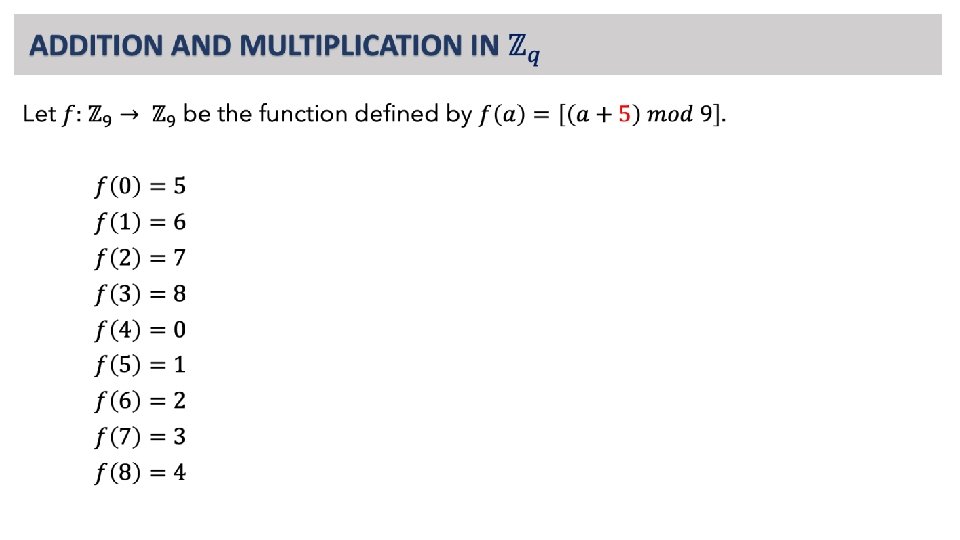
ARITHMETIC: THE BEGINNING •
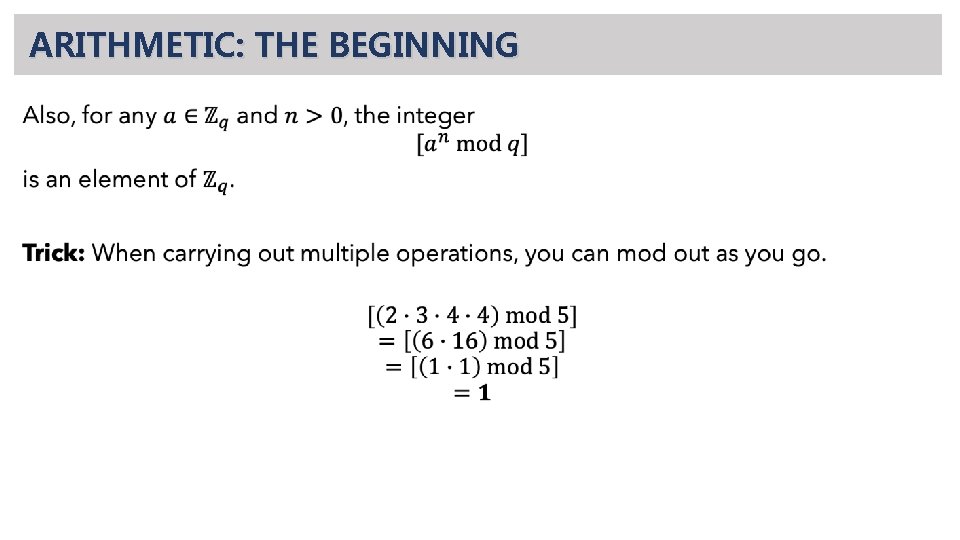
ARITHMETIC: THE BEGINNING •
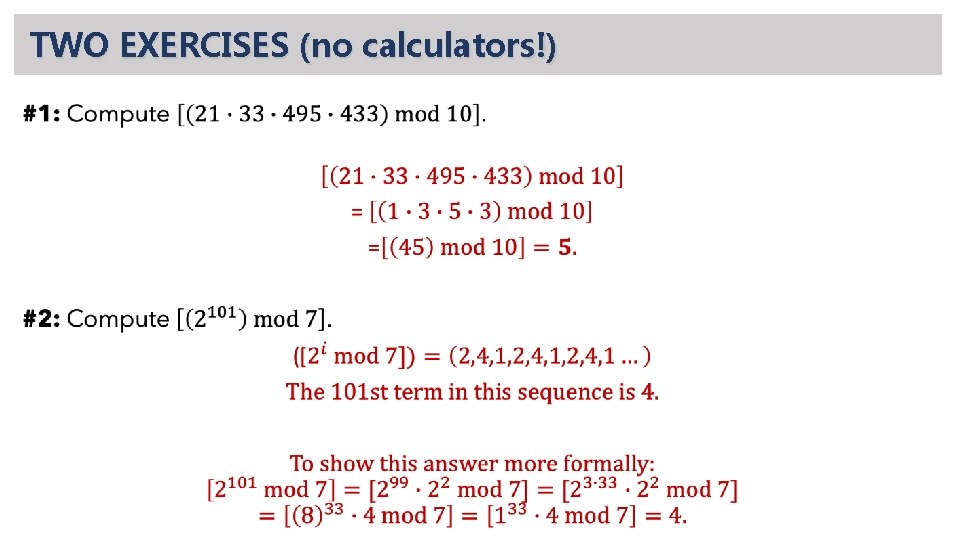
TWO EXERCISES (no calculators!) •
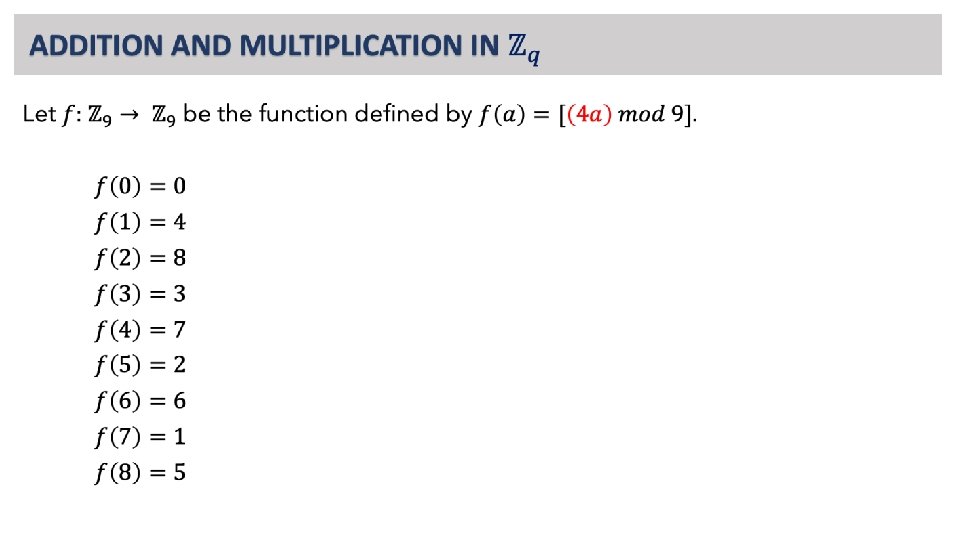
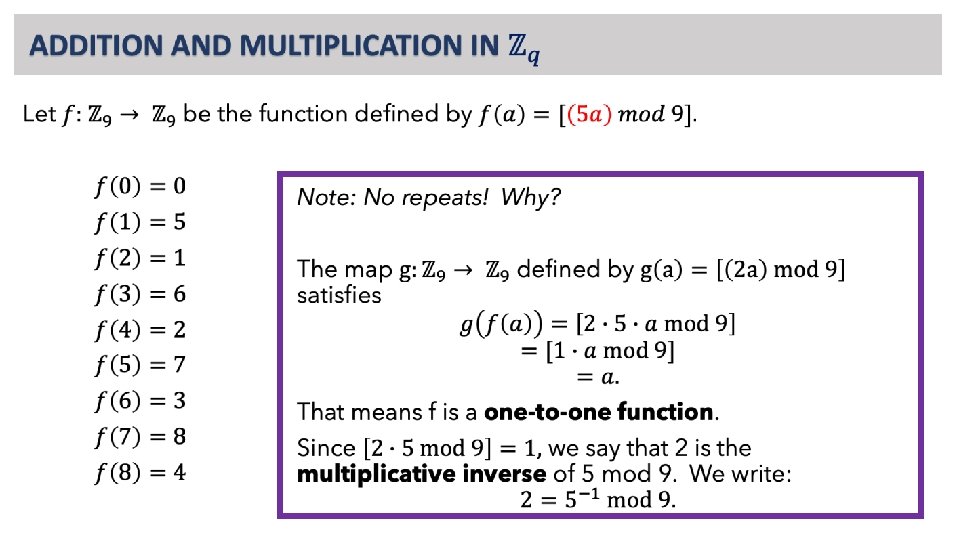
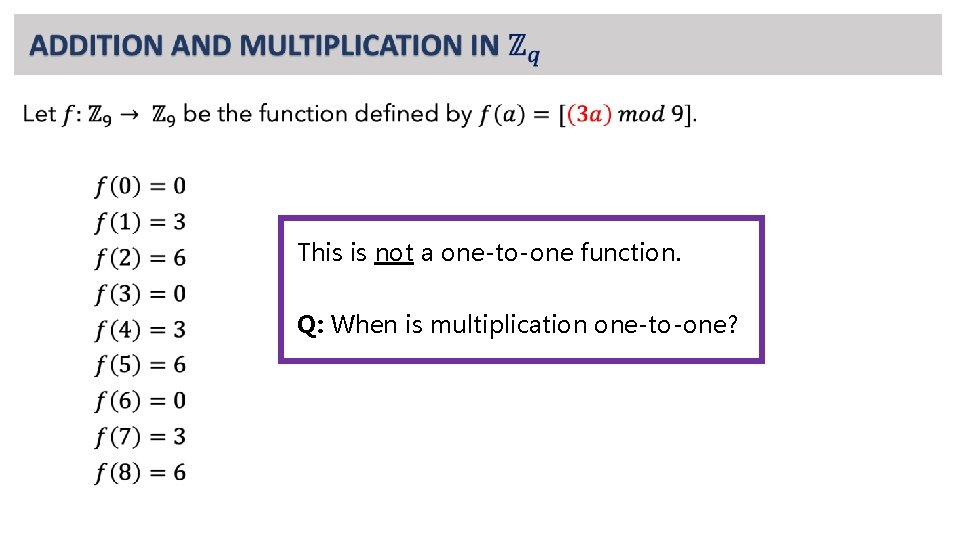
• This is not a one-to-one function. Q: When is multiplication one-to-one?
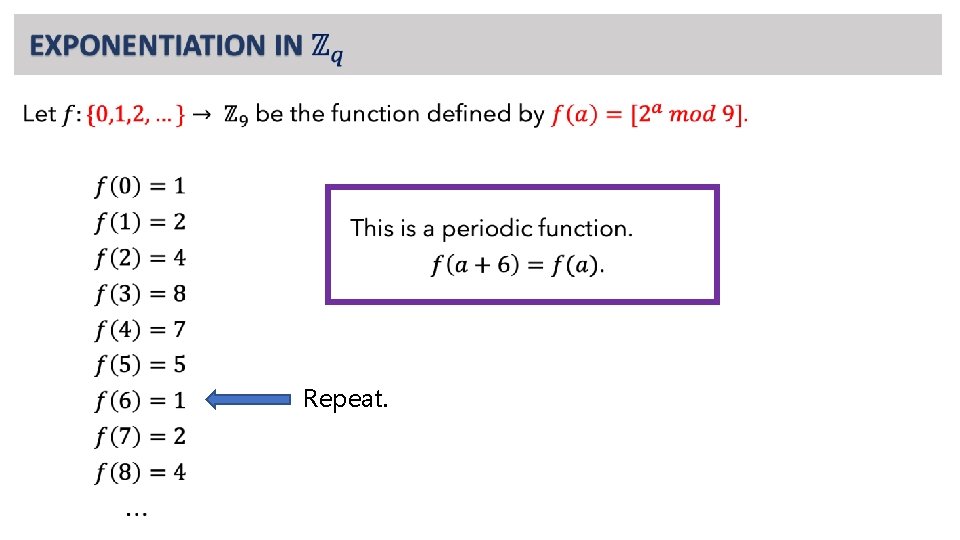
• Repeat.
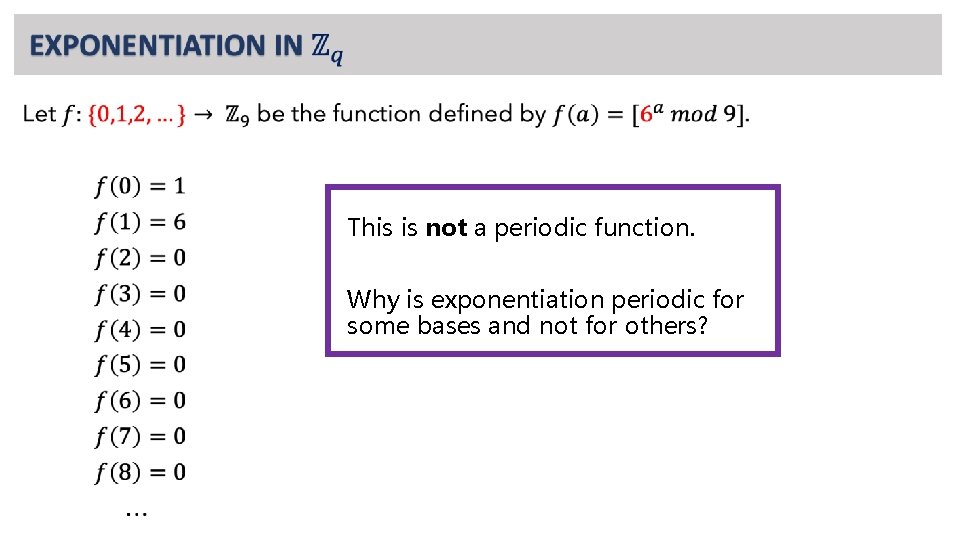
• This is not a periodic function. Why is exponentiation periodic for some bases and not for others?
MODULAR ARITHMETIC: Proofs
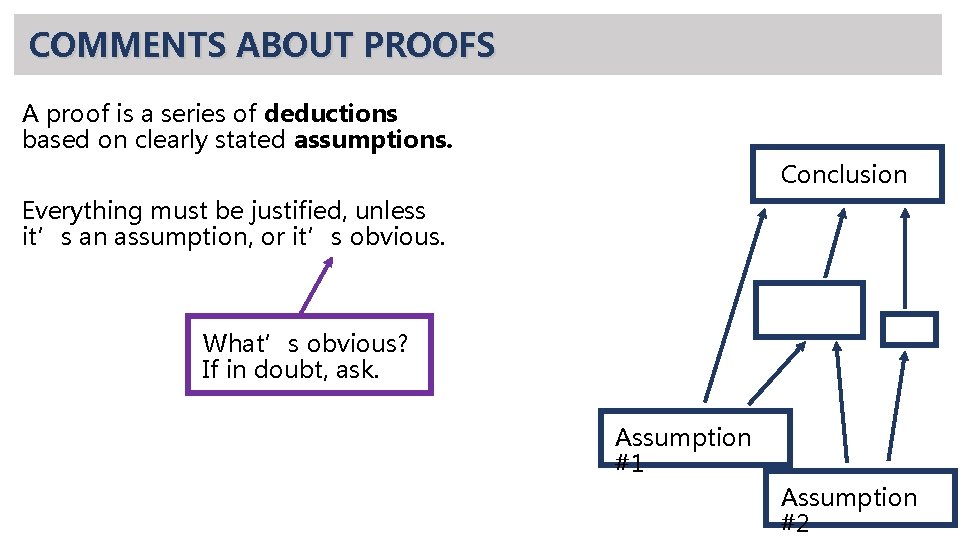
COMMENTS ABOUT PROOFS A proof is a series of deductions based on clearly stated assumptions. Conclusion Everything must be justified, unless it’s an assumption, or it’s obvious. What’s obvious? If in doubt, ask. Assumption #1 Assumption #2
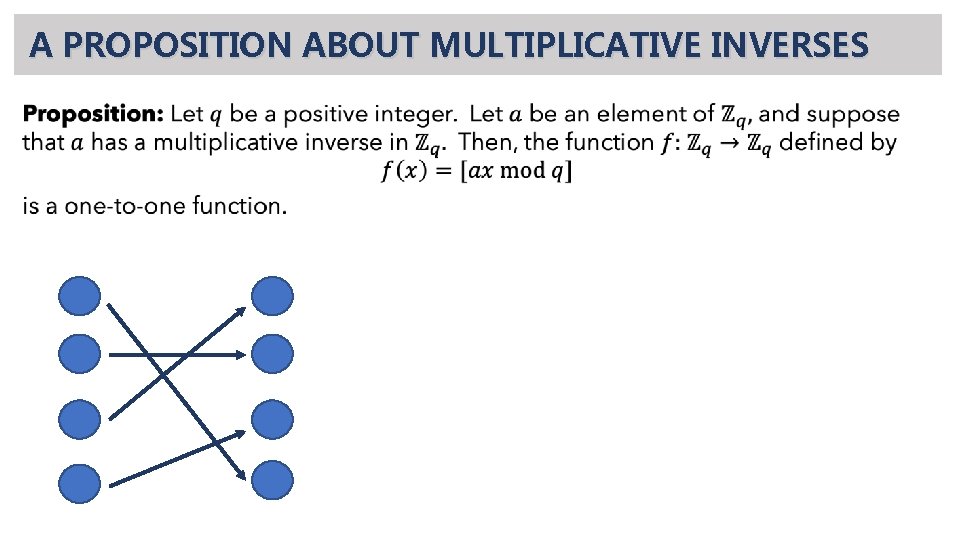
A PROPOSITION ABOUT MULTIPLICATIVE INVERSES •
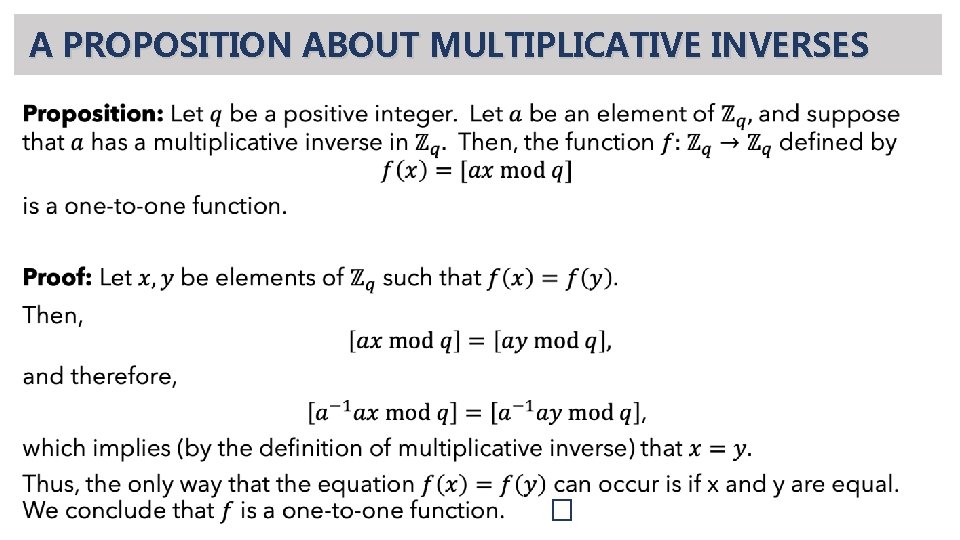
A PROPOSITION ABOUT MULTIPLICATIVE INVERSES •
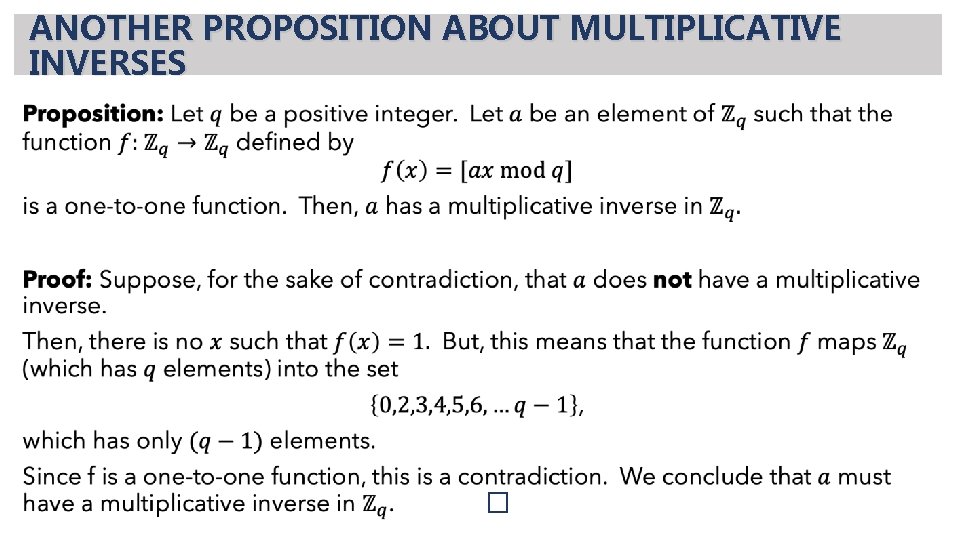
ANOTHER PROPOSITION ABOUT MULTIPLICATIVE INVERSES •
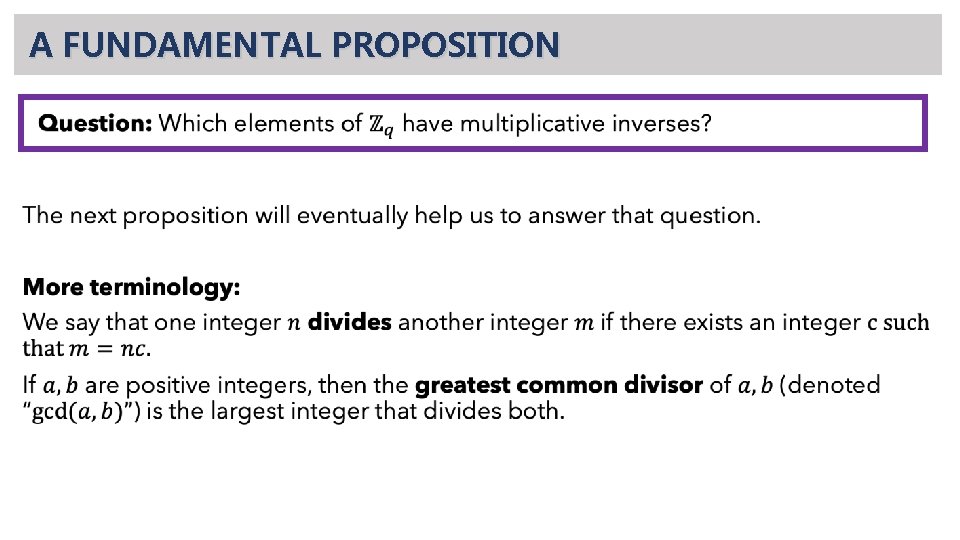
A FUNDAMENTAL PROPOSITION •
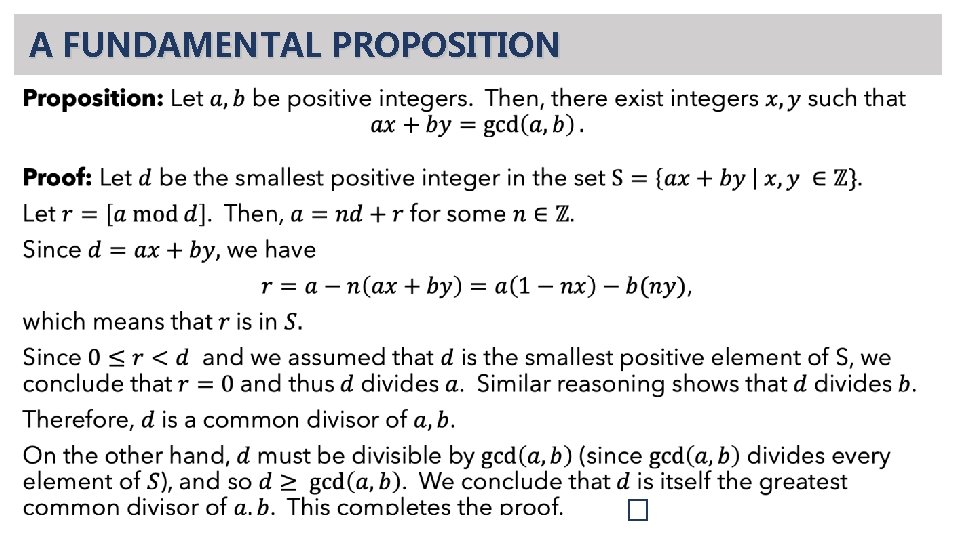
A FUNDAMENTAL PROPOSITION •
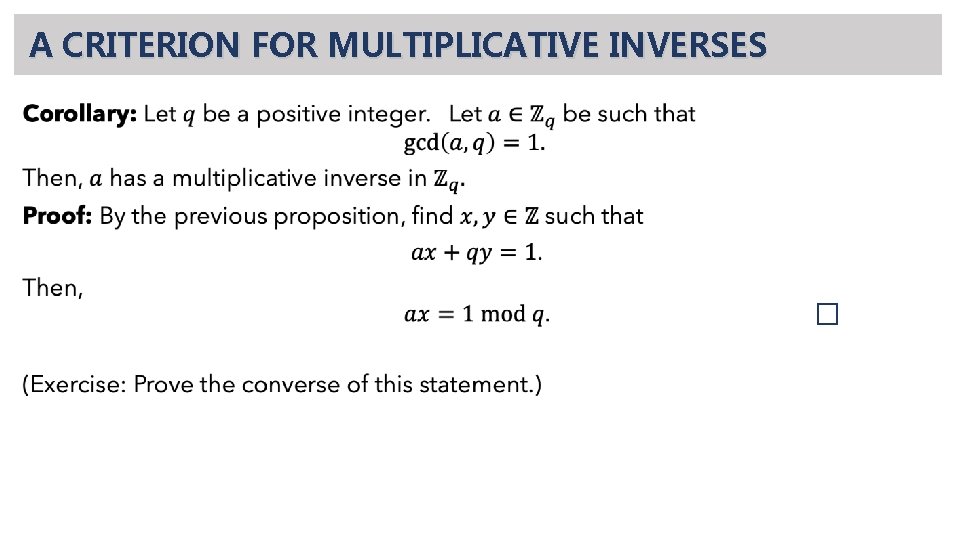
A CRITERION FOR MULTIPLICATIVE INVERSES •
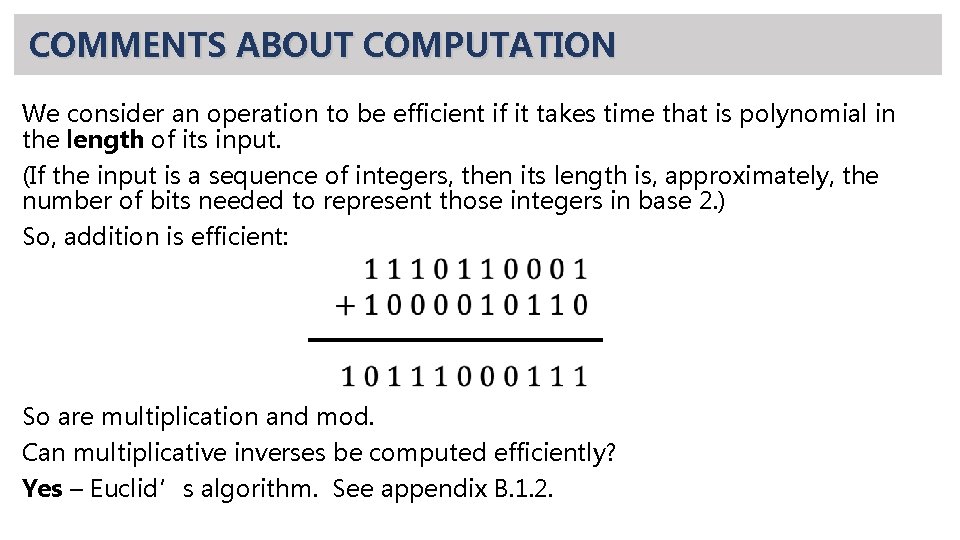
COMMENTS ABOUT COMPUTATION We consider an operation to be efficient if it takes time that is polynomial in the length of its input. (If the input is a sequence of integers, then its length is, approximately, the number of bits needed to represent those integers in base 2. ) So, addition is efficient: So are multiplication and mod. Can multiplicative inverses be computed efficiently? Yes – Euclid’s algorithm. See appendix B. 1. 2.
SUMMING UP •