Managing the Dynamics of Word Teaching and Learning


- Slides: 28
Managing the Dynamics of Word Teaching and Learning CSUF TESOL Club Event – April 12, 2016 Cheryl Boyd Zimmerman, Ph. D. Professor, California State University, Fullerton cbzimmerman@fullerton. edu
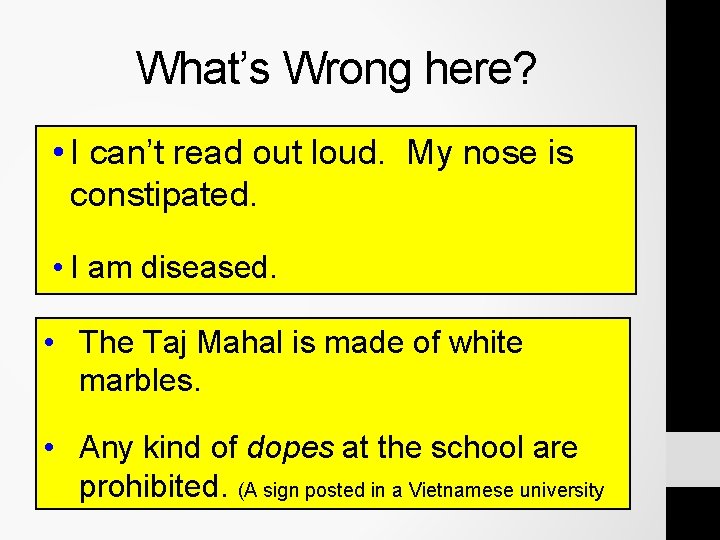
What’s Wrong here? • I can’t read out loud. My nose is constipated. • I am diseased. • The Taj Mahal is made of white marbles. • Any kind of dopes at the school are prohibited. (A sign posted in a Vietnamese university
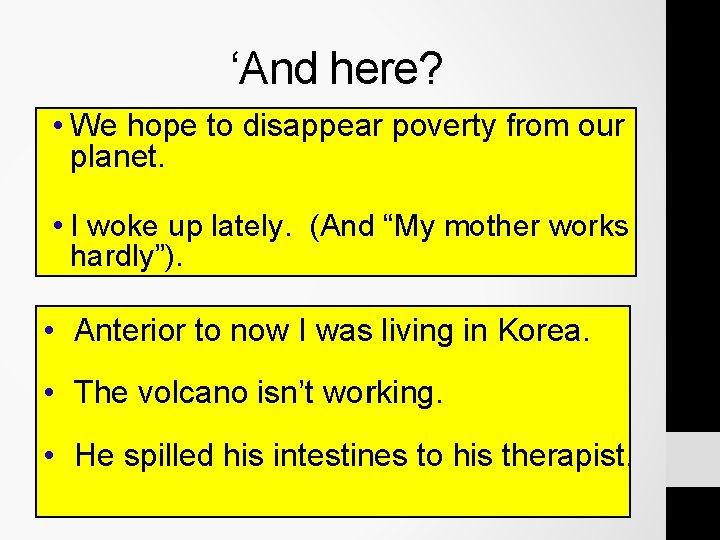
‘And here? • We hope to disappear poverty from our planet. • I woke up lately. (And “My mother works hardly”). • Anterior to now I was living in Korea. • The volcano isn’t working. • He spilled his intestines to his therapist.
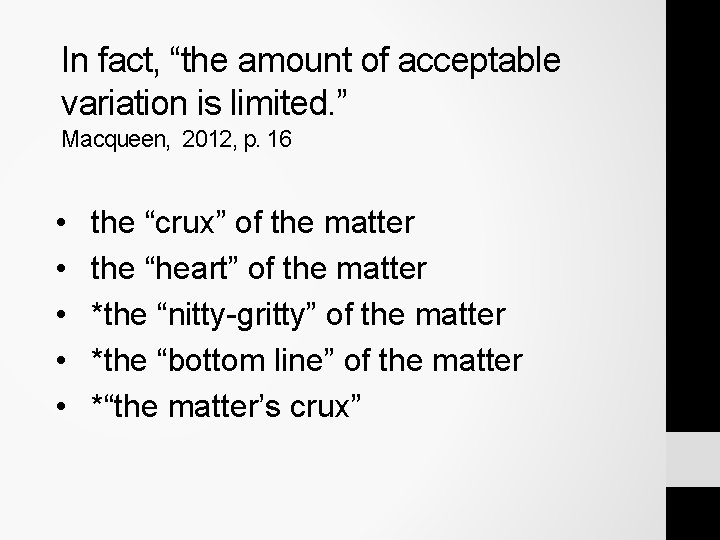
In fact, “the amount of acceptable variation is limited. ” Macqueen, 2012, p. 16 • • • the “crux” of the matter the “heart” of the matter *the “nitty-gritty” of the matter *the “bottom line” of the matter *“the matter’s crux”
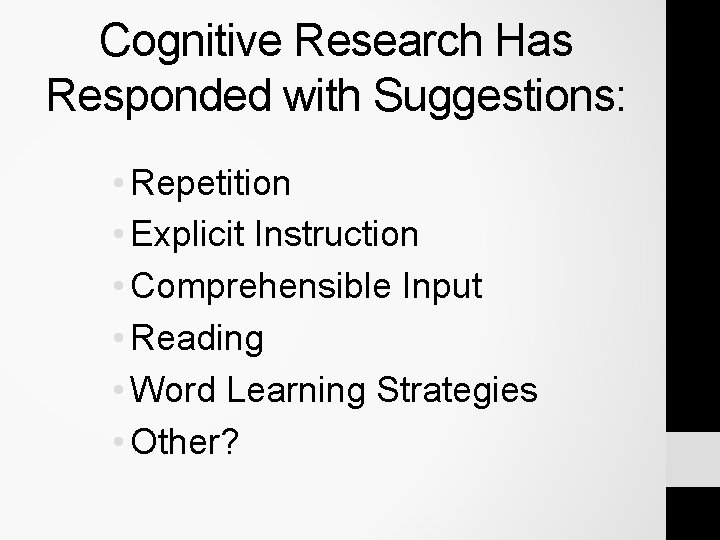
Cognitive Research Has Responded with Suggestions: • Repetition • Explicit Instruction • Comprehensible Input • Reading • Word Learning Strategies • Other?
A Cognitive Approach to Word Learning Does not Explain Everything Learners Need What else, besides this student’s mental learning, is at work here?
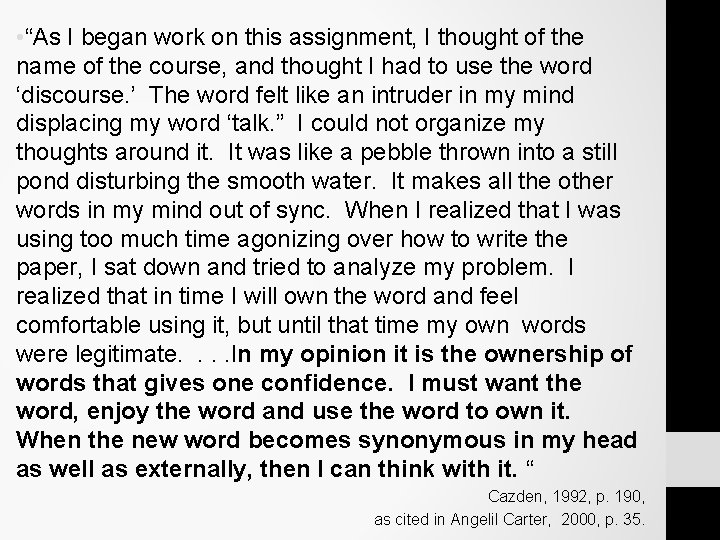
• “As I began work on this assignment, I thought of the name of the course, and thought I had to use the word ‘discourse. ’ The word felt like an intruder in my mind displacing my word ‘talk. ” I could not organize my thoughts around it. It was like a pebble thrown into a still pond disturbing the smooth water. It makes all the other words in my mind out of sync. When I realized that I was using too much time agonizing over how to write the paper, I sat down and tried to analyze my problem. I realized that in time I will own the word and feel comfortable using it, but until that time my own words were legitimate. . In my opinion it is the ownership of words that gives one confidence. I must want the word, enjoy the word and use the word to own it. When the new word becomes synonymous in my head as well as externally, then I can think with it. “ Cazden, 1992, p. 190, as cited in Angelil Carter, 2000, p. 35.
Lexical Insights from More Recent, Socially. Embedded Approaches To SLA
#1 Word Knowledge is a dynamic process rather than a static body of knowledge. Larsen-Freeman & Cameron, 2008; Macqueen, 2012
Recent Lexical “Innovations” • Refudiate • Pharmeceuticals • Spear phishing • Beer o’clock • Fat shame • Other?
What do these words have in common? • Bookmark • Email • Friend • Tweet • Trend • Text
Word Use is “Dynamic” People use language not just to transfer ideas from head to head but to negotiate the kind of relationship they wish to have with their conversational partner. “ Pinker, 2007, p. 3
Practice: How might you say this to : your spouse, your boss, your child, a news reporter, etc. I am not being paid enough and I don’t feel respected.
#2 Word use is more about making meaning than conforming to models. • Larsen-Freeman, 2012 pp. 201 -202
Complex Systems are understood when the “same territory” is visited again and again. 1. Read + You. Tube video on the same topic 2. Narrow Reading (Krashen, 2004) 3. Project-based learning. Larsen-Freeman, 2015
Sentence Re-statement 1. Students read a sentence – take enough time to understand the content well. 2. Put the sentence away. Each student restates the sentence, capturing the central meaning. 3. Discuss the similarities and differences in pairs or as a class. Discuss synonyms, phrases and meaning.
Sentence Re-statement Practice Contrary to the common assumption that families weren’t sending girls to school for cultural reasons, it was discovered that poverty was the main roadblock
#3 Learning “depends on the activity and initiative of the learner more than on ‘inputs’ that are transmitted by a teacher or textbook. ” Macqueen, 2012, p. 278
Not All Words are Equal “Like certain faces among the people I see on the street every day, certain words, for some reason, stand out, and leave an impression on me. Others remain in the background, negligible. “ Lahiri, 2016, p. 41
Personal Dictionaries Ideas from Jumpha Lahiri, 2016. pp. 41; 1. When reading, select words (or phrases) you want to know. 2. Underline them. 3. When finished reading, return to underlining. Record the ones you really want to know. 4. Look up meanings. Record. 5. Return to notebook often.
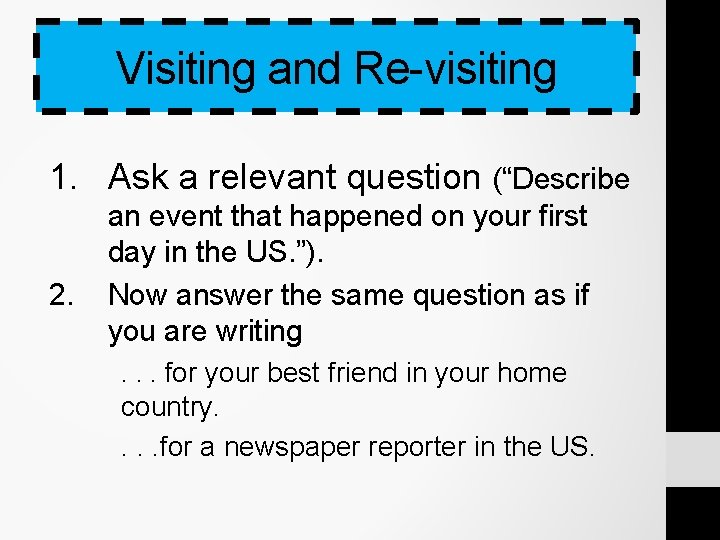
Visiting and Re-visiting 1. Ask a relevant question (“Describe 2. an event that happened on your first day in the US. ”). Now answer the same question as if you are writing . . . for your best friend in your home country. . for a newspaper reporter in the US.
#4 Feedback is “Information Giving”
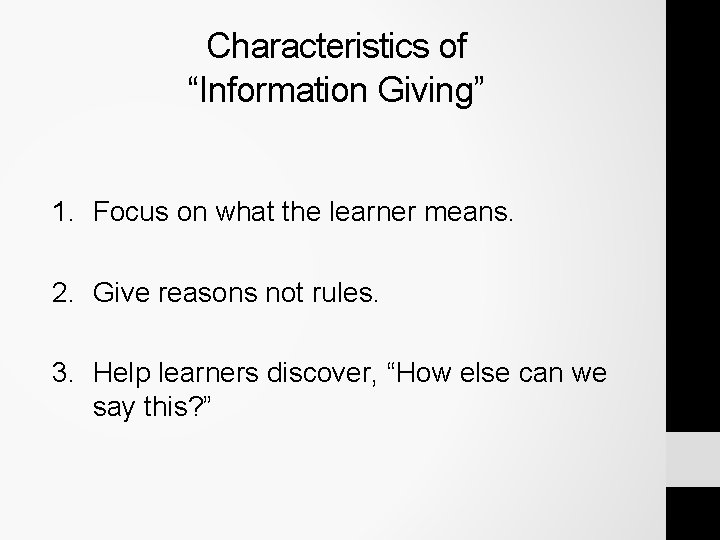
Characteristics of “Information Giving” 1. Focus on what the learner means. 2. Give reasons not rules. 3. Help learners discover, “How else can we say this? ”
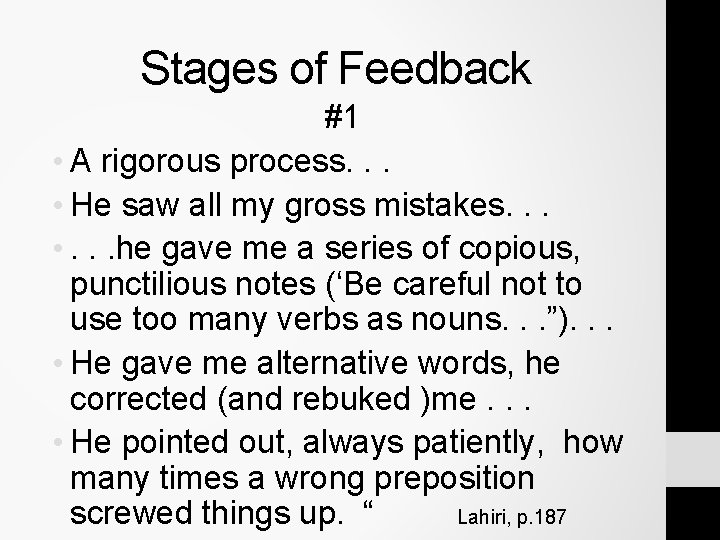
Stages of Feedback #1 • A rigorous process. . . • He saw all my gross mistakes. . . • . . . he gave me a series of copious, punctilious notes (‘Be careful not to use too many verbs as nouns. . . ”). . . • He gave me alternative words, he corrected (and rebuked )me. . . • He pointed out, always patiently, how many times a wrong preposition screwed things up. “ Lahiri, p. 187
#2 • “they explained what sort of impact my reflections had on them, and they always said the most important thing I needed to hear: keep going. ” • “. . . (they) understood my desire to express myself in a new language. ” • “. . . Working together, we made the final fixes. . . ”
Word Learning At first it’s like a dancer, learning a new routine. . . she just mimics the steps and it feels alien. . . ”all energy is on what to do next. . . after awhile she begins to relax and to really dance. ” Angelil-Carter, 2000, p. 34
The Ownership of Words • “. . . In my opinion it is the ownership of words that gives one confidence. I must want the word, enjoy the word and use the word to own it. When the new word becomes synonymous in my head as well as externally, then I can think with it. “ Cazden, 1992, p. 190, as cited in Angelil Carter, 2000, p. 35.