MAdvantage Multimedia Automatic Digital Video Audio Network Through
- Slides: 30
M-Advantage ‘Multimedia - Automatic Digital Video & Audio Network Through Advanced Publishing European Service’ Project proposal Author: Andrea de Polo on the behalf of the M-ADVANTAGE Consortium Presenter: Mari Partio, TUT, Finland 27 th of August, 2005 IASW 2005
Outline • • Motivation State of the Art Scientific and Technological Objectives Outline Implementation Plan Consortium Conclusions References 27 th of August, 2005 IASW 2005 2
Motivation • Aim is to increase the competitiveness of Europe’s digital content industries by semantic services across the content value chain • Target is to build a service infrastructure for automated semantic discovery, extraction, summarization, labeling, composition and personalized delivery of content from heterogeneous multimedia repositories • The project also involves merging multiple heterogeneous datatypes into an integral representation • Goal is to make use of Semantic Web, multimedia description and other standards to enable a broad uptake of M-ADVANTAGE’s open source and non proprietary technologies 27 th of August, 2005 IASW 2005 3
Relation to State of the Art • Tasks, scientific and technological objectives of M-ADVANTAGE can be grouped under intelligent multimedia analysis and access with the use of ontological information. • Thus, the most relevant state of the art is that related to the development of ontological knowledge representations for multimedia applications as well as those related to multimedia analysis and access approaches. 27 th of August, 2005 IASW 2005 4
Description of Multimedia Content • As far as the representation is concerned, the MPEG-7 standard provides a rich set of standardized tools to describe multimedia content. • To make MPEG-7 accessible, re-usable and interoperable in many domains, the semantics of the MPEG-7 metadata should be expressed in an ontology using a machine-understandable language • Additionally there is an increasing need to allow some degree of machine interpretation of multimedia information’s meaning. 27 th of August, 2005 IASW 2005 5
Representing Multimedia Ontology • In [1] Hunter represents multimedia ontology in RDF Schema and demonstrates how this ontology can be exploited and reused by other communities on the semantic web. • First basic multimedia entities and then their hierarchies from the MPEG-7 Multimedia Description Scheme (MDS) basic entities are determined • The RDF schema semantic definitions for MPEG-7 can be linked to their corresponding pre-existing MPEG-7 XML schema definitions. • Additionally, the RDF Schema can be merged with RDF schemas from other domains to generate a single "super-ontology" called Meta. Net. • This super-ontology can be used to enable the co-existence of interoperability, extensibility and diversity within metadata descriptions generated by integrating metadata terms from different domains. • The proposed method for building a multimedia ontology has been applied to manage the manufacturing, performance and image data captured from fuel cell components [8, 9]. 27 th of August, 2005 IASW 2005 6
Using OWL Ontology • • Future work plan of [1] includes the automatic semantic extraction from the MPEG-7 XML schema document as well as linking of the semantics to the XML schema document. To couple with domain-specific and low-level description vocabularies, a similar methodology for enabling interoperability of OWL domain-specific ontologies with the complete MPEG-7 MDS is described in [10]. The approach is based on an OWL ontology, referred as a core ontology, which fully captures the MPEG-7 MDS. For the development of the core ontology, a set of rules is defined to map particular MPEG-7 components to OWL statements. The integration of the domain-specific knowledge is performed by considering the domain specific ontologies as comprising the second layer of the semantic metadata model used in the DS-MIRF framework. Additionally, rules are provided for transforming the OWL/RDF metadata, structured according to the core ontology and the domain-specific ontologies, into MPEG-7 compliant metadata. Following this approach proves advantageous for MPEG-7 -based multimedia content services, such as search and filtering services, since incorporating semantics can lead to more accurate and meaningful results in terms of meeting the user queries. 27 th of August, 2005 IASW 2005 7
Semantic indexing • Semantic indexing aims at finding ”patterns” in unstructured data and use these patterns to offer more effective search and categorization services [12] • Language independent • In order to understand multimedia content, one necessary step is to identify objects within it (similarity search on image parts immersed into various contexts). 27 th of August, 2005 IASW 2005 8
Semantic multimedia retrieval • Semantic multimedia retrieval requires the presence of already annotated multimedia content • Three types of semantic retrieval: – Direct description of semantic track (significance of semantic features should be specified) – Defining semantic track of the target data by giving same type of item as query (sample media file with a set of extracted mathematical features) – Combination of the two earlier methods 27 th of August, 2005 IASW 2005 9
Bayesian Inference • A mathematical technique for modeling the significance of semantic concepts based of how they occur in conjunction with other concepts. • Helps to extract the key conceptual aspects of any piece of unstructural information 27 th of August, 2005 IASW 2005 10
Pattern-matching technology • Information theory provides a mechanism for being able to extract the most meaningful ideas in documents -> pattern matching • Shannon’s theory: ”the less frequently a unit of communication occurs, the more information it conveys” • Pattern-matching approach has the additional benefits: – robust to false positive matches – it can determine how similar documents are 27 th of August, 2005 IASW 2005 11
Scientific & Technological Objectives • • • The M-ADVANTAGE project aims at developing an infrastructure capable of delivering multimedia information and content customized to the needs of end-users. It focuses on building some specific components to provide the functionalities necessary to facilitate the construction of advanced multimedia content applications and the use of structured and unstructured multimedia information. The goal of the M-ADVANTAGE approach to the “delivering multimedia information and content customized to the needs of end-users” is based on three ambitious deliverables: – M-ADVANTAGE is able to automatically integrate heterogeneous multimedia content. – 360° Technology Approach: M-ADVANTAGE infrastructure is based on the more up-to-date technology approaches for managing unstructured information: Keyword, Semantic and Statistical (through a pattern matching system). – Develop specific application services to deliver the content managed by the MADVANTAGE back-end infrastructure 27 th of August, 2005 IASW 2005 12
Scientific & Technological Objectives • These features will enable the utilization of digital content delivery systems distributed across the computer network and will process the information stored within these archives in order to find dependencies, links and similarities between various pieces of information. • It will also allow to automatically manage and customize the available content for the needs of end-user applications built on top of the MADVANTAGE infrastructure 27 th of August, 2005 IASW 2005 13
Scientific objectives • • • Automated (semantic) multimedia discovery, which concerns both retrieval, i. e. search for multimedia files; and extraction, i. e. more focused search for specific structural components of the multimedia: episodes, frames, images (focuses), etc. Advanced video summarization, i. e. general idea of the video content can be obtained quickly. Advanced techniques for semantic labeling, i. e. propagation of labels through hierarchical database structures. Automated multimedia integration / composition: real power is in composition of different structural elements (episodes, frames, focuses) extracted from heterogeneous multimedia files in a coherent track. Semantic personalized delivery: based on semantic interactions of user activities / actions on content and user's explicit preferences; proactive supply to the user of relevant multimedia. Interoperability between heterogeneous (web-) services and multimedia: this is possible following Semantic Web's recommendations about common (upper-) ontology or managing mapping between semantic concepts from different ontologies. 27 th of August, 2005 IASW 2005 14
Technical objectives • M-ADVANTAGE aims at creating a state-of-the-art cutting edge technology that is going to serve public and business sector in the knowledge management for multimedia. In that respect: – To enhance search behavior statistical search will be used as a super set of the conventional methods to grasp concepts embedded in images, text and videos – The combination of semantic / ontology methodologies and the statistical one will offer users the possibility to have a much more precise and to the point interaction with the KB. Users will be profiled and grouped into communities according to their previous interactions with the KB. – Splitting content into its fundamental parts (scene detection, object extraction) – Utilization of speech from video and the most advanced speech to text technology to search for the most meaningful frames related to search argument 27 th of August, 2005 IASW 2005 15
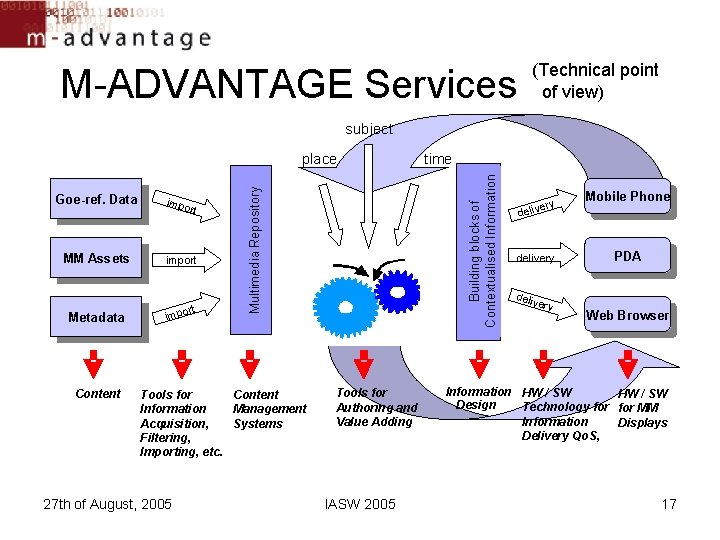
Outline Implementation Plan • M-ADVANTAGE platform intends to provide an integrated solution for the B 2 B value chain starting from the content owners passing through the added-value content creators and arriving to the service providers • Market standard networks and devices are planned to be used by the final users, accessing the services created within the M-ADVANTAGE platform. • This can be broken down into the segmentations described in Figure 1 representing a more in depth view of the content value chain that M-ADVANTAGE intends to address. 27 th of August, 2005 IASW 2005 16
M-ADVANTAGE Services (Technical point of view) subject MM MMAssets Metadata Content impo rt import rt impo Multimedia Repository Goe-ref. Data Tools for Content Information Management Acquisition, Systems Filtering, Importing, etc. 27 th of August, 2005 time Building blocks of Contextualised Information place Tools for Authoring and Value Adding IASW 2005 y er delivery deliv ery Mobile. Phone PDA Web. Browser Information HW / SW Design Technology for MM Information Displays Delivery Qo. S, 17
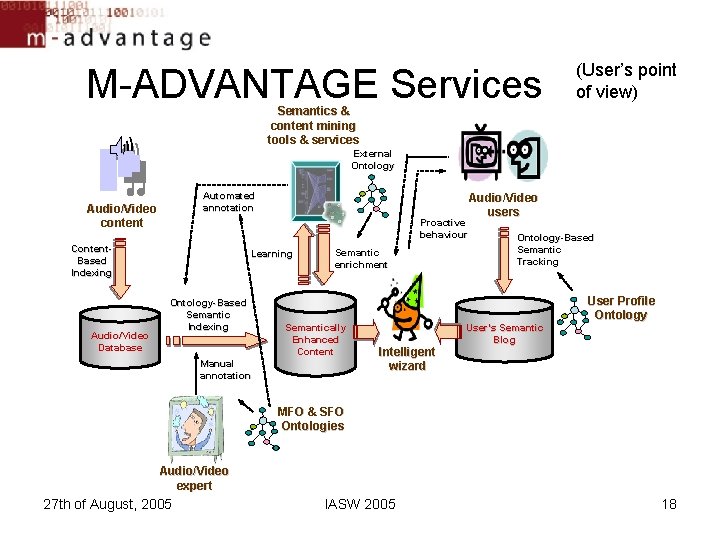
M-ADVANTAGE Services (User’s point of view) Semantics & content mining tools & services External Ontology Automated annotation Audio/Video content Proactive behaviour Content. Based Indexing Audio/Video Database Learning Ontology-Based Semantic Indexing Semantic enrichment Semantically Enhanced Content Manual annotation Intelligent wizard Audio/Video users Ontology-Based Semantic Tracking User’s Semantic Blog User Profile Ontology MFO & SFO Ontologies Audio/Video expert 27 th of August, 2005 IASW 2005 18
M-ADVANTAGE’s Improvements to the Industrial Processes: • Provides access to a larger amount of multimedia information • Simplifies search activities • Offers an integrated Digital Rights Management System (DRMS) • Provides a Customized Multi Licensee Service • Offers a secure online payment mechanism • Pay per View • Automatic tools to enrich ”poor” or unclassified items with enriched multimedia features • Offering customized and personalized search environments 27 th of August, 2005 IASW 2005 19
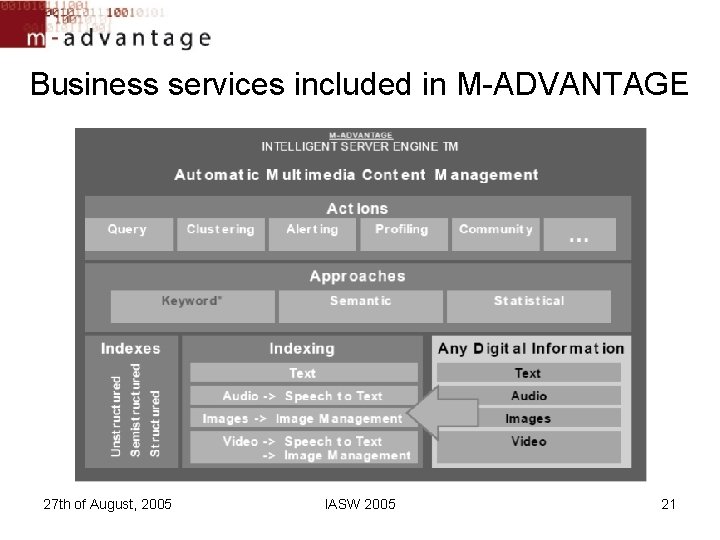
M-ADVANTAGE Platform • M-ADVANTAGE platform is intended to be a basis for a wide set of tools, which satisfy different needs of different actors: – different business approaches – different technological situations – different vocations • To satisfy all these aspects, M-ADVANTAGE needs to integrate and/or develop wide range of tools and services, as briefly summarized in following figure 27 th of August, 2005 IASW 2005 20
Business services included in M-ADVANTAGE 27 th of August, 2005 IASW 2005 21
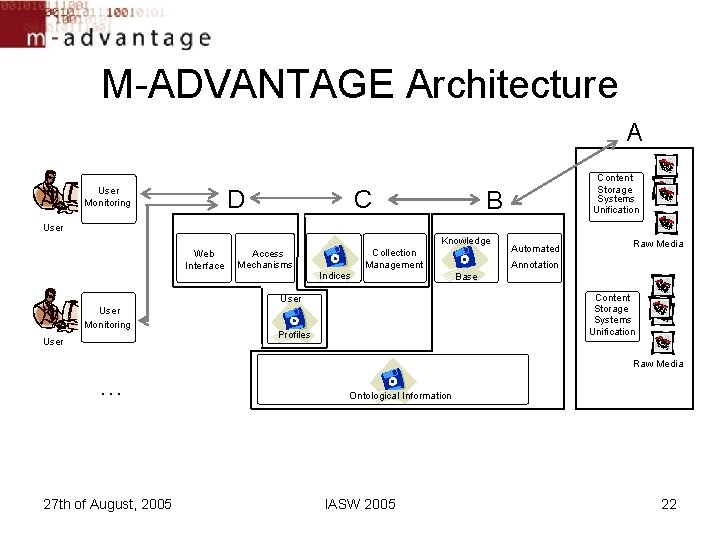
M-ADVANTAGE Architecture A User Monitoring D C Content Storage Systems Unification B User Knowledge Web Interface Collection Management Access Mechanisms Indices User Raw Media Annotation Base Content Storage Systems Unification User Monitoring Automated Profiles Raw Media … 27 th of August, 2005 Ontological Information IASW 2005 22
Development component 1 • One of the main objectives is to enable the access and consideration of heterogeneous archives • Thus the first service is the analysis of existing content storage systems and the specification of a generic querying and access interface capable to support and serve all existing content • Based on this generic interface, it will be possible to create software interfaces, custom to each archive, which allow for the automatic connection of the archive with the overall M-ADVANTAGE system 27 th of August, 2005 IASW 2005 23
Development component 2 • Most important and challenging objective of MADVANTAGE is to contribute to the effort to bridge the semantic gap (knowledge based approaches to semi-automatic and fully automatic media annotation) • Complex ontological data models will be developed • Various methodologies will be utilized (manual annotation to semiautomatic, retainable and adaptive computer assisted annotation and fully automated knowledge driven annotation) 27 th of August, 2005 IASW 2005 24
Development component 3 • The meta-publication description format used to store the analysis results in the knowledge base will also be designed so that it provides optimal balance between effectiveness and efficiency for storage and consequent processes. • While the aim is to provide fundamental measurements of the collection and properties, M-ADVANTAGE will also address the issue in concrete terms of clustering and informative sampling • The aim is to instantiate the concept of collection guiding that extends classical browsing by creating exploration strategies around the document collection and therefore literally guide through it. 27 th of August, 2005 IASW 2005 25
Development component 4 • M-ADVANTAGE aims to offer innovative, intelligent, personalized multimedia search and access services to end users • State of the art content management system will be integrated in the overall platform, allowing for simple, semantic and statistical search; in all of these approaches, knowledge contained in ontological databases will also be considered • User interactions will be analyzed in order to extract user profiles that can be fed back into the system thus enhancing the quality of services offered to each specific user 27 th of August, 2005 IASW 2005 26
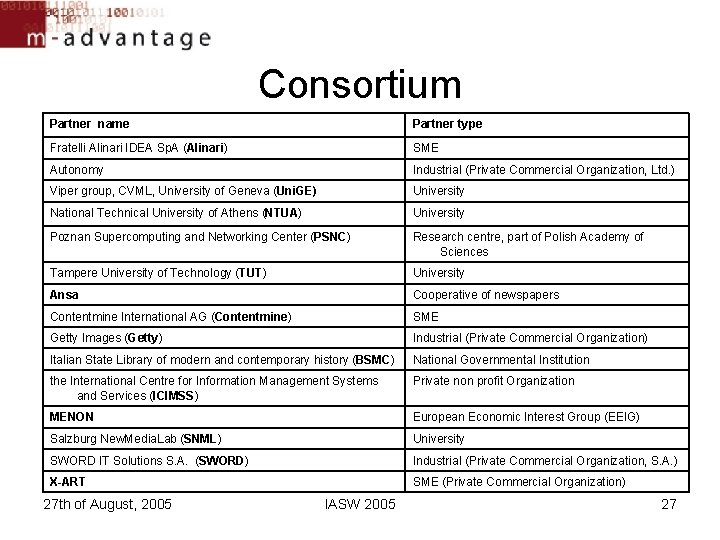
Consortium Partner name Partner type Fratelli Alinari IDEA Sp. A (Alinari) SME Autonomy Industrial (Private Commercial Organization, Ltd. ) Viper group, CVML, University of Geneva (Uni. GE) University National Technical University of Athens (NTUA) University Poznan Supercomputing and Networking Center (PSNC) Research centre, part of Polish Academy of Sciences Tampere University of Technology (TUT) University Ansa Cooperative of newspapers Contentmine International AG (Contentmine) SME Getty Images (Getty) Industrial (Private Commercial Organization) Italian State Library of modern and contemporary history (BSMC) National Governmental Institution the International Centre for Information Management Systems and Services (ICIMSS) Private non profit Organization MENON European Economic Interest Group (EEIG) Salzburg New. Media. Lab (SNML) University SWORD IT Solutions S. A. (SWORD) Industrial (Private Commercial Organization, S. A. ) X-ART SME (Private Commercial Organization) 27 th of August, 2005 IASW 2005 27
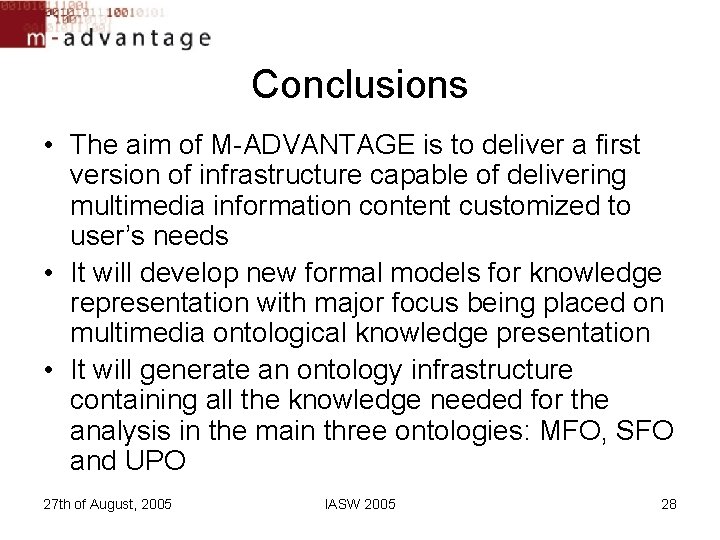
Conclusions • The aim of M-ADVANTAGE is to deliver a first version of infrastructure capable of delivering multimedia information content customized to user’s needs • It will develop new formal models for knowledge representation with major focus being placed on multimedia ontological knowledge presentation • It will generate an ontology infrastructure containing all the knowledge needed for the analysis in the main three ontologies: MFO, SFO and UPO 27 th of August, 2005 IASW 2005 28
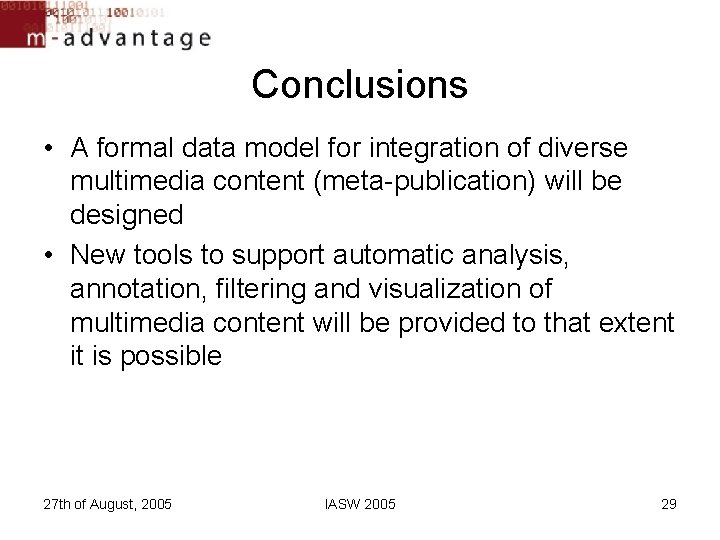
Conclusions • A formal data model for integration of diverse multimedia content (meta-publication) will be designed • New tools to support automatic analysis, annotation, filtering and visualization of multimedia content will be provided to that extent it is possible 27 th of August, 2005 IASW 2005 29
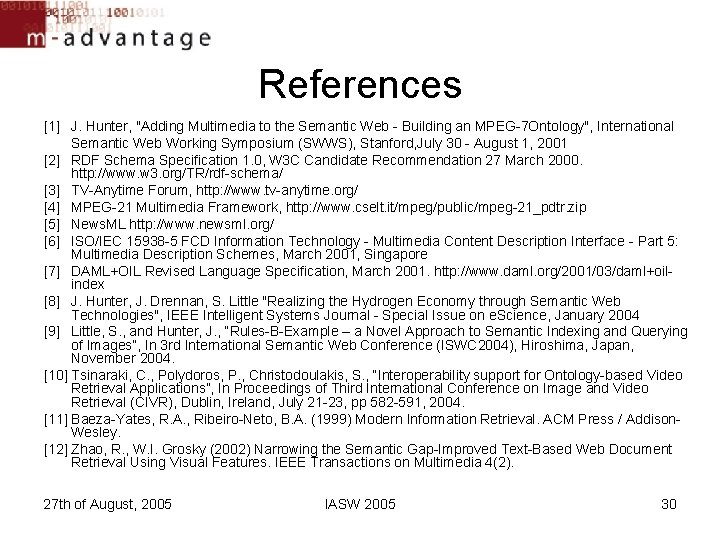
References [1] J. Hunter, "Adding Multimedia to the Semantic Web - Building an MPEG-7 Ontology", International Semantic Web Working Symposium (SWWS), Stanford, July 30 - August 1, 2001 [2] RDF Schema Specification 1. 0, W 3 C Candidate Recommendation 27 March 2000. http: //www. w 3. org/TR/rdf-schema/ [3] TV-Anytime Forum, http: //www. tv-anytime. org/ [4] MPEG-21 Multimedia Framework, http: //www. cselt. it/mpeg/public/mpeg-21_pdtr. zip [5] News. ML http: //www. newsml. org/ [6] ISO/IEC 15938 -5 FCD Information Technology - Multimedia Content Description Interface - Part 5: Multimedia Description Schemes, March 2001, Singapore [7] DAML+OIL Revised Language Specification, March 2001. http: //www. daml. org/2001/03/daml+oilindex [8] J. Hunter, J. Drennan, S. Little "Realizing the Hydrogen Economy through Semantic Web Technologies", IEEE Intelligent Systems Journal - Special Issue on e. Science, January 2004 [9] Little, S. , and Hunter, J. , “Rules-B-Example – a Novel Approach to Semantic Indexing and Querying of Images”, In 3 rd International Semantic Web Conference (ISWC 2004), Hiroshima, Japan, November 2004. [10] Tsinaraki, C. , Polydoros, P. , Christodoulakis, S. , “Interoperability support for Ontology-based Video Retrieval Applications”, In Proceedings of Third International Conference on Image and Video Retrieval (CIVR), Dublin, Ireland, July 21 -23, pp 582 -591, 2004. [11] Baeza-Yates, R. A. , Ribeiro-Neto, B. A. (1999) Modern Information Retrieval. ACM Press / Addison. Wesley. [12] Zhao, R. , W. I. Grosky (2002) Narrowing the Semantic Gap-Improved Text-Based Web Document Retrieval Using Visual Features. IEEE Transactions on Multimedia 4(2). 27 th of August, 2005 IASW 2005 30