Lowx at the LHC and with UHECRs Lowx



- Slides: 34
Low-x at the LHC and with UHECR’s Low-x 2006 Workshop, Lisbon A. M Cooper-Sarkar (Oxford) • The LHC is a low-x machine- at least for the first few years • What can W/Z rapidity spectra tell us about the low-x gluon PDF? • What can the W decay lepton asymmetry tell us about low-x valence PDFs? • Can we use the conventional DGLAP NLO QCD formalism? • Future information from Ultra-High Energy Cosmic Rays
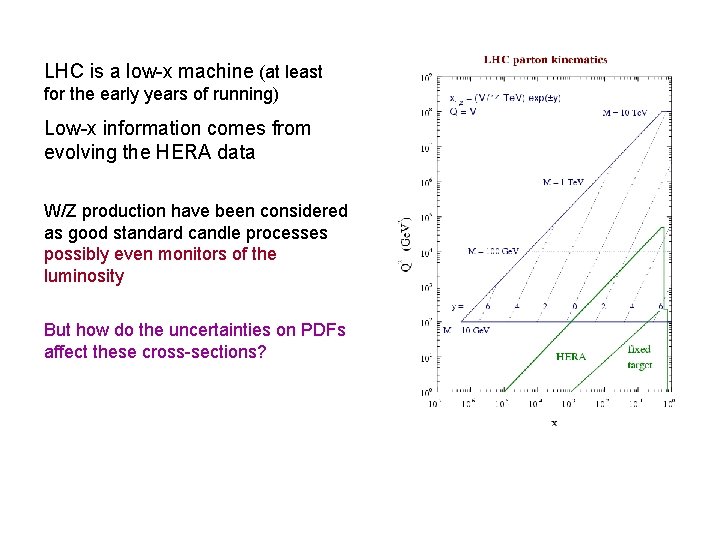
LHC is a low-x machine (at least for the early years of running) Low-x information comes from evolving the HERA data W/Z production have been considered as good standard candle processes possibly even monitors of the luminosity But how do the uncertainties on PDFs affect these cross-sections?
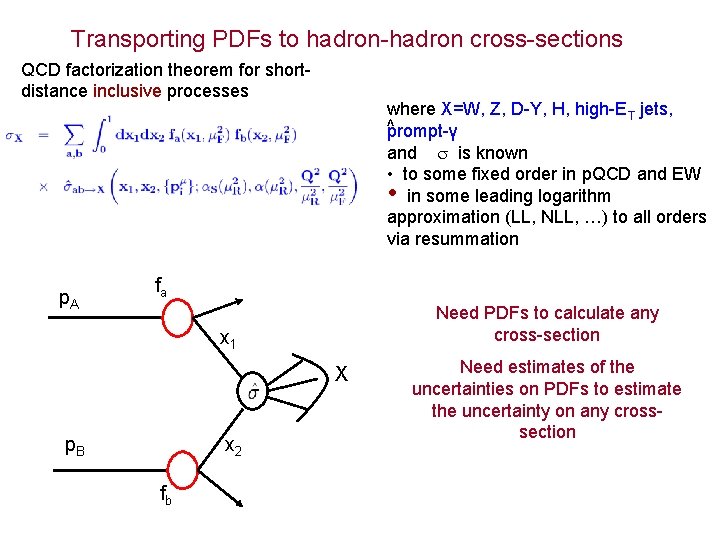
Transporting PDFs to hadron-hadron cross-sections QCD factorization theorem for shortdistance inclusive processes p. A where X=W, Z, D-Y, H, high-ET jets, ^prompt-γ and is known • to some fixed order in p. QCD and EW • in some leading logarithm approximation (LL, NLL, …) to all orders via resummation fa Need PDFs to calculate any cross-section x 1 X x 2 p. B fb Need estimates of the uncertainties on PDFs to estimate the uncertainty on any crosssection
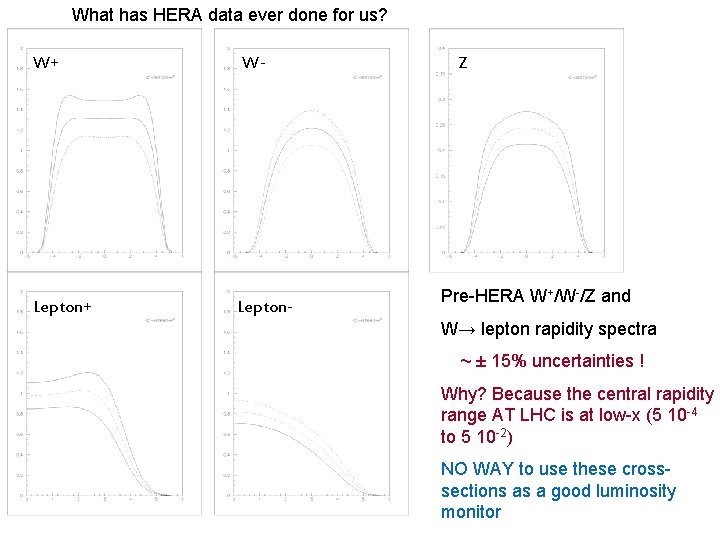
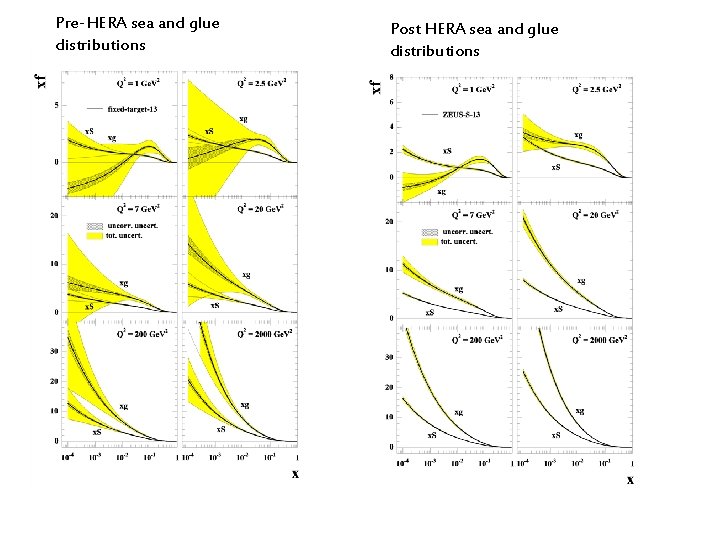
What has HERA data ever done for us? W+ Lepton+ W- Lepton- Z Pre-HERA W+/W-/Z and W→ lepton rapidity spectra ~ ± 15% uncertainties ! Why? Because the central rapidity range AT LHC is at low-x (5 10 -4 to 5 10 -2) NO WAY to use these crosssections as a good luminosity monitor
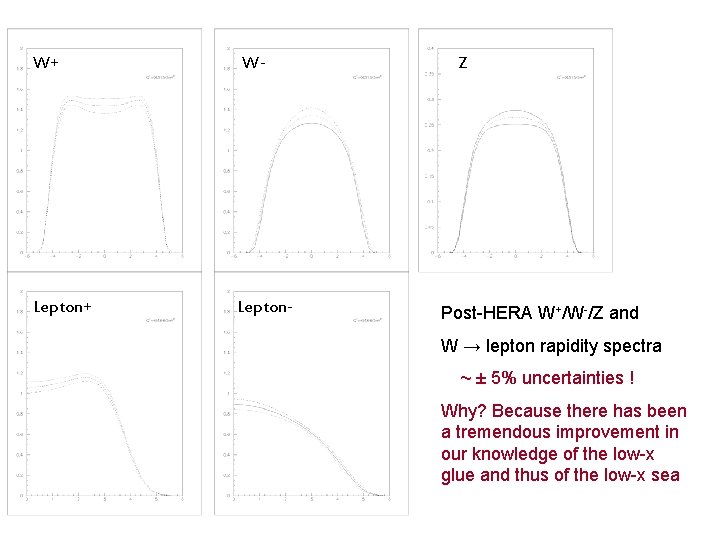
W+ Lepton+ W- Lepton- Z Post-HERA W+/W-/Z and W → lepton rapidity spectra ~ ± 5% uncertainties ! Why? Because there has been a tremendous improvement in our knowledge of the low-x glue and thus of the low-x sea
Pre-HERA sea and glue distributions Post HERA sea and glue distributions
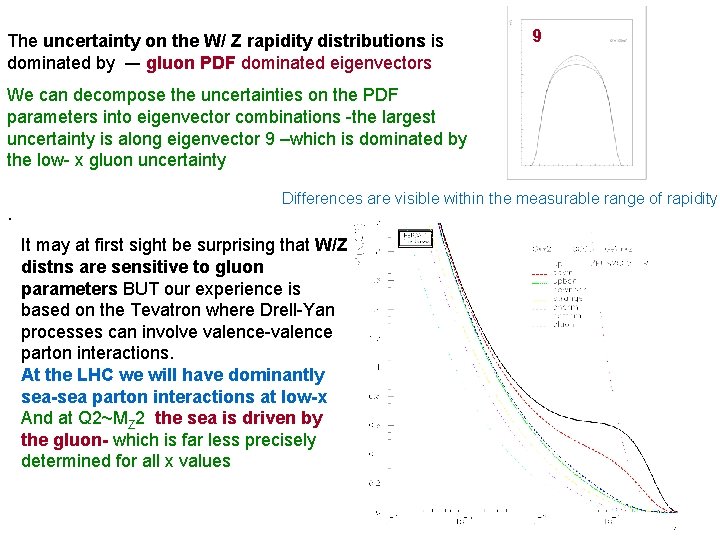
The uncertainty on the W/ Z rapidity distributions is dominated by –- gluon PDF dominated eigenvectors 9 We can decompose the uncertainties on the PDF parameters into eigenvector combinations -the largest uncertainty is along eigenvector 9 –which is dominated by the low- x gluon uncertainty. Differences are visible within the measurable range of rapidity It may at first sight be surprising that W/Z distns are sensitive to gluon parameters BUT our experience is based on the Tevatron where Drell-Yan processes can involve valence-valence parton interactions. At the LHC we will have dominantly sea-sea parton interactions at low-x And at Q 2~MZ 2 the sea is driven by the gluon- which is far less precisely determined for all x values
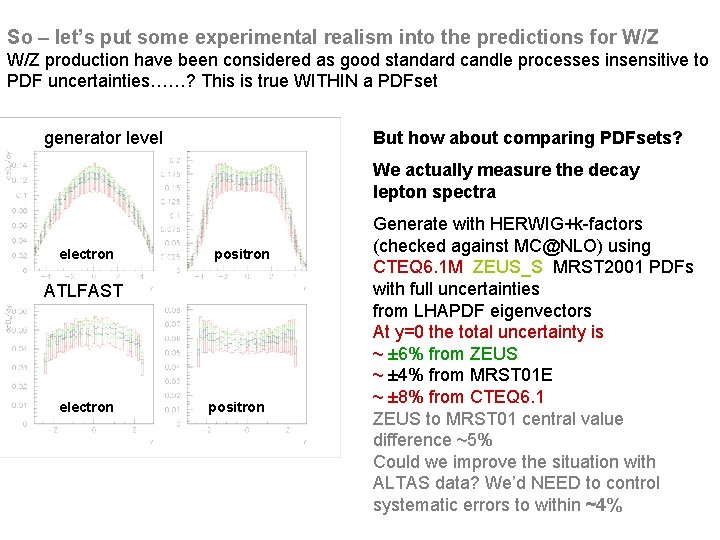
So – let’s put some experimental realism into the predictions for W/Z production have been considered as good standard candle processes insensitive to PDF uncertainties……? This is true WITHIN a PDFset generator level But how about comparing PDFsets? We actually measure the decay lepton spectra electron positron ATLFAST electron positron Generate with HERWIG+k-factors (checked against MC@NLO) using CTEQ 6. 1 M ZEUS_S MRST 2001 PDFs with full uncertainties from LHAPDF eigenvectors At y=0 the total uncertainty is ~ ± 6% from ZEUS ~ ± 4% from MRST 01 E ~ ± 8% from CTEQ 6. 1 ZEUS to MRST 01 central value difference ~5% Could we improve the situation with ALTAS data? We’d NEED to control systematic errors to within ~4%
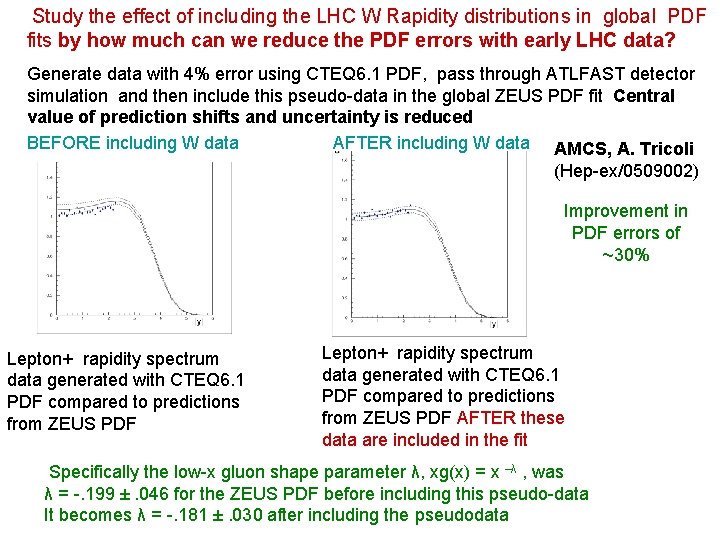
Study the effect of including the LHC W Rapidity distributions in global PDF fits by how much can we reduce the PDF errors with early LHC data? Generate data with 4% error using CTEQ 6. 1 PDF, pass through ATLFAST detector simulation and then include this pseudo-data in the global ZEUS PDF fit Central value of prediction shifts and uncertainty is reduced BEFORE including W data AFTER including W data AMCS, A. Tricoli (Hep-ex/0509002) Improvement in PDF errors of ~30% Lepton+ rapidity spectrum data generated with CTEQ 6. 1 PDF compared to predictions from ZEUS PDF AFTER these data are included in the fit Specifically the low-x gluon shape parameter λ, xg(x) = x –λ , was λ = -. 199 ±. 046 for the ZEUS PDF before including this pseudo-data It becomes λ = -. 181 ±. 030 after including the pseudodata
The uncertainty on the W/Z rapidity distributions is dominated by –- gluon PDF dominated eigenvectors and there is cancellation in the ratios AW = (W+ - W-)/(W+ + W-) ZW = Z/(W+ + W-) Remaining uncertainty comes from valence PDF related eigenvectors Well Known? Gold plated? We will measure the lepton asymmetry Within each PDF set uncertainty in the lepton asymmetry IS LESS than in the lepton rapidity spectra, e. g about 2% for the asymmetry at y=0, as opposed to about 4% for the lepton rapidity spectra themselves (using MRST 2001 PDFS) However the PDF sets differ from each other more strikingly- MRST 01 and CTEQ 6. 1 differ by about 13% at y=0! But this is an opportunity to use ATLAS measurements to increase knowledge of the valence PDFs at x~0. 005 generator level ATLFAST
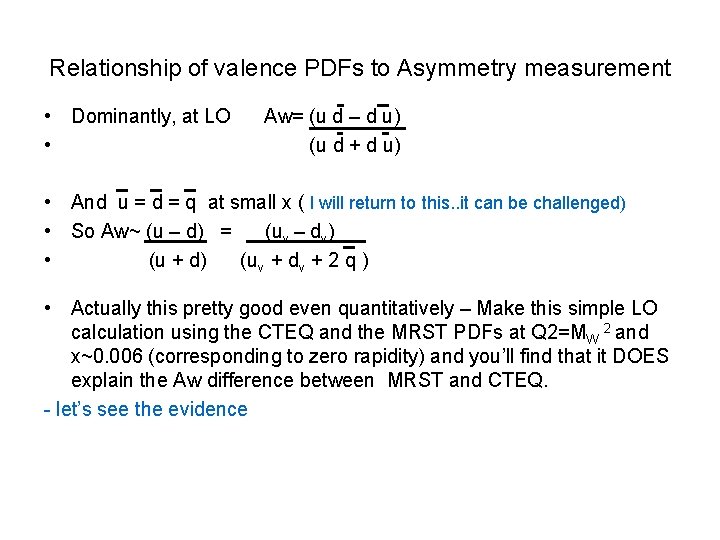
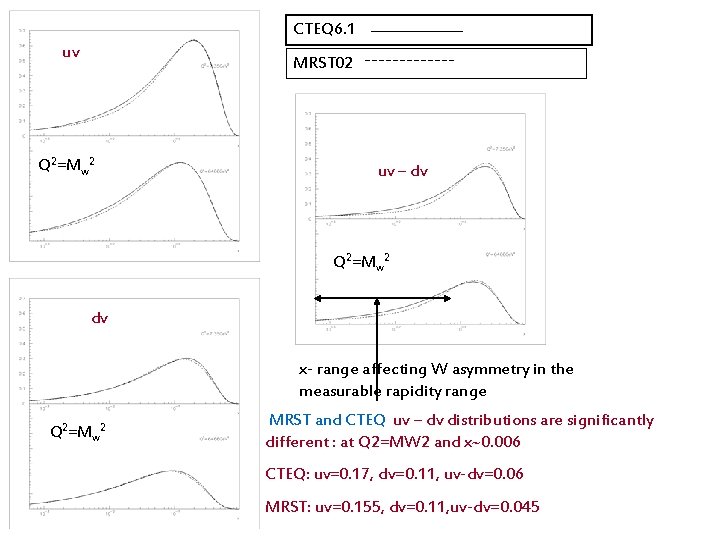
Relationship of valence PDFs to Asymmetry measurement • Dominantly, at LO • Aw= (u d – d u) (u d + d u) • And u = d = q at small x ( I will return to this. . it can be challenged) • So Aw~ (u – d) = (uv – dv) • (u + d) (uv + dv + 2 q ) • Actually this pretty good even quantitatively – Make this simple LO calculation using the CTEQ and the MRST PDFs at Q 2=MW 2 and x~0. 006 (corresponding to zero rapidity) and you’ll find that it DOES explain the Aw difference between MRST and CTEQ. - let’s see the evidence
CTEQ 6. 1 uv MRST 02 Q 2=Mw 2 uv – dv Q 2=Mw 2 dv x- range affecting W asymmetry in the measurable rapidity range Q 2=Mw 2 MRST and CTEQ uv – dv distributions are significantly different : at Q 2=MW 2 and x~0. 006 CTEQ: uv=0. 17, dv=0. 11, uv-dv=0. 06 MRST: uv=0. 155, dv=0. 11, uv-dv=0. 045
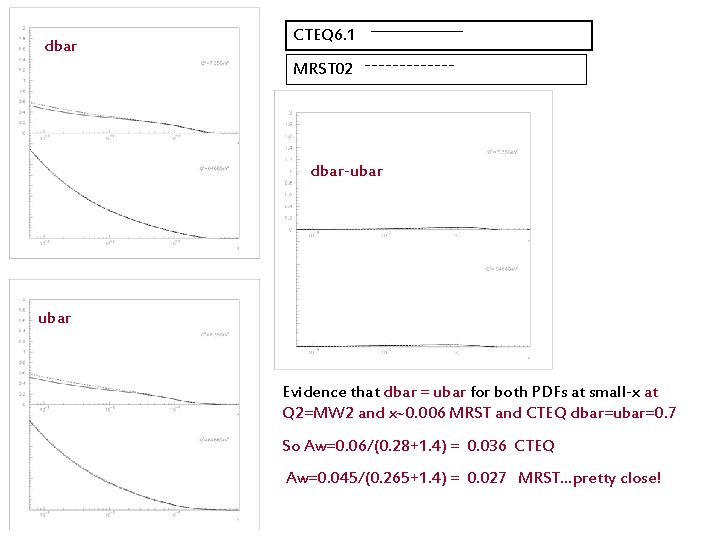
dbar CTEQ 6. 1 MRST 02 dbar-ubar Evidence that dbar = ubar for both PDFs at small-x at Q 2=MW 2 and x~0. 006 MRST and CTEQ dbar=ubar=0. 7 So Aw=0. 06/(0. 28+1. 4) = 0. 036 CTEQ Aw=0. 045/(0. 265+1. 4) = 0. 027 MRST…pretty close!
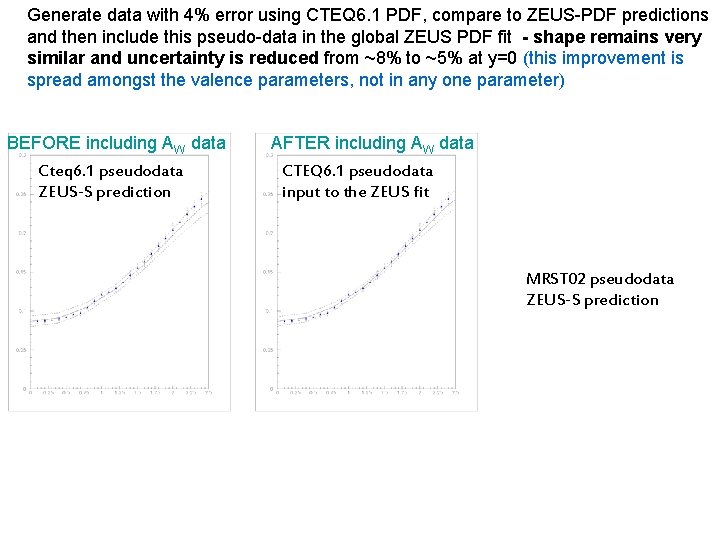
Generate data with 4% error using CTEQ 6. 1 PDF, compare to ZEUS-PDF predictions and then include this pseudo-data in the global ZEUS PDF fit - shape remains very similar and uncertainty is reduced from ~8% to ~5% at y=0 (this improvement is spread amongst the valence parameters, not in any one parameter) BEFORE including AW data Cteq 6. 1 pseudodata ZEUS-S prediction AFTER including AW data CTEQ 6. 1 pseudodata input to the ZEUS fit MRST 02 pseudodata ZEUS-S prediction
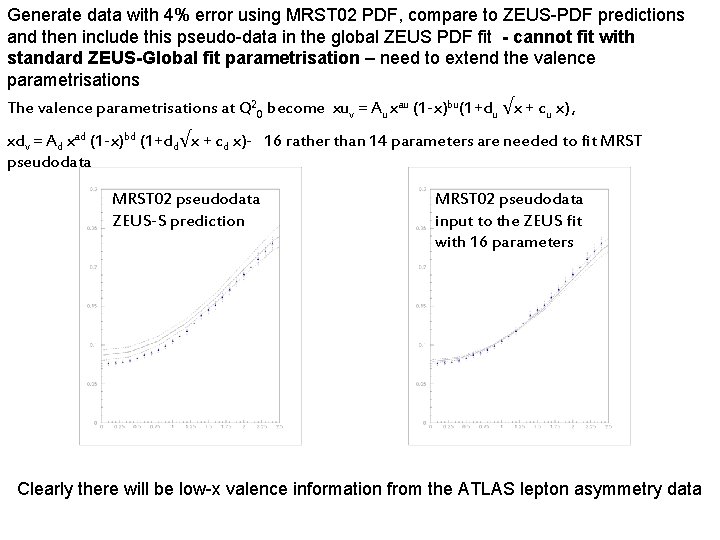
Generate data with 4% error using MRST 02 PDF, compare to ZEUS-PDF predictions and then include this pseudo-data in the global ZEUS PDF fit - cannot fit with standard ZEUS-Global fit parametrisation – need to extend the valence parametrisations The valence parametrisations at Q 20 become xuv = Au xau (1 -x)bu(1+du √x + cu x) , xdv = Ad xad (1 -x)bd (1+dd√x + cd x)- 16 rather than 14 parameters are needed to fit MRST pseudodata MRST 02 pseudodata ZEUS-S prediction MRST 02 pseudodata input to the ZEUS fit with 16 parameters Clearly there will be low-x valence information from the ATLAS lepton asymmetry data
But all of this was within the standard DGLAP NLOQCD theoretical paradigm Is NLO (or even NNLO) DGLAP good enough? The QCD formalism may need extending at small-x
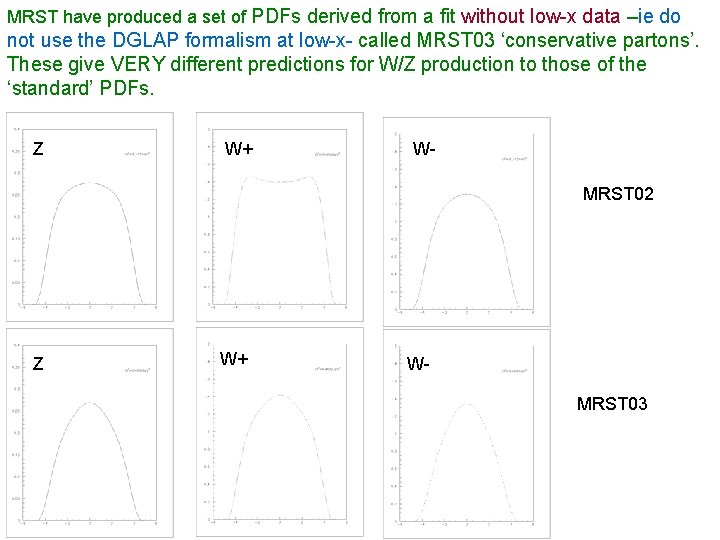
MRST have produced a set of PDFs derived from a fit without low-x data –ie do not use the DGLAP formalism at low-x- called MRST 03 ‘conservative partons’. These give VERY different predictions for W/Z production to those of the ‘standard’ PDFs. Z W+ WMRST 02 Z W+ WMRST 03
Differences persist in the decay lepton spectra and even in their ratio and asymmetry distributions Reconstructed Electron Pseudo-Rapidity Distributions (ATLAS fast simulation) 200 k events of W+- -> e+- generated with HERWIG 6. 505 + NLO K factors Reconstructed e- Reconstructed e+ 6 hours running MRST 02 MRST 03 h Reconstructed e+- e- Asymmetry h Reconstructed e- / e+ Ratio MRST 02 MRST 03 h
Note of caution. MRST 03 conservative partons DO NOT describe the HERA data for x< 5 10 -3 which is not included in the fit which produces them. So there is no reason why they should correctly predict LHC data at non-central y, which probe such low x regions. What is really required is an alternative theoretical treatment of low-x evolution which would describe HERA data at low-x, and could then predict LHC W/Z rapidity distributions reliably – also has consequences for pt distributions. The point of the MRST 03 partons is to illustrate that this prediction COULD be very different from the current ‘standard’ PDF predictions. When older standard predictions for HERA data were made in the early 90’s they did not predict the striking rise of HERA data at low-x. This is a warning against believing that a current theoretical paradigm for the behaviour of QCD at low-x can be extrapolated across decades in Q 2 with full confidence. → The LHC measurements may also tell us something new about QCD
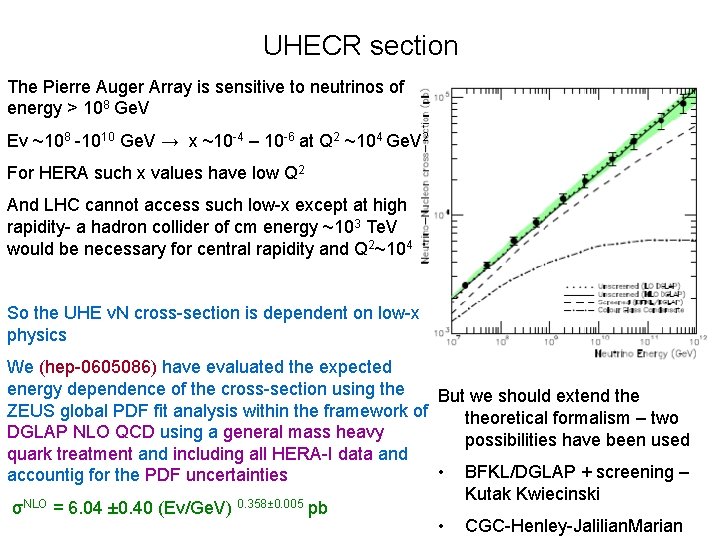
UHECR section The Pierre Auger Array is sensitive to neutrinos of energy > 108 Ge. V Eν ~108 -1010 Ge. V → x ~10 -4 – 10 -6 at Q 2 ~104 Ge. V 2 For HERA such x values have low Q 2 And LHC cannot access such low-x except at high rapidity- a hadron collider of cm energy ~103 Te. V would be necessary for central rapidity and Q 2~104 So the UHE νN cross-section is dependent on low-x physics We (hep-0605086) have evaluated the expected energy dependence of the cross-section using the But we should extend the ZEUS global PDF fit analysis within the framework of theoretical formalism – two DGLAP NLO QCD using a general mass heavy possibilities have been used quark treatment and including all HERA-I data and • BFKL/DGLAP + screening – accountig for the PDF uncertainties Kutak Kwiecinski NLO 0. 358± 0. 005 σ = 6. 04 ± 0. 40 (Eν/Ge. V) pb • CGC-Henley-Jalilian. Marian
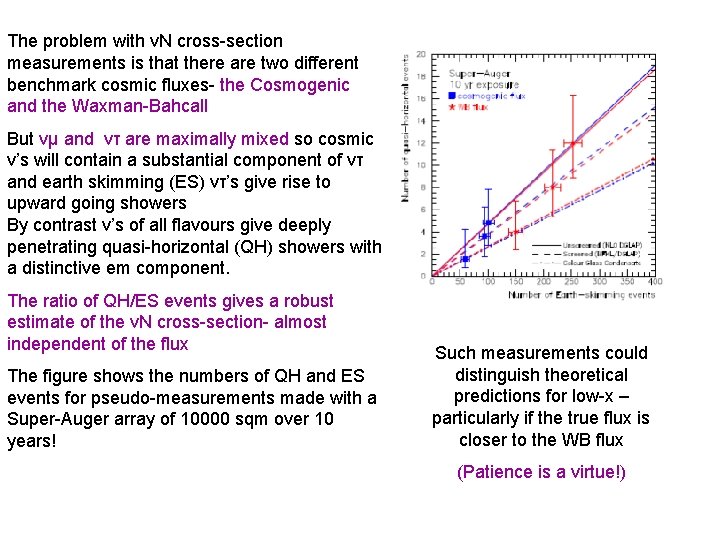
The problem with νN cross-section measurements is that there are two different benchmark cosmic fluxes- the Cosmogenic and the Waxman-Bahcall But νμ and ντ are maximally mixed so cosmic ν’s will contain a substantial component of ντ and earth skimming (ES) ντ’s give rise to upward going showers By contrast ν’s of all flavours give deeply penetrating quasi-horizontal (QH) showers with a distinctive em component. The ratio of QH/ES events gives a robust estimate of the νN cross-section- almost independent of the flux The figure shows the numbers of QH and ES events for pseudo-measurements made with a Super-Auger array of 10000 sqm over 10 years! Such measurements could distinguish theoretical predictions for low-x – particularly if the true flux is closer to the WB flux (Patience is a virtue!)
Summary Measuring W/Z rapidity spectra at the LHC can reduce the uncertainty on the low-x gluon PDF Measuring the W decay lepton asymmetry can give us information on the valence PDFs at x~0. 005 on a proton target The LHC may show us that we need to extend the conventional DGLAP NLO QCD formalism In future the Pierre Auger array measure Ultra-High Energy neutrino cross-sections and be able to distinguish alternative theoretical formalisms at low-x
Extra after ere
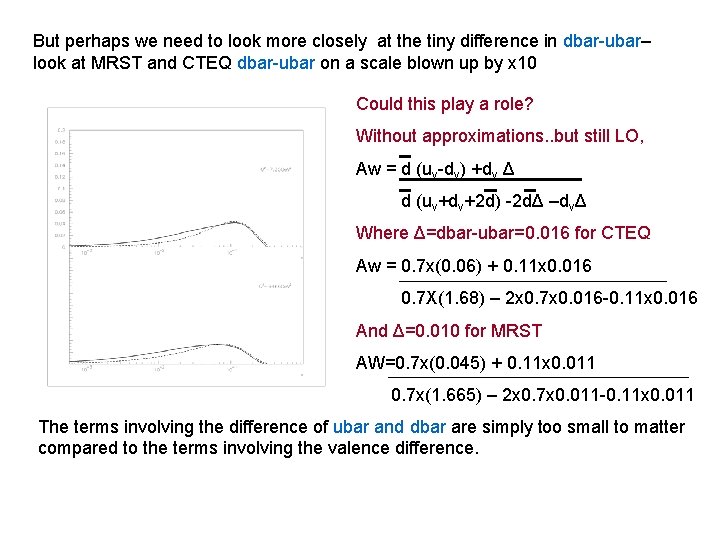
But perhaps we need to look more closely at the tiny difference in dbar-ubar– look at MRST and CTEQ dbar-ubar on a scale blown up by x 10 Could this play a role? Without approximations. . but still LO, Aw = d (uv-dv) +dv Δ d (uv+dv+2 d) -2 dΔ –dvΔ Where Δ=dbar-ubar=0. 016 for CTEQ Aw = 0. 7 x(0. 06) + 0. 11 x 0. 016 0. 7 X(1. 68) – 2 x 0. 7 x 0. 016 -0. 11 x 0. 016 And Δ=0. 010 for MRST AW=0. 7 x(0. 045) + 0. 11 x 0. 011 0. 7 x(1. 665) – 2 x 0. 7 x 0. 011 -0. 11 x 0. 011 The terms involving the difference of ubar and dbar are simply too small to matter compared to the terms involving the valence difference.
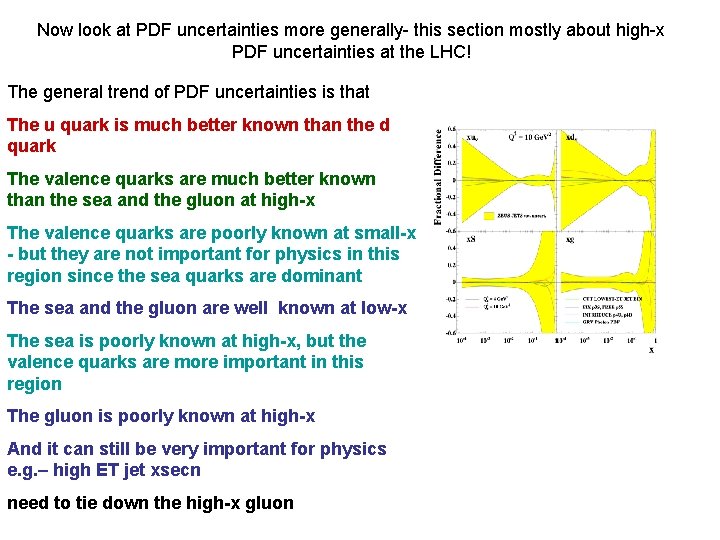
Now look at PDF uncertainties more generally- this section mostly about high-x PDF uncertainties at the LHC! The general trend of PDF uncertainties is that The u quark is much better known than the d quark The valence quarks are much better known than the sea and the gluon at high-x The valence quarks are poorly known at small-x - but they are not important for physics in this region since the sea quarks are dominant The sea and the gluon are well known at low-x The sea is poorly known at high-x, but the valence quarks are more important in this region The gluon is poorly known at high-x And it can still be very important for physics e. g. – high ET jet xsecn need to tie down the high-x gluon
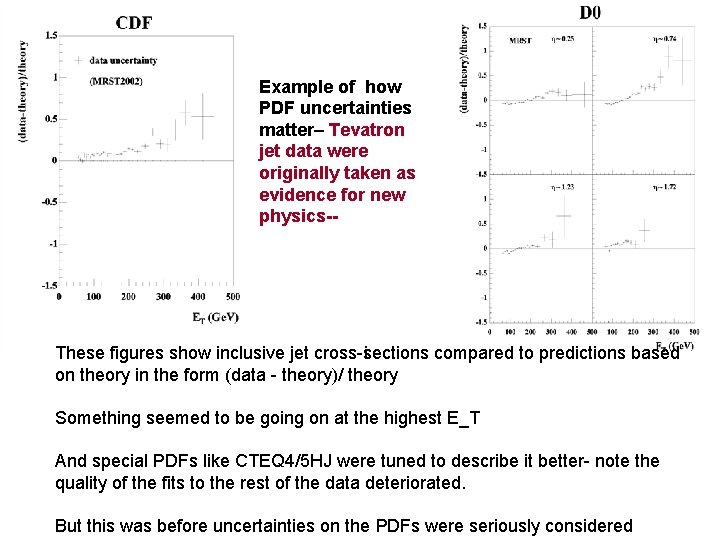
Example of how PDF uncertainties matter– Tevatron jet data were originally taken as evidence for new physics-- These figures show inclusive jet cross-sections i compared to predictions based on theory in the form (data - theory)/ theory Something seemed to be going on at the highest E_T And special PDFs like CTEQ 4/5 HJ were tuned to describe it better- note the quality of the fits to the rest of the data deteriorated. But this was before uncertainties on the PDFs were seriously considered
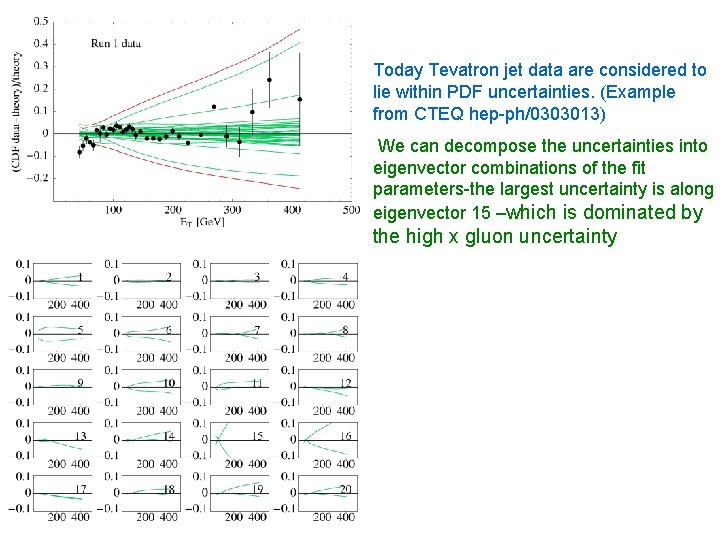
Today Tevatron jet data are considered to lie within PDF uncertainties. (Example from CTEQ hep-ph/0303013) We can decompose the uncertainties into eigenvector combinations of the fit parameters-the largest uncertainty is along eigenvector 15 –which is dominated by the high x gluon uncertainty
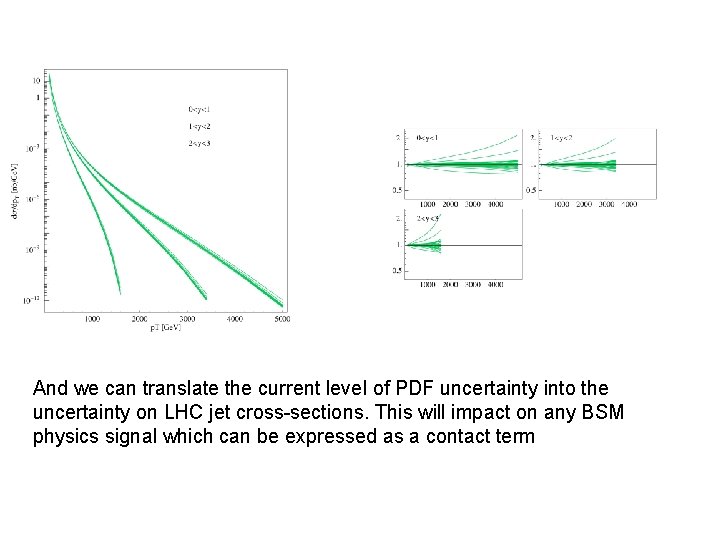
And we can translate the current level of PDF uncertainty into the uncertainty on LHC jet cross-sections. This will impact on any BSM physics signal which can be expressed as a contact term
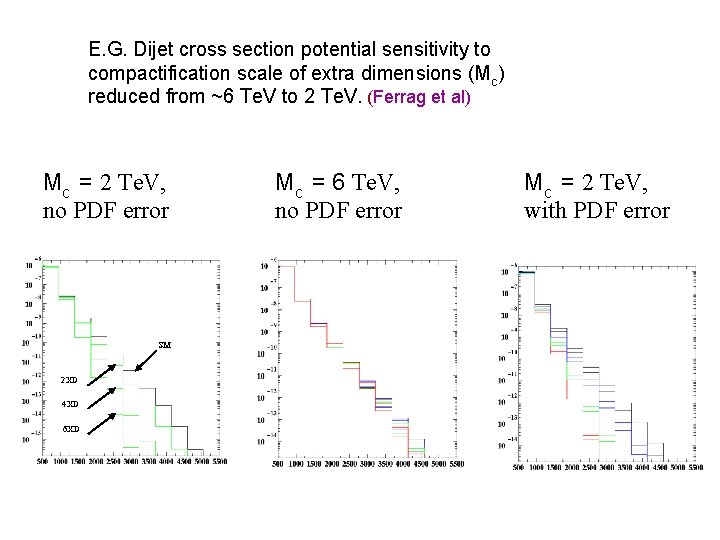
E. G. Dijet cross section potential sensitivity to compactification scale of extra dimensions (Mc) reduced from ~6 Te. V to 2 Te. V. (Ferrag et al) Mc = 2 Te. V, no PDF error SM 2 XD 4 XD 6 XD Mc = 6 Te. V, no PDF error Mc = 2 Te. V, with PDF error
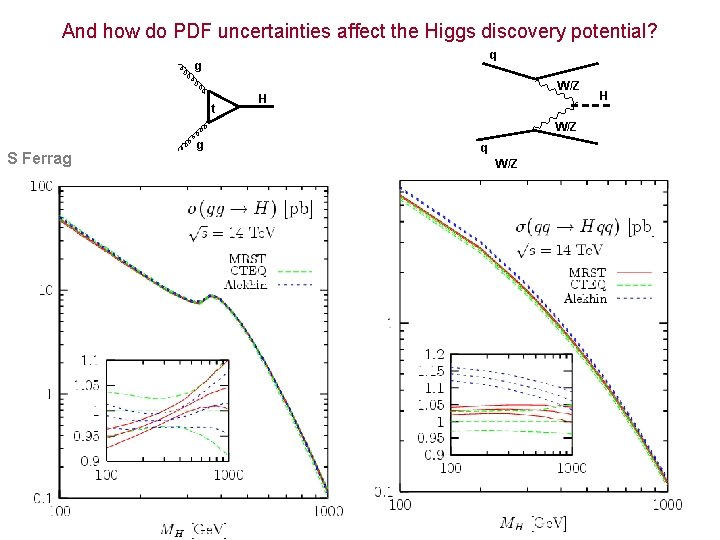
And how do PDF uncertainties affect the Higgs discovery potential? q g t W/Z H W/Z S Ferrag g q W/Z H
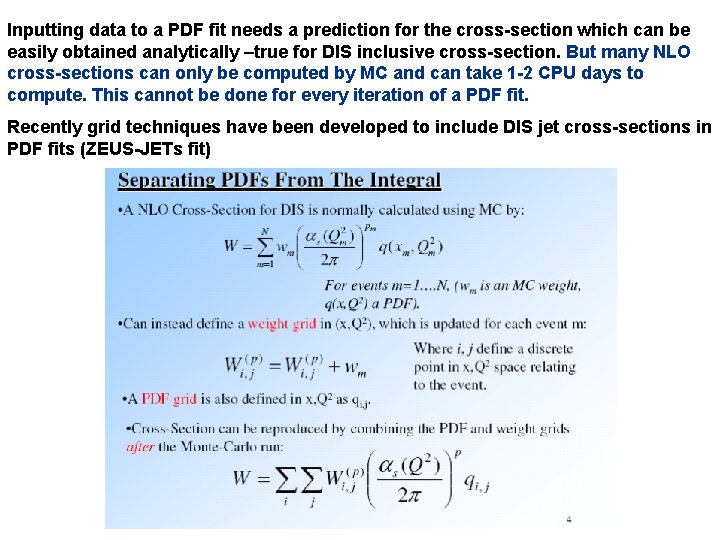
Inputting data to a PDF fit needs a prediction for the cross-section which can be easily obtained analytically –true for DIS inclusive cross-section. But many NLO cross-sections can only be computed by MC and can take 1 -2 CPU days to compute. This cannot be done for every iteration of a PDF fit. Recently grid techniques have been developed to include DIS jet cross-sections in PDF fits (ZEUS-JETs fit)
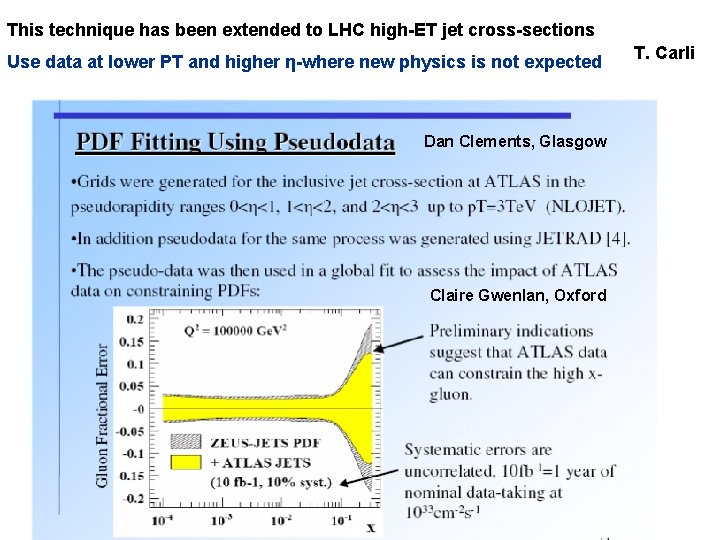
This technique has been extended to LHC high-ET jet cross-sections Use data at lower PT and higher η-where new physics is not expected Dan Clements, Glasgow Claire Gwenlan, Oxford T. Carli
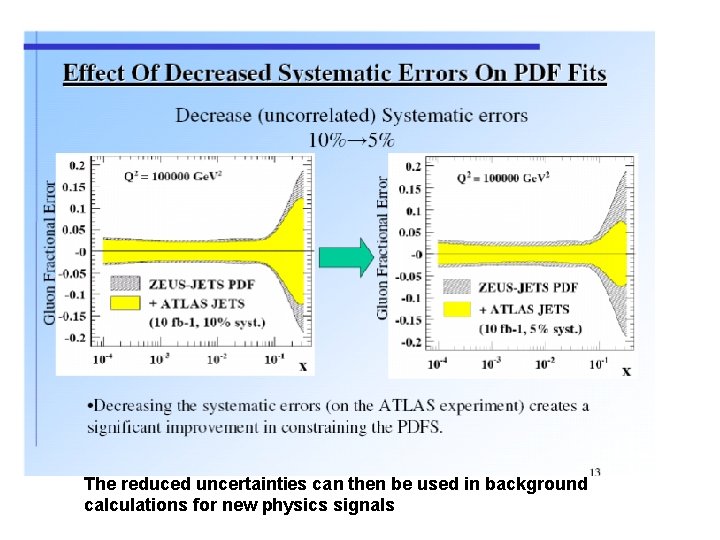
Such PDF uncertainties on the jet cross sections compromise the potential for discovery. E. G. Dijet cross section potential sensitivity to compactification scale of extra dimensions (Mc) reduced from ~6 Te. V to 2 Te. V. (Ferrag et al) Mc = 6 Te. V, no PDF error The reduced uncertainties can then be used in background calculations for new physics signals
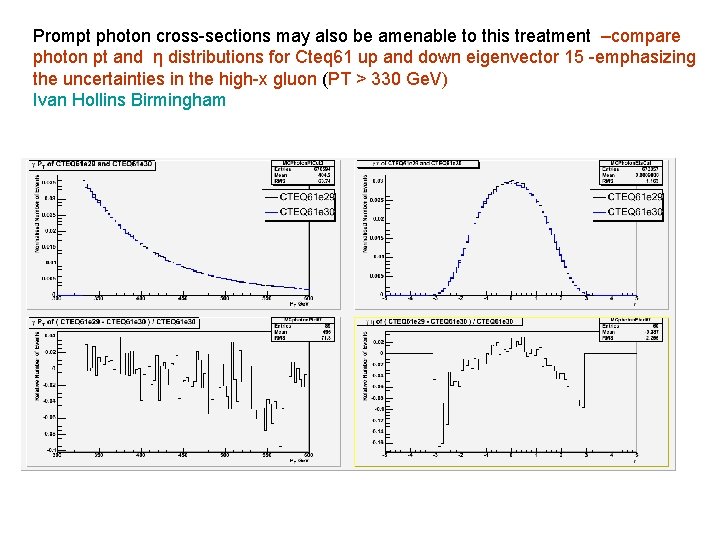
Prompt photon cross-sections may also be amenable to this treatment –compare photon pt and η distributions for Cteq 61 up and down eigenvector 15 -emphasizing the uncertainties in the high-x gluon (PT > 330 Ge. V) Ivan Hollins Birmingham