Link Estimation CTP and Multi Hop LQI Learning
- Slides: 32
Link Estimation, CTP and Multi. Hop. LQI
Learning Objectives • Understand the motivation of link estimation protocols – the time varying nature of a wireless channel • Understand the metric of ETX • Understand the four-bit link estimation • Understand the impact of link estimation on representative Tiny. OS network protocols
Prerequisites • Basic concepts of wireless communications • Basic concepts of physical layer, data link layer, and network layer
Motivation • Data Collection needs to estimate the link quality – To select a good link
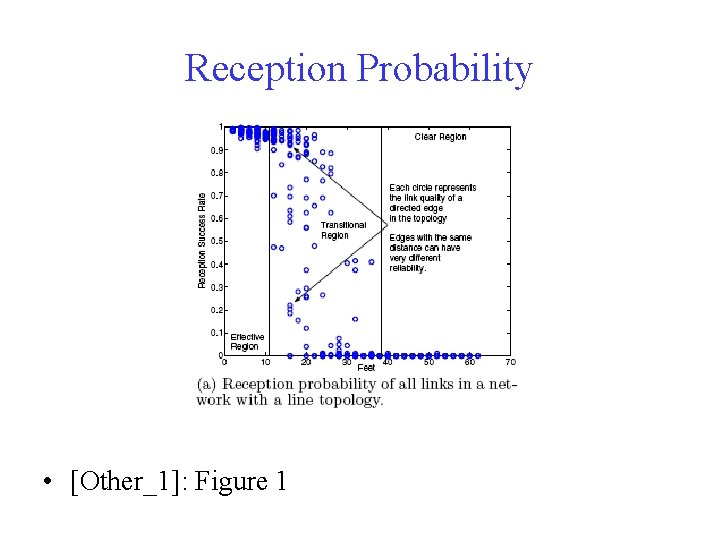
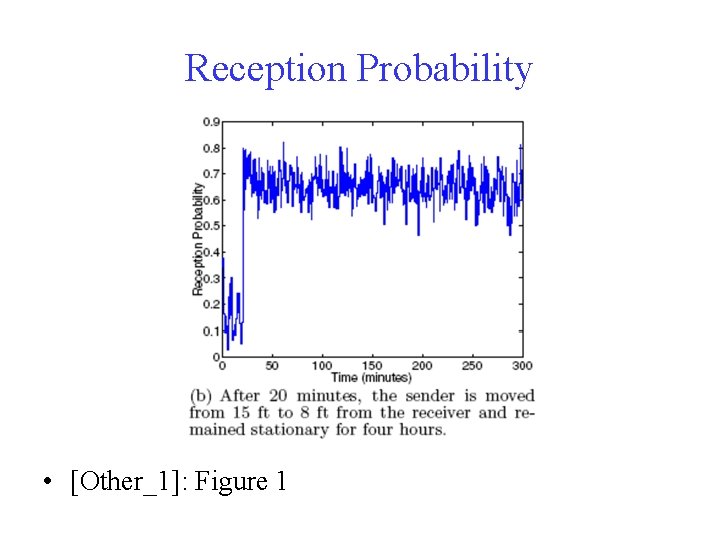
Challenges of Link Quality Estimation • Prevalence of intermediate-quality links • Time-varying nature of a wireless channel – Alternating between high (100% packet reception ratio PRR) and low (0% PRR) quality • Link asymmetries • Hardware variations Ref. [Link. Estimation_1 ]: Section 1
Detour: Time-varying nature of a wireless channel
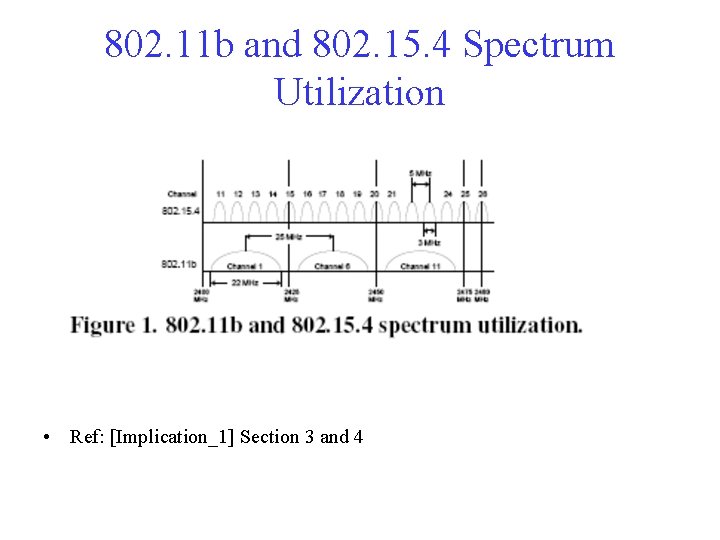
802. 11 b and 802. 15. 4 Spectrum Utilization • Ref: [Implication_1] Section 3 and 4
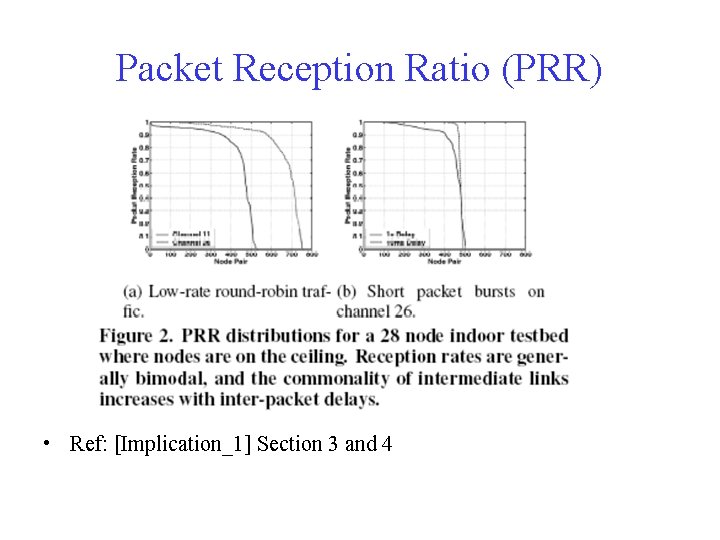
Packet Reception Ratio (PRR) • Ref: [Implication_1] Section 3 and 4
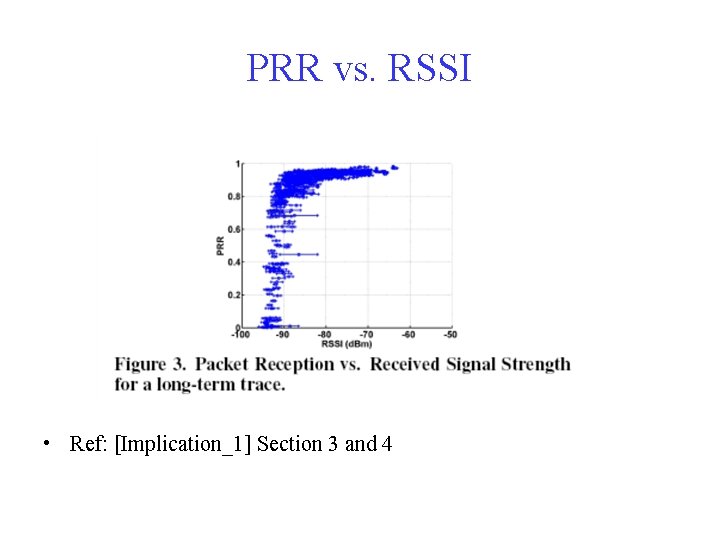
PRR vs. RSSI • Ref: [Implication_1] Section 3 and 4
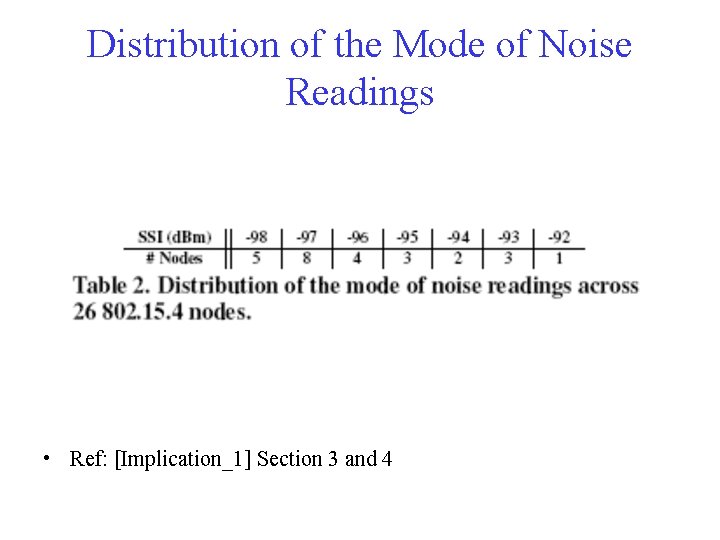
Distribution of the Mode of Noise Readings • Ref: [Implication_1] Section 3 and 4
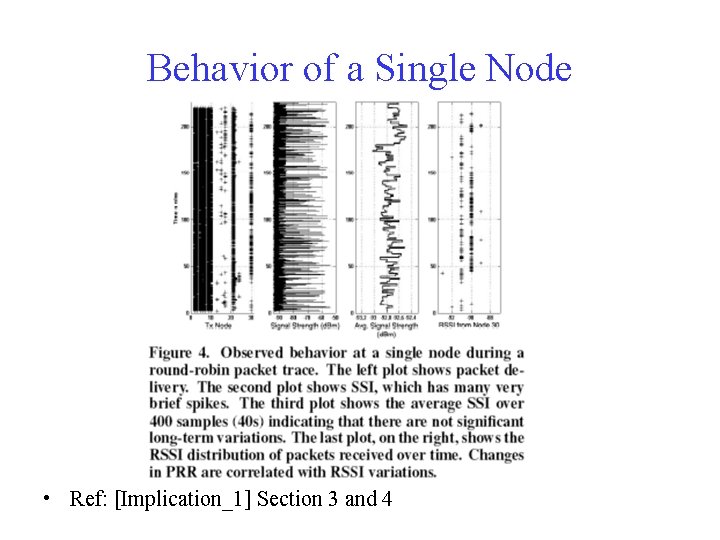
Behavior of a Single Node • Ref: [Implication_1] Section 3 and 4
Reception Probability • [Other_1]: Figure 1
Reception Probability • [Other_1]: Figure 1
Link Estimation – ETX (Expected Transmission Count)
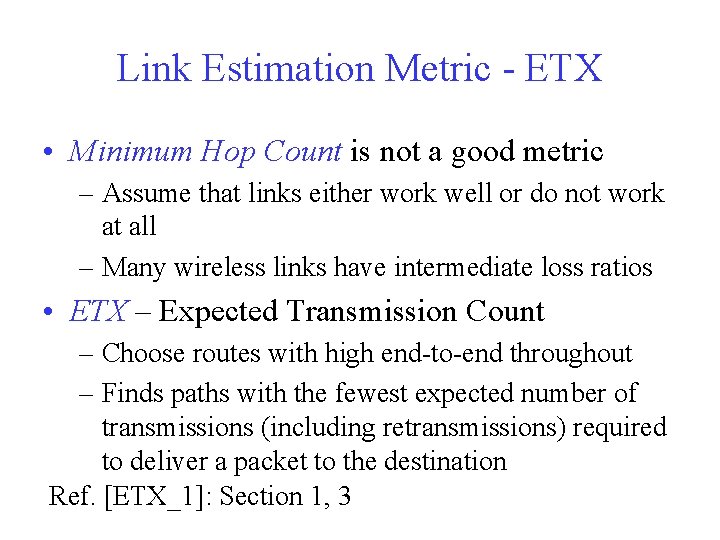
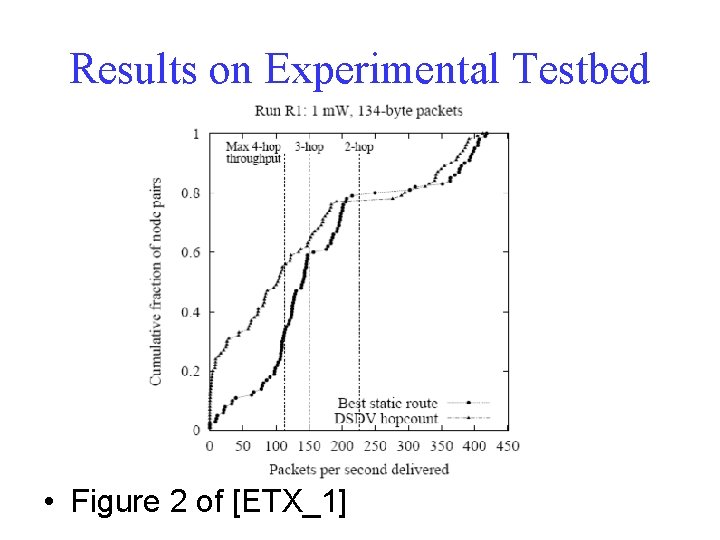
Link Estimation Metric - ETX • Minimum Hop Count is not a good metric – Assume that links either work well or do not work at all – Many wireless links have intermediate loss ratios • ETX – Expected Transmission Count – Choose routes with high end-to-end throughout – Finds paths with the fewest expected number of transmissions (including retransmissions) required to deliver a packet to the destination Ref. [ETX_1]: Section 1, 3
Results on Experimental Testbed • Figure 2 of [ETX_1]
Why some superficially attractive metrics are not suitable? • Hop-count – Ignoring links with loss ratios above a certain threshold • Product of the per-link delivery ratios – Fail to account for inter-hop interference • End-to-end delay – Change with network load – Load adaptive routing metrics Ref. [ETX_1]: Sectiion 3
Link Estimation Metric - ETX • ETX – Consider the wide range of link loss ratios – The existence of links with asymmetric loss ratios – The interference between successive hops of multihop paths Ref. [ETX_1]: Section 1, 3
Link Estimation Metric - ETX • ETX of a link: – The predicted number of data transmissions required to send a packet over a link, including retransmissions – Calculated using the forward and reverse delivery ratios of a link – How to measure: Broadcasting of probe packets and derives link quality information from each direction • ETX of a route: – The sum of the ETX for each link in the route Ref. [ETX_1]: Section 1, 3
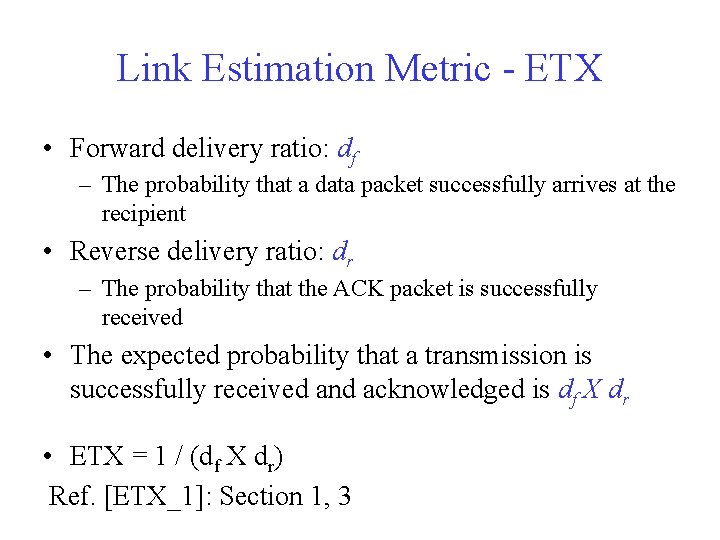
Link Estimation Metric - ETX • Forward delivery ratio: df – The probability that a data packet successfully arrives at the recipient • Reverse delivery ratio: dr – The probability that the ACK packet is successfully received • The expected probability that a transmission is successfully received and acknowledged is df X dr • ETX = 1 / (df X dr) Ref. [ETX_1]: Section 1, 3
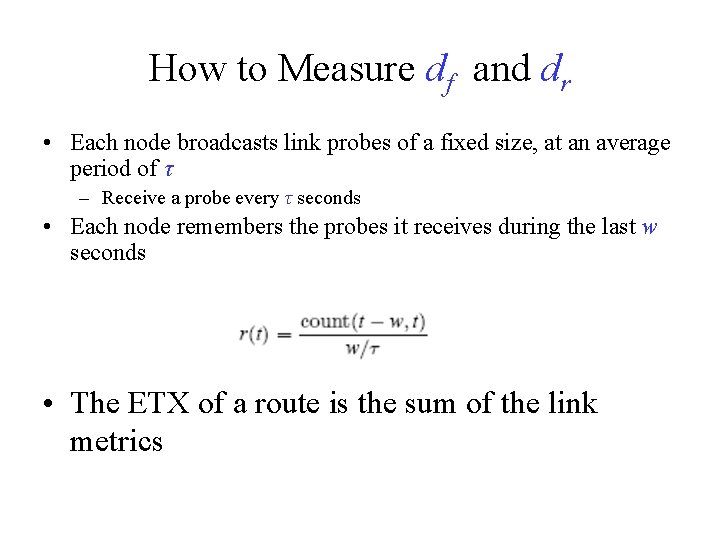
How to Measure df and dr • Each node broadcasts link probes of a fixed size, at an average period of τ – Receive a probe every τ seconds • Each node remembers the probes it receives during the last w seconds • The ETX of a route is the sum of the link metrics
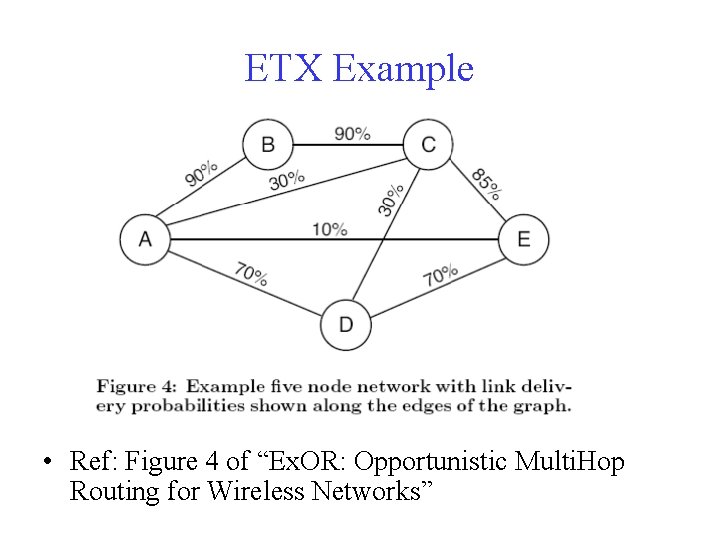
ETX Example • Ref: Figure 4 of “Ex. OR: Opportunistic Multi. Hop Routing for Wireless Networks”
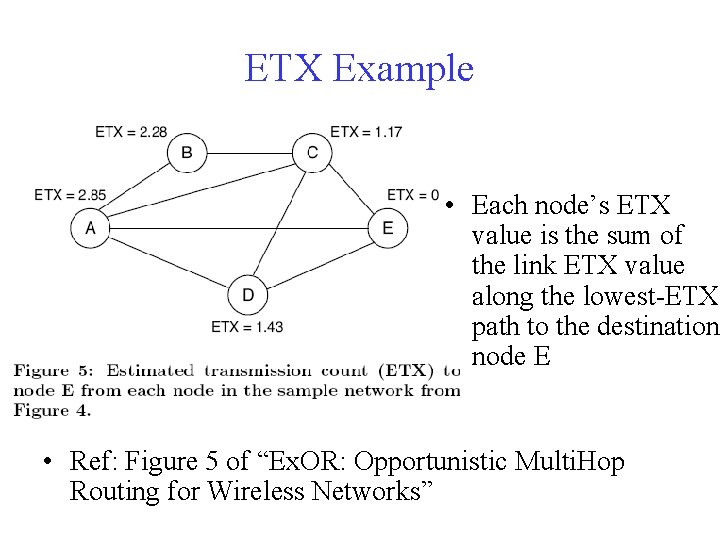
ETX Example • Each node’s ETX value is the sum of the link ETX value along the lowest-ETX path to the destination node E • Ref: Figure 5 of “Ex. OR: Opportunistic Multi. Hop Routing for Wireless Networks”
Link Estimation – Four-bit Wireless Link Estimation
Four-bit Wireless Link Estimation • Physical layer – – Measure channel quality during a packet Measured for single received packet Fast and Inexpensive Sometimes can be misleading because the timevarying nature – Decoding error – The physical layer can provide immediate information on the quality of the decoding of a packet – Example: • Multi. Hop. LQI uses Link Quality Indication (LQI) – a feature of the CC 2420 radio • RSSI, SNR
Four-bit Wireless Link Estimation • Link layer – Measure whether packets are delivered and acknowledged – Such as ETX: use periodic broadcast probes to measure incoming packet reception rates – Slow to adapt
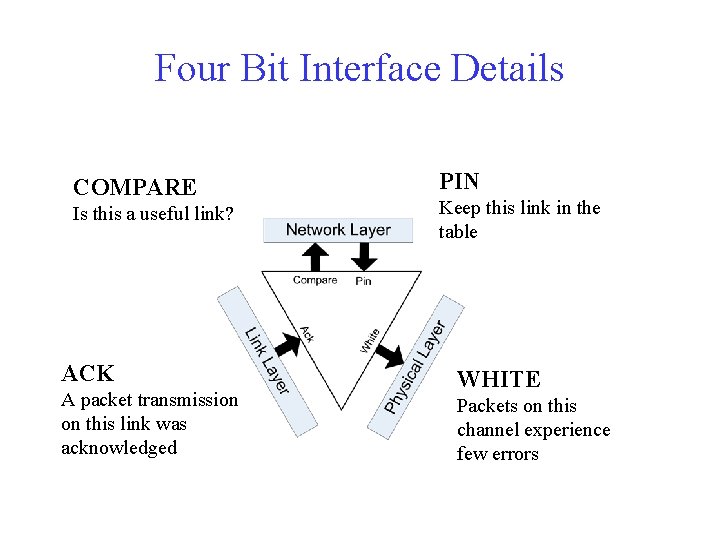
Four-bit Wireless Link Estimation • Network layer – Knows which links are most useful for routing – Is a link useful? – Keep useful links in the table
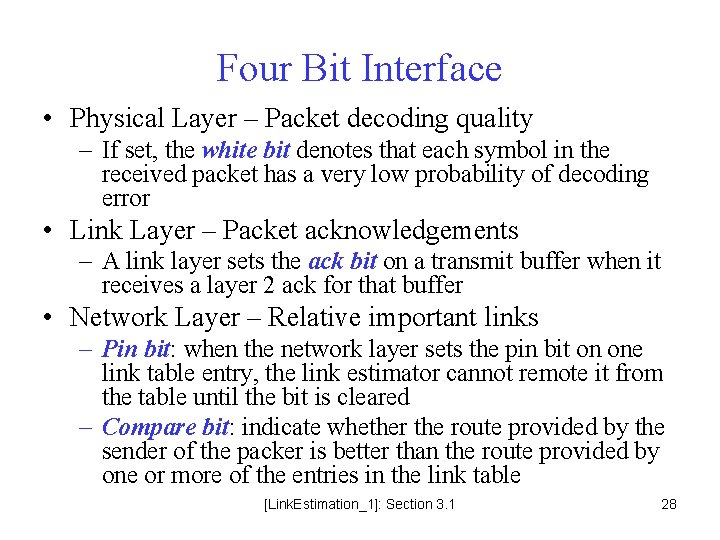
Four Bit Interface • Physical Layer – Packet decoding quality – If set, the white bit denotes that each symbol in the received packet has a very low probability of decoding error • Link Layer – Packet acknowledgements – A link layer sets the ack bit on a transmit buffer when it receives a layer 2 ack for that buffer • Network Layer – Relative important links – Pin bit: when the network layer sets the pin bit on one link table entry, the link estimator cannot remote it from the table until the bit is cleared – Compare bit: indicate whether the route provided by the sender of the packer is better than the route provided by one or more of the entries in the link table [Link. Estimation_1]: Section 3. 1 28
Four Bit Interface Details COMPARE Is this a useful link? ACK A packet transmission on this link was acknowledged PIN Keep this link in the table WHITE Packets on this channel experience few errors
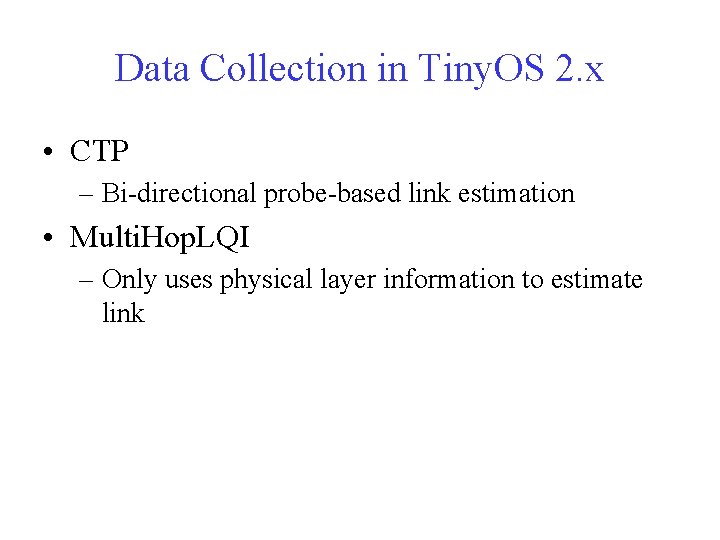
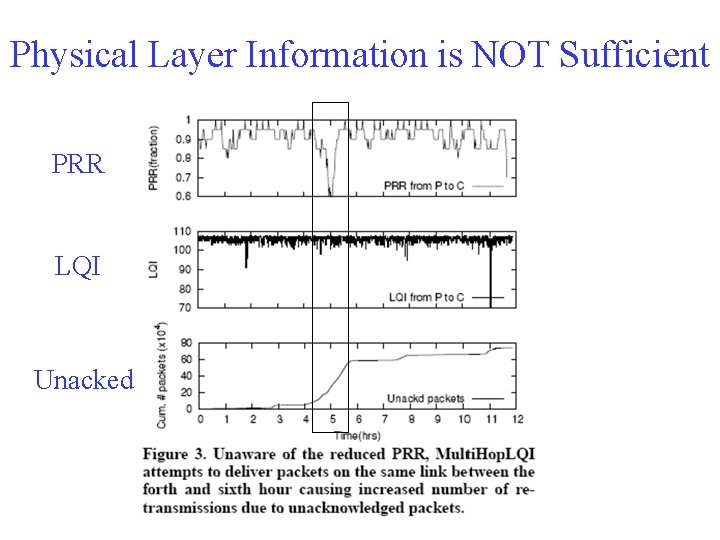
Data Collection in Tiny. OS 2. x • CTP – Bi-directional probe-based link estimation • Multi. Hop. LQI – Only uses physical layer information to estimate link
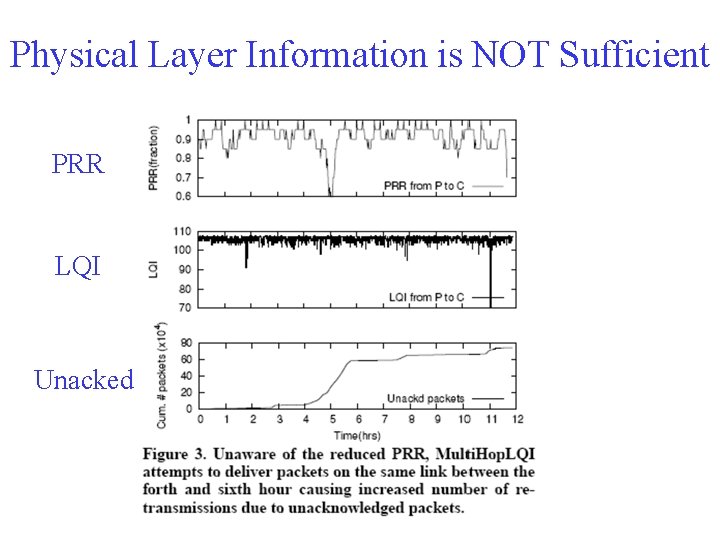
Physical Layer Information is NOT Sufficient PRR LQI Unacked
Physical Layer Information is NOT Sufficient PRR LQI Unacked