Lecture 15 Automated Analysis Video IS 246 Multimedia
- Slides: 37
Lecture 15: Automated Analysis: Video IS 246 Multimedia Information (FILM 240, Section 4) Prof. Marc Davis UC Berkeley SIMS Monday and Wednesday 2: 00 pm – 3: 30 pm Spring 2003 http: //www. sims. berkeley. edu/academics/courses/is 246/s 03/ IS 246 - SPRING 2003. 03. 17 - SLIDE 1
Today’s Agenda • Review of Last Time – Automated Analysis: Audio • Automated Analysis: Video – Signal-Based Parsing – Image Analysis – Video Analysis – Discussion Questions • Action Items for Next Time IS 246 - SPRING 2003. 03. 17 - SLIDE 2
Today’s Agenda • Review of Last Time – Automated Analysis: Audio • Automated Analysis: Video – Signal-Based Parsing – Image Analysis – Video Analysis – Discussion Questions • Action Items for Next Time IS 246 - SPRING 2003. 03. 17 - SLIDE 3
Low-Level Audio Descriptors • Silence, voice onset (Aarons) • Speech/music (Schierer) • Rough spectral features (musclefish) – Loud/soft, bright/dark, low/high • Musical pitch and timbre • Speech emphasis/prosody (Chen, Aarons) • Characteristic audio events – Cheers, gunshots (Pfeiffer) • Musical tempo (Cook & Tzanetakis) – Rhythmic strength? • Fine spectral features – Spectrogram, Mel-frequency cepstral coefficients IS 246 - SPRING 2003. 03. 17 - SLIDE 4
Speech Recognition • Ideally, bridges the “semantic gap” • One little problem: – IT DOESN’T WORK! • Spectrum of reliability – – Known vs. unknown speaker (+ training) Known or small vs. unknown vocabulary (+ training) Read text vs. conversational speech Standard English vs. dialects, accents, other languages – Close microphone vs. distant – Clean, quiet vs. mixed or noisy conditions – Known acoustic channel vs. telephone IS 246 - SPRING 2003. 03. 17 - SLIDE 5
Today’s Agenda • Review of Last Time – Automated Analysis: Audio • Automated Analysis: Video – Signal-Based Parsing – Image Analysis – Video Analysis – Discussion Questions • Action Items for Next Time IS 246 - SPRING 2003. 03. 17 - SLIDE 6
Signal-Based Parsing • Practical problem – Parsing unstructured, unknown video is very, very hard • Theoretical problem – Mismatch between percepts and concepts IS 246 - SPRING 2003. 03. 17 - SLIDE 7
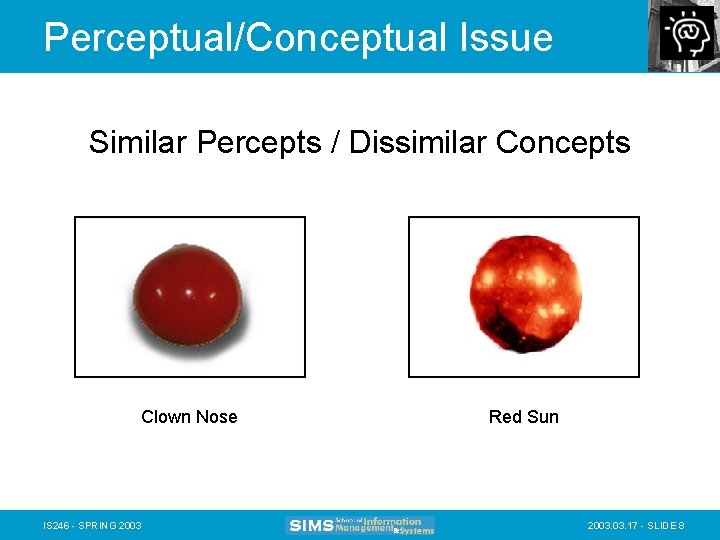
Perceptual/Conceptual Issue Similar Percepts / Dissimilar Concepts Clown Nose IS 246 - SPRING 2003 Red Sun 2003. 17 - SLIDE 8
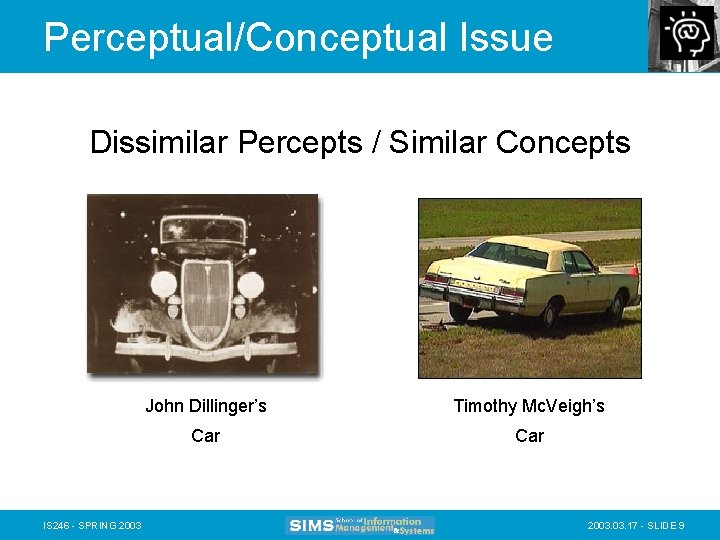
Perceptual/Conceptual Issue Dissimilar Percepts / Similar Concepts IS 246 - SPRING 2003 John Dillinger’s Timothy Mc. Veigh’s Car 2003. 17 - SLIDE 9
Signal-Based Parsing • Effective and useful automatic parsing – Video • • Scene break detection Camera motion analysis Low level visual similarity Feature tracking – Audio • Pause detection • Audio pattern matching • Simple speech recognition IS 246 - SPRING 2003 • Approaches to automated parsing – At the point of capture, integrate the recording device, the environment, and agents in the environment into an interactive system – After capture, use “humanin-the-loop” algorithms to leverage human and machine intelligence 2003. 17 - SLIDE 10
Image/Video Analysis Communities • Research and development – Academia • MIT, CMU, Georgia. Tech, UC Berkeley, Columbia University – Government • NSA, CIA, FBI, etc. – Industry • Media, retail, training, consumer electronics, surveillance, industrial automation, libraries • Research directions – Computer vision, robotics, knowledge representation, digital libraries, media asset management, production automation IS 246 - SPRING 2003. 03. 17 - SLIDE 11
Major Areas • Image analysis – Color similarity – Texture similarity – Shape similarity – Spatial similarity – Object presence analysis • Video analysis – Temporal segmentation – Content and motion analysis IS 246 - SPRING 2003. 03. 17 - SLIDE 12
Semantic Gap • Most of the disappointments with early retrieval systems come from the lack of recognizing the existence of the semantic gap and its consequences for system set-up • The semantic gap is the lack of coincidence between the information that one can extract from the visual data and the interpretation that the same data have for a user in a given situation IS 246 - SPRING 2003. 03. 17 - SLIDE 13
Sensory Gap • The sensory gap is the gap between the object in the world and the information in a (computational) description derived from a recording of that scene • The sensory gap makes the description of objects an illposed problem: – It yields uncertainty in what is known about the state of the object – The sensory gap is particularly poignant when a precise knowledge of the recording conditions is missing – The 2 D-records of different 3 D-objects can be identical—without further knowledge, one has to decide that they might represent the same object – A 2 D-recording of a 3 D-scene contains information accidental for that scene and that sensing but one does not know what part of the information is scene-related IS 246 - SPRING 2003. 03. 17 - SLIDE 14
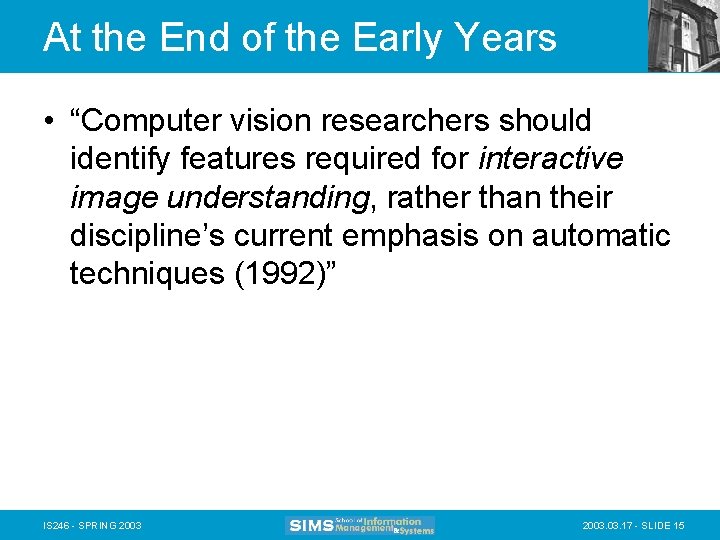
At the End of the Early Years • “Computer vision researchers should identify features required for interactive image understanding, rather than their discipline’s current emphasis on automatic techniques (1992)” IS 246 - SPRING 2003. 03. 17 - SLIDE 15
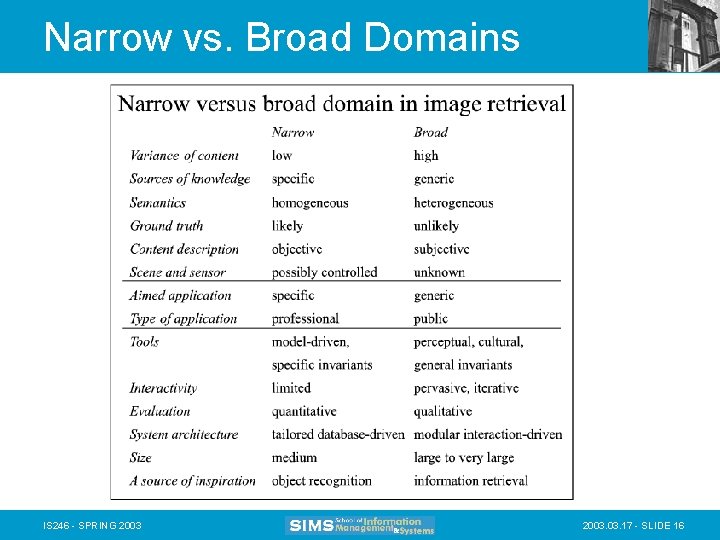
Narrow vs. Broad Domains IS 246 - SPRING 2003. 03. 17 - SLIDE 16
Today’s Agenda • Review of Last Time – Automated Analysis: Audio • Automated Analysis: Video – Signal-Based Parsing – Image Analysis – Video Analysis – Discussion Questions • Action Items for Next Time IS 246 - SPRING 2003. 03. 17 - SLIDE 17
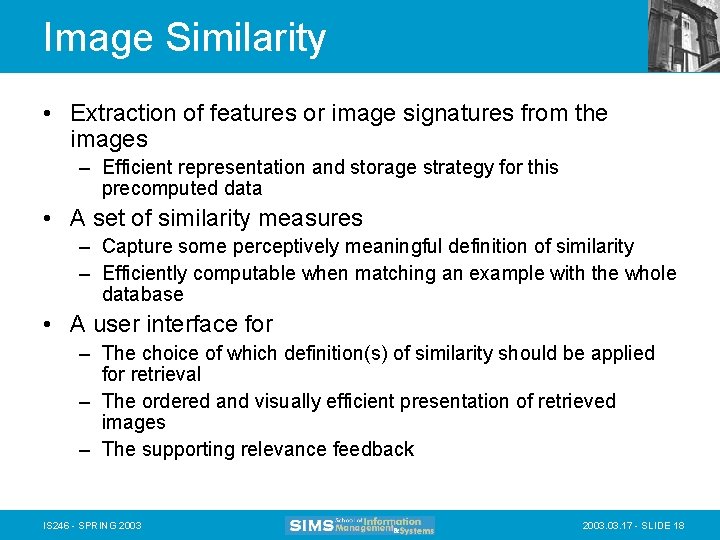
Image Similarity • Extraction of features or image signatures from the images – Efficient representation and storage strategy for this precomputed data • A set of similarity measures – Capture some perceptively meaningful definition of similarity – Efficiently computable when matching an example with the whole database • A user interface for – The choice of which definition(s) of similarity should be applied for retrieval – The ordered and visually efficient presentation of retrieved images – The supporting relevance feedback IS 246 - SPRING 2003. 03. 17 - SLIDE 18
Image Similarity • Color similarity – Choice of color space matters • Texture similarity – Specific textures can be parsed well • Shape similarity – Scale, rotation, and deformation affect shape • Spatial similarity – Relative vs. absolute positions and distances • Object presence analysis – Face detection/recognition is active area IS 246 - SPRING 2003. 03. 17 - SLIDE 19
Object Segmentation • “Object segmentation for broad domains of general images is not likely to succeed, with a possible exception for sophisticated techniques in very narrow domains. ” IS 246 - SPRING 2003. 03. 17 - SLIDE 20
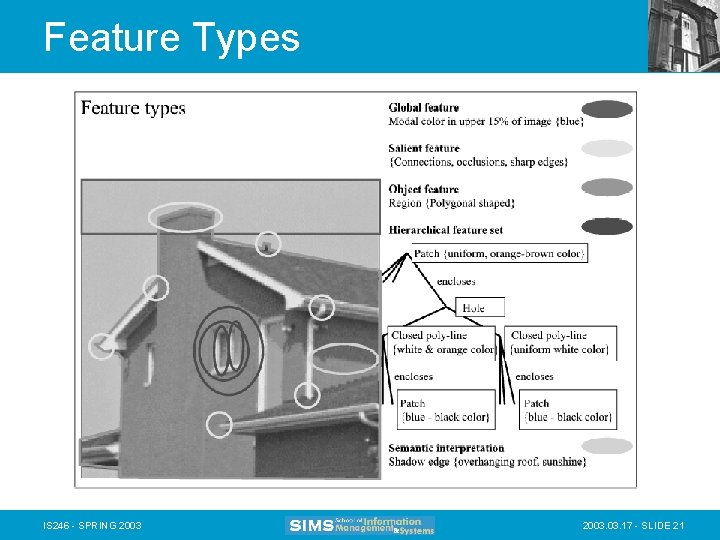
Feature Types IS 246 - SPRING 2003. 03. 17 - SLIDE 21
Today’s Agenda • Review of Last Time – Automated Analysis: Audio • Automated Analysis: Video – Signal-Based Parsing – Image Analysis – Video Analysis – Discussion Questions • Action Items for Next Time IS 246 - SPRING 2003. 03. 17 - SLIDE 22
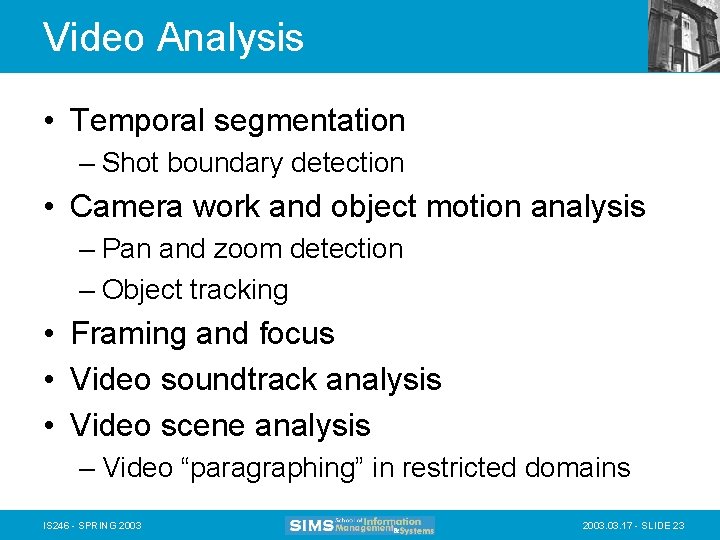
Video Analysis • Temporal segmentation – Shot boundary detection • Camera work and object motion analysis – Pan and zoom detection – Object tracking • Framing and focus • Video soundtrack analysis • Video scene analysis – Video “paragraphing” in restricted domains IS 246 - SPRING 2003. 03. 17 - SLIDE 23
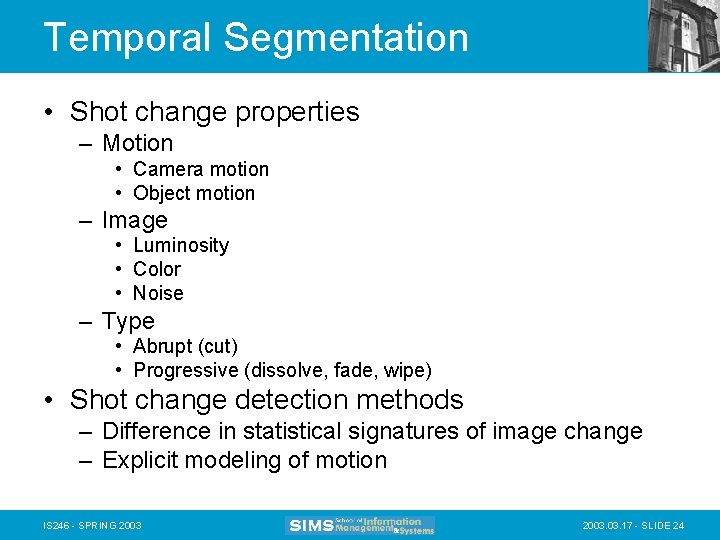
Temporal Segmentation • Shot change properties – Motion • Camera motion • Object motion – Image • Luminosity • Color • Noise – Type • Abrupt (cut) • Progressive (dissolve, fade, wipe) • Shot change detection methods – Difference in statistical signatures of image change – Explicit modeling of motion IS 246 - SPRING 2003. 03. 17 - SLIDE 24
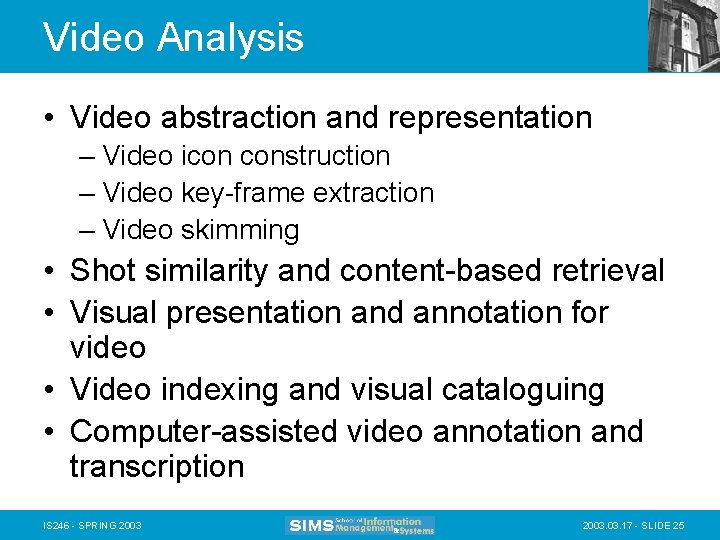
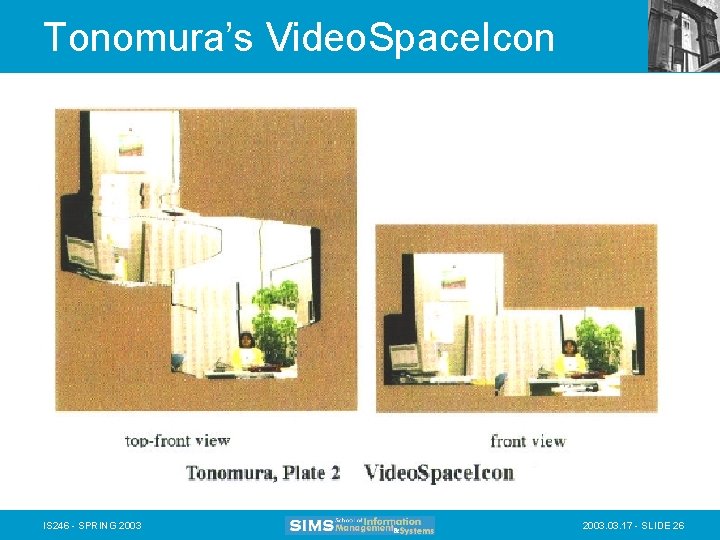
Video Analysis • Video abstraction and representation – Video icon construction – Video key-frame extraction – Video skimming • Shot similarity and content-based retrieval • Visual presentation and annotation for video • Video indexing and visual cataloguing • Computer-assisted video annotation and transcription IS 246 - SPRING 2003. 03. 17 - SLIDE 25
Tonomura’s Video. Space. Icon IS 246 - SPRING 2003. 03. 17 - SLIDE 26
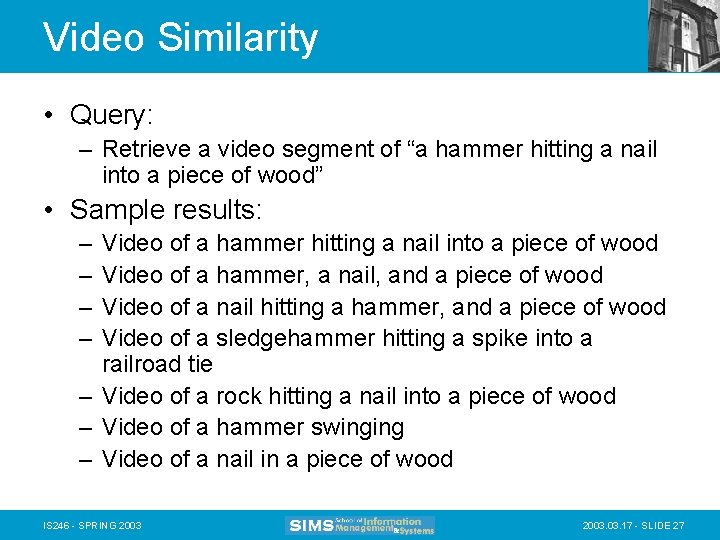
Video Similarity • Query: – Retrieve a video segment of “a hammer hitting a nail into a piece of wood” • Sample results: – – Video of a hammer hitting a nail into a piece of wood Video of a hammer, a nail, and a piece of wood Video of a nail hitting a hammer, and a piece of wood Video of a sledgehammer hitting a spike into a railroad tie – Video of a rock hitting a nail into a piece of wood – Video of a hammer swinging – Video of a nail in a piece of wood IS 246 - SPRING 2003. 03. 17 - SLIDE 27
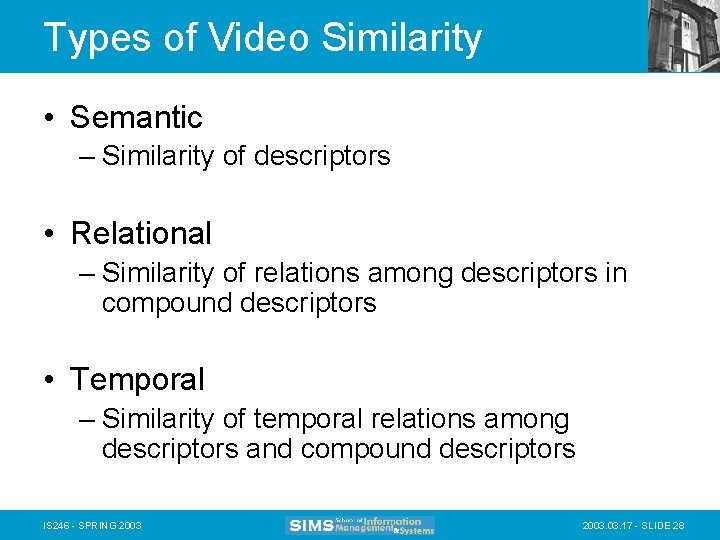
Types of Video Similarity • Semantic – Similarity of descriptors • Relational – Similarity of relations among descriptors in compound descriptors • Temporal – Similarity of temporal relations among descriptors and compound descriptors IS 246 - SPRING 2003. 03. 17 - SLIDE 28
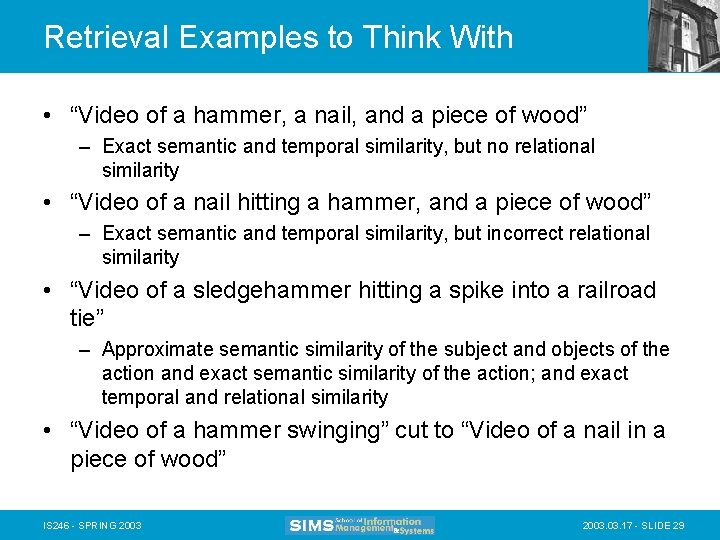
Retrieval Examples to Think With • “Video of a hammer, a nail, and a piece of wood” – Exact semantic and temporal similarity, but no relational similarity • “Video of a nail hitting a hammer, and a piece of wood” – Exact semantic and temporal similarity, but incorrect relational similarity • “Video of a sledgehammer hitting a spike into a railroad tie” – Approximate semantic similarity of the subject and objects of the action and exact semantic similarity of the action; and exact temporal and relational similarity • “Video of a hammer swinging” cut to “Video of a nail in a piece of wood” IS 246 - SPRING 2003. 03. 17 - SLIDE 29
Today’s Agenda • Review of Last Time – Automated Analysis: Audio • Automated Analysis: Video – Signal-Based Parsing – Image Analysis – Video Analysis – Discussion Questions • Action Items for Next Time IS 246 - SPRING 2003. 03. 17 - SLIDE 30
Discussion Questions • On “Content-Based Representation and Retrieval of Visual Media: A State-of-the-Art Review ” (Risto Sarvas) – Are these technologies implemented in current camcorders and editing software? It seems that with these technologies (e. g. , video parsing & video abstraction) a simple functionality like automatically cutting the video into shots wouldn't be too difficult. – How much of these technologies are available for use? For example, are some of the image similarity algorithms available as open source software? – The reading focused on analyzing media content after the recording. How much there is technology for letting the human analyze the content as it is produced? In other words, what is the state-of-the-art in standardizing content annotation? IS 246 - SPRING 2003. 03. 17 - SLIDE 31
Discussion Questions • On “Content-Based Representation and Retrieval of Visual Media: A State-of-the-Art Review ”(Catherine Lai) – While much effort has been spent on discussing the process or conditions of content-based image retrieval, what constitutes a valid evaluation method? How large should the image databases be and who decides what should be included in the image databases? – How can user feedback be exploited to improve user interaction and techniques for image browsing? IS 246 - SPRING 2003. 03. 17 - SLIDE 32
Discussion Questions • On “Content-Based Image Retrieval at the End of the Early Years” (Ana Ramirez) – To what degree do users have to be experts in computer vision to interactively annotate media or query for media? – How is the semantic gap for time-based media different than for static media? IS 246 - SPRING 2003. 03. 17 - SLIDE 33
Discussion Questions • On “Content-Based Image Retrieval at the End of the Early Years” (Ping Yee) – Consider the various types of queries that are typically possible in content-based image retrieval systems: • • • Query by spatial predicate Query by image predicate Query by group predicate Query by spatial example Query by image example Query by group example – Which of these queries are likely to be applicable to retrieval for digital video? In what situations might such queries be made? IS 246 - SPRING 2003. 03. 17 - SLIDE 34
Today’s Agenda • Review of Last Time – Automated Analysis: Audio • Automated Analysis: Video – Signal-Based Parsing – Image Analysis – Video Analysis – Discussion Questions • Action Items for Next Time IS 246 - SPRING 2003. 03. 17 - SLIDE 35
Presentations on Wednesday • Every group will have 15 minutes in class on Wednesday, March 19, 2003, to present their work on Assignment 2 • Your presentation must include – Short Plot Outline – Showing of your movie – Discussion of at least one practical and one theoretical issue you dealt with – Lessons learned – Time for questions IS 246 - SPRING 2003. 03. 17 - SLIDE 36
Hand In • Drop off the following files in your designated group drop-off box under M: /is 246/assignment 2/drop_off/group. X – Final edit • Format: MPEG – Presentation • Format: MS Power. Point or html – Paragraph Answering One or More of the Questions For Thought • Format: txt, MS Word, or html IS 246 - SPRING 2003. 03. 17 - SLIDE 37