Learning Targets Module 42 Expressing Emotion 42 1

- Slides: 36
Learning Targets Module 42 Expressing Emotion 42 -1 Describe our ability to communicate nonverbally. 42 -2 Discuss how the genders differ in their ability to communicate nonverbally. 42 -3 Discuss culture specific and culturally universal gestures and facial expressions. 42 -4 Explain how our facial expressions influence our feelings.
How do we communicate nonverbally? To Westerners, a firm handshake conveys an outgoing, expressive personality. (Chaplin et al. , 2000) A glance can communicate intimacy, while darting eyes may signal anxiety. (Kleinke, 1986; Perkins et al. , 2012) When two people are passionately in love, they typically spend time—quite a bit of time—gazing into each other’s eyes. (Bolmont et al. , 2014; Rubin, 1970)
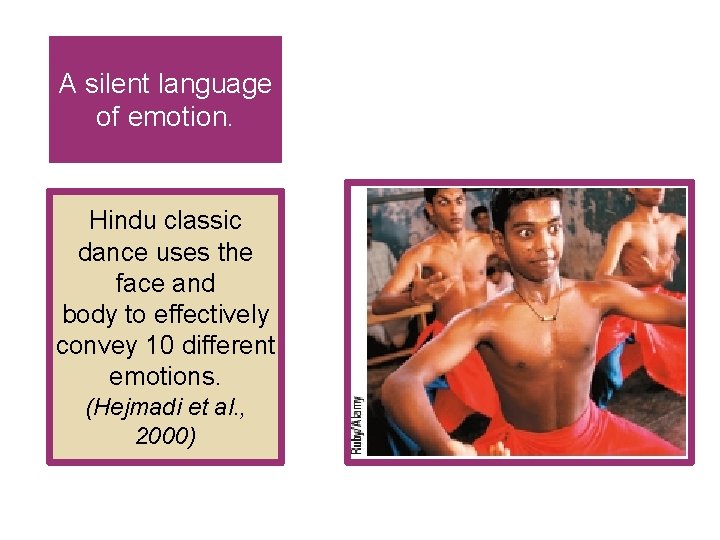
A silent language of emotion. Hindu classic dance uses the face and body to effectively convey 10 different emotions. (Hejmadi et al. , 2000)
Can humans detect nonverbal threats? We readily sense subliminally presented negative words, such as snake or bomb. (Dijksterhuis & Aarts, 2003) A single angry face will “pop out” of a crowd. (Pinkham et al. , 2010)
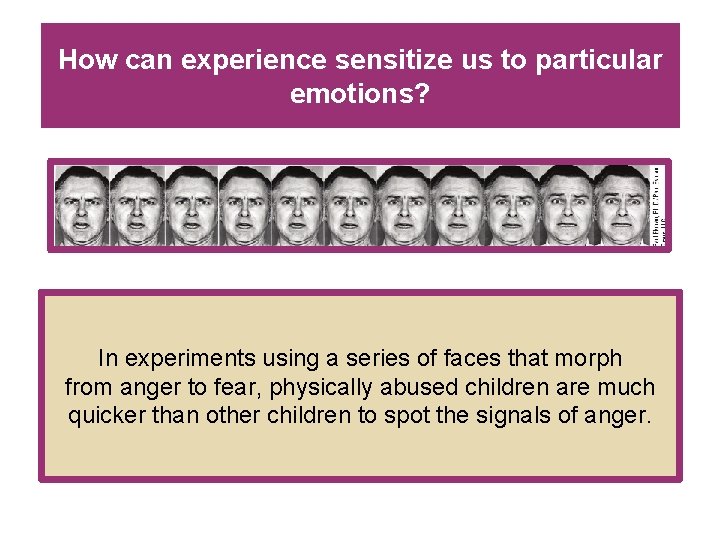
How can experience sensitize us to particular emotions? In experiments using a series of faces that morph from anger to fear, physically abused children are much quicker than other children to spot the signals of anger.
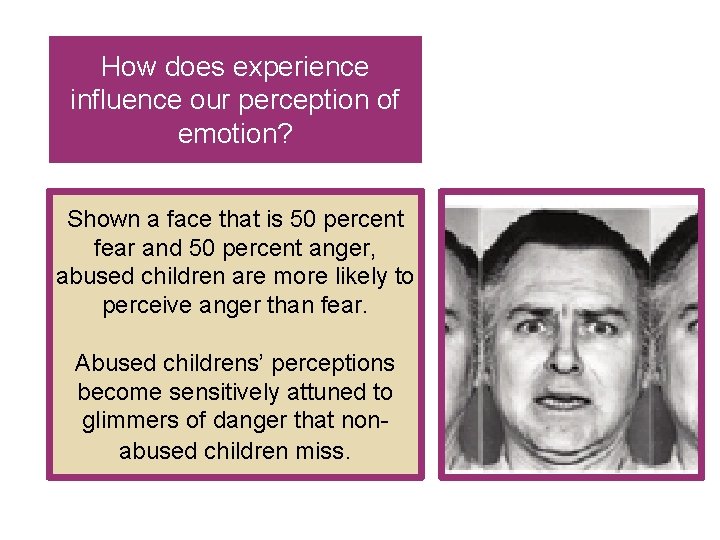
How does experience influence our perception of emotion? Shown a face that is 50 percent fear and 50 percent anger, abused children are more likely to perceive anger than fear. Abused childrens’ perceptions become sensitively attuned to glimmers of danger that nonabused children miss.
How readily can we detect deceit? Despite our brain’s emotion-detecting skill, we find it difficult to discern deceit. The behavioral differences between liars and truth tellers are too minute for most people to detect. (Hartwig & Bond, 2011) Looking at 206 studies, people were just 54 percent accurate in discerning truth from lies—barely better than a coin toss. (Bond & De. Paulo, 2006)
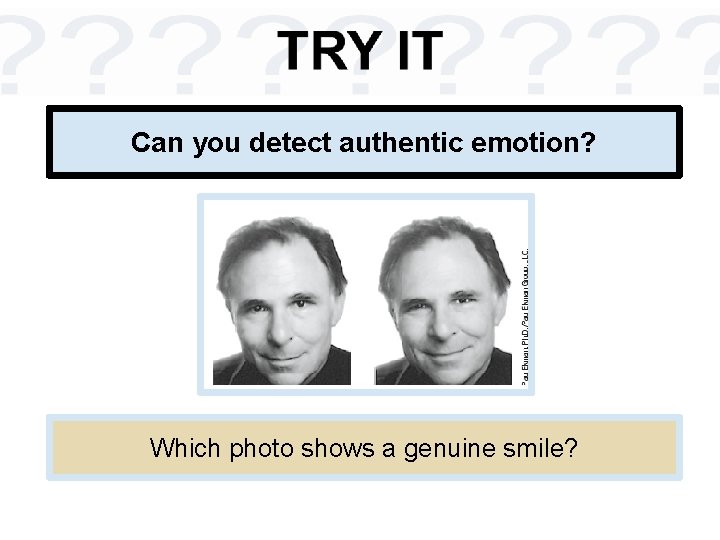
Can you detect authentic emotion? Which photo shows a genuine smile?
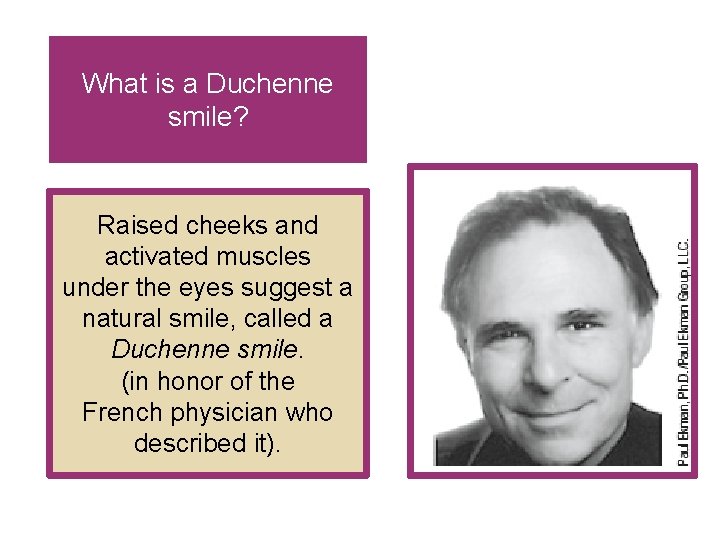
What is a Duchenne smile? Raised cheeks and activated muscles under the eyes suggest a natural smile, called a Duchenne smile. (in honor of the French physician who described it).
How is modern texting impacted by absence of emotion? The absence of expressive emotion can make for ambiguous emotion in electronic communications. To partly remedy that, we often embed visual cues to emotion in our messages. Without the vocal nuances that signal whether our statement is serious, kidding, or sarcastic, we are in danger of what developmental psychologist Jean Piaget called egocentrism, by failing to perceive how others interpret our “just kidding” message. (Kruger et al. , 2005)
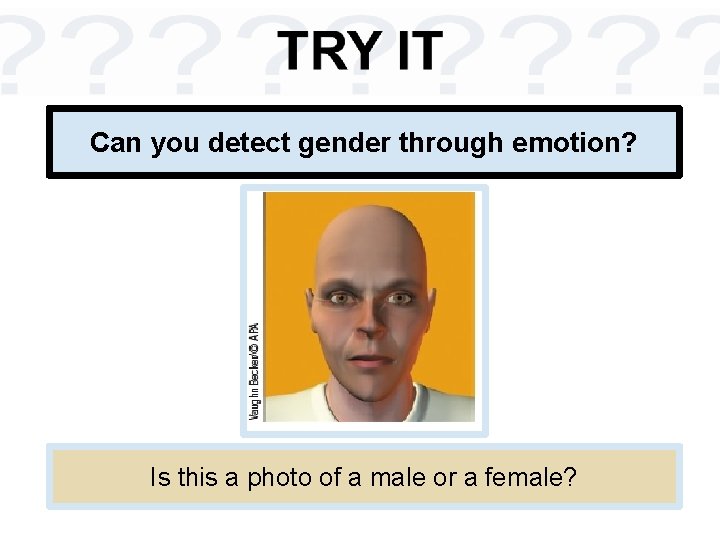
Can you detect gender through emotion? Is this a photo of a male or a female?
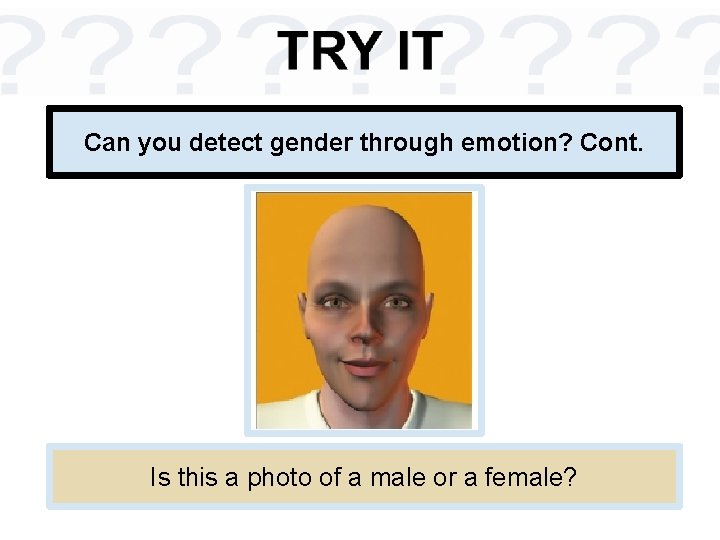
Can you detect gender through emotion? Cont. Is this a photo of a male or a female?
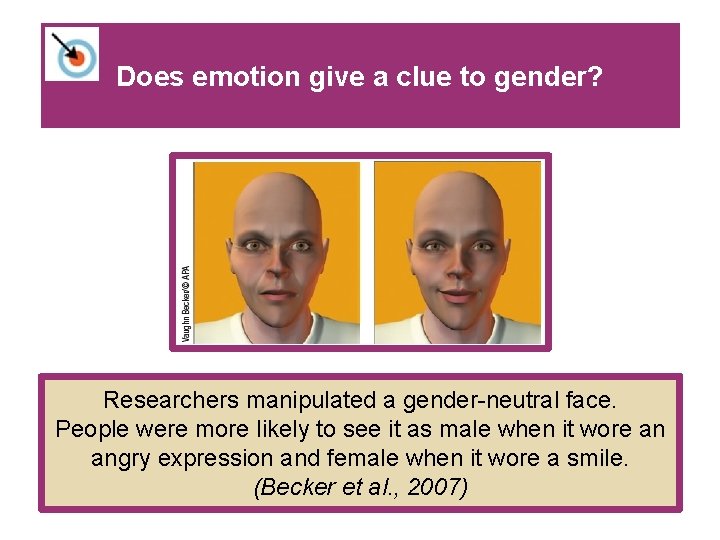
Does emotion give a clue to gender? Researchers manipulated a gender-neutral face. People were more likely to see it as male when it wore an angry expression and female when it wore a smile. (Becker et al. , 2007)
What research has been conducted on gender and emotion? Researchers Kring and Gordon asked male and female students to watch film clips that were sad (children with a dying parent), happy (slapstick comedy), or frightening (a man nearly falling off the ledge of a tall building). Researchers then watched the facial expressions of the men and women as they watched the clips. (Kring & Gordon, 1998)
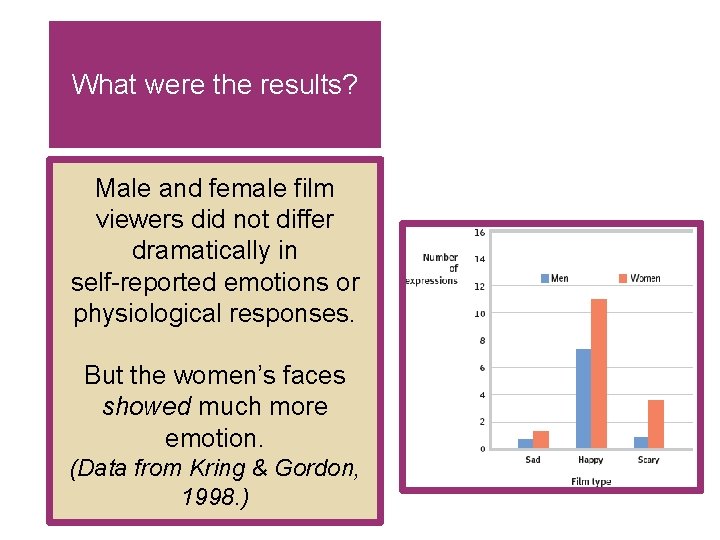
What were the results? Male and female film viewers did not differ dramatically in self-reported emotions or physiological responses. But the women’s faces showed much more emotion. (Data from Kring & Gordon, 1998. )
Does the meaning of gestures vary across cultures? Yes. U. S. President Richard Nixon learned this after making the North American “A-OK” sign before a welcoming crowd of Brazilians, not realizing it was a crude insult in that country
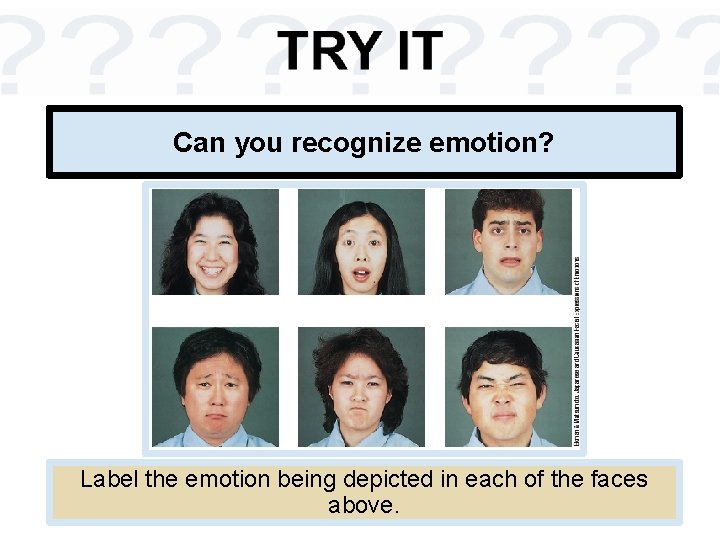
Can you recognize emotion? Label the emotion being depicted in each of the faces above.
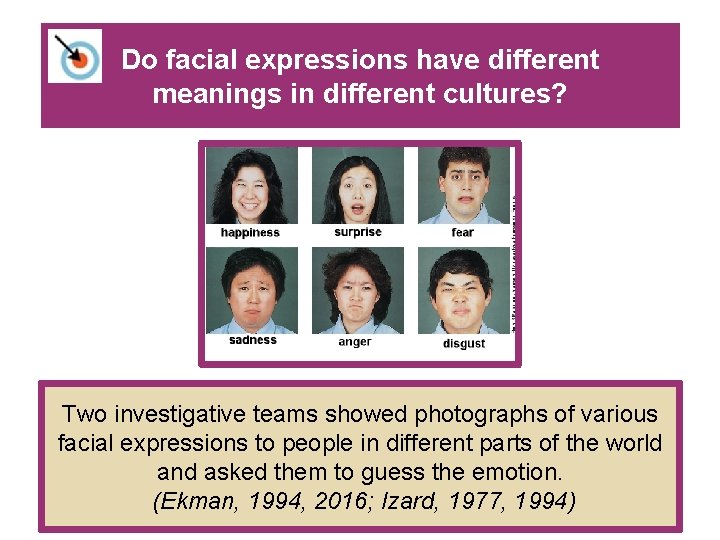
Do facial expressions have different meanings in different cultures? Two investigative teams showed photographs of various facial expressions to people in different parts of the world and asked them to guess the emotion. (Ekman, 1994, 2016; Izard, 1977, 1994)
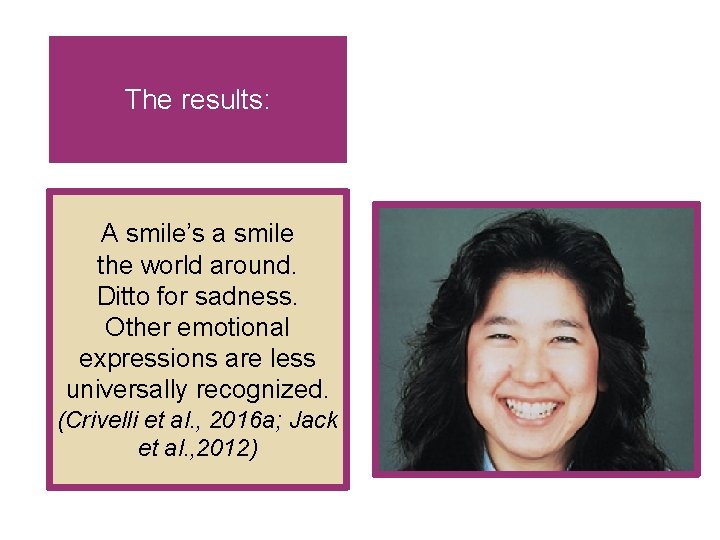
The results: A smile’s a smile the world around. Ditto for sadness. Other emotional expressions are less universally recognized. (Crivelli et al. , 2016 a; Jack et al. , 2012)
1. What Would You Answer? People can most readily detect the emotion of _____ in a set of facial expressions. A. sadness B. happiness C. anger D. fear E. surprise
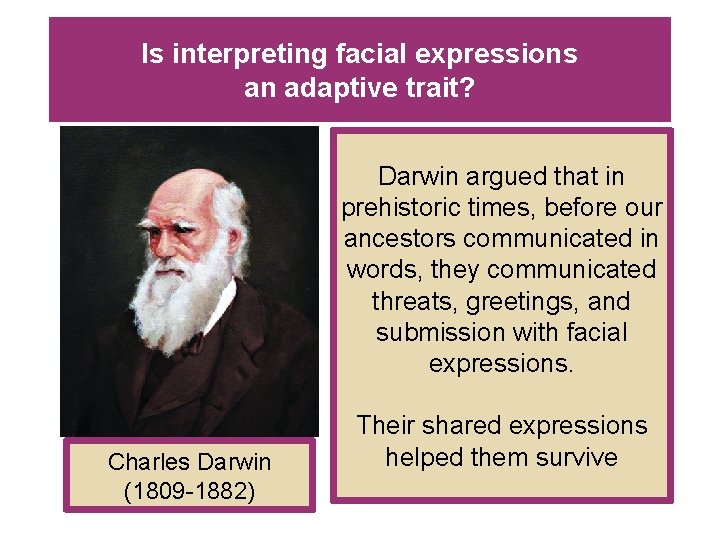
Is interpreting facial expressions an adaptive trait? Darwin argued that in prehistoric times, before our ancestors communicated in words, they communicated threats, greetings, and submission with facial expressions. Charles Darwin (1809 -1882) Their shared expressions helped them survive
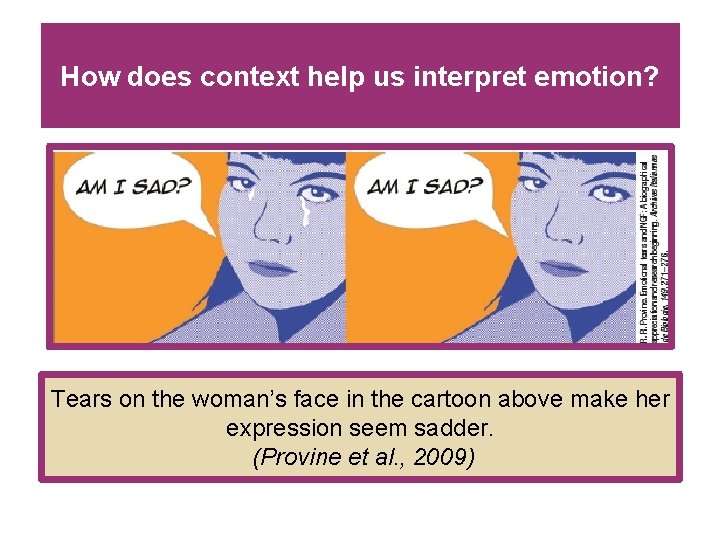
How does context help us interpret emotion? Tears on the woman’s face in the cartoon above make her expression seem sadder. (Provine et al. , 2009)
How does culture impact the amount of emotional expression? Individualistic cultures, as in Western Europe, Australia, New Zealand, and North America, display visible emotions. (van Hemert et al. , 2007) Collectivist cultures, as in Japan and China, often have less visible emotional displays. (Matsumoto et al. , 2009; Tsai et al. , 2007) The mouth, often so expressive in North Americans, conveys less emotion in a Japanese person than do the telltale eyes. (Masuda et al. , 2008; Yuki et al. , 2007)
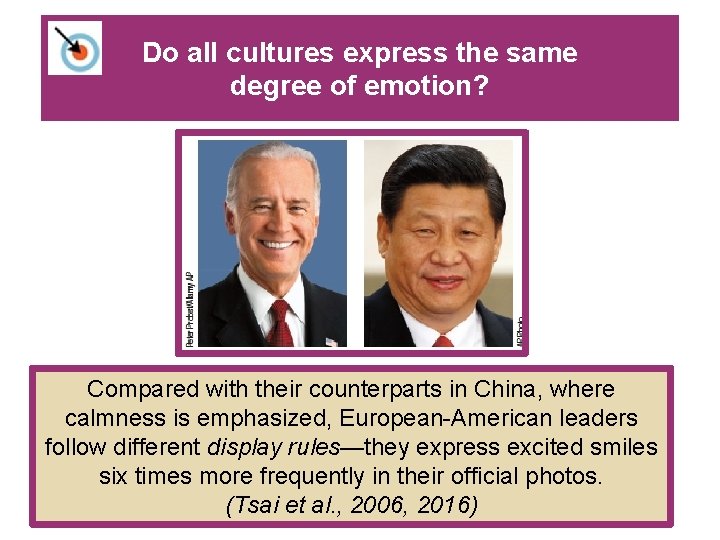
Do all cultures express the same degree of emotion? Compared with their counterparts in China, where calmness is emphasized, European-American leaders follow different display rules—they express excited smiles six times more frequently in their official photos. (Tsai et al. , 2006, 2016)
Give William James’ suggestion a try… As psychologist William James struggled with feelings of depression and grief, he came to believe that we can control emotions by going “through the outward movements” of any emotion we want to experience. “To feel cheerful, ” he advised, “sit up cheerfully, look around cheerfully, and act as if cheerfulness were already there. ” Does it work? Do you feel more cheerful?
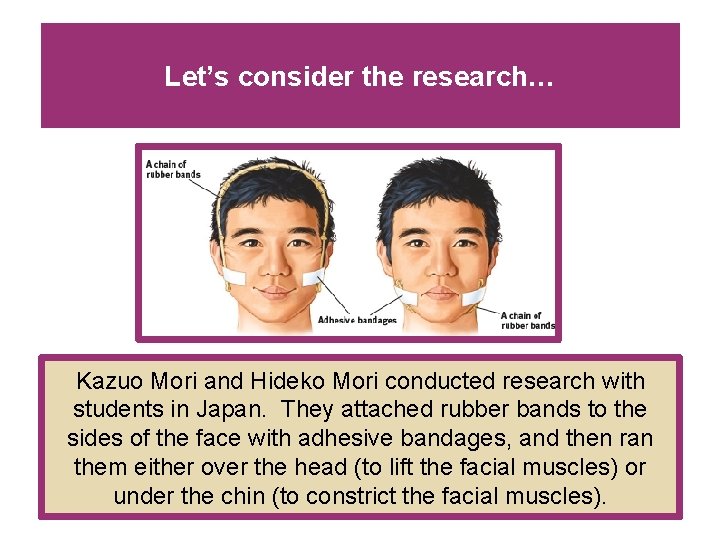
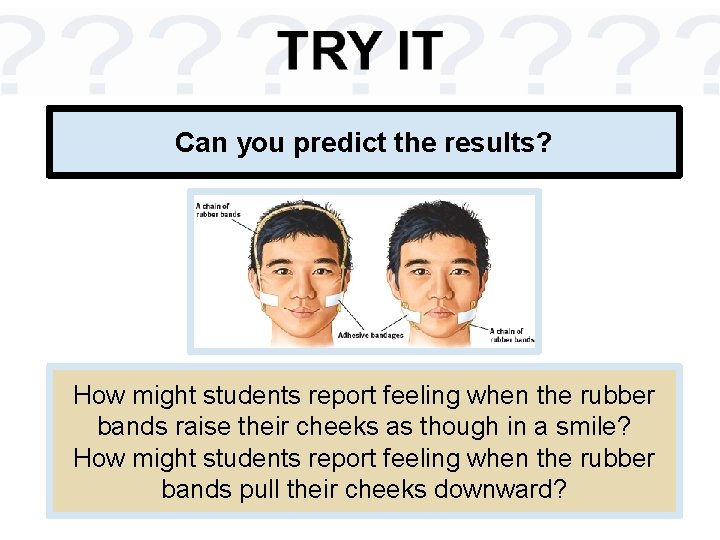
Let’s consider the research… Kazuo Mori and Hideko Mori conducted research with students in Japan. They attached rubber bands to the sides of the face with adhesive bandages, and then ran them either over the head (to lift the facial muscles) or under the chin (to constrict the facial muscles).
Can you predict the results? How might students report feeling when the rubber bands raise their cheeks as though in a smile? How might students report feeling when the rubber bands pull their cheeks downward?
What were the results of this research? Kazuo Mori and Hideko Mori’s results confirmed the facial feedback effect; the tendency of facial muscle states to trigger corresponding feelings such as fear, anger, or happiness. Most students reported feeling more happy than sad when their cheeks were raised upward. Most students reported feeling more sad than happy when their cheeks were pulled downward
How do facial expressions influence our feelings? A hearty smile—made not just with the mouth but with raised cheeks that crinkle the eyes—enhances positive feelings even more when you are reacting to something pleasant or funny. (Soussignan, 2001) When smiling, people more quickly understand sentences that describe pleasant events. (Havas et al. , 2007)
What is the behavior feedback effect? the tendency of behavior to influence our own and others’ thoughts, feelings, and actions For instance, walk for a few minutes with short, shuffling steps, keeping your eyes downcast. Now walk around taking long strides, with your arms swinging and your eyes looking straight ahead. Can you feel your mood shift? Going through the motions awakens the emotions.
How can I make use of the behavior feedback effect and facial feedback effect in my life? You can use your understanding of feedback effects to become more empathic: let your own face mimic another person’s expression. acting as another acts helps us feel what another feels. (Vaughn & Lanzetta, 1981)
Learning Target 42 -1 Review Describe our ability to communicate nonverbally. § Much of our communication is through body movements, facial expressions, and voice tones. Even seconds-long filmed slices of behavior can reveal feelings.
Learning Target 42 -2 Review Discuss how the genders differ in their ability to communicate nonverbally. § Women tend to read emotional cues more easily and to express more empathy.
Learning Target 42 -3 Review Discuss culture specific and culturally universal gestures and facial expressions. § The meaning of gestures varies with culture, but facial expressions, such as those of happiness and fear, are common the world over. § Cultures also differ in the amount of emotion they express.
Learning Target 42 -4 Review Explain how our facial expressions influence our feelings. § Research on the facial feedback effect shows that our facial expressions can trigger emotional feelings and signal our body to respond accordingly. We also mimic others’ expressions, which helps us empathize. § A similar behavior feedback effect is the tendency of behavior to influence our own and others’ thoughts, feelings, and actions.