
Deconstructing st 21 Century CSOs WHAT DO WE
- Slides: 40
Deconstructing st 21 Century CSOs WHAT DO WE EXPECT STUDENTS TO LEARN? TITLE I SCHOOL IMPROVEMENT COORDINATORS ERIN SULLIVAN & GAIL VARNEY
Session Goals Ø Understand the change in the rigor and relevance of the revised CSOs. Ø Participate in a process of deconstructing the CSOs that ensures teachers understand the depth of knowledge and what reasoning and skills students will be expected to master. Ø Understand that the deconstructed CSOs form the basis of designing assessments and selecting appropriate instructional strategies.
Three Ways to Improve Student Learning Ø Raise the level of rigor in the content standards and objectives. Ø Increase the skill and knowledge of teachers in teaching the content. Ø Engage students in active learning designed around the standards for content, learning skills and technology tools.
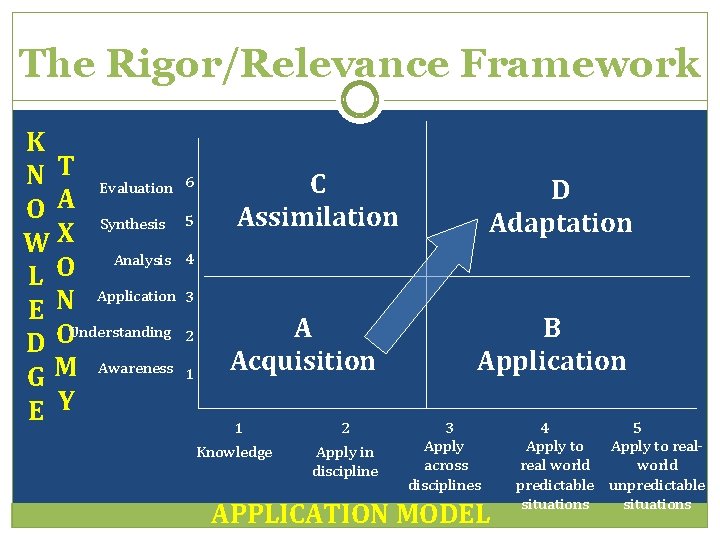
The Rigor/Relevance Framework K N T Evaluation O A Synthesis W X Analysis L O Application N E Understanding O D G M Awareness E Y 6 5 C Assimilation D Adaptation 4 3 2 1 A Acquisition 1 Knowledge 2 Apply in discipline B Application 3 Apply across disciplines APPLICATION MODEL 4 5 Apply to real world predictable unpredictable situations
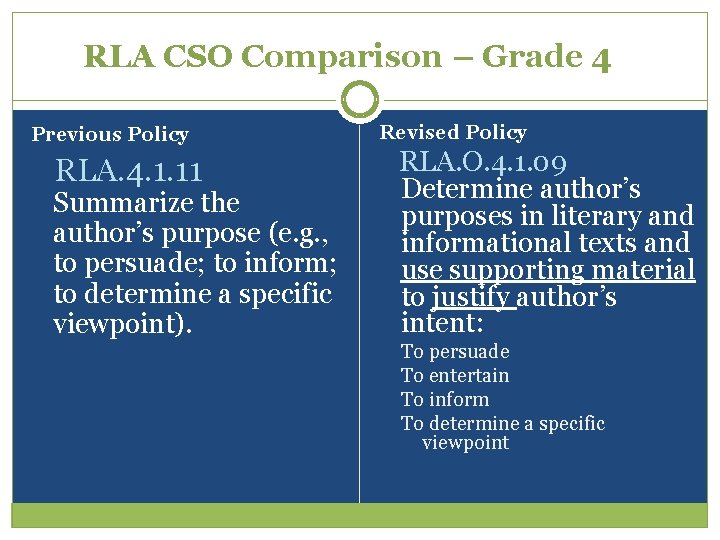
RLA CSO Comparison – Grade 4 Previous Policy RLA. 4. 1. 11 Summarize the author’s purpose (e. g. , to persuade; to inform; to determine a specific viewpoint). Revised Policy RLA. O. 4. 1. 09 Determine author’s purposes in literary and informational texts and use supporting material to justify author’s intent: To persuade To entertain To inform To determine a specific viewpoint
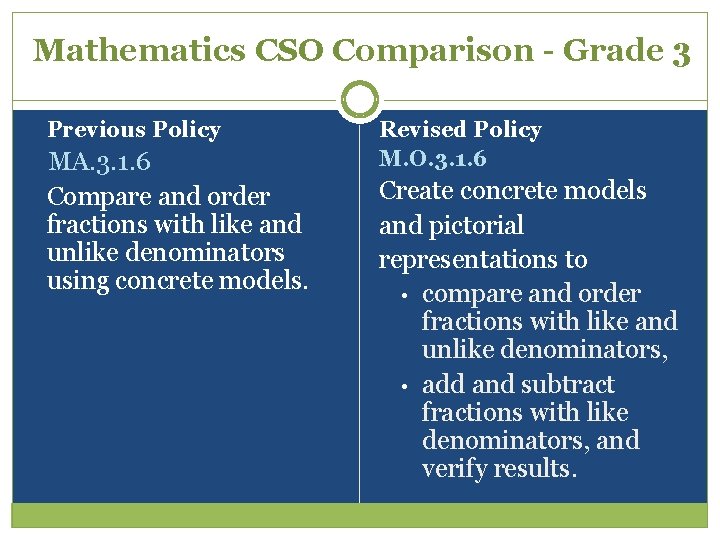
Mathematics CSO Comparison - Grade 3 Previous Policy MA. 3. 1. 6 Compare and order fractions with like and unlike denominators using concrete models. Revised Policy M. O. 3. 1. 6 Create concrete models and pictorial representations to • compare and order fractions with like and unlike denominators, • add and subtract fractions with like denominators, and verify results.
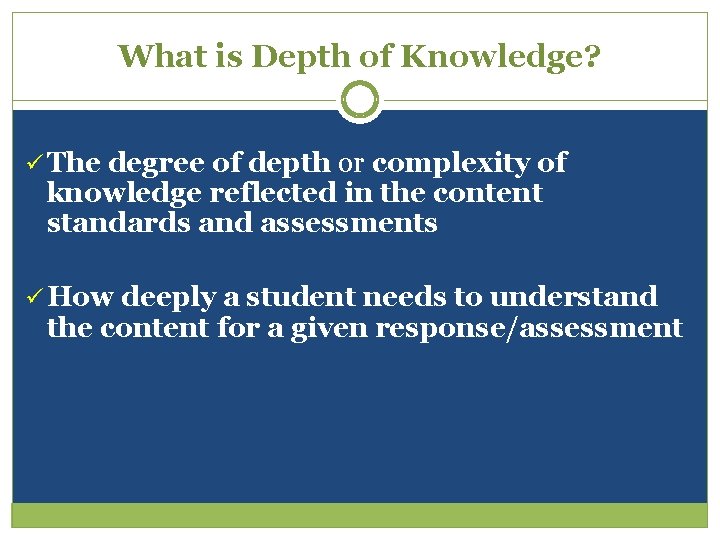
What is Depth of Knowledge? ü The degree of depth or complexity of knowledge reflected in the content standards and assessments ü How deeply a student needs to understand the content for a given response/assessment
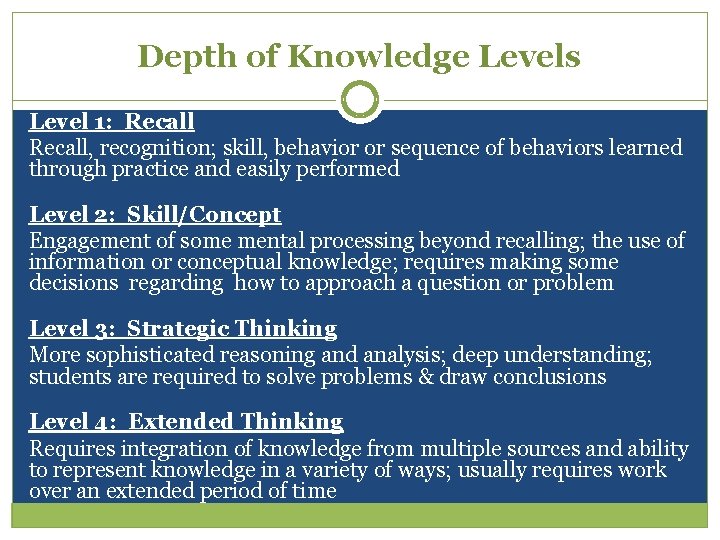
Depth of Knowledge Levels Level 1: Recall, recognition; skill, behavior or sequence of behaviors learned through practice and easily performed Level 2: Skill/Concept Engagement of some mental processing beyond recalling; the use of information or conceptual knowledge; requires making some decisions regarding how to approach a question or problem Level 3: Strategic Thinking More sophisticated reasoning and analysis; deep understanding; students are required to solve problems & draw conclusions Level 4: Extended Thinking Requires integration of knowledge from multiple sources and ability to represent knowledge in a variety of ways; usually requires work over an extended period of time
Understanding Depth of Knowledge Ø DOK is about intended outcome, not difficulty. Ø DOK is a reference to the complexity of mental processing that must occur to answer a question, perform a task, or generate a product.
Understanding Depth of Knowledge Ø Words like explain or analyze have to be considered in context. § “Explain to me where you live” does not raise the DOK of a simple rote response. § Even if the student has to use addresses or landmarks, the student is doing nothing more than recalling and reciting. Copyright © 2007 Mississippi Department of Education
Understanding Depth of Knowledge Difficulty is a reference to how many students answer a question correctly: Ø How many of you know the definition of exaggerate? DOK 1 - recall If all of you know the definition, this question is an easy question. Ø How many of you know the definition of prescient? DOK 1 - recall If most of you do not know the definition, this question is a difficult question. Copyright © 2007 Mississippi Department of Education
Activity: Determining DOK Level Ø DOK ? Describe three characteristics of metamorphic rocks Ø DOK ? Describe the difference between metamorphic and igneous rocks. Ø DOK ? Describe a model that you might use to represent the relationships that exist within the rock cycle.
Practice Activity: Sample One Locate and interpret key information in illustrations, titles, chapter headings, glossaries and maps to answer questions.
Practice Activity: Sample Two Solve one-step linear equations and inequalities with one variable, interpret the solution or solutions in the context from which they arose, and verify the reasonableness of the results.
Practice Activity: Sample Three Design a statistical experiment to study a problem and communicate the outcomes.
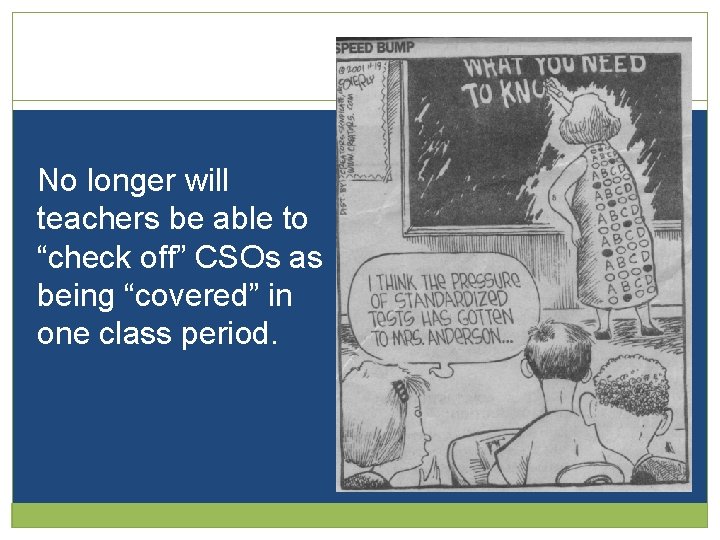
No longer will teachers be able to “check off” CSOs as being “covered” in one class period.
Where do we begin?
Deconstructing the Standards is… …a systematic process to identify embedded learning targets in standards and objectives so that nothing essential is missed during instruction.
Learning Targets What students should know, understand be able to do to master the standards/objectives
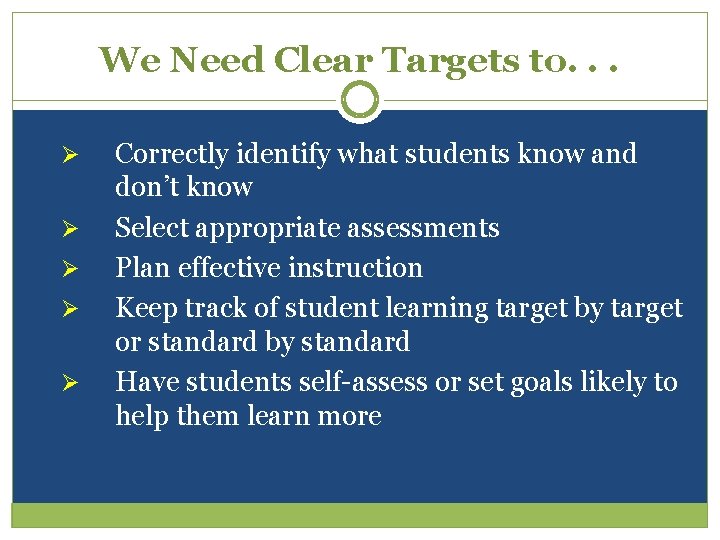
We Need Clear Targets to. . . Ø Ø Ø Correctly identify what students know and don’t know Select appropriate assessments Plan effective instruction Keep track of student learning target by target or standard by standard Have students self-assess or set goals likely to help them learn more
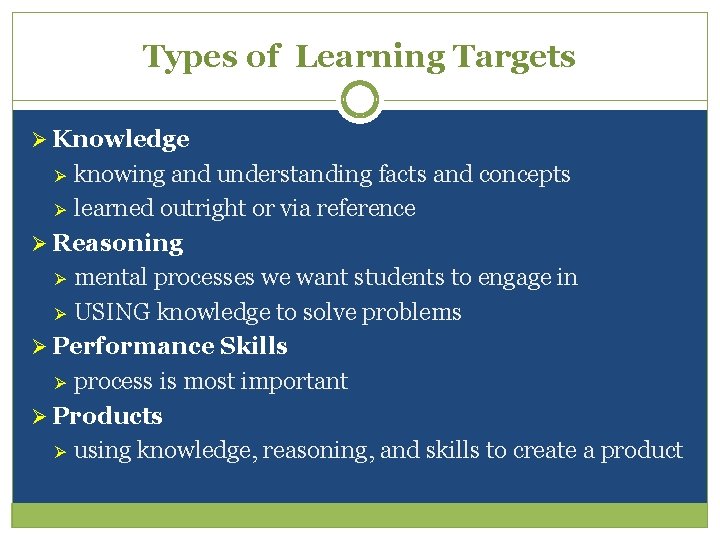
Types of Learning Targets Ø Knowledge knowing and understanding facts and concepts Ø learned outright or via reference Ø Reasoning Ø mental processes we want students to engage in Ø USING knowledge to solve problems Ø Performance Skills Ø process is most important Ø Products Ø using knowledge, reasoning, and skills to create a product Ø
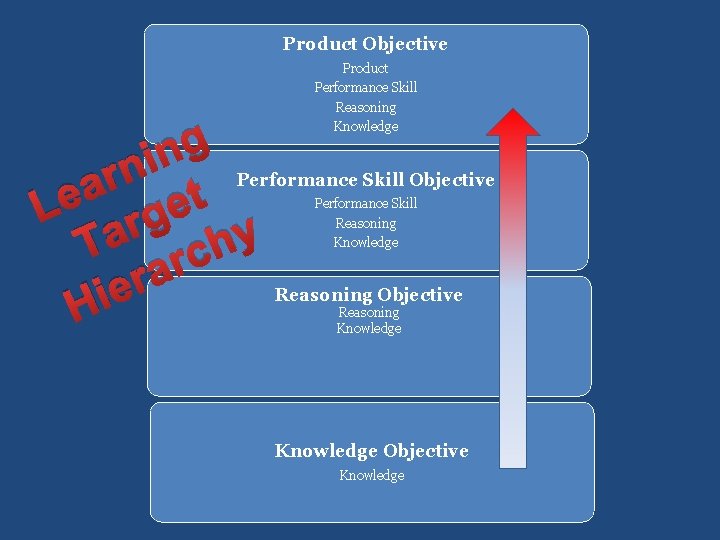
Product Objective Product Performance Skill Reasoning Knowledge g n i n Performance Skill Objective r a t e e L g r Ta rchy a r Reasoning Objective e i H Performance Skill Reasoning Knowledge Objective Knowledge
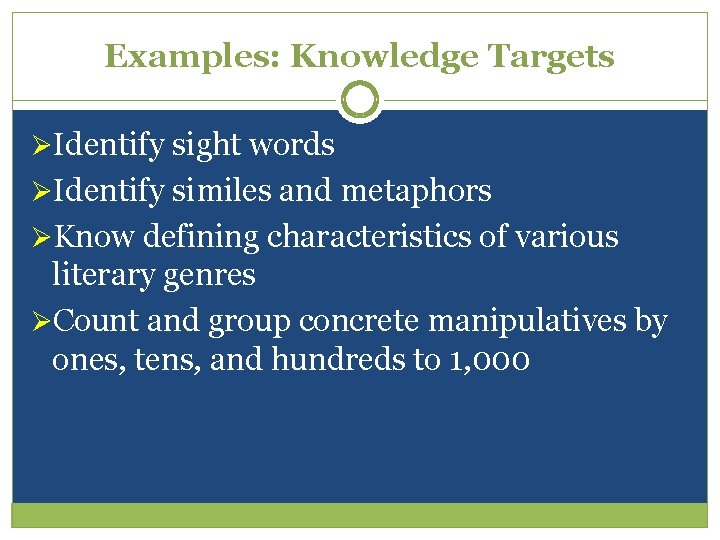
Examples: Knowledge Targets ØIdentify sight words ØIdentify similes and metaphors ØKnow defining characteristics of various literary genres ØCount and group concrete manipulatives by ones, tens, and hundreds to 1, 000
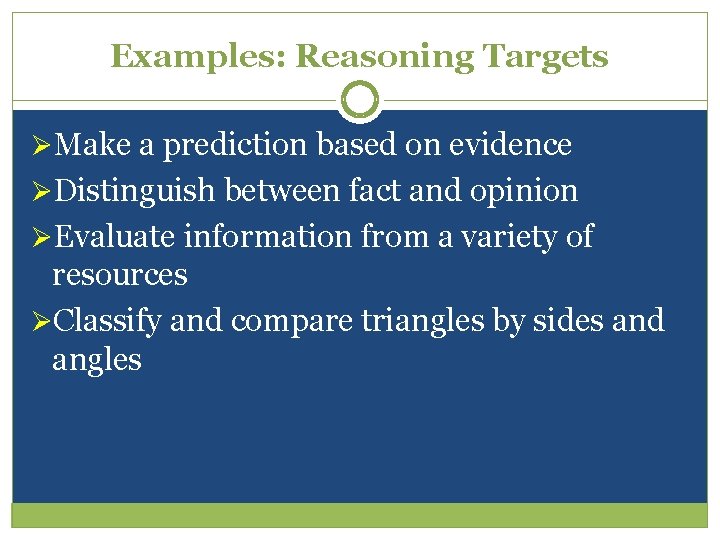
Examples: Reasoning Targets ØMake a prediction based on evidence ØDistinguish between fact and opinion ØEvaluate information from a variety of resources ØClassify and compare triangles by sides and angles
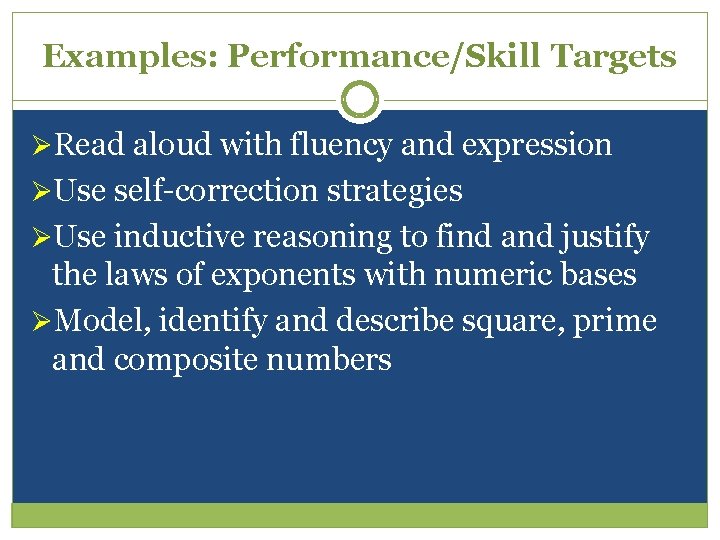
Examples: Performance/Skill Targets ØRead aloud with fluency and expression ØUse self-correction strategies ØUse inductive reasoning to find and justify the laws of exponents with numeric bases ØModel, identify and describe square, prime and composite numbers
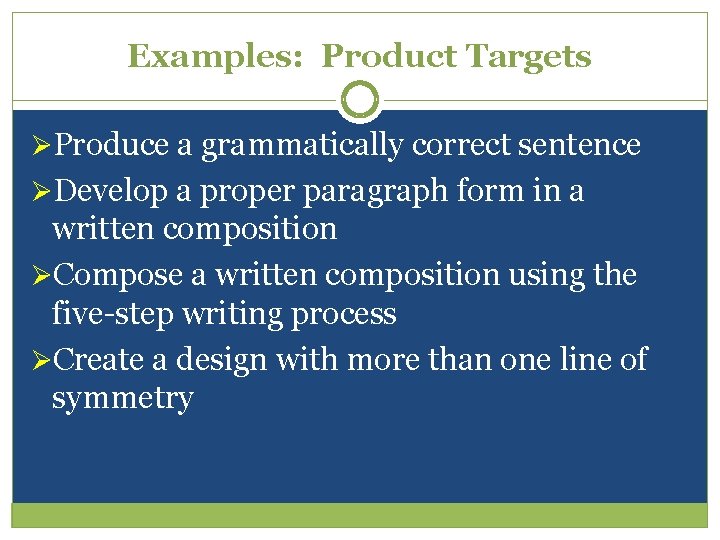
Examples: Product Targets ØProduce a grammatically correct sentence ØDevelop a proper paragraph form in a written composition ØCompose a written composition using the five-step writing process ØCreate a design with more than one line of symmetry
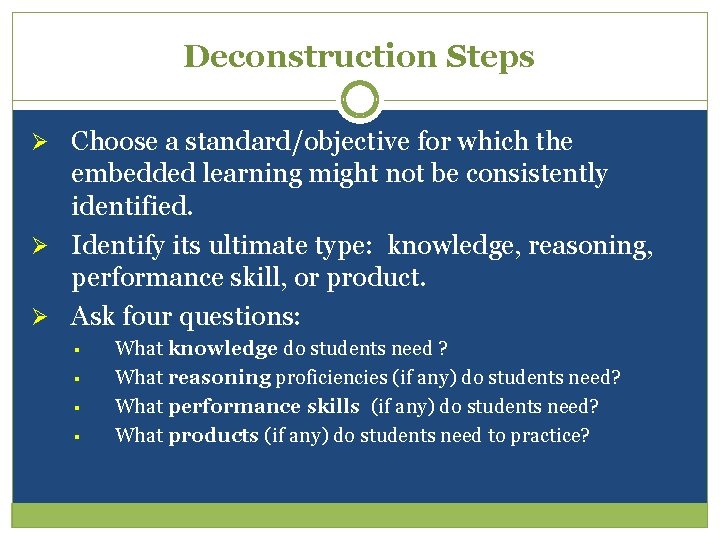
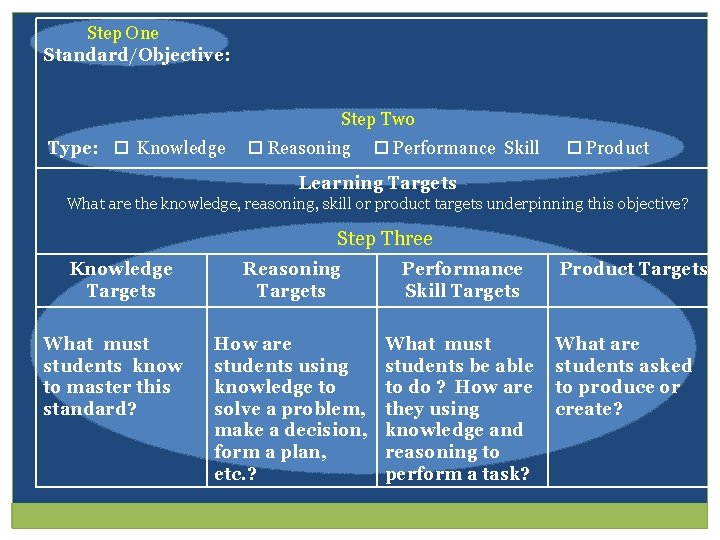
Deconstruction Steps Ø Choose a standard/objective for which the embedded learning might not be consistently identified. Ø Identify its ultimate type: knowledge, reasoning, performance skill, or product. Ø Ask four questions: § § What knowledge do students need ? What reasoning proficiencies (if any) do students need? What performance skills (if any) do students need? What products (if any) do students need to practice?
Step One Standard/Objective: Step Two Type: Knowledge Reasoning Performance Skill Product Learning Targets What are the knowledge, reasoning, skill or product targets underpinning this objective? Step Three Knowledge Targets What must students know to master this standard? Reasoning Targets Performance Skill Targets How are students using knowledge to solve a problem, make a decision, form a plan, etc. ? What must students be able to do ? How are they using knowledge and reasoning to perform a task? Product Targets What are students asked to produce or create?
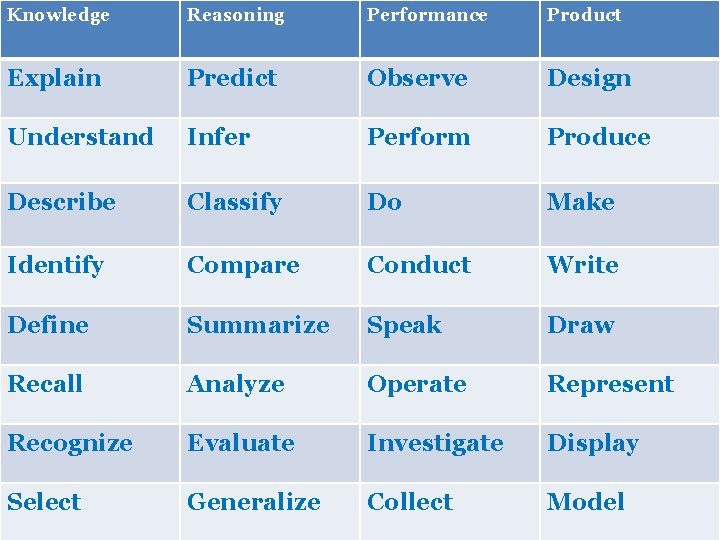
Activity: Learning Target Verb Sort Ø Categorize verbs under correct learning target headings: • • Knowledge Reasoning Performance Skill Product
Knowledge Reasoning Performance Product Explain Predict Observe Design Understand Infer Perform Produce Describe Classify Do Make Identify Compare Conduct Write Define Summarize Speak Draw Recall Analyze Operate Represent Recognize Evaluate Investigate Display Select Generalize Collect Model
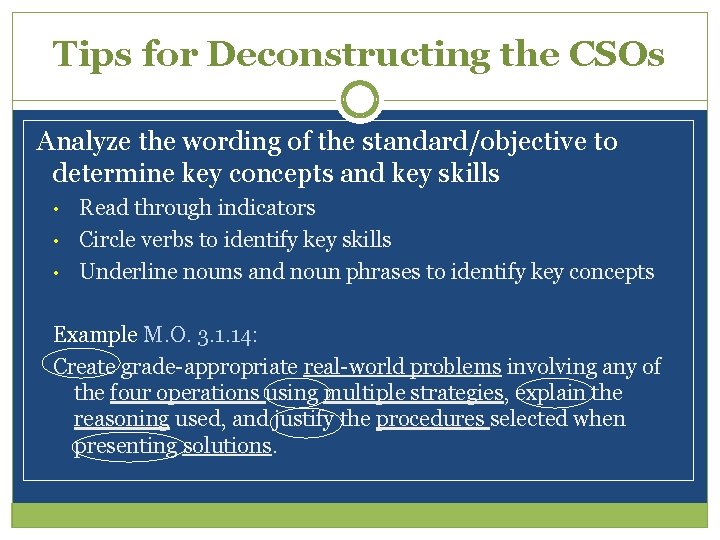
Tips for Deconstructing the CSOs Analyze the wording of the standard/objective to determine key concepts and key skills • • • Read through indicators Circle verbs to identify key skills Underline nouns and noun phrases to identify key concepts Example M. O. 3. 1. 14: Create grade-appropriate real-world problems involving any of the four operations using multiple strategies, explain the reasoning used, and justify the procedures selected when presenting solutions.
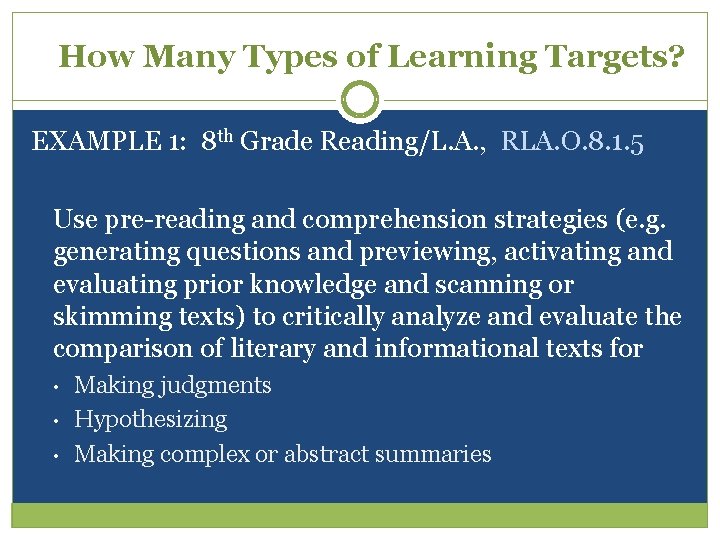
How Many Types of Learning Targets? EXAMPLE 1: 8 th Grade Reading/L. A. , RLA. O. 8. 1. 5 Use pre-reading and comprehension strategies (e. g. generating questions and previewing, activating and evaluating prior knowledge and scanning or skimming texts) to critically analyze and evaluate the comparison of literary and informational texts for • • • Making judgments Hypothesizing Making complex or abstract summaries
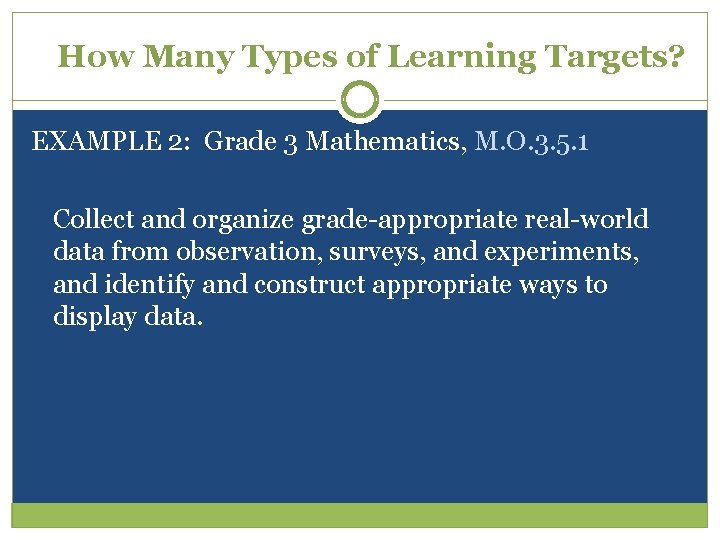
How Many Types of Learning Targets? EXAMPLE 2: Grade 3 Mathematics, M. O. 3. 5. 1 Collect and organize grade-appropriate real-world data from observation, surveys, and experiments, and identify and construct appropriate ways to display data.
Activity Let’s deconstruct one together!
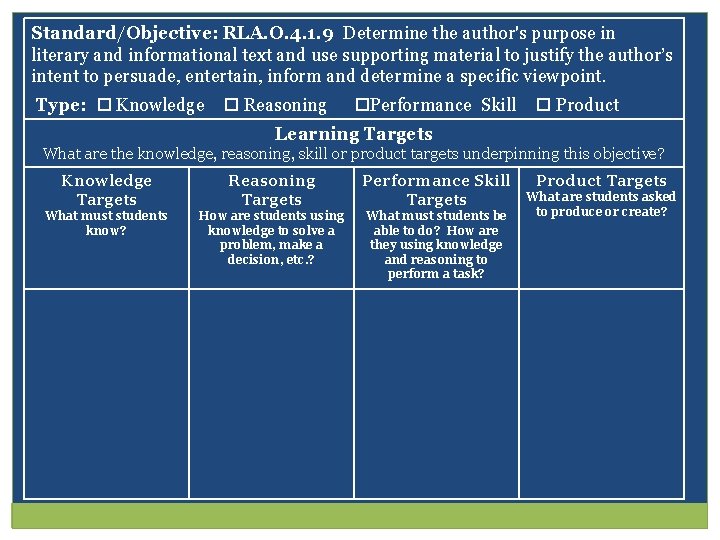
Standard/Objective: RLA. O. 4. 1. 9 Determine the author's purpose in literary and informational text and use supporting material to justify the author’s intent to persuade, entertain, inform and determine a specific viewpoint. Type: Knowledge Reasoning Performance Skill Product Learning Targets What are the knowledge, reasoning, skill or product targets underpinning this objective? Knowledge Targets Reasoning Targets Performance Skill Targets What must students know? How are students using knowledge to solve a problem, make a decision, etc. ? What must students be able to do? How are they using knowledge and reasoning to perform a task? Product Targets What are students asked to produce or create?
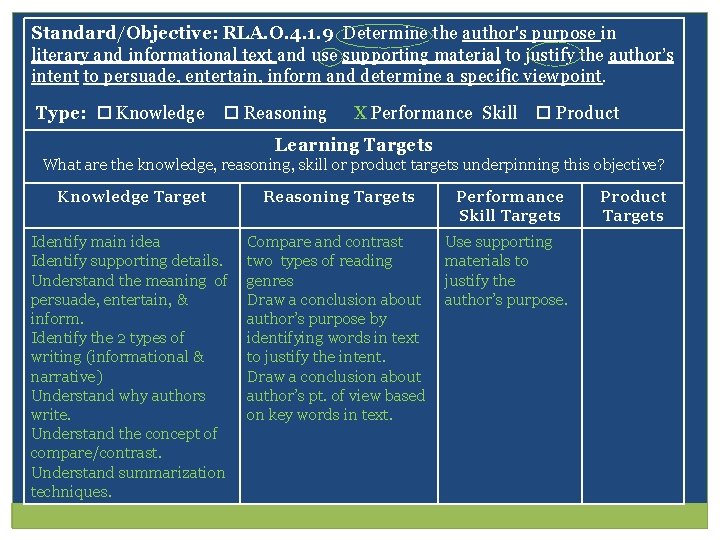
Standard/Objective: RLA. O. 4. 1. 9 Determine the author's purpose in literary and informational text and use supporting material to justify the author’s intent to persuade, entertain, inform and determine a specific viewpoint. Type: Knowledge Reasoning X Performance Skill Product Learning Targets What are the knowledge, reasoning, skill or product targets underpinning this objective? Knowledge Target Reasoning Targets Performance Skill Targets Identify main idea Identify supporting details. Understand the meaning of persuade, entertain, & inform. Identify the 2 types of writing (informational & narrative) Understand why authors write. Understand the concept of compare/contrast. Understand summarization techniques. Compare and contrast two types of reading genres Draw a conclusion about author’s purpose by identifying words in text to justify the intent. Draw a conclusion about author’s pt. of view based on key words in text. Use supporting materials to justify the author’s purpose. Product Targets
Your Turn to Deconstruct Divide into teams. 2. Choose one standard/objective that everyone in the group will tackle. 3. Each group deconstructs the chosen standard/objective. 4. Groups compare learning targets and come to consensus. 1.
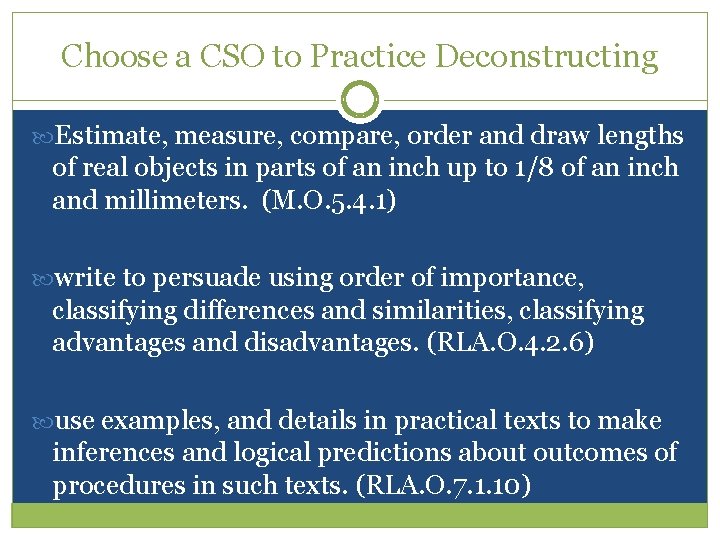
Choose a CSO to Practice Deconstructing Estimate, measure, compare, order and draw lengths of real objects in parts of an inch up to 1/8 of an inch and millimeters. (M. O. 5. 4. 1) write to persuade using order of importance, classifying differences and similarities, classifying advantages and disadvantages. (RLA. O. 4. 2. 6) use examples, and details in practical texts to make inferences and logical predictions about outcomes of procedures in such texts. (RLA. O. 7. 1. 10)
QUESTIONS? ? ?