Latest LHCf physics results Oscar Adriani University of
- Slides: 36
Latest LHCf physics results + Oscar Adriani University of Florence & INFN Firenze ICHEP 2014 Valencia, July 4 th, 2014
+ Physics Motivations Impact on HECR Physics
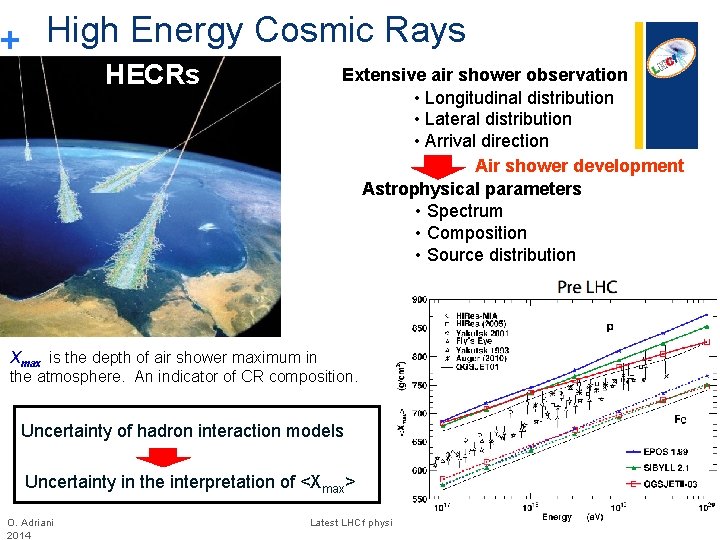
+ High Energy Cosmic Rays HECRs Extensive air shower observation • Longitudinal distribution • Lateral distribution • Arrival direction Air shower development Astrophysical parameters • Spectrum • Composition • Source distribution Xmax is the depth of air shower maximum in the atmosphere. An indicator of CR composition. Uncertainty of hadron interaction models Uncertainty in the interpretation of <Xmax> O. Adriani 2014 Latest LHCf physics results Valencia, July 4 th,
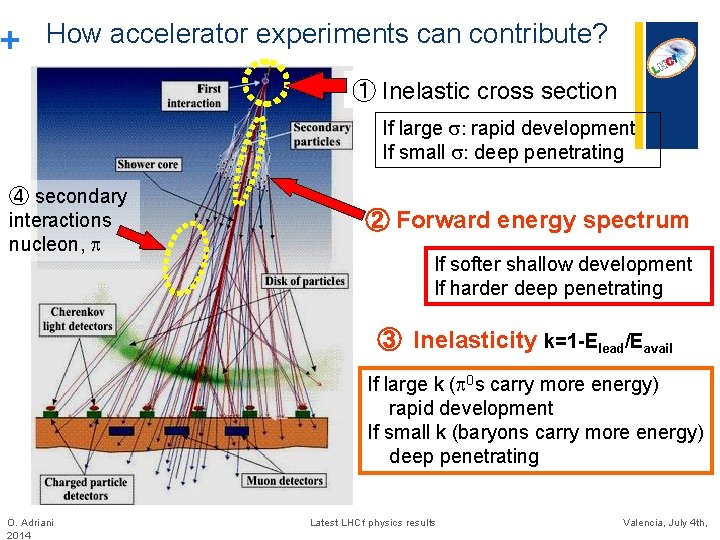
+ How accelerator experiments can contribute? ① Inelastic cross section If large s: rapid development If small s: deep penetrating ④ secondary interactions nucleon, ② Forward energy spectrum If softer shallow development If harder deep penetrating ③ Inelasticity k=1 -Elead/Eavail If large k ( 0 s carry more energy) rapid development If small k (baryons carry more energy) deep penetrating O. Adriani 2014 Latest LHCf physics results Valencia, July 4 th,
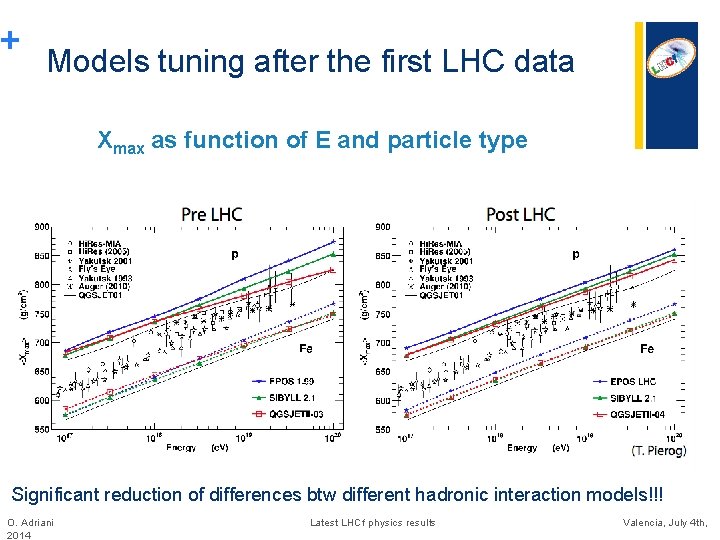
+ Models tuning after the first LHC data Xmax as function of E and particle type Significant reduction of differences btw different hadronic interaction models!!! O. Adriani 2014 Latest LHCf physics results Valencia, July 4 th,
+ LHCf @ LHC The experimental set-up
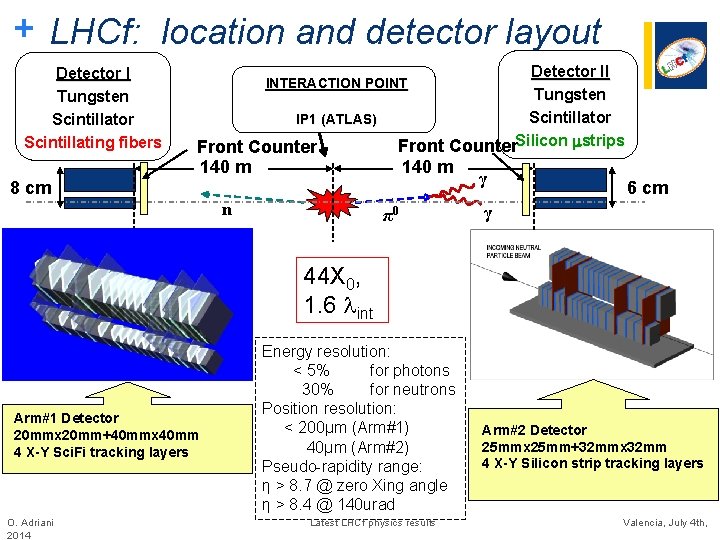
+ LHCf: location and detector layout Detector I Tungsten Scintillator Scintillating fibers Detector II Tungsten Scintillator Front Counter. Silicon mstrips INTERACTION POINT IP 1 (ATLAS) Front Counter 140 m 8 cm n π0 γ 6 cm γ 44 X 0, 1. 6 lint Arm#1 Detector 20 mmx 20 mm+40 mmx 40 mm 4 X-Y Sci. Fi tracking layers O. Adriani 2014 Energy resolution: < 5% for photons 30% for neutrons Position resolution: < 200μm (Arm#1) 40μm (Arm#2) Pseudo-rapidity range: η > 8. 7 @ zero Xing angle η > 8. 4 @ 140 urad Latest LHCf physics results Arm#2 Detector 25 mmx 25 mm+32 mmx 32 mm 4 X-Y Silicon strip tracking layers Valencia, July 4 th,
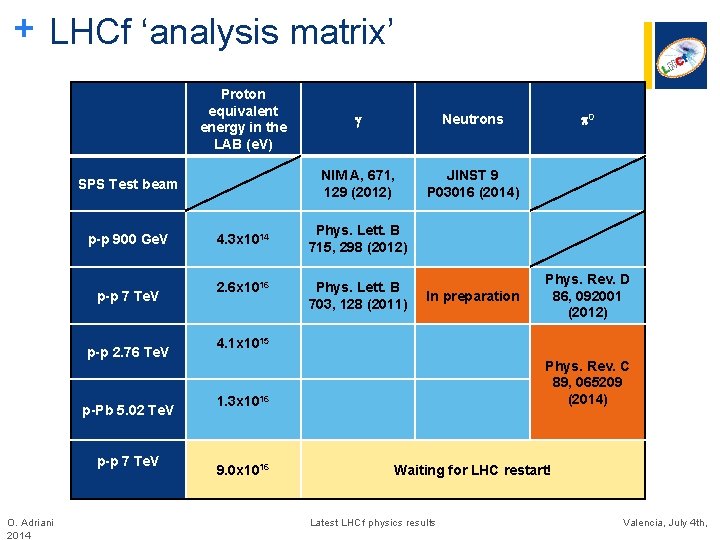
+ LHCf ‘analysis matrix’ Proton equivalent energy in the LAB (e. V) SPS Test beam p-p 900 Ge. V p-p 7 Te. V p-p 2. 76 Te. V p-Pb 5. 02 Te. V p-p 7 Te. V O. Adriani 2014 4. 3 x 10¹⁴ 2. 6 x 10¹⁶ g Neutrons NIM A, 671, 129 (2012) JINST 9 P 03016 (2014) p 0 Phys. Lett. B 715, 298 (2012) Phys. Lett. B 703, 128 (2011) In preparation Phys. Rev. D 86, 092001 (2012) 4. 1 x 10¹⁵ Phys. Rev. C 89, 065209 (2014) 1. 3 x 10¹⁶ 9. 0 x 1016 Waiting for LHC restart! Latest LHCf physics results Valencia, July 4 th,
+ Latest analysis Neutrons in 7 Te. V pp collisions 0 in 5. 02 Te. V p-Pb collisions
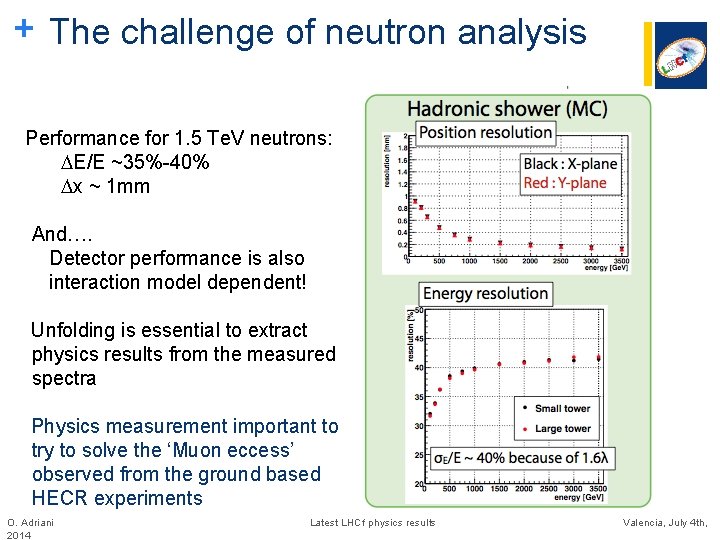
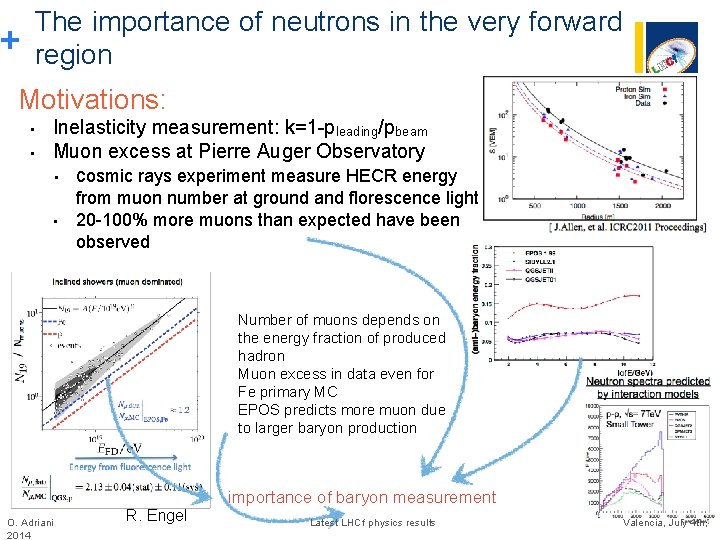
+ The challenge of neutron analysis Performance for 1. 5 Te. V neutrons: DE/E ~35%-40% Dx ~ 1 mm And…. Detector performance is also interaction model dependent! Unfolding is essential to extract physics results from the measured spectra Physics measurement important to try to solve the ‘Muon eccess’ observed from the ground based HECR experiments O. Adriani 2014 Latest LHCf physics results Valencia, July 4 th,
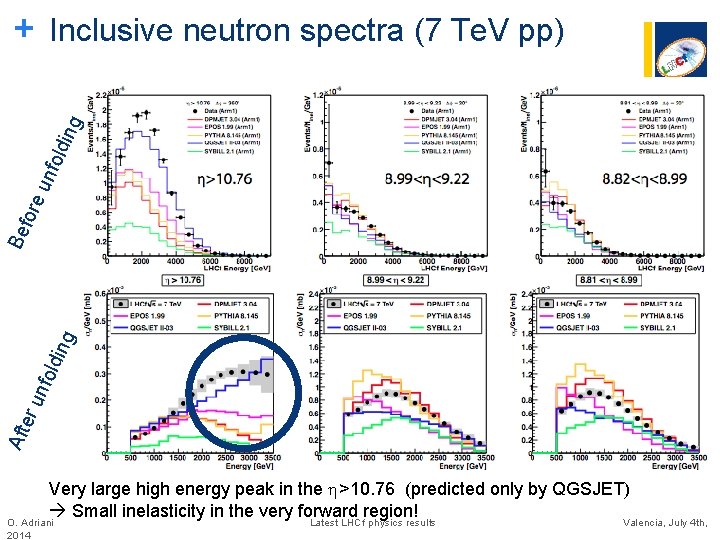
Aft er unf o ldin g Be for eu nfo ldin g + Inclusive neutron spectra (7 Te. V pp) Very large high energy peak in the h>10. 76 (predicted only by QGSJET) Small inelasticity in the very forward region! O. Adriani 2014 Latest LHCf physics results Valencia, July 4 th,
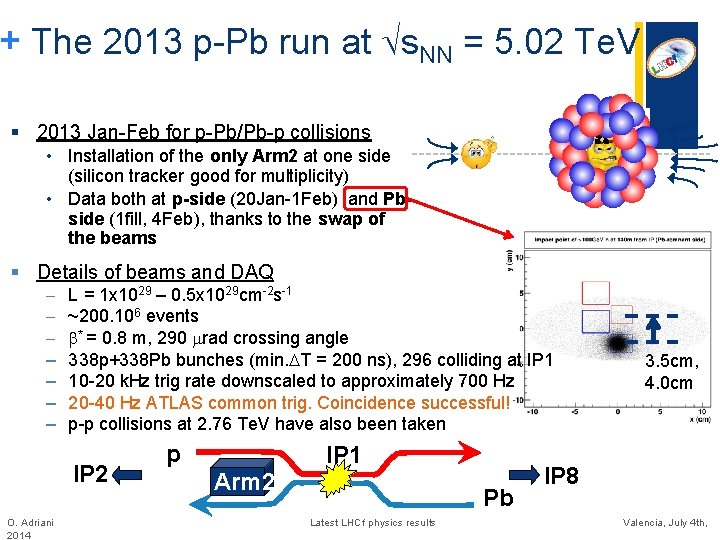
+ The 2013 p-Pb run at s. NN = 5. 02 Te. V § 2013 Jan-Feb for p-Pb/Pb-p collisions • Installation of the only Arm 2 at one side (silicon tracker good for multiplicity) • Data both at p-side (20 Jan-1 Feb) and Pbside (1 fill, 4 Feb), thanks to the swap of the beams § Details of beams and DAQ – – – – L = 1 x 1029 – 0. 5 x 1029 cm-2 s-1 ~200. 106 events b* = 0. 8 m, 290 rad crossing angle 338 p+338 Pb bunches (min. DT = 200 ns), 296 colliding at IP 1 10 -20 k. Hz trig rate downscaled to approximately 700 Hz 20 -40 Hz ATLAS common trig. Coincidence successful! p-p collisions at 2. 76 Te. V have also been taken IP 2 O. Adriani 2014 p IP 1 Arm 2 Pb Latest LHCf physics results 3. 5 cm, 4. 0 cm IP 8 Valencia, July 4 th,
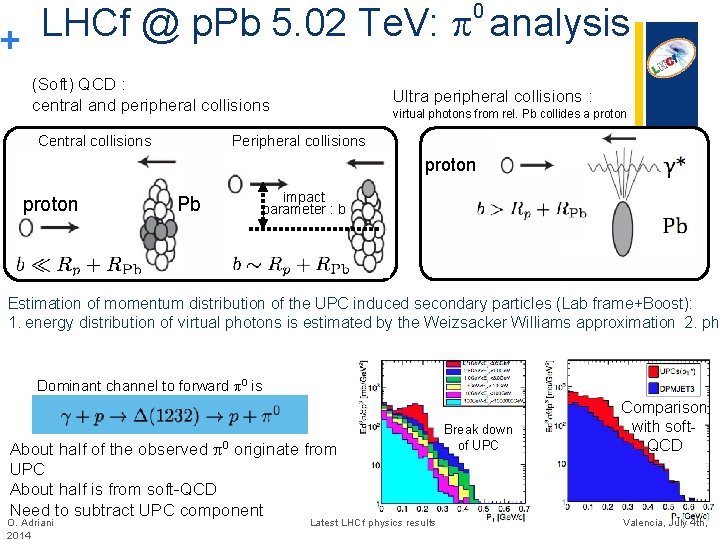
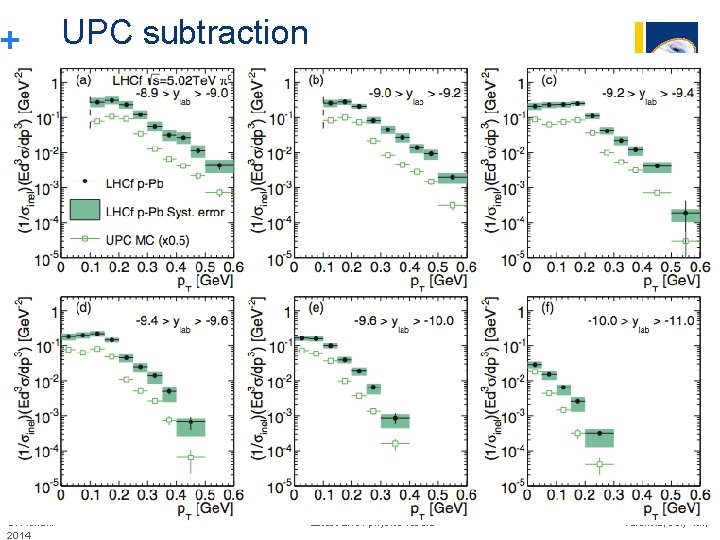
LHCf @ p. Pb 5. 02 Te. V: analysis + 0 (Soft) QCD : central and peripheral collisions Central collisions Ultra peripheral collisions : virtual photons from rel. Pb collides a proton Peripheral collisions proton Pb impact parameter : b Estimation of momentum distribution of the UPC induced secondary particles (Lab frame+Boost): 1. energy distribution of virtual photons is estimated by the Weizsacker Williams approximation 2. pho Dominant channel to forward 0 is About half of the observed π 0 originate from UPC About half is from soft-QCD Need to subtract UPC component O. Adriani 2014 Latest LHCf physics results Break down of UPC Comparison with soft. QCD Valencia, July 4 th,
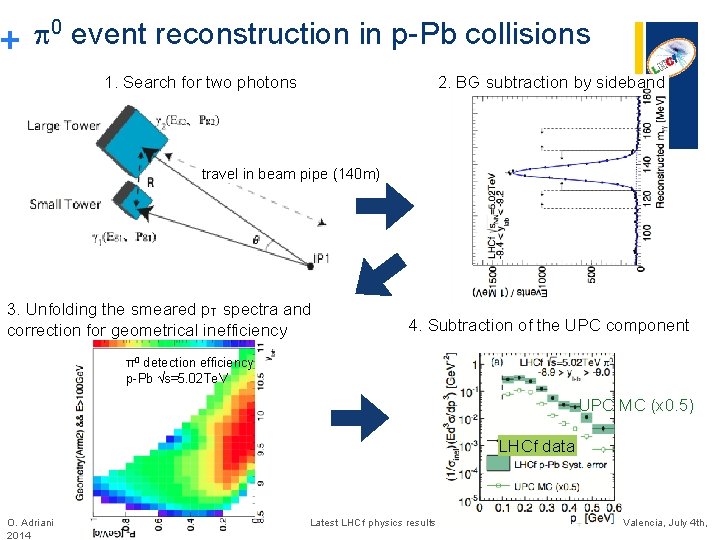
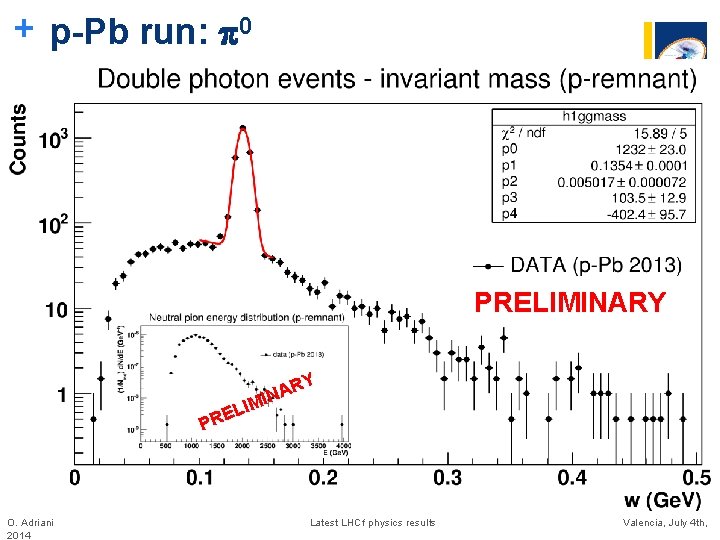
0 event reconstruction in p-Pb collisions + 1. Search for two photons 2. BG subtraction by sideband travel in beam pipe (140 m) 3. Unfolding the smeared p. T spectra and correction for geometrical inefficiency 4. Subtraction of the UPC component π0 detection efficiency p-Pb √s=5. 02 Te. V UPC MC (x 0. 5) LHCf data O. Adriani 2014 Latest LHCf physics results Valencia, July 4 th,
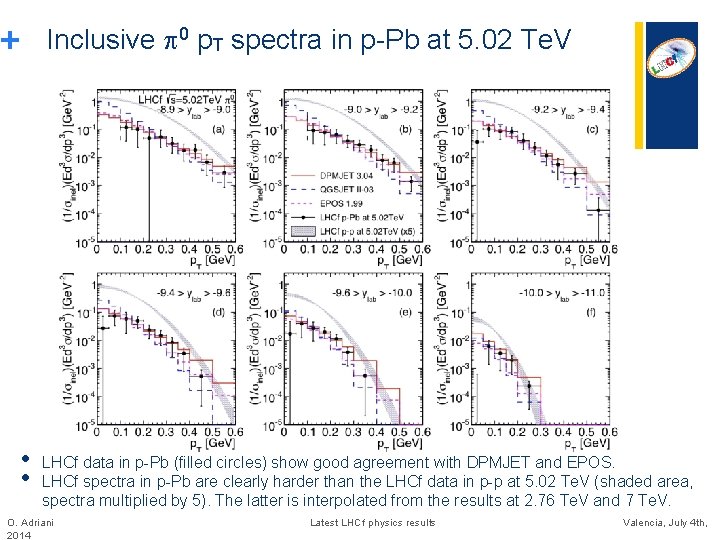
+ • • Inclusive 0 p. T spectra in p-Pb at 5. 02 Te. V LHCf data in p-Pb (filled circles) show good agreement with DPMJET and EPOS. LHCf spectra in p-Pb are clearly harder than the LHCf data in p-p at 5. 02 Te. V (shaded area, spectra multiplied by 5). The latter is interpolated from the results at 2. 76 Te. V and 7 Te. V. O. Adriani 2014 Latest LHCf physics results Valencia, July 4 th,
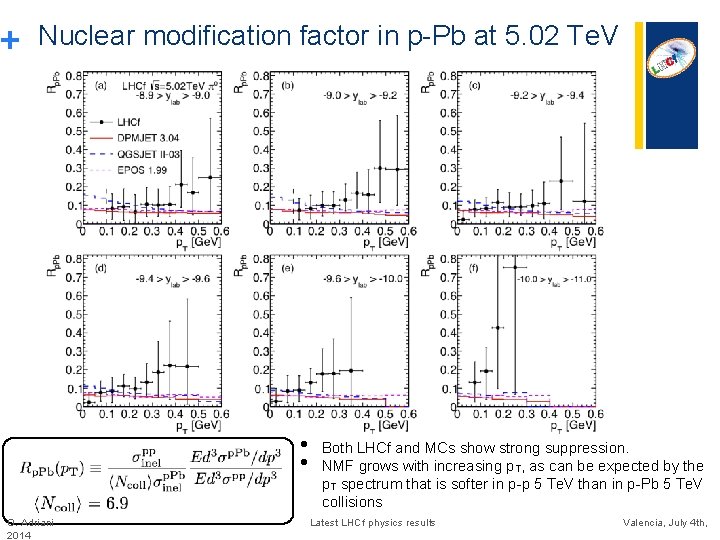
+ Nuclear modification factor in p-Pb at 5. 02 Te. V • • O. Adriani 2014 Both LHCf and MCs show strong suppression. NMF grows with increasing p. T, as can be expected by the p. T spectrum that is softer in p-p 5 Te. V than in p-Pb 5 Te. V collisions Latest LHCf physics results Valencia, July 4 th,
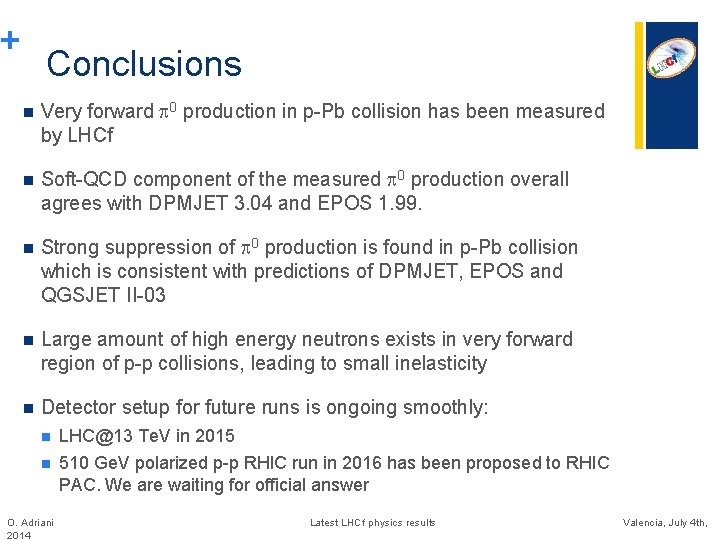
+ Conclusions n Very forward 0 production in p-Pb collision has been measured by LHCf n Soft-QCD component of the measured 0 production overall agrees with DPMJET 3. 04 and EPOS 1. 99. n Strong suppression of 0 production is found in p-Pb collision which is consistent with predictions of DPMJET, EPOS and QGSJET II-03 n Large amount of high energy neutrons exists in very forward region of p-p collisions, leading to small inelasticity n Detector setup for future runs is ongoing smoothly: n LHC@13 Te. V in 2015 n 510 Ge. V polarized p-p RHIC run in 2016 has been proposed to RHIC PAC. We are waiting for official answer O. Adriani 2014 Latest LHCf physics results Valencia, July 4 th,
+ Backup slides O. Adriani 2014 Latest LHCf physics results Valencia, July 4 th,
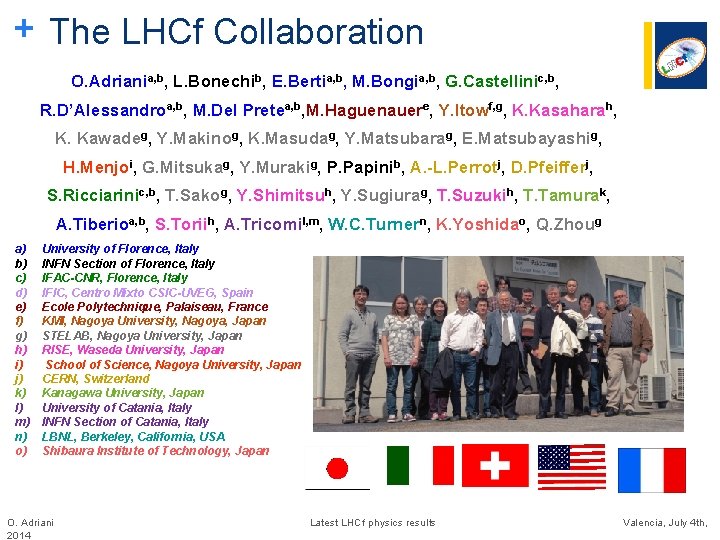
+ The LHCf Collaboration O. Adriania, b, L. Bonechib, E. Bertia, b, M. Bongia, b, G. Castellinic, b, R. D’Alessandroa, b, M. Del Pretea, b, M. Haguenauere, Y. Itowf, g, K. Kasaharah, K. Kawadeg, Y. Makinog, K. Masudag, Y. Matsubarag, E. Matsubayashig, H. Menjoi, G. Mitsukag, Y. Murakig, P. Papinib, A. -L. Perrotj, D. Pfeifferj, S. Ricciarinic, b, T. Sakog, Y. Shimitsuh, Y. Sugiurag, T. Suzukih, T. Tamurak, A. Tiberioa, b, S. Toriih, A. Tricomil, m, W. C. Turnern, K. Yoshidao, Q. Zhoug a) b) c) d) e) f) g) h) i) j) k) l) m) n) o) University of Florence, Italy INFN Section of Florence, Italy IFAC-CNR, Florence, Italy IFIC, Centro Mixto CSIC-UVEG, Spain Ecole Polytechnique, Palaiseau, France KMI, Nagoya University, Nagoya, Japan STELAB, Nagoya University, Japan RISE, Waseda University, Japan School of Science, Nagoya University, Japan CERN, Switzerland Kanagawa University, Japan University of Catania, Italy INFN Section of Catania, Italy LBNL, Berkeley, California, USA Shibaura Institute of Technology, Japan O. Adriani 2014 Latest LHCf physics results Valencia, July 4 th,
+ O. Adriani 2014 UPC subtraction Latest LHCf physics results Valencia, July 4 th,
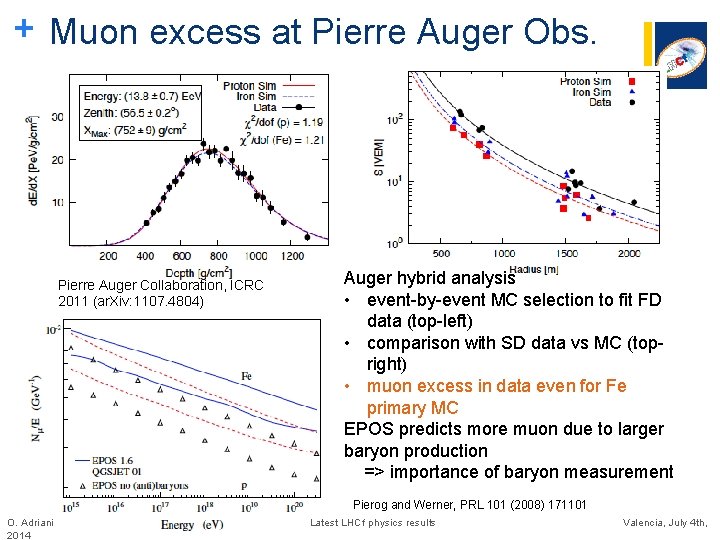
+ Muon excess at Pierre Auger Obs. Pierre Auger Collaboration, ICRC 2011 (ar. Xiv: 1107. 4804) Auger hybrid analysis • event-by-event MC selection to fit FD data (top-left) • comparison with SD data vs MC (topright) • muon excess in data even for Fe primary MC EPOS predicts more muon due to larger baryon production => importance of baryon measurement Pierog and Werner, PRL 101 (2008) 171101 O. Adriani 2014 Latest LHCf physics results Valencia, July 4 th,
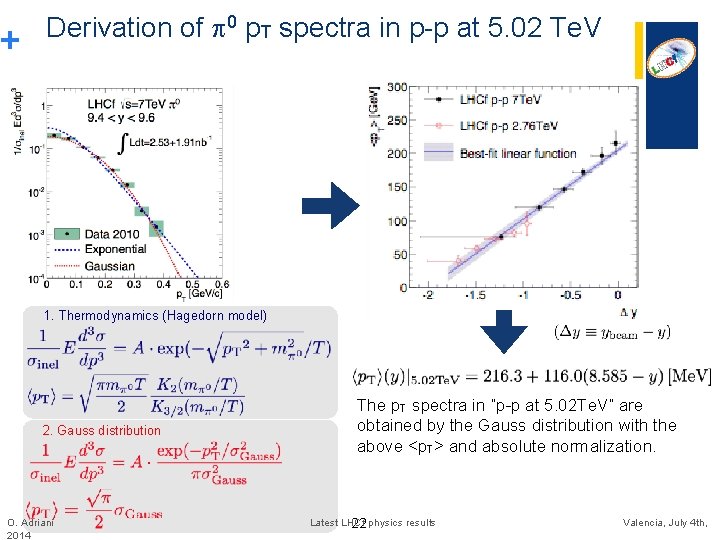
+ Derivation of 0 p. T spectra in p-p at 5. 02 Te. V 1. Thermodynamics (Hagedorn model) 2. Gauss distribution O. Adriani 2014 The p. T spectra in “p-p at 5. 02 Te. V” are obtained by the Gauss distribution with the above <p. T> and absolute normalization. Latest LHCf 22 physics results Valencia, July 4 th,
+ The importance of neutrons in the very forward region Motivations: • • Inelasticity measurement: k=1 -pleading/pbeam Muon excess at Pierre Auger Observatory • cosmic rays experiment measure HECR energy • from muon number at ground and florescence light 20 -100% more muons than expected have been observed Number of muons depends on the energy fraction of produced hadron Muon excess in data even for Fe primary MC EPOS predicts more muon due to larger baryon production O. Adriani 2014 R. Engel importance of baryon measurement Latest LHCf physics results Valencia, July 4 th,
+ p-Pb run: p 0 PRELIMINARY ELI R P O. Adriani 2014 RY A IN M Latest LHCf physics results Valencia, July 4 th,
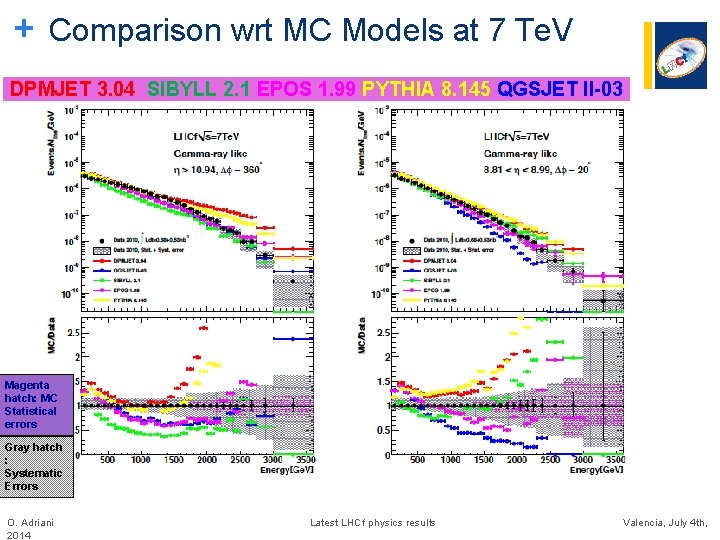
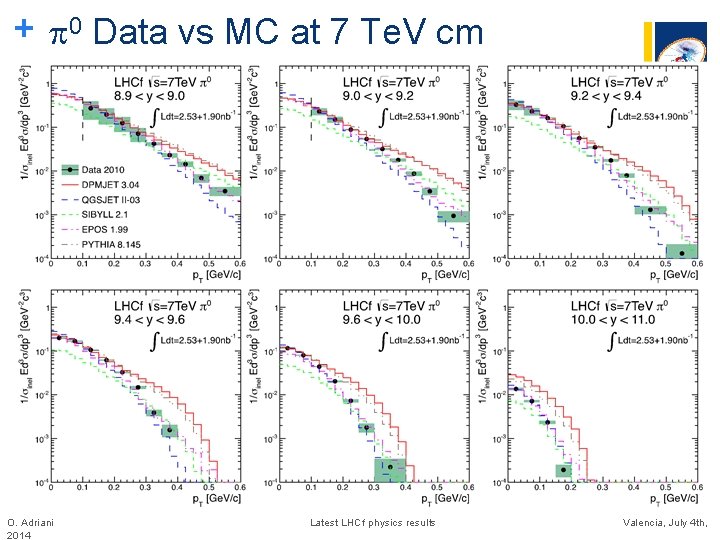
+ Comparison wrt MC Models at 7 Te. V DPMJET 3. 04 SIBYLL 2. 1 EPOS 1. 99 PYTHIA 8. 145 QGSJET II-03 Magenta hatch: MC Statistical errors Gray hatch : Systematic Errors O. Adriani 2014 Latest LHCf physics results Valencia, July 4 th,
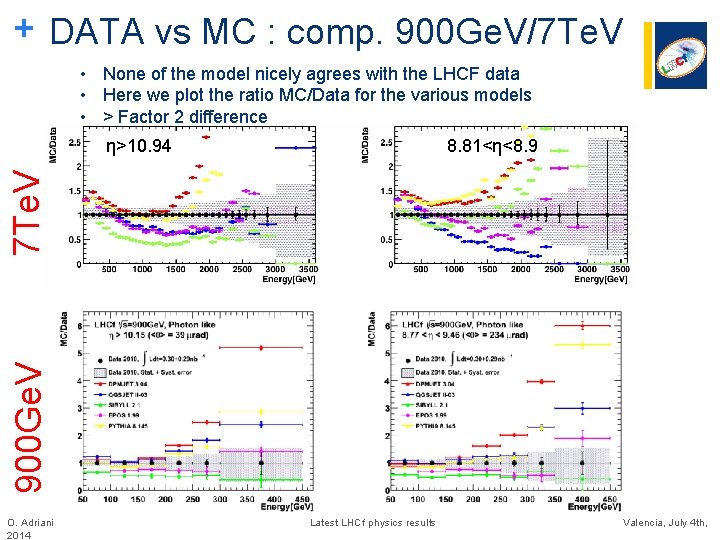
+ DATA vs MC : comp. 900 Ge. V/7 Te. V • None of the model nicely agrees with the LHCF data • Here we plot the ratio MC/Data for the various models • > Factor 2 difference 8. 81<η<8. 9 900 Ge. V 7 Te. V η>10. 94 O. Adriani 2014 Latest LHCf physics results Valencia, July 4 th,
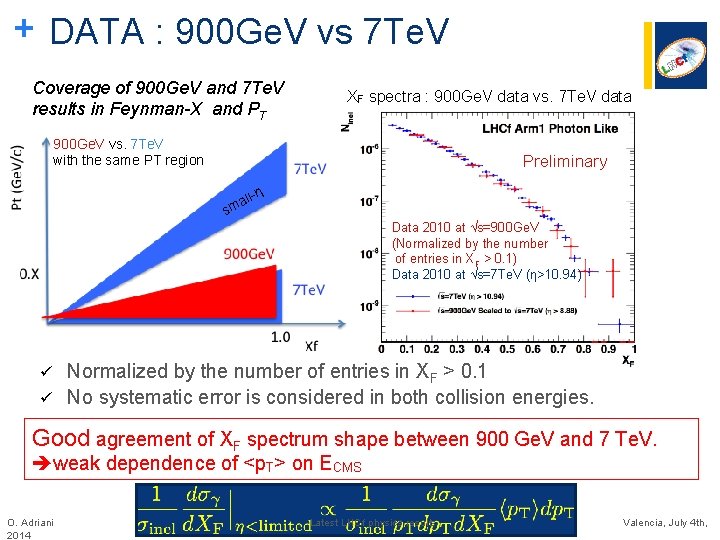
+ DATA : 900 Ge. V vs 7 Te. V Coverage of 900 Ge. V and 7 Te. V results in Feynman-X and PT XF spectra : 900 Ge. V data vs. 7 Te. V data 900 Ge. V vs. 7 Te. V with the same PT region Preliminary ll-η a m s Data 2010 at √s=900 Ge. V (Normalized by the number of entries in XF > 0. 1) Data 2010 at √s=7 Te. V (η>10. 94) Normalized by the number of entries in XF > 0. 1 ü No systematic error is considered in both collision energies. ü Good agreement of XF spectrum shape between 900 Ge. V and 7 Te. V. weak dependence of <p. T> on ECMS O. Adriani 2014 Latest LHCf physics results Valencia, July 4 th,
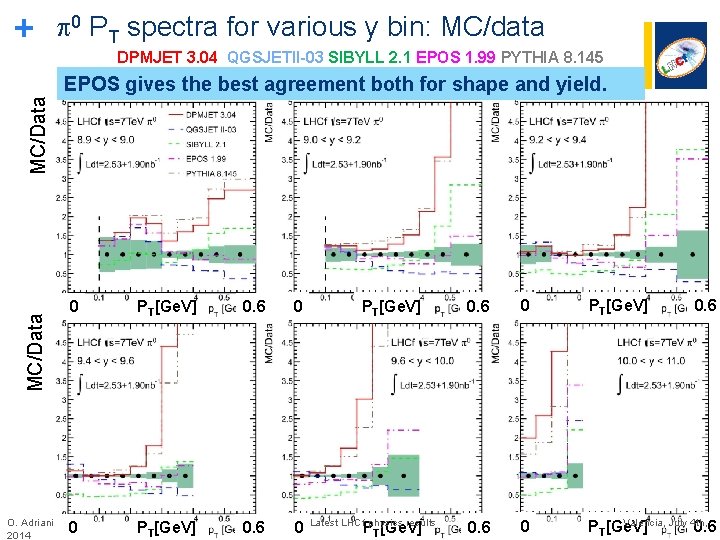
+ 0 PT spectra for various y bin: MC/data DPMJET 3. 04 QGSJETII-03 SIBYLL 2. 1 EPOS 1. 99 PYTHIA 8. 145 MC/Data EPOS gives the best agreement both for shape and yield. O. Adriani 2014 0 PT[Ge. V] 0. 6 0 PT[Ge. V] Latest LHCf physics results PT[Ge. V] 0. 6 0 Valencia, July 4 th, PT[Ge. V] 0. 6
+ 0 Data vs MC at 7 Te. V cm O. Adriani 2014 Latest LHCf physics results Valencia, July 4 th,
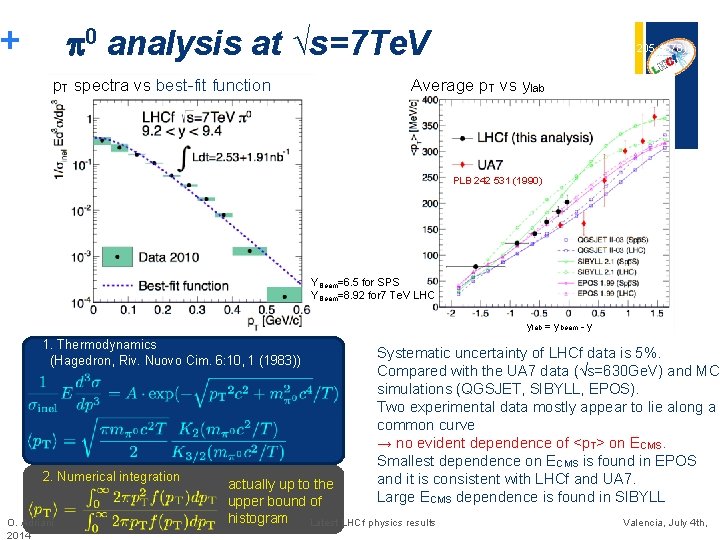
+ p 0 analysis at √s=7 Te. V p. T spectra vs best-fit function Submitted to PRD (ar. Xiv: 1205. 4578). Average p. T vs ylab PLB 242 531 (1990) YBeam=6. 5 for SPS YBeam=8. 92 for 7 Te. V LHC ylab = ybeam - y 1. Thermodynamics (Hagedron, Riv. Nuovo Cim. 6: 10, 1 (1983)) • • • 2. Numerical integration O. Adriani 2014 • Systematic uncertainty of LHCf data is 5%. Compared with the UA 7 data (√s=630 Ge. V) and MC simulations (QGSJET, SIBYLL, EPOS). Two experimental data mostly appear to lie along a common curve → no evident dependence of <p. T> on ECMS. Smallest dependence on ECMS is found in EPOS and it is consistent with LHCf and UA 7. Large ECMS dependence is found in SIBYLL actually up to the • upper bound of histogram Latest LHCf physics results Valencia, July 4 th,
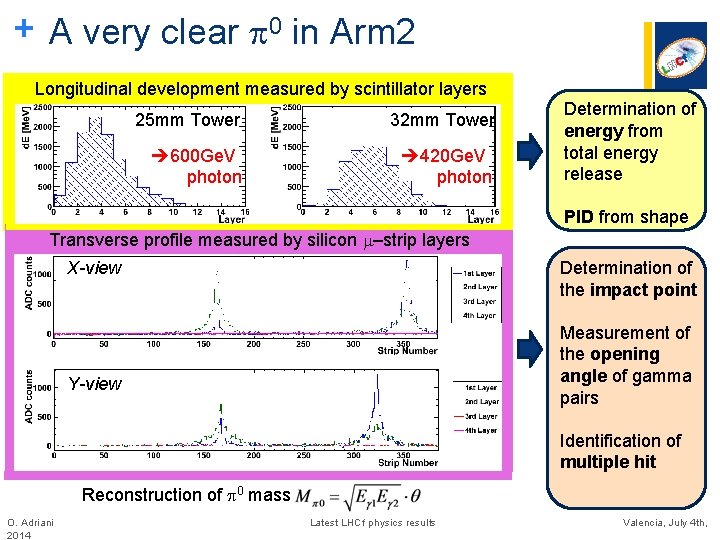
+ A very clear 0 in Arm 2 Longitudinal development measured by scintillator layers 25 mm Tower 32 mm Tower 600 Ge. V photon 420 Ge. V photon ` Transverse profile measured by silicon –strip layers X-view O. Adriani 2014 PID from shape Determination of the impact point Measurement of the opening angle of gamma pairs Y-view Reconstruction of Determination of energy from total energy release 0 Identification of multiple hit ` mass: Latest LHCf physics results Valencia, July 4 th,
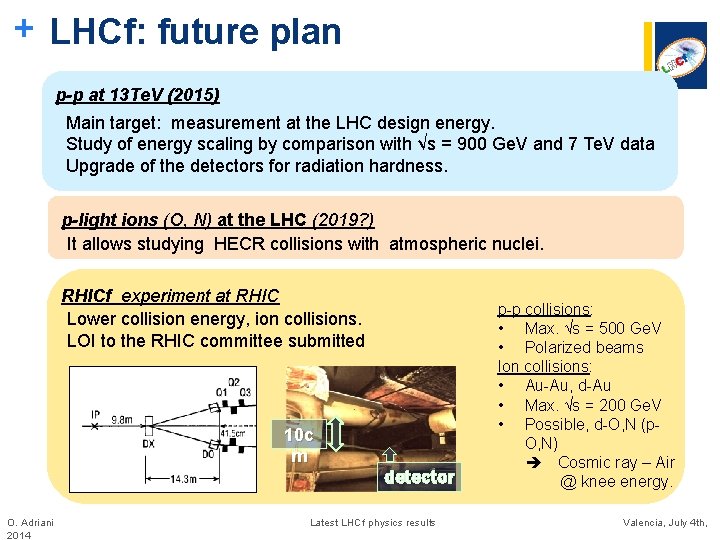
+ LHCf: future plan p-p at 13 Te. V (2015) Main target: measurement at the LHC design energy. Study of energy scaling by comparison with √s = 900 Ge. V and 7 Te. V data Upgrade of the detectors for radiation hardness. p-light ions (O, N) at the LHC (2019? ) It allows studying HECR collisions with atmospheric nuclei. RHICf experiment at RHIC Lower collision energy, ion collisions. LOI to the RHIC committee submitted 10 c m O. Adriani 2014 detector Latest LHCf physics results p-p collisions: • Max. √s = 500 Ge. V • Polarized beams Ion collisions: • Au-Au, d-Au • Max. √s = 200 Ge. V • Possible, d-O, N (p. O, N) Cosmic ray – Air @ knee energy. Valencia, July 4 th,
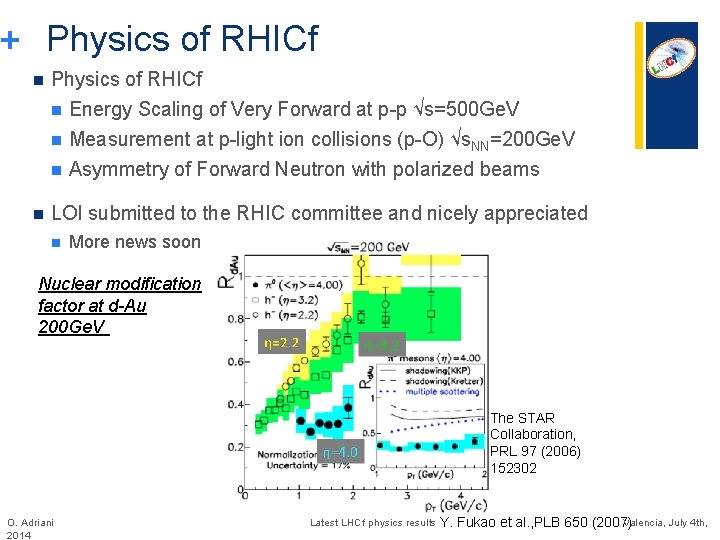
+ Physics of RHICf n Energy Scaling of Very Forward at p-p √s=500 Ge. V n n n Measurement at p-light ion collisions (p-O) √s. NN=200 Ge. V Asymmetry of Forward Neutron with polarized beams LOI submitted to the RHIC committee and nicely appreciated n More news soon Nuclear modification factor at d-Au 200 Ge. V The STAR Collaboration, PRL 97 (2006) 152302 O. Adriani 2014 Latest LHCf physics results Y. Valencia, July 4 th, Fukao et al. , PLB 650 (2007)
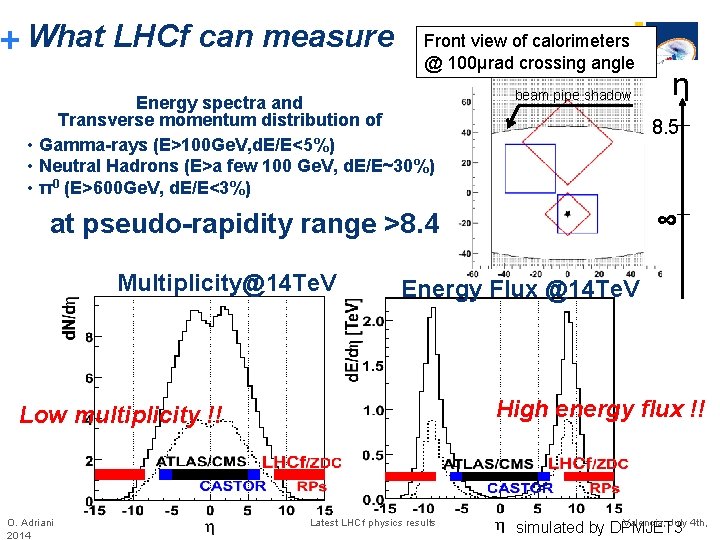
+ What LHCf can measure Front view of calorimeters @ 100μrad crossing angle Energy spectra and Transverse momentum distribution of • Gamma-rays (E>100 Ge. V, d. E/E<5%) • Neutral Hadrons (E>a few 100 Ge. V, d. E/E~30%) • π0 (E>600 Ge. V, d. E/E<3%) beam pipe shadow 8. 5 ∞ at pseudo-rapidity range >8. 4 Multiplicity@14 Te. V Energy Flux @14 Te. V High energy flux !! Low multiplicity !! O. Adriani 2014 η Latest LHCf physics results Valencia, July 4 th, simulated by DPMJET 3
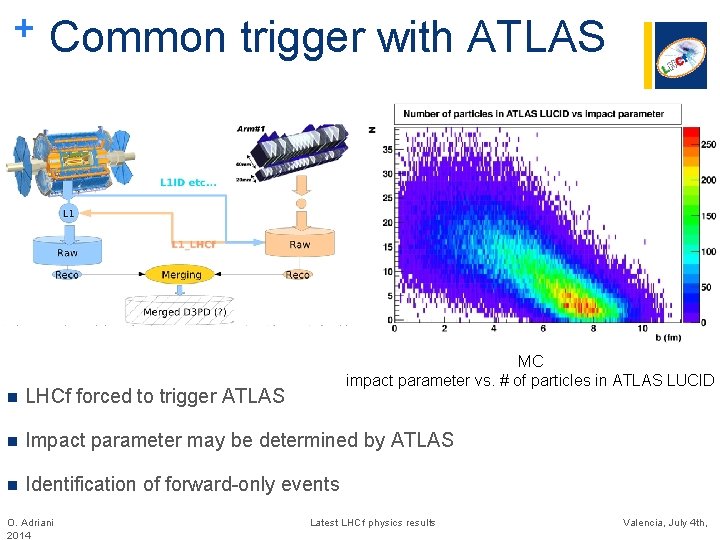
+ Common trigger with ATLAS MC impact parameter vs. # of particles in ATLAS LUCID n LHCf forced to trigger ATLAS n Impact parameter may be determined by ATLAS n Identification of forward-only events O. Adriani 2014 Latest LHCf physics results Valencia, July 4 th,
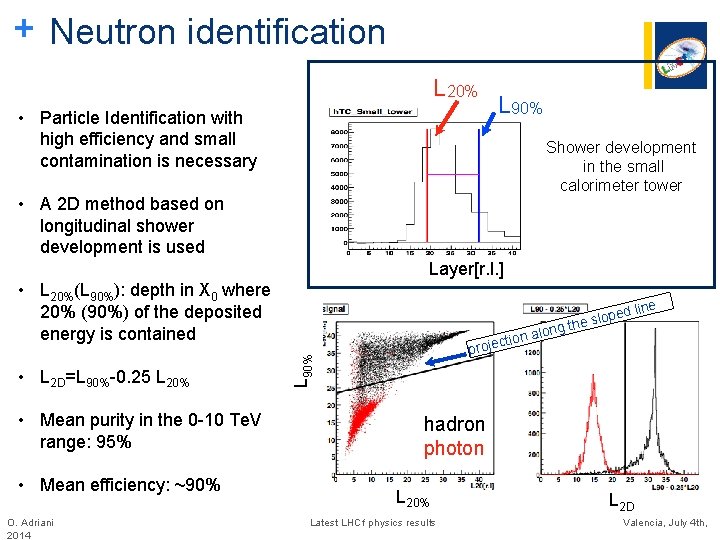
+ Neutron identification L 20% • Particle Identification with high efficiency and small contamination is necessary L 90% Shower development in the small calorimeter tower • A 2 D method based on longitudinal shower development is used Layer[r. l. ] • L 20%(L 90%): depth in X 0 where 20% (90%) of the deposited energy is contained • Mean purity in the 0 -10 Te. V range: 95% • Mean efficiency: ~90% O. Adriani 2014 pro L 90% • L 2 D=L 90%-0. 25 L 20% ped he slo line ong t l a n jectio hadron photon L 20% Latest LHCf physics results L 2 D Valencia, July 4 th,