Language Comprehension Perception of Language The Internal Lexicon

- Slides: 23
Language Comprehension Perception of Language The Internal Lexicon
The structure of speech • Prosodic factors/suprasegmentals stress, intonation, rate influence the perception of speech • Articulatory phonetics - Production based - Place and manner of articulation - voicing • Acoustic phonetics - Examines acoustic properties of speech sounds - Based on the acoustic signal - Formants, transitions, co-articulation, etc.
The Motor theory • This model was developed in 1967 by Liberman and colleagues. • The basic principle of this model lies with the production of speech sounds in the speaker's vocal tract. • The Motor Theory proposes that a listener specifically perceives a speaker's phonetic gestures while they are speaking.
• A researcher, Harry Mc. Gurk, was interested in whether auditory or visual modalities are differentially dominant during infants' perceptual development. • To find out, he asked his technician to create a film to test which modality captured infants' attention. In this film, an actor pronounced the syllable "ga" while an auditory "ba" was dubbed over the tape. • Would babies pay attention to the "ga" or the "ba"?
• The process of making the film, however, led to a surprising finding about adults. The technician (and others) did not perceive either a "ga" or a "ba". Rather, the technician perceived a "da". • Mac. Donald & Mc. Gurk (1978): place of articulation (especially the lips) is cued primarily by eye, and manner of articulation is cued more by ear. • These reports indicate that listeners use information about the way a sound was produced from both auditory and visual modes in the process of speech perception.
Semantic & syntactic factors • Miller & Isard, 1963 isolated the influence of syntactic and semantic information. • Three different types of sentences were presented in continuous speech: 1. Accidents kill motorists on the highways. (grammatical) 2. Accidents carry honey between the house. (anomalous) 3. Around accidents country honey the shoot. (ungrammatical)
• The results indicated that people were most accurate with grammatical strings, somewhat less accurate with anomalous strings, and even less able to recognize ungrammatical strings. It would appear that the more predictable a passage is, the better it is recognized. top-down processing
Phonemic restoration • Warren & Warren (1970) The first /s/ in the word legislatures in this sentence was removed and replaced with a cough: The state governors met with their respective legislatures convening in the capital city. • Listeners reported hearing the excised /s/. In addition, when told that a sound was missing and asked to guess which one, nearly all listeners were unsuccessful. • It is the context that helps determine how phonemic restorations take place.
Mispronunciation detection • Minor errors in pronunciation tend to be ignored, as we ‘‘know’’ what the person was trying to say It has been zuggested that students be required to preregister.
The Internal Lexicon • The topic about internal lexicon means to find out about words as they are stored in the mind. • It also concerns – what they consist of and how do we find them, use them, and relate them to one another. • We try to distinguish between the process of retrieving information about words and storing of the words in memory • The distinction is similar to the one between the information about words contained in dictionary and the processes (flipping the pages and so on) by which we find the information. • Psycholinguists refer to the representation of words in long term memory as the internal lexicon.
• An interesting thing happens to the WORD, once that word has been found in our lexicon. • The linguistic and non-linguistic properties that we associate with the word become available for us to be used in variety of contexts, including the meaning of the word, its spelling, pronunciation, its relationship to other words and related information. • Most of the linguistic properties of the word are also the part of the dictionary, but many of the non-linguistic properties of the words are uniquely given to the internal lexicon. • Example: elephants are said to never forget things. This piece of information is not a linguistic property of the word.
Word Knowledge • • phonological syntactic morphological semantic
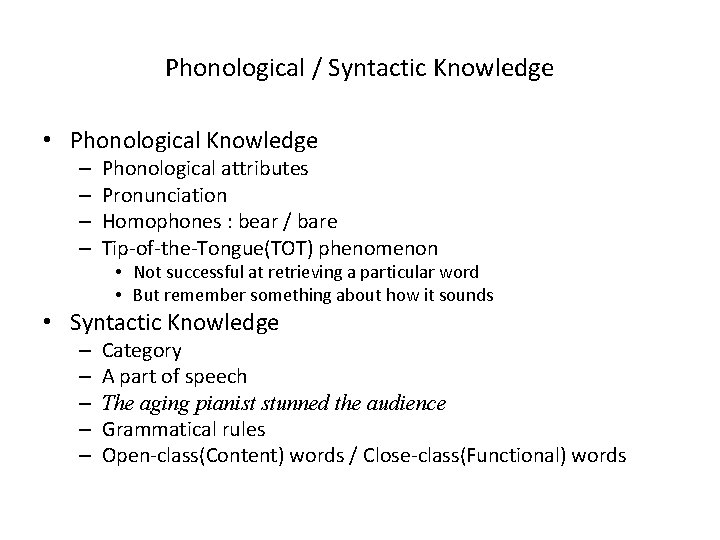
Phonological / Syntactic Knowledge • Phonological Knowledge – – Phonological attributes Pronunciation Homophones : bear / bare Tip-of-the-Tongue(TOT) phenomenon • Not successful at retrieving a particular word • But remember something about how it sounds • Syntactic Knowledge – – – Category A part of speech The aging pianist stunned the audience Grammatical rules Open-class(Content) words / Close-class(Functional) words
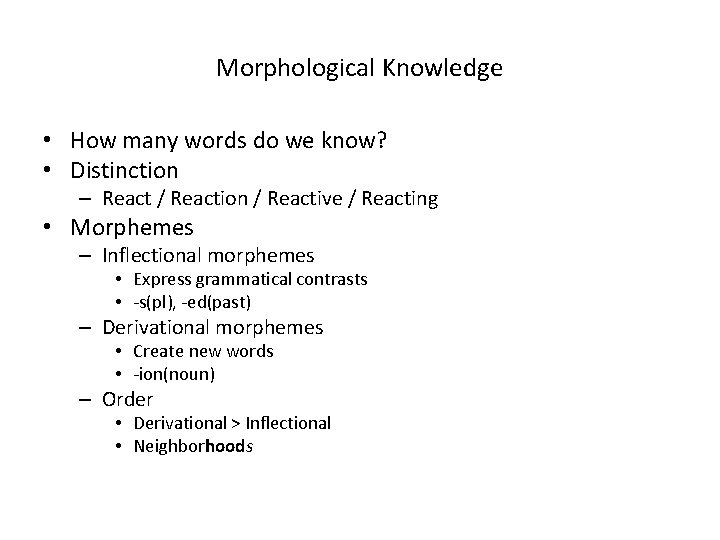
Morphological Knowledge • How many words do we know? • Distinction – React / Reaction / Reactive / Reacting • Morphemes – Inflectional morphemes • Express grammatical contrasts • -s(pl), -ed(past) – Derivational morphemes • Create new words • -ion(noun) – Order • Derivational > Inflectional • Neighborhoods
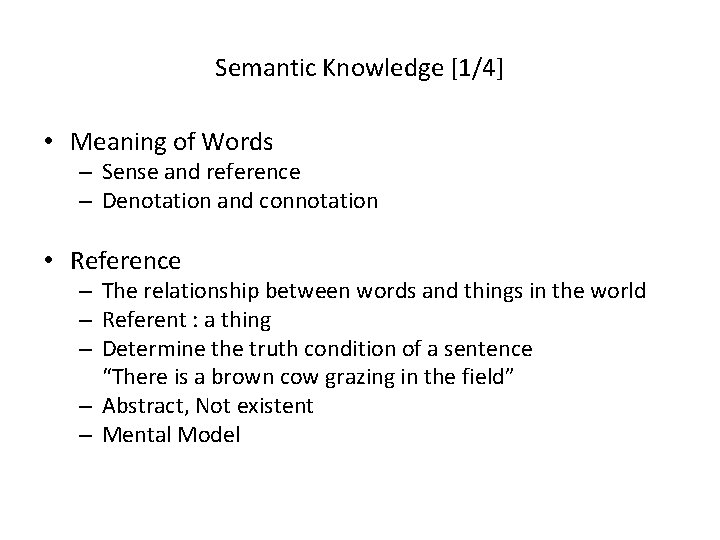
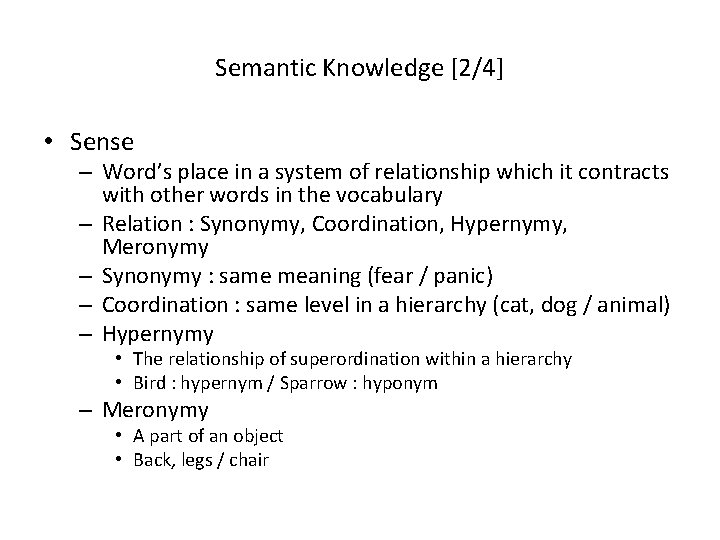
Semantic Knowledge [1/4] • Meaning of Words – Sense and reference – Denotation and connotation • Reference – The relationship between words and things in the world – Referent : a thing – Determine the truth condition of a sentence “There is a brown cow grazing in the field” – Abstract, Not existent – Mental Model
Semantic Knowledge [2/4] • Sense – Word’s place in a system of relationship which it contracts with other words in the vocabulary – Relation : Synonymy, Coordination, Hypernymy, Meronymy – Synonymy : same meaning (fear / panic) – Coordination : same level in a hierarchy (cat, dog / animal) – Hypernymy • The relationship of superordination within a hierarchy • Bird : hypernym / Sparrow : hyponym – Meronymy • A part of an object • Back, legs / chair
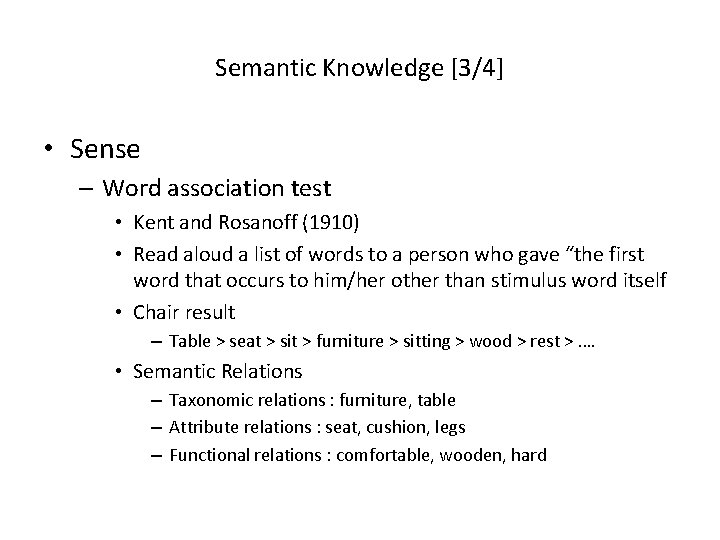
Semantic Knowledge [3/4] • Sense – Word association test • Kent and Rosanoff (1910) • Read aloud a list of words to a person who gave “the first word that occurs to him/her other than stimulus word itself • Chair result – Table > seat > sit > furniture > sitting > wood > rest > …. • Semantic Relations – Taxonomic relations : furniture, table – Attribute relations : seat, cushion, legs – Functional relations : comfortable, wooden, hard
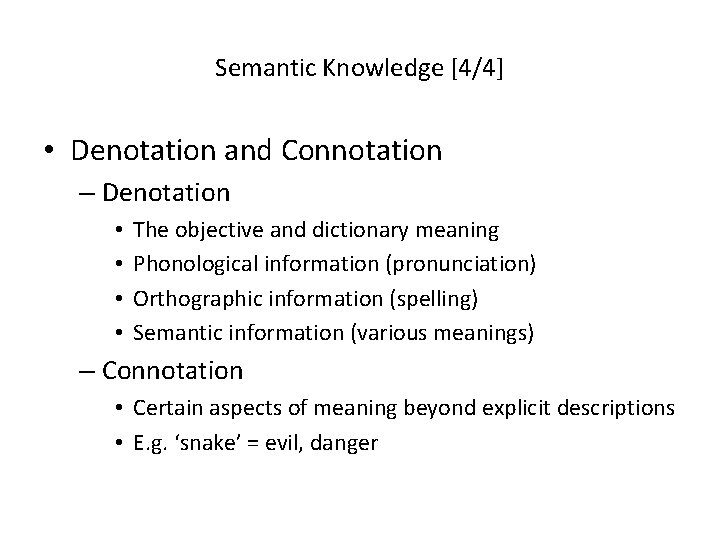
Semantic Knowledge [4/4] • Denotation and Connotation – Denotation • • The objective and dictionary meaning Phonological information (pronunciation) Orthographic information (spelling) Semantic information (various meanings) – Connotation • Certain aspects of meaning beyond explicit descriptions • E. g. ‘snake’ = evil, danger
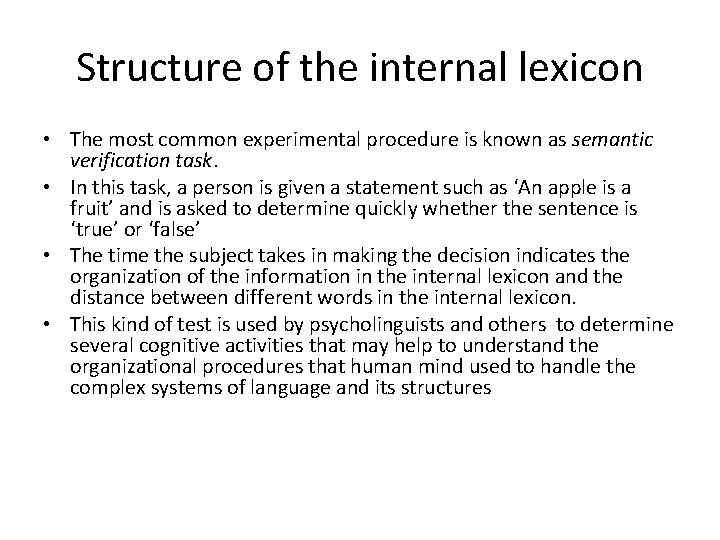
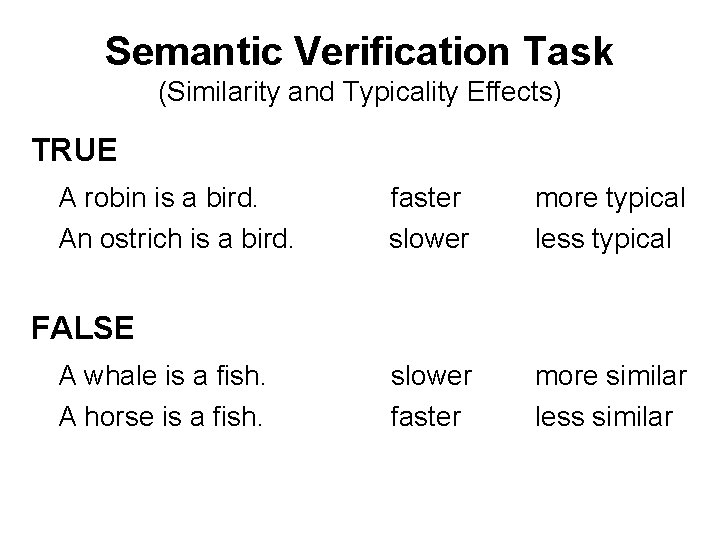
Structure of the internal lexicon • The most common experimental procedure is known as semantic verification task. • In this task, a person is given a statement such as ‘An apple is a fruit’ and is asked to determine quickly whether the sentence is ‘true’ or ‘false’ • The time the subject takes in making the decision indicates the organization of the information in the internal lexicon and the distance between different words in the internal lexicon. • This kind of test is used by psycholinguists and others to determine several cognitive activities that may help to understand the organizational procedures that human mind used to handle the complex systems of language and its structures
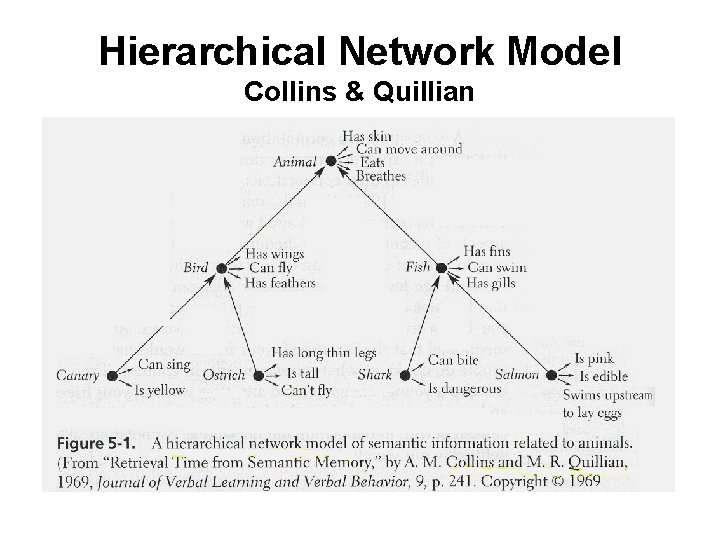
Hierarchical Network Model Collins & Quillian
Semantic Verification Task (Similarity and Typicality Effects) TRUE A robin is a bird. faster An ostrich is a bird. slower more typical less typical FALSE A whale is a fish. A horse is a fish. slower faster more similar less similar
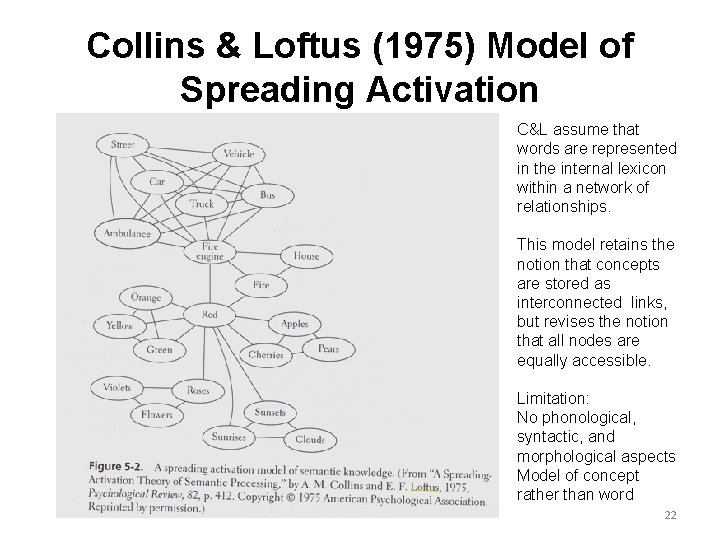
Collins & Loftus (1975) Model of Spreading Activation C&L assume that words are represented in the internal lexicon within a network of relationships. This model retains the notion that concepts are stored as interconnected links, but revises the notion that all nodes are equally accessible. Limitation: No phonological, syntactic, and morphological aspects Model of concept rather than word 22
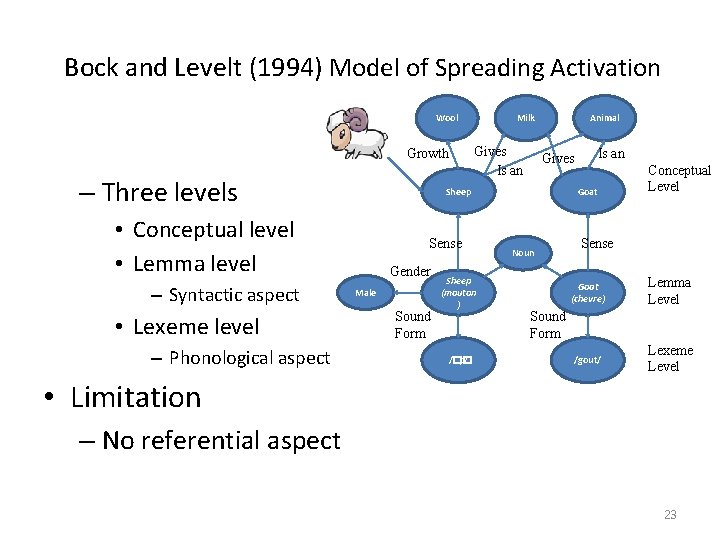
Bock and Levelt (1994) Model of Spreading Activation Wool Growth – Three levels • Lexeme level – Phonological aspect Gives Is an Animal Gives Sheep • Conceptual level • Lemma level – Syntactic aspect Milk Sense Gender Male Sound Form Sheep (mouton ) /�� p/ Is an Goat Noun Conceptual Level Sense Goat (chevre) Lemma Level /gout/ Lexeme Level Sound Form • Limitation – No referential aspect 23