Prefixed Word Forms in the German Mental Lexicon
![German Adjectives Investigated bequem 'comfortable' unbequem 'uncomfortable' un + bequem [ un [ bequem](https://slidetodoc.com/presentation_image/ee5082278bf70a2facc3d13ca42f0160/image-6.jpg "German Adjectives Investigated bequem 'comfortable' unbequem 'uncomfortable' un + bequem [ un [ bequem")
- Slides: 18
Prefixed Word Forms in the German Mental Lexicon Ingrid Sonnenstuhl Meike Hadler Helga Weyerts Harald Clahsen University of Düsseldorf Third International Conference on the Mental Lexicon, Banff, October 5 - 8 2002 1
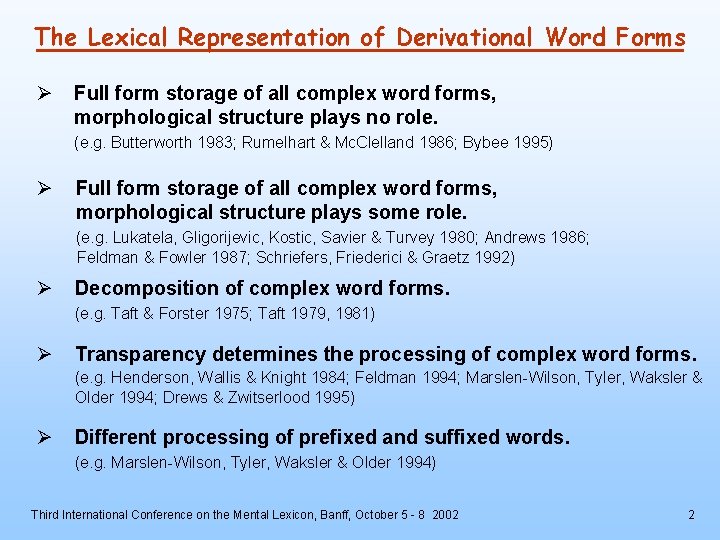
The Lexical Representation of Derivational Word Forms Ø Full form storage of all complex word forms, morphological structure plays no role. (e. g. Butterworth 1983; Rumelhart & Mc. Clelland 1986; Bybee 1995) Ø Full form storage of all complex word forms, morphological structure plays some role. (e. g. Lukatela, Gligorijevic, Kostic, Savier & Turvey 1980; Andrews 1986; Feldman & Fowler 1987; Schriefers, Friederici & Graetz 1992) Ø Decomposition of complex word forms. (e. g. Taft & Forster 1975; Taft 1979, 1981) Ø Transparency determines the processing of complex word forms. (e. g. Henderson, Wallis & Knight 1984; Feldman 1994; Marslen-Wilson, Tyler, Waksler & Older 1994; Drews & Zwitserlood 1995) Ø Different processing of prefixed and suffixed words. (e. g. Marslen-Wilson, Tyler, Waksler & Older 1994) Third International Conference on the Mental Lexicon, Banff, October 5 - 8 2002 2
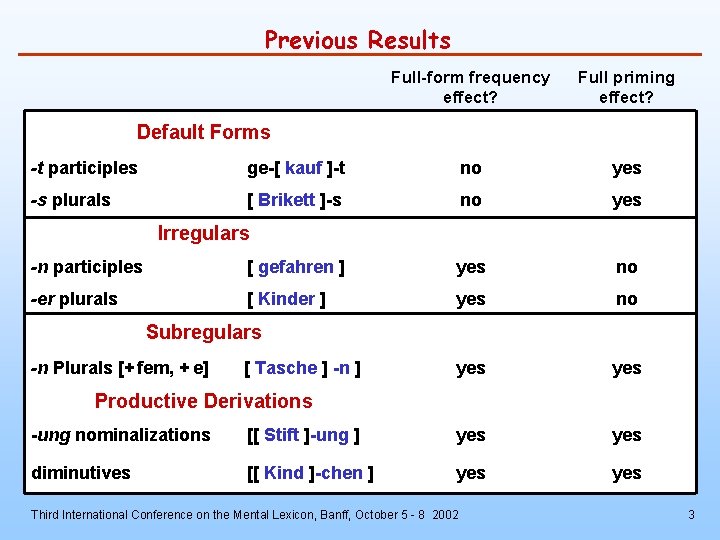
Previous Results Full-form frequency effect? Full priming effect? Default Forms -t participles ge-[ kauf ]-t no yes -s plurals [ Brikett ]-s no yes Irregulars -n participles [ gefahren ] yes no -er plurals [ Kinder ] yes no yes Subregulars -n Plurals [+ fem, + e] [ Tasche ] -n ] Productive Derivations -ung nominalizations [[ Stift ]-ung ] yes diminutives [[ Kind ]-chen ] yes Third International Conference on the Mental Lexicon, Banff, October 5 - 8 2002 3
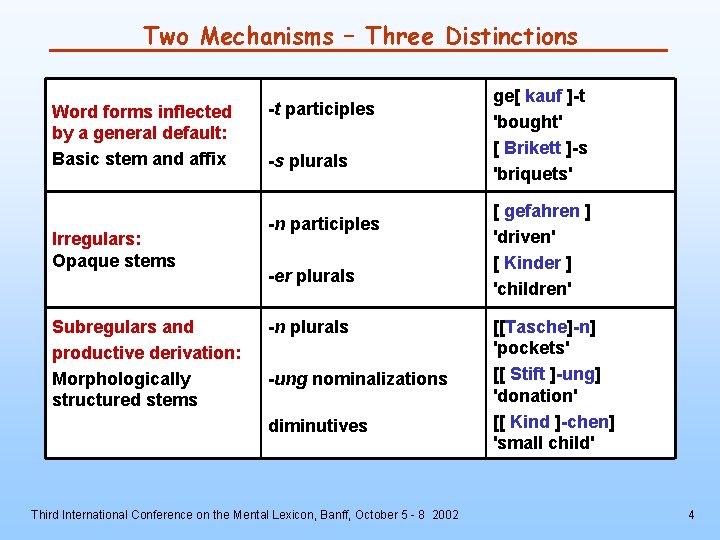
Two Mechanisms – Three Distinctions Word forms inflected by a general default: Basic stem and affix Irregulars: Opaque stems Subregulars and productive derivation: Morphologically structured stems -t participles -s plurals -n participles -er plurals -n plurals -ung nominalizations diminutives Third International Conference on the Mental Lexicon, Banff, October 5 - 8 2002 ge[ kauf ]-t 'bought' [ Brikett ]-s 'briquets' [ gefahren ] 'driven' [ Kinder ] 'children' [[Tasche]-n] 'pockets' [[ Stift ]-ung] 'donation' [[ Kind ]-chen] 'small child' 4
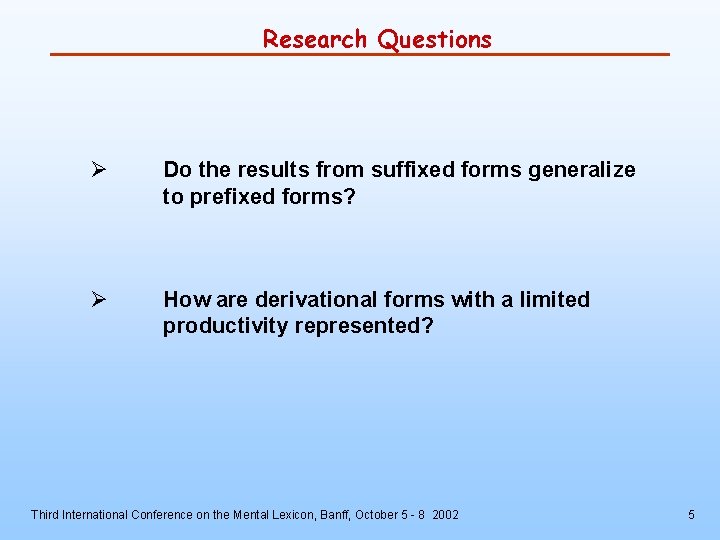
Research Questions Ø Do the results from suffixed forms generalize to prefixed forms? Ø How are derivational forms with a limited productivity represented? Third International Conference on the Mental Lexicon, Banff, October 5 - 8 2002 5
German Adjectives Investigated bequem 'comfortable' unbequem 'uncomfortable' un + bequem [ un [ bequem ] ] stabil 'stable' instabil 'unstable' instabil [ instabil ] Third International Conference on the Mental Lexicon, Banff, October 5 - 8 2002 6
Experiment 1 Frequency Effects insta bil Unprimed Lexical Decision Access Representations Third International Conference on the Mental Lexicon, Banff, October 5 - 8 2002 7
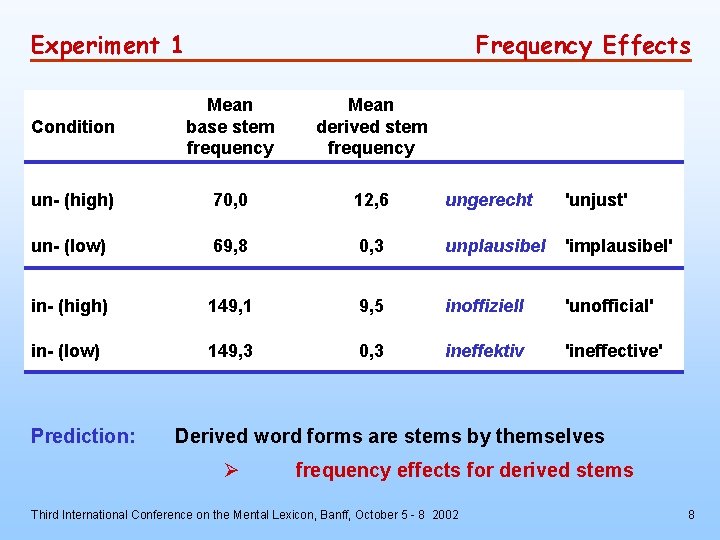
Experiment 1 Frequency Effects Condition Mean base stem frequency Mean derived stem frequency un- (high) 70, 0 12, 6 ungerecht 'unjust' un- (low) 69, 8 0, 3 unplausibel 'implausibel' in- (high) 149, 1 9, 5 inoffiziell 'unofficial' in- (low) 149, 3 0, 3 ineffektiv 'ineffective' Prediction: Derived word forms are stems by themselves Ø frequency effects for derived stems Third International Conference on the Mental Lexicon, Banff, October 5 - 8 2002 8
Experiment 1 Frequency Effects Results • Word- form frequency effects for both derivational forms Ø Full-form representations for fully productive and less productive prefixed adjectives Third International Conference on the Mental Lexicon, Banff, October 5 - 8 2002 9
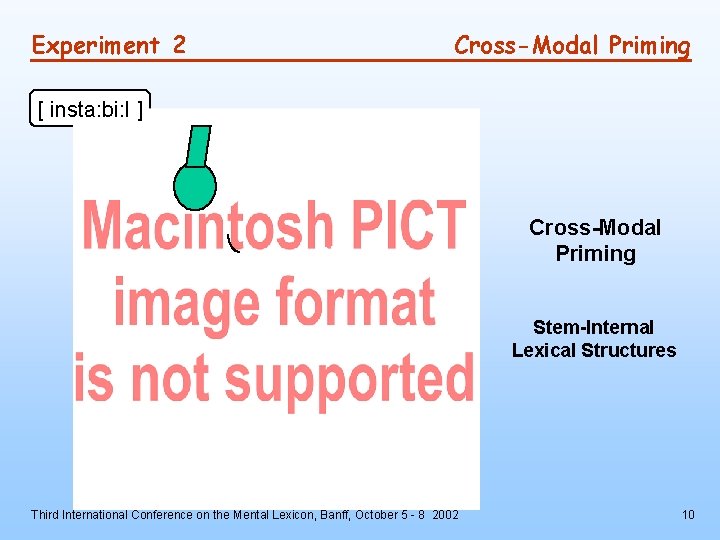
Experiment 2 Cross-Modal Priming [ insta: bi: l ] stabi l Cross-Modal Priming Stem-Internal Lexical Structures Third International Conference on the Mental Lexicon, Banff, October 5 - 8 2002 10
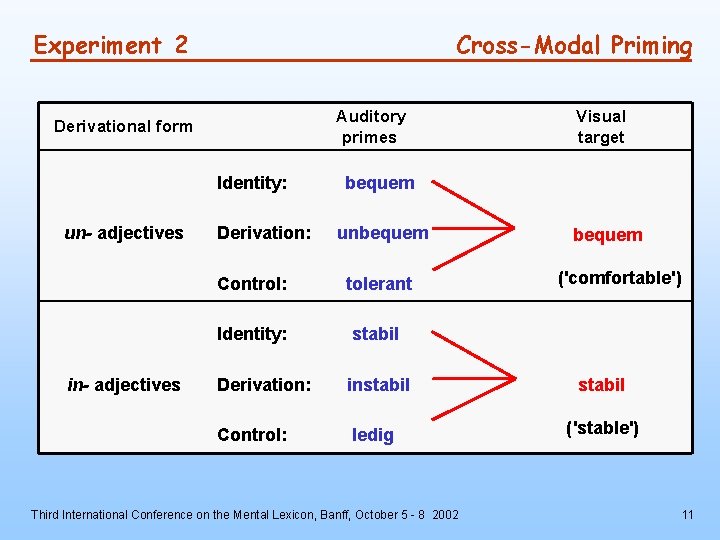
Experiment 2 Cross-Modal Priming Auditory primes Derivational form Identity: un- adjectives in- adjectives Derivation: Visual target bequem unbequem Control: tolerant Identity: stabil Derivation: instabil Control: ledig Third International Conference on the Mental Lexicon, Banff, October 5 - 8 2002 bequem ('comfortable') stabil ('stable') 11
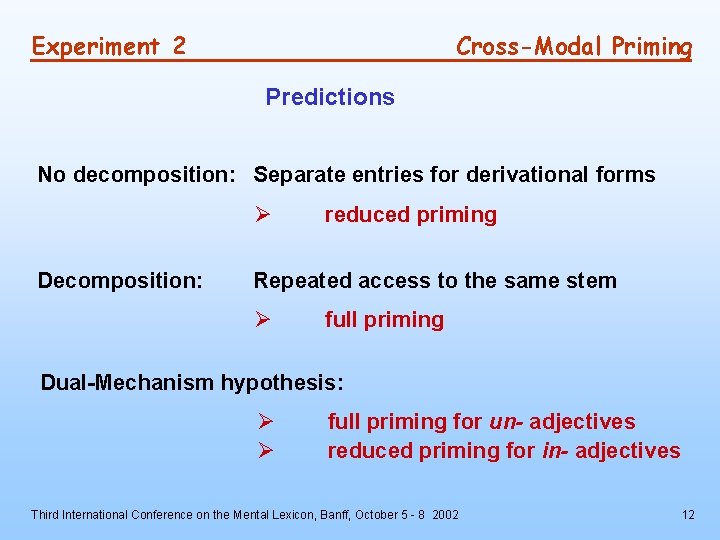
Experiment 2 Cross-Modal Priming Predictions No decomposition: Separate entries for derivational forms Ø Decomposition: reduced priming Repeated access to the same stem Ø full priming Dual-Mechanism hypothesis: Ø Ø full priming for un- adjectives reduced priming for in- adjectives Third International Conference on the Mental Lexicon, Banff, October 5 - 8 2002 12
Experiment 2 Cross-Modal Priming Results • Full priming for un- forms Ø decomposed lexical representations • Reduced priming for in- forms Ø full-form lexical representations Third International Conference on the Mental Lexicon, Banff, October 5 - 8 2002 13
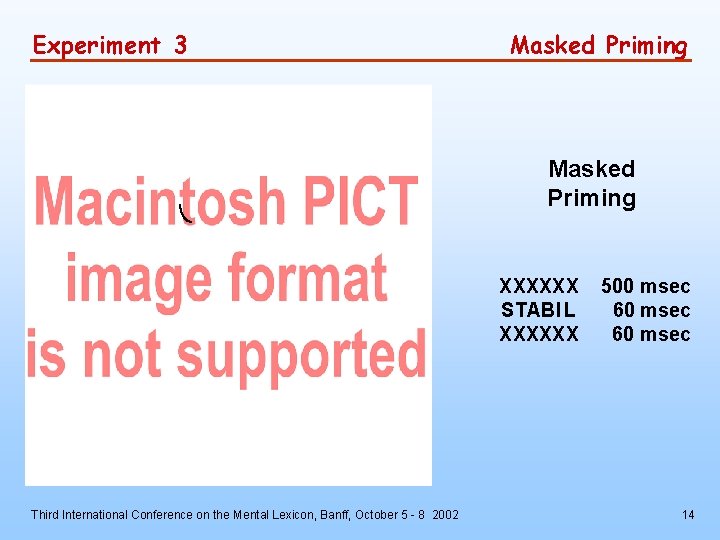
Experiment 3 Masked Priming stabi l XXXXXX STABI L XXXXXX Third International Conference on the Mental Lexicon, Banff, October 5 - 8 2002 500 msec 60 msec 14
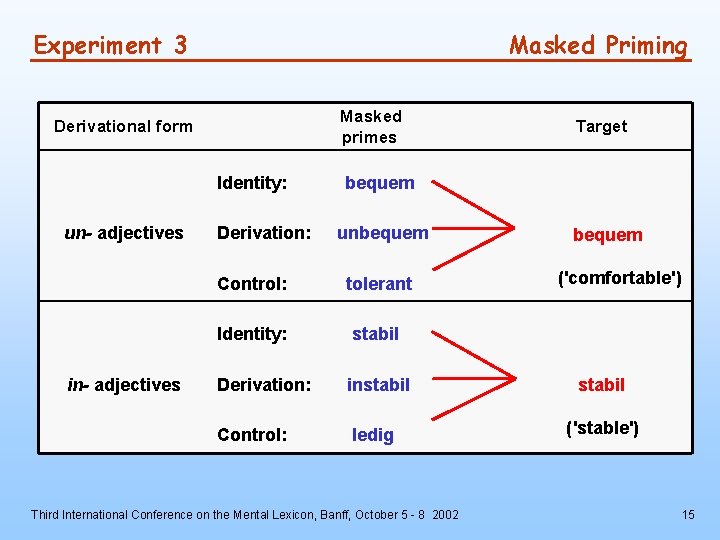
Experiment 3 Masked Priming Masked primes Derivational form Identity: un- adjectives in- adjectives Derivation: Target bequem unbequem Control: tolerant Identity: stabil Derivation: instabil Control: ledig Third International Conference on the Mental Lexicon, Banff, October 5 - 8 2002 bequem ('comfortable') stabil ('stable') 15
Experiment 3 Masked Priming Results • Full priming for un- forms Ø decomposed lexical representations • Reduced priming for in- forms Ø full-form lexical representations Third International Conference on the Mental Lexicon, Banff, October 5 - 8 2002 16
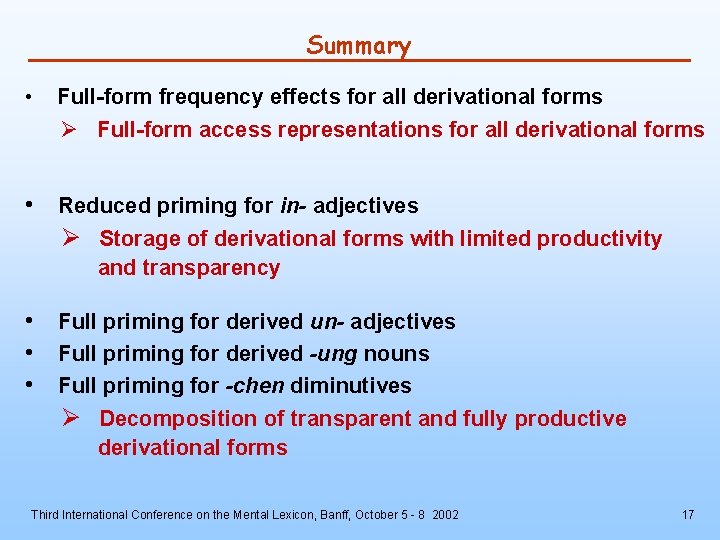
Summary • Full-form frequency effects for all derivational forms Ø Full-form access representations for all derivational forms • Reduced priming for in- adjectives Ø Storage of derivational forms with limited productivity and transparency • Full priming for derived un- adjectives • Full priming for derived -ung nouns • Full priming for -chen diminutives Ø Decomposition of transparent and fully productive derivational forms Third International Conference on the Mental Lexicon, Banff, October 5 - 8 2002 17
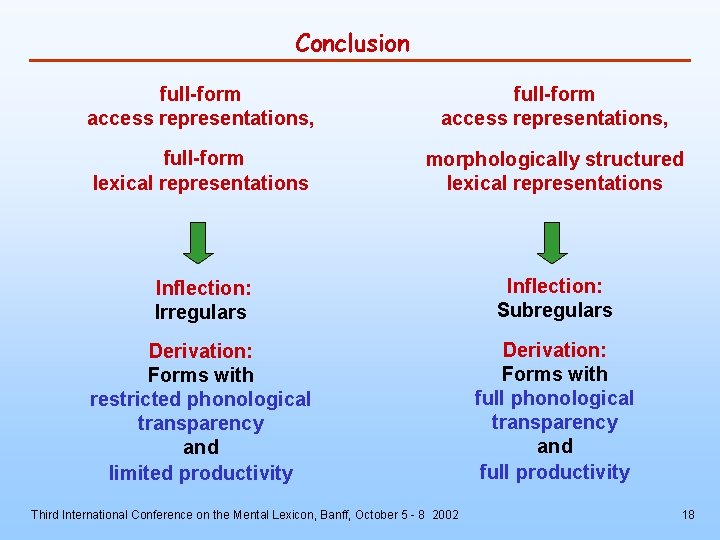
Conclusion full-form access representations, full-form lexical representations morphologically structured lexical representations Inflection: Irregulars Inflection: Subregulars Derivation: Forms with restricted phonological transparency and limited productivity Derivation: Forms with full phonological transparency and full productivity Third International Conference on the Mental Lexicon, Banff, October 5 - 8 2002 18