KFParticle Ivan Kisel 1 2 Igor Kulakov 1

- Slides: 27
KFParticle Ivan Kisel 1, 2, Igor Kulakov 1, 3, Iourii Vassiliev 1, 2, Maksym Zyzak 1, 3 1 – Goethe-Universität Frankfurt, Frankfurt am Main, Germany 2 – GSI Helmholtzzentrum für Schwerionenforschung Gmb. H, Darmstadt, Germany 3 – Taras Shevchenko National University of Kyiv, Ukraine Third International Workshop for Future Challenges in Tracking and Trigger Concepts 29. 02. 2012
Content • Concept of the KFParticle package • Kalman filter and KFParticle mathematics • Functionality of the KFParticle package • SIMDized KFParticle • Examples of the code with KFParticle • Particles finding with the SIMDized KFParticle package 29. 02. 2012 Maksym Zyzak, 3 rd Tracking Workshop 2/27
Principal Concept • Direct estimation of the parameters of the decayed particle • The KFParticle object has the parameters as the physical particle – x, y, z coordinates and px, py, pz components of the momentum • The parameters do not depend on the track models and the experiment geometry • Simple access to the most interesting parameters of the particle: mass, momentum, lifetime, decay length • Construction mother particles from tracks or other particles • Reconstruction of decay chains 29. 02. 2012 Maksym Zyzak, 3 rd Tracking Workshop 3/27
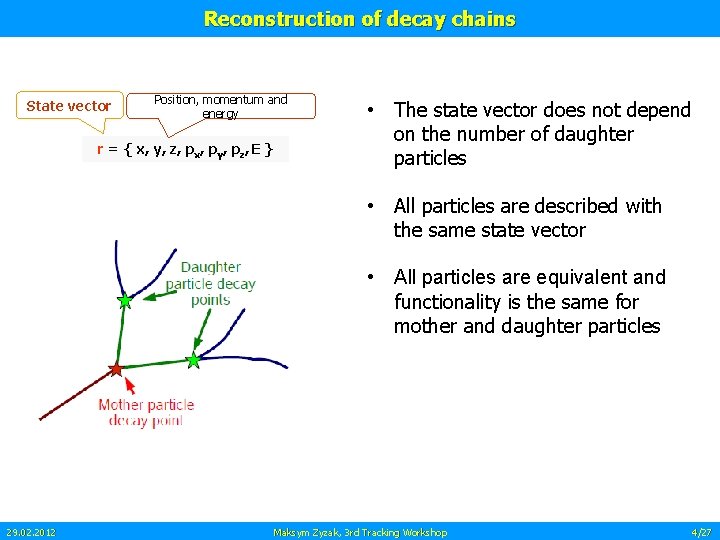
Reconstruction of decay chains State vector Position, momentum and energy r = { x, y, z, px, py, pz, E } • The state vector does not depend on the number of daughter particles • All particles are described with the same state vector • All particles are equivalent and functionality is the same for mother and daughter particles 29. 02. 2012 Maksym Zyzak, 3 rd Tracking Workshop 4/27
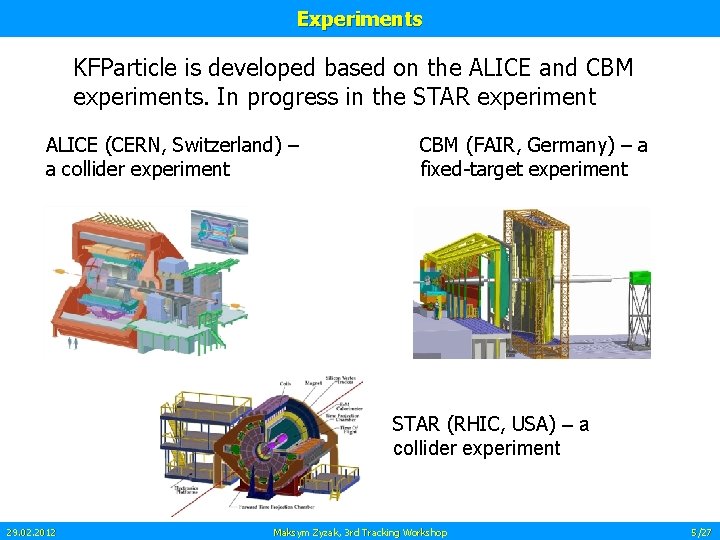
Experiments KFParticle is developed based on the ALICE and CBM experiments. In progress in the STAR experiment ALICE (CERN, Switzerland) – a collider experiment CBM (FAIR, Germany) – a fixed-target experiment STAR (RHIC, USA) – a collider experiment 29. 02. 2012 Maksym Zyzak, 3 rd Tracking Workshop 5/27
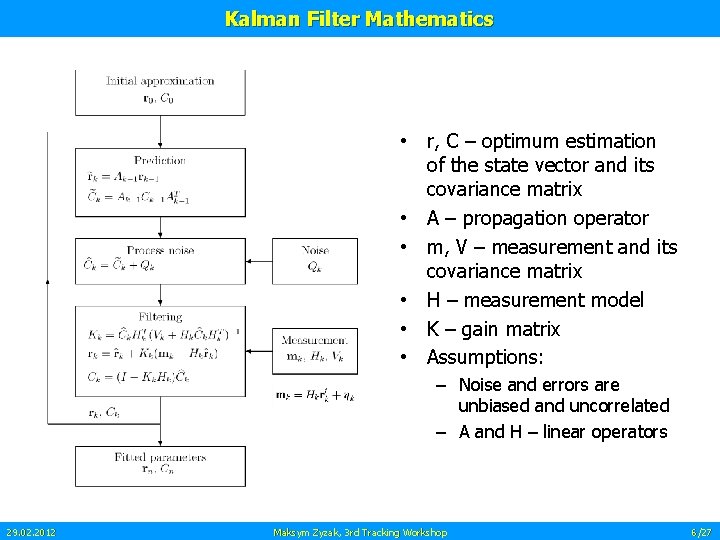
Kalman Filter Mathematics • r, C – optimum estimation of the state vector and its covariance matrix • A – propagation operator • m, V – measurement and its covariance matrix • H – measurement model • K – gain matrix • Assumptions: – Noise and errors are unbiased and uncorrelated – A and H – linear operators 29. 02. 2012 Maksym Zyzak, 3 rd Tracking Workshop 6/27
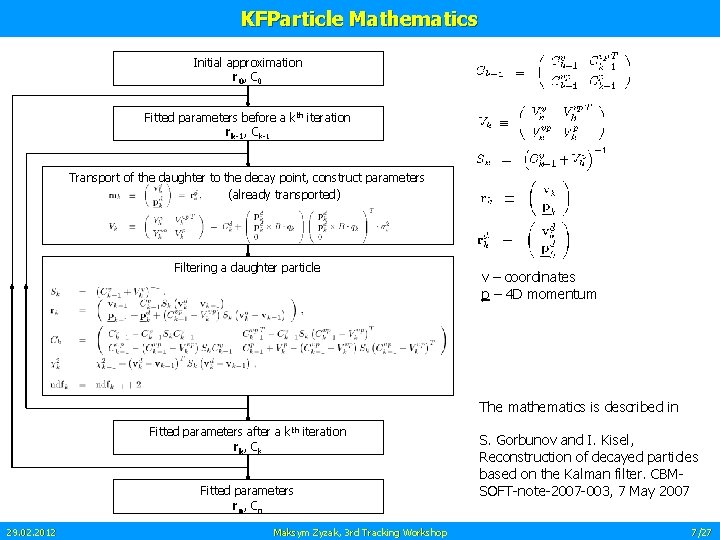
KFParticle Mathematics Initial approximation r 0, C 0 Fitted parameters before a k th iteration rk-1, Ck-1 Transport of the daughter to the decay point, construct parameters (already transported) Filtering a daughter particle v – coordinates p – 4 D momentum The mathematics is described in Fitted parameters after a k th iteration rk, Ck Fitted parameters rn, Cn 29. 02. 2012 Maksym Zyzak, 3 rd Tracking Workshop S. Gorbunov and I. Kisel, Reconstruction of decayed particles based on the Kalman filter. CBMSOFT-note-2007 -003, 7 May 2007 7/27
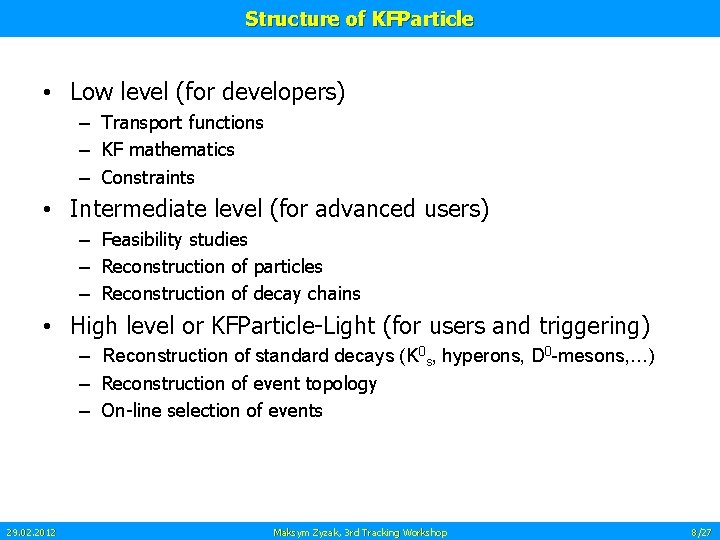
Structure of KFParticle • Low level (for developers) – Transport functions – KF mathematics – Constraints • Intermediate level (for advanced users) – Feasibility studies – Reconstruction of particles – Reconstruction of decay chains • High level or KFParticle-Light (for users and triggering) – Reconstruction of standard decays (K 0 s, hyperons, D 0 -mesons, …) – Reconstruction of event topology – On-line selection of events 29. 02. 2012 Maksym Zyzak, 3 rd Tracking Workshop 8/27
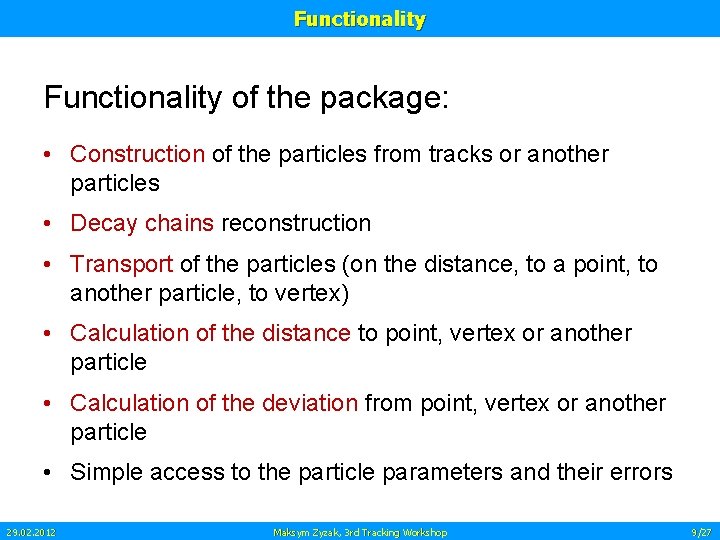
Functionality of the package: • Construction of the particles from tracks or another particles • Decay chains reconstruction • Transport of the particles (on the distance, to a point, to another particle, to vertex) • Calculation of the distance to point, vertex or another particle • Calculation of the deviation from point, vertex or another particle • Simple access to the particle parameters and their errors 29. 02. 2012 Maksym Zyzak, 3 rd Tracking Workshop 9/27
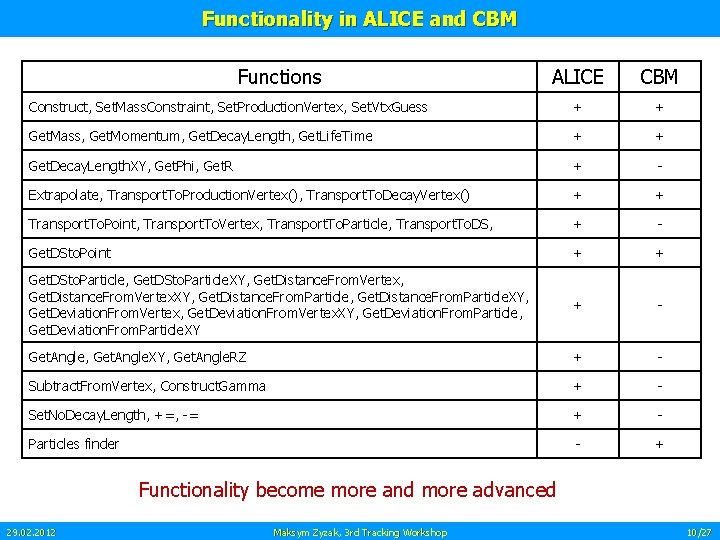
Functionality in ALICE and CBM Functions ALICE CBM Construct, Set. Mass. Constraint, Set. Production. Vertex, Set. Vtx. Guess + + Get. Mass, Get. Momentum, Get. Decay. Length, Get. Life. Time + + Get. Decay. Length. XY, Get. Phi, Get. R + - Extrapolate, Transport. To. Production. Vertex(), Transport. To. Decay. Vertex() + + Transport. To. Point, Transport. To. Vertex, Transport. To. Particle, Transport. To. DS, + - Get. DSto. Point + + Get. DSto. Particle, Get. DSto. Particle. XY, Get. Distance. From. Vertex, Get. Distance. From. Vertex. XY, Get. Distance. From. Particle. XY, Get. Deviation. From. Vertex, Get. Deviation. From. Vertex. XY, Get. Deviation. From. Particle, Get. Deviation. From. Particle. XY + - Get. Angle, Get. Angle. XY, Get. Angle. RZ + - Subtract. From. Vertex, Construct. Gamma + - Set. No. Decay. Length, +=, -= + - Particles finder - + Functionality become more and more advanced 29. 02. 2012 Maksym Zyzak, 3 rd Tracking Workshop 10/27
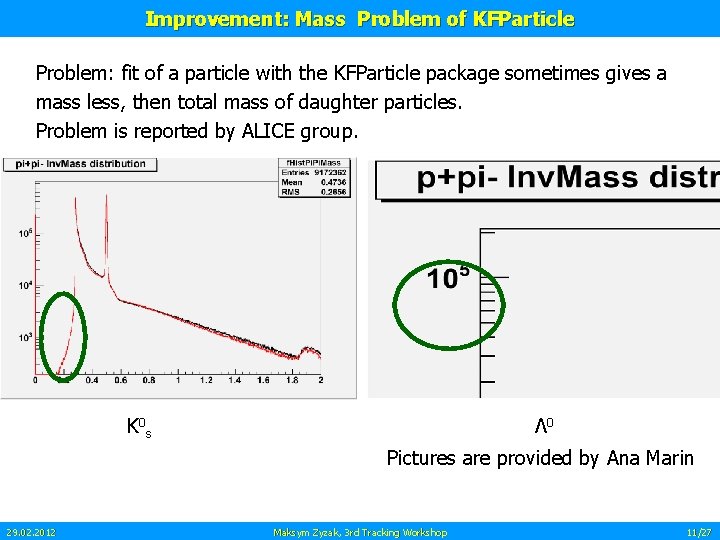
Improvement: Mass Problem of KFParticle Problem: fit of a particle with the KFParticle package sometimes gives a mass less, then total mass of daughter particles. Problem is reported by ALICE group. K 0 s Λ 0 Pictures are provided by Ana Marin 29. 02. 2012 Maksym Zyzak, 3 rd Tracking Workshop 11/27
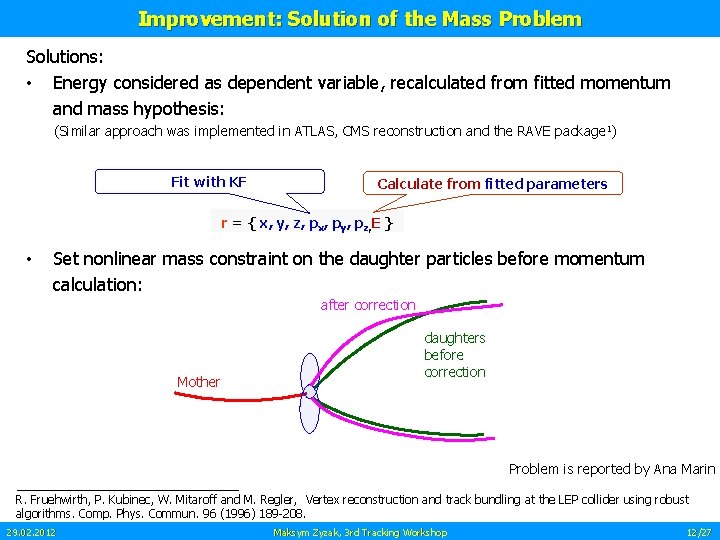
Improvement: Solution of the Mass Problem Solutions: • Energy considered as dependent variable, recalculated from fitted momentum and mass hypothesis: (Similar approach was implemented in ATLAS, CMS reconstruction and the RAVE package 1) Fit with KF Calculate from fitted parameters r = { x, y, z, px, py, pz, E } • Set nonlinear mass constraint on the daughter particles before momentum calculation: after correction Mother daughters before correction Problem is reported by Ana Marin R. Fruehwirth, P. Kubinec, W. Mitaroff and M. Regler, Vertex reconstruction and track bundling at the LEP collider using robust algorithms. Comp. Phys. Commun. 96 (1996) 189 -208. 29. 02. 2012 Maksym Zyzak, 3 rd Tracking Workshop 12/27
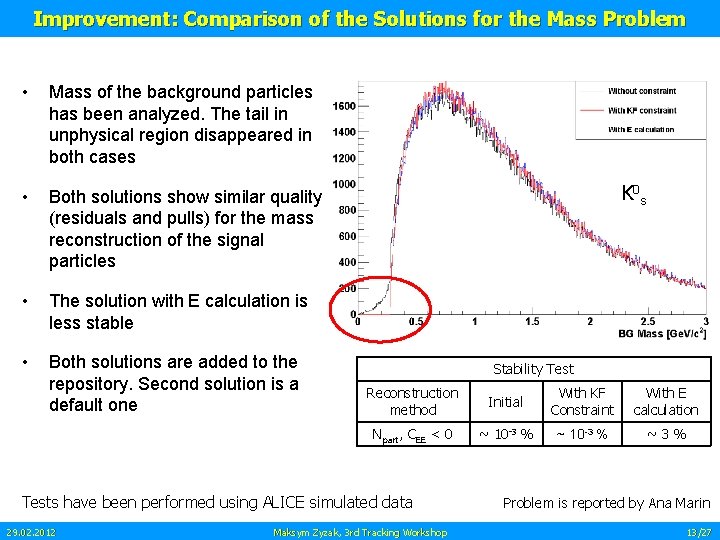
Improvement: Comparison of the Solutions for the Mass Problem • Mass of the background particles has been analyzed. The tail in unphysical region disappeared in both cases • Both solutions show similar quality (residuals and pulls) for the mass reconstruction of the signal particles • The solution with E calculation is less stable • Both solutions are added to the repository. Second solution is a default one K 0 s Stability Test Reconstruction method Initial With KF Constraint With E calculation Npart, CEE < 0 ~ 10 -3 % ~ 3 % Tests have been performed using ALICE simulated data 29. 02. 2012 Maksym Zyzak, 3 rd Tracking Workshop Problem is reported by Ana Marin 13/27
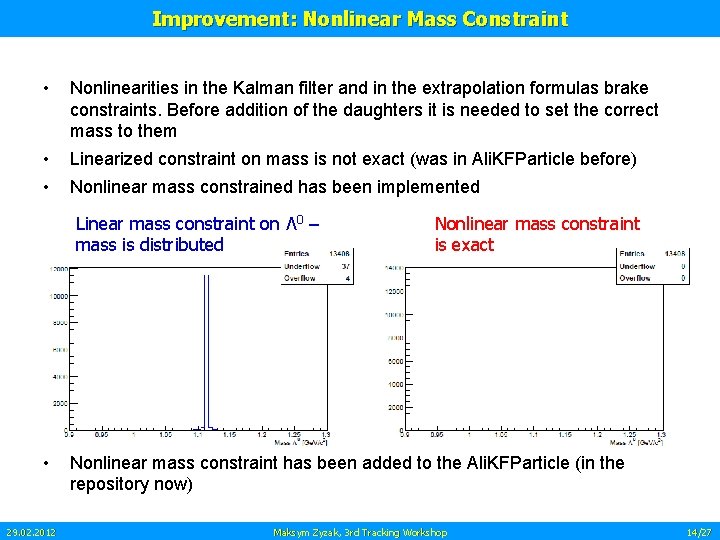
Improvement: Nonlinear Mass Constraint • Nonlinearities in the Kalman filter and in the extrapolation formulas brake constraints. Before addition of the daughters it is needed to set the correct mass to them • • Linearized constraint on mass is not exact (was in Ali. KFParticle before) Nonlinear mass constrained has been implemented Linear mass constraint on Λ 0 – mass is distributed • 29. 02. 2012 Nonlinear mass constraint is exact Nonlinear mass constraint has been added to the Ali. KFParticle (in the repository now) Maksym Zyzak, 3 rd Tracking Workshop 14/27
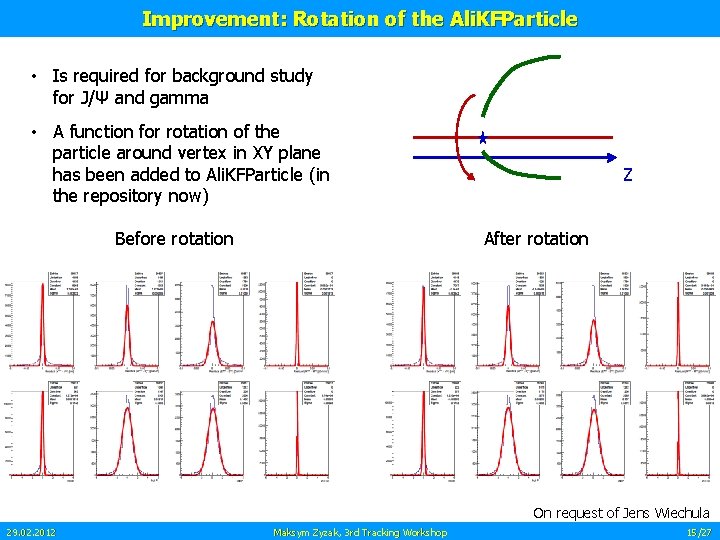
Improvement: Rotation of the Ali. KFParticle • Is required for background study for J/Ψ and gamma • A function for rotation of the particle around vertex in XY plane has been added to Ali. KFParticle (in the repository now) Before rotation Z After rotation On request of Jens Wiechula 29. 02. 2012 Maksym Zyzak, 3 rd Tracking Workshop 15/27
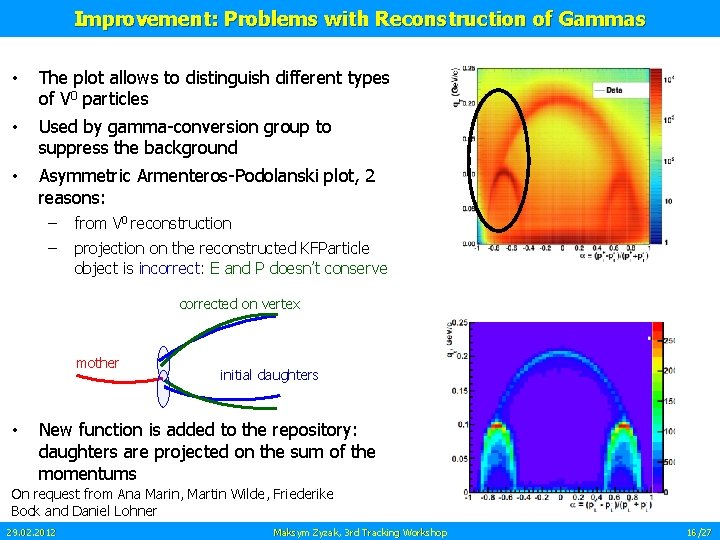
Improvement: Problems with Reconstruction of Gammas • The plot allows to distinguish different types of V 0 particles • Used by gamma-conversion group to suppress the background • Asymmetric Armenteros-Podolanski plot, 2 reasons: – from V 0 reconstruction – projection on the reconstructed KFParticle object is incorrect: E and P doesn’t conserve corrected on vertex mother • initial daughters New function is added to the repository: daughters are projected on the sum of the momentums On request from Ana Marin, Martin Wilde, Friederike Bock and Daniel Lohner 29. 02. 2012 Maksym Zyzak, 3 rd Tracking Workshop 16/27
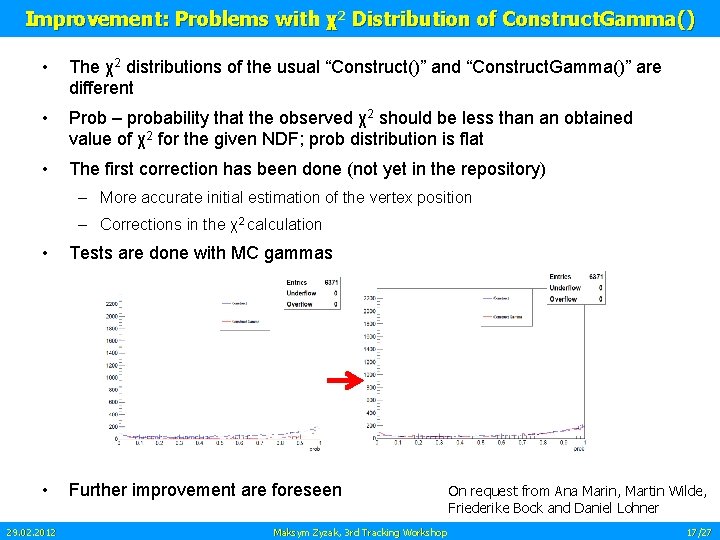
Improvement: Problems with χ2 Distribution of Construct. Gamma() • The χ2 distributions of the usual “Construct()” and “Construct. Gamma()” are different • Prob – probability that the observed χ2 should be less than an obtained value of χ2 for the given NDF; prob distribution is flat • The first correction has been done (not yet in the repository) – More accurate initial estimation of the vertex position – Corrections in the χ2 calculation • Tests are done with MC gammas • Further improvement are foreseen 29. 02. 2012 Maksym Zyzak, 3 rd Tracking Workshop On request from Ana Marin, Martin Wilde, Friederike Bock and Daniel Lohner 17/27
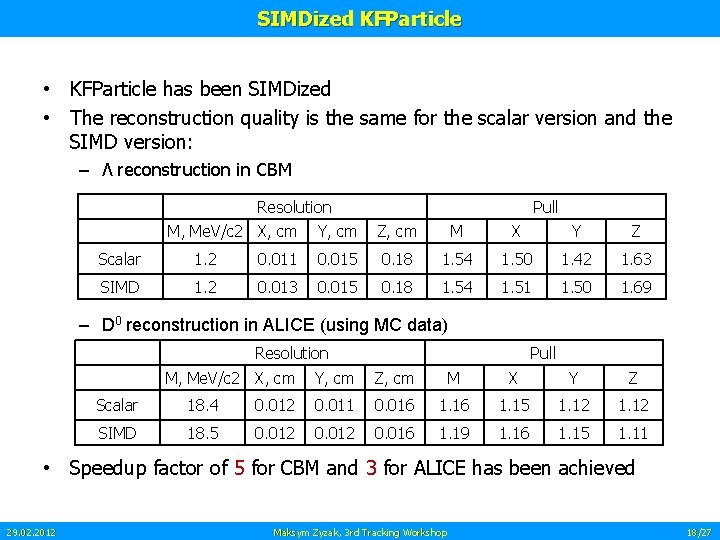
SIMDized KFParticle • KFParticle has been SIMDized • The reconstruction quality is the same for the scalar version and the SIMD version: – Λ reconstruction in CBM Resolution M, Me. V/c 2 X, cm Pull Y, cm Z, cm M X Y Z Scalar 1. 2 0. 011 0. 015 0. 18 1. 54 1. 50 1. 42 1. 63 SIMD 1. 2 0. 013 0. 015 0. 18 1. 54 1. 51 1. 50 1. 69 – D 0 reconstruction in ALICE (using MC data) Resolution M, Me. V/c 2 X, cm Pull Y, cm Z, cm M X Y Z Scalar 18. 4 0. 012 0. 011 0. 016 1. 15 1. 12 SIMD 18. 5 0. 012 0. 016 1. 19 1. 16 1. 15 1. 11 • Speedup factor of 5 for CBM and 3 for ALICE has been achieved 29. 02. 2012 Maksym Zyzak, 3 rd Tracking Workshop 18/27
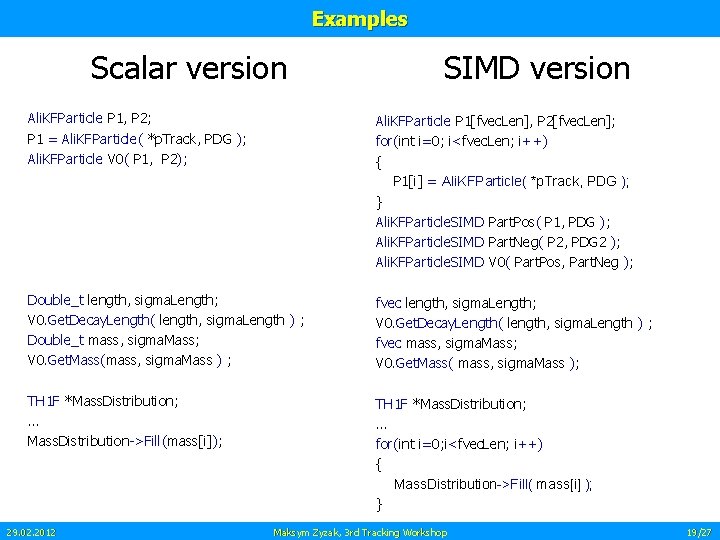
Examples Scalar version SIMD version Ali. KFParticle P 1, P 2; P 1 = Ali. KFParticle( *p. Track, PDG ); Ali. KFParticle V 0( P 1, P 2); Ali. KFParticle P 1[fvec. Len], P 2[fvec. Len]; for(int i=0; i<fvec. Len; i++) { P 1[i] = Ali. KFParticle( *p. Track, PDG ); } Ali. KFParticle. SIMD Part. Pos( P 1, PDG ); Ali. KFParticle. SIMD Part. Neg( P 2, PDG 2 ); Ali. KFParticle. SIMD V 0( Part. Pos, Part. Neg ); Double_t length, sigma. Length; V 0. Get. Decay. Length( length, sigma. Length ) ; Double_t mass, sigma. Mass; V 0. Get. Mass(mass, sigma. Mass ) ; fvec length, sigma. Length; V 0. Get. Decay. Length( length, sigma. Length ) ; fvec mass, sigma. Mass; V 0. Get. Mass( mass, sigma. Mass ); TH 1 F *Mass. Distribution; … Mass. Distribution->Fill(mass[i]); TH 1 F *Mass. Distribution; … for(int i=0; i<fvec. Len; i++) { Mass. Distribution->Fill( mass[i] ); } 29. 02. 2012 Maksym Zyzak, 3 rd Tracking Workshop 19/27
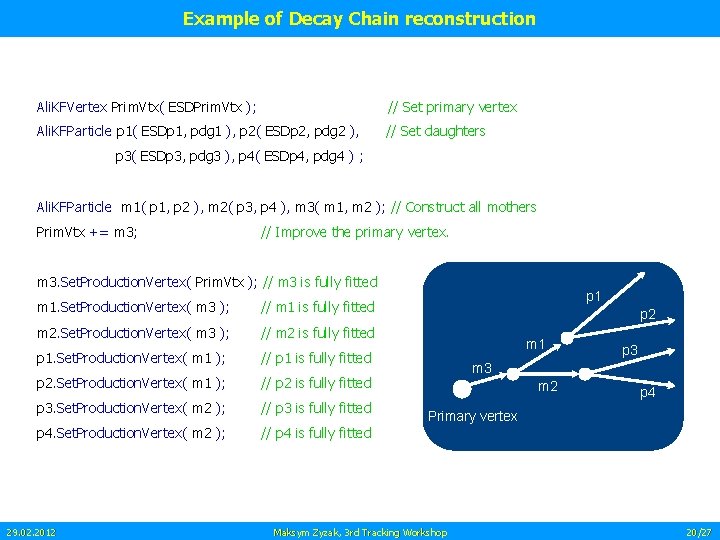
Example of Decay Chain reconstruction Ali. KFVertex Prim. Vtx( ESDPrim. Vtx ); // Set primary vertex Ali. KFParticle p 1( ESDp 1, pdg 1 ), p 2( ESDp 2, pdg 2 ), // Set daughters p 3( ESDp 3, pdg 3 ), p 4( ESDp 4, pdg 4 ) ; Ali. KFParticle m 1( p 1, p 2 ), m 2( p 3, p 4 ), m 3( m 1, m 2 ); // Construct all mothers Prim. Vtx += m 3; // Improve the primary vertex. m 3. Set. Production. Vertex( Prim. Vtx ); // m 3 is fully fitted p 1 m 1. Set. Production. Vertex( m 3 ); // m 1 is fully fitted p 2 m 2. Set. Production. Vertex( m 3 ); // m 2 is fully fitted m 1 p 1. Set. Production. Vertex( m 1 ); // p 1 is fully fitted m 3 p 2. Set. Production. Vertex( m 1 ); // p 2 is fully fitted p 3. Set. Production. Vertex( m 2 ); // p 3 is fully fitted p 3 m 2 p 4 Primary vertex p 4. Set. Production. Vertex( m 2 ); // p 4 is fully fitted 29. 02. 2012 Maksym Zyzak, 3 rd Tracking Workshop 20/27
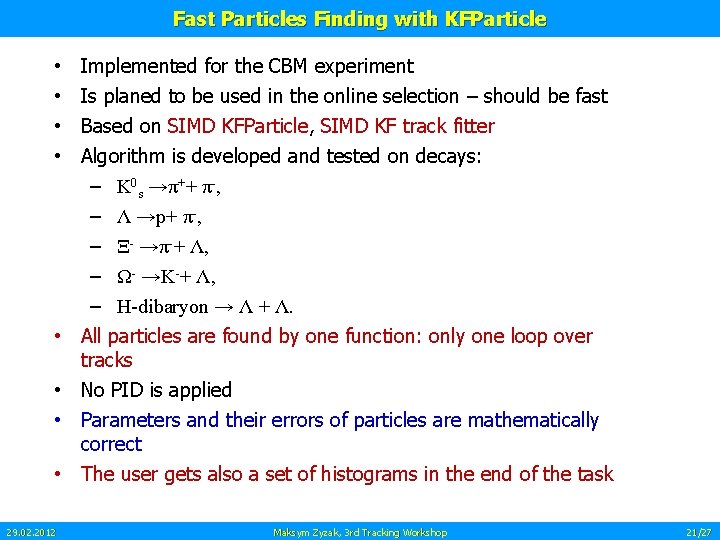
Fast Particles Finding with KFParticle • • Implemented for the CBM experiment Is planed to be used in the online selection – should be fast Based on SIMD KFParticle, SIMD KF track fitter Algorithm is developed and tested on decays: ‒ K 0 s →π++ π-, ‒ Λ →p+ π-, ‒ Ξ- →π-+ Λ, ‒ Ω- →K-+ Λ, ‒ H-dibaryon → Λ + Λ. • All particles are found by one function: only one loop over tracks • No PID is applied • Parameters and their errors of particles are mathematically correct • The user gets also a set of histograms in the end of the task 29. 02. 2012 Maksym Zyzak, 3 rd Tracking Workshop 21/27
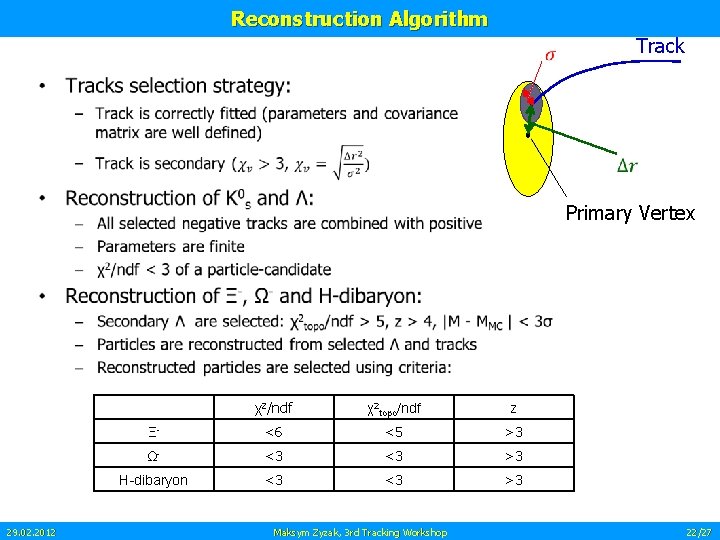
Reconstruction Algorithm Track • Primary Vertex 29. 02. 2012 χ2/ndf χ2 topo/ndf z Ξ- <6 <5 >3 Ω- <3 <3 >3 H-dibaryon <3 <3 >3 Maksym Zyzak, 3 rd Tracking Workshop 22/27
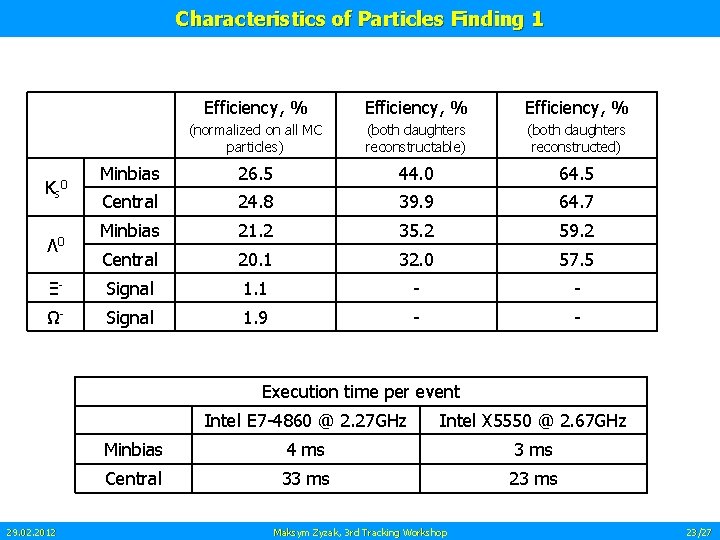
Characteristics of Particles Finding 1 Efficiency, % (normalized on all MC particles) (both daughters reconstructable) (both daughters reconstructed) Minbias 26. 5 44. 0 64. 5 Central 24. 8 39. 9 64. 7 Minbias 21. 2 35. 2 59. 2 Central 20. 1 32. 0 57. 5 Ξ- Signal 1. 1 - - Ω- Signal 1. 9 - - Ks 0 Λ 0 Execution time per event 29. 02. 2012 Intel E 7 -4860 @ 2. 27 GHz Intel X 5550 @ 2. 67 GHz Minbias 4 ms 3 ms Central 33 ms 23 ms Maksym Zyzak, 3 rd Tracking Workshop 23/27
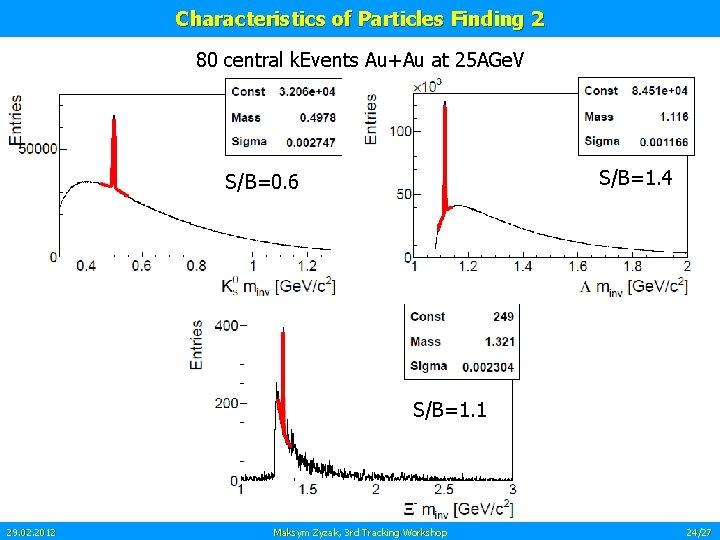
Characteristics of Particles Finding 2 80 central k. Events Au+Au at 25 AGe. V S/B=1. 4 S/B=0. 6 S/B=1. 1 29. 02. 2012 Maksym Zyzak, 3 rd Tracking Workshop 24/27
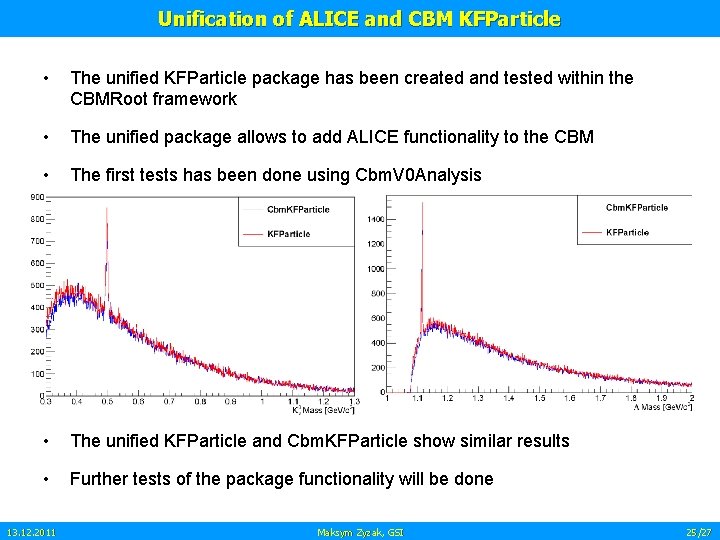
Unification of ALICE and CBM KFParticle • The unified KFParticle package has been created and tested within the CBMRoot framework • The unified package allows to add ALICE functionality to the CBM • The first tests has been done using Cbm. V 0 Analysis • The unified KFParticle and Cbm. KFParticle show similar results • Further tests of the package functionality will be done 13. 12. 2011 Maksym Zyzak, GSI 25/27
Summary • The KFParticle package is a particle reconstruction package with a rich functionality. The functionality become more and more advanced. • KFParticle has been SIMDized version shows the same results. • The first steps for a unification of the KFParticle have been done. • The particles finder has been developed based on the SIMDized KFParticle package. The algorithm shows high speed and efficiency. 29. 02. 2012 Maksym Zyzak, 3 rd Tracking Workshop 26/27
Future Plans • Increase the functionality of the package, create the KFParticle library. • Add KFParticle to the STAR experiment and STAR HLT. • Further development of the KFParticle package using real data from the ALICE (CERN) and STAR (RHIC) experiments. • Implement statistical methods for the particle reconstruction and selection based on KFParticle. • Add user code for the physics analysis to KFParticle and help to speed up it. • Reconstruct the full topology of the event within KFParticle. • Multi vertex events reconstruction with KFParticle. • Add adaptive methods (DAF, PDAF, etc. ) to the KFParticle package. • Use KFParticle for the 4 D tracking developing. 29. 02. 2012 Maksym Zyzak, 3 rd Tracking Workshop 27/27