
NeutronTarget Data for Pion Photoproduction Igor Strakovsky The
![SAID for Pion Photoproduction [W. Chen, et al, ar. Xiv: 1203. 4412 [hep-ph] ·](https://slidetodoc.com/presentation_image_h/0169c884dc6b135e7a1b8e39c442d1ea/image-5.jpg "SAID for Pion Photoproduction [W. Chen, et al, ar. Xiv: 1203. 4412 [hep-ph] ·")
![Neutron Multipoles from GB 12 [W. Chen, et al, ar. Xiv: 1203. 4412 [hep-ph]](https://slidetodoc.com/presentation_image_h/0169c884dc6b135e7a1b8e39c442d1ea/image-16.jpg "Neutron Multipoles from GB 12 [W. Chen, et al, ar. Xiv: 1203. 4412 [hep-ph]")

- Slides: 21
Neutron-Target Data for Pion Photoproduction Igor Strakovsky The George Washington University · Single Pion Photo. Prod · Proton Multipoles · FSI for gn p-p · CLAS gn p-p data for PWA · Neutron Multipoles · Summary & Prospects 2/19/2021 ATHOS 2012, Camogli, Italy, June 2012 Igor Strakovsky 1
Phenomenology for non-strange Resonances • . y r eo th UP o olo n e m phen gy t en m i r e exp 2/19/2021 ATHOS 2012, Camogli, Italy, June 2012 Igor Strakovsky 2
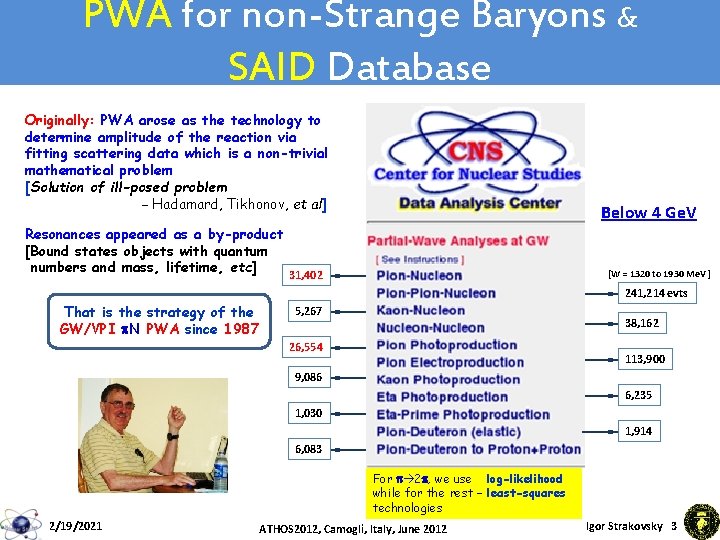
PWA for non-Strange Baryons & SAID Database Originally: PWA arose as the technology to determine amplitude of the reaction via fitting scattering data which is a non-trivial mathematical problem [Solution of ill-posed problem - Hadamard, Tikhonov, et al] Below 4 Ge. V Resonances appeared as a by-product [Bound states objects with quantum numbers and mass, lifetime, etc] 31, 402 [W = 1320 to 1930 Me. V ] 241, 214 evts That is the strategy of the GW/VPI p. N PWA since 1987 5, 267 38, 162 26, 554 113, 900 9, 086 6, 235 1, 030 1, 914 6, 083 For p 2 p, we use log-likelihood while for the rest - least-squares technologies 2/19/2021 ATHOS 2012, Camogli, Italy, June 2012 Igor Strakovsky 3
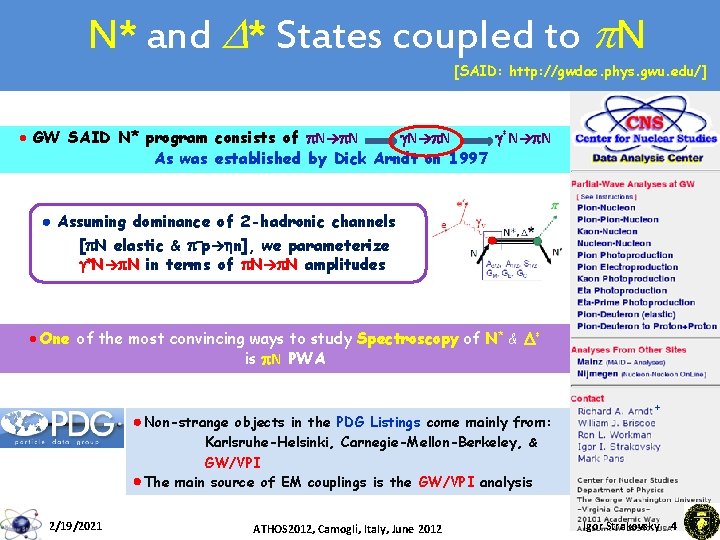
N* and D* States coupled to p. N [SAID: http: //gwdac. phys. gwu. edu/] · GW SAID N* program consists of p. N g. N p. N g*N p. N As was established by Dick Arndt on 1997 · Assuming dominance of 2 -hadronic channels [p. N elastic & p-p hn], we parameterize g*N p. N in terms of p. N amplitudes · One of the most convincing ways to study Spectroscopy of N* & D* is p. N PWA · Non-strange objects in the PDG Listings come mainly from: + Karlsruhe-Helsinki, Carnegie-Mellon-Berkeley, & GW/VPI · The main source of EM couplings is the GW/VPI analysis 2/19/2021 ATHOS 2012, Camogli, Italy, June 2012 Igor Strakovsky 4
SAID for Pion Photoproduction [W. Chen, et al, ar. Xiv: 1203. 4412 [hep-ph] · · · Energy dependent GB 12 and associated SES E = 145 – 2700 Me. V [W = 1080 – 2460 Me. V] PWs = 60 [E & M multipoles] [J < 6] Prms = 210 Constraint: M = (Born + A)(1+i. Tp. N) + BTp. N + (C+i. D)(Im. Tp. N-|Tp. N|2) Reaction Data (Dpol) c 2 gp p 0 p 14, 612 (3 %) 32, 449 gp p+n 8, 510 (5 %) 16, 520 gn p-p 3, 058 (0 %) 6, 396 gn p 0 n 364 (0 %) 1, 201 Total 26, 554 p. N-PWA [no theoretical input] 23, 122 data 56, 566 · 1 st generation - (‘ 60 -‘ 90) 10 k data [85% bremsstrahlung data] 30% data is polarized [limited coverage, broad energy binning] · 2 nd generation ('90 -'10) SAID fits 25 k data [60% tagged data] 30% data is polarized Dearth of neutron data · 3 rd generation ('10+) New data will come from JLab, MAMI-C, SPring-8, CB-ELSA, MAX-lab, & LNS 2/19/2021 Born [no free parameters to fit] 3, 422 data Much less known, 15% ATHOS 2012, Camogli, Italy, June 2012 Igor Strakovsky 5
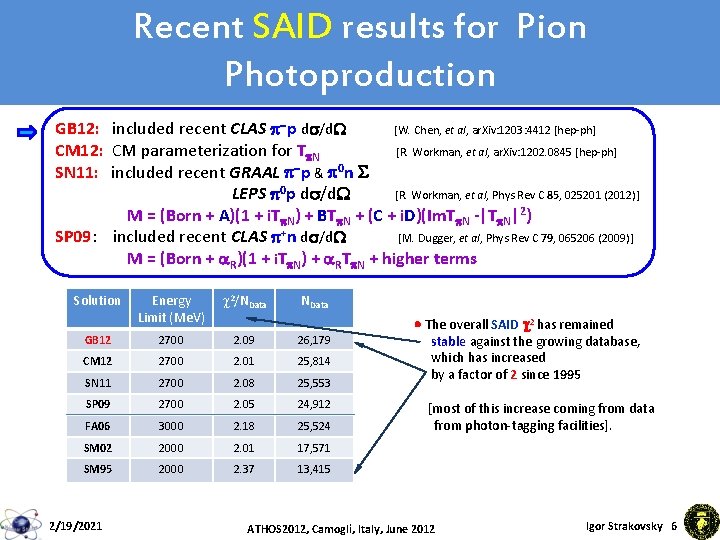
Recent SAID results for Pion Photoproduction GB 12: included recent CLAS p-p ds/d. W [W. Chen, et al, ar. Xiv: 1203: 4412 [hep-ph] CM 12: CM parameterization for Tp. N [R. Workman, et al, ar. Xiv: 1202. 0845 [hep-ph] SN 11: included recent GRAAL p-p & p 0 n S LEPS p 0 p ds/d. W [R. Workman, et al, Phys Rev C 85, 025201 (2012)] M = (Born + A)(1 + i. Tp. N) + BTp. N + (C + i. D)(Im. Tp. N -|Tp. N|2) SP 09: included recent CLAS p+n ds/d. W [M. Dugger, et al, Phys Rev C 79, 065206 (2009)] M = (Born + a. R)(1 + i. Tp. N) + a. RTp. N + higher terms Energy Limit (Me. V) c 2/NData GB 12 2700 2. 09 26, 179 CM 12 2700 2. 01 25, 814 SN 11 2700 2. 08 25, 553 SP 09 2700 2. 05 24, 912 FA 06 3000 2. 18 25, 524 SM 02 2000 2. 01 17, 571 SM 95 2000 2. 37 13, 415 Solution 2/19/2021 NData · The overall SAID c 2 has remained stable against the growing database, which has increased by a factor of 2 since 1995 [most of this increase coming from data from photon-tagging facilities]. Forum for MAX-IV Ring, Lund, Nov 2011 ATHOS 2012, Camogli, Italy, June 2012 Igor Strakovsky 6
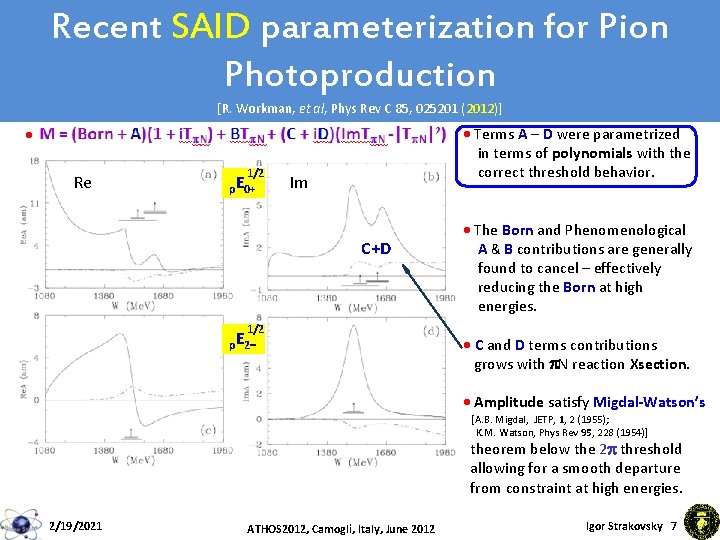
Recent SAID parameterization for Pion Photoproduction [R. Workman, et al, Phys Rev C 85, 025201 (2012)] · Re 1/2 p. E 0+ · Terms A – D were parametrized in terms of polynomials with the correct threshold behavior. Im C+D 1/2 p. E 2 - · The Born and Phenomenological A & B contributions are generally found to cancel – effectively reducing the Born at high energies. · C and D terms contributions grows with p. N reaction Xsection. · Amplitude satisfy Migdal-Watson’s [A. B. Migdal, JETP, 1, 2 (1955); K. M. Watson, Phys Rev 95, 228 (1954)] theorem below the 2 p threshold allowing for a smooth departure from constraint at high energies. 2/19/2021 Forum for MAX-IV Ring, Lund, Nov 2011 ATHOS 2012, Camogli, Italy, June 2012 Igor Strakovsky 7
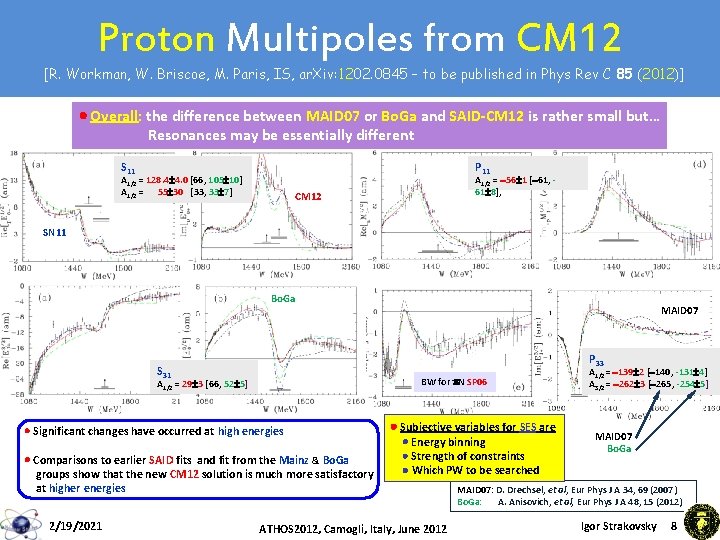
Proton Multipoles from CM 12 [R. Workman, W. Briscoe, M. Paris, IS, ar. Xiv: 1202. 0845 – to be published in Phys Rev C 85 (2012)] · Overall: the difference between MAID 07 or Bo. Ga and SAID-CM 12 is rather small but… Resonances may be essentially different S 11 P 11 A 1/2 = 128. 4 4. 0 [66, 105 10] A 1/2 = 55 30 [33, 33 7] A 1/2 = -56 1 [-61, 61 8], CM 12 SN 11 Bo. Ga P 33 S 31 BW for p. N SP 06 A 1/2 = 29 3 [66, 52 5] · Significant changes have occurred at high energies · Comparisons to earlier SAID fits and fit from the Mainz & Bo. Ga groups show that the new CM 12 solution is much more satisfactory at higher energies 2/19/2021 MAID 07 · Subjective variables for SES are · Energy binning · Strength of constraints · Which PW to be searched ATHOS 2012, Camogli, Italy, June 2012 A 1/2 = -139 2 [-140, -131 4] A 3/2 = -262 3 [-265, -254 5] MAID 07 Bo. Ga MAID 07: D. Drechsel, et al, Eur Phys J A 34, 69 (2007) Bo. Ga: A. Anisovich, et al, Eur Phys J A 48, 15 (2012) Igor Strakovsky 8
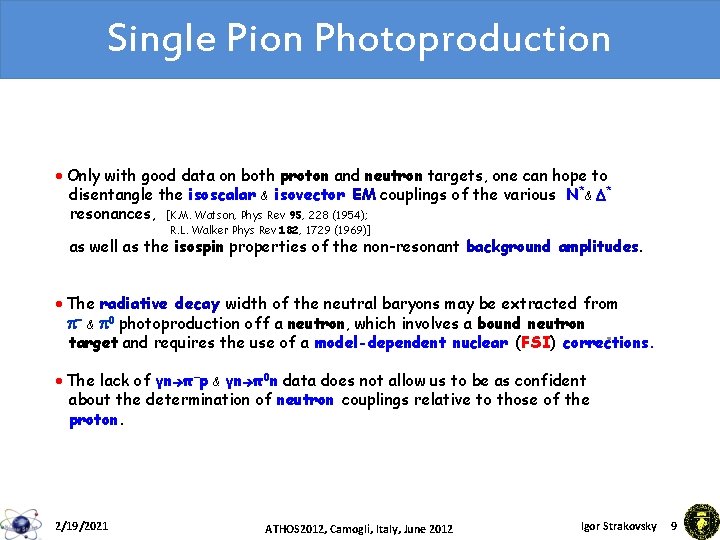
Single Pion Photoproduction · Only with good data on both proton and neutron targets, one can hope to disentangle the isoscalar & isovector EM couplings of the various N*& D* resonances, [K. M. Watson, Phys Rev 95, 228 (1954); R. L. Walker Phys Rev 182, 1729 (1969)] as well as the isospin properties of the non-resonant background amplitudes. · The radiative decay width of the neutral baryons may be extracted from p- & p 0 photoproduction off a neutron, which involves a bound neutron target and requires the use of a model-dependent nuclear (FSI) corrections. . · The lack of γn π−p & γn π0 n data does not allow us to be as confident about the determination of neutron couplings relative to those of the proton. 2/19/2021 ATHOS 2012, Camogli, Italy, June 2012 Igor Strakovsky 9
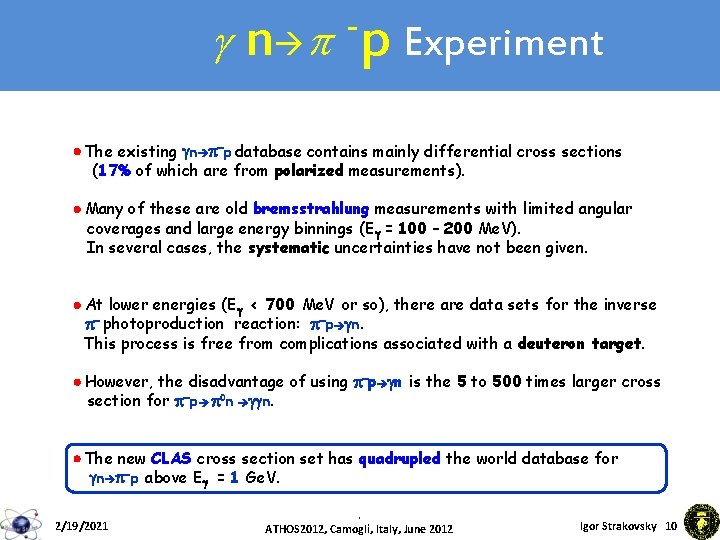
g n p p Experiment · The existing gn p-p database contains mainly differential cross sections (17% of which are from polarized measurements). · Many of these are old bremsstrahlung measurements with limited angular coverages and large energy binnings (Eg = 100 – 200 Me. V). In several cases, the systematic uncertainties have not been given. · At lower energies (Eg < 700 Me. V or so), there are data sets for the inverse p- photoproduction reaction: p-p gn. This process is free from complications associated with a deuteron target. THANKS · However, the disadvantage of using p-p gn is the 5 to 500 times larger cross section for p-p p 0 n ggn. igor@gwu. edu · The new CLAS cross section set has quadrupled the world database for gn p-p above Eg = 1 Ge. V. 2/19/2021 . ATHOS 2012, Camogli, Italy, June 2012 Igor Strakovsky 10
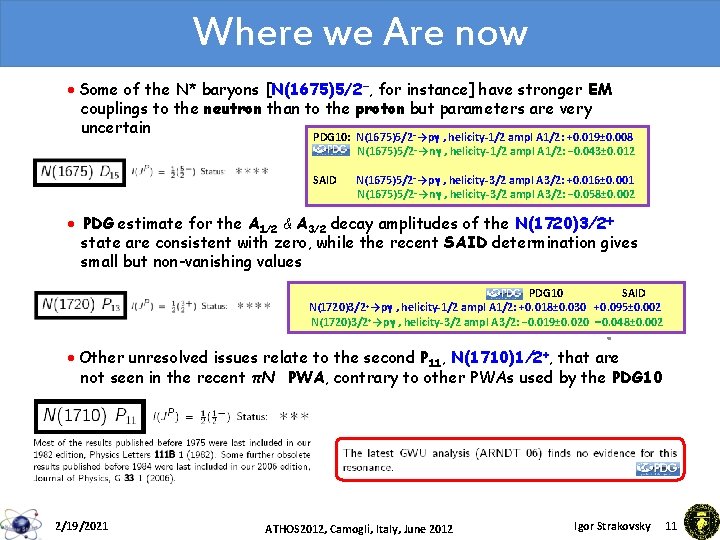
Where we Are now · Some of the N* baryons [N(1675)5/2−, for instance] have stronger EM couplings to the neutron than to the proton but parameters are very uncertain PDG 10: N(1675)5/2 −→pγ , helicity-1/2 ampl A 1/2: +0. 019± 0. 008 N(1675)5/2−→nγ , helicity-1/2 ampl A 1/2: − 0. 043± 0. 012 SAID N(1675)5/2−→pγ , helicity-3/2 ampl A 3/2: +0. 016± 0. 001 N(1675)5/2−→nγ , helicity-3/2 ampl A 3/2: − 0. 058± 0. 002 · PDG estimate for the A 1/2 & A 3/2 decay amplitudes of the N(1720)3/2+ state are consistent with zero, while the recent SAID determination gives small but non-vanishing values PDG 10 SAID N(1720)3/2+→pγ , helicity-1/2 ampl A 1/2: +0. 018± 0. 030 +0. 095± 0. 002 N(1720)3/2+→pγ , helicity-3/2 ampl A 3/2: − 0. 019± 0. 020 -0. 048± 0. 002 . · Other unresolved issues relate to the second P 11, N(1710)1/2+, that are not seen in the recent πN PWA, contrary to other PWAs used by the PDG 10 2/19/2021 ATHOS 2012, Camogli, Italy, June 2012 Igor Strakovsky 11
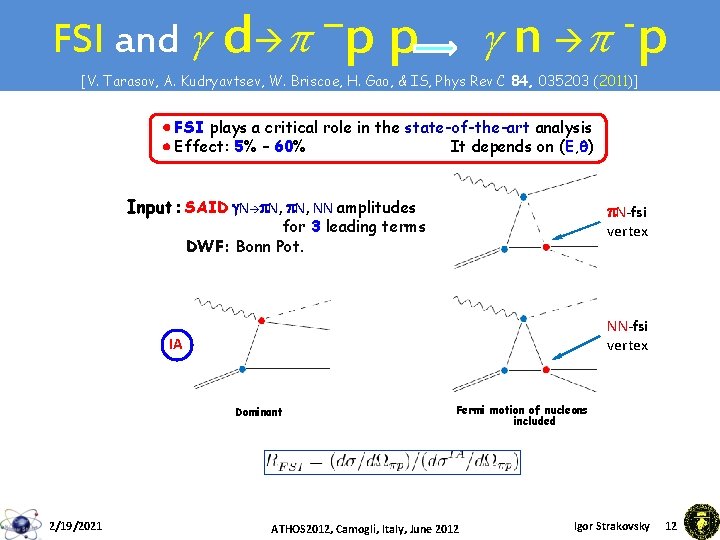
– FSI and g d p p p gn p p [V. Tarasov, A. Kudryavtsev, W. Briscoe, H. Gao, & IS, Phys Rev C 84, 035203 (2011)] · FSI plays a critical role in the state-of-the-art analysis · Effect: 5% – 60% It depends on (E, q) Input: SAID g. N p. N, NN amplitudes p. N-fsi vertex for 3 leading terms DWF: Bonn Pot. NN-fsi vertex IA Dominant 2/19/2021 Fermi motion of nucleons included ATHOS 2012, Camogli, Italy, June 2012 Igor Strakovsky 12
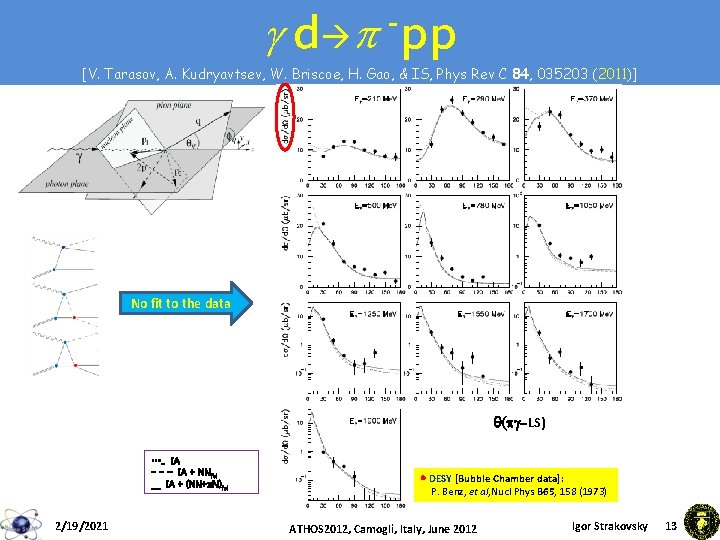
g d p pp [V. Tarasov, A. Kudryavtsev, W. Briscoe, H. Gao, & IS, Phys Rev C 84, 035203 (2011)] . No fit to the data . q(pg-LS) …. . IA - - - IA + NNfsi ___ IA + (NN+p. N)fsi 2/19/2021 · DESY [Bubble Chamber data]: P. Benz, et al, Nucl Phys B 65, 158 (1973) ATHOS 2012, Camogli, Italy, June 2012 Igor Strakovsky 13
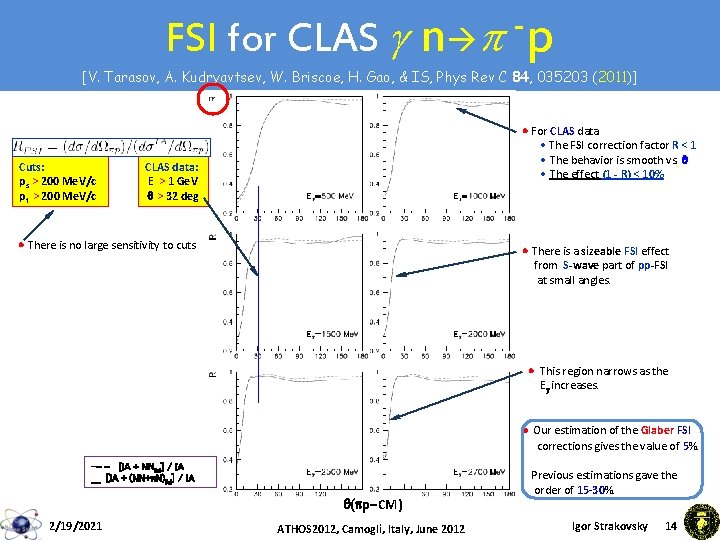
FSI for CLAS g n p p [V. Tarasov, A. Kudryavtsev, W. Briscoe, H. Gao, & IS, Phys Rev C 84, 035203 (2011)] . Cuts: ps > 200 Me. V/c pf > 200 Me. V/c CLAS data: E > 1 Ge. V q > 32 deg · There is no large sensitivity to cuts · For CLAS data · The FSI correction factor R < 1 · The behavior is smooth vs. q · The effect (1 - R) < 10% · There is a sizeable FSI effect from S-wave part of pp-FSI at small angles. . · This region narrows as the Eg increases. · Our estimation of the Glaber FSI corrections gives the value of 5%. -- - [IA + NNfsi] / IA ___ [IA + (NN+p. N)fsi] / IA q(pp-CM) 2/19/2021 ATHOS 2012, Camogli, Italy, June 2012 Previous estimations gave the order of 15 -30%. Igor Strakovsky 14
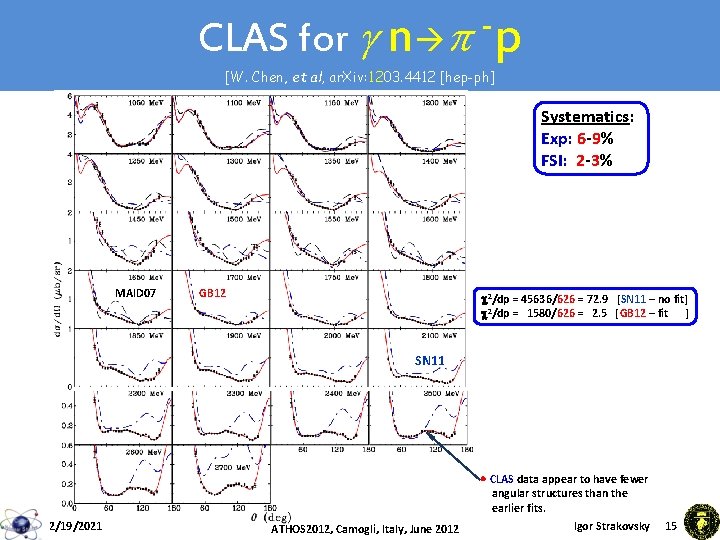
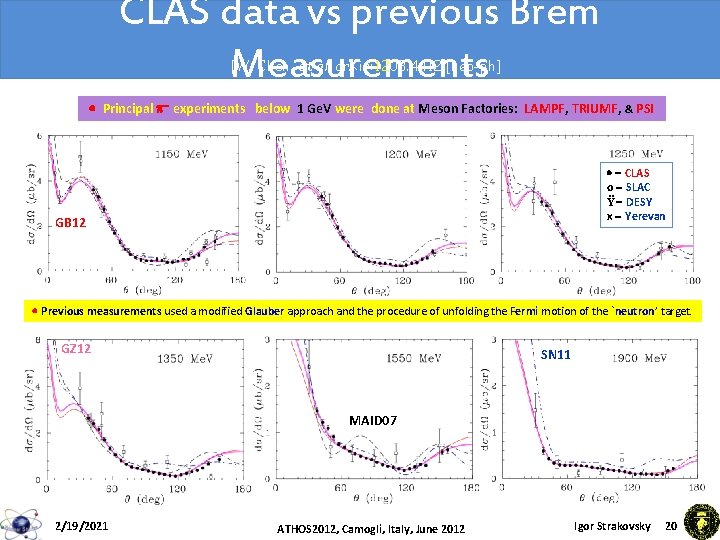
CLAS for g n p p [W. Chen, et al, ar. Xiv: 1203. 4412 [hep-ph] Systematics: Exp: 6 -9% FSI: 2 -3% MAID 07 GB 12 c 2/dp = 45636/626 = 72. 9 [SN 11 – no fit] c 2/dp = 1580/626 = 2. 5 [GB 12 – fit ] SN 11 · CLAS data appear to have fewer angular structures than the earlier fits. 2/19/2021 ATHOS 2012, Camogli, Italy, June 2012 Igor Strakovsky 15
Neutron Multipoles from GB 12 [W. Chen, et al, ar. Xiv: 1203. 4412 [hep-ph] · Overall: the difference between MAID 07 and SAID-GB 12 is rather small but… Resonances may be essentially different MAID 07 BW for p. N SP 06 GB 12 SN 11 S 11 P 11 A 1/2 = -58 6 [-51] A 1/2 = -40 10 [ 9] A 1/2 = 48 4 [54] GZ 12 D 13 F 15 A 1/2 = -46 6 [ -77] A 1/2 = -115 5 [-154] A 1/2 = 26 4 [ 28] A 3/2 = -29 2 [-38] · Significant changes have occurred at high energies · Comparisons to earlier SAID fits and fit from the Mainz group show that the new GB 12 solution is much more satisfactory at higher energies 2/19/2021 ATHOS 2012, Camogli, Italy, June 2012 MAID 07: D. Drechsel, et al, Eur Phys J A 34, 69 (2007) Igor Strakovsky 16
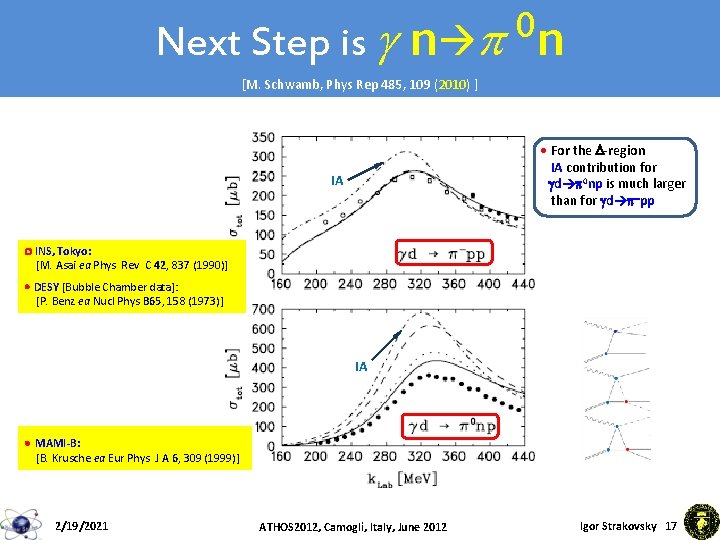
Next Step is g 0 n p n [M. Schwamb, Phys Rep 485, 109 (2010) ] · For the D-region IA contribution for gd p 0 np is much larger than for gd p-pp IA o INS, Tokyo: [M. Asai ea Phys Rev C 42, 837 (1990)] · DESY [Bubble Chamber data]: [P. Benz ea Nucl Phys B 65, 158 (1973)] IA · MAMI-B: [B. Krusche ea Eur Phys J A 6, 309 (1999)] 2/19/2021 Forum for MAX-IV Ring, Lund, Nov 2011 ATHOS 2012, Camogli, Italy, June 2012 Igor Strakovsky 17
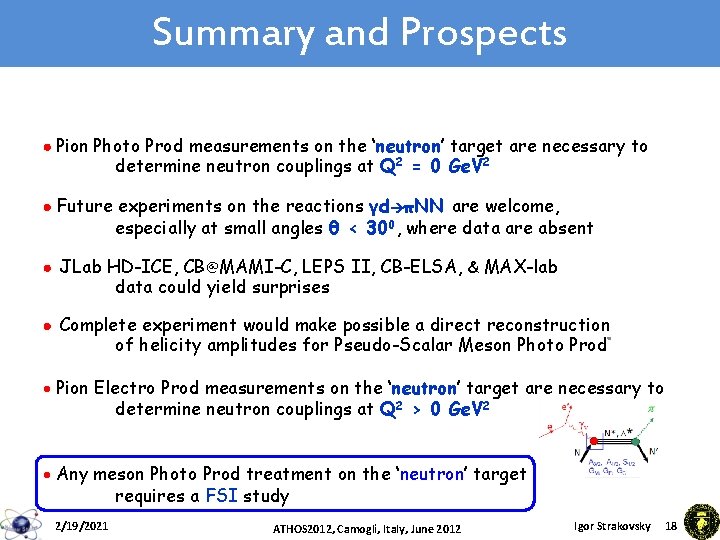
Summary and Prospects · Pion Photo Prod measurements on the ‘neutron’ target are necessary to determine neutron couplings at Q 2 = 0 Ge. V 2 · Future experiments on the reactions γd πNN are welcome, especially at small angles θ < 300, where data are absent · JLab HD-ICE, CB@MAMI-C, LEPS II, CB-ELSA, & MAX-lab data could yield surprises . · Complete experiment would make possible a direct reconstruction of helicity amplitudes for Pseudo-Scalar Meson Photo Prod · Pion Electro Prod measurements on the ‘neutron’ target are necessary to determine neutron couplings at Q 2 > 0 Ge. V 2 · Any meson Photo Prod treatment on the ‘neutron’ target requires a FSI study 2/19/2021 ATHOS 2012, Camogli, Italy, June 2012 Igor Strakovsky 18
THANKS igor@gwu. edu 2/19/2021 ATHOS 2012, Camogli, Italy, June 2012 Igor Strakovsky 19
CLAS data vs previous Brem Measurements [W. Chen, et al, ar. Xiv: 1203. 4412 [hep-ph] · Principal p- experiments below 1 Ge. V were done at Meson Factories: LAMPF, TRIUMF, & PSI · - CLAS o - SLAC Ÿ - DESY x - Yerevan GB 12 · Previous measurements used a modified Glauber approach and the procedure of unfolding the Fermi motion of the `neutron’ target. GZ 12 SN 11 . MAID 07 2/19/2021 ATHOS 2012, Camogli, Italy, June 2012 Igor Strakovsky 20
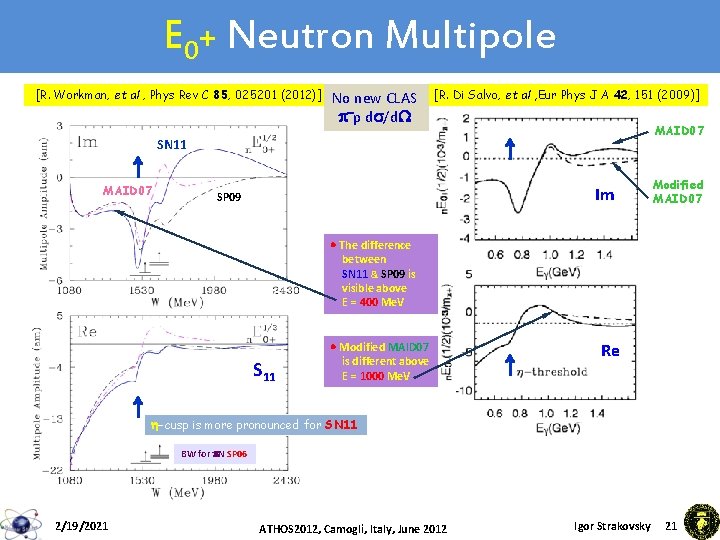
E 0+ Neutron Multipole [R. Workman, et al , Phys Rev C 85, 025201 (2012)] No new CLAS p-p ds/d. W [R. Di Salvo, et al , Eur Phys J A 42, 151 (2009)] MAID 07 SN 11 MAID 07 Im SP 09 Modified MAID 07 · The difference between SN 11 & SP 09 is visible above E = 400 Me. V S 11 · Modified MAID 07 is different above E = 1000 Me. V Re h-cusp is more pronounced for SN 11 BW for p. N SP 06 2/19/2021 ATHOS 2012, Camogli, Italy, June 2012 Igor Strakovsky 21