
Coupler ShortRange Wakefield Kicks Karl Bane and Igor
Coupler Short-Range Wakefield Kicks Karl Bane and Igor Zagorodnov Wake Fest 07, 11 December 2007 Thanks to M. Dohlus; and to Z. Li, and other participants at C. Adolphsen’s Thursday morning RF meeting at SLAC
In the ILC linac rf cavities, the fundamental mode (fm) and higher mode (hm) couplers break the structure symmetry => transverse wakefields are excited even on the cavity axis Outline: • Numerical calculation of the transverse wakes of the three couplers (of a cavity) in a beam pipe • Analytical estimates (for confirmation) • Asymptotic result after several cavities (with couplers) • Estimate of effect on ILC beam • Conclusions
1. Numerical Calculation Use I. Zagorodnov’s 3 D time domain code, ECHO 3 D, to find transverse wake for couplers in a beam pipe • Reduced mesh dispersion => short bunches in long structures ok • 3 D indirect calculation of wake => no long catch-up distance Refs: 1. Zagorodnov I, Weiland T. , TE/TM Field Solver for Particle Beam Simulations without Numerical Cherenkov Radiation// Physical Review – STAB, 8, 2005. 2. Zagorodnov I. , Indirect Methods for Wake Potential Integration // Physical Review -STAB, 9, 2006. 3. Zagorodnov I, Dohlus M, “Coupler Kick, ” talk given at ILC Workshop, DESY, May 2007.
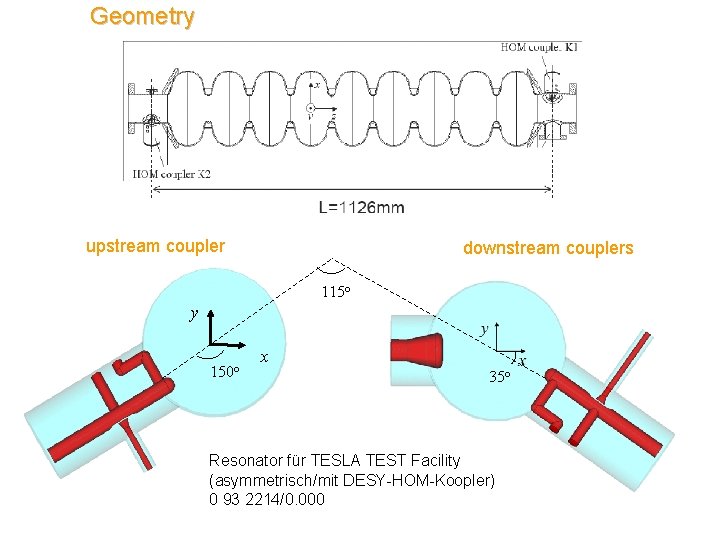
Geometry upstream coupler downstream couplers 115 o y 150 o x 35 o Resonator für TESLA TEST Facility (asymmetrisch/mit DESY-HOM-Koopler) 0 93 2214/0. 000
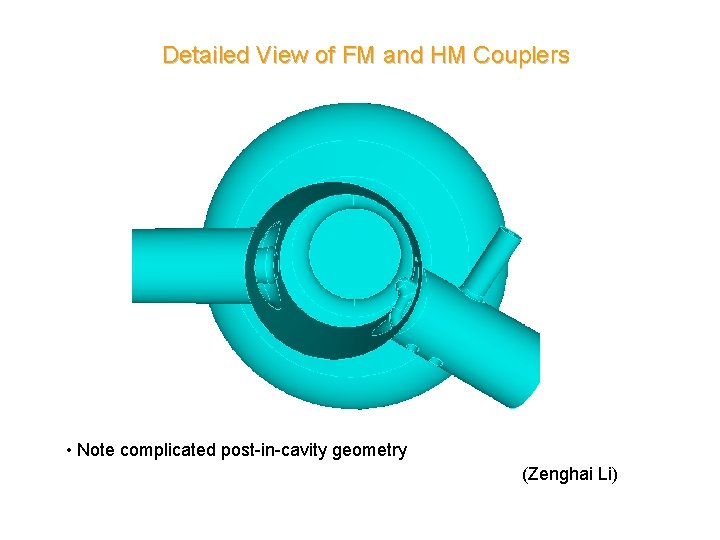
Detailed View of FM and HM Couplers • Note complicated post-in-cavity geometry (Zenghai Li)
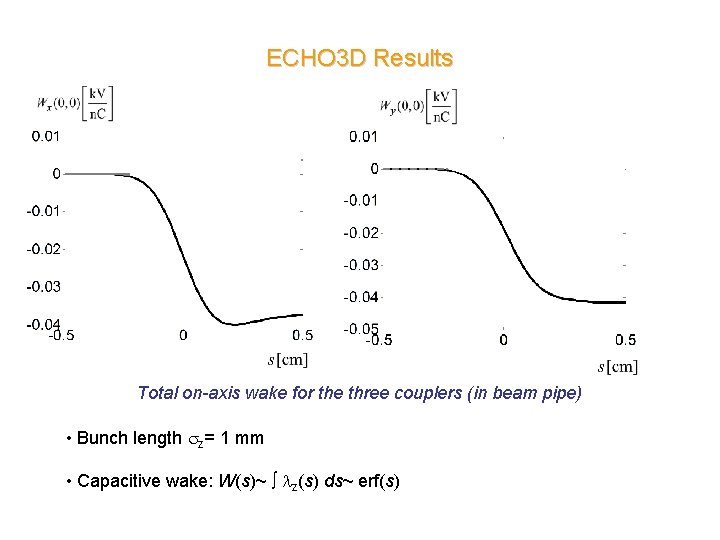
ECHO 3 D Results Total on-axis wake for the three couplers (in beam pipe) • Bunch length z= 1 mm • Capacitive wake: W(s)~ z(s) ds~ erf(s)
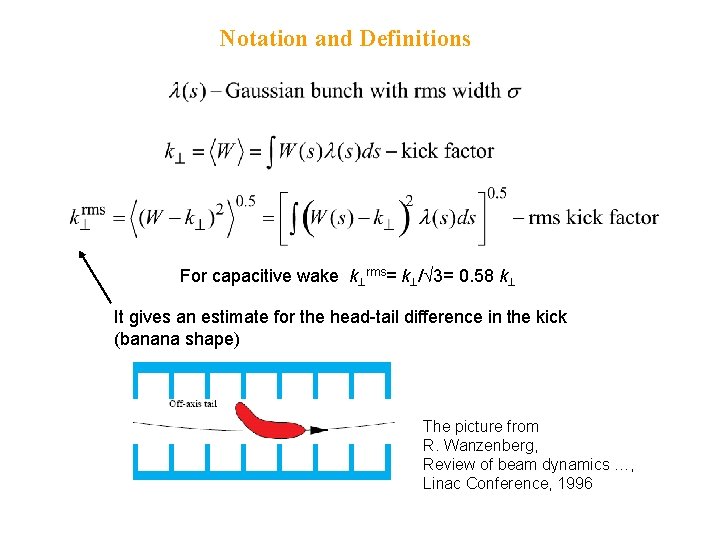
Notation and Definitions For capacitive wake k rms= k / 3= 0. 58 k It gives an estimate for the head-tail difference in the kick (banana shape) The picture from R. Wanzenberg, Review of beam dynamics …, Linac Conference, 1996
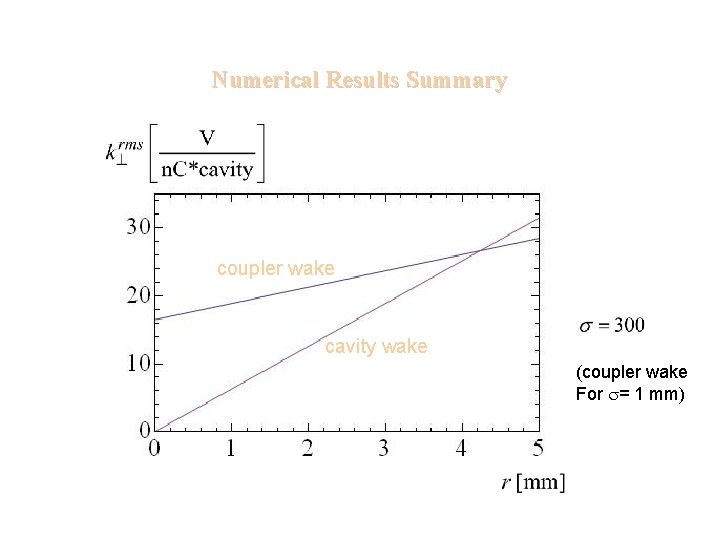
Numerical Results Summary coupler wake cavity wake (coupler wake For = 1 mm)
2. Analytical Approximation • High frequency impedance of an abrupt transition in a beam pipe, e. g. an iris or the ILC couplers can be obtained using the Optical Approximation • Result depends only on cross-sectional shape of object (and the beam pipe shape) • This is a lower order effect than the Diffraction Model (high frequency impedance of a cavity with beam pipes) => for the ILC couplers, the cavities around the posts can be ignored Refs: 1. Stupakov G. , Bane K. L. F. , Zagorodnov I. , Optical approximation in theory of geometric impedance, Physical Review--STAB, 10: 054401, 2007. 2. Bane K. L. F, Stupakov G. , Zagorodnov I. , Impedance Calculations of Non. Axisymmetric Transitions Using the Optical Approximation, Physical Review--STAB, 10: 074401, 2007.
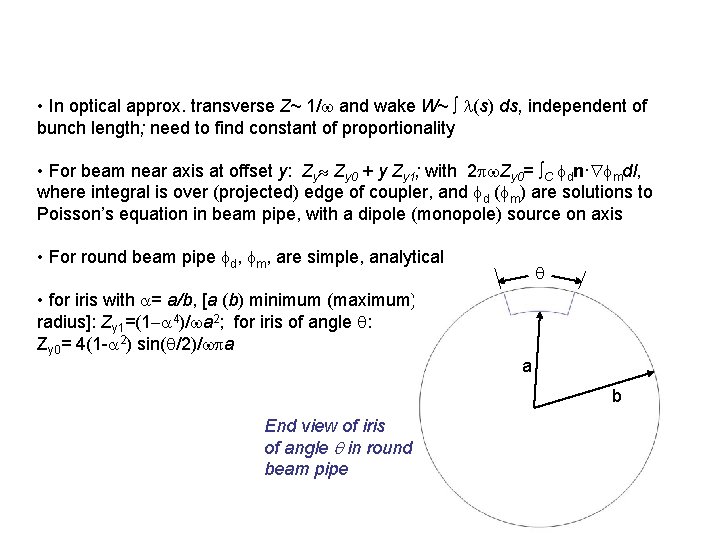
• In optical approx. transverse Z~ 1/ and wake W~ (s) ds, independent of bunch length; need to find constant of proportionality • For beam near axis at offset y: Zy Zy 0 + y Zy 1; with 2 Zy 0= C dn· mdl, where integral is over (projected) edge of coupler, and d ( m) are solutions to Poisson’s equation in beam pipe, with a dipole (monopole) source on axis • For round beam pipe d, m, are simple, analytical • for iris with = a/b, [a (b) minimum (maximum) radius]: Zy 1=(1 4)/ a 2; for iris of angle : Zy 0= 4(1 - 2) sin( /2)/ a a b End view of iris of angle in round beam pipe
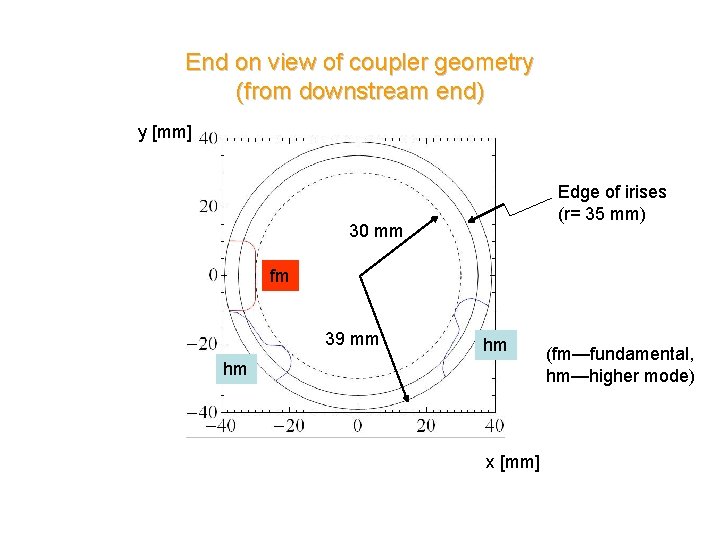
End on view of coupler geometry (from downstream end) y [mm] Edge of irises (r= 35 mm) 30 mm fm 39 mm hm hm x [mm] (fm—fundamental, hm—higher mode)
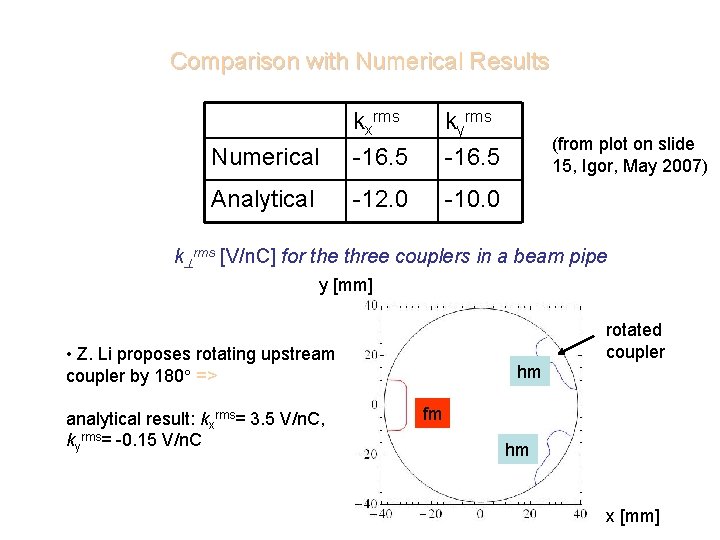
Comparison with Numerical Results Numerical kxrms -16. 5 kyrms -16. 5 Analytical -12. 0 -10. 0 (from plot on slide 15, Igor, May 2007) k rms [V/n. C] for the three couplers in a beam pipe y [mm] rotated coupler • Z. Li proposes rotating upstream coupler by 180 => analytical result: kxrms= 3. 5 V/n. C, kyrms= -0. 15 V/n. C hm fm hm x [mm]
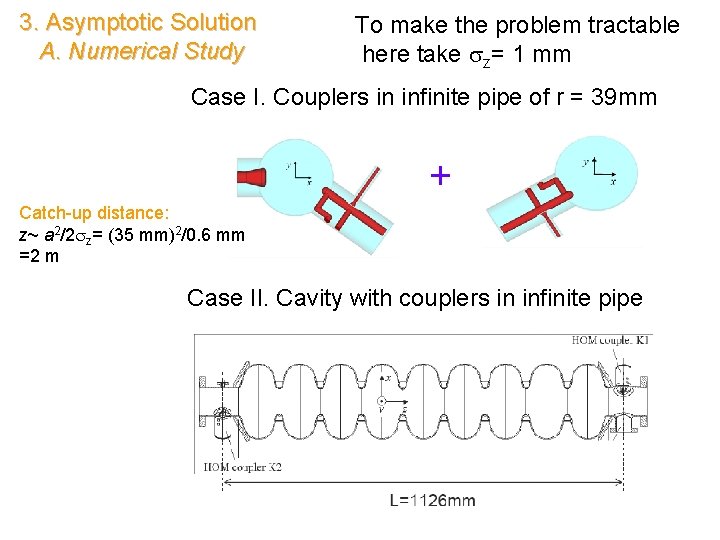
3. Asymptotic Solution A. Numerical Study To make the problem tractable here take z= 1 mm Case I. Couplers in infinite pipe of r = 39 mm + Catch-up distance: z~ a 2/2 z= (35 mm)2/0. 6 mm =2 m Case II. Cavity with couplers in infinite pipe
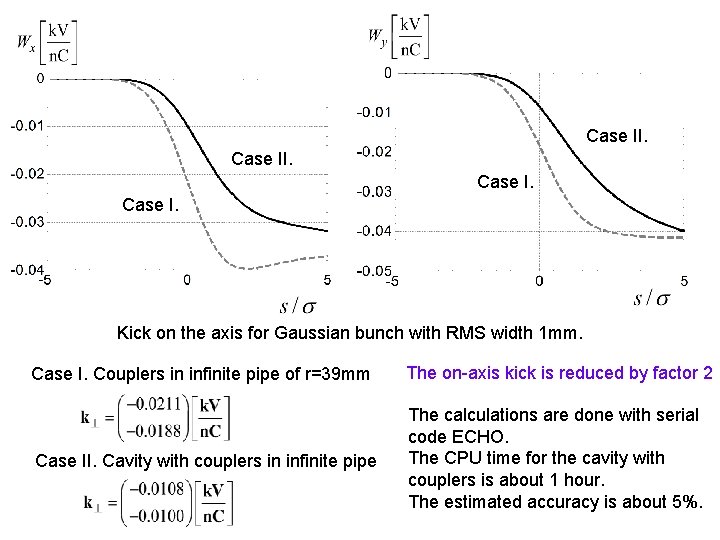
Case II. Case I. Kick on the axis for Gaussian bunch with RMS width 1 mm. Case I. Couplers in infinite pipe of r=39 mm The on-axis kick is reduced by factor 2 Case II. Cavity with couplers in infinite pipe The calculations are done with serial code ECHO. The CPU time for the cavity with couplers is about 1 hour. The estimated accuracy is about 5%.
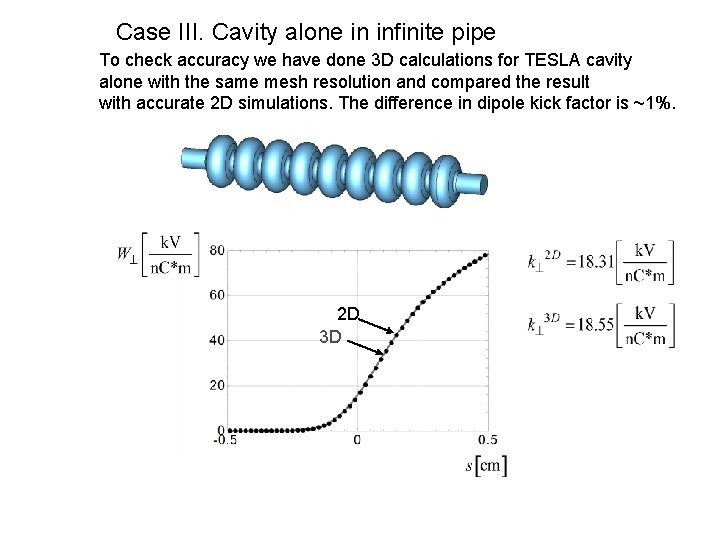
Case III. Cavity alone in infinite pipe To check accuracy we have done 3 D calculations for TESLA cavity alone with the same mesh resolution and compared the result with accurate 2 D simulations. The difference in dipole kick factor is ~1%. 2 D 3 D
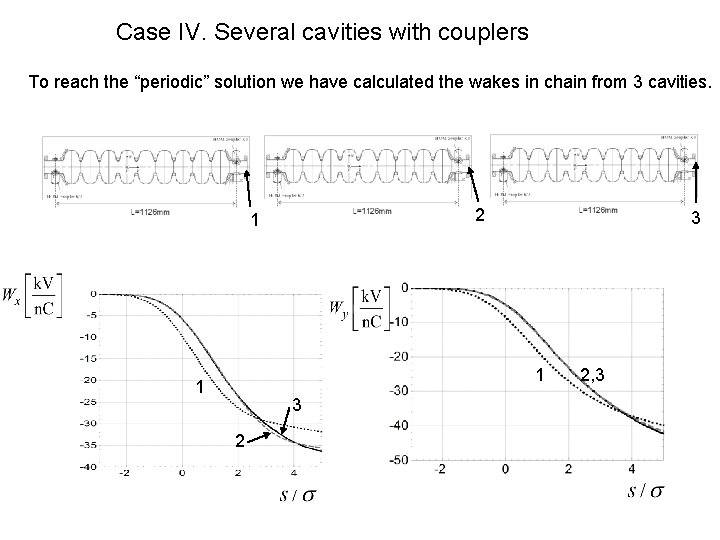
Case IV. Several cavities with couplers To reach the “periodic” solution we have calculated the wakes in chain from 3 cavities. 2 1 3 1 1 3 2 2, 3
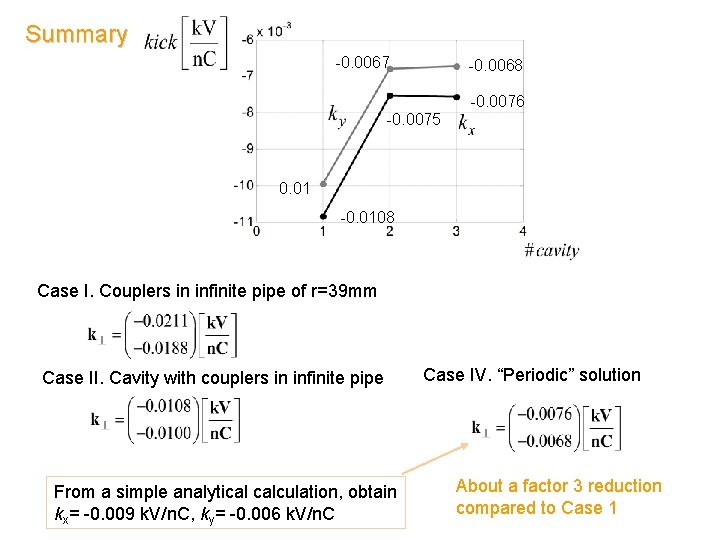
Summary -0. 0067 -0. 0068 -0. 0076 -0. 0075 0. 01 -0. 0108 Case I. Couplers in infinite pipe of r=39 mm Case II. Cavity with couplers in infinite pipe From a simple analytical calculation, obtain kx= -0. 009 k. V/n. C, ky= -0. 006 k. V/n. C Case IV. “Periodic” solution About a factor 3 reduction compared to Case 1

4. Effect on Beam Wake has two components: offset and slope Slope: from numerical results Wav~ 2. 4 V/n. C/mm/m; for periodic case should reduce a factor 2~3 to ~1 V/n. C/mm/m, which is a factor 20 smaller than the cavity wake Offset: a constant driving term to the equation of motion generates a kind of dispersion => the closed orbit depends on longitudinal position; model: y’’ + y/ 2= e 2 N W(s)/E has solution y= 2 e 2 N W(s)/E + betatron oscillation(s) Particles will perform free betatron oscillation about different centers, depending on s; no real wake effect Assume e. N= 3 n. C, = 100 m, = 2*10 -8 m, head-to-tail wake W= 20 V/n. C => at 15 Ge. V beam is spread out in y by 5 y, at 250 Ge. V by 1. 6 y • Z. Li’s modified coupler configuration will have ~0 coupler wake; smaller iris cavity, that shadows couplers, will also have ~0 coupler wake
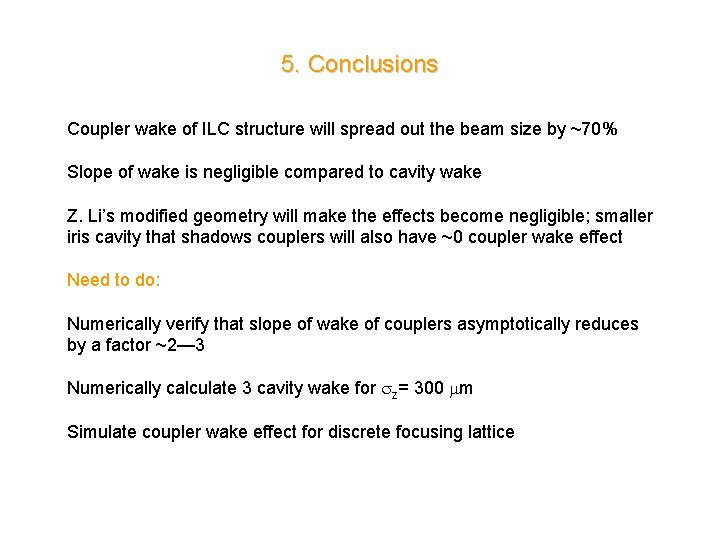
5. Conclusions Coupler wake of ILC structure will spread out the beam size by ~70% Slope of wake is negligible compared to cavity wake Z. Li’s modified geometry will make the effects become negligible; smaller iris cavity that shadows couplers will also have ~0 coupler wake effect Need to do: Numerically verify that slope of wake of couplers asymptotically reduces by a factor ~2— 3 Numerically calculate 3 cavity wake for z= 300 m Simulate coupler wake effect for discrete focusing lattice
- Slides: 19