Josef Janko Klaus Noekel WP 03 Multimodal Transportation






- Slides: 21
Josef Janko, Klaus Noekel WP 03: Multimodal Transportation Model PTV Planung Transport Verkehr AG Implementation Report Stumpfstrasse 1 31 August 2001 D-76131 Karlsruhe Tel. +49 721 96 51 -0 Fax +49 721 96 51 -699 Internet: www. ptv. de
PTV AG Contents of the Presentation w Transport modelling in the context of SUTRA w Modeling Park & Ride w Modeling High-Occupancy Vehicles (HOV) w Modeling Road Pricing w Data Exchange with other Models 2
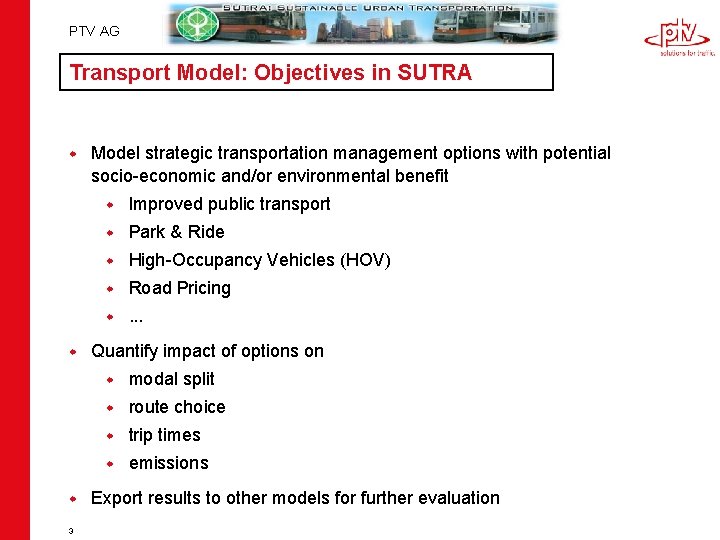
PTV AG Transport Model: Objectives in SUTRA w w w 3 Model strategic transportation management options with potential socio-economic and/or environmental benefit w Improved public transport w Park & Ride w High-Occupancy Vehicles (HOV) w Road Pricing w . . . Quantify impact of options on w modal split w route choice w trip times w emissions Export results to other models for further evaluation
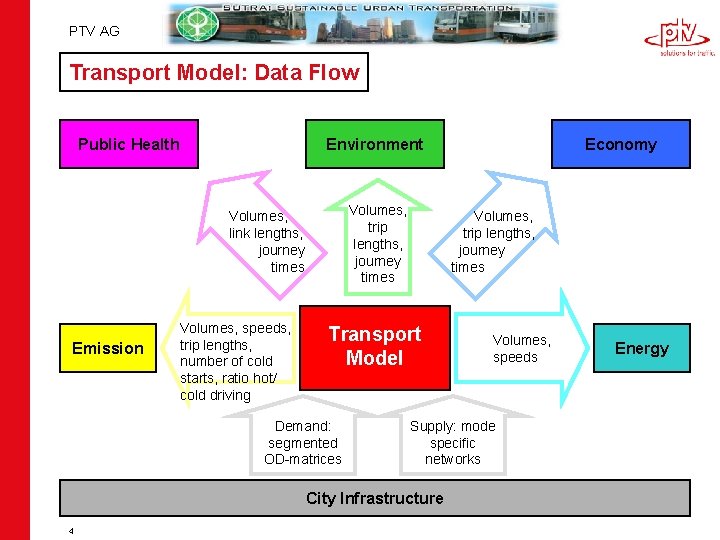
PTV AG Transport Model: Data Flow Environment Public Health Volumes, trip lengths, journey times Volumes, link lengths, journey times Emission Volumes, speeds, trip lengths, number of cold starts, ratio hot/ cold driving Volumes, trip lengths, journey times Transport Model Demand: segmented OD-matrices Volumes, speeds Supply: mode specific networks City Infrastructure 4 Economy Energy
PTV AG Contents of the Presentation w Transport modelling in the context of SUTRA w Modeling Park & Ride w Modeling High-Occupancy Vehicles (HOV) w Modeling Road Pricing w Data Exchange with other Models 6
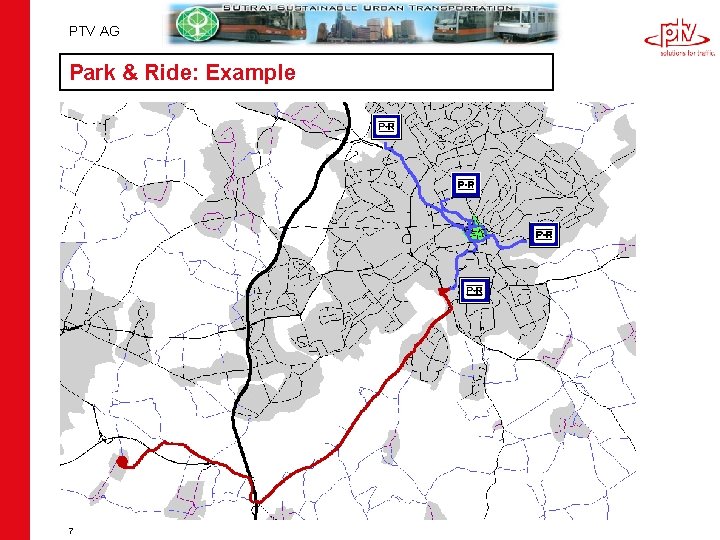
PTV AG Park & Ride: Example 7
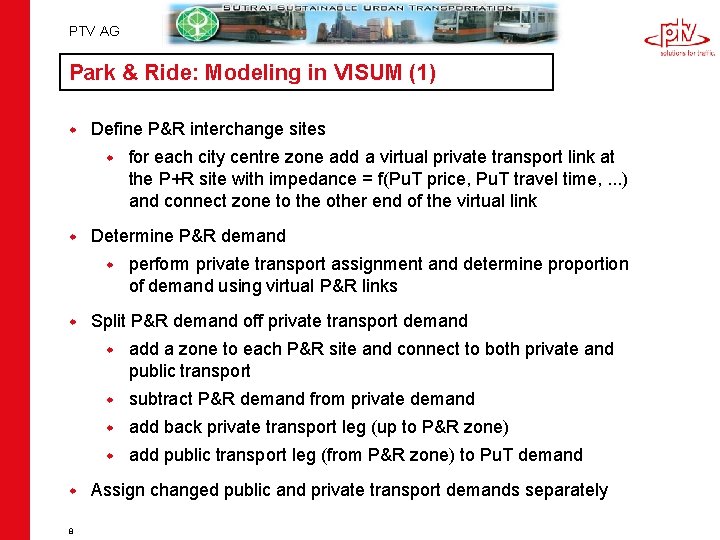
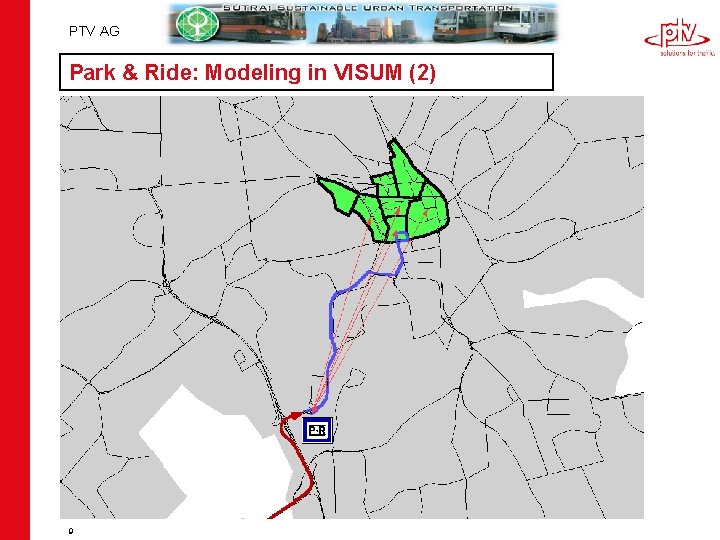
PTV AG Park & Ride: Modeling in VISUM (1) w Define P&R interchange sites w w Determine P&R demand w w w 8 for each city centre zone add a virtual private transport link at the P+R site with impedance = f(Pu. T price, Pu. T travel time, . . . ) and connect zone to the other end of the virtual link perform private transport assignment and determine proportion of demand using virtual P&R links Split P&R demand off private transport demand w add a zone to each P&R site and connect to both private and public transport w subtract P&R demand from private demand w add back private transport leg (up to P&R zone) w add public transport leg (from P&R zone) to Pu. T demand Assign changed public and private transport demands separately
PTV AG Park & Ride: Modeling in VISUM (2) 9
PTV AG Contents of the Presentation w Transport modelling in the context of SUTRA w Modeling Park & Ride w Modeling High-Occupancy Vehicles (HOV) w Modeling Road Pricing w Data Exchange with other Models 10
PTV AG HOV: Example w Focus in SUTRA: car pools w Incentives for participating in a car pool: w 11 w Availability of dedicated HOV lanes w Reserved parking spaces at convenient locations w Exemption from road pricing Typical usage similar to Park & Ride w car pool members start their trips separately, w meet at an agreed place, w share one vehicle for remaining leg
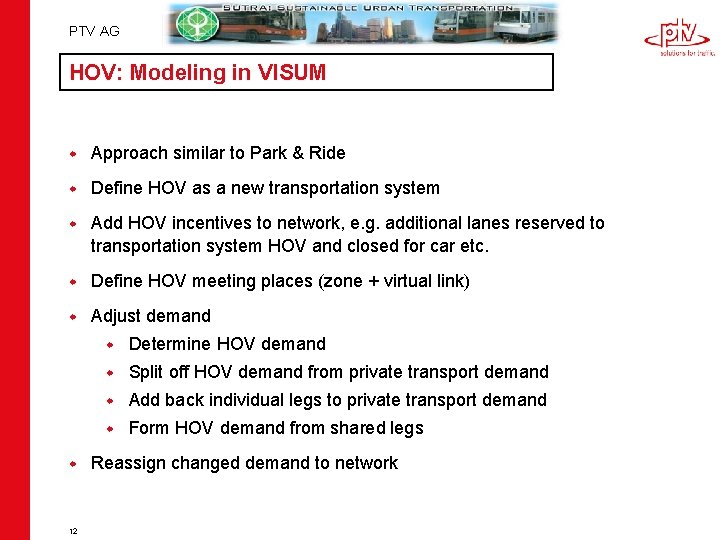
PTV AG HOV: Modeling in VISUM w Approach similar to Park & Ride w Define HOV as a new transportation system w Add HOV incentives to network, e. g. additional lanes reserved to transportation system HOV and closed for car etc. w Define HOV meeting places (zone + virtual link) w Adjust demand w 12 w Determine HOV demand w Split off HOV demand from private transport demand w Add back individual legs to private transport demand w Form HOV demand from shared legs Reassign changed demand to network
PTV AG Contents of the Presentation w Transport modelling in the context of SUTRA w Modeling Park & Ride w Modeling High-Occupancy Vehicles (HOV) w Modeling Road Pricing w Data Exchange with other Models 13
PTV AG Road Pricing • traditional approach: route choice depends on travel time • considering toll: route choice depends on travel time and costs problem: drivers have different sensitivity to costs („value of time“) 14
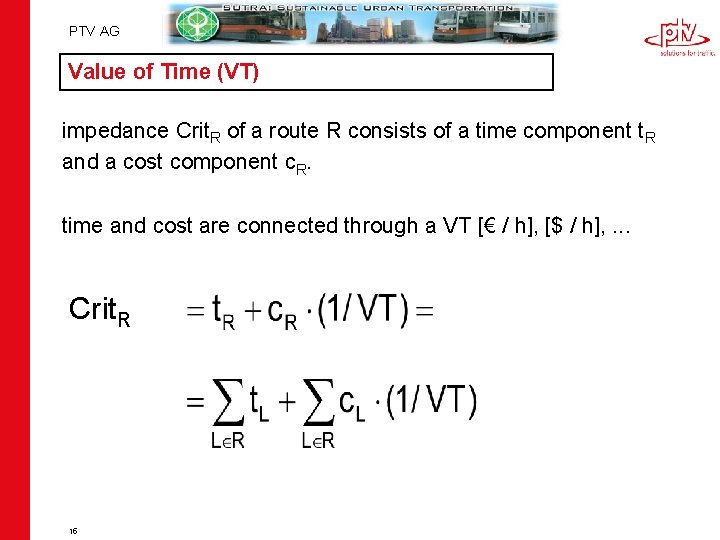
PTV AG Value of Time (VT) impedance Crit. R of a route R consists of a time component t. R and a cost component c. R. time and cost are connected through a VT [€ / h], [$ / h], . . . Crit. R 15
PTV AG Traditional Assignment vs. TRIBUT Crit. R „traditional“ toll assignment constant VT for all users monocriterial 16 TRIBUT randomly distributed VT bicriterial
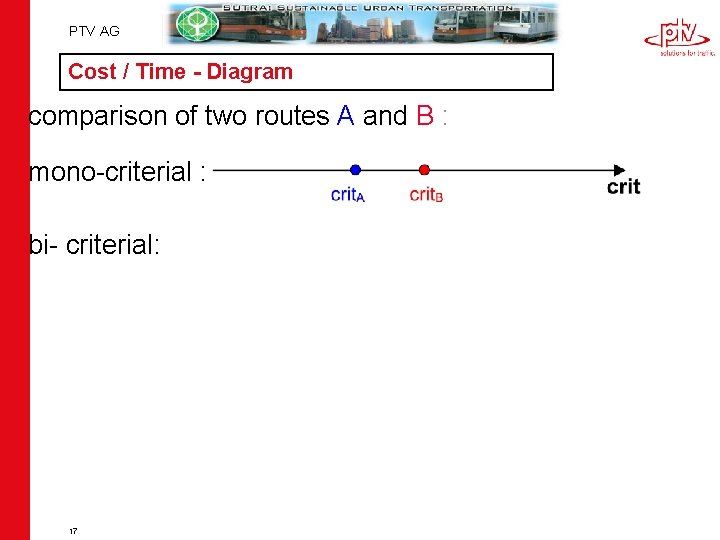
PTV AG Cost / Time - Diagram comparison of two routes A and B : mono-criterial : bi- criterial: 17
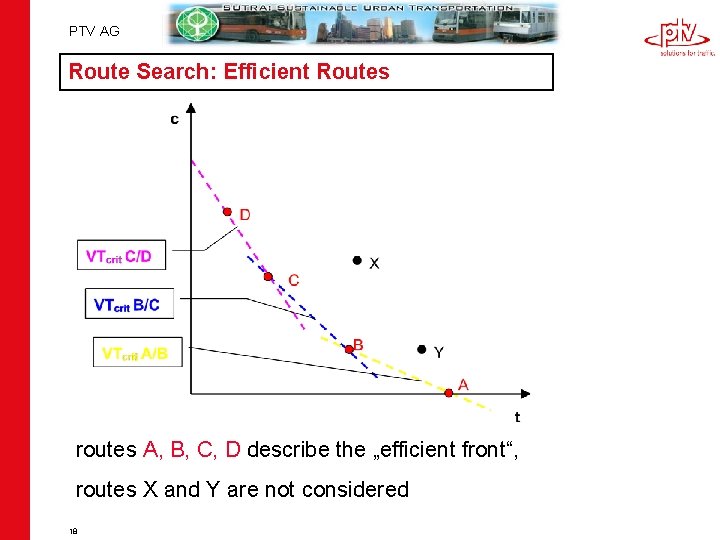
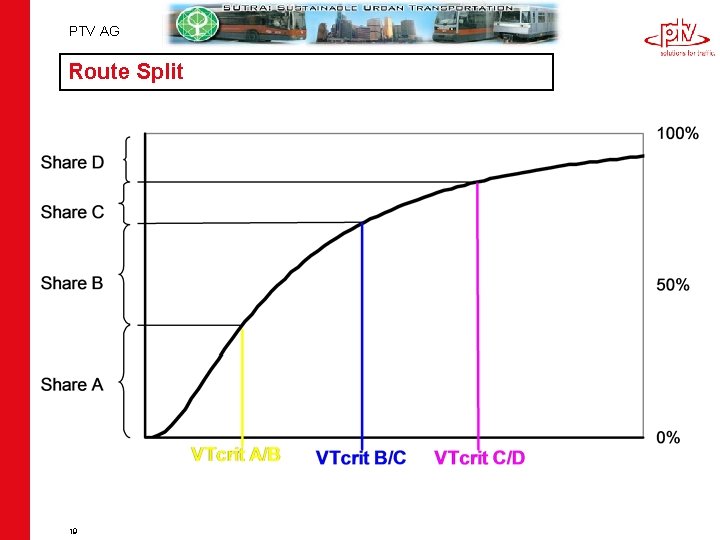
PTV AG Route Search: Efficient Routes routes A, B, C, D describe the „efficient front“, routes X and Y are not considered 18
PTV AG Route Split 19
PTV AG Contents of the Presentation w Transport modelling in the context of SUTRA w Modeling Park & Ride w Modeling High-Occupancy Vehicles (HOV) w Modeling Road Pricing w Data Exchange with other Models 20
PTV AG Data Exchange w w Input data through VISUM GUI or conversion from existing models w Demand w Supply Output to other models w w 21 user configurable tabular reports for w links w nodes w zones w areas can be written to text files or copied & pasted directly into other Windows applications
PTV AG Open problems w VISUM Language Problems with non-Latin script Windows versions w w w 22 bug to be fixed until end of September MUULI (matrix manipulation) English version incomplete w program ready now w English documentation will be complete in ~3 weeks w all city partners will receive program + manual as soon as it is available Remaining „problems“ mainly due to inaccuracies in input data w missing turning relations w incorrect link lengths and/or capacities w unconnected zones