It is the process of allocating memory during

- Slides: 14
[ It is the process of allocating memory during Runtime (Execution Time) ]
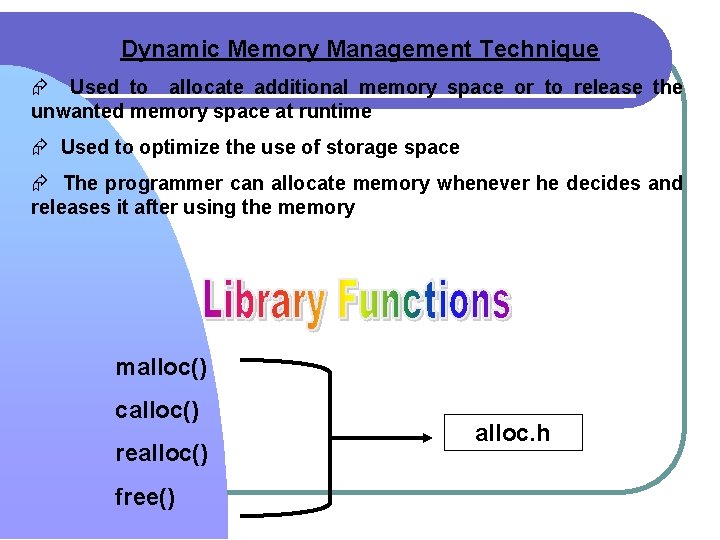
Dynamic Memory Management Technique Æ Used to allocate additional memory space or to release the unwanted memory space at runtime Æ Used to optimize the use of storage space Æ The programmer can allocate memory whenever he decides and releases it after using the memory malloc() calloc() realloc() free() alloc. h
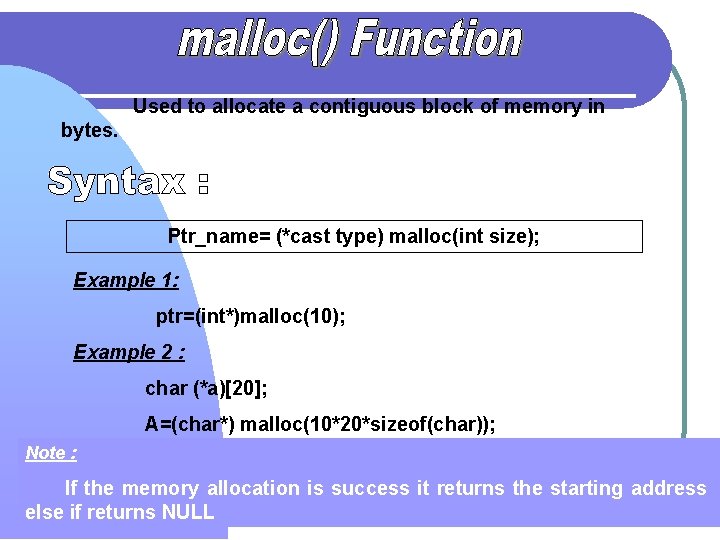
Used to allocate a contiguous block of memory in bytes. Ptr_name= (*cast type) malloc(int size); Example 1: ptr=(int*)malloc(10); Example 2 : char (*a)[20]; A=(char*) malloc(10*20*sizeof(char)); Note : If the memory allocation is success it returns the starting address else if returns NULL
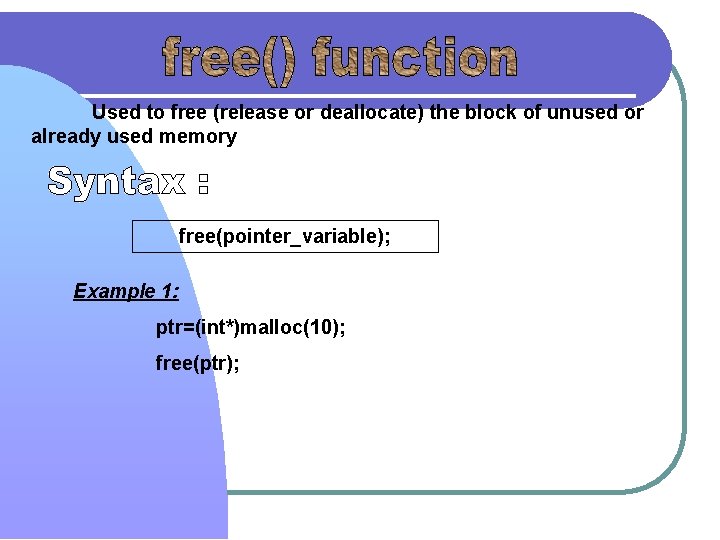
Used to free (release or deallocate) the block of unused or already used memory free(pointer_variable); Example 1: ptr=(int*)malloc(10); free(ptr);
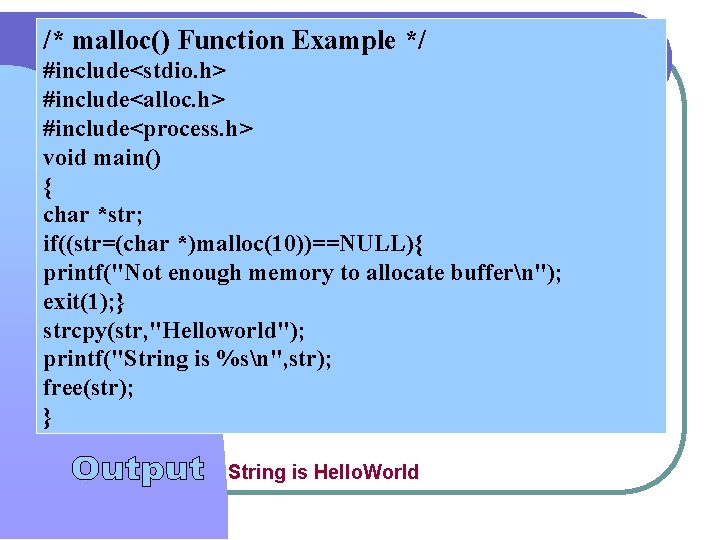
/* malloc() Function Example */ #include<stdio. h> #include<alloc. h> #include<process. h> void main() { char *str; if((str=(char *)malloc(10))==NULL){ printf("Not enough memory to allocate buffern"); exit(1); } strcpy(str, "Helloworld"); printf("String is %sn", str); free(str); } String is Hello. World
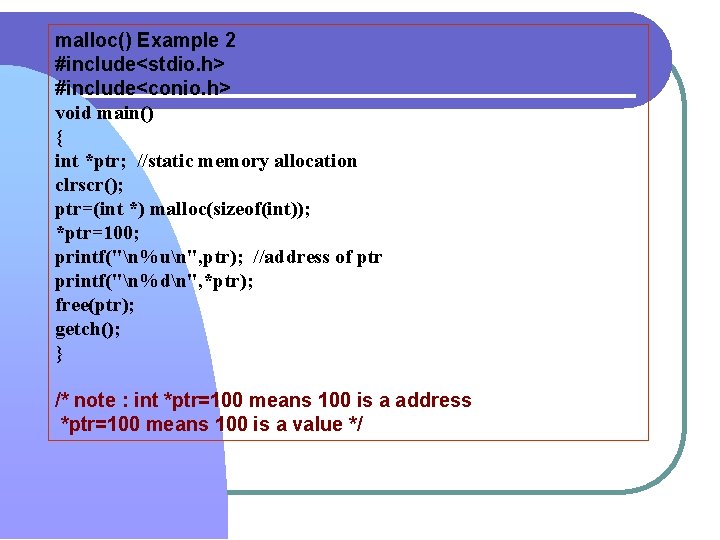
malloc() Example 2 #include<stdio. h> #include<conio. h> void main() { int *ptr; //static memory allocation clrscr(); ptr=(int *) malloc(sizeof(int)); *ptr=100; printf("n%un", ptr); //address of ptr printf("n%dn", *ptr); free(ptr); getch(); } /* note : int *ptr=100 means 100 is a address *ptr=100 means 100 is a value */
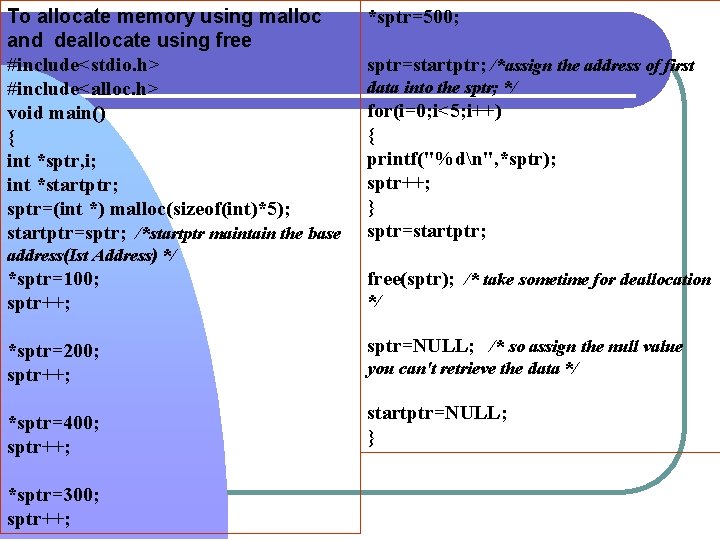
To allocate memory using malloc and deallocate using free #include<stdio. h> #include<alloc. h> void main() { int *sptr, i; int *startptr; sptr=(int *) malloc(sizeof(int)*5); startptr=sptr; /*startptr maintain the base *sptr=500; sptr=startptr; /*assign the address of first data into the sptr; */ for(i=0; i<5; i++) { printf("%dn", *sptr); sptr++; } sptr=startptr; address(Ist Address) */ *sptr=100; sptr++; free(sptr); /* take sometime for deallocation *sptr=200; sptr++; sptr=NULL; /* so assign the null value *sptr=400; sptr++; startptr=NULL; } *sptr=300; sptr++; */ you can't retrieve the data */
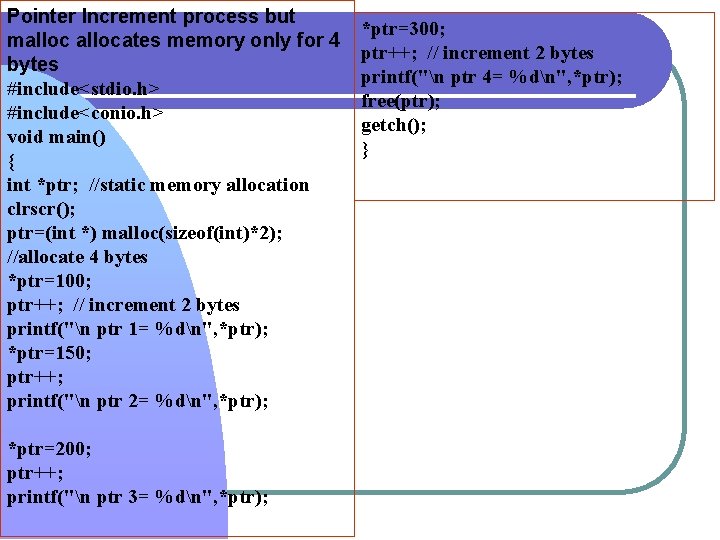
Pointer Increment process but mallocates memory only for 4 bytes #include<stdio. h> #include<conio. h> void main() { int *ptr; //static memory allocation clrscr(); ptr=(int *) malloc(sizeof(int)*2); //allocate 4 bytes *ptr=100; ptr++; // increment 2 bytes printf("n ptr 1= %dn", *ptr); *ptr=150; ptr++; printf("n ptr 2= %dn", *ptr); *ptr=200; ptr++; printf("n ptr 3= %dn", *ptr); *ptr=300; ptr++; // increment 2 bytes printf("n ptr 4= %dn", *ptr); free(ptr); getch(); }
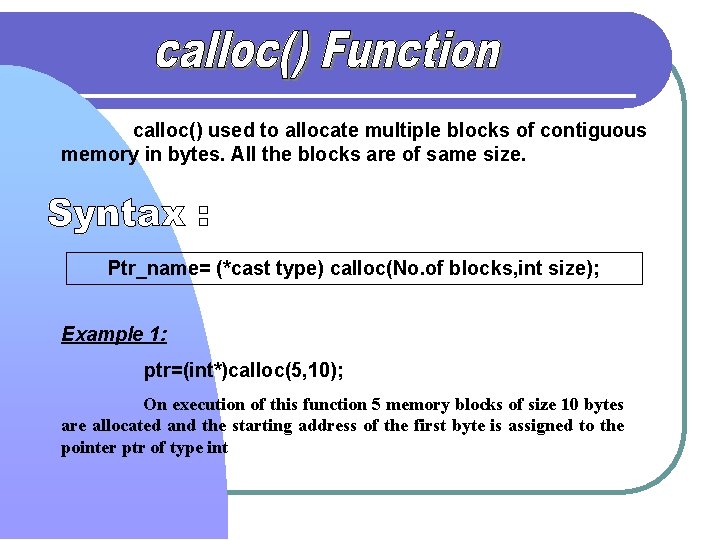
calloc() used to allocate multiple blocks of contiguous memory in bytes. All the blocks are of same size. Ptr_name= (*cast type) calloc(No. of blocks, int size); Example 1: ptr=(int*)calloc(5, 10); On execution of this function 5 memory blocks of size 10 bytes are allocated and the starting address of the first byte is assigned to the pointer ptr of type int
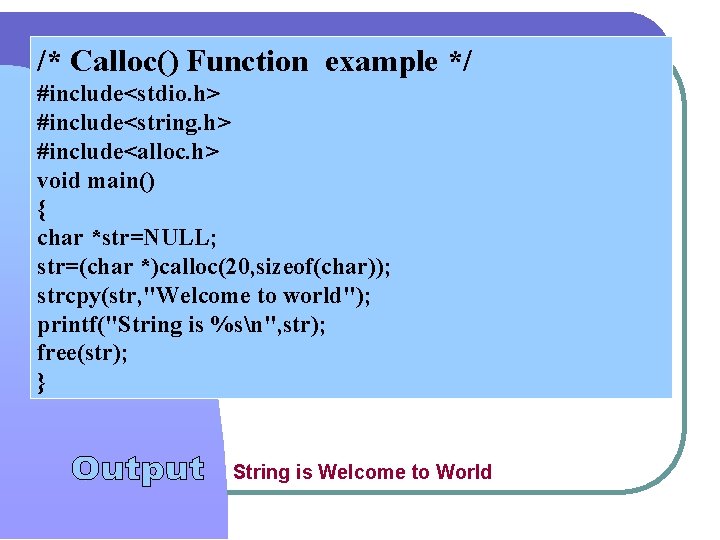
/* Calloc() Function example */ #include<stdio. h> #include<string. h> #include<alloc. h> void main() { char *str=NULL; str=(char *)calloc(20, sizeof(char)); strcpy(str, "Welcome to world"); printf("String is %sn", str); free(str); } String is Welcome to World
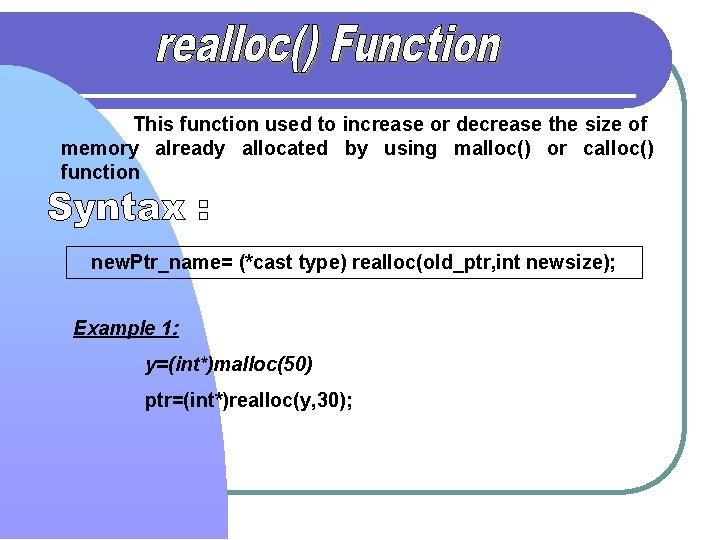
This function used to increase or decrease the size of memory already allocated by using malloc() or calloc() function new. Ptr_name= (*cast type) realloc(old_ptr, int newsize); Example 1: y=(int*)malloc(50) ptr=(int*)realloc(y, 30);
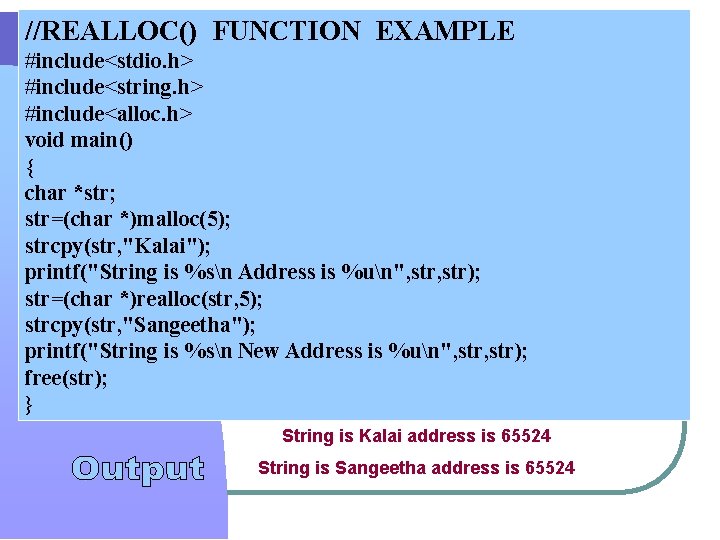
//REALLOC() FUNCTION EXAMPLE #include<stdio. h> #include<string. h> #include<alloc. h> void main() { char *str; str=(char *)malloc(5); strcpy(str, "Kalai"); printf("String is %sn Address is %un", str); str=(char *)realloc(str, 5); strcpy(str, "Sangeetha"); printf("String is %sn New Address is %un", str); free(str); } String is Kalai address is 65524 String is Sangeetha address is 65524
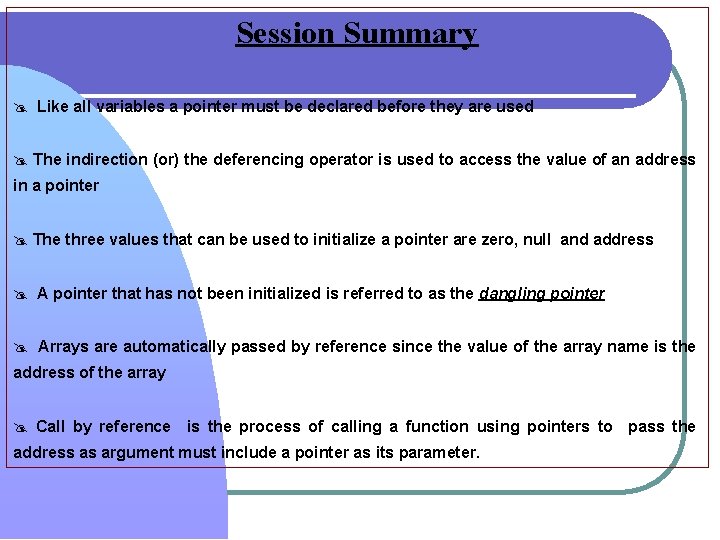
Session Summary @ Like all variables a pointer must be declared before they are used @ The indirection (or) the deferencing operator is used to access the value of an address in a pointer @ The three values that can be used to initialize a pointer are zero, null and address @ A pointer that has not been initialized is referred to as the dangling pointer @ Arrays are automatically passed by reference since the value of the array name is the address of the array @ Call by reference is the process of calling a function using pointers to pass the address as argument must include a pointer as its parameter.
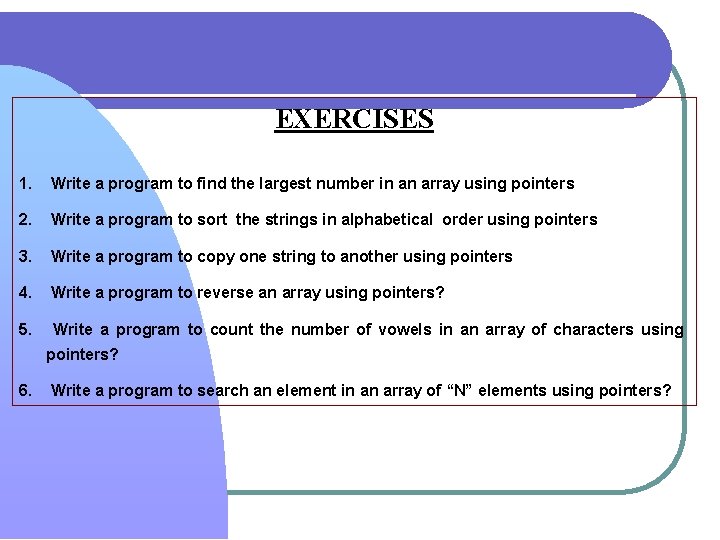
EXERCISES 1. Write a program to find the largest number in an array using pointers 2. Write a program to sort the strings in alphabetical order using pointers 3. Write a program to copy one string to another using pointers 4. Write a program to reverse an array using pointers? 5. Write a program to count the number of vowels in an array of characters using pointers? 6. Write a program to search an element in an array of “N” elements using pointers?