IS 2150 TEL 2810 Introduction to Security James
- Slides: 28
IS 2150 / TEL 2810 Introduction to Security James Joshi Associate Professor, SIS Lecture 12. 2 Nov 20, 2012 Integer Issues 1
Integer Security l l Integers represent a growing and underestimated source of vulnerabilities in C and C++ programs. Integer range checking has not been systematically applied in the development of most C and C++ software. security flaws involving integers exist l a portion of these are likely to be vulnerabilities l l A software vulnerability may result when a program evaluates an integer to an unexpected value.
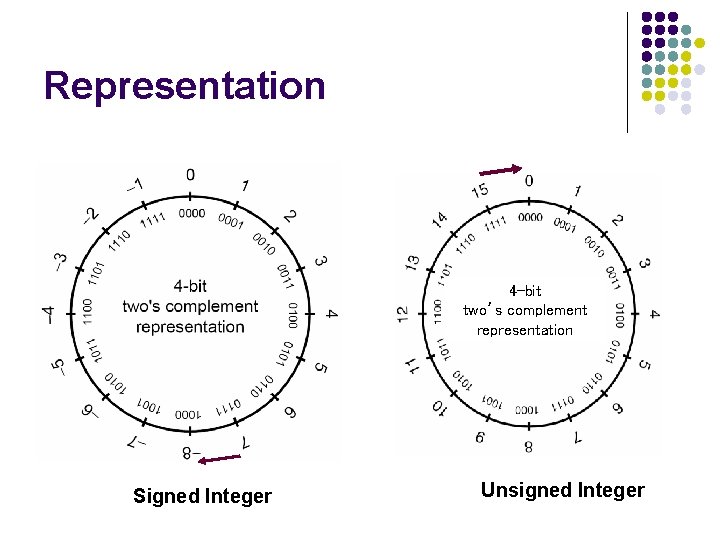
Representation 4 -bit two’s complement representation Signed Integer Unsigned Integer
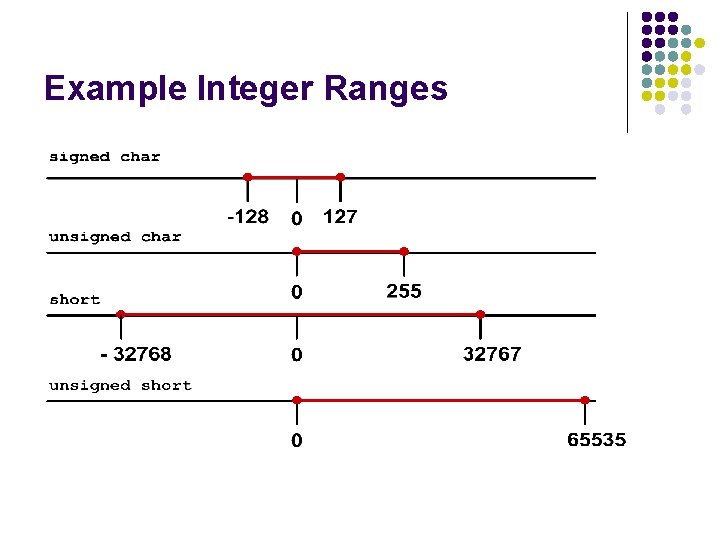
Example Integer Ranges
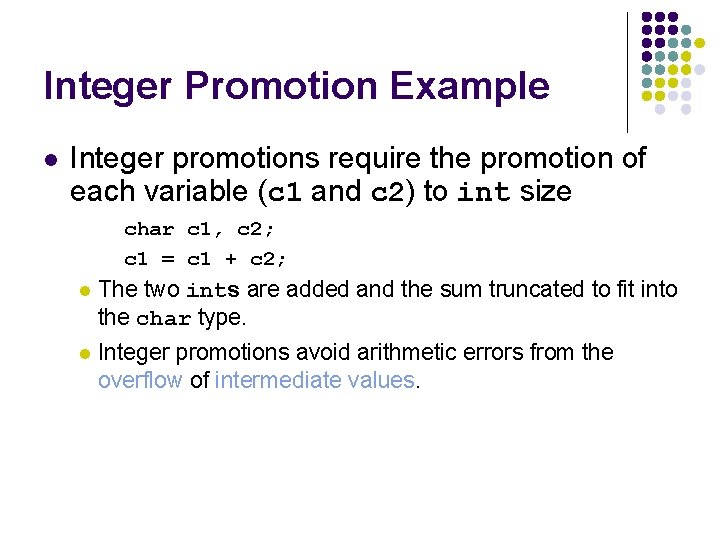
Integer Promotion Example l Integer promotions require the promotion of each variable (c 1 and c 2) to int size char c 1, c 2; c 1 = c 1 + c 2; l The two ints are added and the sum truncated to fit into the char type. l Integer promotions avoid arithmetic errors from the overflow of intermediate values.
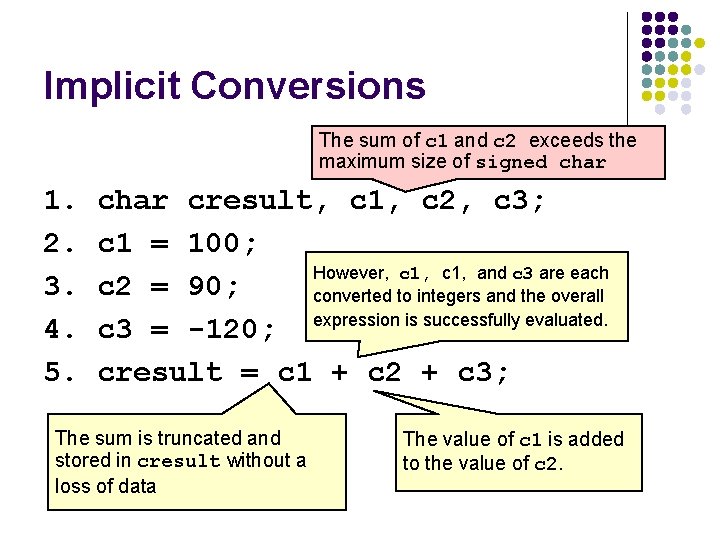
Implicit Conversions The sum of c 1 and c 2 exceeds the maximum size of signed char 1. char cresult, c 1, c 2, c 3; 2. c 1 = 100; However, c 1, and c 3 are each 3. c 2 = 90; converted to integers and the overall 4. c 3 = -120; expression is successfully evaluated. 5. cresult = c 1 + c 2 + c 3; The sum is truncated and stored in cresult without a loss of data The value of c 1 is added to the value of c 2.
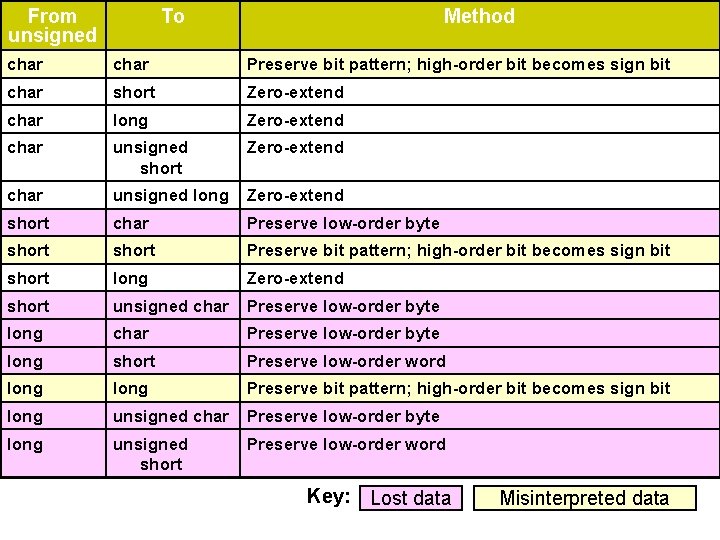
From unsigned To Method char Preserve bit pattern; high-order bit becomes sign bit char short Zero-extend char long Zero-extend char unsigned short Zero-extend char unsigned long Zero-extend short char Preserve low-order byte short Preserve bit pattern; high-order bit becomes sign bit short long Zero-extend short unsigned char Preserve low-order byte long short Preserve low-order word long Preserve bit pattern; high-order bit becomes sign bit long unsigned char Preserve low-order byte long unsigned short Preserve low-order word Key: Lost data Misinterpreted data
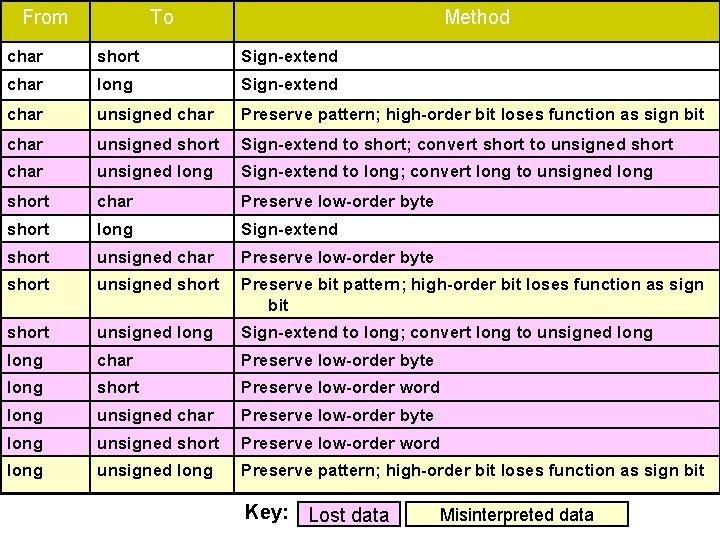
From To Method char short Sign-extend char long Sign-extend char unsigned char Preserve pattern; high-order bit loses function as sign bit char unsigned short Sign-extend to short; convert short to unsigned short char unsigned long Sign-extend to long; convert long to unsigned long short char Preserve low-order byte short long Sign-extend short unsigned char Preserve low-order byte short unsigned short Preserve bit pattern; high-order bit loses function as sign bit short unsigned long Sign-extend to long; convert long to unsigned long char Preserve low-order byte long short Preserve low-order word long unsigned char Preserve low-order byte long unsigned short Preserve low-order word long unsigned long Preserve pattern; high-order bit loses function as sign bit Key: Lost data Misinterpreted data
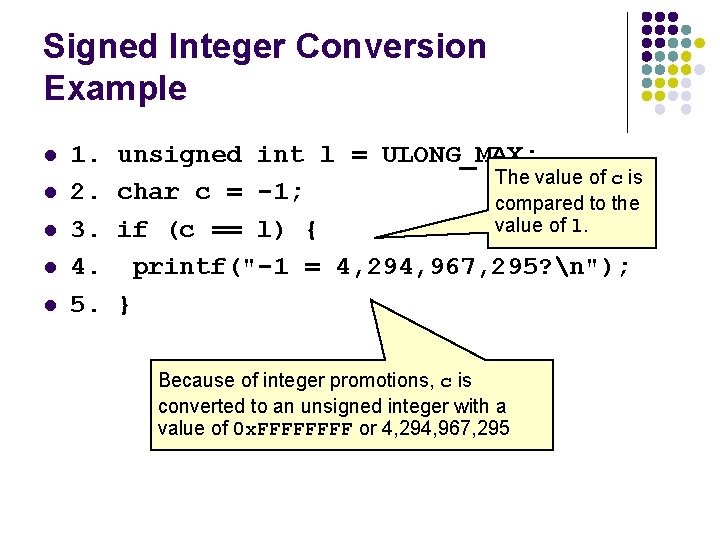
Signed Integer Conversion Example l l l 1. unsigned int l = ULONG_MAX; The value of c is 2. char c = -1; compared to the value of l. 3. if (c == l) { 4. printf("-1 = 4, 294, 967, 295? n"); 5. } Because of integer promotions, c is converted to an unsigned integer with a value of 0 x. FFFF or 4, 294, 967, 295
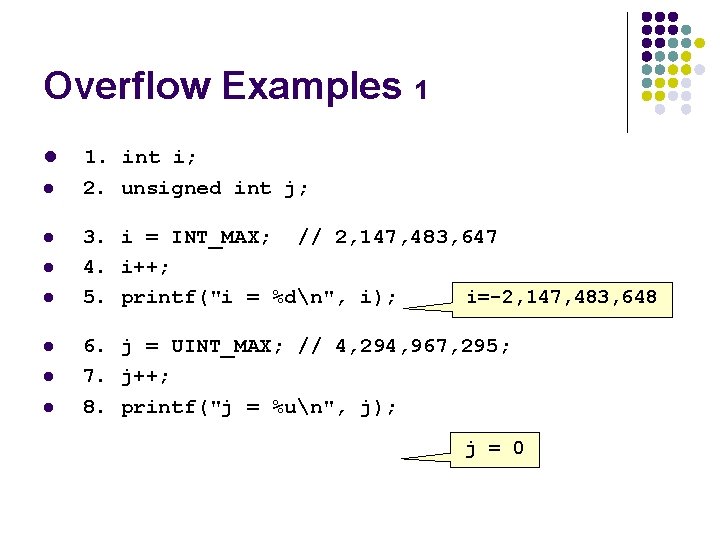
Overflow Examples 1 l l l l 1. int i; 2. unsigned int j; 3. i = INT_MAX; // 2, 147, 483, 647 4. i++; 5. printf("i = %dn", i); i=-2, 147, 483, 648 6. j = UINT_MAX; // 4, 294, 967, 295; 7. j++; 8. printf("j = %un", j); j = 0
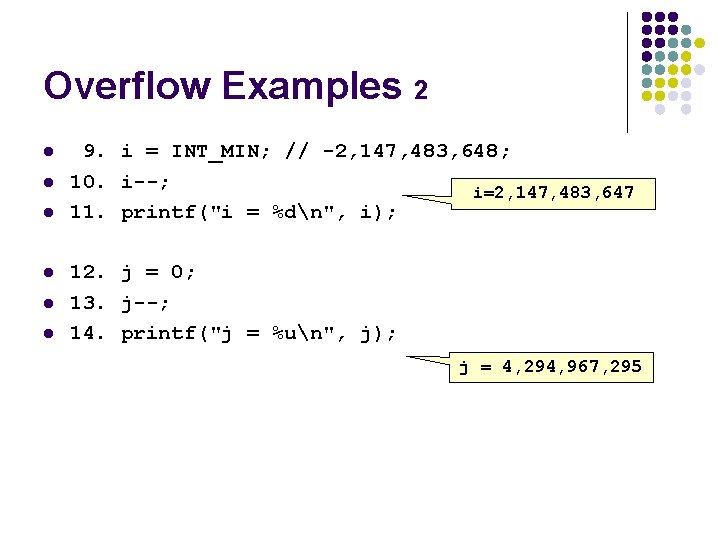
Overflow Examples 2 l l l 9. i = INT_MIN; // -2, 147, 483, 648; 10. i--; i=2, 147, 483, 647 11. printf("i = %dn", i); 12. j = 0; 13. j--; 14. printf("j = %un", j); j = 4, 294, 967, 295
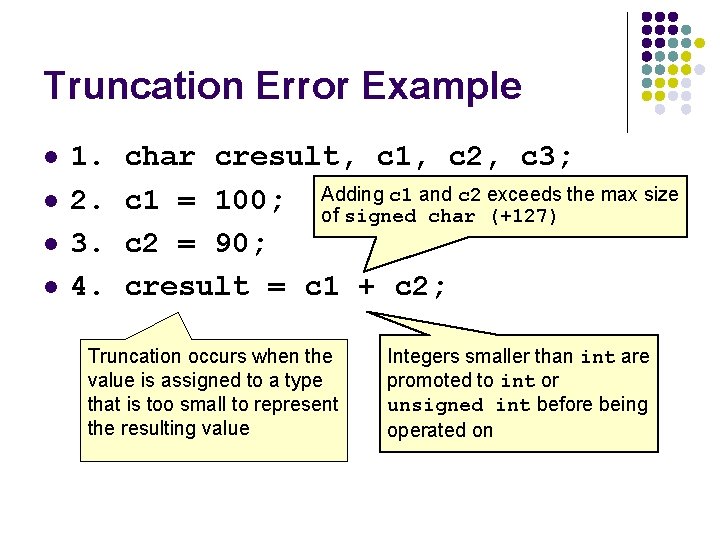
Truncation Error Example l l 1. char cresult, c 1, c 2, c 3; c 1 and c 2 exceeds the max size 2. c 1 = 100; Adding of signed char (+127) 3. c 2 = 90; 4. cresult = c 1 + c 2; Truncation occurs when the value is assigned to a type that is too small to represent the resulting value Integers smaller than int are promoted to int or unsigned int before being operated on
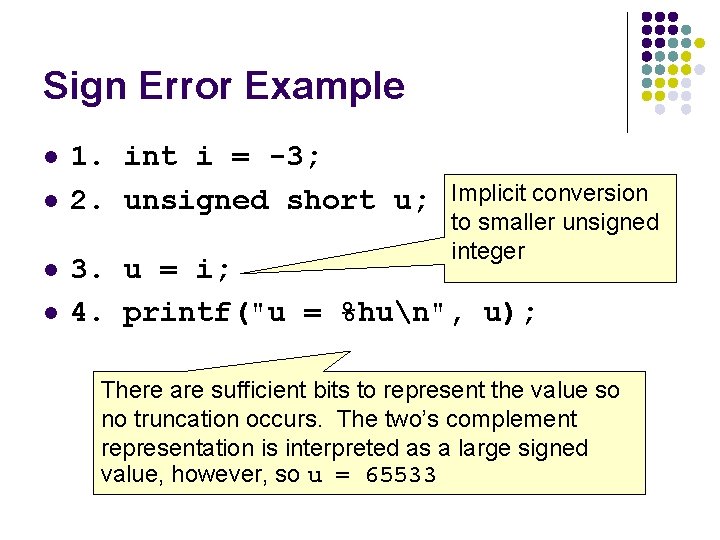
Sign Error Example l l 1. int i = -3; 2. unsigned short u; Implicit conversion to smaller unsigned integer 3. u = i; 4. printf("u = %hun", u); There are sufficient bits to represent the value so no truncation occurs. The two’s complement representation is interpreted as a large signed value, however, so u = 65533
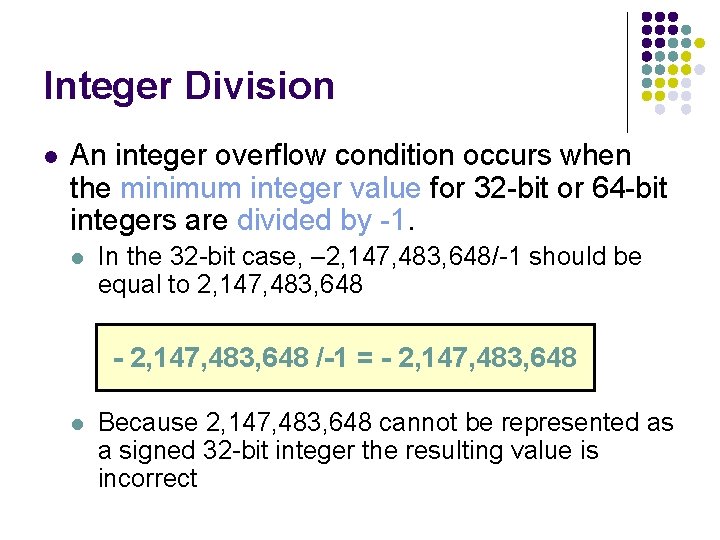
Integer Division l An integer overflow condition occurs when the minimum integer value for 32 -bit or 64 -bit integers are divided by -1. l In the 32 -bit case, – 2, 147, 483, 648/-1 should be equal to 2, 147, 483, 648 - 2, 147, 483, 648 /-1 = - 2, 147, 483, 648 l Because 2, 147, 483, 648 cannot be represented as a signed 32 -bit integer the resulting value is incorrect
Vulnerabilities Section Agenda l l Integer overflow Sign error Truncation Non-exceptional
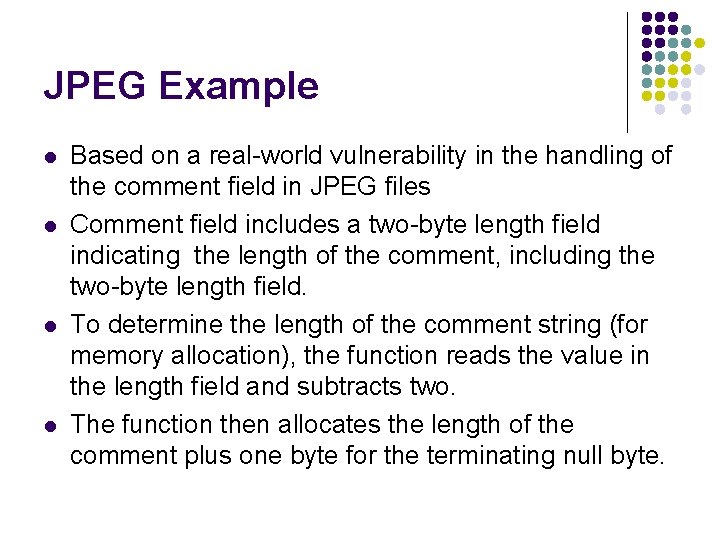
JPEG Example l l Based on a real-world vulnerability in the handling of the comment field in JPEG files Comment field includes a two-byte length field indicating the length of the comment, including the two-byte length field. To determine the length of the comment string (for memory allocation), the function reads the value in the length field and subtracts two. The function then allocates the length of the comment plus one byte for the terminating null byte.
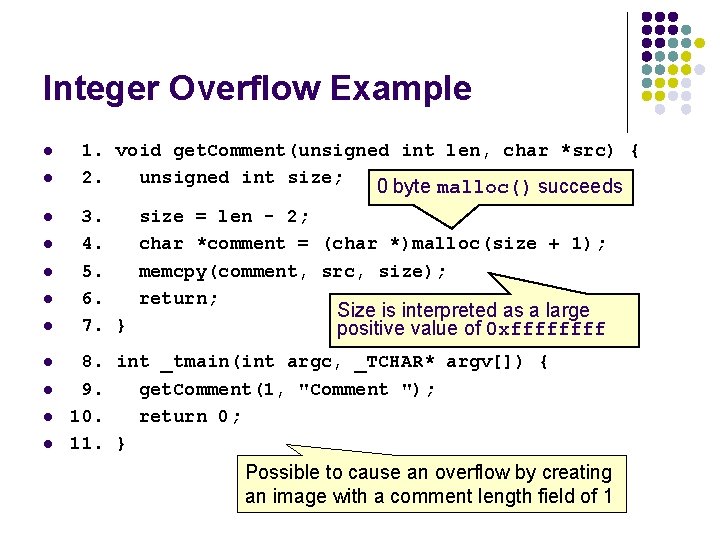
Integer Overflow Example l l l 1. void get. Comment(unsigned int len, char *src) { 2. unsigned int size; 0 byte malloc() succeeds 3. size = len - 2; 4. char *comment = (char *)malloc(size + 1); 5. memcpy(comment, src, size); 6. return; Size is interpreted as a large 7. } positive value of 0 xffff 8. int _tmain(int argc, _TCHAR* argv[]) { 9. get. Comment(1, "Comment "); 10. return 0; 11. } Possible to cause an overflow by creating an image with a comment length field of 1
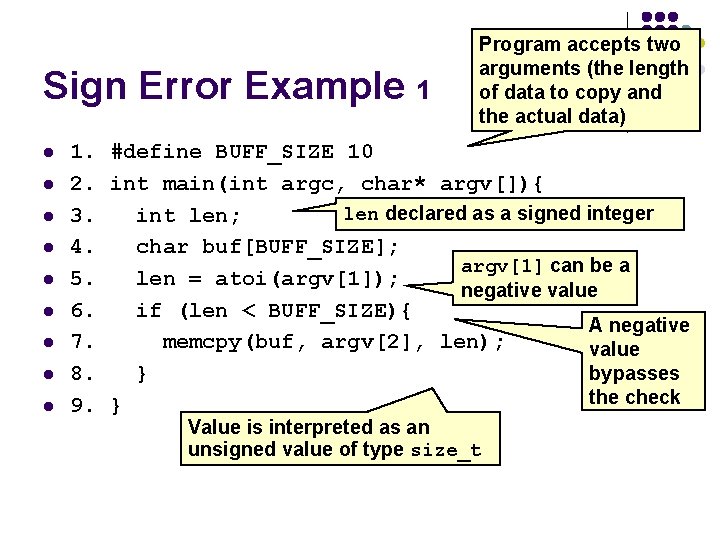
Sign Error Example 1 l l l l l Program accepts two arguments (the length of data to copy and the actual data) 1. #define BUFF_SIZE 10 2. int main(int argc, char* argv[]){ len declared as a signed integer 3. int len; 4. char buf[BUFF_SIZE]; argv[1] can be a 5. len = atoi(argv[1]); negative value 6. if (len < BUFF_SIZE){ A negative 7. memcpy(buf, argv[2], len); value 8. } bypasses the check 9. } Value is interpreted as an unsigned value of type size_t
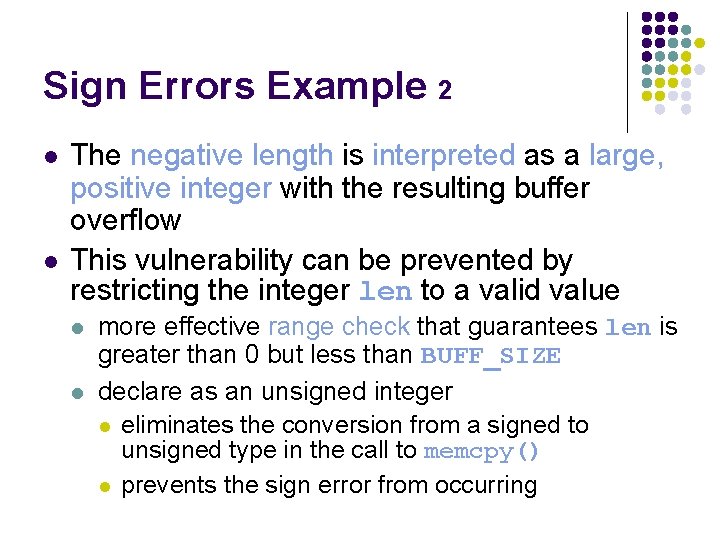
Sign Errors Example 2 l l The negative length is interpreted as a large, positive integer with the resulting buffer overflow This vulnerability can be prevented by restricting the integer len to a valid value l l more effective range check that guarantees len is greater than 0 but less than BUFF_SIZE declare as an unsigned integer l eliminates the conversion from a signed to unsigned type in the call to memcpy() l prevents the sign error from occurring
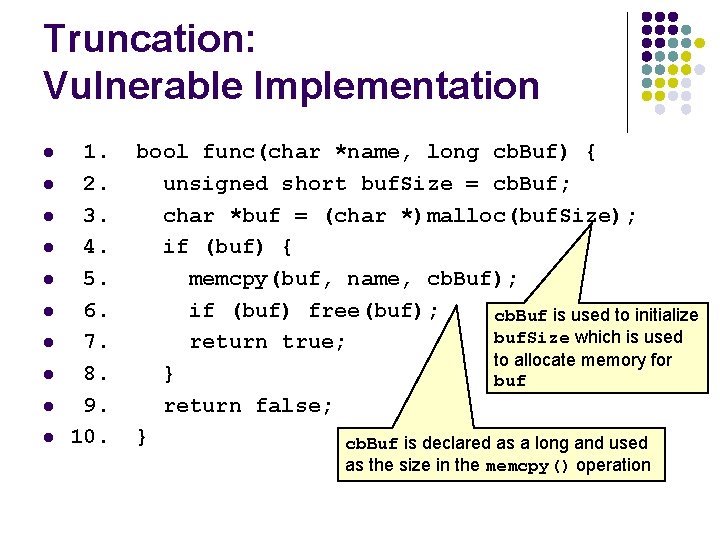
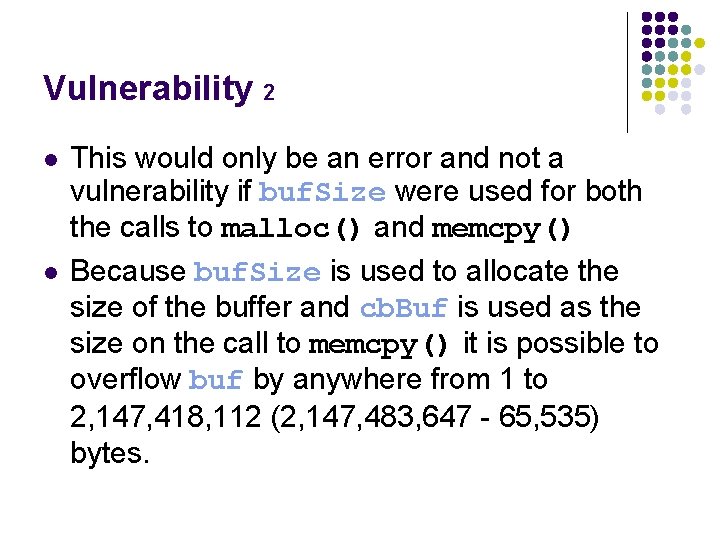
Truncation: Vulnerable Implementation l l l l l 1. bool func(char *name, long cb. Buf) { 2. unsigned short buf. Size = cb. Buf; 3. char *buf = (char *)malloc(buf. Size); 4. if (buf) { 5. memcpy(buf, name, cb. Buf); 6. if (buf) free(buf); cb. Buf is used to initialize buf. Size which is used 7. return true; to allocate memory for 8. } buf 9. return false; 10. } cb. Buf is declared as a long and used as the size in the memcpy() operation
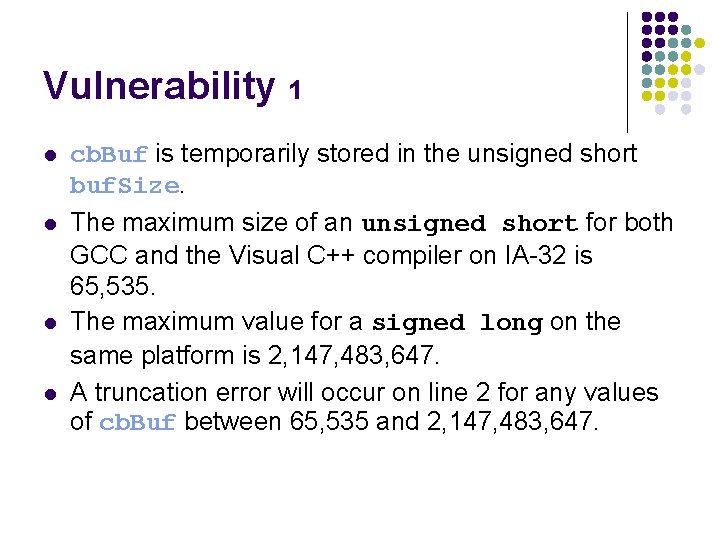
Vulnerability 1 l l cb. Buf is temporarily stored in the unsigned short buf. Size. The maximum size of an unsigned short for both GCC and the Visual C++ compiler on IA-32 is 65, 535. The maximum value for a signed long on the same platform is 2, 147, 483, 647. A truncation error will occur on line 2 for any values of cb. Buf between 65, 535 and 2, 147, 483, 647.
Vulnerability 2 l l This would only be an error and not a vulnerability if buf. Size were used for both the calls to malloc() and memcpy() Because buf. Size is used to allocate the size of the buffer and cb. Buf is used as the size on the call to memcpy() it is possible to overflow buf by anywhere from 1 to 2, 147, 418, 112 (2, 147, 483, 647 - 65, 535) bytes.
Mitigation l l l Type range checking Strong typing Compiler checks Safe integer operations Testing and reviews
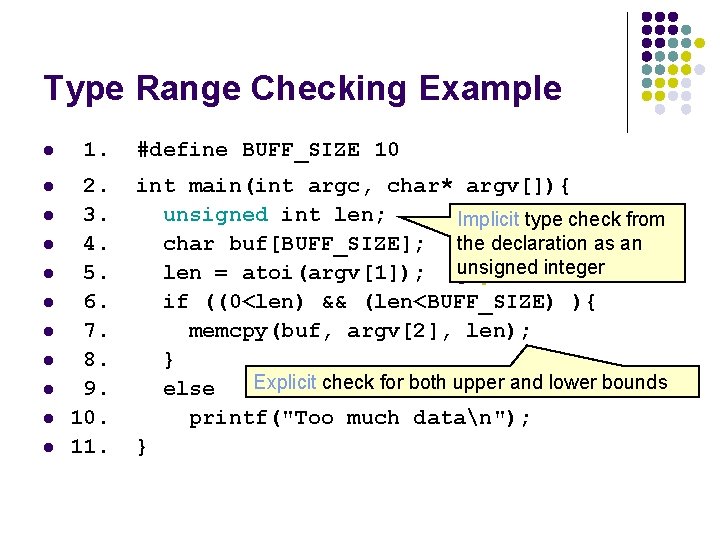
Type Range Checking Example l 1. #define BUFF_SIZE 10 l 2. int main(int argc, char* argv[]){ 3. unsigned int len; Implicit type check from 4. char buf[BUFF_SIZE]; the declaration as an integer 5. len = atoi(argv[1]); lunsigned. 6. if ((0<len) && (len<BUFF_SIZE) ){ 7. memcpy(buf, argv[2], len); 8. } Explicit check for both upper and lower bounds 9. else 10. printf("Too much datan"); 11. } l l l l l
Strong Typing l l One way to provide better type checking is to provide better types. Using an unsigned type can guarantee that a variable does not contain a negative value. This solution does not prevent overflow. Strong typing should be used so that the compiler can be more effective in identifying range problems.
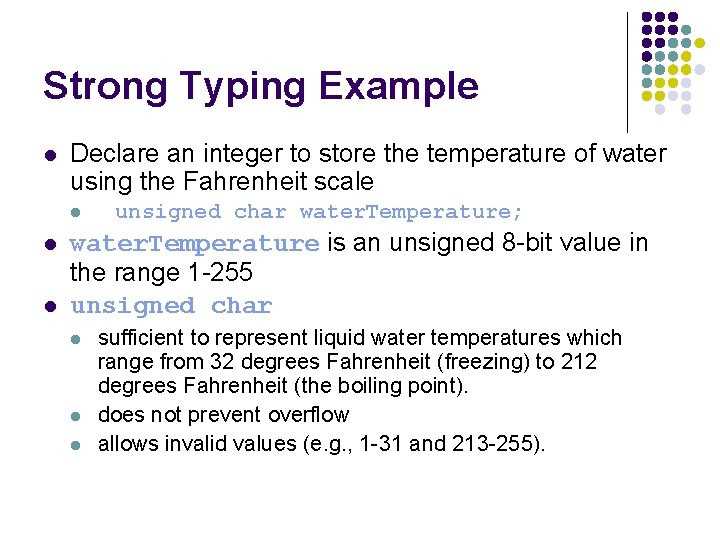
Strong Typing Example l Declare an integer to store the temperature of water using the Fahrenheit scale l l l unsigned char water. Temperature; water. Temperature is an unsigned 8 -bit value in the range 1 -255 unsigned char l l l sufficient to represent liquid water temperatures which range from 32 degrees Fahrenheit (freezing) to 212 degrees Fahrenheit (the boiling point). does not prevent overflow allows invalid values (e. g. , 1 -31 and 213 -255).
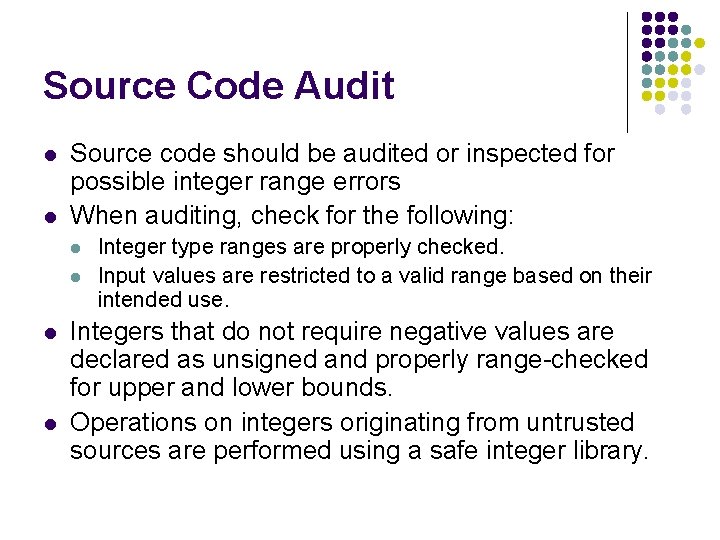
Source Code Audit l l Source code should be audited or inspected for possible integer range errors When auditing, check for the following: l l Integer type ranges are properly checked. Input values are restricted to a valid range based on their intended use. Integers that do not require negative values are declared as unsigned and properly range-checked for upper and lower bounds. Operations on integers originating from untrusted sources are performed using a safe integer library.
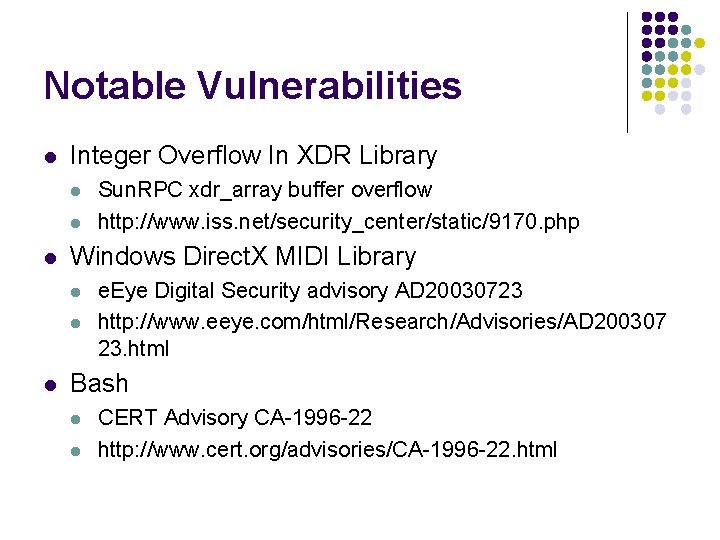
Notable Vulnerabilities l Integer Overflow In XDR Library l l l Windows Direct. X MIDI Library l l l Sun. RPC xdr_array buffer overflow http: //www. iss. net/security_center/static/9170. php e. Eye Digital Security advisory AD 20030723 http: //www. eeye. com/html/Research/Advisories/AD 200307 23. html Bash l l CERT Advisory CA-1996 -22 http: //www. cert. org/advisories/CA-1996 -22. html