Introduction to NonProfit Organizations Judith G H Edington
- Slides: 17
Introduction to Non-Profit Organizations Judith G. H. Edington Russell J. Stein Boston Bar Association Tax-Exempt Fundamentals October 9, 2012
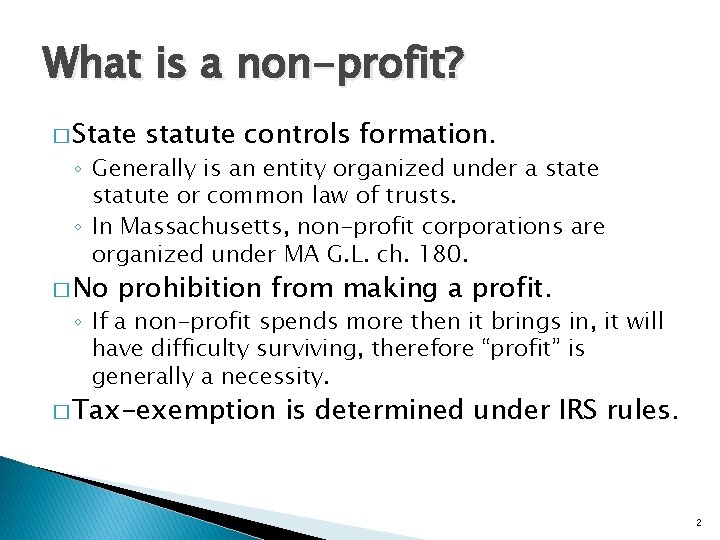
What is a non-profit? � State statute controls formation. ◦ Generally is an entity organized under a state statute or common law of trusts. ◦ In Massachusetts, non-profit corporations are organized under MA G. L. ch. 180. � No prohibition from making a profit. ◦ If a non-profit spends more then it brings in, it will have difficulty surviving, therefore “profit” is generally a necessity. � Tax-exemption is determined under IRS rules. 2
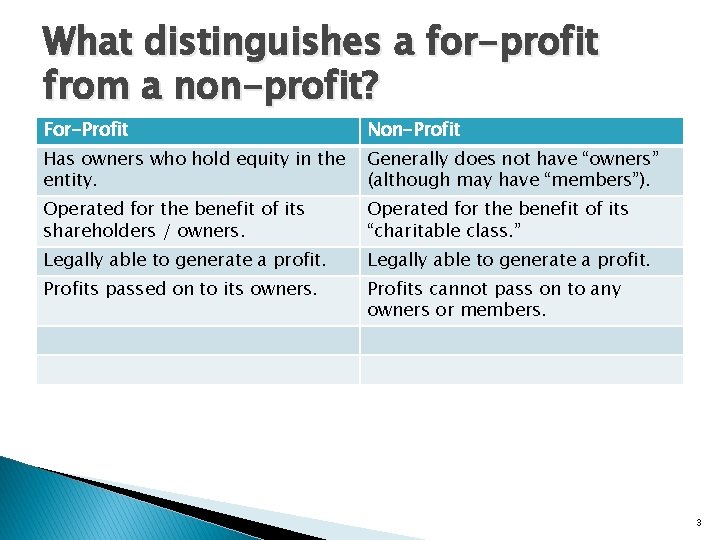
What distinguishes a for-profit from a non-profit? For-Profit Non-Profit Has owners who hold equity in the entity. Generally does not have “owners” (although may have “members”). Operated for the benefit of its shareholders / owners. Operated for the benefit of its “charitable class. ” Legally able to generate a profit. Profits passed on to its owners. Profits cannot pass on to any owners or members. 3
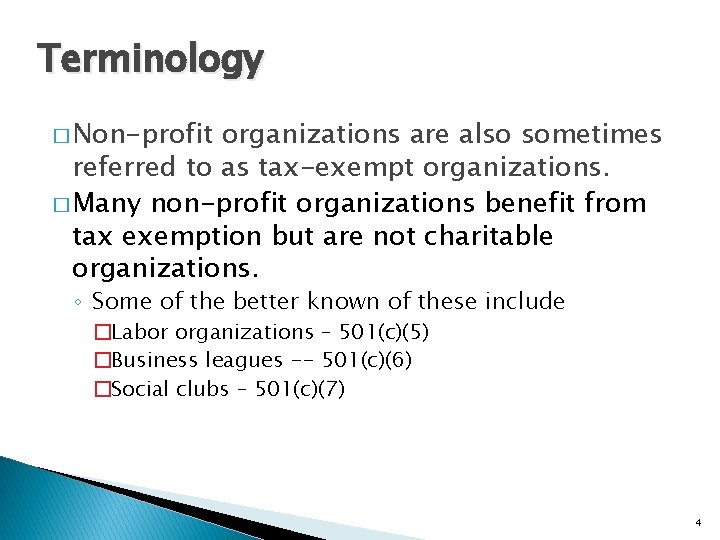
Terminology � Non-profit organizations are also sometimes referred to as tax-exempt organizations. � Many non-profit organizations benefit from tax exemption but are not charitable organizations. ◦ Some of the better known of these include �Labor organizations – 501(c)(5) �Business leagues -- 501(c)(6) �Social clubs – 501(c)(7) 4
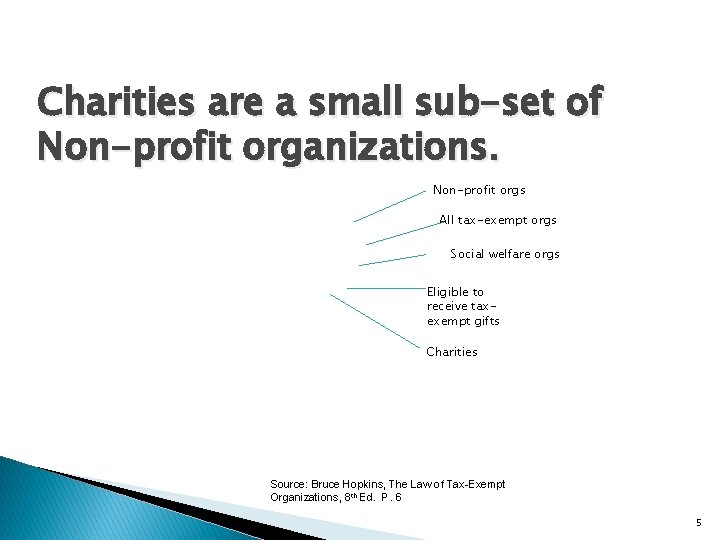
Charities are a small sub-set of Non-profit organizations. Non-profit orgs All tax-exempt orgs Social welfare orgs Eligible to receive taxexempt gifts Charities Source: Bruce Hopkins, The Law of Tax-Exempt Organizations, 8 th Ed. P. 6 5
Charitable Organizations = 501(c)(3) �A 501(c)(3) organization is one that is organized and operated for one or more of the following exempt purposes: ◦ ◦ ◦ ◦ Religious Charitable Scientific Testing for public safety Literary Educational Prevention of cruelty to children or animals 6
Private Foundation v. Public Charity ◦ Both are 501(c)(3) charitable organizations. ◦ Private foundation is the default 501(c)(3) classification. ◦ An organization has to “earn” public charity status. �broad public financial support -- e. g. American Red Cross, United Way, Boston Symphony Orchestra �status based – e. g. school, hospital, church ◦ Why does it matter? �public charities enjoy more favorable rules with respect to the charitable income tax deduction �private foundations are subject to a strict code of behavior not applicable to public charities 7
Charitable Entity Tests � Primary Purpose Test ◦ Organization must be organized and operated exclusively for an exempt purpose. �“Exclusively” has been interpreted as “primarily. ” � Organizational Test ◦ Organization’s formation documents must set out charitable purpose. ◦ Assets must be dedicated to an exempt purpose. Upon dissolution, assets must be distributed in furtherance of exempt purpose. � Operational Test ◦ Must engage primarily in activities that accomplish one or more of its exempt purposes. ◦ Will not meet the test if more than an insubstantial part of its activities is not in furtherance of an exempt purposes. 8
Public v. Private Benefit � Charitable assets must be used for the benefit of the public and not for any particular private use. ◦ No “private inurement. ” No income or asset may unduly benefit a person that is closely related to the organization. ◦ Only incidental “private benefit” is permitted. A private benefit is a non-incidental benefit accruing to an outside party. 9
Charitable Class �A charitable class is a group of individuals that may properly receive assistance from a charitable organization. � A charitable class must be either large enough that the potential beneficiaries cannot be individually identified, or sufficiently indefinite that the community as a whole, rather than a pre -selected group of people, benefits when a charity provides assistance. � The concept of charitable class is another way of unpacking the public versus private benefit concept. 10
Additional restrictions on charitable organizations � In addition to the prohibition against private inurement and private benefit, charities may not ◦ Devote more than an insubstantial part of its activities to lobbying. ◦ Participate in elections. 11
Tax deductible contributions � Tax law encourages financial support of 501(c)(3) charitable organizations because of their public rather than private focus. � Contributions are deductible for income tax purposes only if made to domestic charitable organizations. � Charitable deductions are itemized deductions on an individual’s tax return. ◦ Subject to income limitations: � 50% / 30% / 20% limitations � Contributions must be properly substantiated. 12
Other Public Charity Types � Supporting Organizations ◦ SOs obtain public charity status by virtue of their close relationship with another public charity. � Donor advised funds ◦ An account held at a public charity over which the donor retains advisory privileges with respect to charitable grants from the fund. � “Friends of” organizations ◦ When properly structured, enable tax deductible contributions to support the work of foreign charities. 13
Fiscal Sponsorship � Incubation � Bridge (until 501(c)(3) status obtained) � Ongoing sponsorship of charitable program ◦ A charitable activity may not require a new charitable organization with all of the ongoing legal and financial compliance responsibilities that come with a separate legal entity. ◦ Consider partnering with an existing organization with similar charitable goals. 14
Trend: Overlapping of for-profit and non-profit activities and goals � Hybrid Organizations ◦ L 3 Cs ◦ Benefit corporations �B �G. L. ch. 156 E Corps (a branding tool) 15
On-line Resources � The IRS: www. irs. gov/charities-&-non-profits � Massachusetts office of the Attorney General Charities Division: http: //www. mass. gov/ago/doing-business-inmassachusetts/public-charities-or-not-forprofits/ � Nonprofit law blog: www. nonprofitlawblog. com � Nonprofit law prof blog: http: //lawprofessors. typepad. com/nonprofit/ � ABA Tax-exempt listserve � Guidestar: www. guidestar. org 16
Schedule of Tax-Exempt Fundamentals brown-bags � November 13 ◦ Formation of a charitable organizations � January 8, 2013 ◦ Governance and fiduciary duties � February 12, 2013 ◦ Taxes for the tax-exempts � March 12, 2013 ◦ Dissolution of a non-profit organization � Year 2: Oct 2013 – March 2014 ◦ Focus will be on private foundations 17