
The Missing Link Nonprofit Bike Shops and Improved
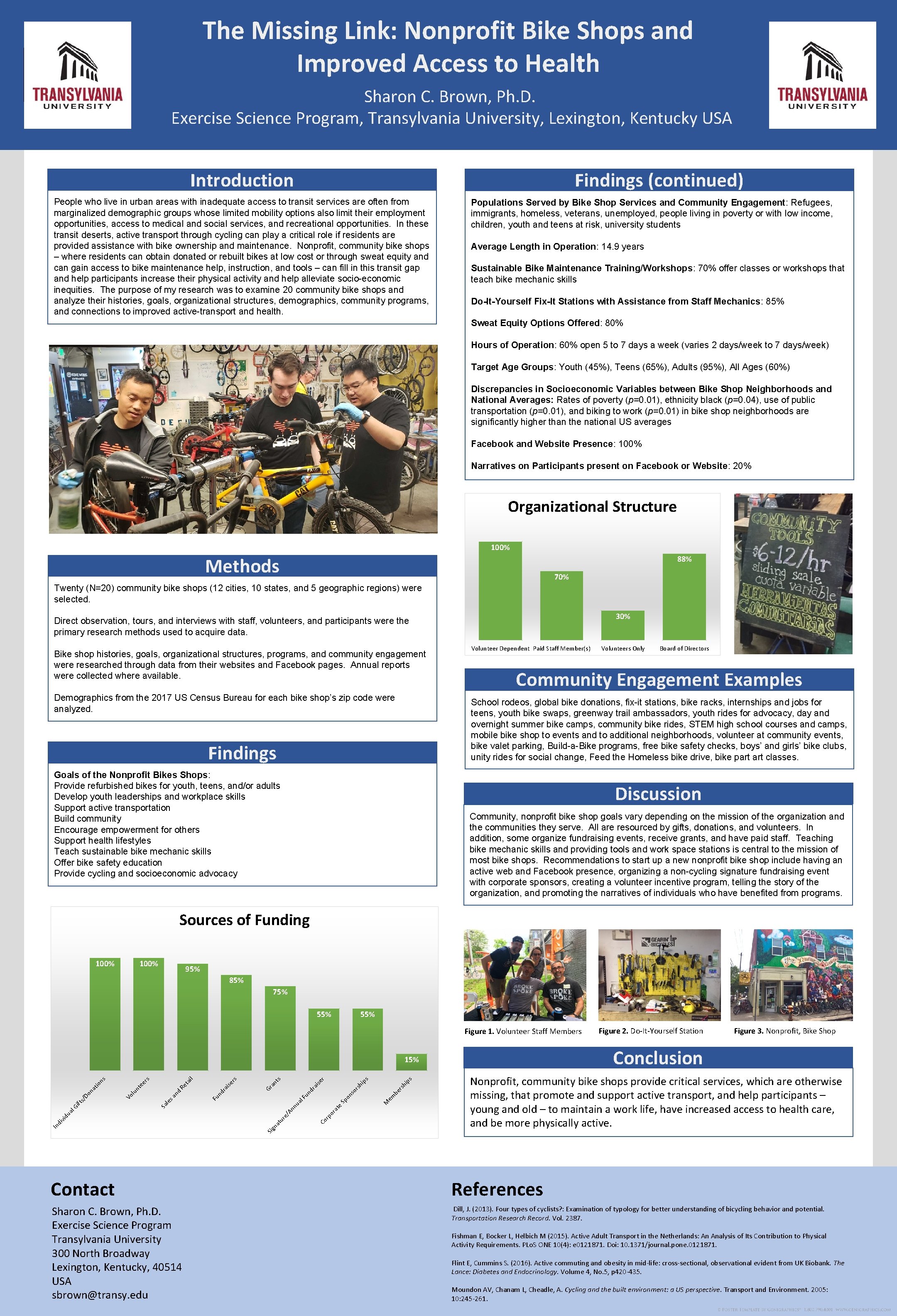
The Missing Link: Nonprofit Bike Shops and Improved Access to Health REPLACE THIS BOX WITH YOUR ORGANIZATION’S HIGH RESOLUTION LOGO Sharon C. Brown, Ph. D. Exercise Science Program, Transylvania University, Lexington, Kentucky USA Introduction Findings (continued) People who live in urban areas with inadequate access to transit services are often from marginalized demographic groups whose limited mobility options also limit their employment opportunities, access to medical and social services, and recreational opportunities. In these transit deserts, active transport through cycling can play a critical role if residents are provided assistance with bike ownership and maintenance. Nonprofit, community bike shops – where residents can obtain donated or rebuilt bikes at low cost or through sweat equity and can gain access to bike maintenance help, instruction, and tools – can fill in this transit gap and help participants increase their physical activity and help alleviate socio-economic inequities. The purpose of my research was to examine 20 community bike shops and analyze their histories, goals, organizational structures, demographics, community programs, and connections to improved active-transport and health. Populations Served by Bike Shop Services and Community Engagement: Refugees, immigrants, homeless, veterans, unemployed, people living in poverty or with low income, children, youth and teens at risk, university students Average Length in Operation: 14. 9 years Sustainable Bike Maintenance Training/Workshops: 70% offer classes or workshops that teach bike mechanic skills Do-It-Yourself Fix-It Stations with Assistance from Staff Mechanics: 85% Sweat Equity Options Offered: 80% Hours of Operation: 60% open 5 to 7 days a week (varies 2 days/week to 7 days/week) Target Age Groups: Youth (45%), Teens (65%), Adults (95%), All Ages (60%) Discrepancies in Socioeconomic Variables between Bike Shop Neighborhoods and National Averages: Rates of poverty (p=0. 01), ethnicity black (p=0. 04), use of public transportation (p=0. 01), and biking to work (p=0. 01) in bike shop neighborhoods are significantly higher than the national US averages Facebook and Website Presence: 100% Narratives on Participants present on Facebook or Website: 20% Organizational Structure 100% Methods 88% 70% Twenty (N=20) community bike shops (12 cities, 10 states, and 5 geographic regions) were selected. 30% Direct observation, tours, and interviews with staff, volunteers, and participants were the primary research methods used to acquire data. Bike shop histories, goals, organizational structures, programs, and community engagement were researched through data from their websites and Facebook pages. Annual reports were collected where available. Demographics from the 2017 US Census Bureau for each bike shop’s zip code were analyzed. Volunteer Dependent Paid Staff Member(s) Volunteers Only Board of Directors Community Engagement Examples School rodeos, global bike donations, fix-it stations, bike racks, internships and jobs for teens, youth bike swaps, greenway trail ambassadors, youth rides for advocacy, day and overnight summer bike camps, community bike rides, STEM high school courses and camps, mobile bike shop to events and to additional neighborhoods, volunteer at community events, bike valet parking, Build-a-Bike programs, free bike safety checks, boys’ and girls’ bike clubs, unity rides for social change, Feed the Homeless bike drive, bike part classes. Findings Goals of the Nonprofit Bikes Shops: Provide refurbished bikes for youth, teens, and/or adults Develop youth leaderships and workplace skills Support active transportation Build community Encourage empowerment for others Support health lifestyles Teach sustainable bike mechanic skills Offer bike safety education Provide cycling and socioeconomic advocacy Discussion Community, nonprofit bike shop goals vary depending on the mission of the organization and the communities they serve. All are resourced by gifts, donations, and volunteers. In addition, some organize fundraising events, receive grants, and have paid staff. Teaching bike mechanic skills and providing tools and work space stations is central to the mission of most bike shops. Recommendations to start up a new nonprofit bike shop include having an active web and Facebook presence, organizing a non-cycling signature fundraising event with corporate sponsors, creating a volunteer incentive program, telling the story of the organization, and promoting the narratives of individuals who have benefited from programs. Sources of Funding 100% 95% 85% 75% 55% Figure 1. Volunteer Staff Members hi ps be em M Sp at e or rp Co Sig na tu re / An n ua l F on un dr so rs ai se r s nt Gr a rs ra nd Fu Sa le s a nd R et ise ai l rs ee nt Vo lu ns tio na s/ Do ua l G ift vid di Figure 3. Nonprofit, Bike Shop Conclusion 15% In Figure 2. Do-It-Yourself Station Nonprofit, community bike shops provide critical services, which are otherwise missing, that promote and support active transport, and help participants – young and old – to maintain a work life, have increased access to health care, and be more physically active. Contact References Sharon C. Brown, Ph. D. Exercise Science Program Transylvania University 300 North Broadway Lexington, Kentucky, 40514 USA sbrown@transy. edu Dill, J. (2013). Four types of cyclists? : Examination of typology for better understanding of bicycling behavior and potential. Transportation Research Record. Vol. 2387. Fishman E, Bocker L, Helbich M (2015). Active Adult Transport in the Netherlands: An Analysis of Its Contribution to Physical Activity Requirements. PLo. S ONE 10(4): e 0121871. Doi: 10. 1371/journal. pone. 0121871. Flint E, Cummins S. (2016). Active commuting and obesity in mid-life: cross-sectional, observational evident from UK Biobank. The Lance: Diabetes and Endocrinology. Volume 4, No. 5, p 420 -435. Moundon AV, Chanam L, Cheadle, A. Cycling and the built environment: a US perspective. Transport and Environment. 2005: 10: 245 -261.
- Slides: 1