Introduction to Linguistics Week 8 11292020 intro 2

- Slides: 27
Introduction to Linguistics Week 8 11/29/2020 intro 2 ling/ssn/2007 1
Syntax The Analysis of Sentence Structure 11/29/2020 intro 2 ling/ssn/2007 2
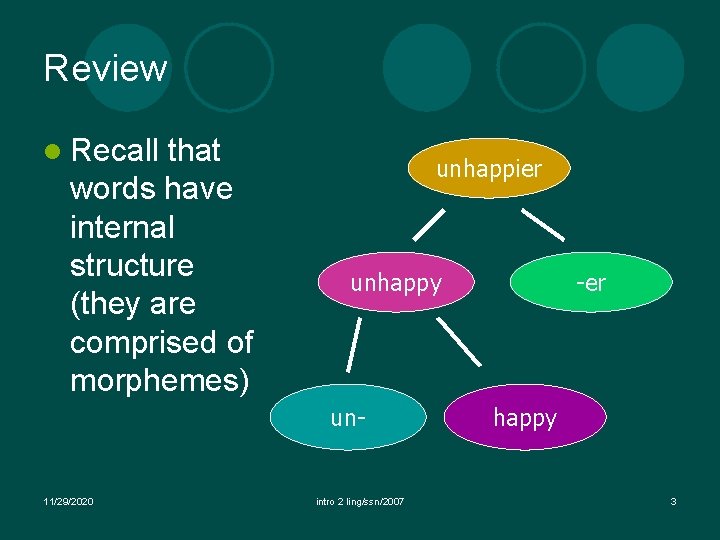
Review l Recall that words have internal structure (they are comprised of morphemes) unhappier unhappy un- 11/29/2020 intro 2 ling/ssn/2007 -er happy 3
Definition l the subfield of linguistics that studies the internal structure of sentences and the interrelationships among their component parts l the arrangement of words in sentences, clauses, and phrases l the study of the formation of sentences and the relationship of their component parts 11/29/2020 intro 2 ling/ssn/2007 4
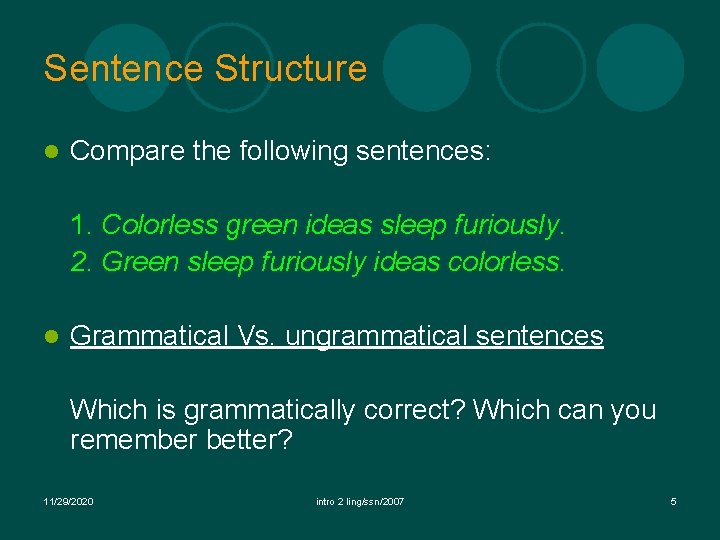
Sentence Structure l Compare the following sentences: 1. Colorless green ideas sleep furiously. 2. Green sleep furiously ideas colorless. l Grammatical Vs. ungrammatical sentences Which is grammatically correct? Which can you remember better? 11/29/2020 intro 2 ling/ssn/2007 5
l How do we COMBINE WORDS to make SENTENCES? → Syntax uses trees (just as in morphology) but the trees are built on WORDS instead of morphemes → The laws of combination for words are the syntactic rules. 11/29/2020 intro 2 ling/ssn/2007 6
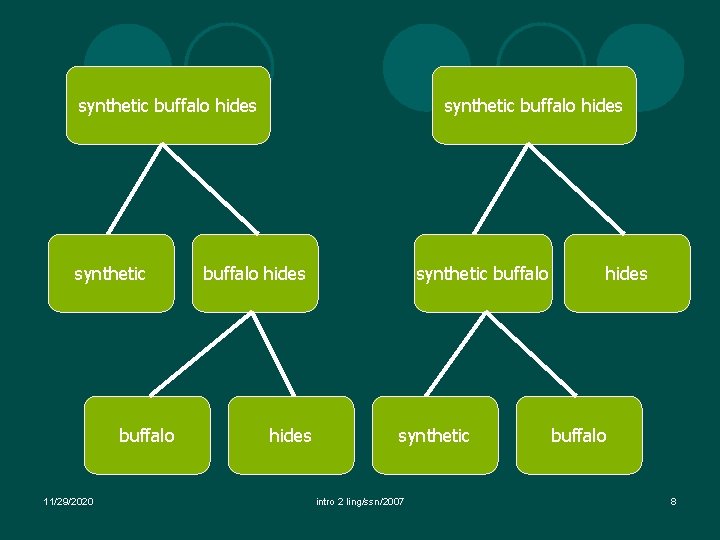
Structural Ambiguity l Recall that un-tie-able is ambiguous word, with two meanings correspond to different word structures. l The same kind of structural ambiguity can be found in sentences as well. Consider the phrase: synthetic buffalo hides 11/29/2020 intro 2 ling/ssn/2007 7
synthetic buffalo hides synthetic buffalo 11/29/2020 synthetic buffalo hides synthetic buffalo synthetic intro 2 ling/ssn/2007 hides buffalo 8
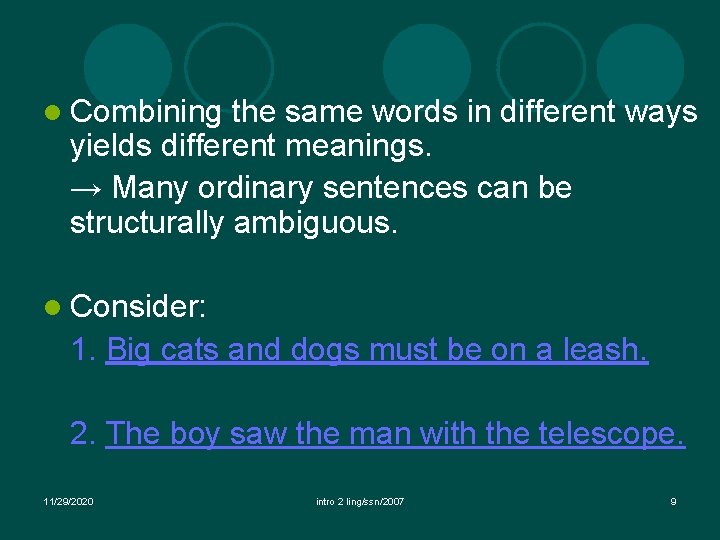
l Combining the same words in different ways yields different meanings. → Many ordinary sentences can be structurally ambiguous. l Consider: 1. Big cats and dogs must be on a leash. 2. The boy saw the man with the telescope. 11/29/2020 intro 2 ling/ssn/2007 9
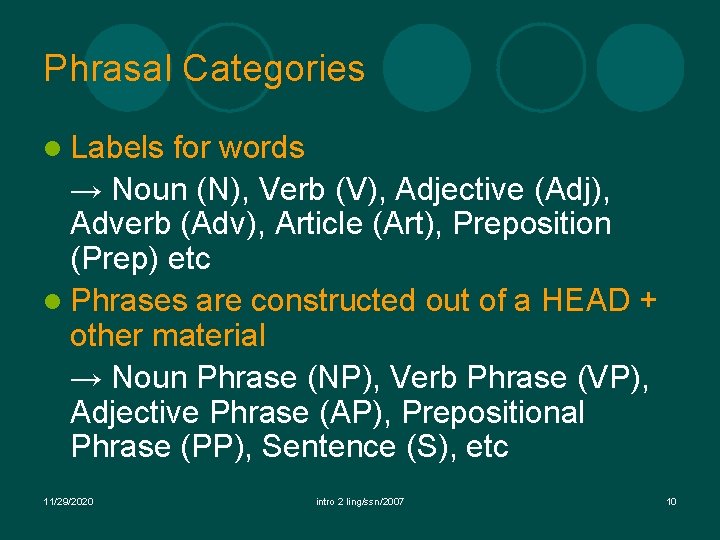
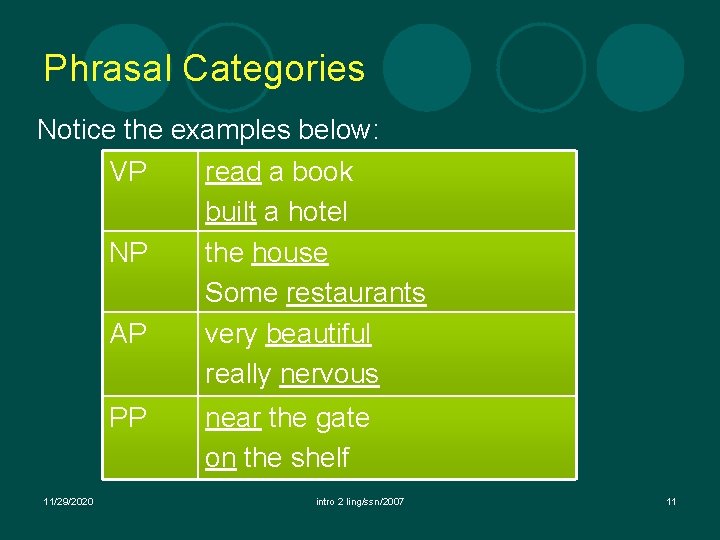
Phrasal Categories l Labels for words → Noun (N), Verb (V), Adjective (Adj), Adverb (Adv), Article (Art), Preposition (Prep) etc l Phrases are constructed out of a HEAD + other material → Noun Phrase (NP), Verb Phrase (VP), Adjective Phrase (AP), Prepositional Phrase (PP), Sentence (S), etc 11/29/2020 intro 2 ling/ssn/2007 10
Phrasal Categories Notice the examples below: VP read a book built a hotel NP the house Some restaurants AP very beautiful really nervous PP 11/29/2020 near the gate on the shelf intro 2 ling/ssn/2007 11
Constituency Tests l Constituent: a word or an intuitively natural grouping of words that behaves as a unit with respect to some grammatical rules (phrase) l How can we tell what the structure of a sentence is? How do we know where the phrases are? How can we prove it? → constituency test 11/29/2020 intro 2 ling/ssn/2007 12
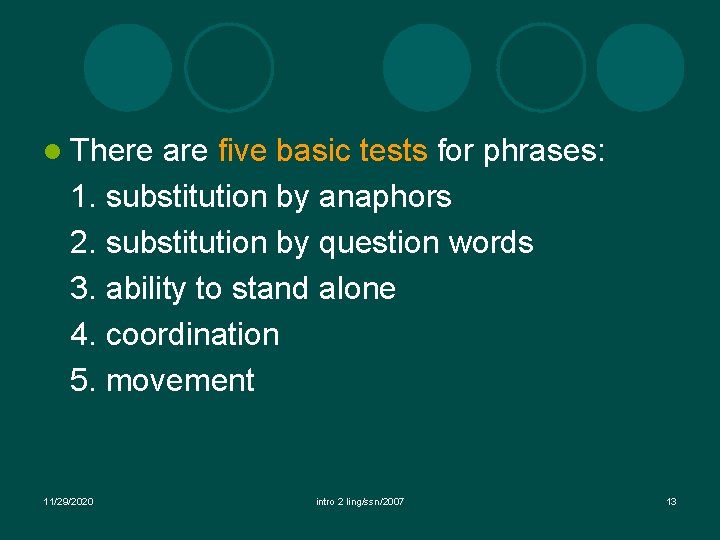
l There are five basic tests for phrases: 1. substitution by anaphors 2. substitution by question words 3. ability to stand alone 4. coordination 5. movement 11/29/2020 intro 2 ling/ssn/2007 13
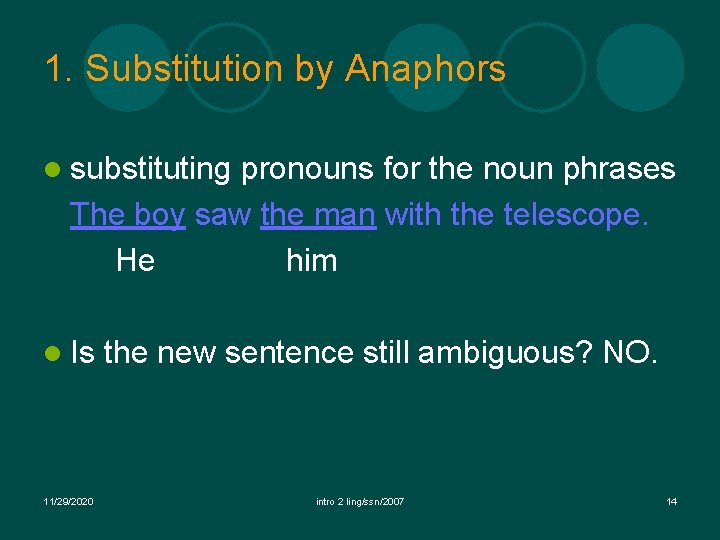
1. Substitution by Anaphors l substituting pronouns for the noun phrases The boy saw the man with the telescope. He him l Is 11/29/2020 the new sentence still ambiguous? NO. intro 2 ling/ssn/2007 14
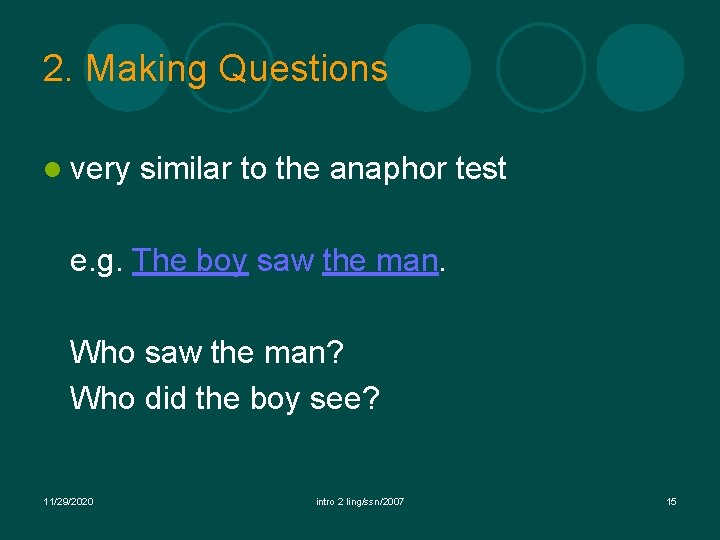
2. Making Questions l very similar to the anaphor test e. g. The boy saw the man. Who saw the man? Who did the boy see? 11/29/2020 intro 2 ling/ssn/2007 15
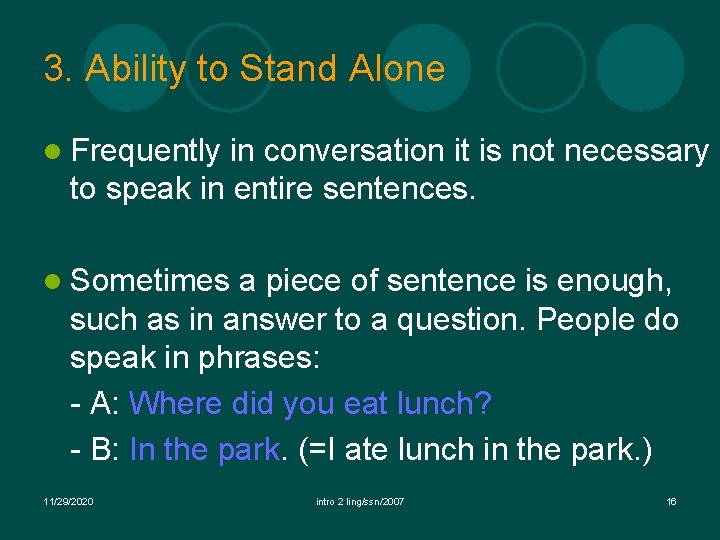
3. Ability to Stand Alone l Frequently in conversation it is not necessary to speak in entire sentences. l Sometimes a piece of sentence is enough, such as in answer to a question. People do speak in phrases: - A: Where did you eat lunch? - B: In the park. (=I ate lunch in the park. ) 11/29/2020 intro 2 ling/ssn/2007 16
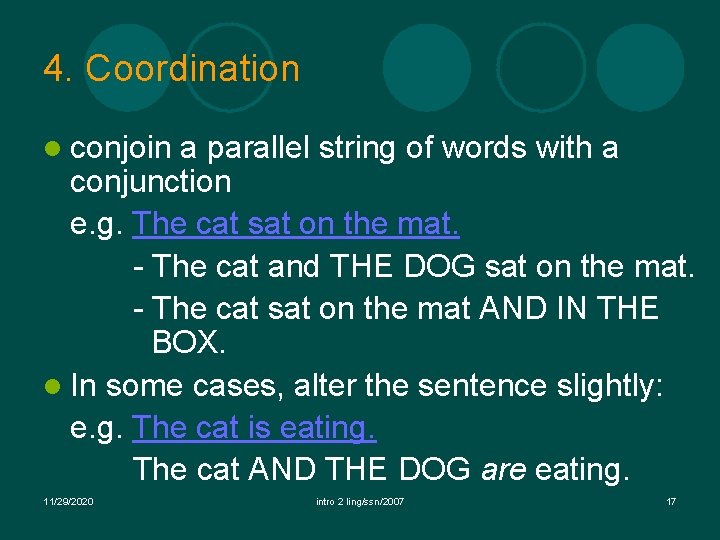
4. Coordination l conjoin a parallel string of words with a conjunction e. g. The cat sat on the mat. - The cat and THE DOG sat on the mat. - The cat sat on the mat AND IN THE BOX. l In some cases, alter the sentence slightly: e. g. The cat is eating. The cat AND THE DOG are eating. 11/29/2020 intro 2 ling/ssn/2007 17
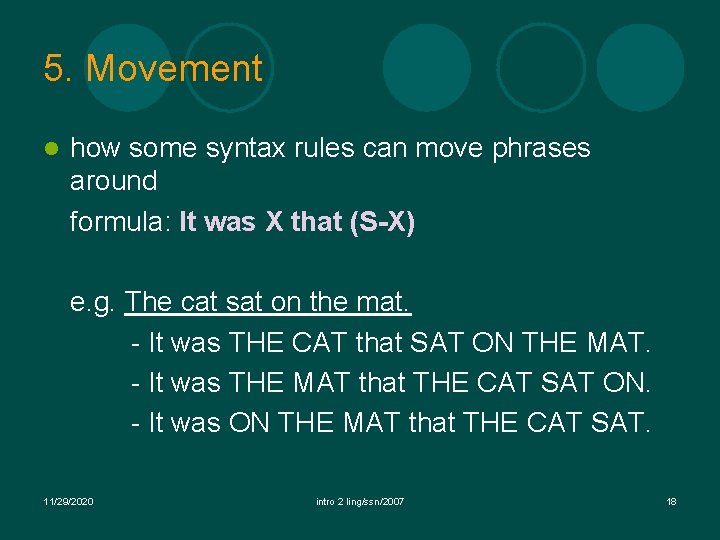
5. Movement l how some syntax rules can move phrases around formula: It was X that (S-X) e. g. The cat sat on the mat. - It was THE CAT that SAT ON THE MAT. - It was THE MAT that THE CAT SAT ON. - It was ON THE MAT that THE CAT SAT. 11/29/2020 intro 2 ling/ssn/2007 18
TREE DIAGRAMS/STRUCTURE…. . 11/29/2020 intro 2 ling/ssn/2007 19
The boy saw the cat on the mat. S VP NP PP NP NP Art N the boy saw 11/29/2020 V Art N the cat intro 2 ling/ssn/2007 P Art N on the mat 20
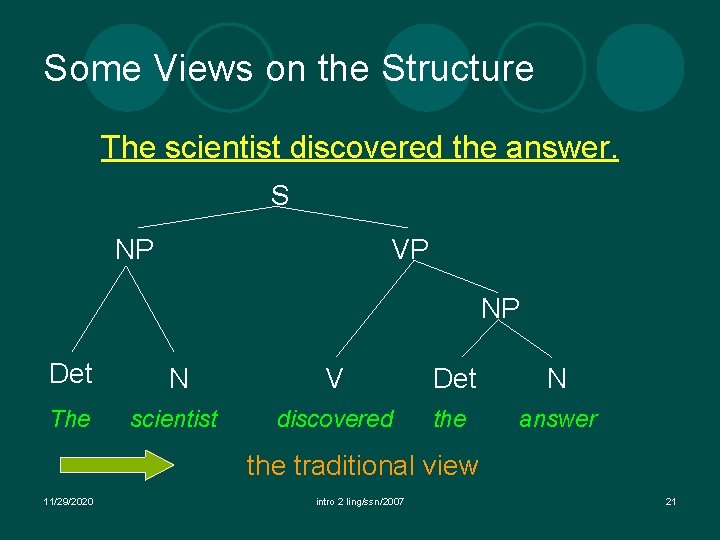
Some Views on the Structure The scientist discovered the answer. S NP VP NP Det N V Det N The scientist discovered the answer the traditional view 11/29/2020 intro 2 ling/ssn/2007 21
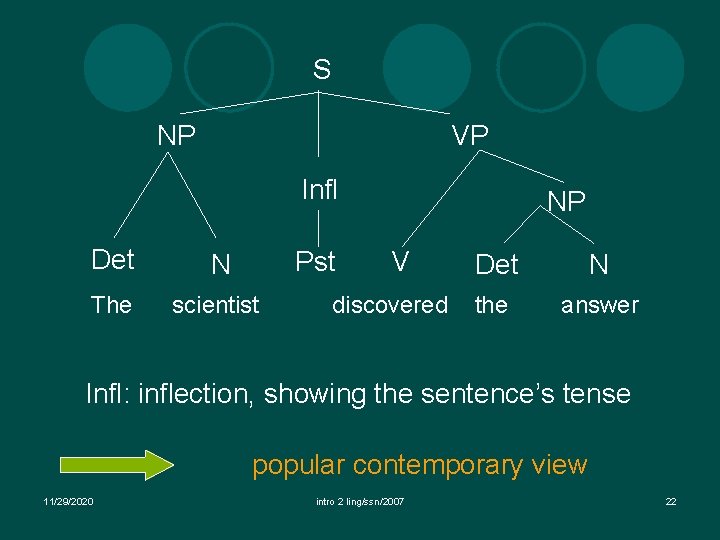
S NP VP Infl Det N The scientist Pst NP V discovered Det N the answer Infl: inflection, showing the sentence’s tense popular contemporary view 11/29/2020 intro 2 ling/ssn/2007 22
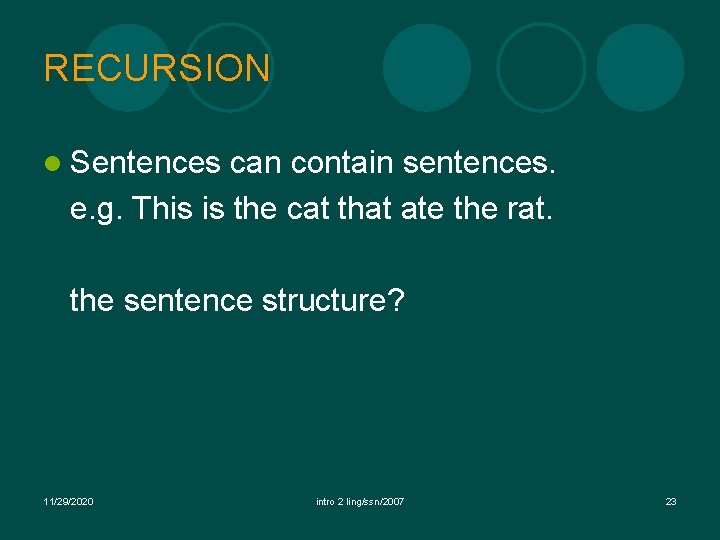
RECURSION l Sentences can contain sentences. e. g. This is the cat that ate the rat. the sentence structure? 11/29/2020 intro 2 ling/ssn/2007 23
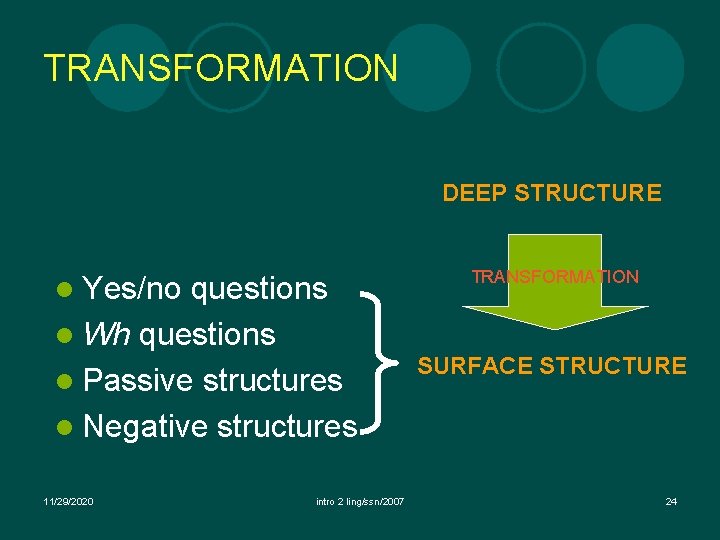
TRANSFORMATION DEEP STRUCTURE l Yes/no questions l Wh questions l Passive structures l Negative structures 11/29/2020 intro 2 ling/ssn/2007 TRANSFORMATION SURFACE STRUCTURE 24
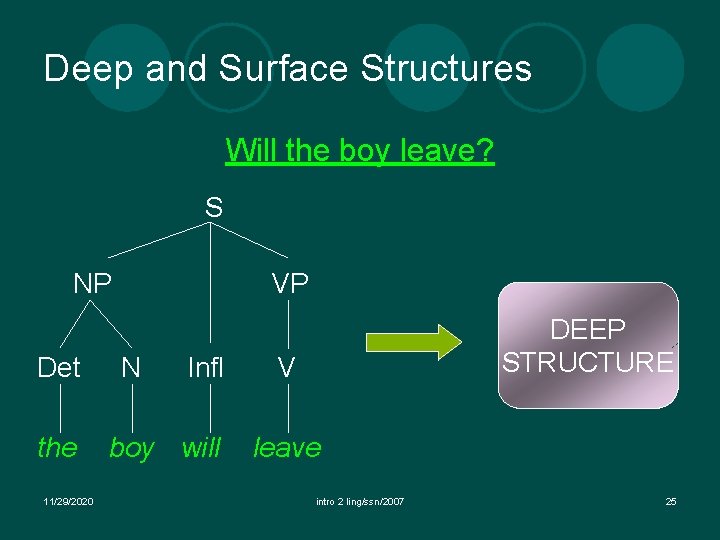
Deep and Surface Structures Will the boy leave? S NP Det the 11/29/2020 VP N Infl boy will DEEP STRUCTURE V leave intro 2 ling/ssn/2007 25
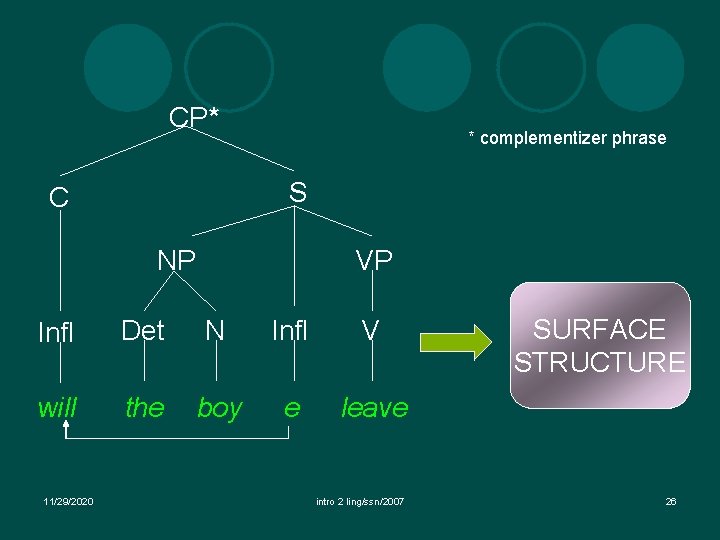
CP* * complementizer phrase S C NP VP Infl Det N Infl V will the boy e leave 11/29/2020 intro 2 ling/ssn/2007 SURFACE STRUCTURE 26
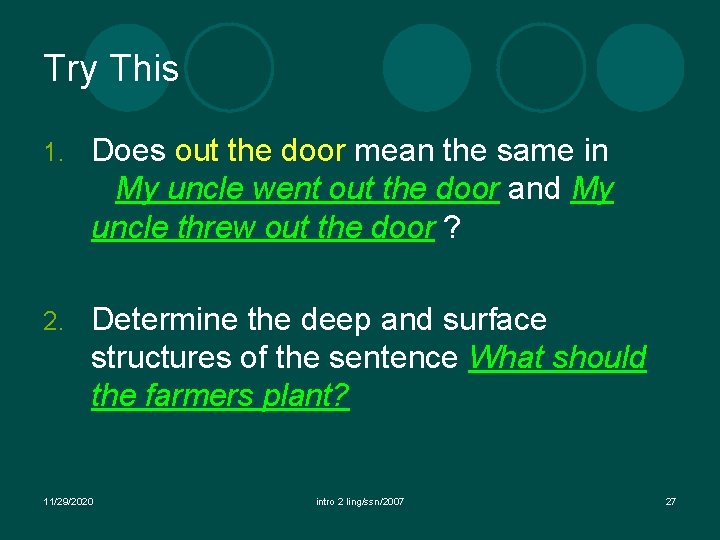
Try This 1. Does out the door mean the same in My uncle went out the door and My uncle threw out the door ? 2. Determine the deep and surface structures of the sentence What should the farmers plant? 11/29/2020 intro 2 ling/ssn/2007 27