Introduction to Grid Dyn Open Source Power Transmission
- Slides: 28
Introduction to Grid. Dyn Open Source Power Transmission System Simulation Philip Top Lawrence Livermore National Laboratory LLNL-PRES-698578 This work was performed under the auspices of the U. S. Department of Energy by Lawrence Livermore National Laboratory under contract DE-AC 52 -07 NA 27344. Lawrence Livermore National Security, LLC
Origins q Internal Research Project (2013 -2015) • The goal of the project was to explore the coupling between transmission and distribution systems. • In 2014, coupling with communication systems was added as a goal. q Grid Dynamics LLNL-PRES-698578 2
Software Requirements q Works seamlessly with both HPC and standalone systems q Provides easy access to manipulate solvers and solution methodology q Includes a variety of model features q Able to couple with other software-modeling platforms q Serves as an experimental platform for development of scalable high-performance power grid modeling methods q Supports a wide range of power system features: limits, dead bands, protections, relays, sensors, etc. LLNL-PRES-698578 3
Software Trade Study q Commercial-Off-The-Shelf (COTS) software: • • Siemens — PSS®E General Electric — Positive Sequence Load Flow (PSLF) Power. Tech Labs Inc. — DSA Tools Power. World Corp. — Power. World Simulator q Freeware: • Inter. PSS • Dome q Open Source software: • • Power System Analysis Toolbox (PSAT) Mat. Power Mat. Dyn Py. Power q Academic Code LLNL-PRES-698578 4
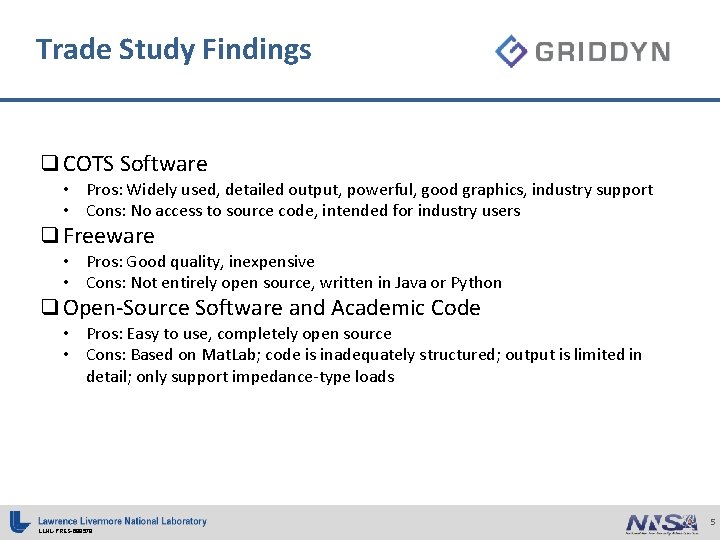
Trade Study Findings q COTS Software • Pros: Widely used, detailed output, powerful, good graphics, industry support • Cons: No access to source code, intended for industry users q Freeware • Pros: Good quality, inexpensive • Cons: Not entirely open source, written in Java or Python q Open-Source Software and Academic Code • Pros: Easy to use, completely open source • Cons: Based on Mat. Lab; code is inadequately structured; output is limited in detail; only support impedance-type loads LLNL-PRES-698578 5
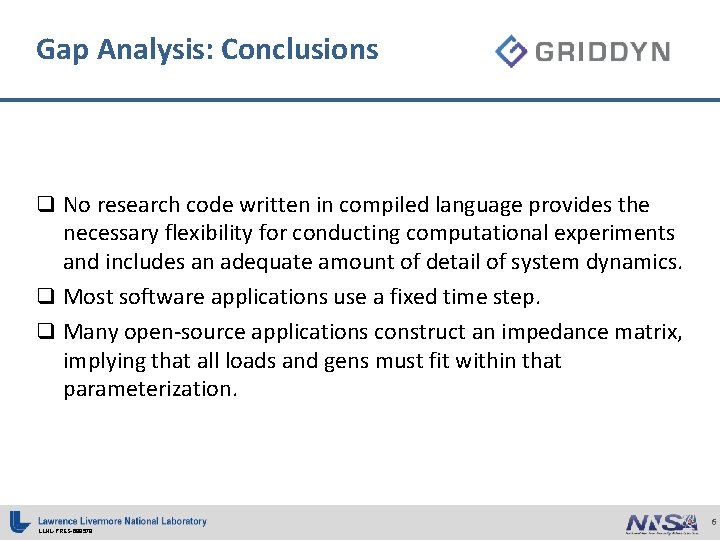
Gap Analysis: Conclusions q No research code written in compiled language provides the necessary flexibility for conducting computational experiments and includes an adequate amount of detail of system dynamics. q Most software applications use a fixed time step. q Many open-source applications construct an impedance matrix, implying that all loads and gens must fit within that parameterization. LLNL-PRES-698578 6
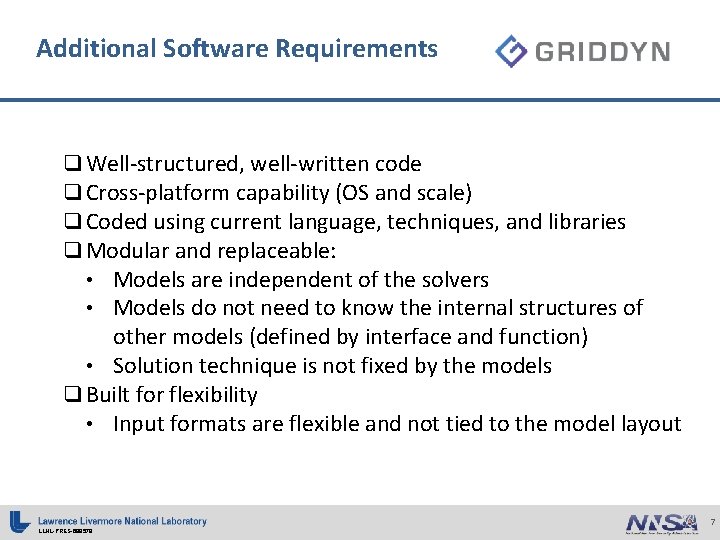
Additional Software Requirements q Well-structured, well-written code q Cross-platform capability (OS and scale) q Coded using current language, techniques, and libraries q Modular and replaceable: • Models are independent of the solvers • Models do not need to know the internal structures of other models (defined by interface and function) • Solution technique is not fixed by the models q Built for flexibility • Input formats are flexible and not tied to the model layout LLNL-PRES-698578 7
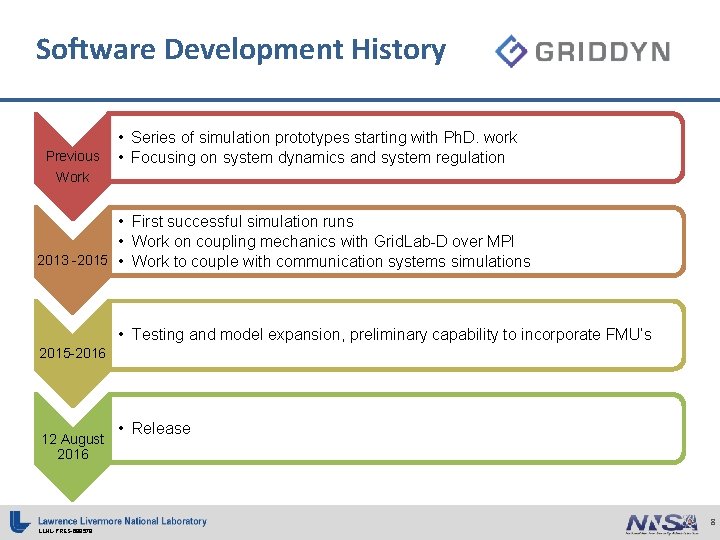
Software Development History Previous • Series of simulation prototypes starting with Ph. D. work • Focusing on system dynamics and system regulation Work • First successful simulation runs • Work on coupling mechanics with Grid. Lab-D over MPI 2013 -2015 • Work to couple with communication systems simulations • Testing and model expansion, preliminary capability to incorporate FMU’s 2015 -2016 12 August 2016 LLNL-PRES-698578 • Release 8
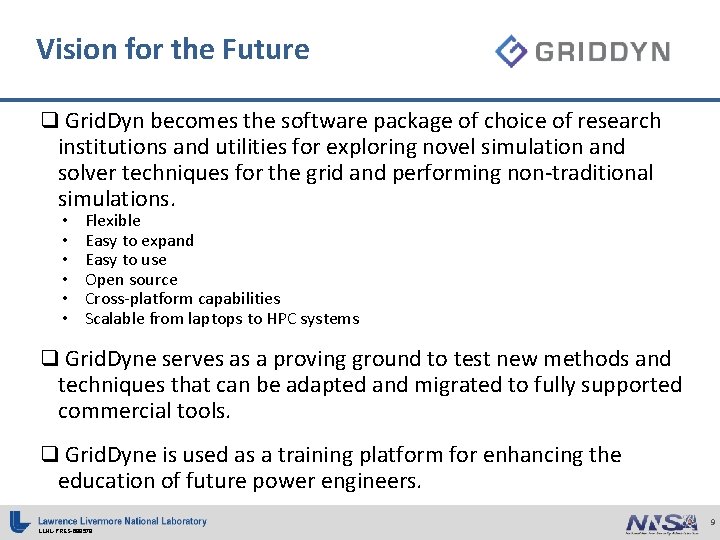
Vision for the Future q Grid. Dyn becomes the software package of choice of research institutions and utilities for exploring novel simulation and solver techniques for the grid and performing non-traditional simulations. • • • Flexible Easy to expand Easy to use Open source Cross-platform capabilities Scalable from laptops to HPC systems q Grid. Dyne serves as a proving ground to test new methods and techniques that can be adapted and migrated to fully supported commercial tools. q Grid. Dyne is used as a training platform for enhancing the education of future power engineers. LLNL-PRES-698578 9
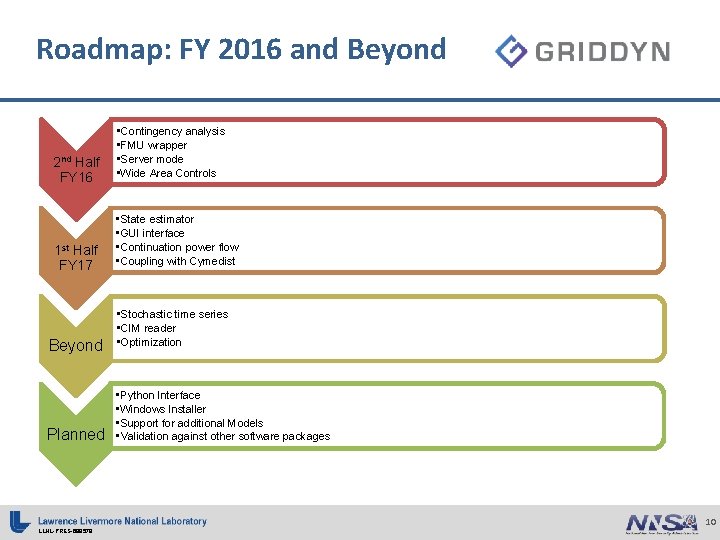
Roadmap: FY 2016 and Beyond 2 nd Half FY 16 1 st Half FY 17 Beyond Planned LLNL-PRES-698578 • Contingency analysis • FMU wrapper • Server mode • Wide Area Controls • State estimator • GUI interface • Continuation power flow • Coupling with Cymedist • Stochastic time series • CIM reader • Optimization • Python Interface • Windows Installer • Support for additional Models • Validation against other software packages 10
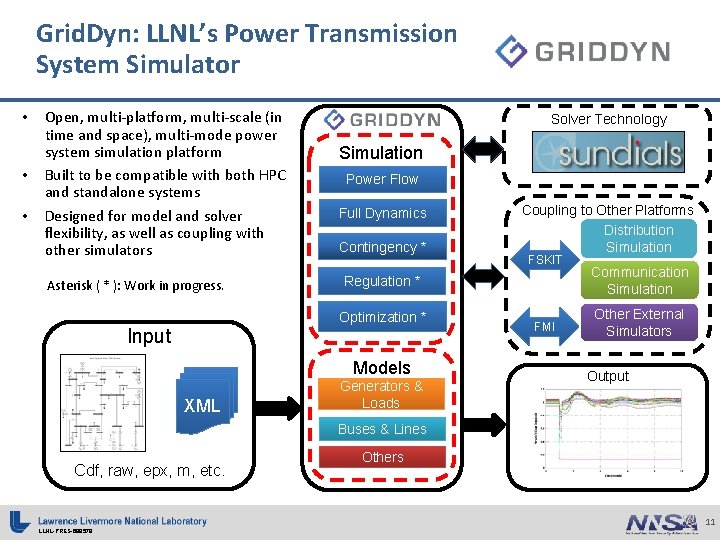
Grid. Dyn: LLNL’s Power Transmission System Simulator • • • Open, multi-platform, multi-scale (in time and space), multi-mode power system simulation platform Built to be compatible with both HPC and standalone systems Designed for model and solver flexibility, as well as coupling with other simulators Asterisk ( * ): Work in progress. Solver Technology Simulation Power Flow Full Dynamics Contingency * Models XML FSKIT Regulation * Optimization * Input Coupling to Other Platforms Distribution Simulation Generators & Loads FMI Communication Simulation Other External Simulators Output Buses & Lines Cdf, raw, epx, m, etc. LLNL-PRES-698578 Others 11
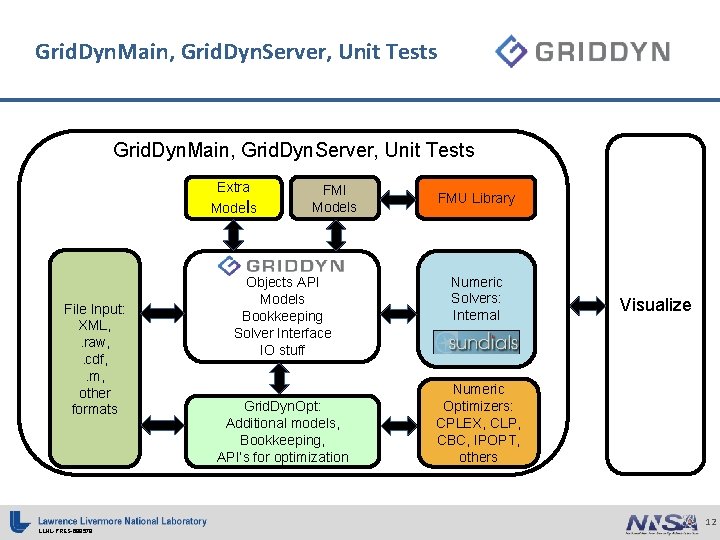
Grid. Dyn. Main, Grid. Dyn. Server, Unit Tests Extra Models File Input: XML, . raw, . cdf, . m, other formats LLNL-PRES-698578 FMI Models Objects API Models Bookkeeping Solver Interface IO stuff Grid. Dyn. Opt: Additional models, Bookkeeping, API’s for optimization FMU Library Numeric Solvers: Internal Visualize Numeric Optimizers: CPLEX, CLP, CBC, IPOPT, others 12
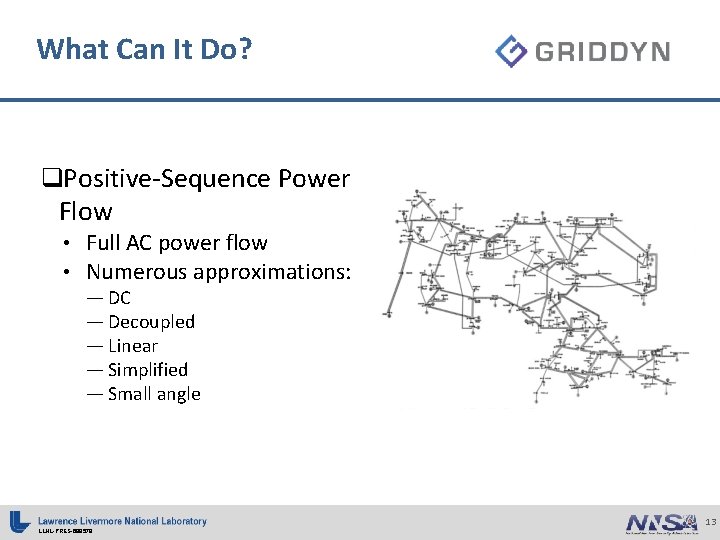
What Can It Do? q. Positive-Sequence Power Flow • Full AC power flow • Numerous approximations: — DC — Decoupled — Linear — Simplified — Small angle LLNL-PRES-698578 13
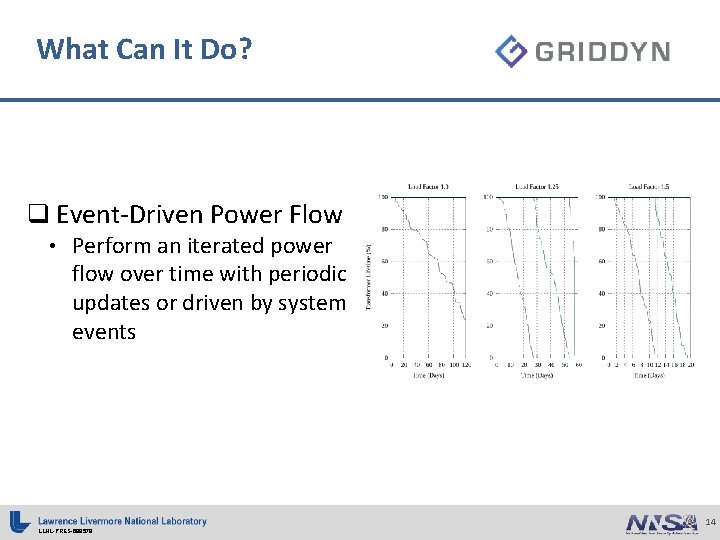
What Can It Do? q Event-Driven Power Flow • Perform an iterated power flow over time with periodic updates or driven by system events LLNL-PRES-698578 14
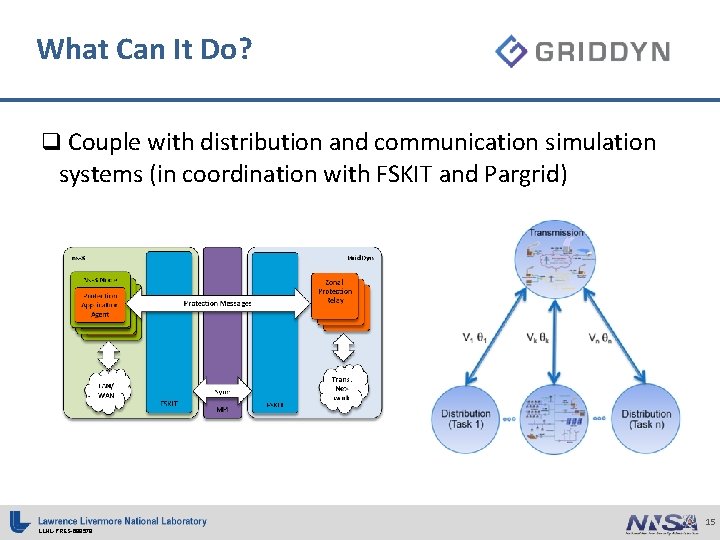
What Can It Do? q Couple with distribution and communication simulation systems (in coordination with FSKIT and Pargrid) LLNL-PRES-698578 15
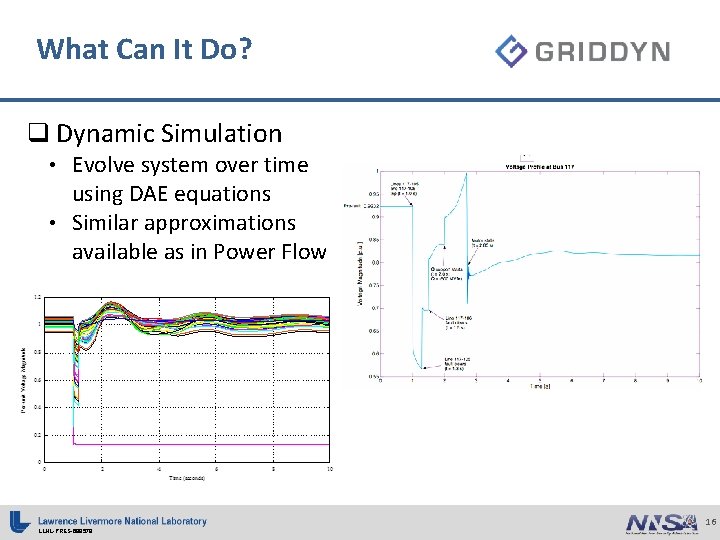
What Can It Do? q Dynamic Simulation • Evolve system over time using DAE equations • Similar approximations available as in Power Flow LLNL-PRES-698578 16
Current Projects q Currently Active Development • • Contingency analysis Coupling with communication systems Adding FMU capability Adding FMU interface Coupling with distribution systems Development of visualization interface Wide area controls q Potential Projects • • Long-term simulation Sensitivity analysis Optimization State estimation LLNL-PRES-698578 17
Active Projects q Cyber Security q Parallel-In-Time Solver Methods q Coupled Transmission, Distribution, and Communication Simulations LLNL-PRES-698578 18
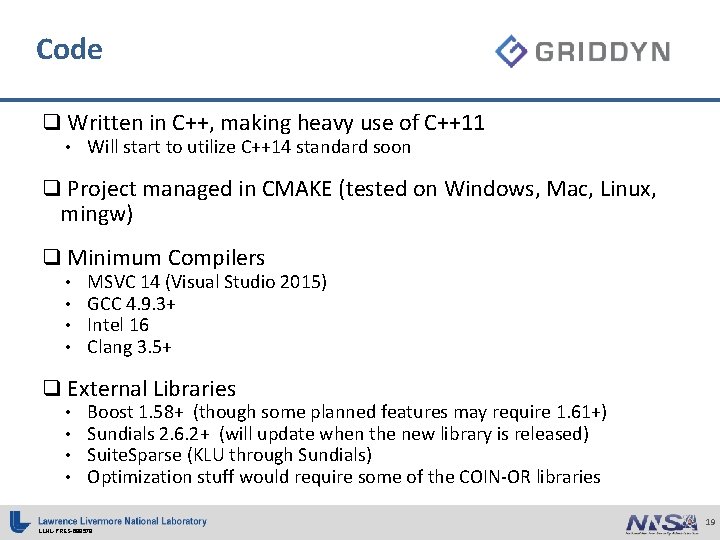
Code q Written in C++, making heavy use of C++11 • Will start to utilize C++14 standard soon q Project managed in CMAKE (tested on Windows, Mac, Linux, mingw) q Minimum Compilers • • MSVC 14 (Visual Studio 2015) GCC 4. 9. 3+ Intel 16 Clang 3. 5+ q External Libraries • • Boost 1. 58+ (though some planned features may require 1. 61+) Sundials 2. 6. 2+ (will update when the new library is released) Suite. Sparse (KLU through Sundials) Optimization stuff would require some of the COIN-OR libraries LLNL-PRES-698578 19
Code (continued) q Hosted at www. github. com/llnl/Grid. Dyn q Open source licensed with BSD license q In source documentation through Doxygen q Latex user manuals (a work in progress) q Currently version 0. 5 LLNL-PRES-698578 20
§ Some sort of Transition slide LLNL-PRES-698578 21
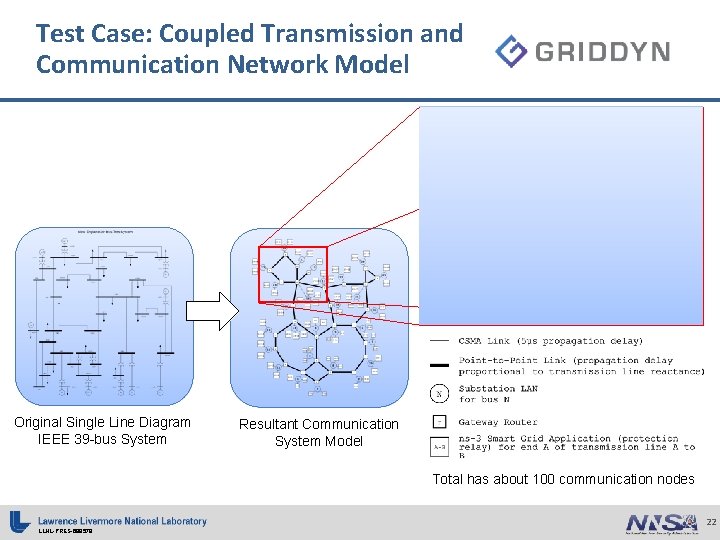
Test Case: Coupled Transmission and Communication Network Model Original Single Line Diagram IEEE 39 -bus System Resultant Communication System Model Total has about 100 communication nodes LLNL-PRES-698578 22
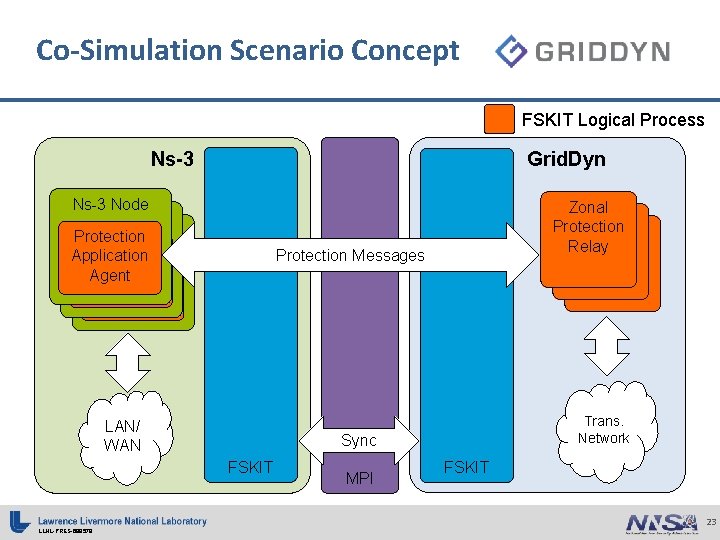
Co-Simulation Scenario Concept FSKIT Logical Process Grid. Dyn Ns-3 Node Protection Application Agent Protection Messages LAN/ WAN Trans. Network Sync FSKIT LLNL-PRES-698578 Zonal Protection Relay MPI FSKIT 23
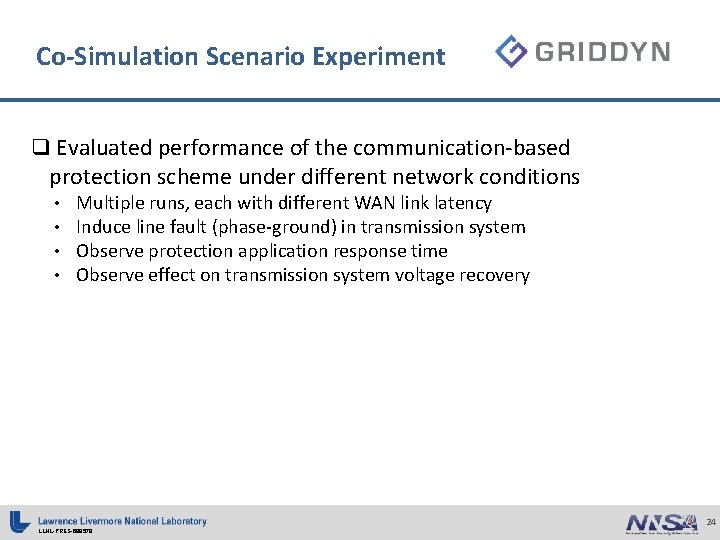
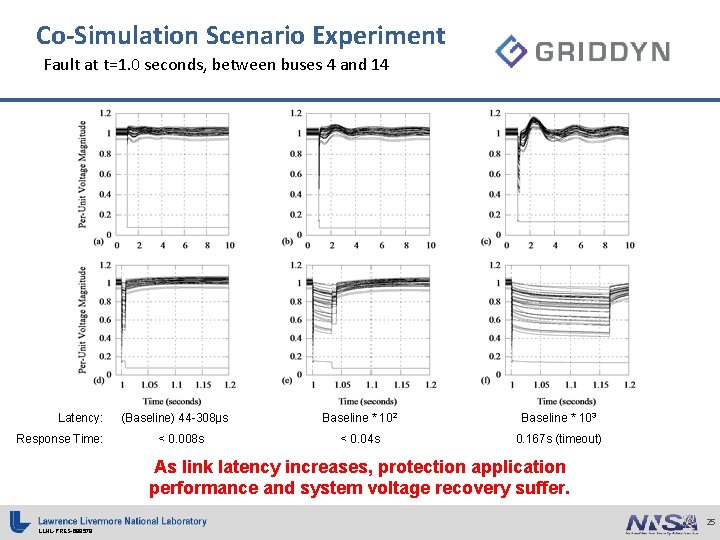
Co-Simulation Scenario Experiment q Evaluated performance of the communication-based protection scheme under different network conditions • • Multiple runs, each with different WAN link latency Induce line fault (phase-ground) in transmission system Observe protection application response time Observe effect on transmission system voltage recovery LLNL-PRES-698578 24
Co-Simulation Scenario Experiment Fault at t=1. 0 seconds, between buses 4 and 14 Latency: Response Time: (Baseline) 44 -308μs < 0. 008 s Baseline * 102 Baseline * 103 < 0. 04 s 0. 167 s (timeout) As link latency increases, protection application performance and system voltage recovery suffer. LLNL-PRES-698578 25
Key Features q Open Source q All models are independent and replaceable q All solvers are replaceable LLNL-PRES-698578 26
Conclusion: Grid. Dyne and the Future of Power Grid Simulation q The present state of the application is foundational q The grid is changing; the computation needs of power grid research are changing as well. • How do we make a platform that can grow and adapt to the future simulation needs of the power grid research community? • How do we make it easier to try new things (solvers, optimizers, models, test cases, visualizations, and other simulators)? • How do we build upon past work? LLNL-PRES-698578 27
Acknowledgements q. Steve Smith, Carol Woodward, Brian Kelley, Liang Min, Eddy Banks, Rafael Rivera-Soto. q. Funding from LLNL Lab Directed Research and Development 13 -ERD-043 q. DOE Office of Electricity Advanced Grid Modeling program q. California Energy Systems for the 21 st Century LLNL-PRES-698578 28