
Introduction to GRID computing and overview of the


- Slides: 26
Introduction to GRID computing and overview of the European Data Grid The European Data. Grid Project http: //www. edg. org
Overview Ø Introduction n What is GRID computing ? n What is a GRID ? n Why GRIDs ? Ø GRID projects world-wide Ø The European Data Grid (EDG) n Overview of EDG goals and organization n Overview of the EDG middleware components Introduction to GRID Computing and the EDG 2
What is GRID computing : Ø coordinated resource sharing and problem solving in dynamic, multi-institutional virtual organizations. [ I. Foster] Ø A VO is a collection of users sharing similar needs and requirements in their access to processing, data and distributed resources and pursuing similar goals. Ø Key n concept : ability to negotiate resource-sharing arrangements among a set of participating parties (providers and consumers) and then to use the resulting resource pool for some purpose [I. Foster] Introduction to GRID Computing and the EDG 3
What is a GRID: Ø Ø Ø collaborative set of computing, data storage and network resources belonging to different administrative domains that has knowledge about the status of its components through active, distributed information services allows certified users belonging to multi-domain Virtual Organizations to access a large amount of resources via single log in. (sign on) Manage concurrent access by large numbers of dispersed users Provide a service that can cope with unavailability of distributed resources Has no single point of failure Introduction to GRID Computing and the EDG 4
A Checklist for a GRID to be a GRID (I. Foster) Ø Ø a GRID coordinates resources that are not subject to centralized control and live within different control domains and addresses the issues of security, policy, payment, membership… that arise in these settings. (i. e. it is not a local management system. ) uses standard, open, general-purpose protocols and interfaces (i. e. it is not an application-specific system). a GRID allows its constituent resources to be used in a coordinated fashion to deliver various qualities of service ( response time, throughput, availability, and security, and/or co-allocation of multiple resource types ). the utility of the combined system is significantly greater than that of the sum of its parts to meet complex user demands. Introduction to GRID Computing and the EDG 5
Elements of the GRID problem Ø Ø Flexible, secure, coordinated resource sharing n Trust n Policy n Negotiation n Payment User communities able to share geographically distributed resources Ø Absence of a central location, a centralized control Ø Optimize the global efficiency in the usage of resources n status is not under our direct control n current status is uncertain to some degree Introduction to GRID Computing and the EDG 6
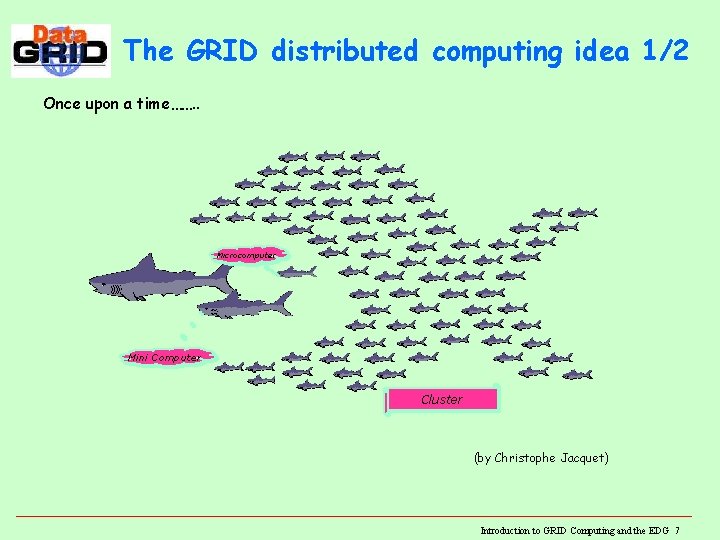
The GRID distributed computing idea 1/2 Once upon a time……. . Microcomputer Mini Computer Cluster (by Christophe Jacquet) Introduction to GRID Computing and the EDG 7
The GRID distributed computing idea 2/2 …and today (by Christophe Jacquet) Introduction to GRID Computing and the EDG 8
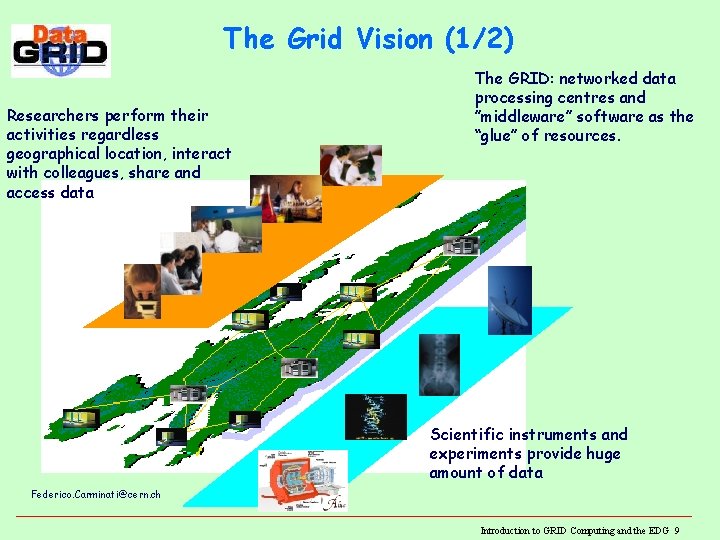
The Grid Vision (1/2) Researchers perform their activities regardless geographical location, interact with colleagues, share and access data The GRID: networked data processing centres and ”middleware” software as the “glue” of resources. Scientific instruments and experiments provide huge amount of data Federico. Carminati@cern. ch Introduction to GRID Computing and the EDG 9
The Grid Vision (2/2) Ø Ø Ø (I. Foster, G. Gilder) On-demand, ubiquitous access to computing, data, and services. New capabilities constructed dynamically and transparently from distributed services “When the network is as fast as the computer's internal links, the machine disintegrates across the net into a set of special purpose appliances” (George Gilder) Fabrizio. Gagliardi@cern. ch, GEANT Commissioning Event, Brussels, 22 May 2002 Introduction to GRID Computing and the EDG 10
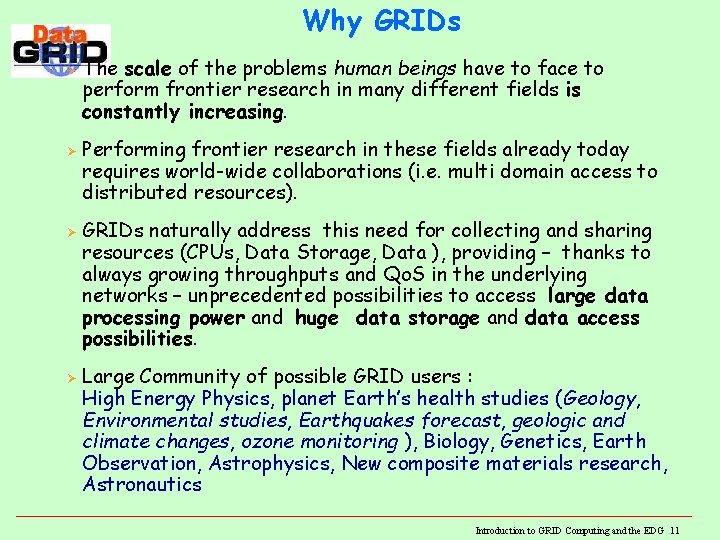
Why GRIDs Ø Ø The scale of the problems human beings have to face to perform frontier research in many different fields is constantly increasing. Performing frontier research in these fields already today requires world-wide collaborations (i. e. multi domain access to distributed resources). GRIDs naturally address this need for collecting and sharing resources (CPUs, Data Storage, Data ), providing – thanks to always growing throughputs and Qo. S in the underlying networks – unprecedented possibilities to access large data processing power and huge data storage and data access possibilities. Large Community of possible GRID users : High Energy Physics, planet Earth’s health studies (Geology, Environmental studies, Earthquakes forecast, geologic and climate changes, ozone monitoring ), Biology, Genetics, Earth Observation, Astrophysics, New composite materials research, Astronautics Introduction to GRID Computing and the EDG 11
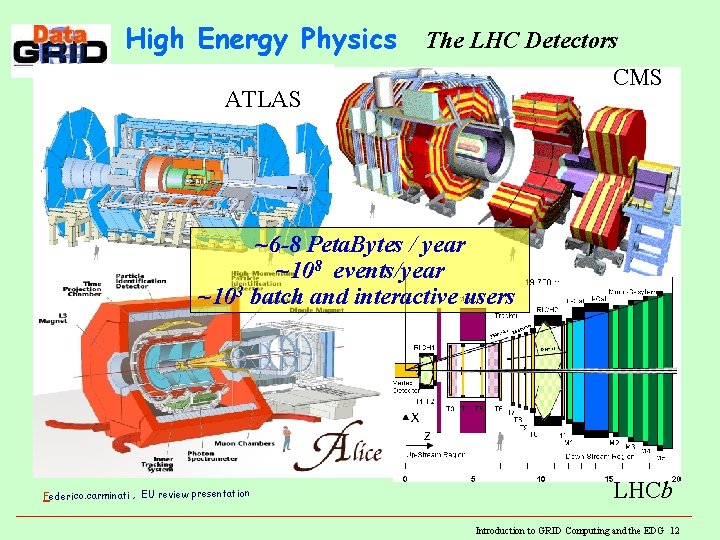
High Energy Physics The LHC Detectors CMS ATLAS ~6 -8 Peta. Bytes / year ~108 events/year ~103 batch and interactive users Federico. carminati , EU review presentation LHCb Introduction to GRID Computing and the EDG 12
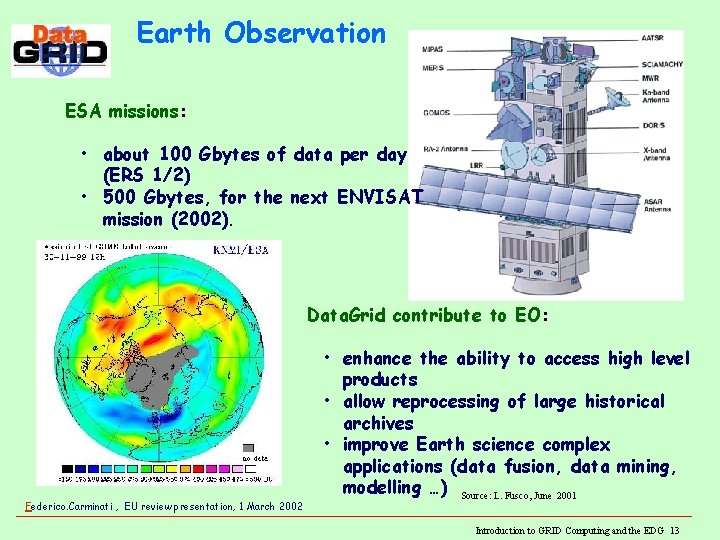
Earth Observation ESA missions: • about 100 Gbytes of data per day (ERS 1/2) • 500 Gbytes, for the next ENVISAT mission (2002). Data. Grid contribute to EO: Federico. Carminati , EU review presentation, 1 March 2002 • enhance the ability to access high level products • allow reprocessing of large historical archives • improve Earth science complex applications (data fusion, data mining, modelling …) Source: L. Fusco, June 2001 Introduction to GRID Computing and the EDG 13
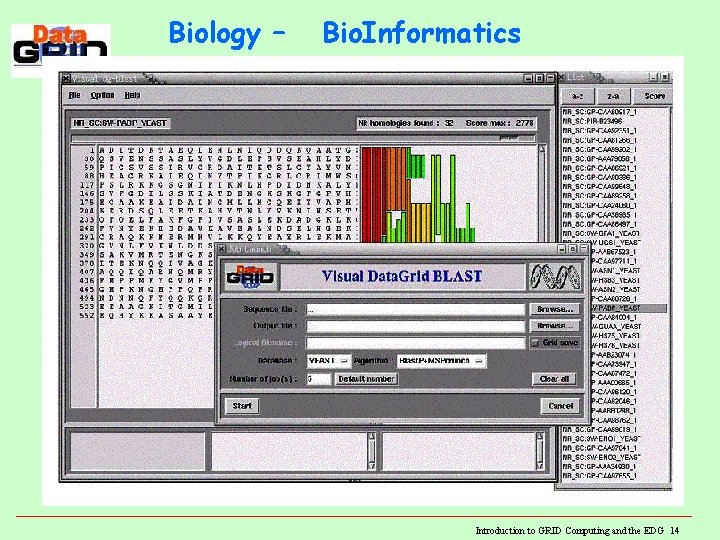
Biology – Bio. Informatics Introduction to GRID Computing and the EDG 14
GRID computing and High Throughput Computing Ø Ø Ø High Throughput Computing is the effective management and exploitation of all available computing resources. limited predictability of the actual availability of distributed, remote, multi-domain resources requires a way to cope with it. main challenge for HTC: maximizing the amount of resources accessible to its customers. Distributed ownership of computing resources is the major obstacle such an environment has to overcome in order to expand the pool of resources it can draw from. Introduction to GRID Computing and the EDG 15
GRID Security Ø Ø Ø user’s identity has to be certified by (mutually recognized) national Certification Authorities (accessing resources belonging to different domains requires identity to be certified). secure access to resources is required (security framework to allow resources access only to certified, identified users (X. 509 Public Key Infrastructure )). resources (node machines) have to be certified by CAs temporary delegation from users to processes to be executed “in user’s name” ( proxy certificates ). Common agreed policies for accessing resource and handling user’s rights across different domains in within the same Virtual Organization a user belongs to. Introduction to GRID Computing and the EDG 16
GRID projects world wide Ø Ø EU n EDG (EU-IST) – R&D EU GRID project [ www. edg. org ] n Cross. GRID – Qo. S – Real Time apps. [ www. crossgrid. org ] n Data. TAG - GLUE (EU-USA) [ www. datatag. org ] n LCG – The LHC Computing GRID – Deployment [ cern. ch/lcg ] n The new 16, 2 B Euro EU VI Framework Prog. GEANT based GRID projects USA n Gri. Phy. N [ www. griphyn. org ] Ø i. VDGL-VDTv 1 [ www. idvgl. org ] PPDG ( NSF, Do. E ) [ www. ppdg. org ] Asia n Ap. Grid [ www. apgrid. org ] Pragma (USA-Asia) [ http: //pragma. ucsd. edu ] Introduction to GRID Computing and the EDG 17
The European Data Grid Ø Ø EDG is a project funded by the European Union to exploit and build the next generation computing infrastructure providing intensive computation and analysis of shared large-scale databases. Enable data intensive sciences by providing world wide Grid test beds to large distributed scientific organisations. Start ( Kick off ) : Jan 1, 2001 Ø End : Dec 31, 2003 Ø Applications/End User Communities : HEP, Earth Observation, Biology. Ø Specific Project Objectives: n Middleware for Jobs (Workload) and Data Management, Information Systems, Fabric & GRID management, Network Monitoring n Large scale testbed n Production quality demonstrations n Contribute to Open Standards and international bodies ( GGF, Industry & Research forum) Introduction to GRID Computing and the EDG 18
The EDG Main Partners Ø CERN – International (Switzerland/France) Ø CNRS - France Ø ESA/ESRIN – International (Italy) Ø INFN - Italy Ø NIKHEF – The Netherlands Ø PPARC - UK Introduction to GRID Computing and the EDG 19
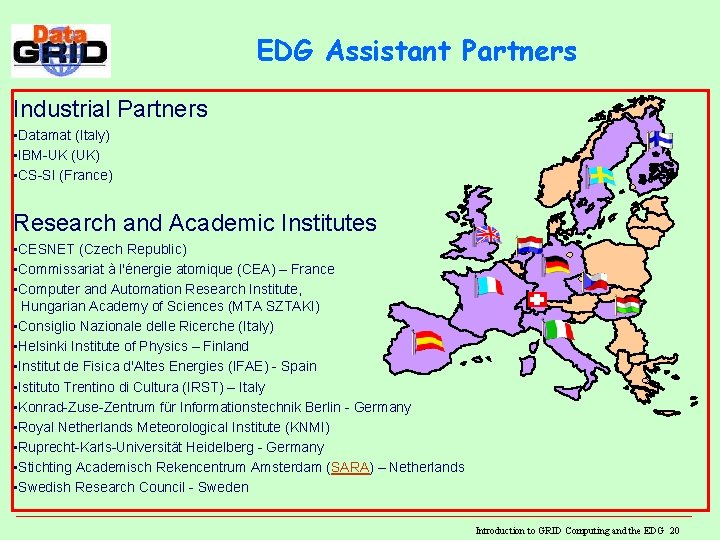
EDG Assistant Partners Industrial Partners • Datamat (Italy) • IBM-UK (UK) • CS-SI (France) Research and Academic Institutes • CESNET (Czech Republic) • Commissariat à l'énergie atomique (CEA) – France • Computer and Automation Research Institute, Hungarian Academy of Sciences (MTA SZTAKI) • Consiglio Nazionale delle Ricerche (Italy) • Helsinki Institute of Physics – Finland • Institut de Fisica d'Altes Energies (IFAE) - Spain • Istituto Trentino di Cultura (IRST) – Italy • Konrad-Zuse-Zentrum für Informationstechnik Berlin - Germany • Royal Netherlands Meteorological Institute (KNMI) • Ruprecht-Karls-Universität Heidelberg - Germany • Stichting Academisch Rekencentrum Amsterdam (SARA) – Netherlands • Swedish Research Council - Sweden Introduction to GRID Computing and the EDG 20
EDG overview: Middleware release schedule Ø Release schedule n Release 1. 4: n Ø Ø Release 2. 0: December 2002 May 2003 Each release includes n feedback from use of previous release by application groups n planned improvements/extension by middle-ware groups High Energy Physics experiments and Data Challenges: n ATLAS production data challenge demonstration on EDG currently On-going ( main EDG production demo effort – mid September ) n CMS, LHCb, ALICE, Earth Obs. & Bio-Info. will follow ATLAS in demonstrating productions Introduction to GRID Computing and the EDG 21
EDG overview : current project status Ø Ø EDG currently provides set of middleware services Ø Job & Data Management Ø GRID & Network monitoring Ø Security, Authentication & Authorization tools Ø Fabric Management Runs on Linux Red Hat 6. 2 platform Ø Site install & config tools and set of common services available Ø Ø 5 principle EDG 1. 2. 0 sites currently belonging to the EDG-Testbed Ø CERN(CH), RAL(UK), NIKHEF(NL), CNAF(I), CC-Lyon(F), Ø Ø ( Resource Brokers, VO-LDAP servers for Authentication, VO-based Replica Catalogs, VO-management services ) being deployed on other EDG testbed sites (~10) Intense middleware development continuously going on, concerning: n New features for job partitioning and check-pointing, billing and accounting n New tools for Data Management and Information Systems. n Integration of network monitoring information inside the brokering polices Introduction to GRID Computing and the EDG 22
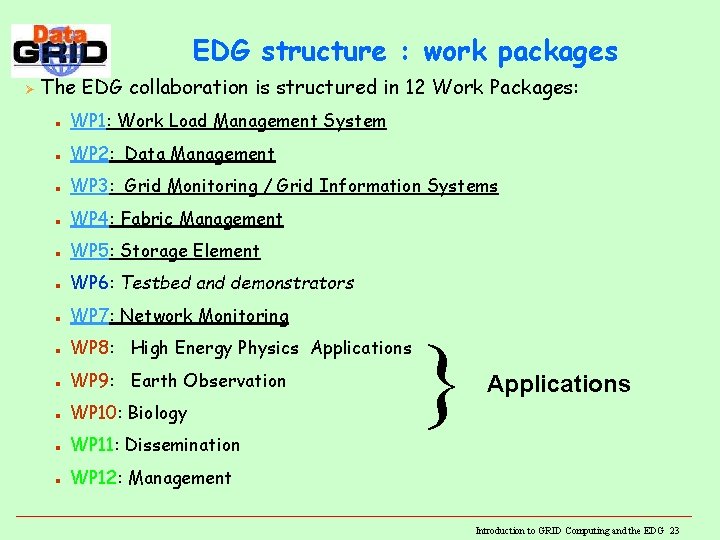
EDG structure : work packages Ø The EDG collaboration is structured in 12 Work Packages: n WP 1: Work Load Management System n WP 2: Data Management n WP 3: Grid Monitoring / Grid Information Systems n WP 4: Fabric Management n WP 5: Storage Element n WP 6: Testbed and demonstrators n WP 7: Network Monitoring n WP 8: High Energy Physics Applications n WP 9: Earth Observation n WP 10: Biology n WP 11: Dissemination n WP 12: Management } Applications Introduction to GRID Computing and the EDG 23
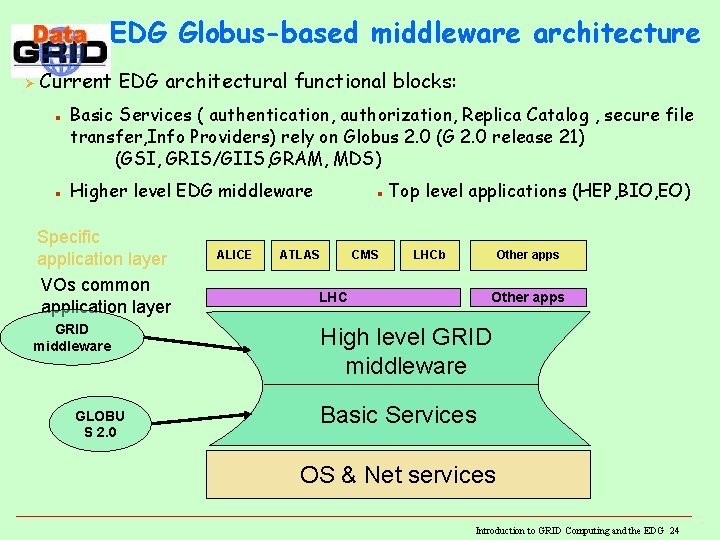
EDG Globus-based middleware architecture Ø Current EDG architectural functional blocks: n n Basic Services ( authentication, authorization, Replica Catalog , secure file transfer, Info Providers) rely on Globus 2. 0 (G 2. 0 release 21) (GSI, GRIS/GIIS, GRAM, MDS) Higher level EDG middleware Specific application layer VOs common application layer GRID middleware GLOBU S 2. 0 ALICE Top level applications (HEP, BIO, EO) ATLAS CMS LHCb Other apps LHC Other apps High level GRID middleware Basic Services OS & Net services Introduction to GRID Computing and the EDG 24
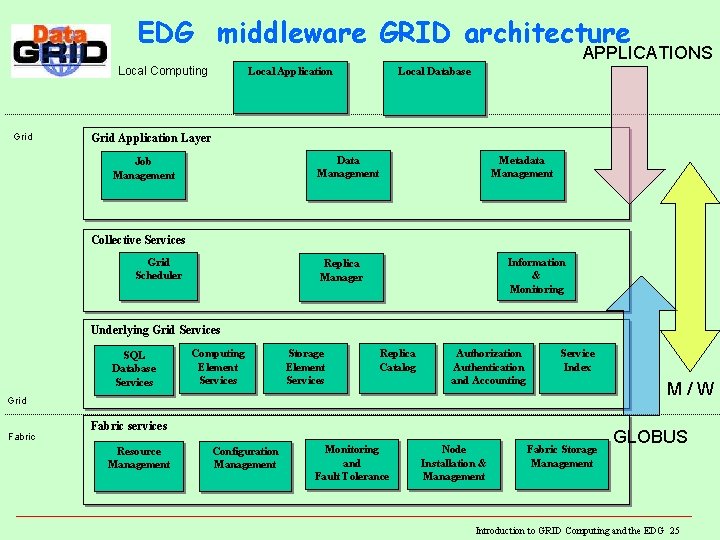
EDG middleware GRID architecture APPLICATIONS Local Computing Grid Local Application Local Database Grid Application Layer Data Management Job Management Metadata Management Collective Services Grid Scheduler Information & Monitoring Replica Manager Underlying Grid Services SQL Database Services Computing Element Services Storage Element Services Replica Catalog Authorization Authentication and Accounting Service Index M / W Grid Fabric services Resource Management Configuration Management Monitoring and Fault Tolerance Node Installation & Management Fabric Storage Management GLOBUS Introduction to GRID Computing and the EDG 25
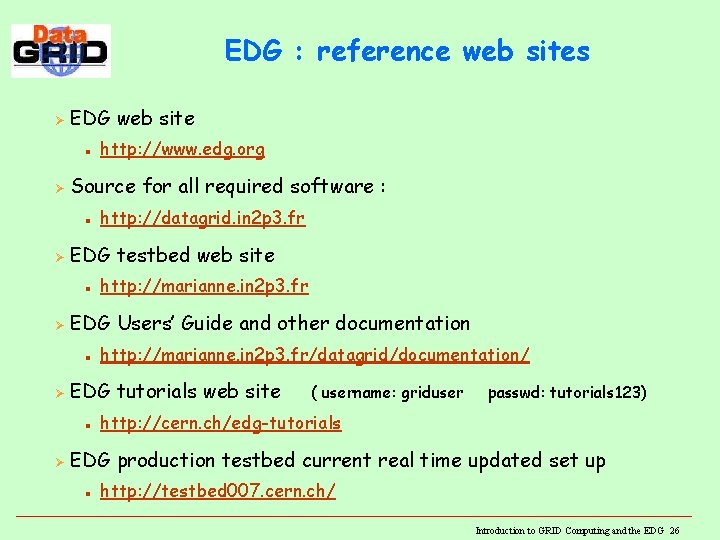
EDG : reference web sites Ø EDG web site n Ø Source for all required software : n Ø http: //marianne. in 2 p 3. fr/datagrid/documentation/ EDG tutorials web site n Ø http: //marianne. in 2 p 3. fr EDG Users’ Guide and other documentation n Ø http: //datagrid. in 2 p 3. fr EDG testbed web site n Ø http: //www. edg. org ( username: griduser passwd: tutorials 123) http: //cern. ch/edg-tutorials EDG production testbed current real time updated set up n http: //testbed 007. cern. ch/ Introduction to GRID Computing and the EDG 26