Interprofessional Education Mercer University Health Sciences Center H




- Slides: 49
Interprofessional Education Mercer University Health Sciences Center H. W. “Ted” Matthews, Ph. D. , R. Ph. Senior Vice President for Health Sciences and Dean, College of Pharmacy and Health Sciences August 27, 2014
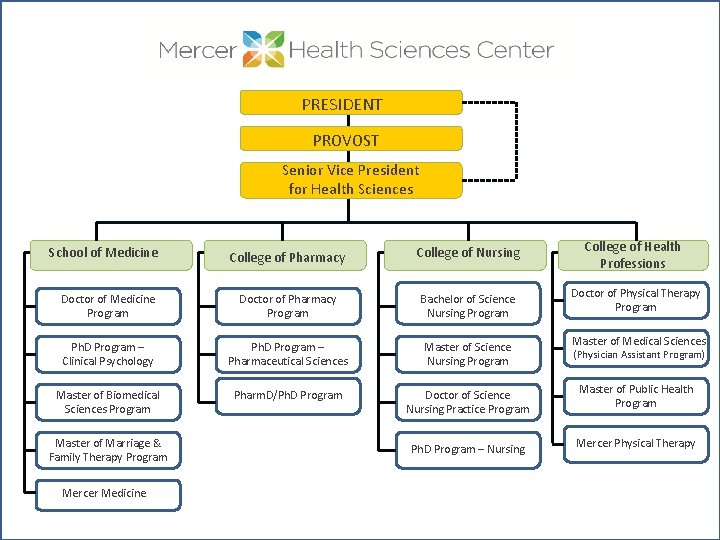
PRESIDENT PROVOST Senior Vice President for Health Sciences College of Pharmacy College of Nursing College of Health Professions Doctor of Medicine Program Doctor of Pharmacy Program Bachelor of Science Nursing Program Doctor of Physical Therapy Program Ph. D Program – Clinical Psychology Ph. D Program – Pharmaceutical Sciences Master of Science Nursing Program Master of Medical Sciences Master of Biomedical Sciences Program Pharm. D/Ph. D Program Doctor of Science Nursing Practice Program Master of Public Health Program Ph. D Program – Nursing Mercer Physical Therapy School of Medicine Master of Marriage & Family Therapy Program Mercer Medicine (Physician Assistant Program)
Objectives 1. 2. 3. 4. Define and describe Interprofessional Education (IPE) Provide examples of IPE activity Describe the IPE domains and competencies Discuss the significance of IPE and its relationship to inter-professional collaboration in patient care 5. Describe briefly the IPE events that occur across campuses at Mercer 6. Collaborate with faculty members with similar interests to develop IPE activities that would meet program goals 7. Recognize the opportunities for grants and research available through IPE
IMPORTANCE OF INTERPROFESSIONAL EDUCATION (IPE)
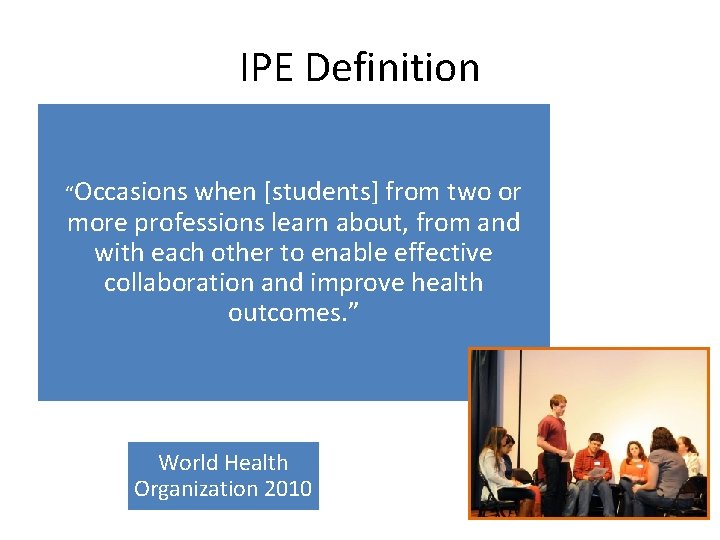
IPE Definition “Occasions when [students] from two or more professions learn about, from and with each other to enable effective collaboration and improve health outcomes. ” World Health Organization 2010
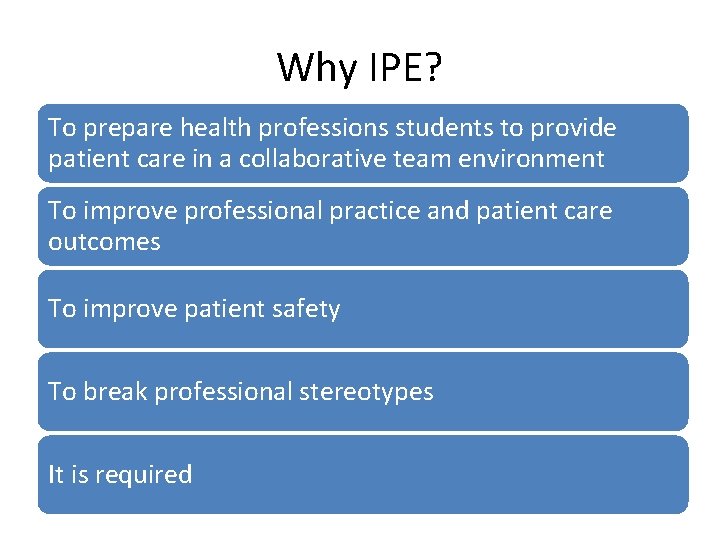
Why IPE? To prepare health professions students to provide patient care in a collaborative team environment To improve professional practice and patient care outcomes To improve patient safety To break professional stereotypes It is required
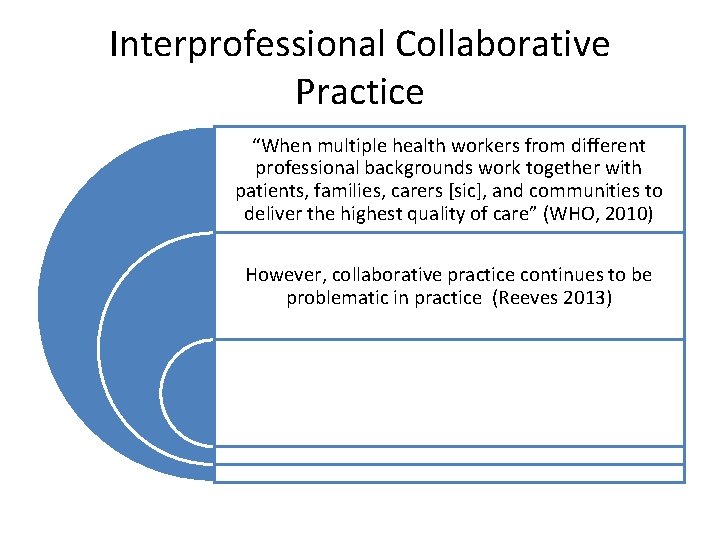
Interprofessional Collaborative Practice “When multiple health workers from different professional backgrounds work together with patients, families, carers [sic], and communities to deliver the highest quality of care” (WHO, 2010) However, collaborative practice continues to be problematic in practice (Reeves 2013)
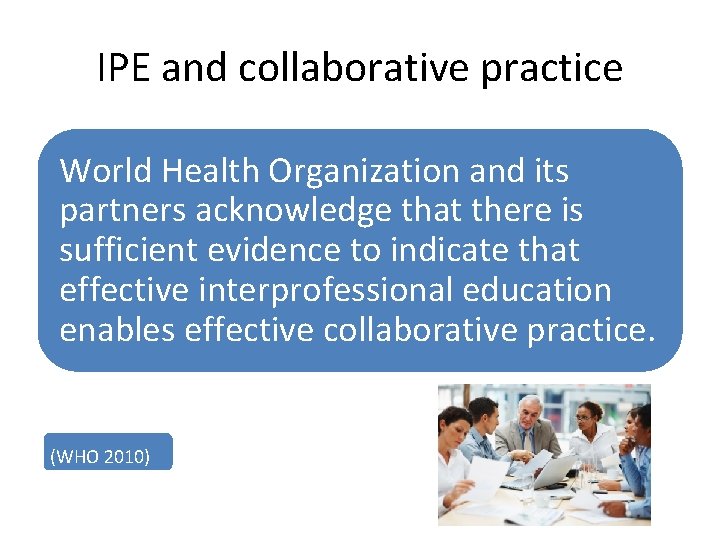
IPE and collaborative practice World Health Organization and its partners acknowledge that there is sufficient evidence to indicate that effective interprofessional education enables effective collaborative practice. (WHO 2010)
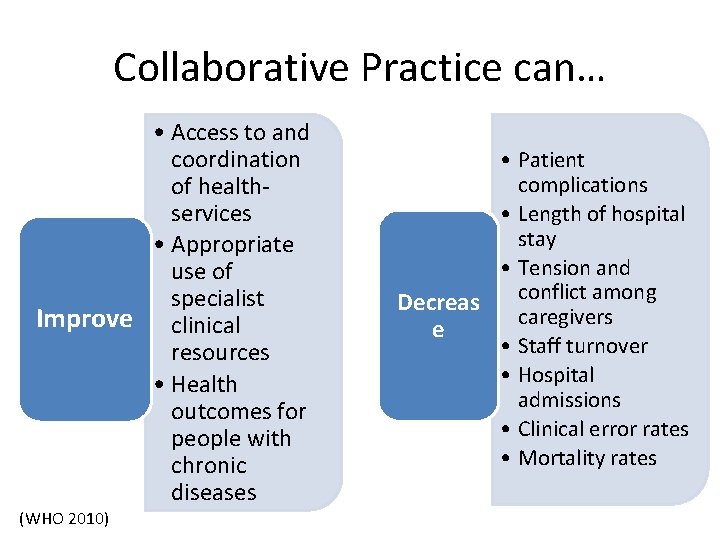
Collaborative Practice can… • Access to and coordination of healthservices • Appropriate use of specialist Improve clinical resources • Health outcomes for people with chronic diseases (WHO 2010) • Patient complications • Length of hospital stay • Tension and conflict among Decreas caregivers e • Staff turnover • Hospital admissions • Clinical error rates • Mortality rates
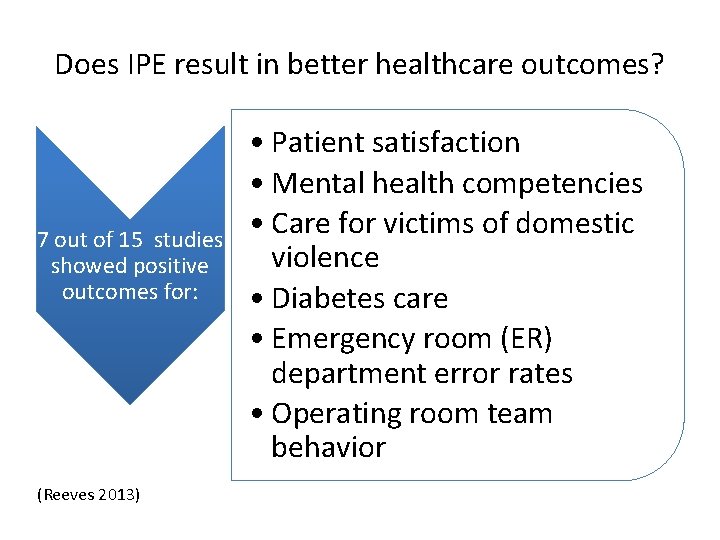
Does IPE result in better healthcare outcomes? 7 out of 15 studies showed positive outcomes for: (Reeves 2013) • Patient satisfaction • Mental health competencies • Care for victims of domestic violence • Diabetes care • Emergency room (ER) department error rates • Operating room team behavior
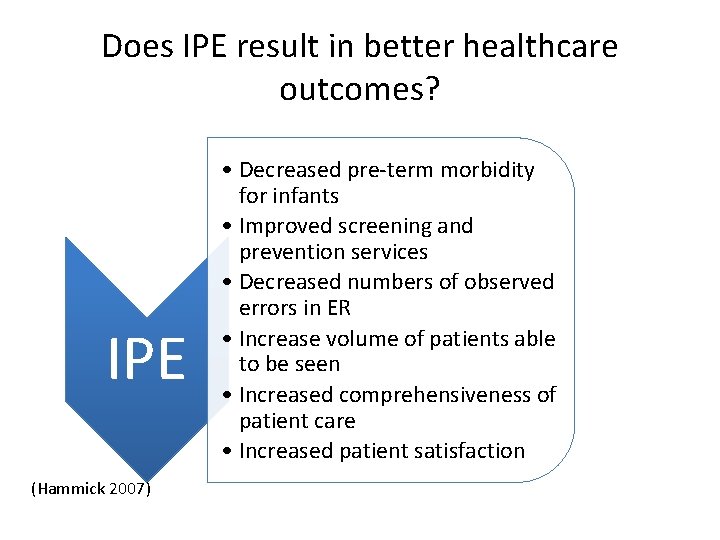
Does IPE result in better healthcare outcomes? IPE (Hammick 2007) • Decreased pre-term morbidity for infants • Improved screening and prevention services • Decreased numbers of observed errors in ER • Increase volume of patients able to be seen • Increased comprehensiveness of patient care • Increased patient satisfaction
Does IPE n kno epro wle co fes nc breakdge, the sio attit nei udes, ve mo skills red and id po valu ea siti es s vel reve yof aled th that ne prec at oth onc tri ers. epti bu Vie ons te ws coul s be dco be of chan va me ged rio mo stereotype?
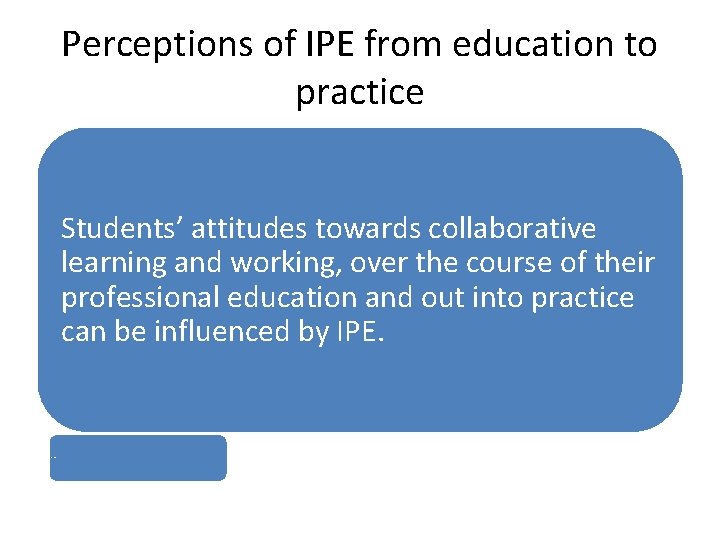
Perceptions of IPE from education to practice Students’ attitudes towards collaborative learning and working, over the course of their professional education and out into practice can be influenced by IPE. (Pollard 2008)
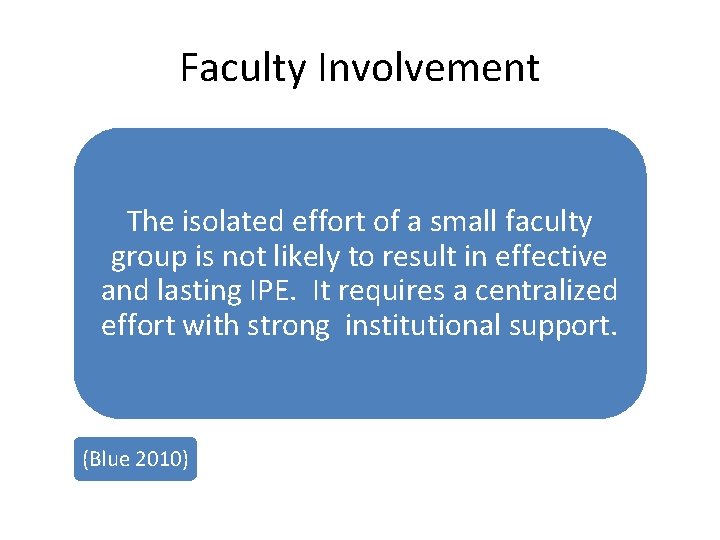
Faculty Involvement The isolated effort of a small faculty group is not likely to result in effective and lasting IPE. It requires a centralized effort with strong institutional support. (Blue 2010)
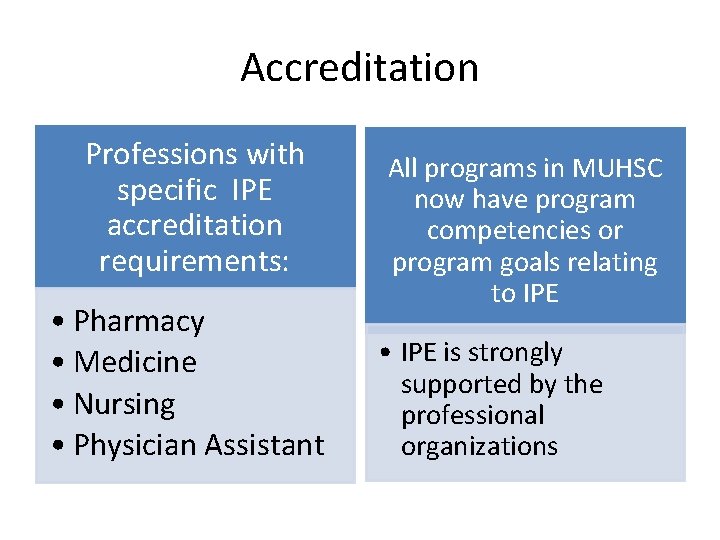
Accreditation Professions with specific IPE accreditation requirements: • Pharmacy • Medicine • Nursing • Physician Assistant All programs in MUHSC now have program competencies or program goals relating to IPE • IPE is strongly supported by the professional organizations
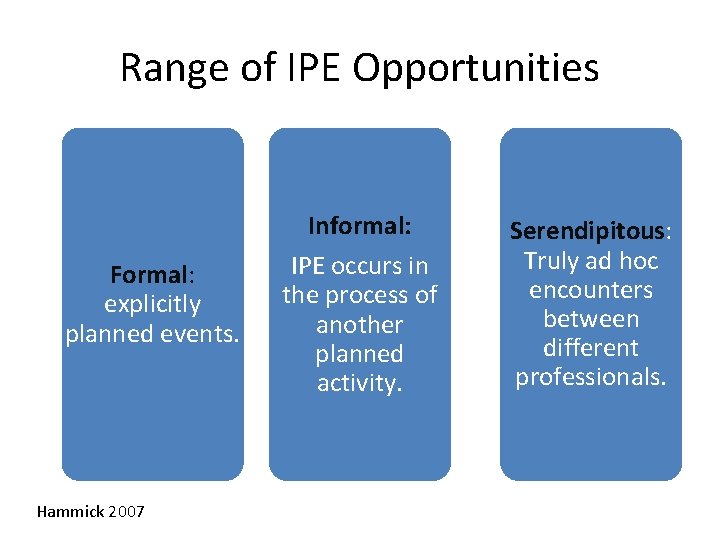
Range of IPE Opportunities Formal: explicitly planned events. Hammick 2007 Informal: IPE occurs in the process of another planned activity. Serendipitous: Truly ad hoc encounters between different professionals.
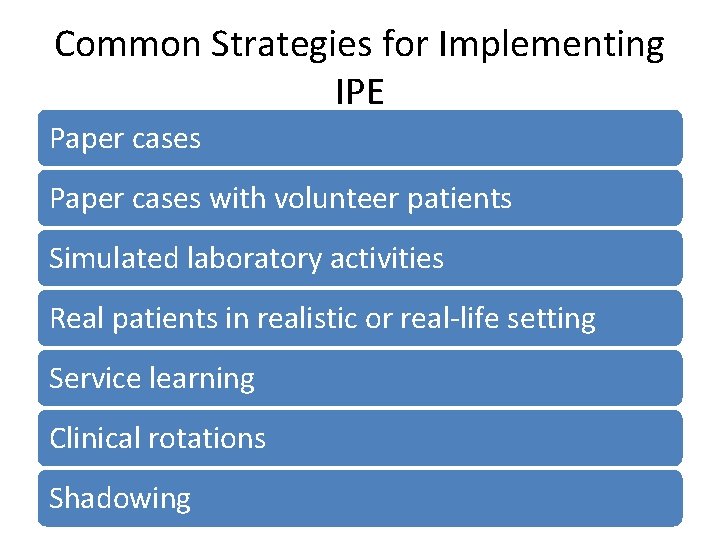
Common Strategies for Implementing IPE Paper cases with volunteer patients Simulated laboratory activities Real patients in realistic or real-life setting Service learning Clinical rotations Shadowing
Our role as teachers is to create the learning context, facilitate interaction, and promote reflection
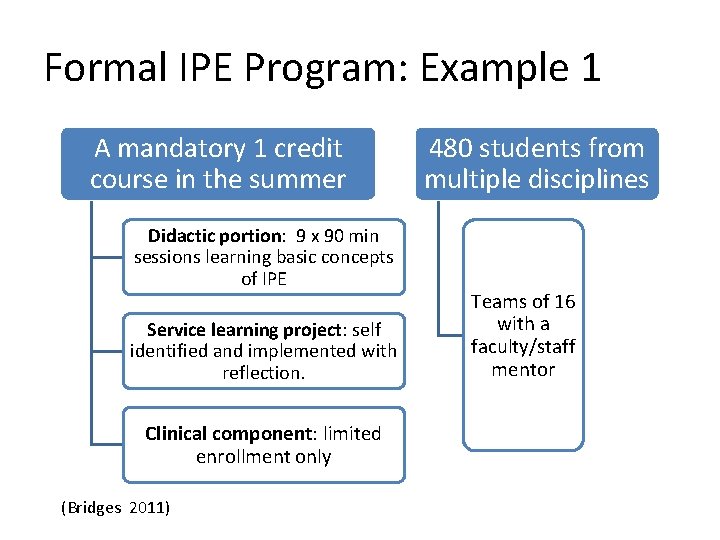
Formal IPE Program: Example 1 A mandatory 1 credit course in the summer Didactic portion: 9 x 90 min sessions learning basic concepts of IPE Service learning project: self identified and implemented with reflection. Clinical component: limited enrollment only (Bridges 2011) 480 students from multiple disciplines Teams of 16 with a faculty/staff mentor
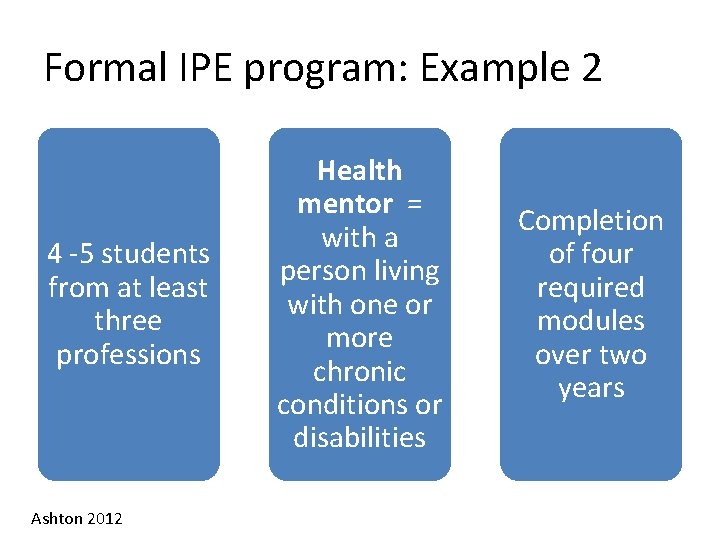
Formal IPE program: Example 2 4 -5 students from at least three professions Ashton 2012 Health mentor = with a person living with one or more chronic conditions or disabilities Completion of four required modules over two years
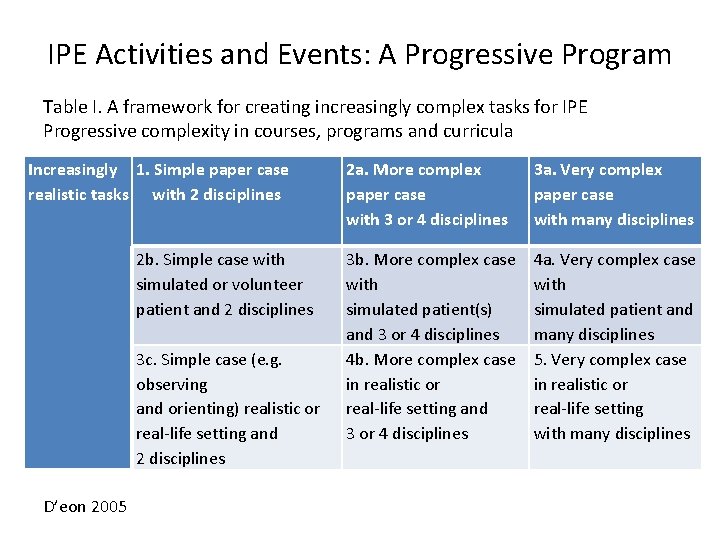
IPE Activities and Events: A Progressive Program Table I. A framework for creating increasingly complex tasks for IPE Progressive complexity in courses, programs and curricula Increasingly 1. Simple paper case realistic tasks with 2 disciplines 2 b. Simple case with simulated or volunteer patient and 2 disciplines 3 c. Simple case (e. g. observing and orienting) realistic or real-life setting and 2 disciplines D’eon 2005 2 a. More complex paper case with 3 or 4 disciplines 3 a. Very complex paper case with many disciplines 3 b. More complex case with simulated patient(s) and 3 or 4 disciplines 4 b. More complex case in realistic or real-life setting and 3 or 4 disciplines 4 a. Very complex case with simulated patient and many disciplines 5. Very complex case in realistic or real-life setting with many disciplines
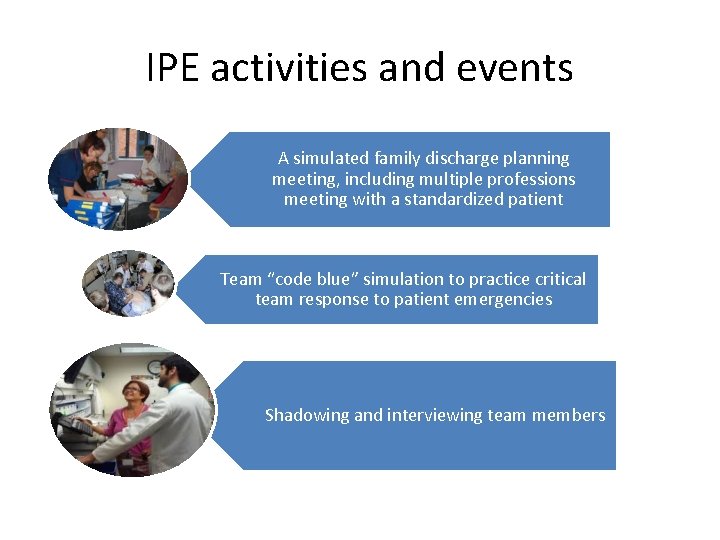
IPE activities and events A simulated family discharge planning meeting, including multiple professions meeting with a standardized patient Team “code blue” simulation to practice critical team response to patient emergencies Shadowing and interviewing team members
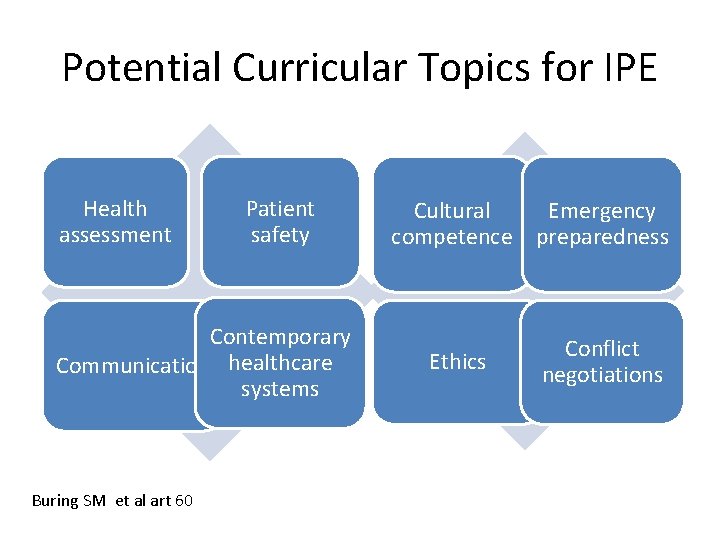
Potential Curricular Topics for IPE Health assessment Patient safety Contemporary Communication healthcare systems Buring SM et al art 60 Cultural Emergency competence preparedness Ethics Conflict negotiations
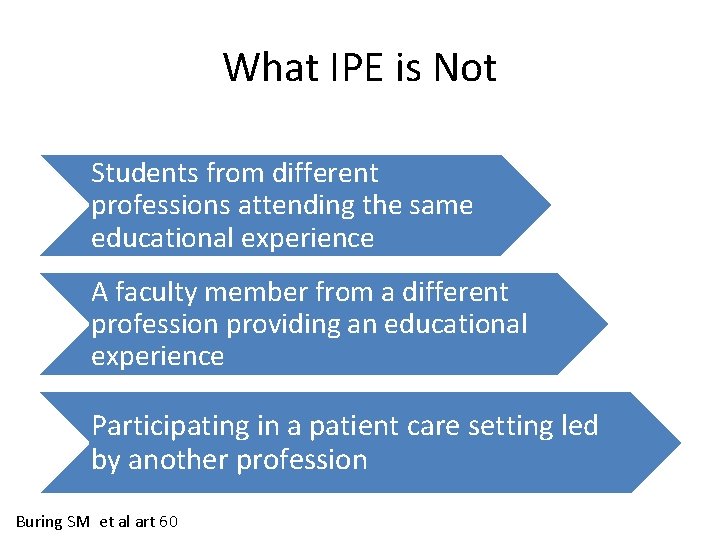
What IPE is Not Students from different professions attending the same educational experience A faculty member from a different profession providing an educational experience Participating in a patient care setting led by another profession Buring SM et al art 60
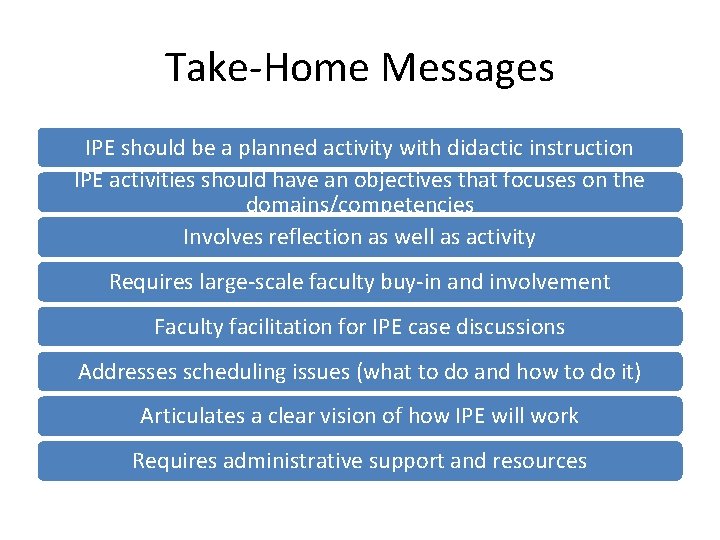
Take-Home Messages IPE should be a planned activity with didactic instruction IPE activities should have an objectives that focuses on the domains/competencies Involves reflection as well as activity Requires large-scale faculty buy-in and involvement Faculty facilitation for IPE case discussions Addresses scheduling issues (what to do and how to do it) Articulates a clear vision of how IPE will work Requires administrative support and resources
DOMAINS AND CORE COMPETENCIES
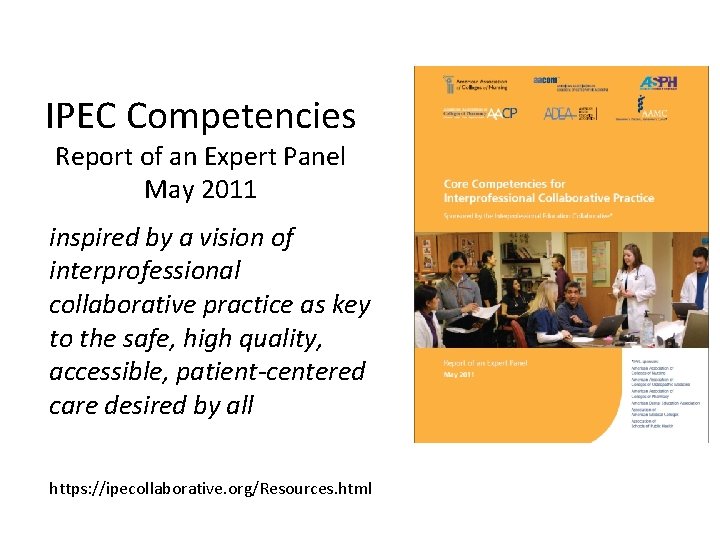
IPEC Competencies Report of an Expert Panel May 2011 inspired by a vision of interprofessional collaborative practice as key to the safe, high quality, accessible, patient-centered care desired by all https: //ipecollaborative. org/Resources. html
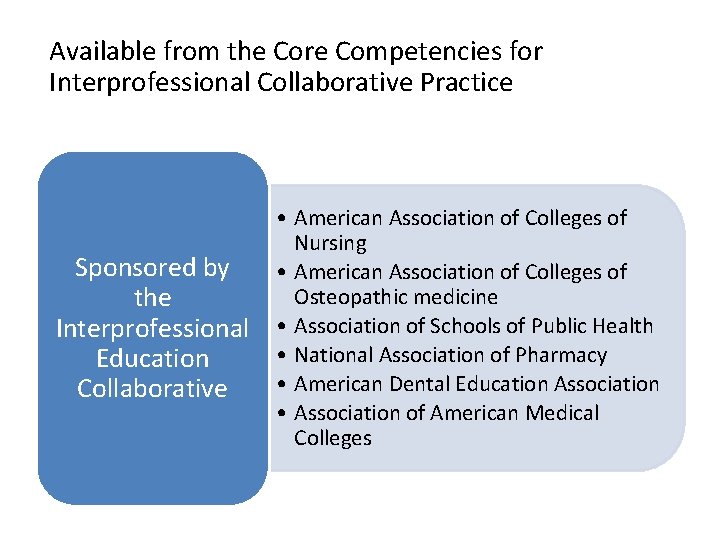
Available from the Core Competencies for Interprofessional Collaborative Practice Sponsored by the Interprofessional Education Collaborative • American Association of Colleges of Nursing • American Association of Colleges of Osteopathic medicine • Association of Schools of Public Health • National Association of Pharmacy • American Dental Education Association • Association of American Medical Colleges
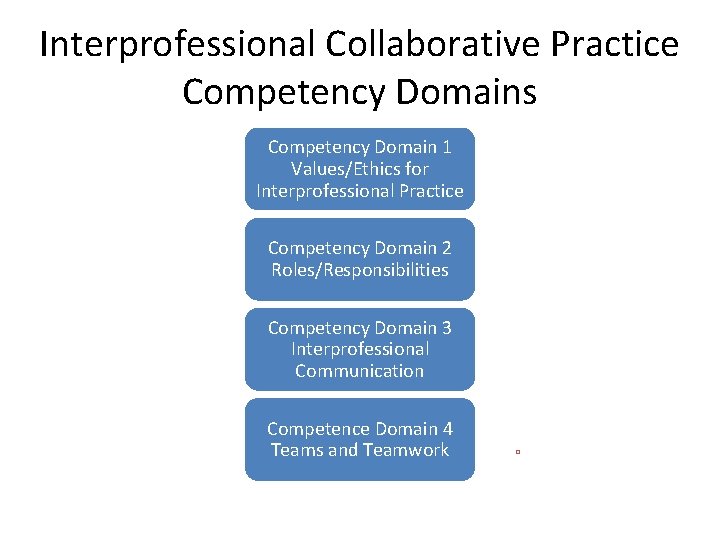
Interprofessional Collaborative Practice Competency Domains Competency Domain 1 Values/Ethics for Interprofessional Practice Competency Domain 2 Roles/Responsibilities Competency Domain 3 Interprofessional Communication Competence Domain 4 Teams and Teamwork
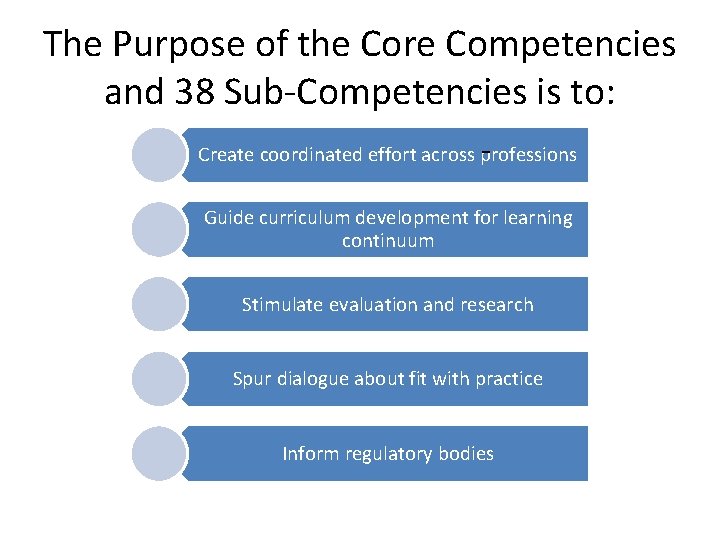
The Purpose of the Core Competencies and 38 Sub-Competencies is to: Create coordinated effort across professions Guide curriculum development for learning continuum Stimulate evaluation and research Spur dialogue about fit with practice Inform regulatory bodies
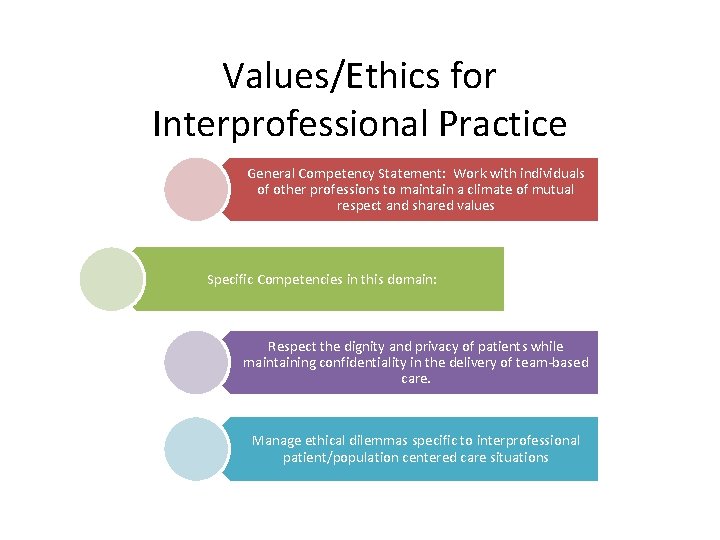
Values/Ethics for Interprofessional Practice General Competency Statement: Work with individuals of other professions to maintain a climate of mutual respect and shared values Specific Competencies in this domain: Respect the dignity and privacy of patients while maintaining confidentiality in the delivery of team-based care. Manage ethical dilemmas specific to interprofessional patient/population centered care situations
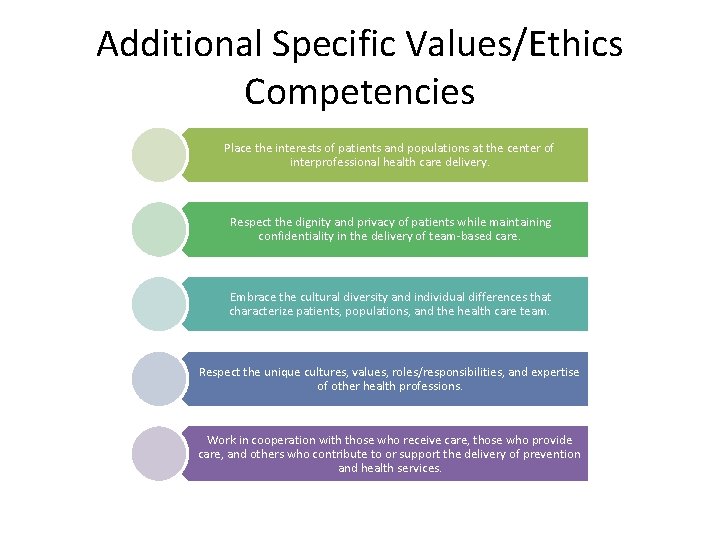
Additional Specific Values/Ethics Competencies Place the interests of patients and populations at the center of interprofessional health care delivery. Respect the dignity and privacy of patients while maintaining confidentiality in the delivery of team-based care. Embrace the cultural diversity and individual differences that characterize patients, populations, and the health care team. Respect the unique cultures, values, roles/responsibilities, and expertise of other health professions. Work in cooperation with those who receive care, those who provide care, and others who contribute to or support the delivery of prevention and health services.
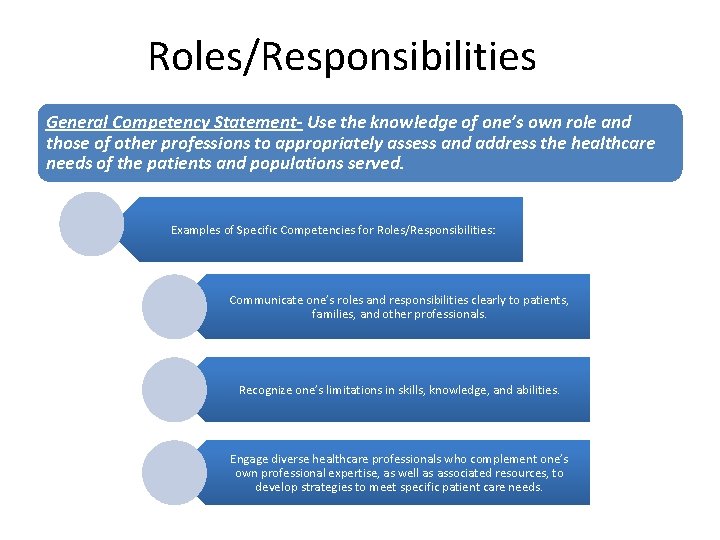
Roles/Responsibilities General Competency Statement- Use the knowledge of one’s own role and those of other professions to appropriately assess and address the healthcare needs of the patients and populations served. Examples of Specific Competencies for Roles/Responsibilities: Communicate one’s roles and responsibilities clearly to patients, families, and other professionals. Recognize one’s limitations in skills, knowledge, and abilities. Engage diverse healthcare professionals who complement one’s own professional expertise, as well as associated resources, to develop strategies to meet specific patient care needs.
Interprofessional Communication General Competency Statement -Communicate with patients, families, communities, and other health professionals in a responsive and responsible manner that supports a team approach to the maintenance of health and the treatment of disease.
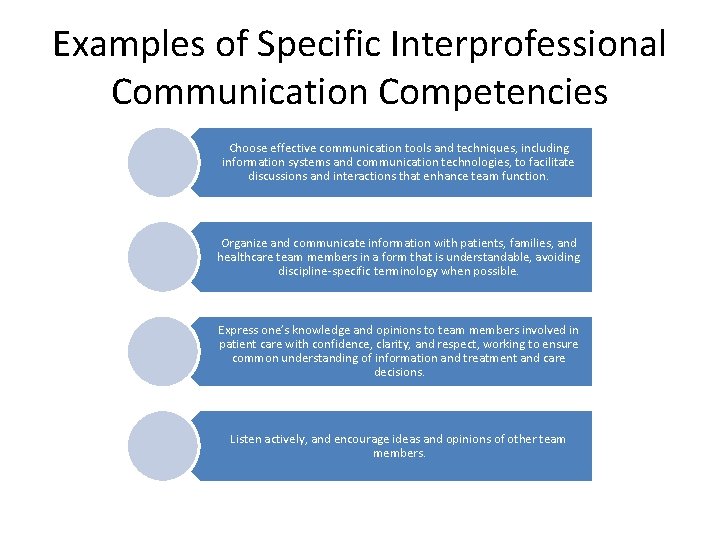
Examples of Specific Interprofessional Communication Competencies Choose effective communication tools and techniques, including information systems and communication technologies, to facilitate discussions and interactions that enhance team function. Organize and communicate information with patients, families, and healthcare team members in a form that is understandable, avoiding discipline-specific terminology when possible. Express one’s knowledge and opinions to team members involved in patient care with confidence, clarity, and respect, working to ensure common understanding of information and treatment and care decisions. Listen actively, and encourage ideas and opinions of other team members.
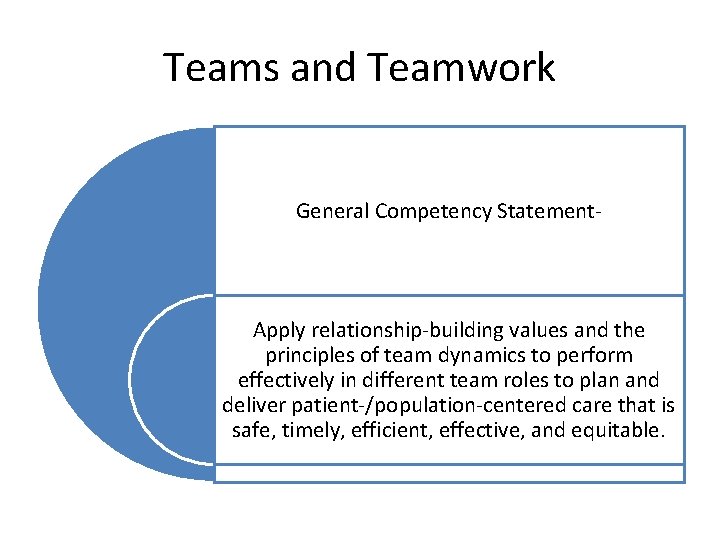
Teams and Teamwork General Competency Statement- Apply relationship-building values and the principles of team dynamics to perform effectively in different team roles to plan and deliver patient-/population-centered care that is safe, timely, efficient, effective, and equitable.
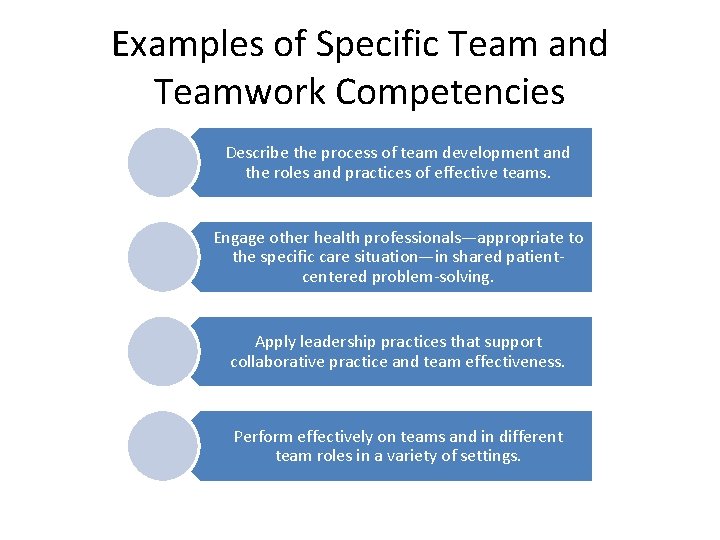
Examples of Specific Team and Teamwork Competencies Describe the process of team development and the roles and practices of effective teams. Engage other health professionals—appropriate to the specific care situation—in shared patientcentered problem-solving. Apply leadership practices that support collaborative practice and team effectiveness. Perform effectively on teams and in different team roles in a variety of settings.
MUHSC IPE ACTIVITIES
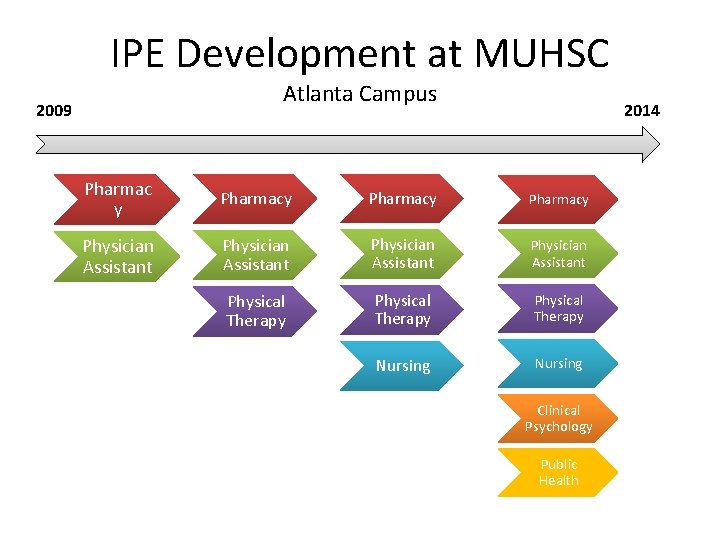
IPE Development at MUHSC Atlanta Campus 2009 2014 Pharmac y Pharmacy Physician Assistant Physical Therapy Nursing Clinical Psychology Public Health
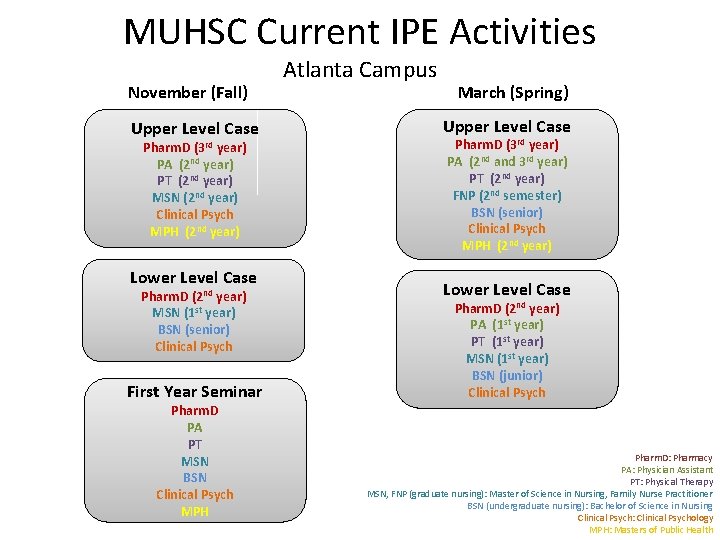
MUHSC Current IPE Activities November (Fall) Upper Level Case Pharm. D (3 rd year) PA (2 nd year) PT (2 nd year) MSN (2 nd year) Clinical Psych MPH (2 nd year) Lower Level Case Pharm. D (2 nd year) MSN (1 st year) BSN (senior) Clinical Psych First Year Seminar Pharm. D PA PT MSN BSN Clinical Psych MPH Atlanta Campus March (Spring) Upper Level Case Pharm. D (3 rd year) PA (2 nd and 3 rd year) PT (2 nd year) FNP (2 nd semester) BSN (senior) Clinical Psych MPH (2 nd year) Lower Level Case Pharm. D (2 nd year) PA (1 st year) PT (1 st year) MSN (1 st year) BSN (junior) Clinical Psych Pharm. D: Pharmacy PA: Physician Assistant PT: Physical Therapy MSN, FNP (graduate nursing): Master of Science in Nursing, Family Nurse Practitioner BSN (undergraduate nursing): Bachelor of Science in Nursing Clinical Psych: Clinical Psychology MPH: Masters of Public Health
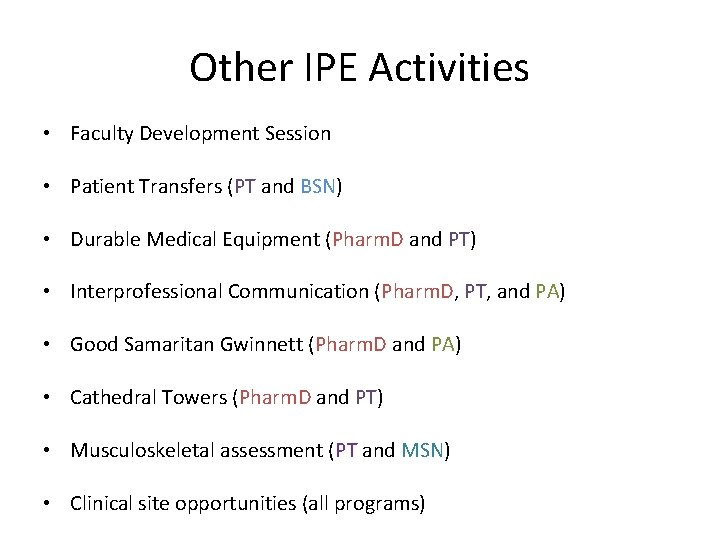
Other IPE Activities • Faculty Development Session • Patient Transfers (PT and BSN) • Durable Medical Equipment (Pharm. D and PT) • Interprofessional Communication (Pharm. D, PT, and PA) • Good Samaritan Gwinnett (Pharm. D and PA) • Cathedral Towers (Pharm. D and PT) • Musculoskeletal assessment (PT and MSN) • Clinical site opportunities (all programs)
MUHSC IPE SCHOLARSHIP OPPORTUNITIES
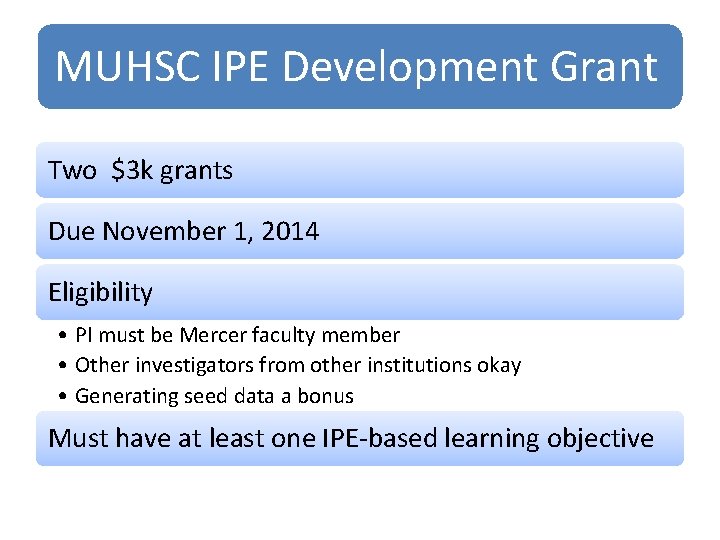
MUHSC IPE Development Grant Two $3 k grants Due November 1, 2014 Eligibility • PI must be Mercer faculty member • Other investigators from other institutions okay • Generating seed data a bonus Must have at least one IPE-based learning objective
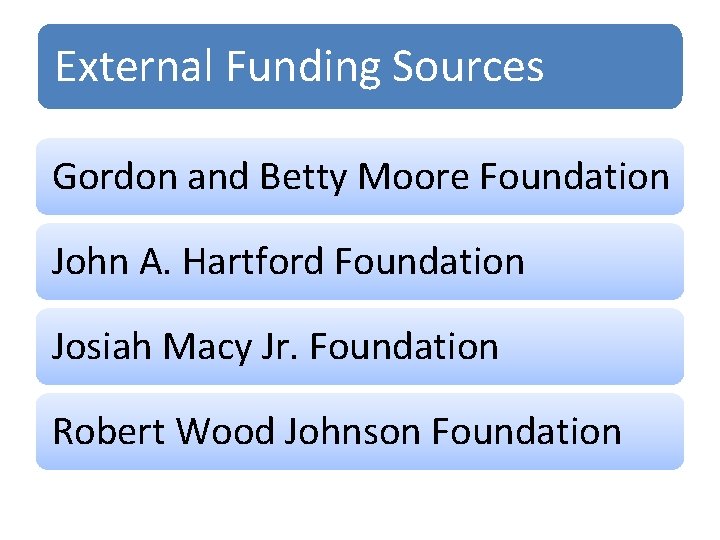
External Funding Sources Gordon and Betty Moore Foundation John A. Hartford Foundation Josiah Macy Jr. Foundation Robert Wood Johnson Foundation
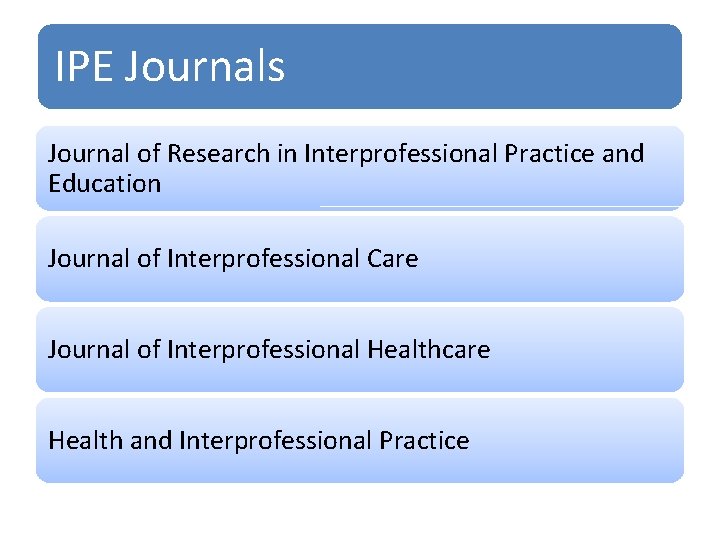
IPE Journals Journal of Research in Interprofessional Practice and Education Journal of Interprofessional Care Journal of Interprofessional Healthcare Health and Interprofessional Practice
GROUP IPE PLANNING ACTIVITY
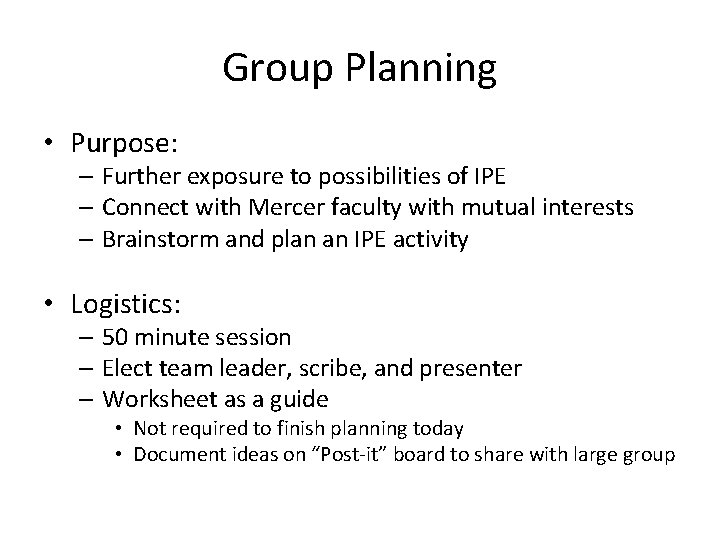
Group Planning • Purpose: – Further exposure to possibilities of IPE – Connect with Mercer faculty with mutual interests – Brainstorm and plan an IPE activity • Logistics: – 50 minute session – Elect team leader, scribe, and presenter – Worksheet as a guide • Not required to finish planning today • Document ideas on “Post-it” board to share with large group
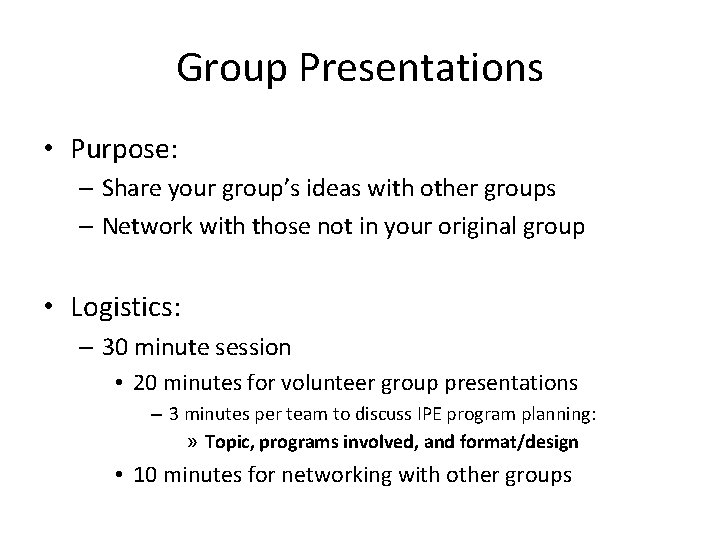
Group Presentations • Purpose: – Share your group’s ideas with other groups – Network with those not in your original group • Logistics: – 30 minute session • 20 minutes for volunteer group presentations – 3 minutes per team to discuss IPE program planning: » Topic, programs involved, and format/design • 10 minutes for networking with other groups
References 1. 2. 3. 4. 5. 6. 7. 8. 9. 10. 11. 12. 13. 14. 15. 16. 17. Anderson ES, Thorpe LN, Hammick M. Interprofessional staff development: Changing attitudes and winning hearts and minds. J Interprofess Care, 2011, 25: 11– 17 Aston et al. Interprofessional Education: A Review and Analysis of Programs From Three Academic Health Centers. Academic Medicine. 2012 Vol. 87, No. 7 Ateah C. et al. Stereotyping as a barrier to collaboration: Does interprofessional education make a difference? Nurse Educ. Today. 2011. 3 208– 213 Blue AV, Mitcham M, Smith T, Raymond J, Greenberg R. Changing the future of health professions: embedding interprofessional education within an academic health center. Acad Med. 2010 Aug; 85(8): 1290 -5. doi: 10. 1097/ACM. 0 b 013 e 3181 e 53 e 07 Bridges DR, Davidson RA, Soule Odegard P, Maki IV, Tomkowiak J. Interprofessional collaboration: three best practice models of interprofessional education. Med Educ Online 2011, 16: 6035 - DOI: 10. 3402/meo. v 16 i 0. 6035 Buring SM et al. Interprofessional Education Supplement. Keys to successful implementation of internprofessional education: learning, location, faculty development, and curricular themes Am J Pharm Ed. 2009; 73 (4) Art 60. Buring SM et al. Interprofessional Education Supplement. Interprofessional education: definitions, student competencies and guidelines for implementation. Am J Pharm Ed. 2009; 73 (4) Art 59. D’eon M. A blueprint for interprofessional learning. J Interprofess Care 2005, Supplement 1, 49– 59. Hammick M, Freeth D, Koppel I, Reeves S, Barr H. A best evidence systematic review of interprofessional education: BEME Guide no. 9. Medical Teacher. 2007; 29: 735 – 751 Hawkes G, Nunney I, Lindqvist S. Caring for attitudes as a means of caring for patients – improving medical, pharmacy and nursing students’ attitudes to each other’s professions by engaging them in interprofessional learning. Medical Teacher. 2013; 35: e 1302–e 1308 Hean S, Macleod Clarke J, Adams K, Humphris, D. Will opposites attract? Similarities and differences in students’ perceptions of the stereotype profiles of other health and social care professional groups. J Interprofess Care. 2006; 20(2): 162 – 181 Lapkin S, Levett-Jones T, Gilligan C. A systematic review of the effectiveness of interprofessional education in health professional programs. Nurse Educ Today. 2013. 33 90– 102 Pollard KC, Miers ME. From students to professionals: Results of a longitudinal study of attitudes to pre-qualifying collaborative learning and working in health and social care in the United Kingdom. 2008 J Interprofessl Care; 22(4): 399– 416 Reeves S, Perrier L, Goldman J, Freeth D, Zwarenstein M. Interprofessional education: effects on professional practice and healthcare outcomes (update). Cochrane Database of Systematic Reviews 2013, Issue 3. Art. No. : CD 002213. DOI: 10. 1002/14651858. CD 002213. pub 3. Steinert Y. Learning together to teach together: Interprofessional education and faculty development. J Interprofess Care. May 2005; Supplement 1: 60 – 75 World Health Organization. Framework for Action on Interprofessional Education and Collaborative Practice. Geneva, Switzerland: World Health Organization; 2010. p. 8 http: //www. who. int/hrh/resources/framework_action/en/index. html. Accessed July 14 th, 2014. Wright A, Hawkes G, Baker, Lindqvist SM. Reflections and unprompted observations by healthcare students of and interprofessional shadowing visit. J Interprofess Care. 2012; 26: 305 -311.