Institutional theory concepts IN 5210 Information systems Johan




- Slides: 30
Institutional theory - concepts IN 5210 Information systems Johan Ivar Sæbø
Outline: Lecture of two parts 1. (very basic) Overview of institutional theory, following the chapter by Currie. I will not cover everything in this chapter (and I will not use other references much) What, Why, How? 2. Example of institutional theory used in information systems research – In particular, such theory used in the HISP project on health information systems strengthening in developing countries • The idea is that the second part will make it easier to digest and understand the first part. Institutional theory in practice!
What?
What is an institution? • Many definitions, some commonalities: – Multi-faceted, durable, social structures, made up of symbolic elements, social activities, and material resources” - Scott (2001) • Family, religion, economic systems, legal systems, language, mass media, businesses, academia, the nation-state, art…
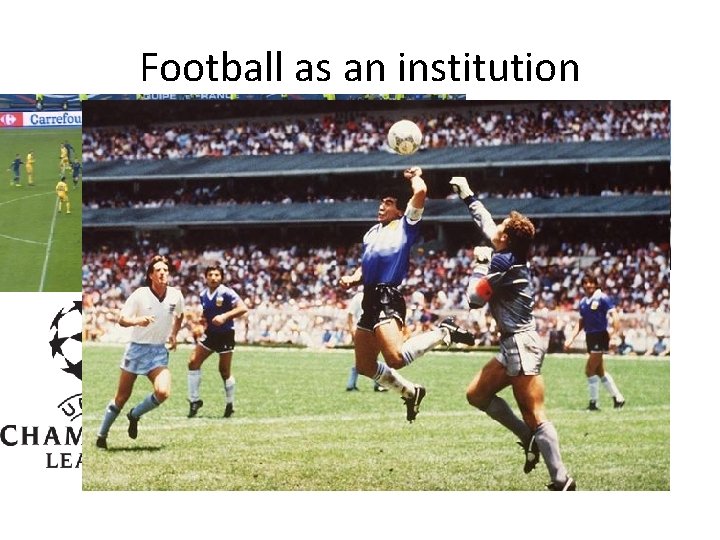
What’s the difference between an organization and an institution? • A school is an organization; education is an institution • A football club is an organization; football as a game is an institution • ”An organization is a player, while institutions are the rules of the game”
Football as an institution
Institutional theory is about the stability and change of institutions • Institutionalization is the process by which an institution attains a stable and durable state or property • Deinstitutionalization is a process by which the legitimacy of an established practice erodes or discontinues • Reinstitutionalization is an exit from one institutionalization, and entry into another institutional form
Example: Family • ”Multi-faceted, durable, social structures, made up of symbolic elements, social activities, and material resources” • Mother, father, children. ”Western nuclear family” • Formal rules (marriage, laws, etc), informal rules (no cheating, division of responsibilities), symbolic elements (wedding, ring, ”mother in law”), social activities (vacation, Friday taco!, etc), material resources (shared home, the table around which you gather for dinner, etc) • Is this institution similar all over the world? • How stable is it? Is it changing?
Why?
Why are institutions interesting from an IT/IS perspective? • Instititutional theory is/has traditionally been concerned with stability, while technologies are often associated with rapid and sometimes disruptive societal and organizational changes • Developing and using IT are subject to social pressures (not necessarily felt or understood) – We, developers and users, are actors in many instituions • So: IT influence institutions influence IT
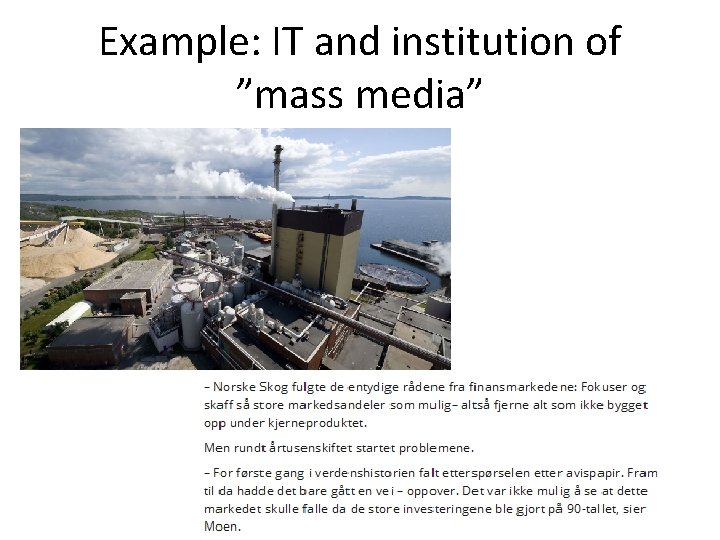
Example: IT and institution of ”mass media”
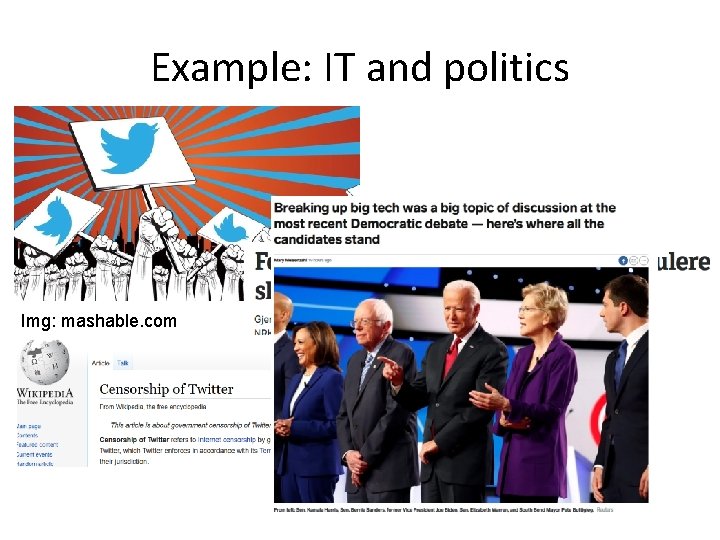
Example: IT and politics Img: mashable. com
Can better explain adoption (or non-adoption) of IT • Institutional theory brings in the social context, challenging an economic-rationalistic perspective • The boundary of rational choice (about IT) is socially constructed, and if legitimated and taken for granted as a social fact, operates and persists even beneath the level of consciousness – We (and our organizations) act out of socially constructed ideas of what is beneficial. We use institutional arguments rather than rational choice arguments • Provides an understanding of phenomena not so well explained by economic-rationalist models, such as the wide adoption and acceptance of IT innovations seemingly suboptimal in economic and technical terms
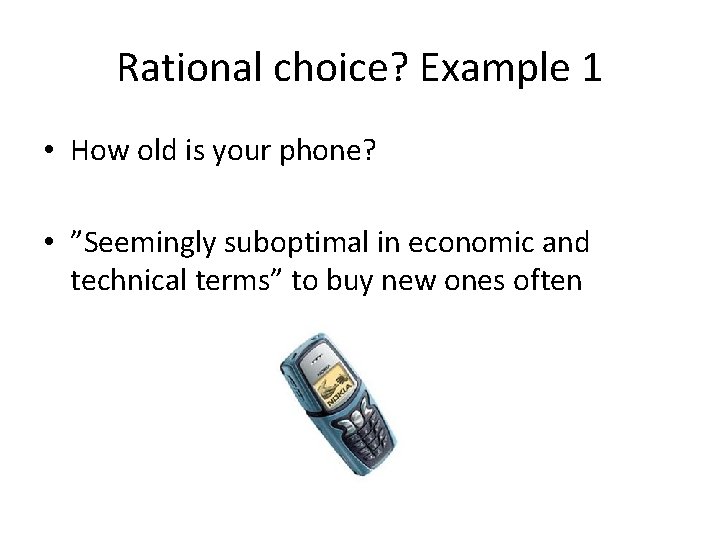
Rational choice? Example 1 • How old is your phone? • ”Seemingly suboptimal in economic and technical terms” to buy new ones often
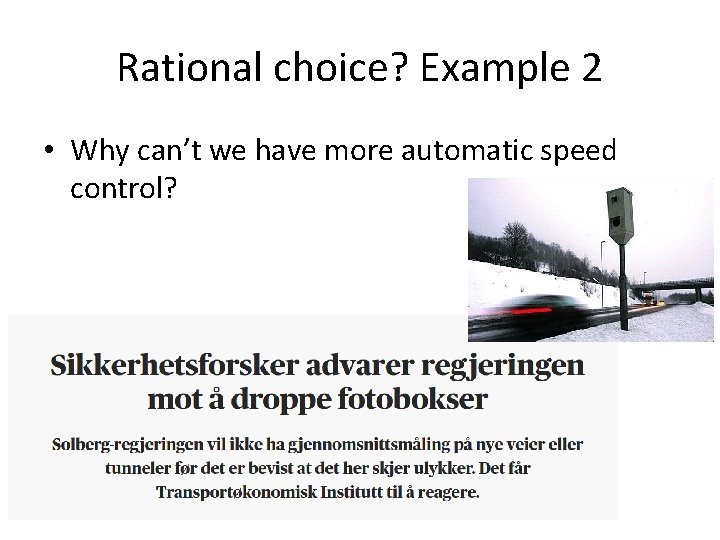
Rational choice? Example 2 • Why can’t we have more automatic speed control?
One final introductory comment. . • The chapter talks a lot about (old) institutionalism and neoinstitutionalism. It is possible to define both so that they seem either mutually exclusive, or mostly overlapping! (thus, no need to get too deep into this story unless you want to do a Ph. D) • Old institutionalism saw organizations as organic whole, focused on the state or governments, and rational-choice approaches • New institutionalism has more focus on individuals (in institutions), and their conceptions (as opposed to rational choice), and does not only deal with governments and states
The HOWs Moving to some central concepts… (or, the language institutional theory gives us to explain things)
Institutional change • This is the overarching theme. The following slides deals with different constructs to look at this – The reading by Currie goes a bit back and forth • I will thus not focus too much on this per se, but re-iterate that all concepts of change should be seen as useful also to describe/understand lack of change.
Organizational field • ”Those organizations that, in the aggregate, constitute a recognized area of insitutional life” – Di. Maggio and Powell 1983 • All universities and university colleges in Norway (all universities in the world? ) – The players (organizations) than play a certain game (institutions). In this case, the game of ”higher education”.
Organizational isomorphism • Isomorphism: to become the same • Within an organizational field, researchers found ”rational actors make their organizations increasingly similar as they try to change them” • Universities operate more or less the same way? • Any big differences between Rema and Kiwi?
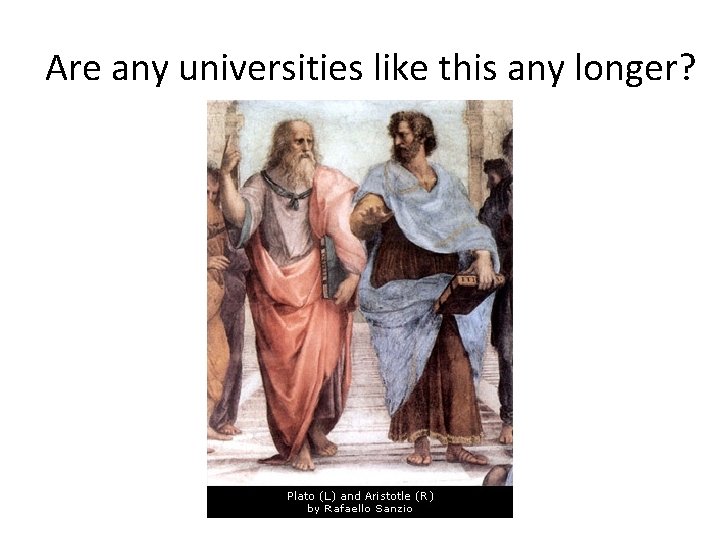
Are any universities like this any longer?
Organizational isomorphism • Coercive isomorphism: formal and informal pressures exerted on organization by powerful entities such as the state and by cultural expectations in the organization’s environment • Mimetic isomorphism stems from uncertainty. When things are uncertain (as with new technologies), you watch what others are doing and model yourself after them • Normative pressures stem largely from professionalization. Collective struggle of members of an occuption to define conditions and methods or their work
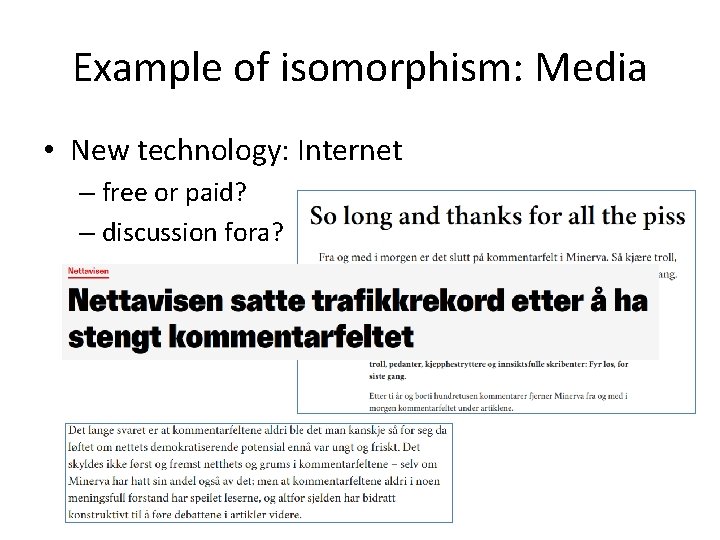
Example of isomorphism: Media • New technology: Internet – free or paid? – discussion fora?
Institutional logics • ”sets of material practices and symbolic constructions which constitute a field’s organizing principles and which are available to organizations and individuals to elaborate” – Friedland Alford 1991 • Formal and informal rules of action, interaction, and interpretations that guide and constrain decision makers. Cognitive maps and belief systems. • Example: Our economy (an institution) has certain shared belief systems (such as capitalism). Alternatives? – Communism/planned economy – Islamic banking (no usury, profit and loss sharing, etc) • More on this in the second part of the lecture…
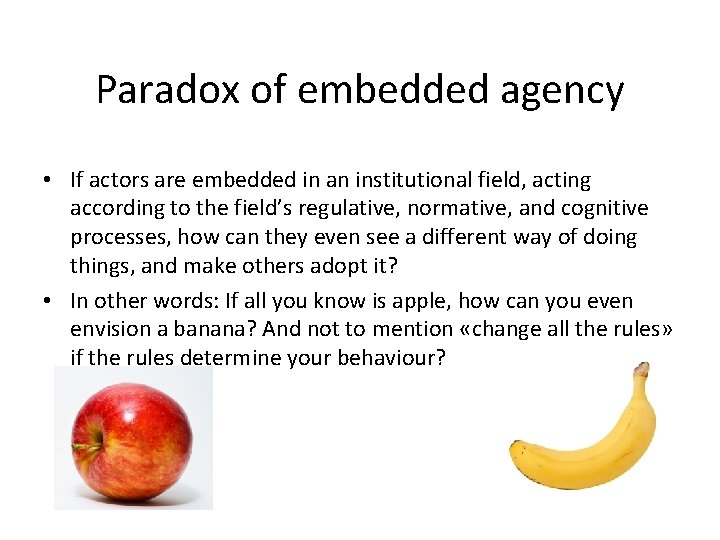
Paradox of embedded agency • If actors are embedded in an institutional field, acting according to the field’s regulative, normative, and cognitive processes, how can they even see a different way of doing things, and make others adopt it? • In other words: If all you know is apple, how can you even envision a banana? And not to mention «change all the rules» if the rules determine your behaviour?
One attempt: Institutional entrepreneur • Institutional entrepreneurship ”activities of actors who have an interest in particular institutional arrangements and who leverages resources to create new institutions or to transform existing ones” – Maguire, Hardy, and Lawrence 2004 • Re-introduction of agency and interest into institutional analysis. We are not slaves of our institutions. • Furthermore, we are not only part of the institutions in which we work. While I’m in the ”academic world”, I am also living within many other institutions (parliamentary democracy, market economy, ”Western popular culture”, etc), which may shape my conceptions of work practices at the university.
Institutional theory in IS research • Not as rigourous. Play down the ambiguities and multidisciplinarity of the field (second part of the lecture will show this) • Selective in the use: more on institutional effects on IT, less on IT as process of institutionalization – Examples: mindful innovation (Swanson and Ramiller), coercive, mimetic and normative pressures on assimilation of IT (Liang et al), institutionalization of IT budgeting (Hu and Quan), managment fashions of IT adoption (Currie) + + • Currie found seven broad categories of use: – Technology and institutions, innovation, industrial sectors, adoption and diffusion, strategy and outsourcing, applications development and implementation, and knowledge-based work
Summary on the use of Institutional theory in IS • Dominant view is that institutions are part of the environment shaping development and use of IT • IT-as-institution: focus on institutionalization of technology within a single organization. IT itself treated as ”Multi-faceted, durable, social structures, made up of symbolic elements, social activities, and material resources” • Institutional concepts are often simplified • IS researchers rarely relates to the history and interdisciplinarity of institutional theory
Some challenges of using institutional theory in IS • IT research focus on lower level of analysis rather than the ”regulative processes, normative systems, and cultural frameworks” • What is science? Positivist methods (surveys, experiments) vs interpretivist methods (case studies and ethnographies). Many IT/IS researchers apply the former, and may we wary about ill-defined institutionalist concepts • Poorly defined concepts, multiple definitions of institutions, a field with ”almost no limits” • Shift from asking ”Big questions” towards ”narrowly oriented research” like `normal` science
Summary of part 1 • Instititutional theory deals with stability and change of institutions • Central concepts: organizational fields, organizational isomorphism, institutional logics, intstitutional entrepreneurs • Have increasingly been used to look at IT and IS; mostly on how technology development and use is shaped by institutions • Is a large, interdisciplinary field, and most IT/IS application is piecemeal