Inferring Networks of Diffusion and Influence Manuel Gomez

- Slides: 25
Inferring Networks of Diffusion and Influence Manuel Gomez Rodriguez 1, 2 Jure Leskovec 1 Andreas Krause 3 1 Stanford University for Biological Cybernetics 3 California Institute of Technology 2 MPI 1
Hidden and implicit networks § Many social or information networks are implicit or hard to observe: Hidden/hard-to-reach populations: § § Implicit connections: § § § Network of information propagation in online news media But can observe results of the processes taking place on such (invisible) networks: Virus propagation: § § Drug users get sick, and we observe when they see the doctor Information networks: § § § Network of needle sharing between the drug injection users We observe when media sites mention information Question: Can we infer the hidden networks? 2
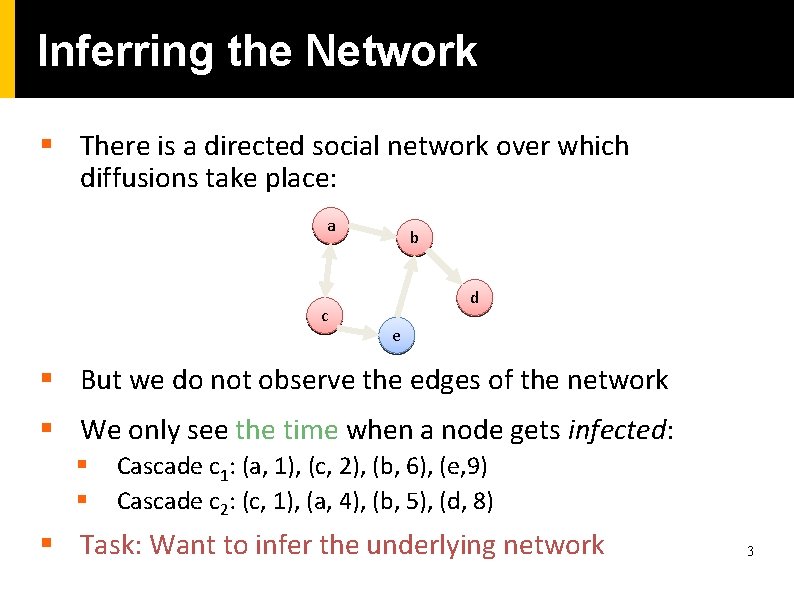
Inferring the Network § There is a directed social network over which diffusions take place: a c b d e § But we do not observe the edges of the network § We only see the time when a node gets infected: § § Cascade c 1: (a, 1), (c, 2), (b, 6), (e, 9) Cascade c 2: (c, 1), (a, 4), (b, 5), (d, 8) § Task: Want to infer the underlying network 3
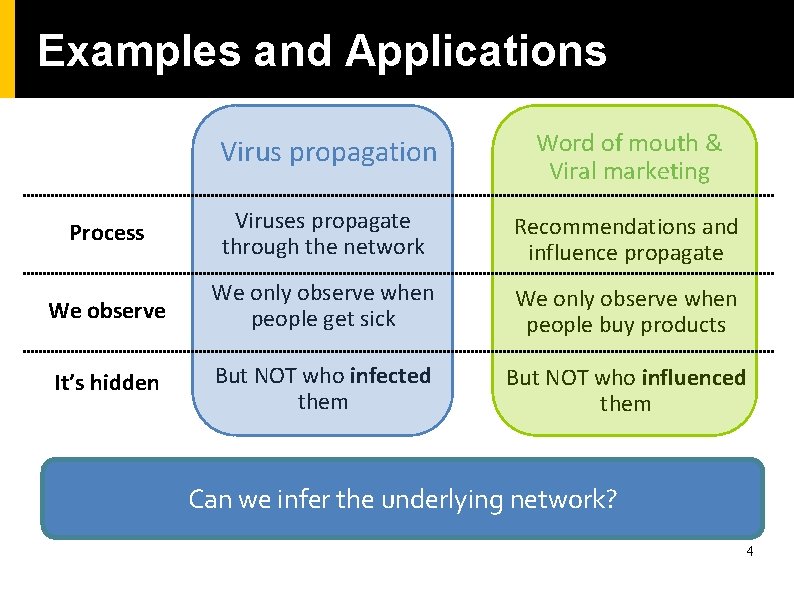
Examples and Applications Virus propagation Word of mouth & Viral marketing Process Viruses propagate through the network Recommendations and influence propagate We observe We only observe when people get sick We only observe when people buy products It’s hidden But NOT who infected them But NOT who influenced them Can we infer the underlying network? 4
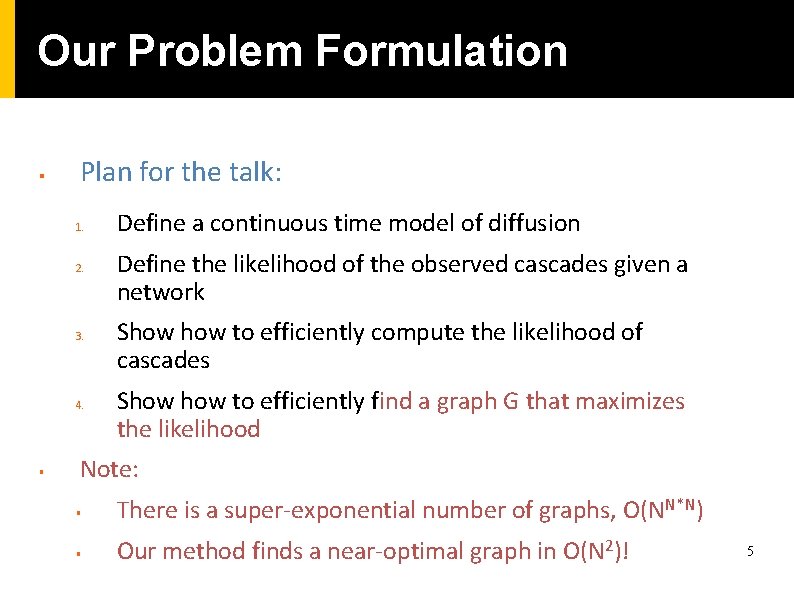
Our Problem Formulation § Plan for the talk: 1. 2. 3. 4. § Define a continuous time model of diffusion Define the likelihood of the observed cascades given a network Show to efficiently compute the likelihood of cascades Show to efficiently find a graph G that maximizes the likelihood Note: § There is a super-exponential number of graphs, O(NN*N) § Our method finds a near-optimal graph in O(N 2)! 5
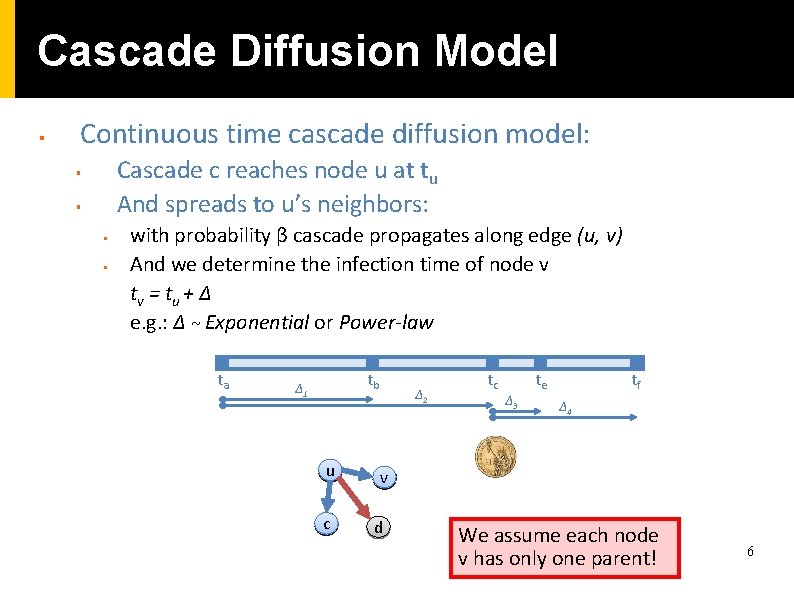
Cascade Diffusion Model § Continuous time cascade diffusion model: Cascade c reaches node u at tu And spreads to u’s neighbors: § § with probability β cascade propagates along edge (u, v) And we determine the infection time of node v tv = tu + Δ e. g. : Δ ~ Exponential or Power-law ta tb Δ 1 u a c Δ 2 tc Δ 3 te tf Δ 4 bv d We assume each node v has only one parent! 6
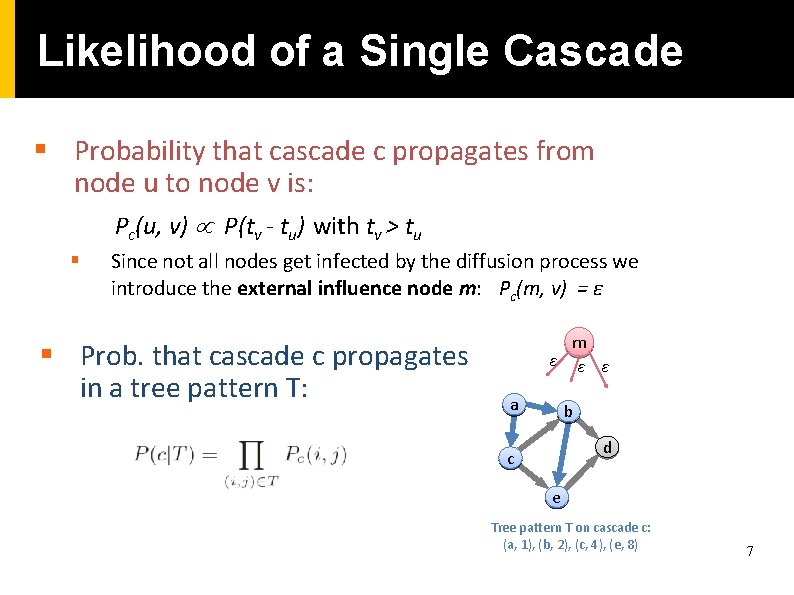
Likelihood of a Single Cascade § Probability that cascade c propagates from node u to node v is: Pc(u, v) P(tv - tu) with tv > tu § Since not all nodes get infected by the diffusion process we introduce the external influence node m: Pc(m, v) = ε § Prob. that cascade c propagates in a tree pattern T: m ε ε ε a b d c e Tree pattern T on cascade c: (a, 1), (b, 2), (c, 4), (e, 8) 7
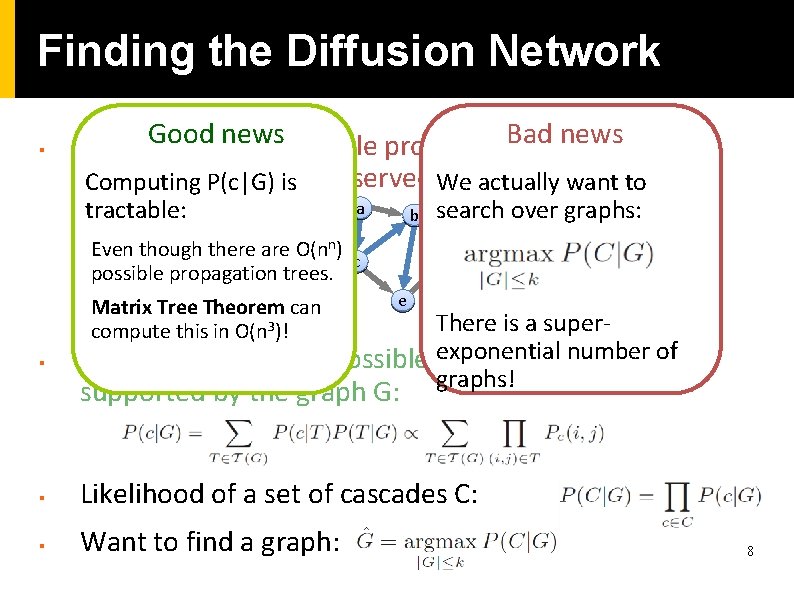
Finding the Diffusion Network § newspossible propagation Badtrees newsthat are There. Good are many consistent with the data: Computing P(c|G) is observed We actually want to § c: (a, a 1), (c, b 2), (b, 3), (e, 4) a tractable: b d are O(nn) Even though there c c possible propagation trees. Matrix Treee. Theorem can compute this in O(n 3)! § a graphs: search over b d e d c e There is a supernumber Need to consider all possible exponential propagation trees of T graphs! supported by the graph G: § Likelihood of a set of cascades C: § Want to find a graph: 8
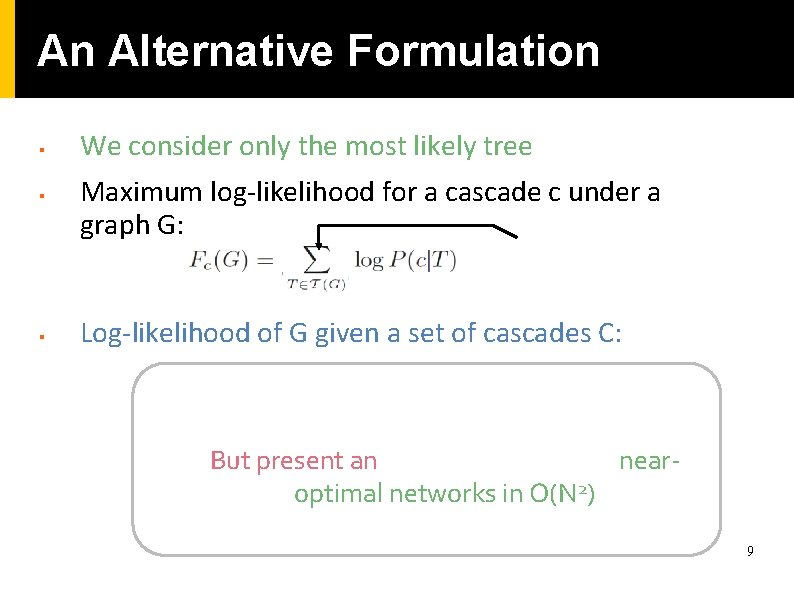
An Alternative Formulation § § § We consider only the most likely tree Maximum log-likelihood for a cascade c under a graph G: Log-likelihood of G given a set of cascades C: The problem is still intractable (NP-hard) But present an algorithm that finds nearoptimal networks in O(N 2) 9
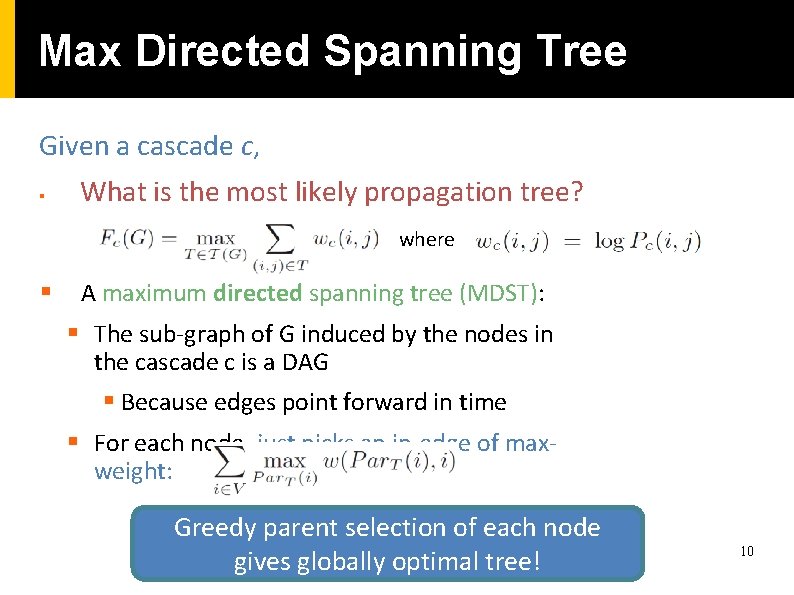
Max Directed Spanning Tree Given a cascade c, § What is the most likely propagation tree? where § A maximum directed spanning tree (MDST): § The sub-graph of G induced by the nodes in the cascade c is a DAG § Because edges point forward in time § For each node, just picks an in-edge of maxweight: Greedy parent selection of each node gives globally optimal tree! 10
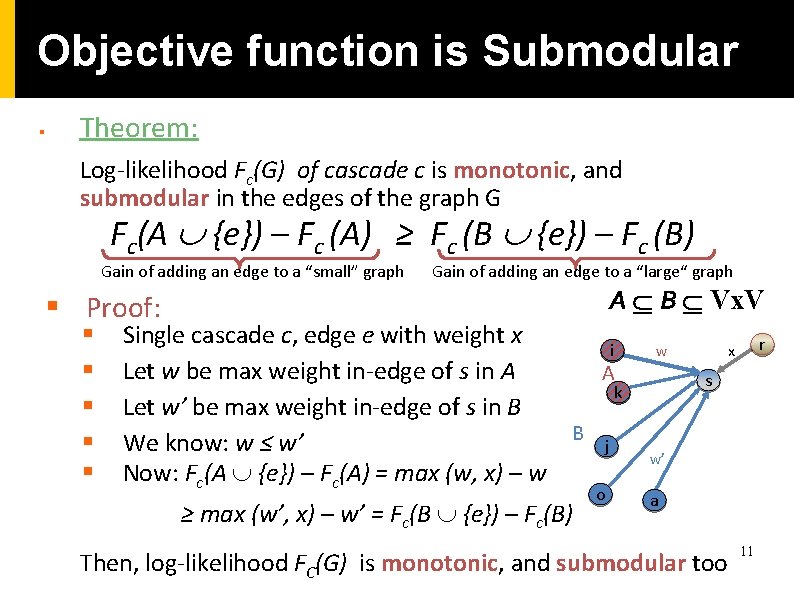
Objective function is Submodular § Theorem: Log-likelihood Fc(G) of cascade c is monotonic, and submodular in the edges of the graph G Fc(A {e}) – Fc (A) ≥ Fc (B {e}) – Fc (B) Gain of adding an edge to a “small” graph Gain of adding an edge to a “large“ graph A B Vx. V § Proof: § § § Single cascade c, edge e with weight x i Let w be max weight in-edge of s in A A k Let w’ be max weight in-edge of s in B B We know: w ≤ w’ j Now: Fc(A {e}) – Fc(A) = max (w, x) – w ≥ max (w’, x) – w’ = Fc(B {e}) – Fc(B) o w r x s w’ a Then, log-likelihood FC(G) is monotonic, and submodular too 11
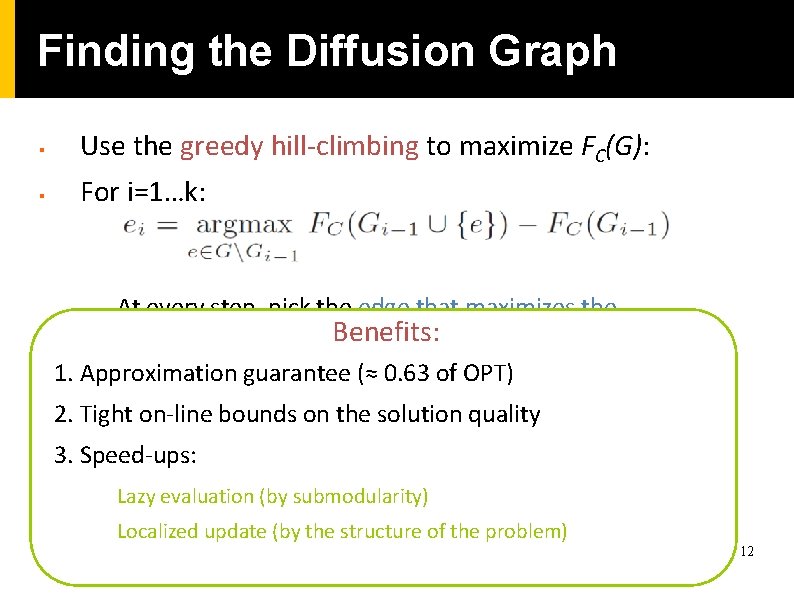
Finding the Diffusion Graph § Use the greedy hill-climbing to maximize FC(G): § For i=1…k: At every step, pick the edge that maximizes the Benefits: b marginal a : 12 improvement a c a : 3 1. Approximation guarantee (≈ 0. 63 bof OPT) d a : 6 § Marginal gains a c d e a b b c e b d b : 20 b : 17 18 Localized 24 b : 1 Localized c update 35 b : 1 update c : 15 Localized : 68 Lazycd evaluation (by submodularity)e update : 16 Localized d : 78 update Localized (by the structure of d : 810 update e : 7 e : 13 2. Tight on-line bounds on the solution quality d 3. Speed-ups: the problem) 12
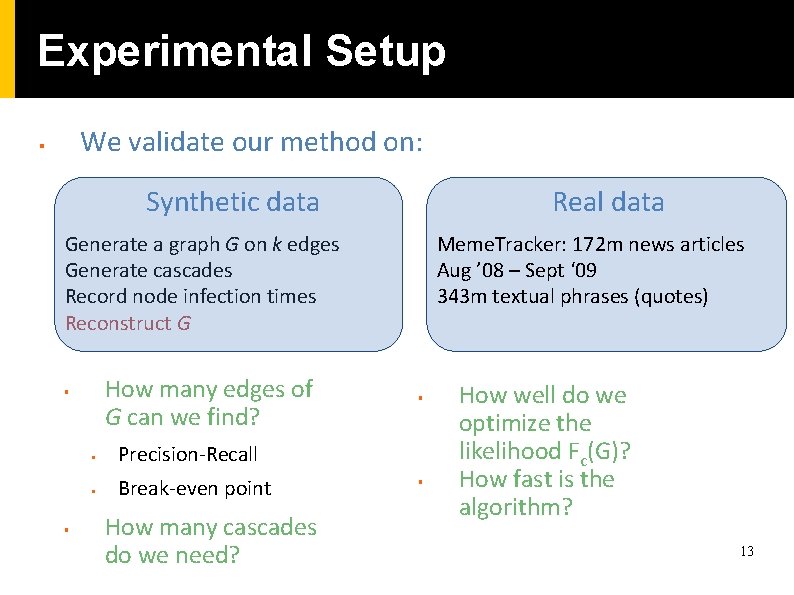
Experimental Setup We validate our method on: § Synthetic data Real data Generate a graph G on k edges Generate cascades Record node infection times Reconstruct G How many edges of G can we find? § § § Precision-Recall § Break-even point How many cascades do we need? Meme. Tracker: 172 m news articles Aug ’ 08 – Sept ‘ 09 343 m textual phrases (quotes) § § How well do we optimize the likelihood Fc(G)? How fast is the algorithm? 13
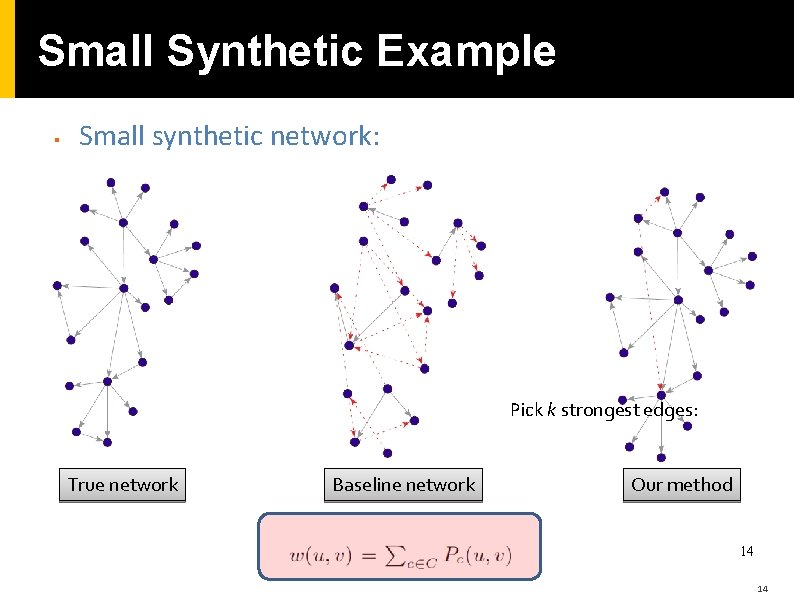
Small Synthetic Example § Small synthetic network: Pick k strongest edges: True network Baseline network Our method 14 14
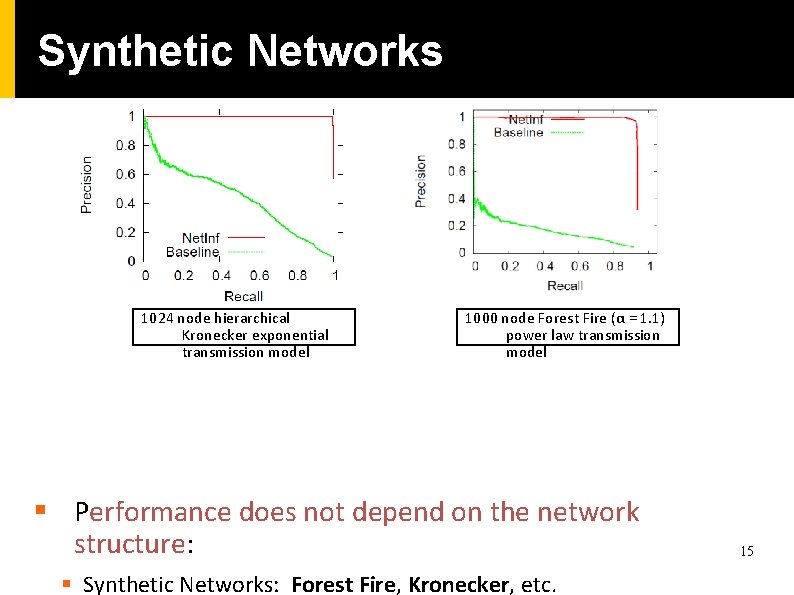
Synthetic Networks 1024 node hierarchical Kronecker exponential transmission model 1000 node Forest Fire (α = 1. 1) power law transmission model § Performance does not depend on the network structure: § Synthetic Networks: Forest Fire, Kronecker, etc. 15
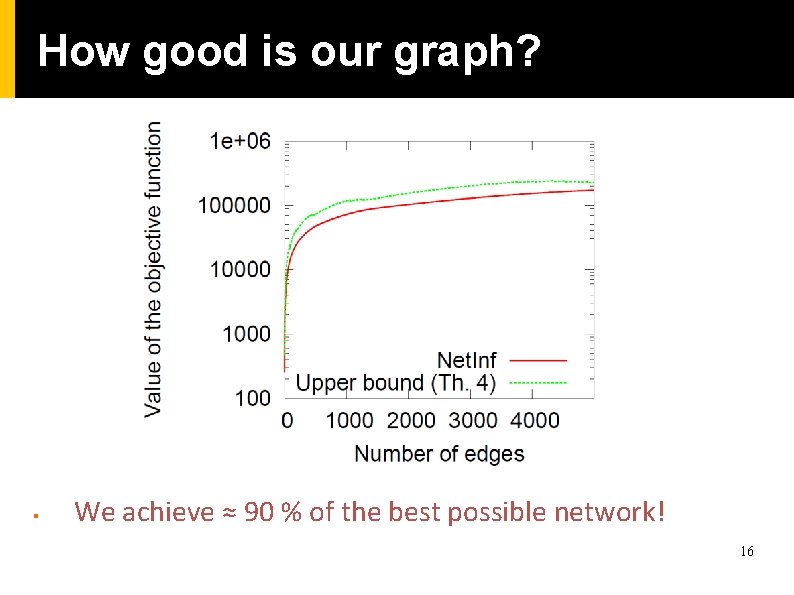
How good is our graph? § We achieve ≈ 90 % of the best possible network! 16
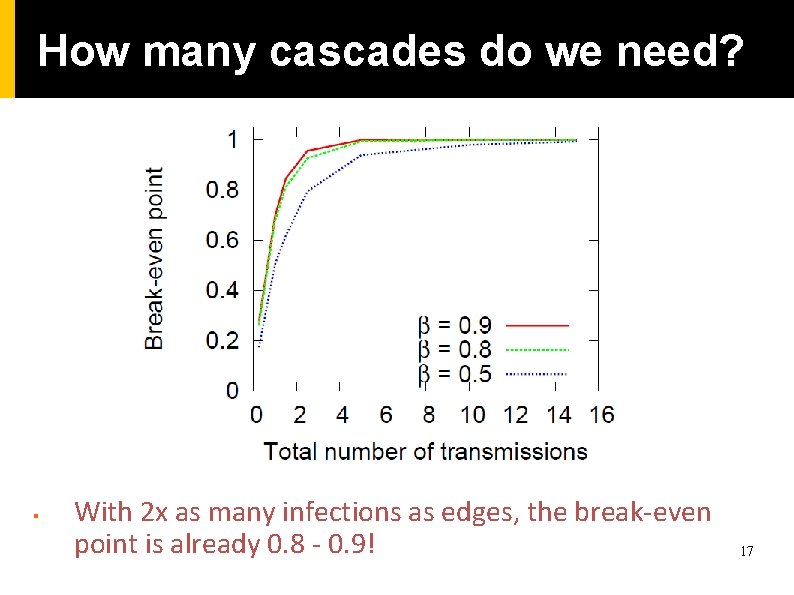
How many cascades do we need? § With 2 x as many infections as edges, the break-even point is already 0. 8 - 0. 9! 17
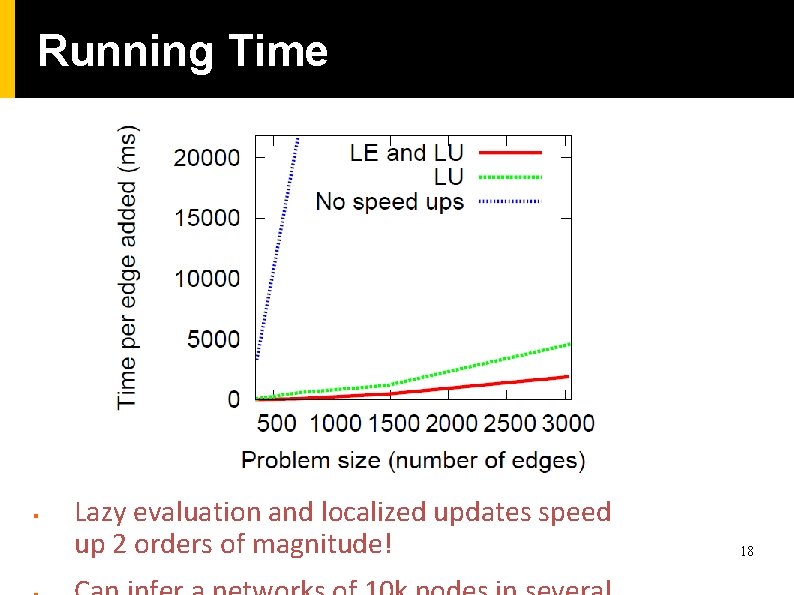
Running Time § Lazy evaluation and localized updates speed up 2 orders of magnitude! 18
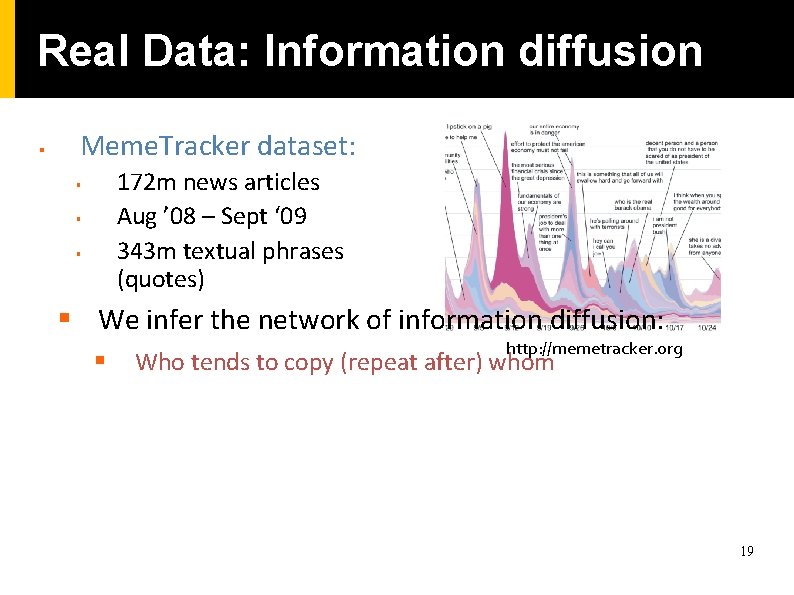
Real Data: Information diffusion § Meme. Tracker dataset: 172 m news articles Aug ’ 08 – Sept ‘ 09 343 m textual phrases (quotes) § § We infer the network of information diffusion: § http: //memetracker. org Who tends to copy (repeat after) whom 19
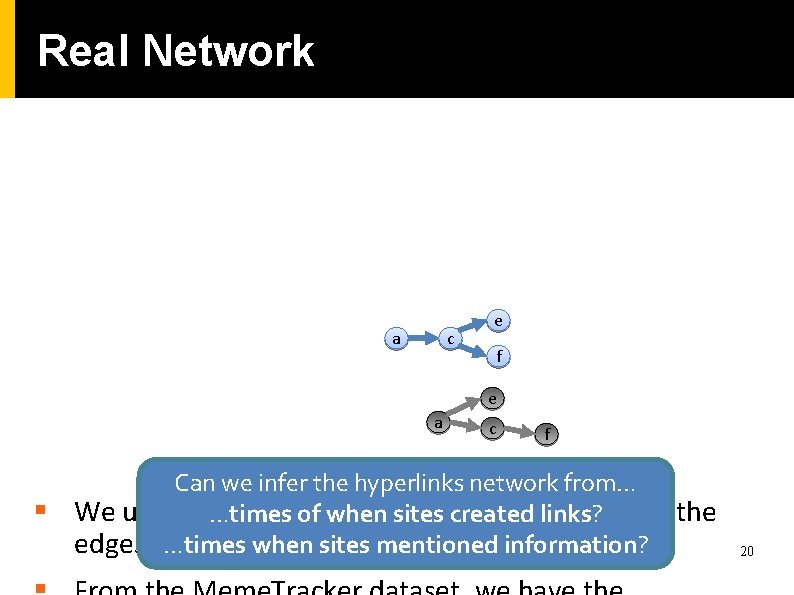
Real Network a c e f e a § c f Can we infer the hyperlinks network from… We use the…times hyperlinks between sites tolinks? generate the of when sites created edges of…times a ground truth when sites. Gmentioned information? 20
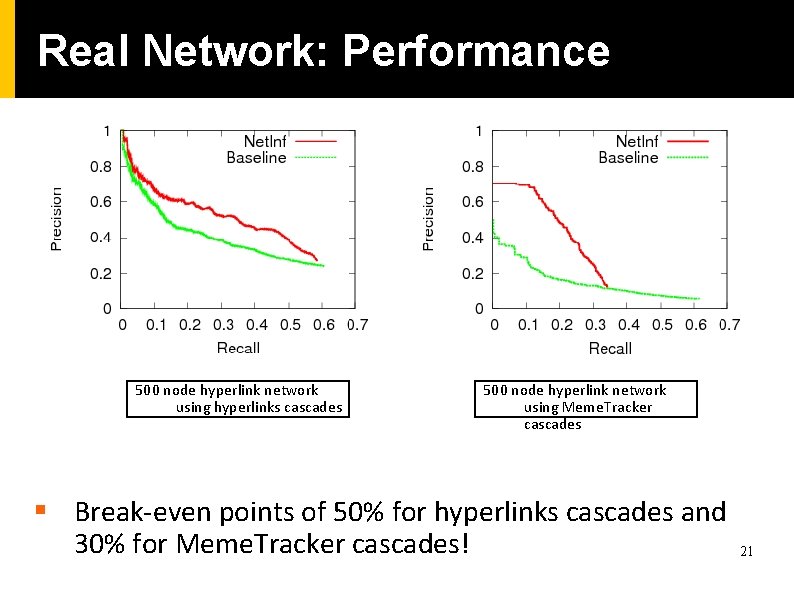
Real Network: Performance 500 node hyperlink network using hyperlinks cascades 500 node hyperlink network using Meme. Tracker cascades § Break-even points of 50% for hyperlinks cascades and 30% for Meme. Tracker cascades! 21
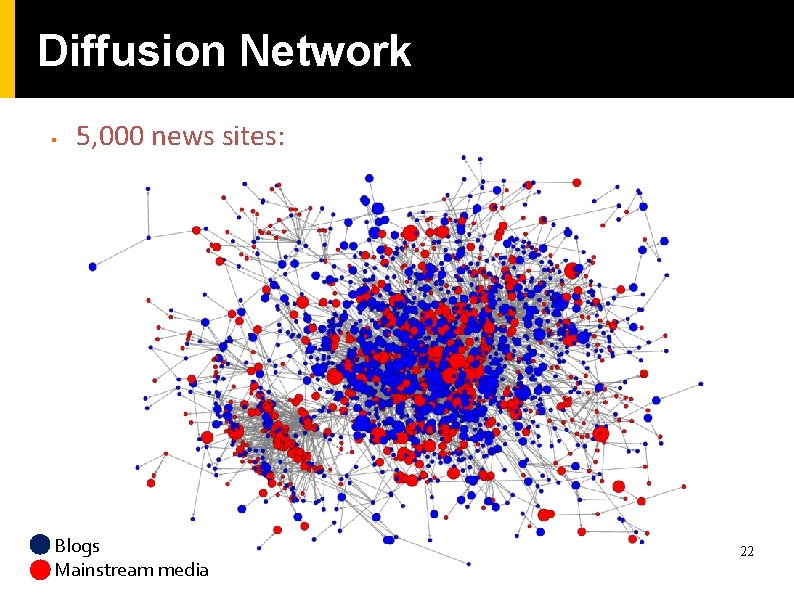
Diffusion Network § 5, 000 news sites: Blogs Mainstream media 22
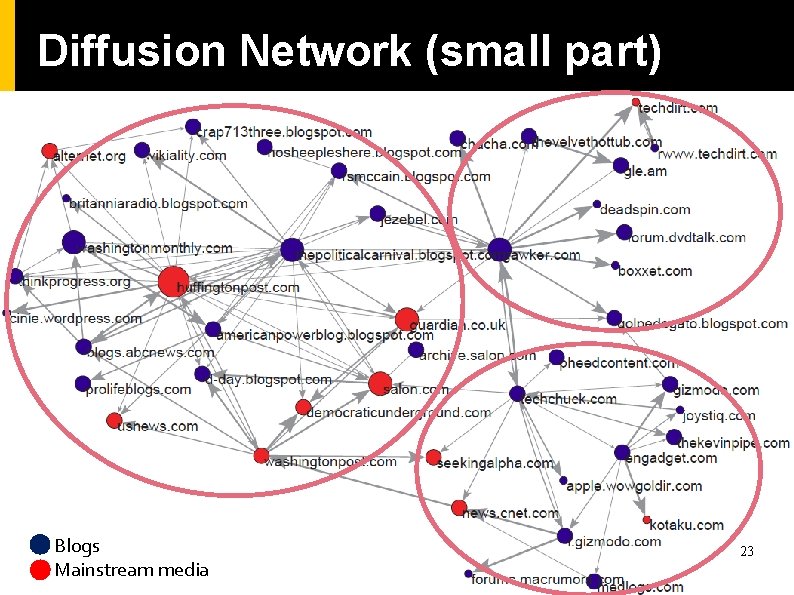
Diffusion Network (small part) Blogs Mainstream media 23
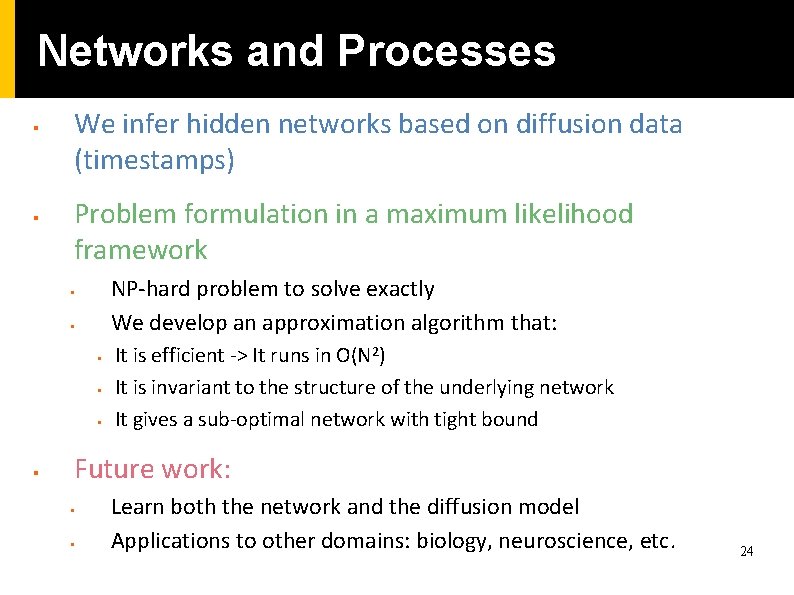
Networks and Processes § § We infer hidden networks based on diffusion data (timestamps) Problem formulation in a maximum likelihood framework NP-hard problem to solve exactly We develop an approximation algorithm that: § § § It is efficient -> It runs in O(N 2) It is invariant to the structure of the underlying network It gives a sub-optimal network with tight bound Future work: § § Learn both the network and the diffusion model Applications to other domains: biology, neuroscience, etc. 24
Thanks! For more (Code & Data): http: //snap. stanford. edu/netinf 25