IndoEuropean Studies Department of Nordic Studies and Linguistics
- Slides: 35
Indo-European Studies, Department of Nordic Studies and Linguistics Roots of Europe - Indo-European outside Europe Bjarne Simmelkjær Sandgaard Hansen Postdoc fellow, Ph. D. Department of Nordic Studies and Linguistics Copenhagen, 28 October 2014 Dias 1
Indo-European Studies, Department of Nordic Studies and Linguistics Contents Midway adjustment Central and southern Asia • Indo-Iranian • Tocharian Anatolia and the Middle East • Anatolian • Mitanni Indic • Euphratic (guest lecture by Gordon Whittaker) Questions Copenhagen, 28 October 2014 Dias 2
Indo-European Studies, Department of Nordic Studies and Linguistics Midway adjustment Central and southern Asia • Indo-Iranian • Tocharian Anatolia and the Middle East • Anatolian • Mitanni Indic • Euphratic (guest lecture by Gordon Whittaker) Questions Copenhagen, 28 October 2014 Dias 3
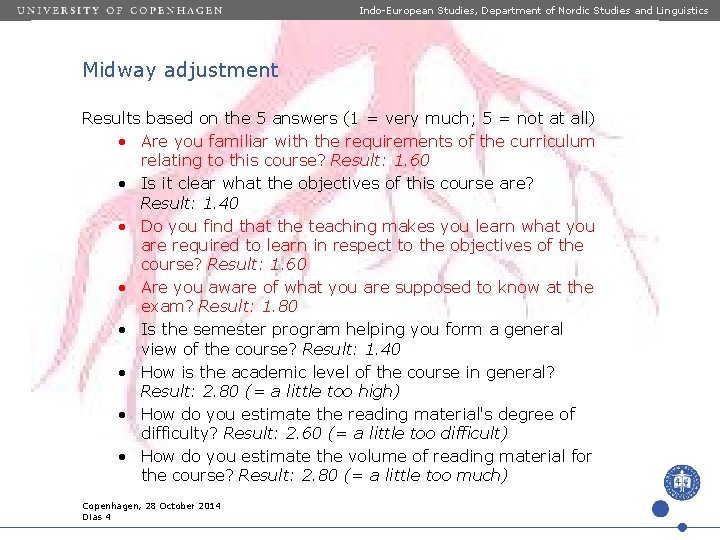
Indo-European Studies, Department of Nordic Studies and Linguistics Midway adjustment Results based on the 5 answers (1 = very much; 5 = not at all) • Are you familiar with the requirements of the curriculum relating to this course? Result: 1. 60 • Is it clear what the objectives of this course are? Result: 1. 40 • Do you find that the teaching makes you learn what you are required to learn in respect to the objectives of the course? Result: 1. 60 • Are you aware of what you are supposed to know at the exam? Result: 1. 80 • Is the semester program helping you form a general view of the course? Result: 1. 40 • How is the academic level of the course in general? Result: 2. 80 (= a little too high) • How do you estimate the reading material's degree of difficulty? Result: 2. 60 (= a little too difficult) • How do you estimate the volume of reading material for the course? Result: 2. 80 (= a little too much) Copenhagen, 28 October 2014 Dias 4
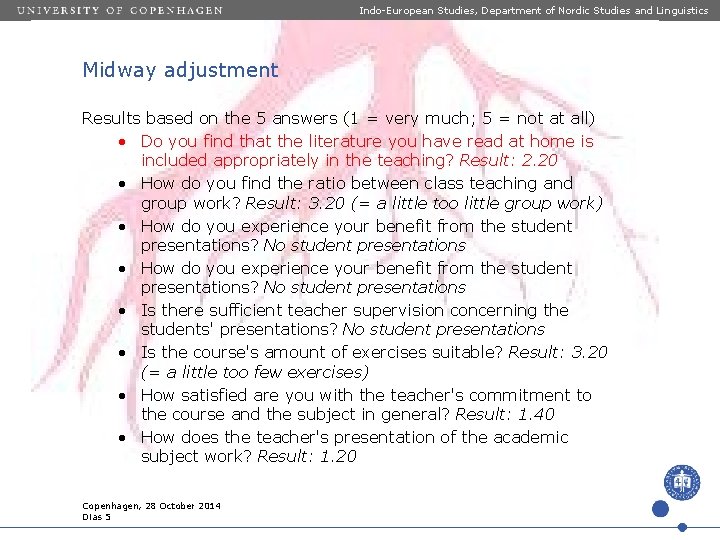
Indo-European Studies, Department of Nordic Studies and Linguistics Midway adjustment Results based on the 5 answers (1 = very much; 5 = not at all) • Do you find that the literature you have read at home is included appropriately in the teaching? Result: 2. 20 • How do you find the ratio between class teaching and group work? Result: 3. 20 (= a little too little group work) • How do you experience your benefit from the student presentations? No student presentations • Is there sufficient teacher supervision concerning the students' presentations? No student presentations • Is the course's amount of exercises suitable? Result: 3. 20 (= a little too few exercises) • How satisfied are you with the teacher's commitment to the course and the subject in general? Result: 1. 40 • How does the teacher's presentation of the academic subject work? Result: 1. 20 Copenhagen, 28 October 2014 Dias 5
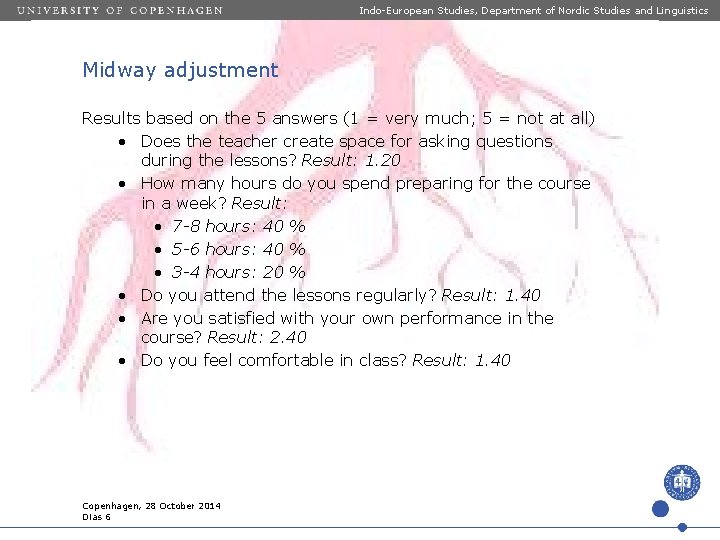
Indo-European Studies, Department of Nordic Studies and Linguistics Midway adjustment Results based on the 5 answers (1 = very much; 5 = not at all) • Does the teacher create space for asking questions during the lessons? Result: 1. 20 • How many hours do you spend preparing for the course in a week? Result: • 7 -8 hours: 40 % • 5 -6 hours: 40 % • 3 -4 hours: 20 % • Do you attend the lessons regularly? Result: 1. 40 • Are you satisfied with your own performance in the course? Result: 2. 40 • Do you feel comfortable in class? Result: 1. 40 Copenhagen, 28 October 2014 Dias 6
Indo-European Studies, Department of Nordic Studies and Linguistics Midway adjustment Results based on the 5 answers • What parts of the course work well? • The presentations thus far have all been good, the topics are nicely covered. Both in giving a good overview and with specific details. The individual teachers have proven both enthusiastic, competent and good at relaying their subject to the students. • The technical setup that allows participation online have been a nice bonus in those cases where it has not been possible to attend in person. • The subjects so far covered have themselves proven to be both interesting and well-prepared, neither feeling to heavy to take nor too light to be of use, but suitable overall. • So far we have not gotten to the international part of the course, so I can't say how well that will work, but I am looking very much forward to it. Copenhagen, 28 October 2014 Dias 7
Indo-European Studies, Department of Nordic Studies and Linguistics Midway adjustment Results based on the 5 answers • What parts of the course work well (continued)? • The interdisciplinary way of teaching a class like this is very valuable. Really great with the combination of specialized teachers, ranging from our own teachers to world leading professors all the way from e. g. Germany and USA, some of which are able to teach us from their home with Adobe Connect. Some new and groundbreaking yet unpublished news has been broken to the students, making them knowledgeable to new findings in a way not possible elsewhere. Also great the classes are taped for future study and reference. • How could the course be improved? • The sound and picture quality of the recordings could be better, and with long distance teaching the internet connection could be better too. Copenhagen, 28 October 2014 Dias 8
Indo-European Studies, Department of Nordic Studies and Linguistics Midway adjustment Results based on the 5 answers • How could the course be improved (continued)? • So far there is not been any post-lecture discussions as was originally mentioned. And a three hour lecture, no matter how interesting, is heavy and hard to take in past the two-hour mark, where some internal class-discussion between teacher and students might be more engaging at that point. My comments to the midway adjustment answers • Objectives of the course • “account in outline for theories (originating from the fields of e. g. language history, archaeology, science of religion and genetics) on European prehistory and on the migrations and developments that have formed Europe as we know it from the time of the earliest written sources; Copenhagen, 28 October 2014 Dias 9
Indo-European Studies, Department of Nordic Studies and Linguistics Midway adjustment My comments to the midway adjustment answers • Objectives of the course (continued) • evaluate mutually contradictory theories critically by reference to the above-mentioned knowledge; and • present this evaluation and the considerations underlying it in an accurate and comprehensive manner using the terminology normally applied within the research fields of relevance. ” • I’ll ask the lecturers (again) to focus more on OBL (= outcomes based learning), student including activities (e. g. discussion) and inclusion of recommended literature • Remember, however, the recommended literature is only recommended, not mandatory, i. e. you need not read it before class. Often, it only serves as further inspiration for an exam paper on the topic • We’ll do our best with the technical difficulties, including the quality of the internet connections, but it’s hard to predict when there will be problems Copenhagen, 28 October 2014 Dias 10
Indo-European Studies, Department of Nordic Studies and Linguistics Indo-Iranian Midway adjustment Central and southern Asia • Indo-Iranian • Tocharian Anatolia and the Middle East • Anatolian • Mitanni Indic • Euphratic (guest lecture by Gordon Whittaker) Questions Copenhagen, 28 October 2014 Dias 11
Indo-European Studies, Department of Nordic Studies and Linguistics Indo-Iranian To be divided into at least Indo-Aryan (Indic) and Iranian • Indo-Aryan (Indic) • Vedic Sanskrit (from 14 th century BCE) • Middle Indic (7 th century BCE – 11 th century CE): Ashoka, Pāli, Ardhamāgadhī Prakrits (Sauraseni, Maharashtri, Māgadhī etc. ) • Apabhram śa (12 th – 16 th century CE) • Modern Indic: Hindustani (= Hindi-Urdu), Bengali, Punjabi, Romani, Sinhalese, Bengali, Rajastani, Gujarati, Nepali, Assamese, Kashmiri etc. • Possible branch: Nuristani (or Kafiristani) • Several difficultly accessible languages spoken in the remote and war-torn Hindukush area of North. Eastern Afghanistan and North-Western Pakistan • Branch identified by Georg Morgenstierne (1926, 1973, 1975) Copenhagen, 28 October 2014 Dias 12
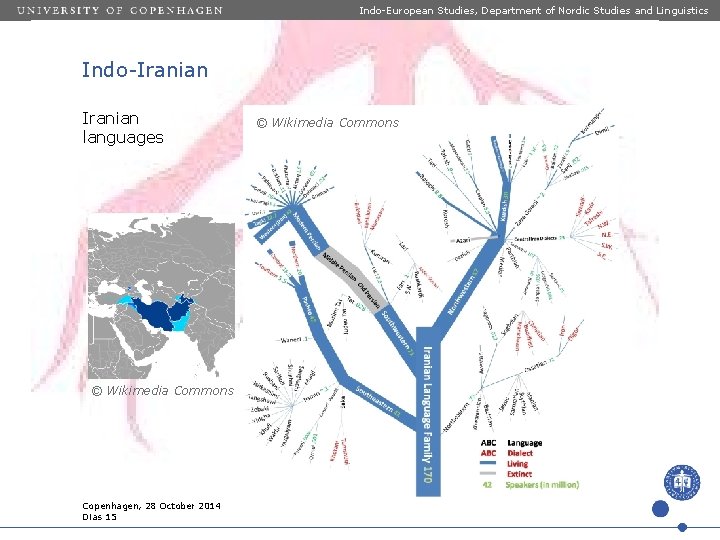
Indo-European Studies, Department of Nordic Studies and Linguistics Indo-Iranian To be divided into at least Indo-Aryan (Indic) and Iranian • North-Eastern: Old/Gathic Avestan and Young Avestan (written down 3 rd - 4 th century CE, but extinct much earlier, liturgical language of Zoroastrianism), †Scythian, †Choresmian/Khwarezmian, †Bactrian, †Sogdian, Ossetian and Yaghnobi • South-Eastern: †Saka (†Khotanese, †Tumshuqese), Pashto and many minor languages • North-Western: †Median, †Parthian, Balochi, Kurdish and many minor languages • South-Western: Old Persian (6 th - 4 th century BCE, Persian Achaemenid dynasty), †Middle Persian (†Pahlavi/Pehlevi), Modern Persian (Farsi, Dari, Tajiki) and many minor languages Copenhagen, 28 October 2014 Dias 13
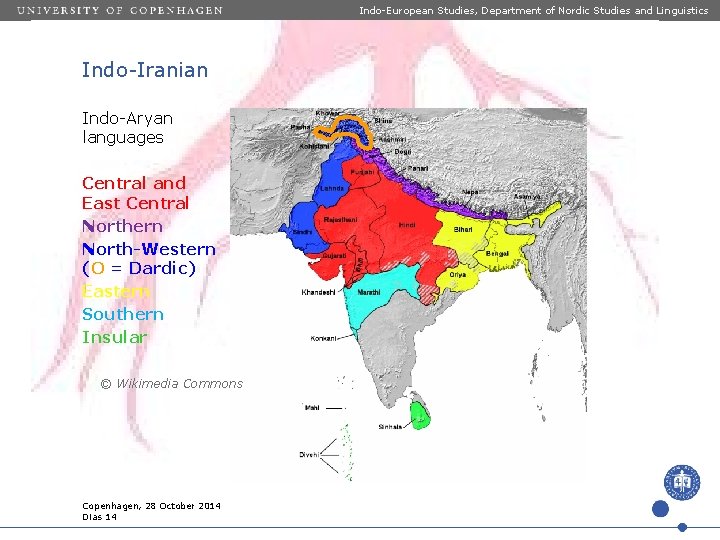
Indo-European Studies, Department of Nordic Studies and Linguistics Indo-Iranian Indo-Aryan languages Central and East Central Northern North-Western (O = Dardic) Eastern Southern Insular © Wikimedia Commons Copenhagen, 28 October 2014 Dias 14
Indo-European Studies, Department of Nordic Studies and Linguistics Indo-Iranian languages © Wikimedia Commons Copenhagen, 28 October 2014 Dias 15 © Wikimedia Commons
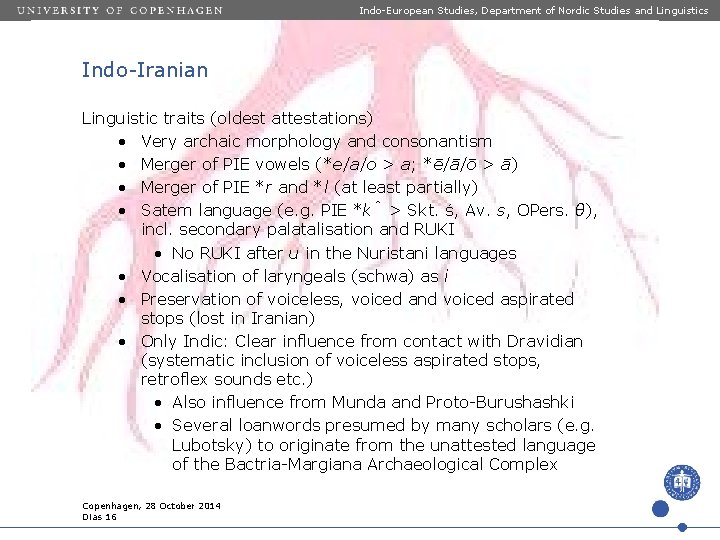
Indo-European Studies, Department of Nordic Studies and Linguistics Indo-Iranian Linguistic traits (oldest attestations) • Very archaic morphology and consonantism • Merger of PIE vowels (*e/a/o > a; *ē/ā/ō > ā) • Merger of PIE *r and *l (at least partially) • Satem language (e. g. PIE *k > Skt. ś, Av. s, OPers. θ), incl. secondary palatalisation and RUKI • No RUKI after u in the Nuristani languages • Vocalisation of laryngeals (schwa) as i • Preservation of voiceless, voiced and voiced aspirated stops (lost in Iranian) • Only Indic: Clear influence from contact with Dravidian (systematic inclusion of voiceless aspirated stops, retroflex sounds etc. ) • Also influence from Munda and Proto-Burushashki • Several loanwords presumed by many scholars (e. g. Lubotsky) to originate from the unattested language of the Bactria-Margiana Archaeological Complex Copenhagen, 28 October 2014 Dias 16
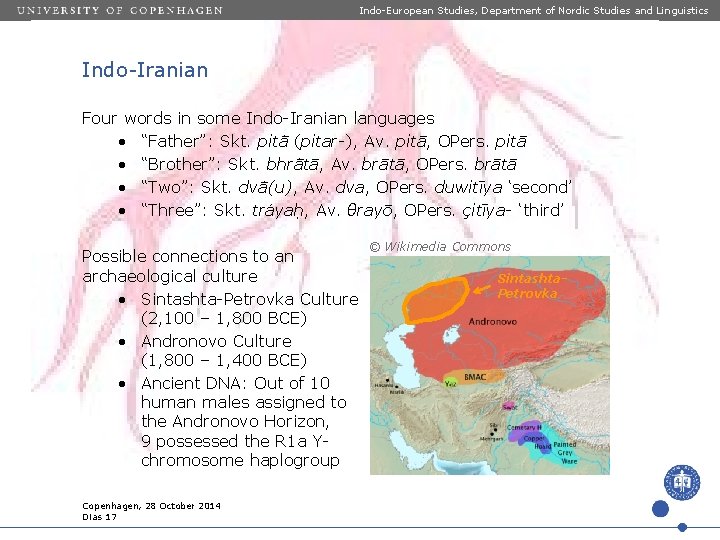
Indo-European Studies, Department of Nordic Studies and Linguistics Indo-Iranian Four words in some Indo-Iranian languages • “Father”: Skt. pitā (pitar-), Av. pitā, OPers. pitā • “Brother”: Skt. bhrā tā, Av. brātā, OPers. brātā • “Two”: Skt. dvā (u), Av. dva, OPers. duwitīya ‘second’ • “Three”: Skt. tráyah , Av. θrayō, OPers. çitīya- ‘third’ Possible connections to an archaeological culture • Sintashta-Petrovka Culture (2, 100 – 1, 800 BCE) • Andronovo Culture (1, 800 – 1, 400 BCE) • Ancient DNA: Out of 10 human males assigned to the Andronovo Horizon, 9 possessed the R 1 a Ychromosome haplogroup Copenhagen, 28 October 2014 Dias 17 © Wikimedia Commons Sintashta. Petrovka
Indo-European Studies, Department of Nordic Studies and Linguistics Tocharian Midway adjustment Central and southern Asia • Indo-Iranian • Tocharian Anatolia and the Middle East • Anatolian • Mitanni Indic • Euphratic (guest lecture by Gordon Whittaker) Questions Copenhagen, 28 October 2014 Dias 18
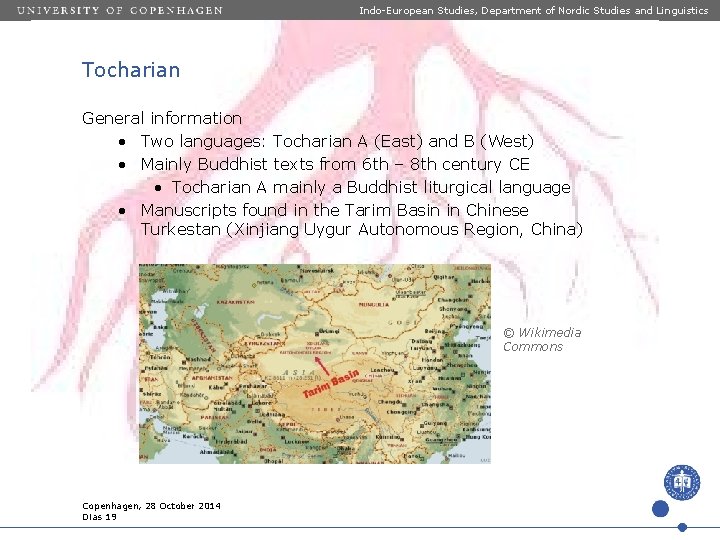
Indo-European Studies, Department of Nordic Studies and Linguistics Tocharian General information • Two languages: Tocharian A (East) and B (West) • Mainly Buddhist texts from 6 th – 8 th century CE • Tocharian A mainly a Buddhist liturgical language • Manuscripts found in the Tarim Basin in Chinese Turkestan (Xinjiang Uygur Autonomous Region, China) © Wikimedia Commons Copenhagen, 28 October 2014 Dias 19
Indo-European Studies, Department of Nordic Studies and Linguistics Tocharian Linguistic traits • Simplified system of stops (only p, t, c, k) • Centum language (PToch. *k and *kw) • Very complicated developments of the vowel system • Increase of the number of cases (PIE: 8 Toch. : 10 -11) • Dramatic decrease in the number of inherited cases (nom. , voc. , acc. , gen. ) Creation of 6 -7 new cases • Contact with Uralic and above all Altaic languages is normally seen as responsible for the simplification of the stop system and the rearrangement of the case system • Four numbers (singular, dual, paral and plural) Four words in Tocharian • “Father”: A pācar, B pācer • “Brother”: A pracar, B procer • “Two”: A wu, B wi • “Three”: A tre, B trai Copenhagen, 28 October 2014 Dias 20
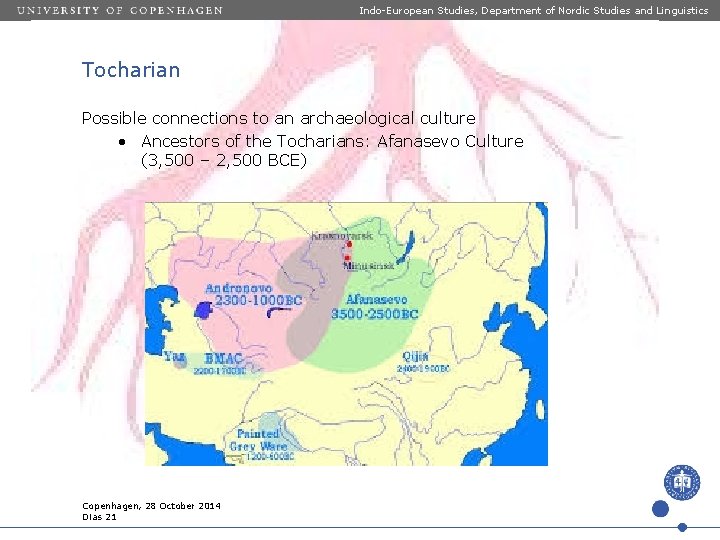
Indo-European Studies, Department of Nordic Studies and Linguistics Tocharian Possible connections to an archaeological culture • Ancestors of the Tocharians: Afanasevo Culture (3, 500 – 2, 500 BCE) Copenhagen, 28 October 2014 Dias 21
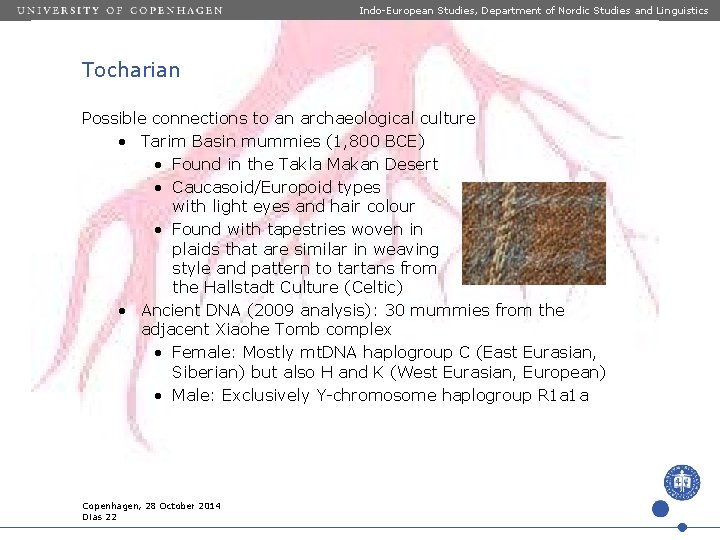
Indo-European Studies, Department of Nordic Studies and Linguistics Tocharian Possible connections to an archaeological culture • Tarim Basin mummies (1, 800 BCE) • Found in the Takla Makan Desert • Caucasoid/Europoid types with light eyes and hair colour • Found with tapestries woven in plaids that are similar in weaving style and pattern to tartans from the Hallstadt Culture (Celtic) • Ancient DNA (2009 analysis): 30 mummies from the adjacent Xiaohe Tomb complex • Female: Mostly mt. DNA haplogroup C (East Eurasian, Siberian) but also H and K (West Eurasian, European) • Male: Exclusively Y-chromosome haplogroup R 1 a 1 a Copenhagen, 28 October 2014 Dias 22
Indo-European Studies, Department of Nordic Studies and Linguistics Anatolian Midway adjustment Central and southern Asia • Indo-Iranian • Tocharian Anatolia and the Middle East • Anatolian • Mitanni Indic • Euphratic (guest lecture by Gordon Whittaker) Questions Copenhagen, 28 October 2014 Dias 23
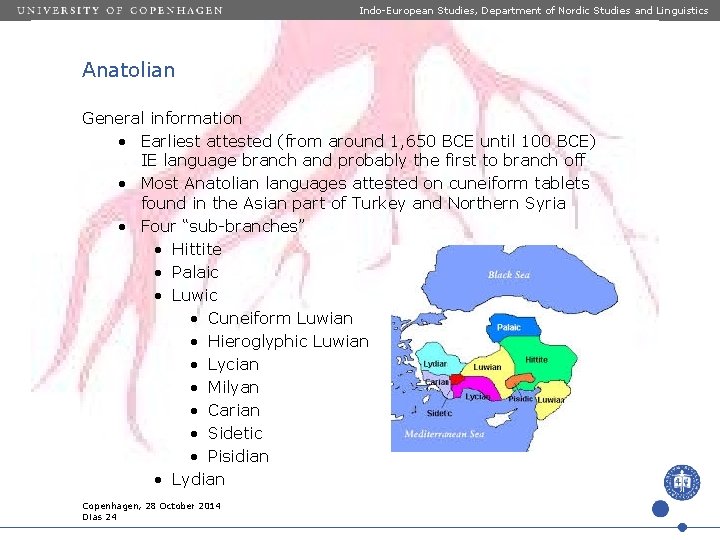
Indo-European Studies, Department of Nordic Studies and Linguistics Anatolian General information • Earliest attested (from around 1, 650 BCE until 100 BCE) IE language branch and probably the first to branch off • Most Anatolian languages attested on cuneiform tablets found in the Asian part of Turkey and Northern Syria • Four “sub-branches” • Hittite • Palaic • Luwic • Cuneiform Luwian • Hieroglyphic Luwian • Lycian • Milyan • Carian • Sidetic • Pisidian • Lydian Copenhagen, 28 October 2014 Dias 24
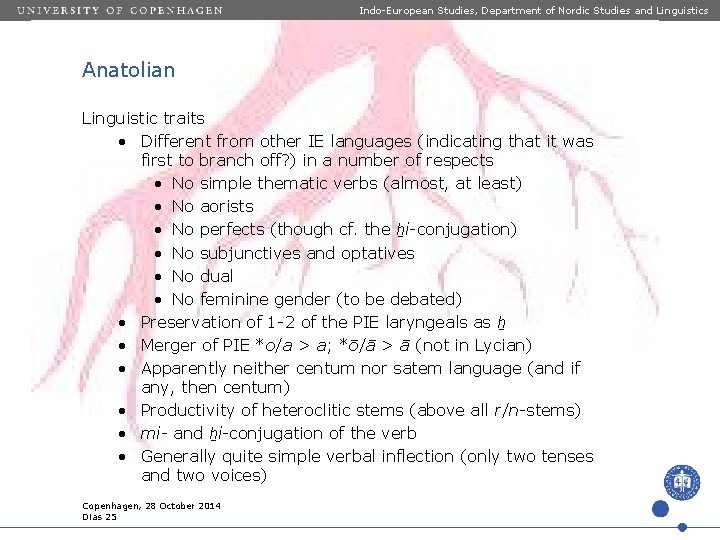
Indo-European Studies, Department of Nordic Studies and Linguistics Anatolian Linguistic traits • Different from other IE languages (indicating that it was first to branch off? ) in a number of respects • No simple thematic verbs (almost, at least) • No aorists • No perfects (though cf. the ẖi-conjugation) • No subjunctives and optatives • No dual • No feminine gender (to be debated) • Preservation of 1 -2 of the PIE laryngeals as ẖ • Merger of PIE *o/a > a; *ō/ā > ā (not in Lycian) • Apparently neither centum nor satem language (and if any, then centum) • Productivity of heteroclitic stems (above all r/n-stems) • mi- and ẖi-conjugation of the verb • Generally quite simple verbal inflection (only two tenses and two voices) Copenhagen, 28 October 2014 Dias 25
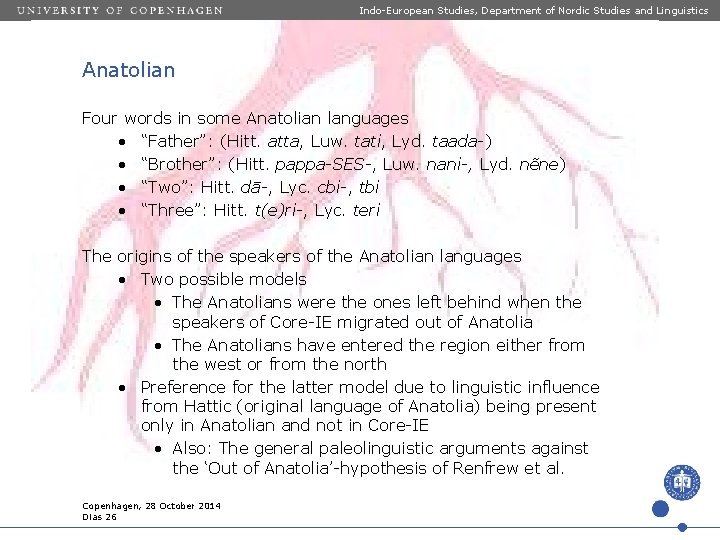
Indo-European Studies, Department of Nordic Studies and Linguistics Anatolian Four words in some Anatolian languages • “Father”: (Hitt. atta, Luw. tati, Lyd. taada-) • “Brother”: (Hitt. pappa-SES-, Luw. nani-, Lyd. nẽne) • “Two”: Hitt. dā-, Lyc. cbi-, tbi • “Three”: Hitt. t(e)ri-, Lyc. teri The origins of the speakers of the Anatolian languages • Two possible models • The Anatolians were the ones left behind when the speakers of Core-IE migrated out of Anatolia • The Anatolians have entered the region either from the west or from the north • Preference for the latter model due to linguistic influence from Hattic (original language of Anatolia) being present only in Anatolian and not in Core-IE • Also: The general paleolinguistic arguments against the ‘Out of Anatolia’-hypothesis of Renfrew et al. Copenhagen, 28 October 2014 Dias 26
Indo-European Studies, Department of Nordic Studies and Linguistics Mitanni Indic Midway adjustment Central and southern Asia • Indo-Iranian • Tocharian Anatolia and the Middle East • Anatolian • Mitanni Indic • Euphratic (guest lecture by Gordon Whittaker) Questions Copenhagen, 28 October 2014 Dias 27
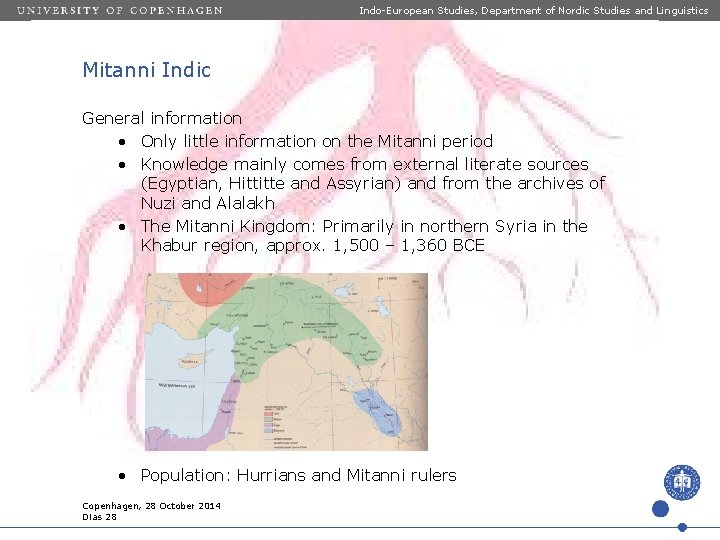
Indo-European Studies, Department of Nordic Studies and Linguistics Mitanni Indic General information • Only little information on the Mitanni period • Knowledge mainly comes from external literate sources (Egyptian, Hittitte and Assyrian) and from the archives of Nuzi and Alalakh • The Mitanni Kingdom: Primarily in northern Syria in the Khabur region, approx. 1, 500 – 1, 360 BCE • Population: Hurrians and Mitanni rulers Copenhagen, 28 October 2014 Dias 28
Indo-European Studies, Department of Nordic Studies and Linguistics Mitanni Indic Words of seemingly Indo-Iranian origin • Approximately 100 personal names of kings, princes and officials of high rank • Artas s umara (= Skt. Arta-smara ‘who thinks of Ṛta’) • Biridās wa (= Skt. Prītāśva ‘whose horse is dear’ or even better Skt. Vṛddhāśva ‘possessing great horses’) • Priiamazda (= Skt. Priyamedha ‘whose wisdom is dear’ • Associations to horses, horse racing and chariot warfare • aika-wartanna (= Skt. eka vartanam ‘(of) one round’) • Indicates appurtenance of Mitanni to Indo-Aryan rather than Iranian, cf. Skt. eka, Av. aēva ‘one’) • tera-wartanna (= Skt. tri … ‘(of) three rounds’) • panza-wartanna (= Skt. panca … ‘(of) five rounds’) • babru(-nnu) (= Skt. babhru- ‘brown’) • pinkara(-nnu) (= Skt. pingala- ‘red’) • The Vedic gods Mitra-, Varuṇa-, Indra- and Nāsatya- on Mitanni/Hatti treaties Copenhagen, 28 October 2014 Dias 29
Indo-European Studies, Department of Nordic Studies and Linguistics Mitanni Indic The Mitanni people and its identity • Only little knowledge from the archaeological material • Original view: Indo-European (pre-Indic) warriors on horseback conquering northern Syria • More recent discourse within archaeology • Based on Agency, i. e. the human being is an acting agent that can, to a certain extent, make its own decisions and thereby have influence on cultural changes and the shaping of identity • Language ≠ Ethnicity ≠ Culture ≠ Identity • Ethnical identity: Based on self-perception and selfdefinition (human beings can actively change ethnical identity) Difficult to trace in archaeological material • Cultural identity: Can be observed in all aspects of a culture including archaeological material • Social identity: Can be observed in archaeological material Copenhagen, 28 October 2014 Dias 30
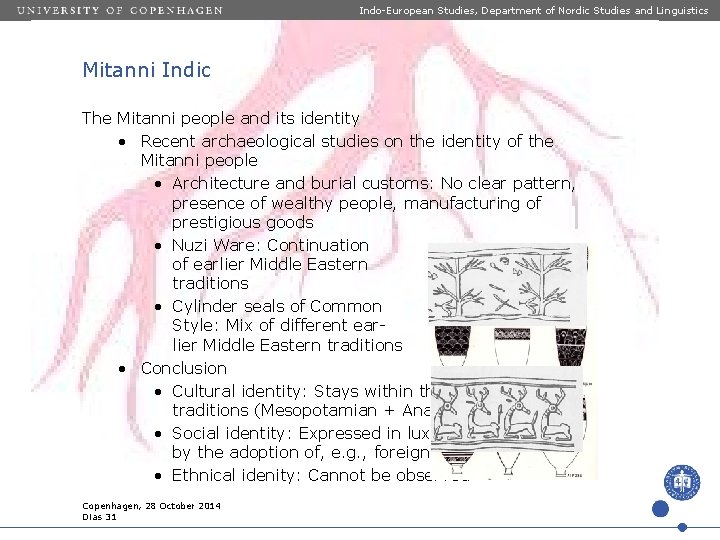
Indo-European Studies, Department of Nordic Studies and Linguistics Mitanni Indic The Mitanni people and its identity • Recent archaeological studies on the identity of the Mitanni people • Architecture and burial customs: No clear pattern, presence of wealthy people, manufacturing of prestigious goods • Nuzi Ware: Continuation of earlier Middle Eastern traditions • Cylinder seals of Common Style: Mix of different earlier Middle Eastern traditions • Conclusion • Cultural identity: Stays within the Neаr Eastern traditions (Mesopotamian + Anatolian elements) • Social identity: Expressed in luxurious objects, and by the adoption of, e. g. , foreign names • Ethnical idenity: Cannot be observed Copenhagen, 28 October 2014 Dias 31
Indo-European Studies, Department of Nordic Studies and Linguistics Euphratic (guest lecture by Gordon Whittaker) Midway adjustment Central and southern Asia • Indo-Iranian • Tocharian Anatolia and the Middle East • Anatolian • Mitanni Indic • Euphratic (guest lecture by Gordon Whittaker) Questions Copenhagen, 28 October 2014 Dias 32
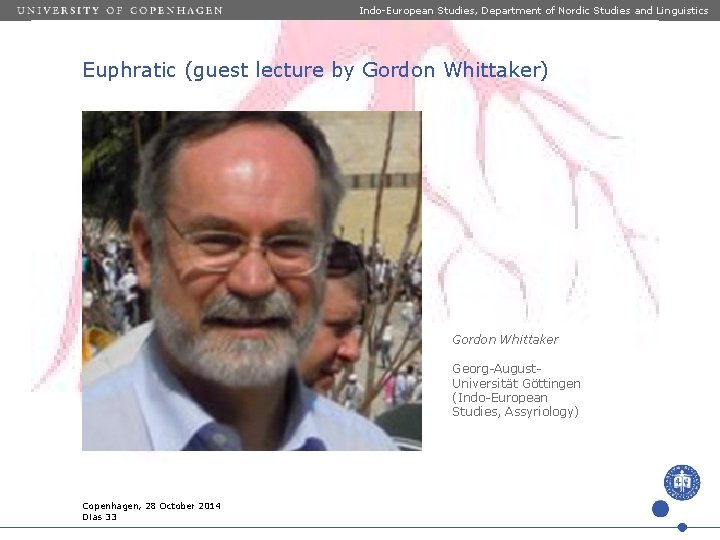
Indo-European Studies, Department of Nordic Studies and Linguistics Euphratic (guest lecture by Gordon Whittaker) Gordon Whittaker Georg-August. Universität Göttingen (Indo-European Studies, Assyriology) Copenhagen, 28 October 2014 Dias 33
Indo-European Studies, Department of Nordic Studies and Linguistics Questions Midway adjustment Central and southern Asia • Indo-Iranian • Tocharian Anatolia and the Middle East • Anatolian • Mitanni Indic • Euphratic (guest lecture by Gordon Whittaker) Questions Copenhagen, 28 October 2014 Dias 34
Indo-European Studies, Department of Nordic Studies and Linguistics Questions Copenhagen, 28 October 2014 Dias 35