Indexing Mixed Types for Approximate Retrieval Liang Jin

- Slides: 36
Indexing Mixed Types for Approximate Retrieval • Liang Jin* • Nick Koudas Toronto • Chen Li* • Anthony K. H. Tung Singapore UC Irvine University of UC Irvine National University of * Liang Jin and Chen Li: supported by NSF CAREER Award IIS-0238586
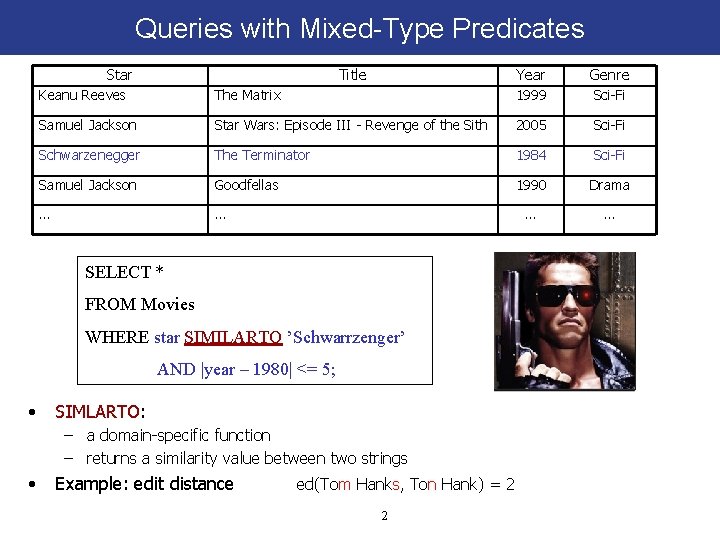
Queries with Mixed-Type Predicates Star Title The Matrix 1999 Sci-Fi Samuel Jackson Star Wars: Episode III - Revenge of the Sith 2005 Sci-Fi Schwarzenegger The Terminator 1984 Sci-Fi Samuel Jackson Goodfellas 1990 Drama … … FROM Movies WHERE star SIMILARTO ’Schwarrzenger’ AND |year – 1980| <= 5; SIMLARTO: – a domain-specific function – returns a similarity value between two strings • Genre Keanu Reeves SELECT * • Year Example: edit distance ed(Tom Hanks, Ton Hank) = 2 2
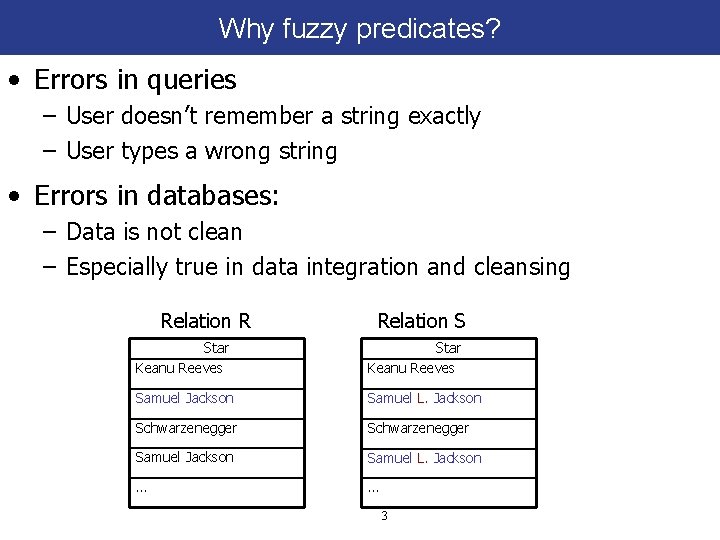
Why fuzzy predicates? • Errors in queries – User doesn’t remember a string exactly – User types a wrong string • Errors in databases: – Data is not clean – Especially true in data integration and cleansing Relation R Relation S Star Keanu Reeves Samuel Jackson Samuel L. Jackson Schwarzenegger Samuel Jackson Samuel L. Jackson … … 3
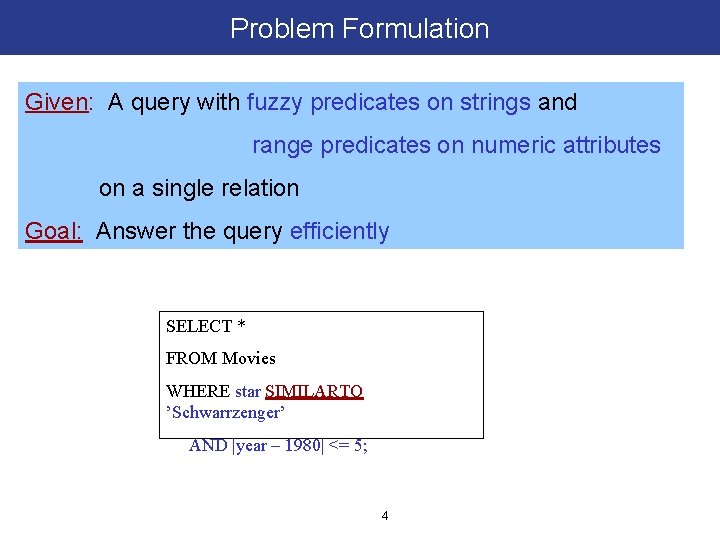
Problem Formulation Given: A query with fuzzy predicates on strings and range predicates on numeric attributes on a single relation Goal: Answer the query efficiently SELECT * FROM Movies WHERE star SIMILARTO ’Schwarrzenger’ AND |year – 1980| <= 5; 4
Rest of the talk • • Motivation: supporting queries with mixed-type predicates Our approach: MAT tree Construction and maintenance of MAT tree Experiments 5
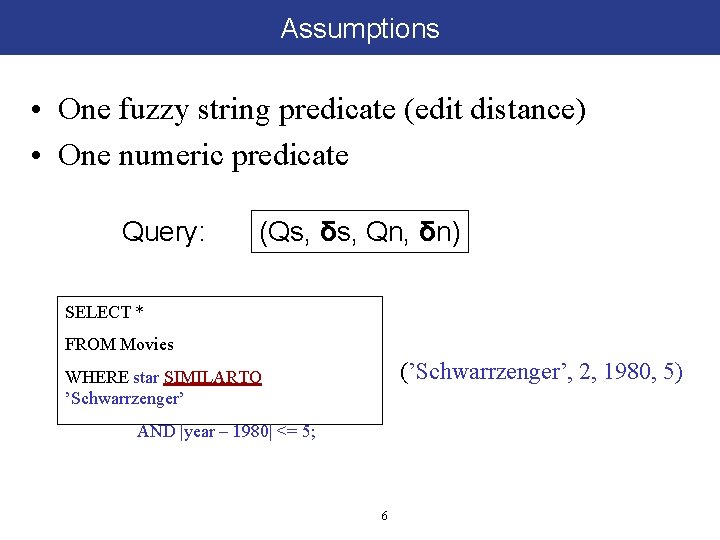
Assumptions • One fuzzy string predicate (edit distance) • One numeric predicate Query: (Qs, δs, Qn, δn) SELECT * FROM Movies (’Schwarrzenger’, 2, 1980, 5) WHERE star SIMILARTO ’Schwarrzenger’ AND |year – 1980| <= 5; 6
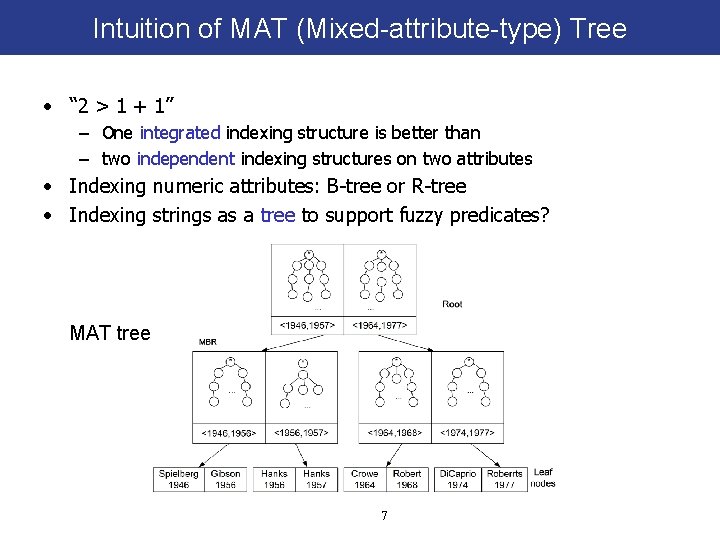
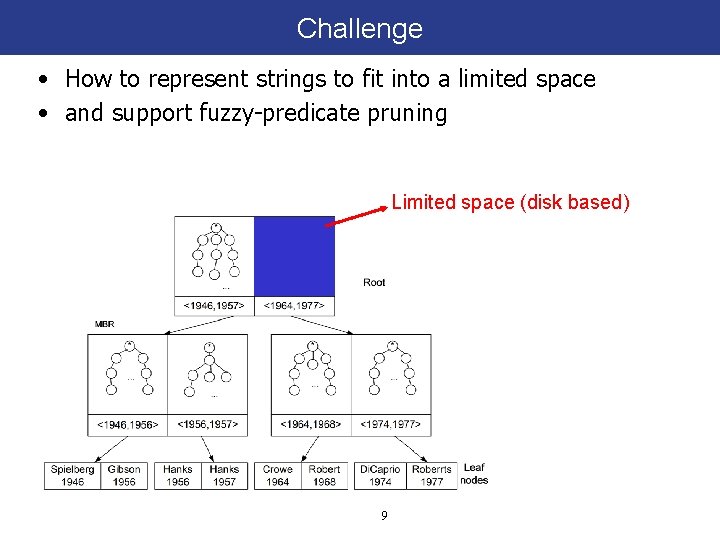
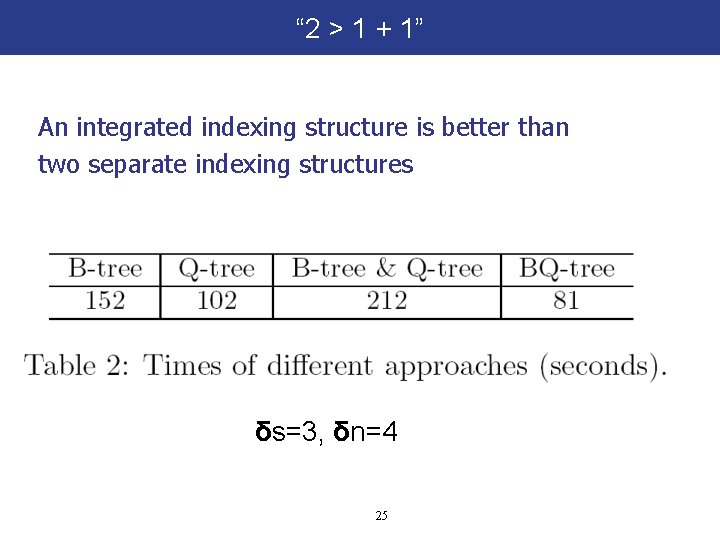
Intuition of MAT (Mixed-attribute-type) Tree • “ 2 > 1 + 1” – One integrated indexing structure is better than – two independent indexing structures on two attributes • Indexing numeric attributes: B-tree or R-tree • Indexing strings as a tree to support fuzzy predicates? MAT tree 7
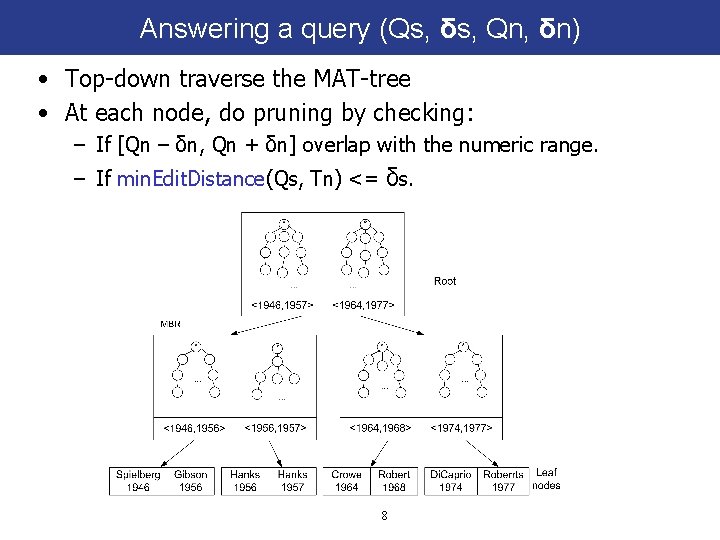
Answering a query (Qs, δs, Qn, δn) • Top-down traverse the MAT-tree • At each node, do pruning by checking: – If [Qn – δn, Qn + δn] overlap with the numeric range. – If min. Edit. Distance(Qs, Tn) <= δs. 8
Challenge • How to represent strings to fit into a limited space • and support fuzzy-predicate pruning Limited space (disk based) 9
Existing Approaches to Indexing Strings as Trees • M-tree: – Edit distance: metric space • Q-tree – Utilize the q-gram property of strings. – See our paper for details 10
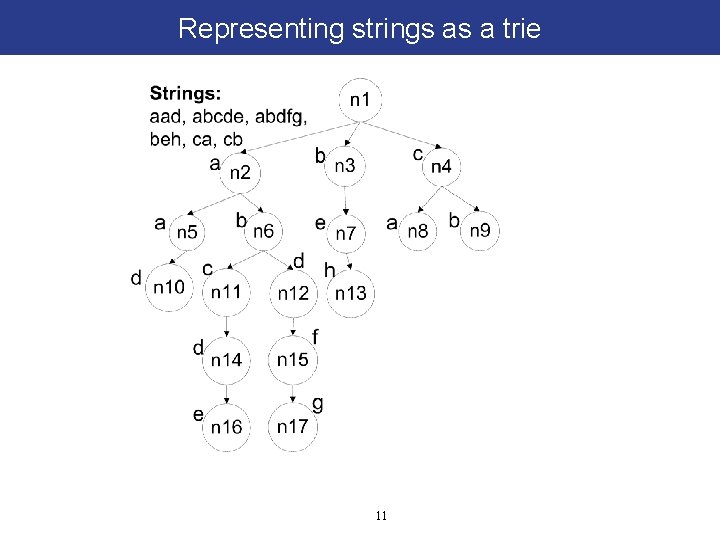
Representing strings as a trie 11
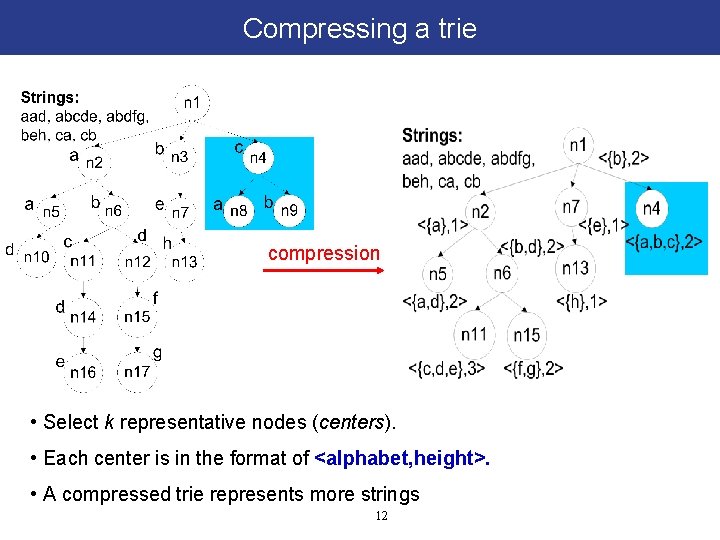
Compressing a trie compression • Select k representative nodes (centers). • Each center is in the format of <alphabet, height>. • A compressed trie represents more strings 12
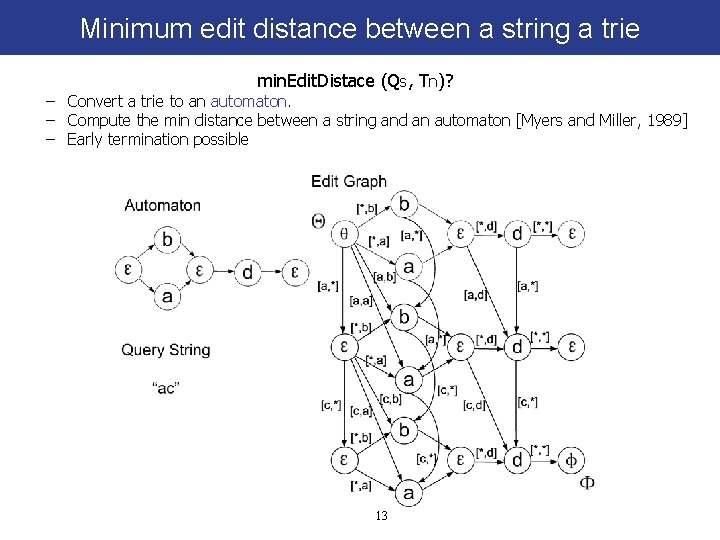
Minimum edit distance between a string a trie min. Edit. Distace (Qs, Tn)? – Convert a trie to an automaton. – Compute the min distance between a string and an automaton [Myers and Miller, 1989] – Early termination possible 13
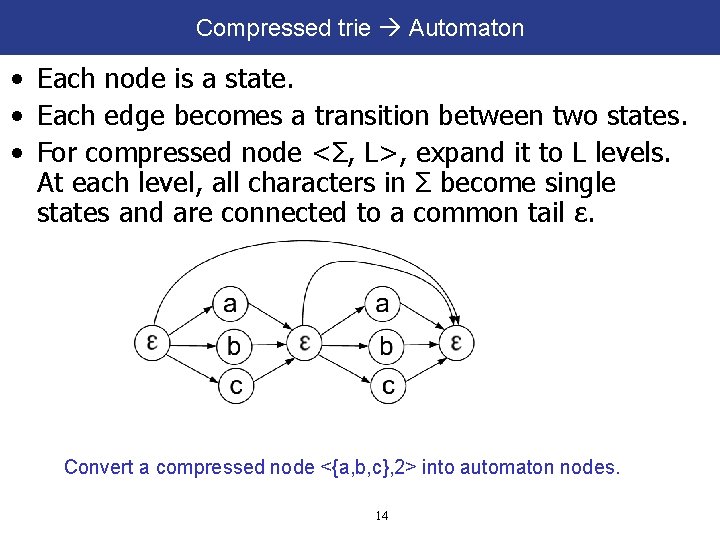
Compressed trie Automaton • Each node is a state. • Each edge becomes a transition between two states. • For compressed node <Σ, L>, expand it to L levels. At each level, all characters in Σ become single states and are connected to a common tail ε. Convert a compressed node <{a, b, c}, 2> into automaton nodes. 14
Outline • • Motivation: supporting queries with mixed-type predicates Our approach: MAT tree Construction and maintenance of MAT tree Experiments 15
Constructing MAT-tree • Option 1: insert records one by one. • Option 2: – bulk-load records – construct the MAT-tree bottom-up 16
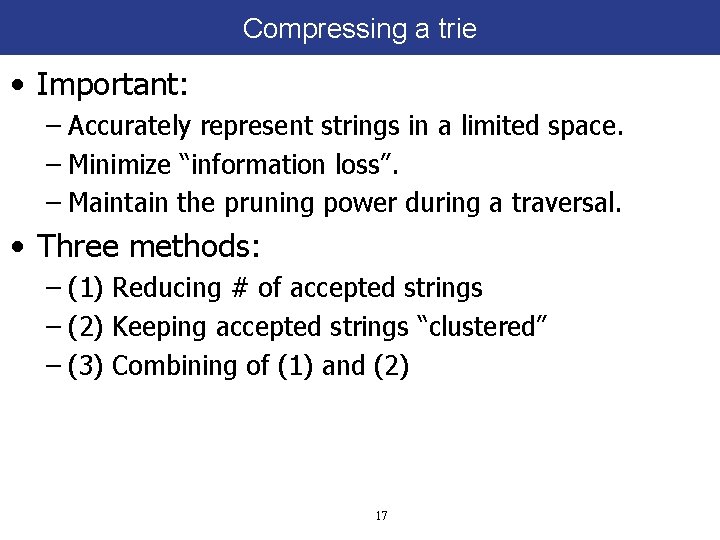
Compressing a trie • Important: – Accurately represent strings in a limited space. – Minimize “information loss”. – Maintain the pruning power during a traversal. • Three methods: – (1) Reducing # of accepted strings – (2) Keeping accepted strings “clustered” – (3) Combining of (1) and (2) 17
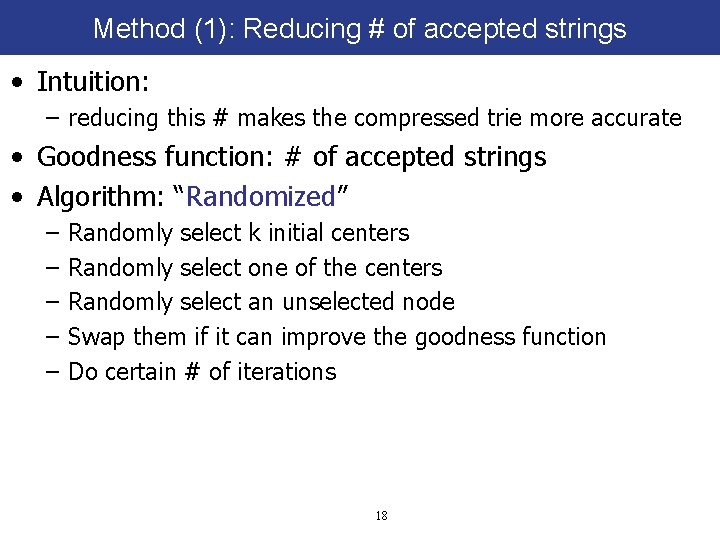
Method (1): Reducing # of accepted strings • Intuition: – reducing this # makes the compressed trie more accurate • Goodness function: # of accepted strings • Algorithm: “Randomized” – – – Randomly select k initial centers Randomly select one of the centers Randomly select an unselected node Swap them if it can improve the goodness function Do certain # of iterations 18
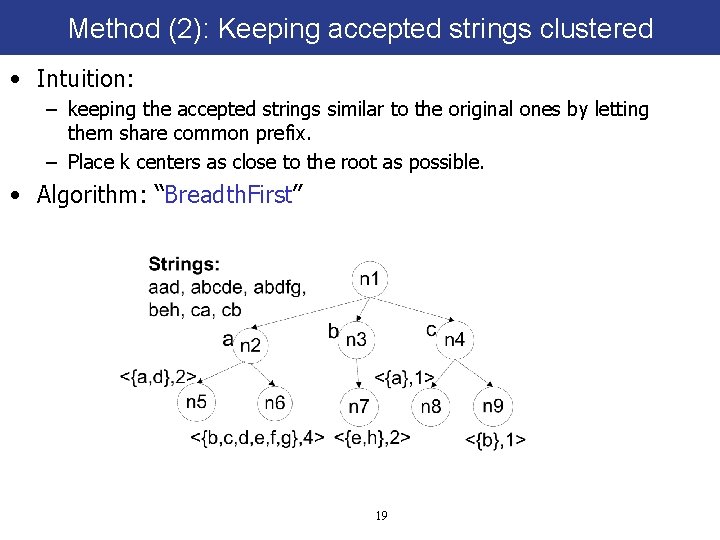
Method (2): Keeping accepted strings clustered • Intuition: – keeping the accepted strings similar to the original ones by letting them share common prefix. – Place k centers as close to the root as possible. • Algorithm: “Breadth. First” 19
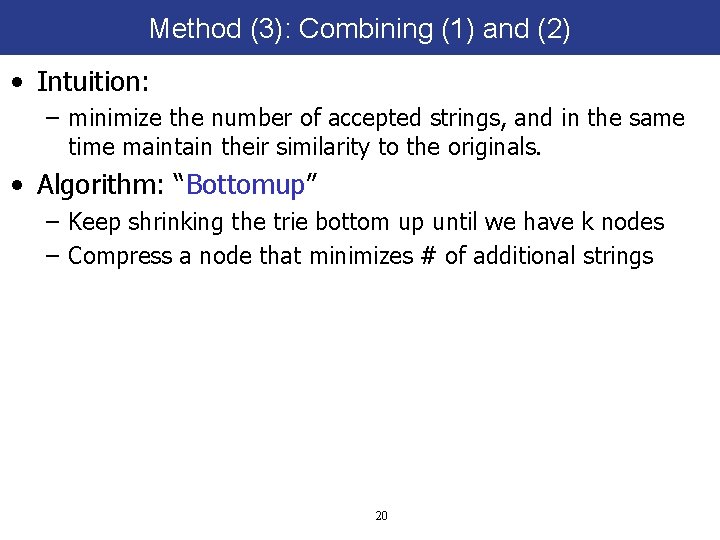
Method (3): Combining (1) and (2) • Intuition: – minimize the number of accepted strings, and in the same time maintain their similarity to the originals. • Algorithm: “Bottomup” – Keep shrinking the trie bottom up until we have k nodes – Compress a node that minimizes # of additional strings 20
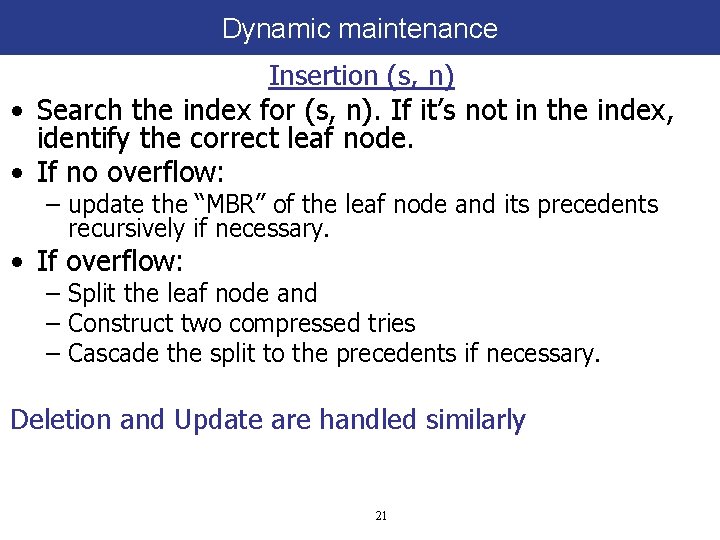
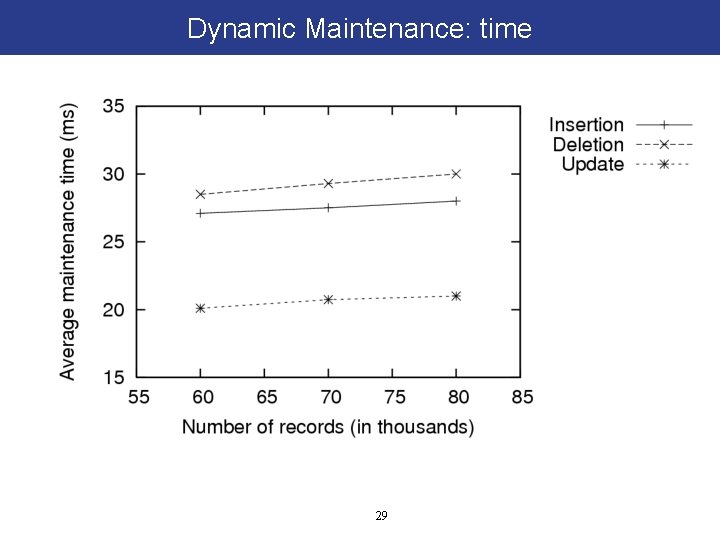
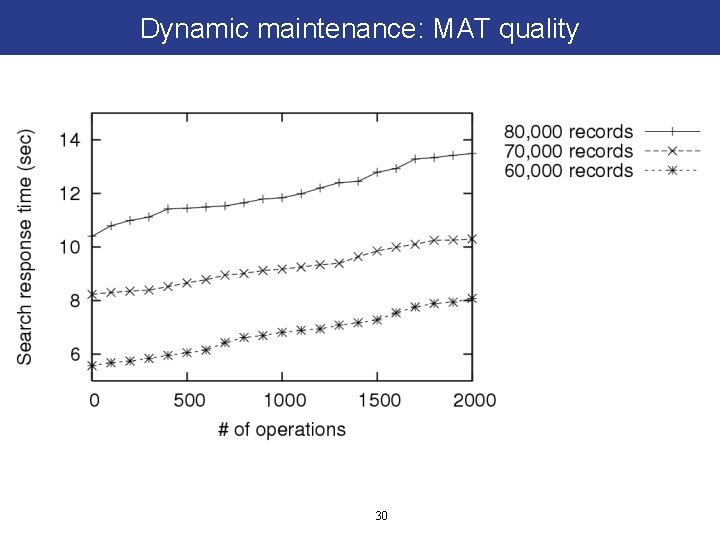
Dynamic maintenance Insertion (s, n) • Search the index for (s, n). If it’s not in the index, identify the correct leaf node. • If no overflow: – update the “MBR” of the leaf node and its precedents recursively if necessary. • If overflow: – Split the leaf node and – Construct two compressed tries – Cascade the split to the precedents if necessary. Deletion and Update are handled similarly 21
Outline • • Motivation: supporting queries with mixed-type predicates Our approach: MAT tree Construction and maintenance of MAT tree Experiments 22
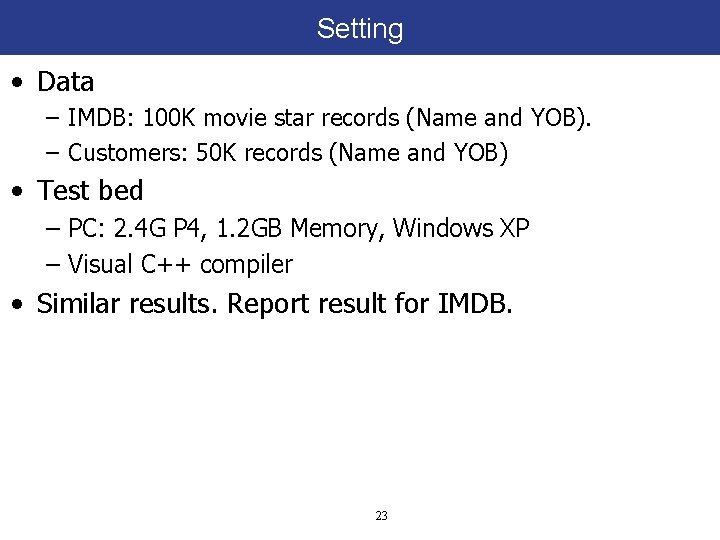
Setting • Data – IMDB: 100 K movie star records (Name and YOB). – Customers: 50 K records (Name and YOB) • Test bed – PC: 2. 4 G P 4, 1. 2 GB Memory, Windows XP – Visual C++ compiler • Similar results. Report result for IMDB. 23
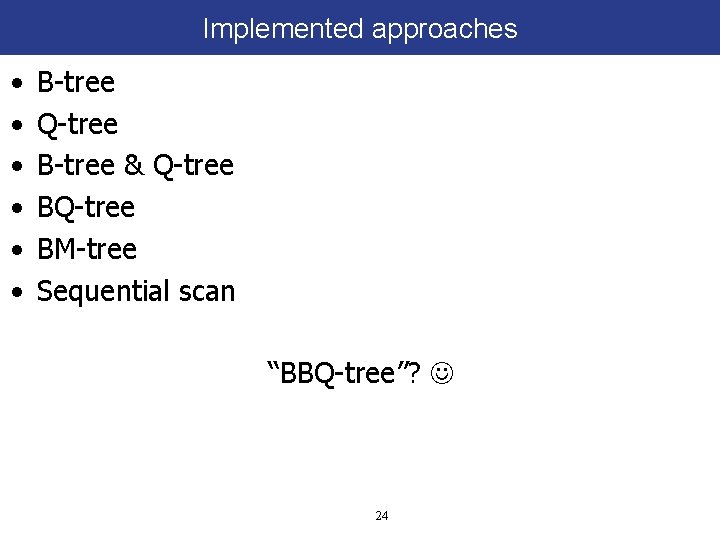
Implemented approaches • • • B-tree Q-tree B-tree & Q-tree BM-tree Sequential scan “BBQ-tree”? 24
“ 2 > 1 + 1” An integrated indexing structure is better than two separate indexing structures δs=3, δn=4 25
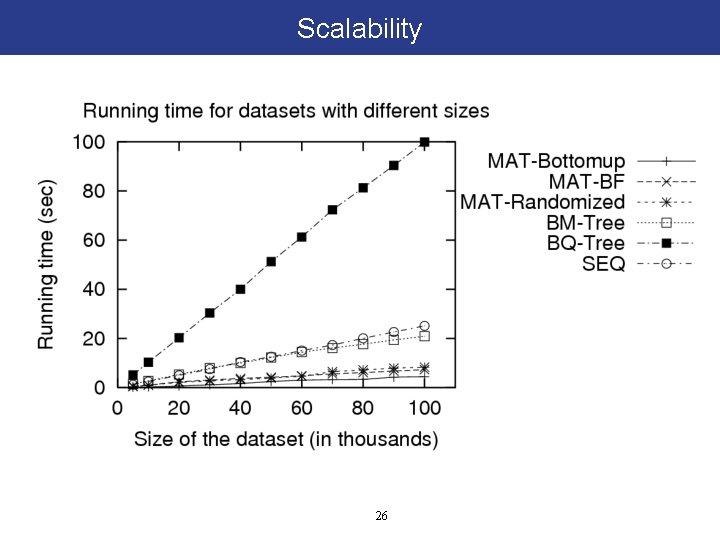
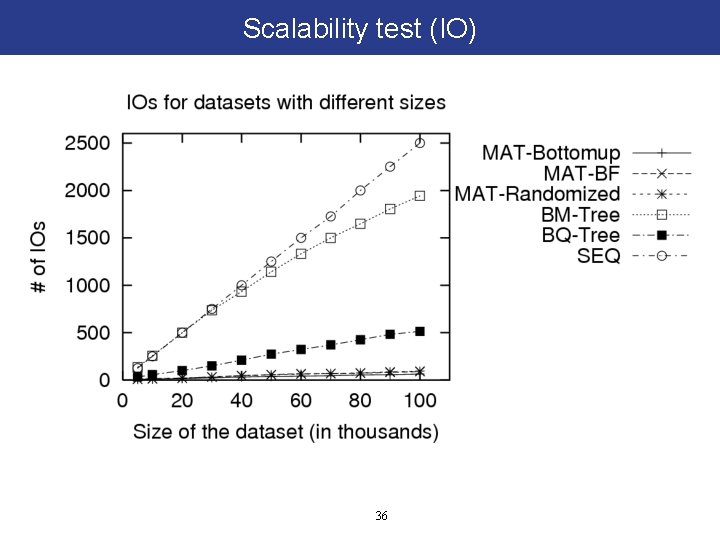
Scalability 26
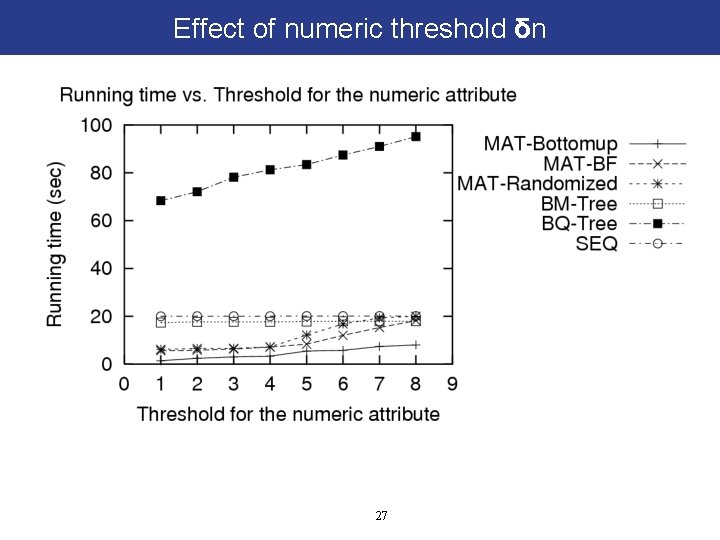
Effect of numeric threshold δn 27
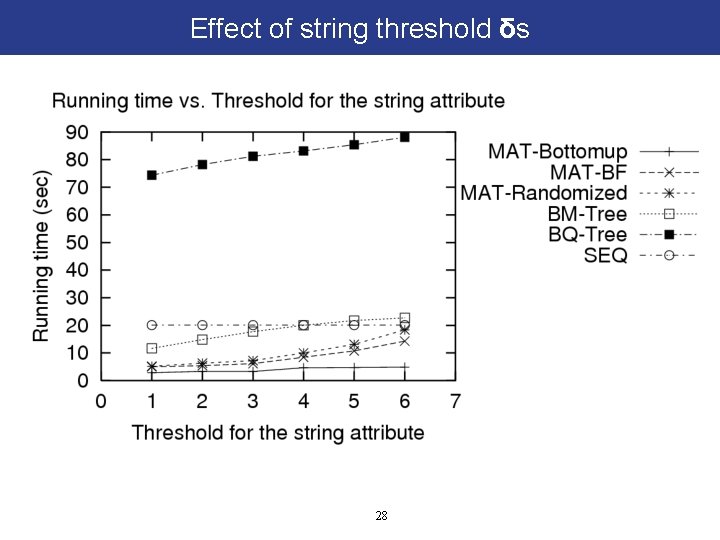
Effect of string threshold δs 28
Dynamic Maintenance: time 29
Dynamic maintenance: MAT quality 30
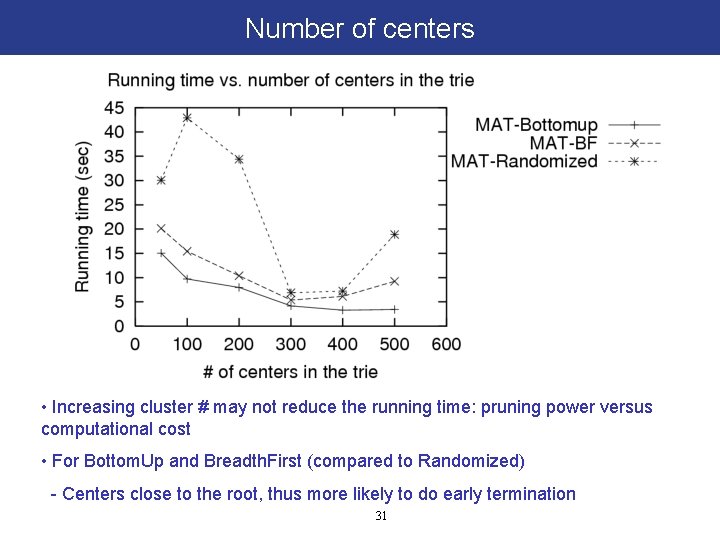
Number of centers • Increasing cluster # may not reduce the running time: pruning power versus computational cost • For Bottom. Up and Breadth. First (compared to Randomized) - Centers close to the root, thus more likely to do early termination 31
Conclusion • MAT-tree: an efficient indexing structure for queries with mixed-type predicates • Can be efficiently constructed and maintained • Future work: develop a uniform framework to support different kinds of similarity functions The Flamingo Project : http: //www. ics. uci. edu/~flamingo/ Q&A? 32
Backup Slides 33
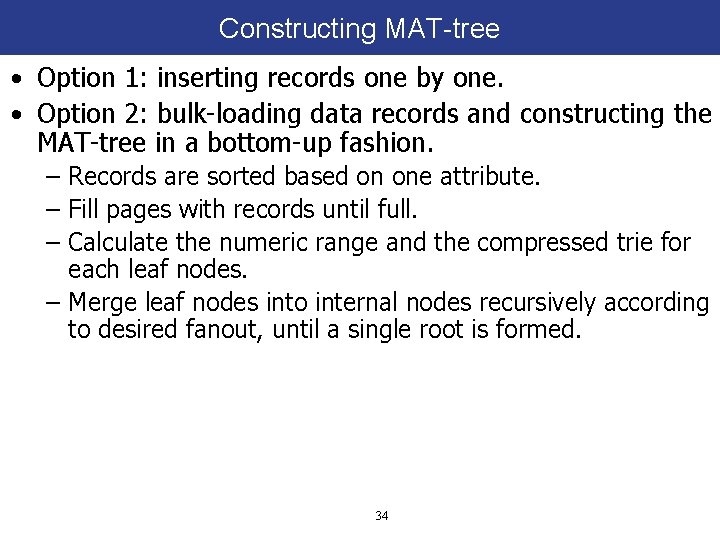
Constructing MAT-tree • Option 1: inserting records one by one. • Option 2: bulk-loading data records and constructing the MAT-tree in a bottom-up fashion. – Records are sorted based on one attribute. – Fill pages with records until full. – Calculate the numeric range and the compressed trie for each leaf nodes. – Merge leaf nodes into internal nodes recursively according to desired fanout, until a single root is formed. 34
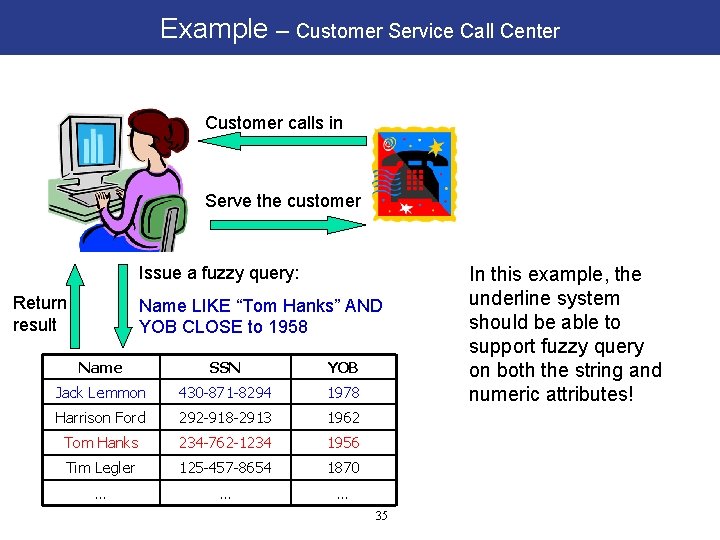
Example – Customer Service Call Center Customer calls in Serve the customer Issue a fuzzy query: Return result Name LIKE “Tom Hanks” AND YOB CLOSE to 1958 Name SSN YOB Jack Lemmon 430 -871 -8294 1978 Harrison Ford 292 -918 -2913 1962 Tom Hanks 234 -762 -1234 1956 Tim Legler 125 -457 -8654 1870 … … … 35 In this example, the underline system should be able to support fuzzy query on both the string and numeric attributes!
Scalability test (IO) 36