
Shengmin Jin and Reza Zafarani shengmindata syr edu
- Slides: 15
Shengmin Jin and Reza Zafarani shengmin@data. syr. edu Data Lab, EECS Department Syracuse University 1
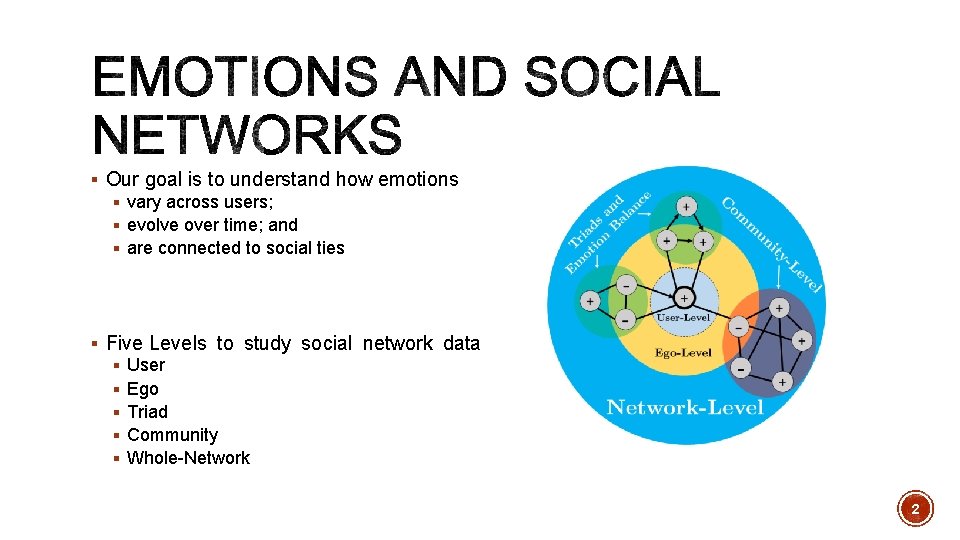
§ Our goal is to understand how emotions § vary across users; § evolve over time; and § are connected to social ties § Five Levels to study social network data § User § Ego § Triad § Community § Whole-Network 2
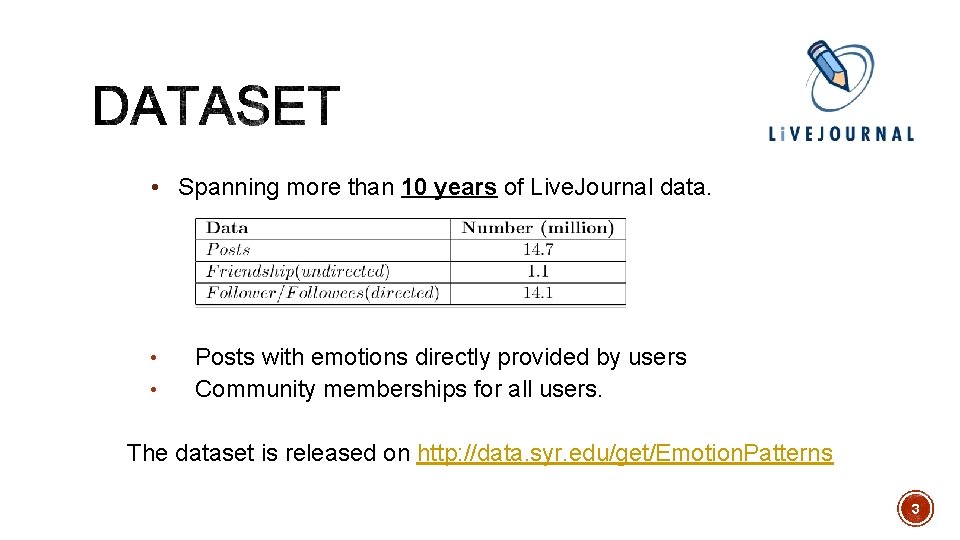
• Spanning more than 10 years of Live. Journal data. • • Posts with emotions directly provided by users Community memberships for all users. The dataset is released on http: //data. syr. edu/get/Emotion. Patterns 3
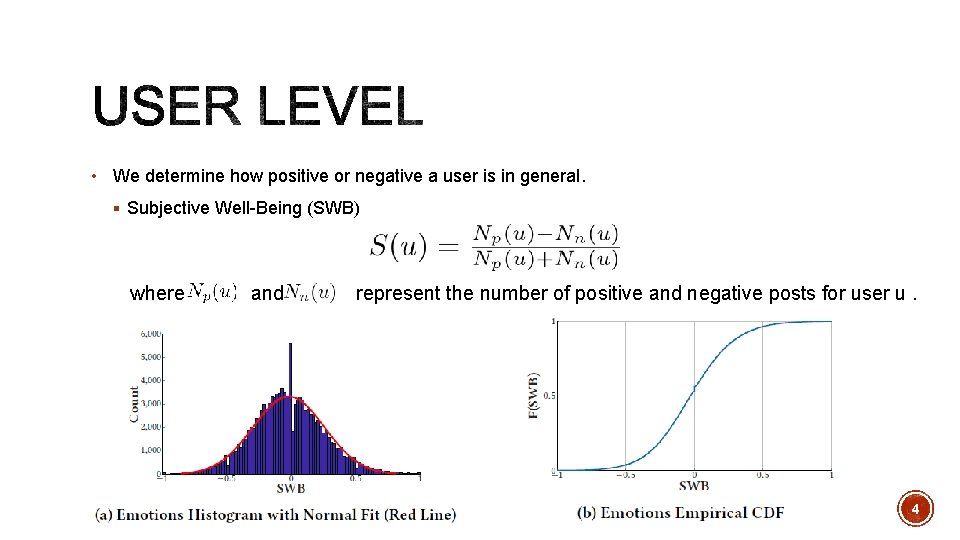
• We determine how positive or negative a user is in general. § Subjective Well-Being (SWB) where and represent the number of positive and negative posts for user u. 4
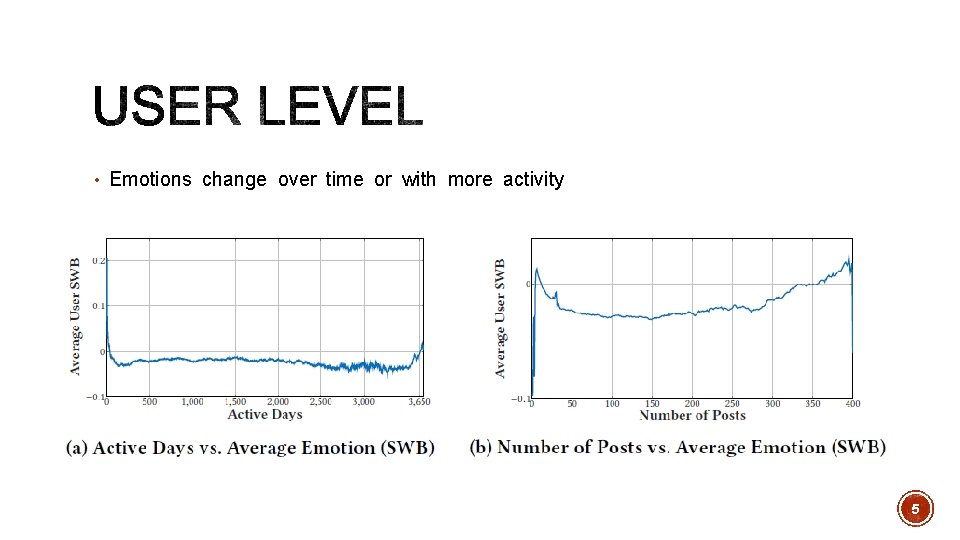
• Emotions change over time or with more activity 5
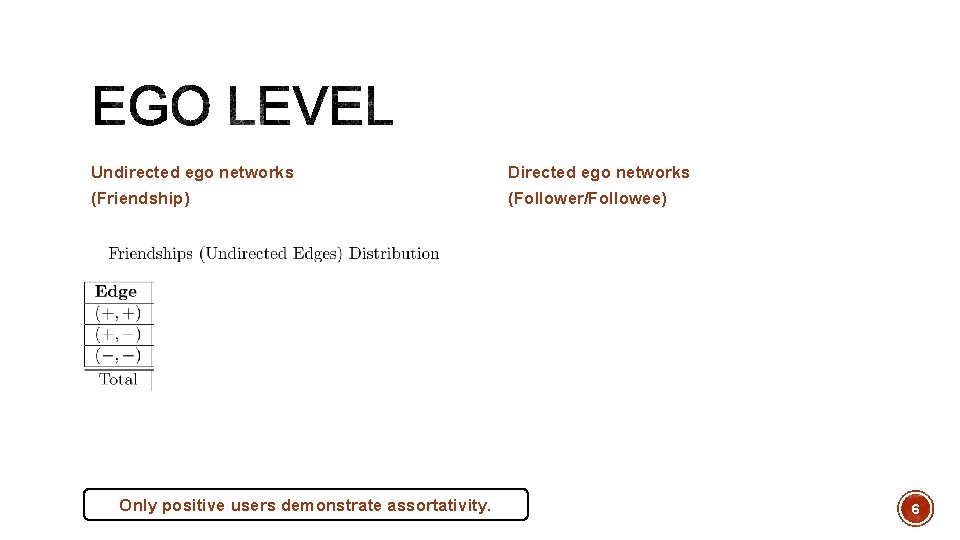
Undirected ego networks Directed ego networks (Friendship) (Follower/Followee) Only positive users demonstrate assortativity. 6
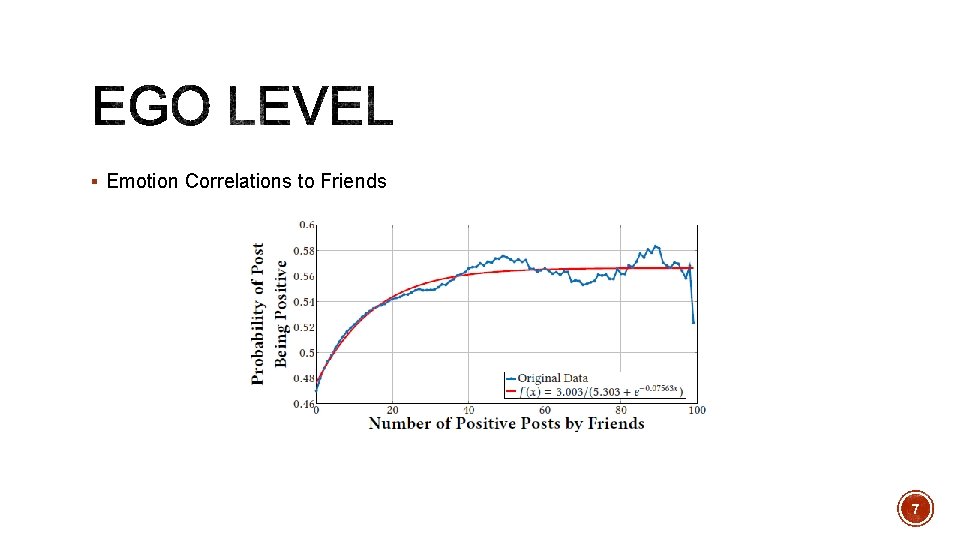
§ Emotion Correlations to Friends 7
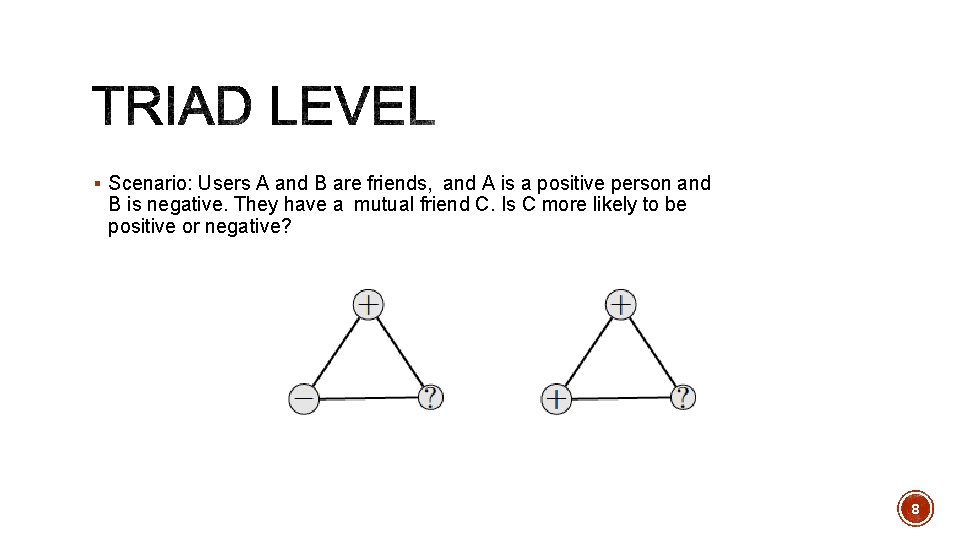
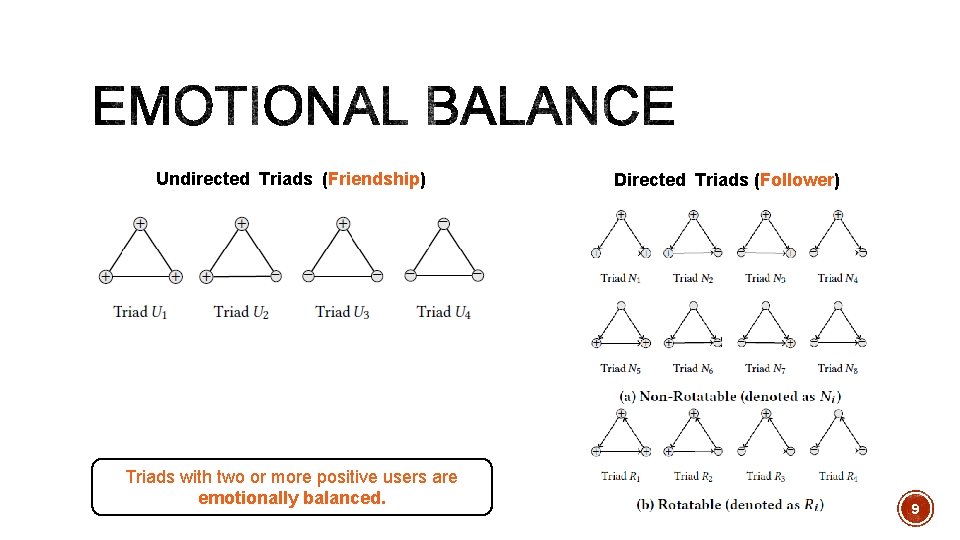
§ Scenario: Users A and B are friends, and A is a positive person and B is negative. They have a mutual friend C. Is C more likely to be positive or negative? 8
Undirected Triads (Friendship) Triads with two or more positive users are emotionally balanced. Directed Triads (Follower) 9
§ Are Community Members Emotionally-Similar? § Are Structural Properties of Communities Related to their Members’ Emotions? 10
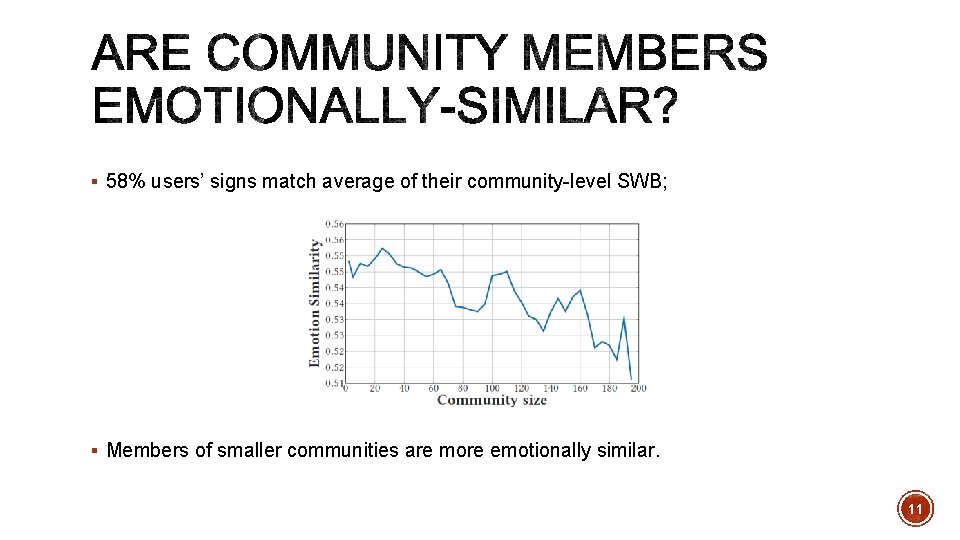
§ 58% users’ signs match average of their community-level SWB; § Members of smaller communities are more emotionally similar. 11
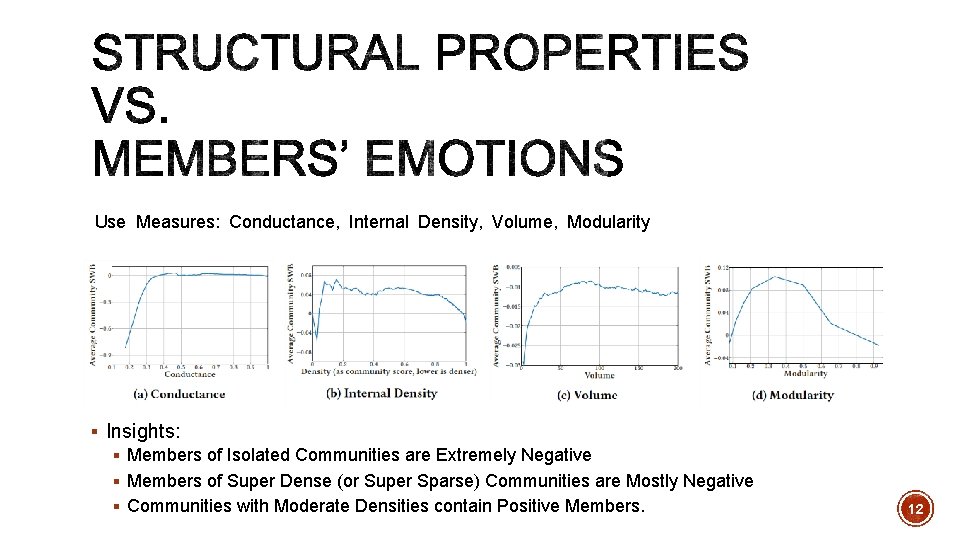
Use Measures: Conductance, Internal Density, Volume, Modularity § Insights: § Members of Isolated Communities are Extremely Negative § Members of Super Dense (or Super Sparse) Communities are Mostly Negative § Communities with Moderate Densities contain Positive Members. 12
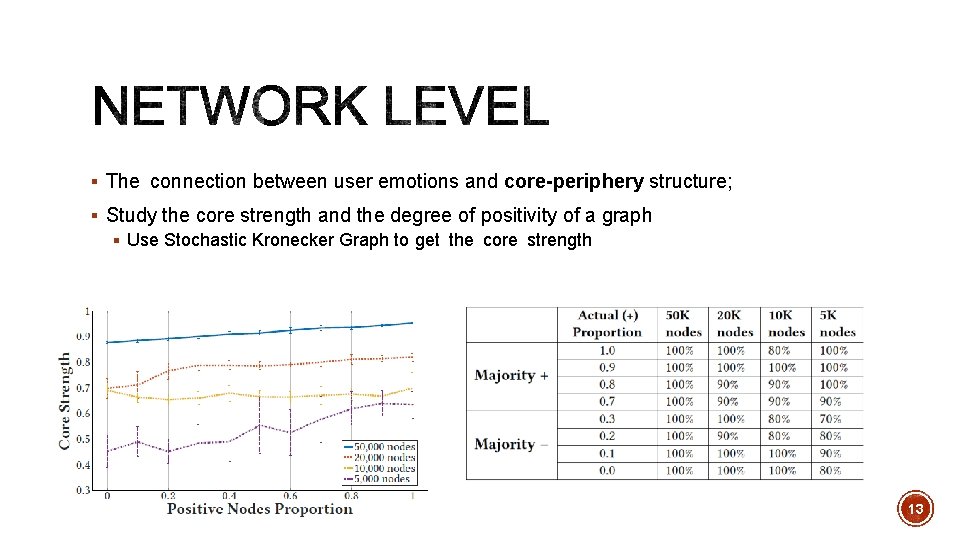
§ The connection between user emotions and core-periphery structure; § Study the core strength and the degree of positivity of a graph § Use Stochastic Kronecker Graph to get the core strength 13
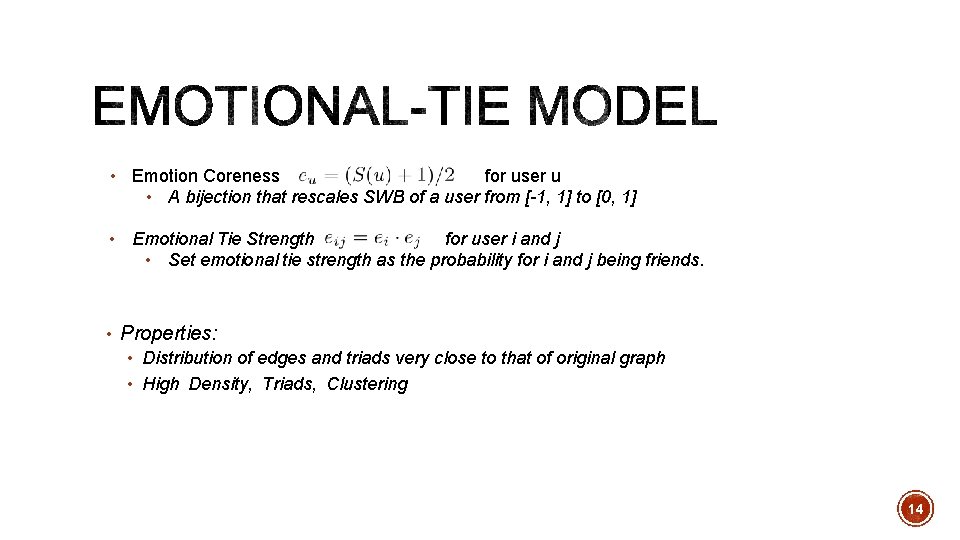
• Emotion Coreness for user u • A bijection that rescales SWB of a user from [-1, 1] to [0, 1] • Emotional Tie Strength for user i and j • Set emotional tie strength as the probability for i and j being friends. • Properties: • Distribution of edges and triads very close to that of original graph • High Density, Triads, Clustering 14
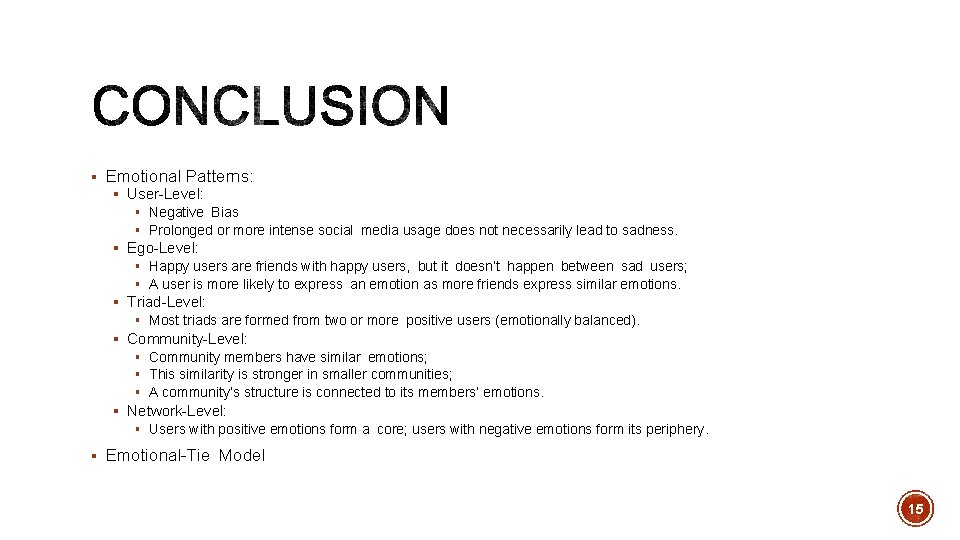
§ Emotional Patterns: § User-Level: § Negative Bias § Prolonged or more intense social media usage does not necessarily lead to sadness. § Ego-Level: § Happy users are friends with happy users, but it doesn’t happen between sad users; § A user is more likely to express an emotion as more friends express similar emotions. § Triad-Level: § Most triads are formed from two or more positive users (emotionally balanced). § Community-Level: § Community members have similar emotions; § This similarity is stronger in smaller communities; § A community’s structure is connected to its members’ emotions. § Network-Level: § Users with positive emotions form a core; users with negative emotions form its periphery. § Emotional-Tie Model 15