In the Renaissance a new philosophy HUMANISM emphasized

- Slides: 53
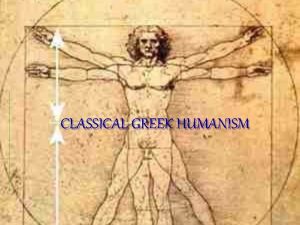
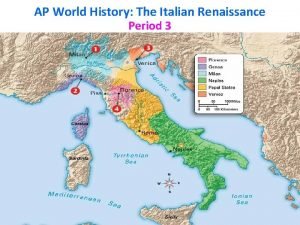
In the Renaissance a new philosophy, HUMANISM, emphasized: 1. INDIVIDUALISM: INDIVIDUALISM glorifying potential, talents and accomplishments of individual human beings. 2. CLASSICISM: CLASSICISM Re-discovery and appreciation of ancient Greek & Roman culture (especially in Italy…why is that? ) 3. SECULARISM: SECULARISM emphasis on this world (the “here & now”) and its material pleasures rather than the afterlife (“hereafter”) or spiritual world.
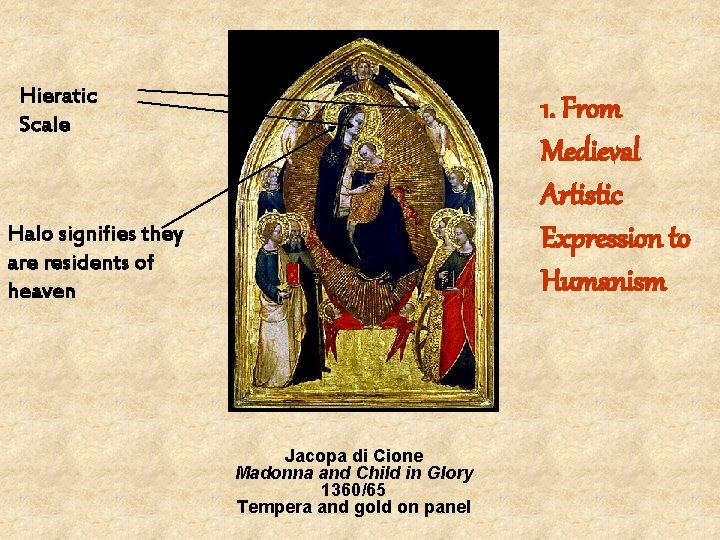
Hieratic Scale 1. From Medieval Artistic Expression to Humanism Halo signifies they are residents of heaven Jacopa di Cione Madonna and Child in Glory 1360/65 Tempera and gold on panel
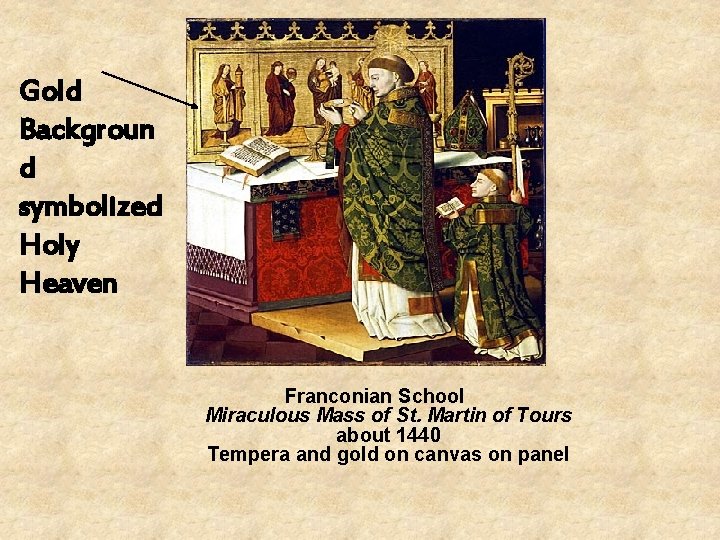
Gold Backgroun d symbolized Holy Heaven Franconian School Miraculous Mass of St. Martin of Tours about 1440 Tempera and gold on canvas on panel
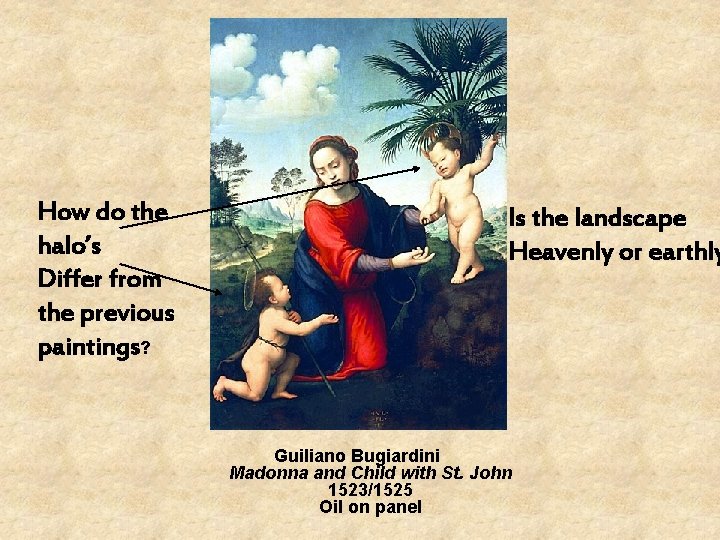
How do the halo’s Differ from the previous paintings? Is the landscape Heavenly or earthly Guiliano Bugiardini Madonna and Child with St. John 1523/1525 Oil on panel
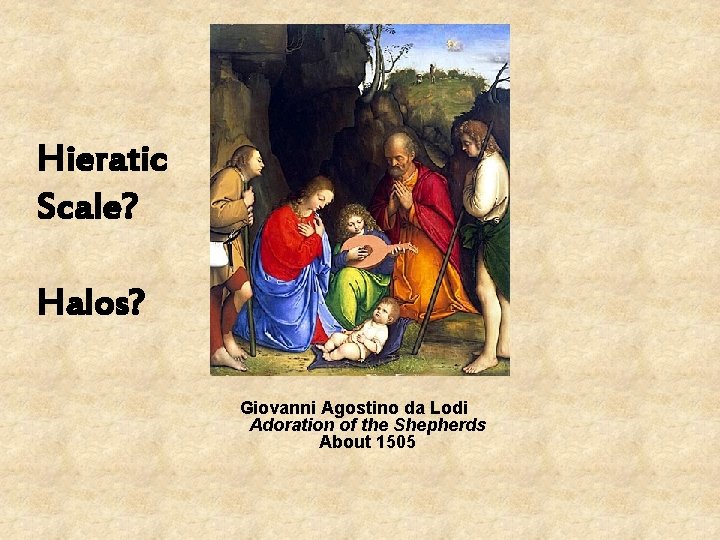
Hieratic Scale? Halos? Giovanni Agostino da Lodi Adoration of the Shepherds About 1505
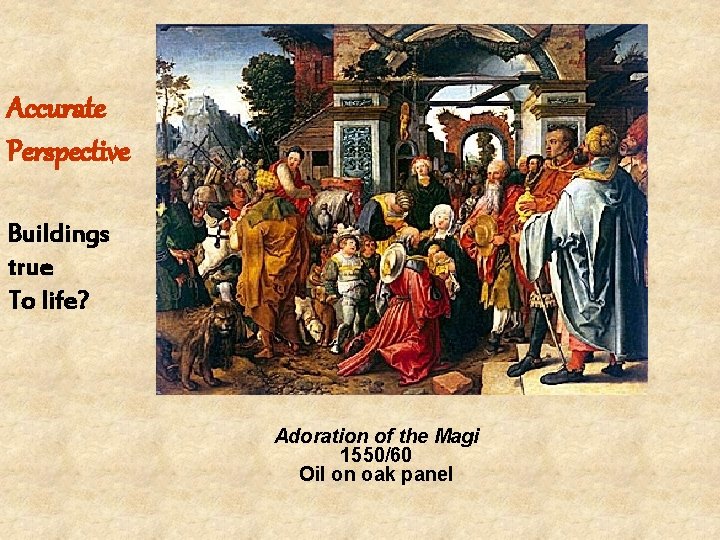
Accurate Perspective Buildings true To life? Adoration of the Magi 1550/60 Oil on oak panel
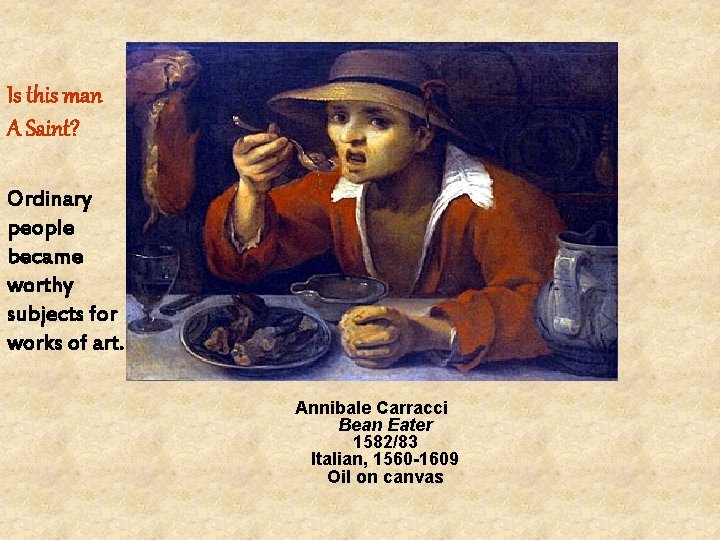
Is this man A Saint? Ordinary people became worthy subjects for works of art. Annibale Carracci Bean Eater 1582/83 Italian, 1560 -1609 Oil on canvas
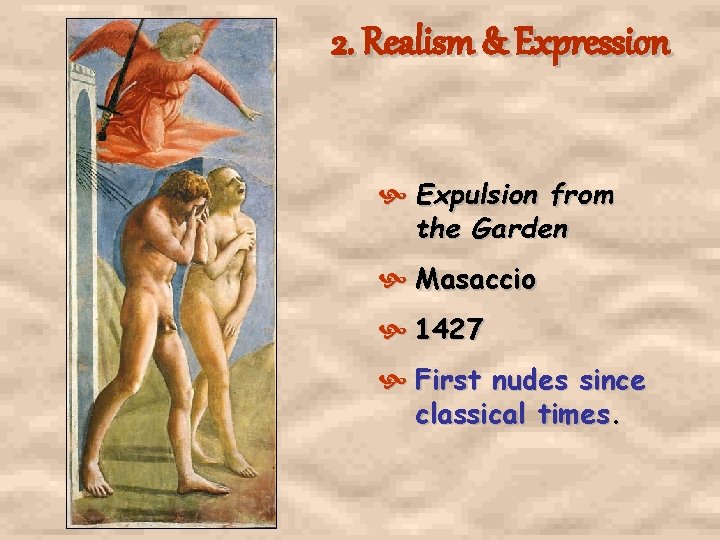
2. Realism & Expression Expulsion from the Garden Masaccio 1427 First nudes since classical times.
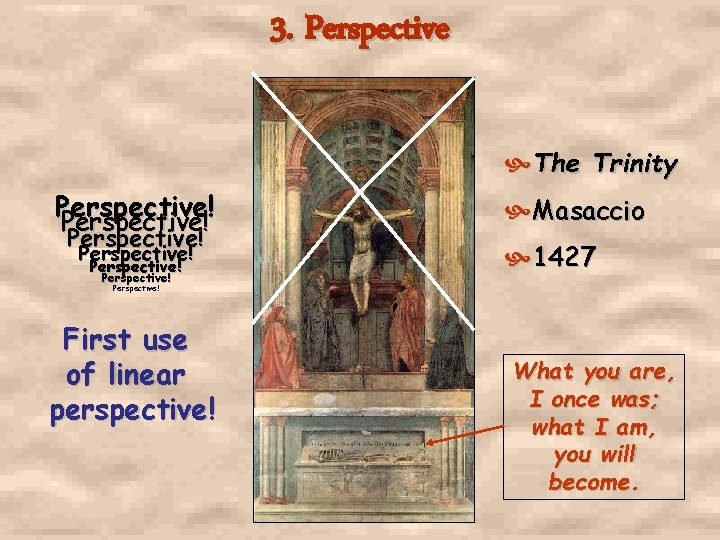
3. Perspective The Trinity Perspective! Perspective! Masaccio 1427 Perspective! First use of linear perspective! What you are, I once was; what I am, you will become.
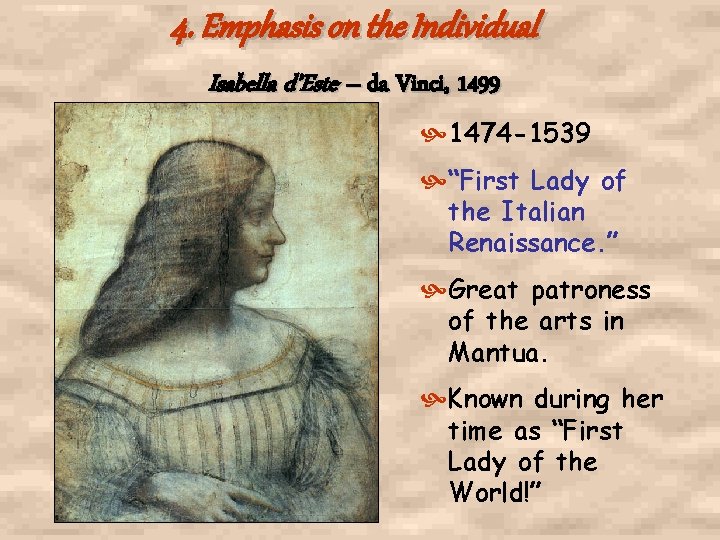
4. Emphasis on the Individual Isabella d’Este – da Vinci, 1499 1474 -1539 “First Lady of the Italian Renaissance. ” Great patroness of the arts in Mantua. Known during her time as “First Lady of the World!”
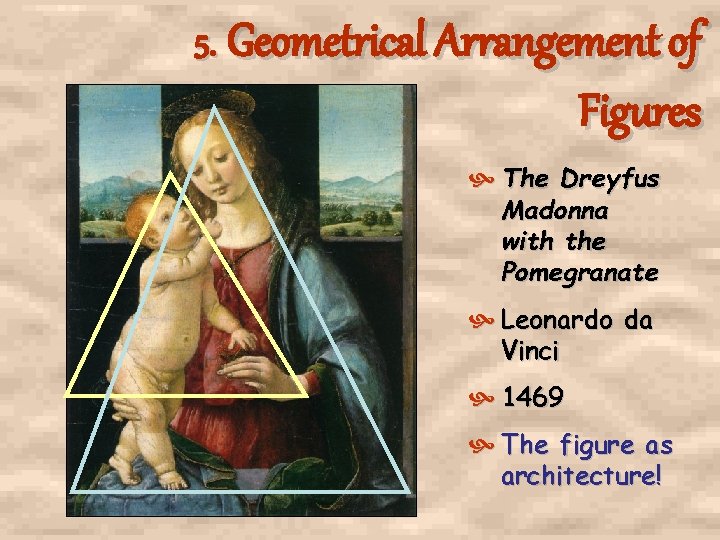
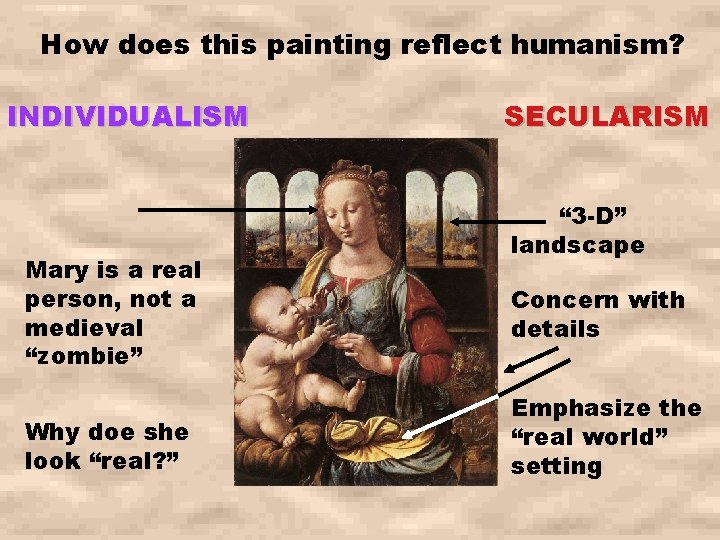
5. Geometrical Arrangement of Figures The Dreyfus Madonna with the Pomegranate Leonardo da Vinci 1469 The figure as architecture!
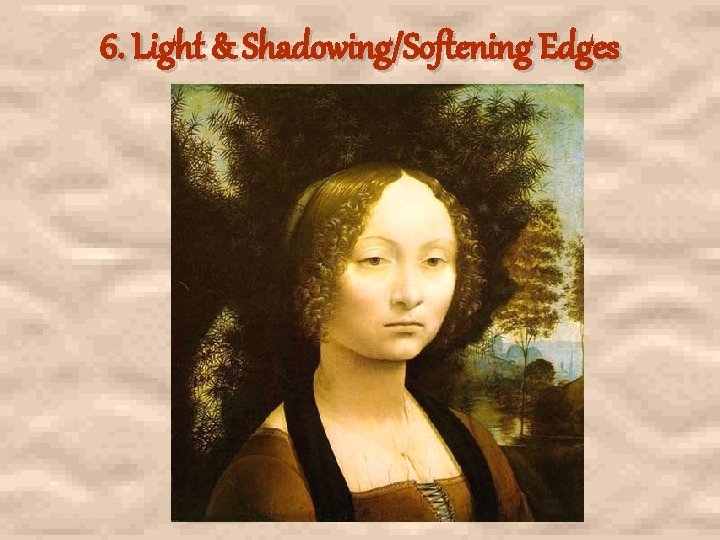
6. Light & Shadowing/Softening Edges
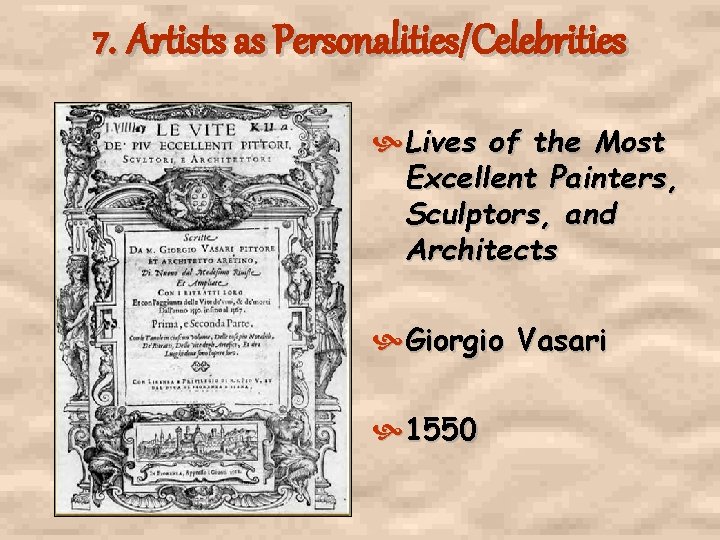
7. Artists as Personalities/Celebrities Lives of the Most Excellent Painters, Sculptors, and Architects Giorgio Vasari 1550
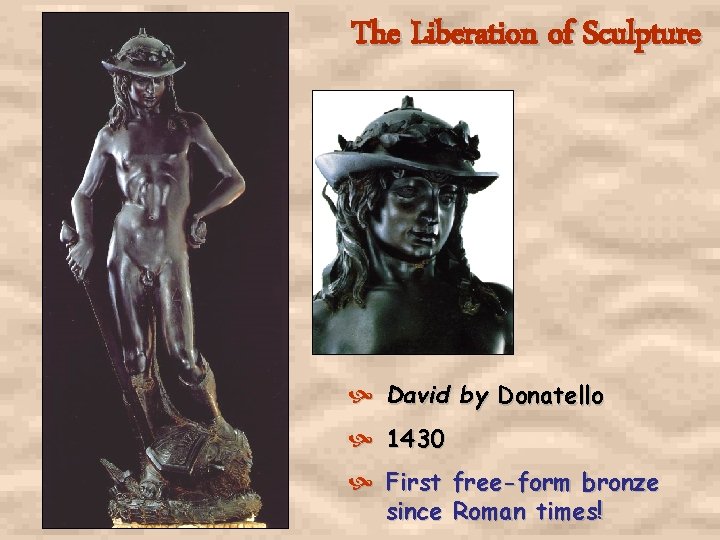
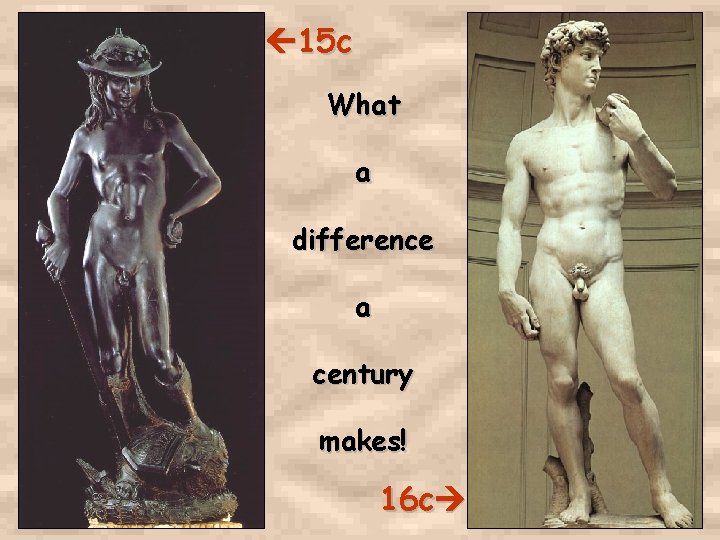
The Liberation of Sculpture David by Donatello 1430 First free-form bronze since Roman times!
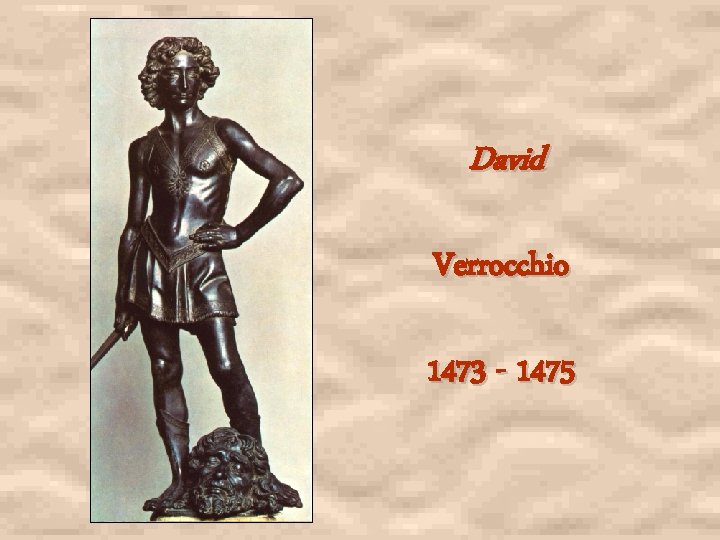
David Verrocchio 1473 - 1475
The Renaissance “Man” Broad knowledge about many things in different fields. Deep knowledge/skill in one area. Able to link information from different areas/disciplines and create new knowledge. The Greek ideal of the “well-rounded man” was at the heart of Renaissance education.
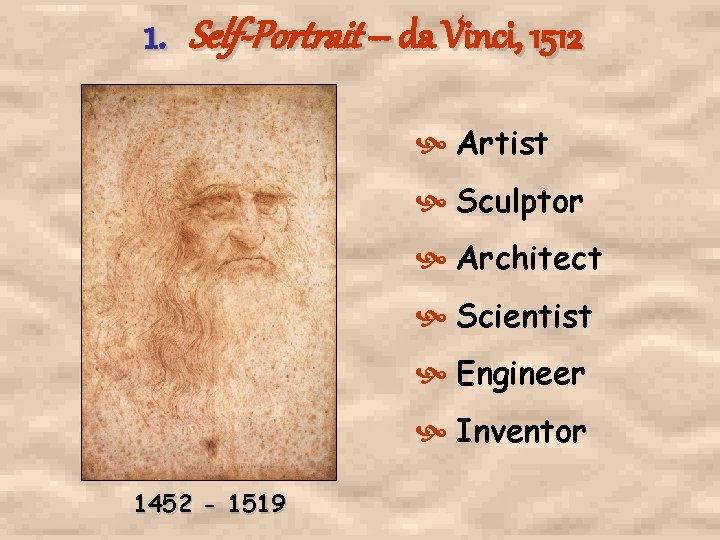
1. Self-Portrait -- da Vinci, 1512 Artist Sculptor Architect Scientist Engineer Inventor 1452 - 1519
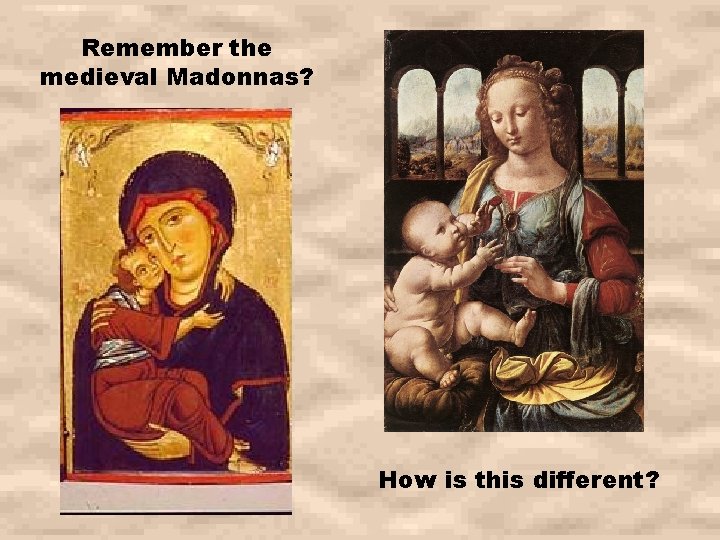
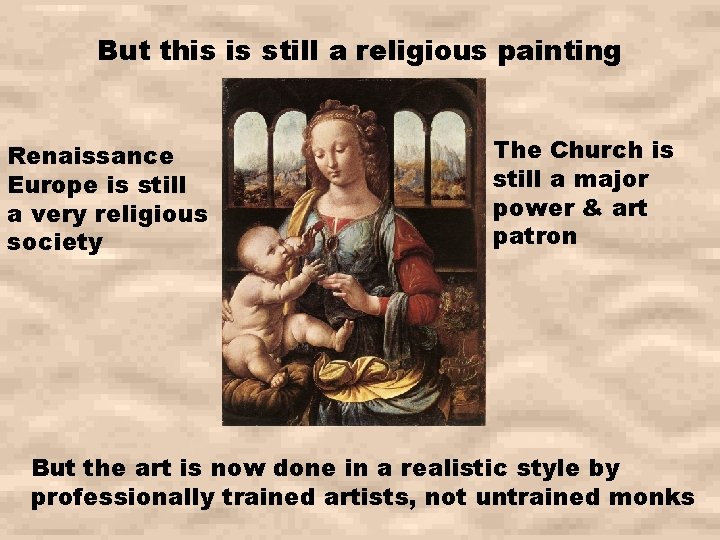
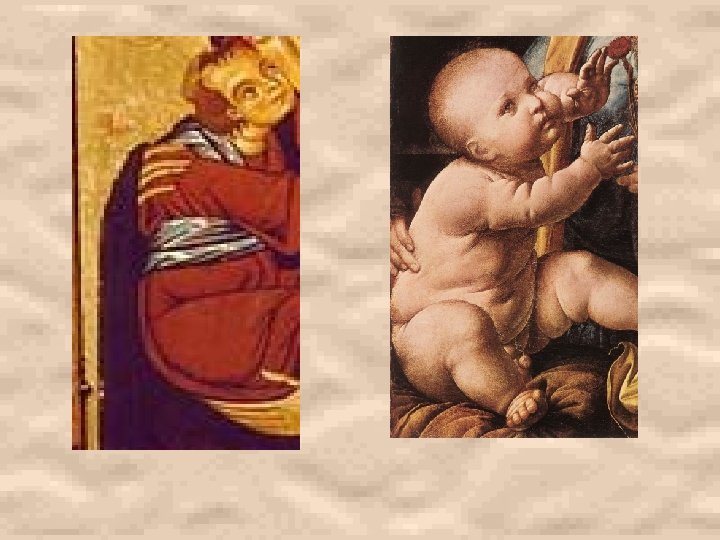
Remember the medieval Madonnas? How is this different?
But this is still a religious painting Renaissance Europe is still a very religious society The Church is still a major power & art patron But the art is now done in a realistic style by professionally trained artists, not untrained monks
How does this painting reflect humanism? INDIVIDUALISM Mary is a real person, not a medieval “zombie” Why doe she look “real? ” SECULARISM “ 3 -D” landscape Concern with details Emphasize the “real world” setting
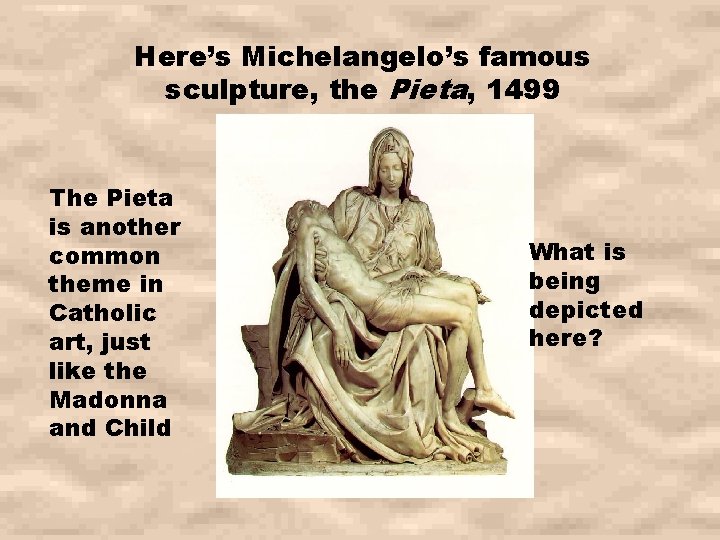
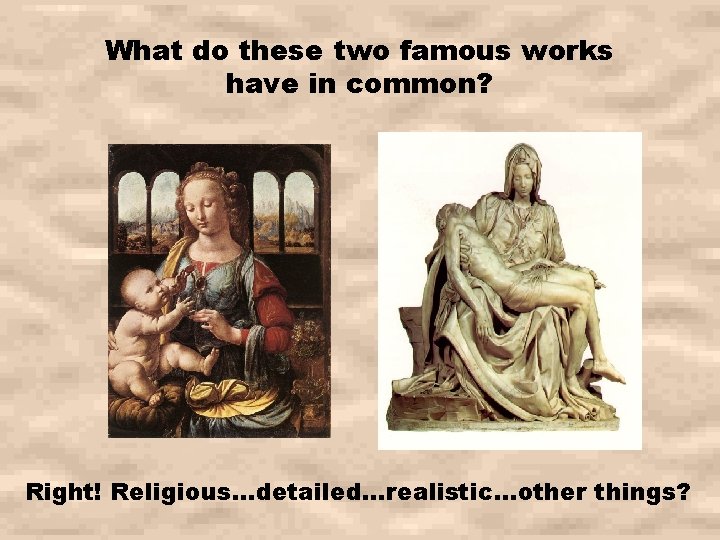
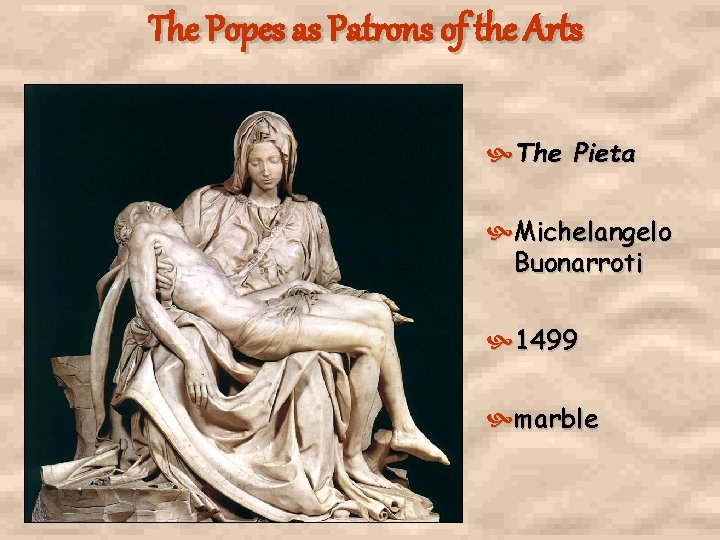
Here’s Michelangelo’s famous sculpture, the Pieta, 1499 The Pieta is another common theme in Catholic art, just like the Madonna and Child What is being depicted here?
What do these two famous works have in common? Right! Religious…detailed…realistic…other things?
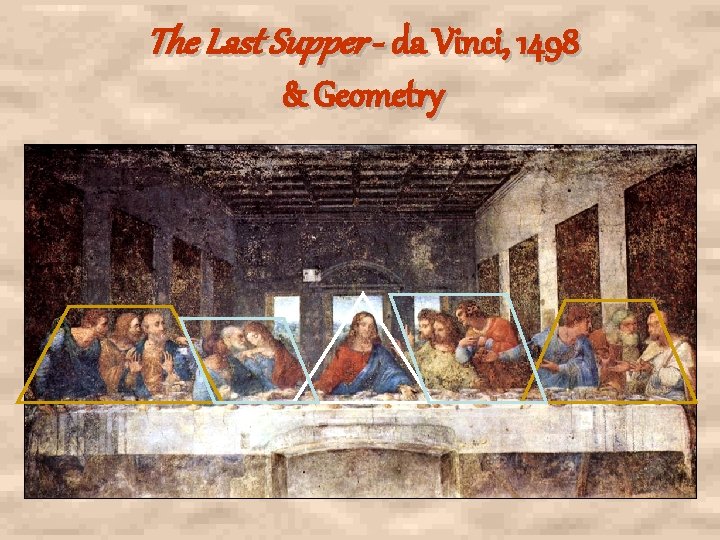
The Last Supper - da Vinci, 1498 & Geometry
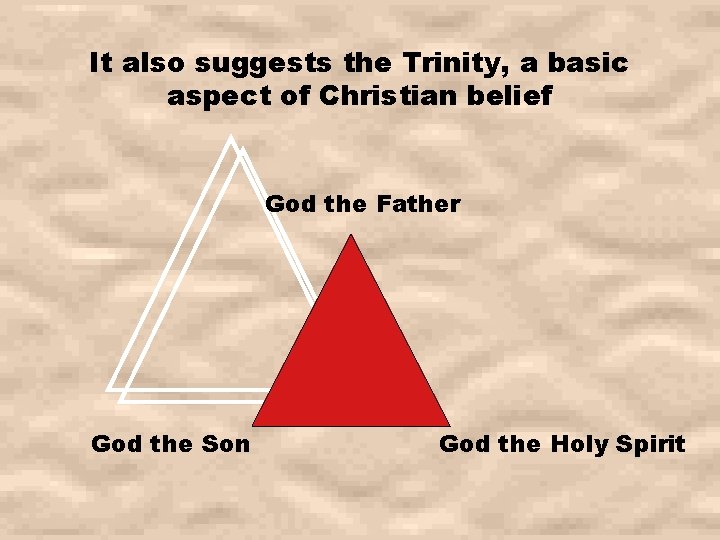
It also suggests the Trinity, a basic aspect of Christian belief God the Father God the Son God the Holy Spirit
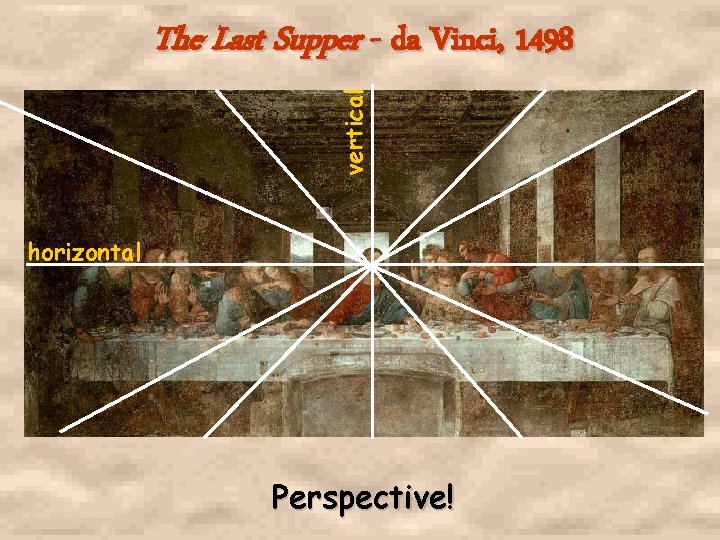
vertical The Last Supper - da Vinci, 1498 horizontal Perspective!
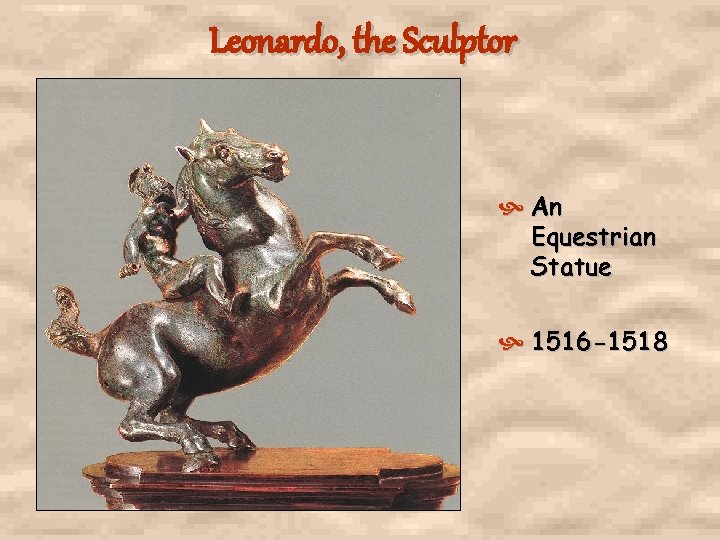
Leonardo, the Sculptor An Equestrian Statue 1516 -1518
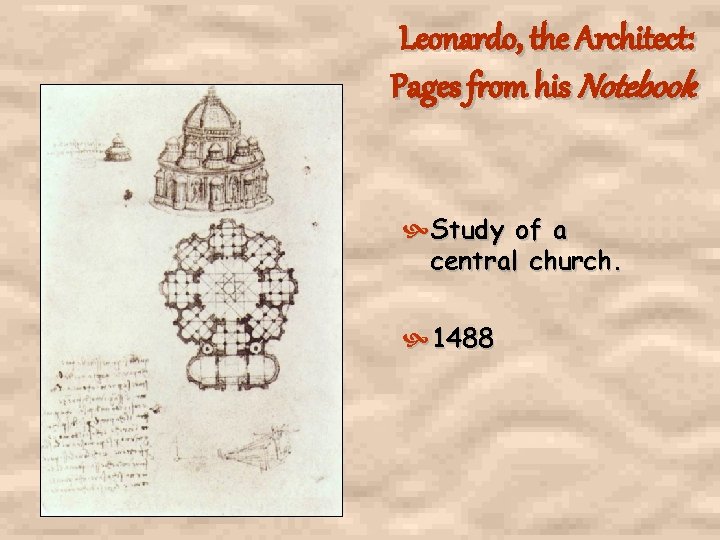
Leonardo, the Architect: Pages from his Notebook Study of a central church. 1488
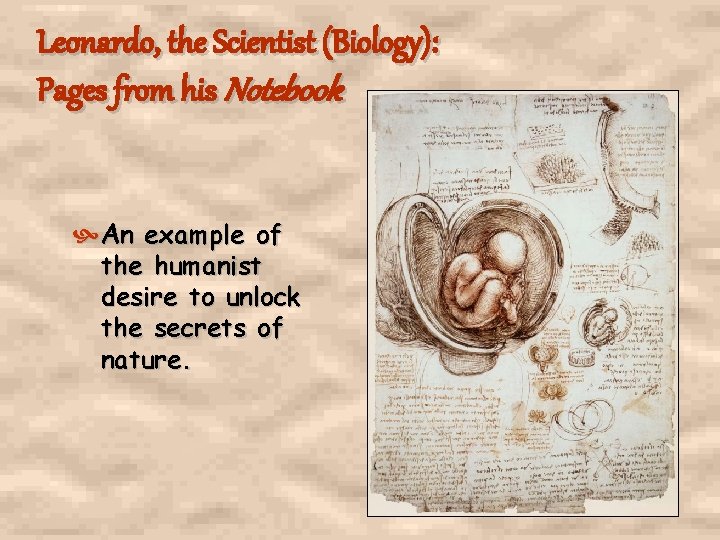
Leonardo, the Scientist (Biology): Pages from his Notebook An example of the humanist desire to unlock the secrets of nature.
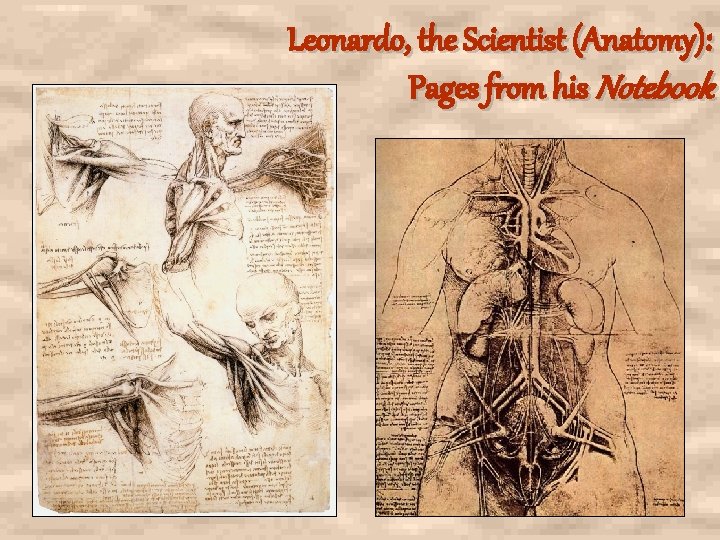
Leonardo, the Scientist (Anatomy): Pages from his Notebook
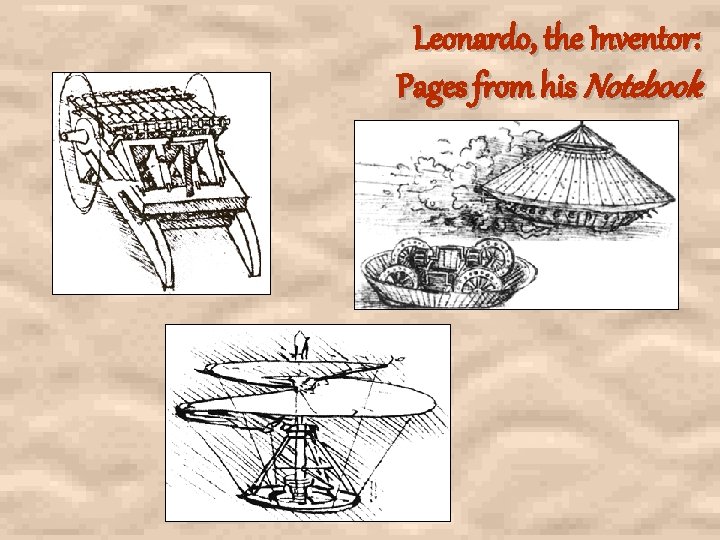
Leonardo, the Inventor: Pages from his Notebook
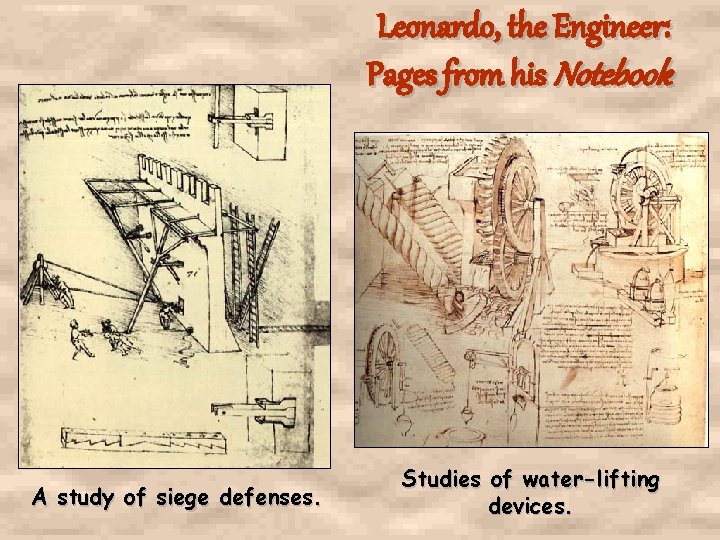
Leonardo, the Engineer: Pages from his Notebook A study of siege defenses. Studies of water-lifting devices.
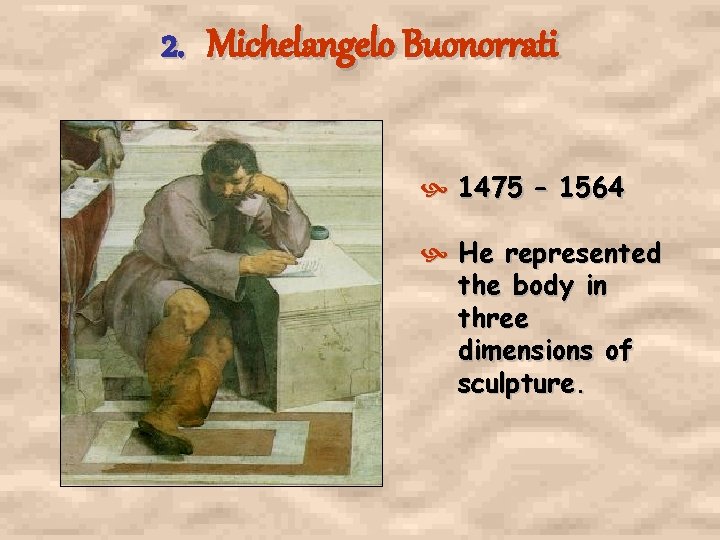
2. Michelangelo Buonorrati 1475 – 1564 He represented the body in three dimensions of sculpture.
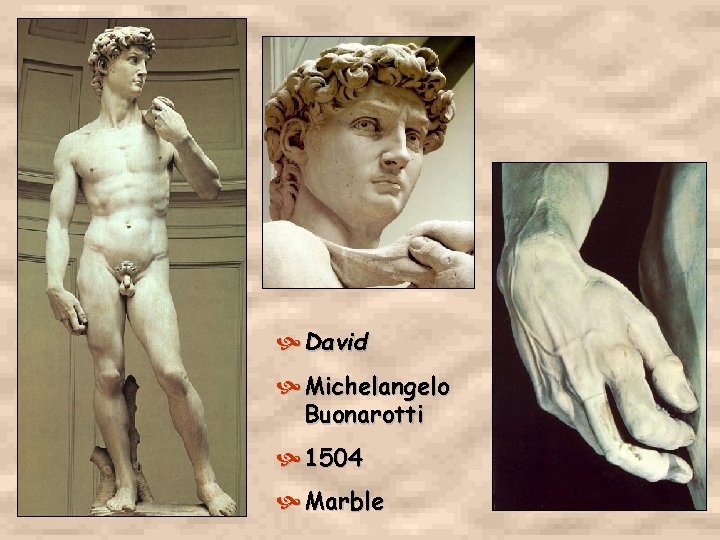
David Michelangelo Buonarotti 1504 Marble
15 c What a difference a century makes! 16 c
The Popes as Patrons of the Arts The Pieta Michelangelo Buonarroti 1499 marble
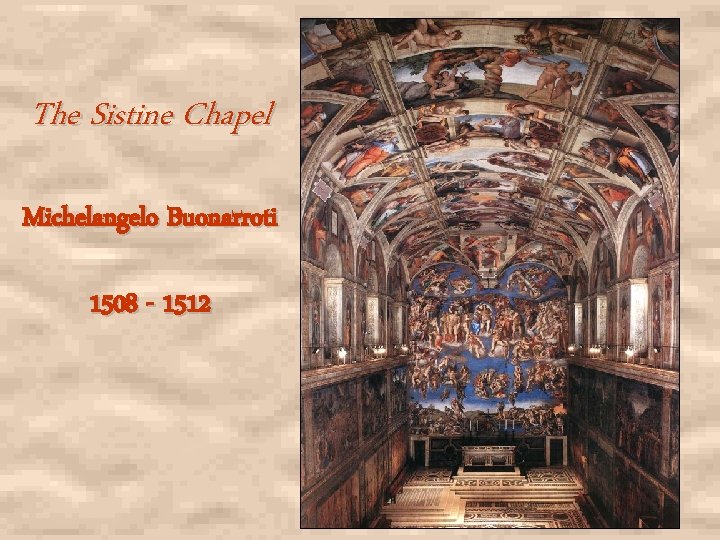
The Sistine Chapel Michelangelo Buonarroti 1508 - 1512
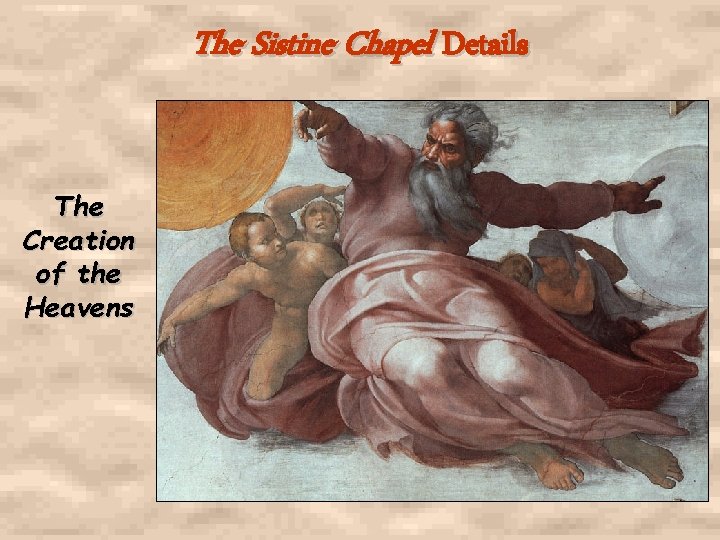
The Sistine Chapel Details The Creation of the Heavens
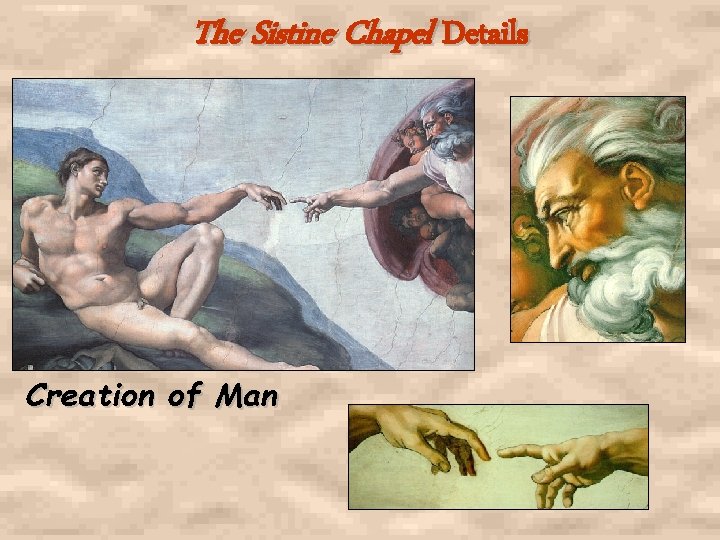
The Sistine Chapel Details Creation of Man
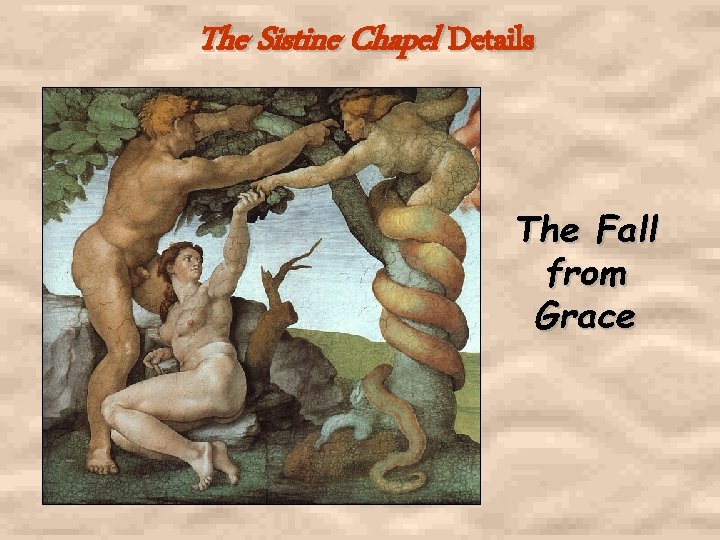
The Sistine Chapel Details The Fall from Grace
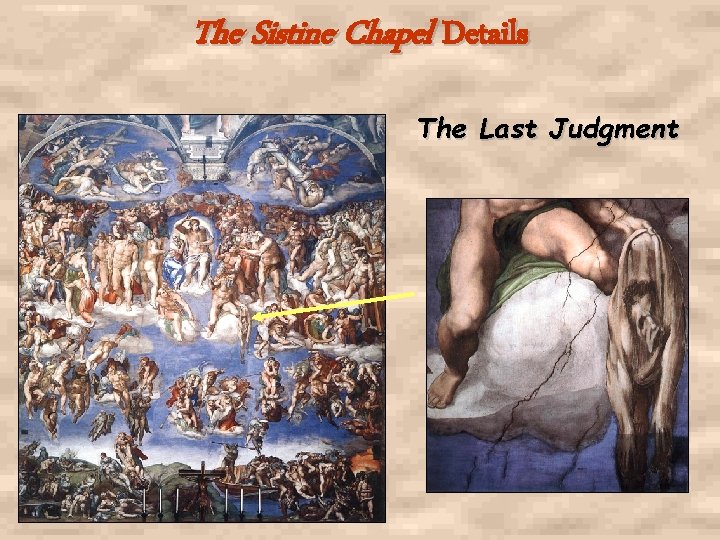
The Sistine Chapel Details The Last Judgment
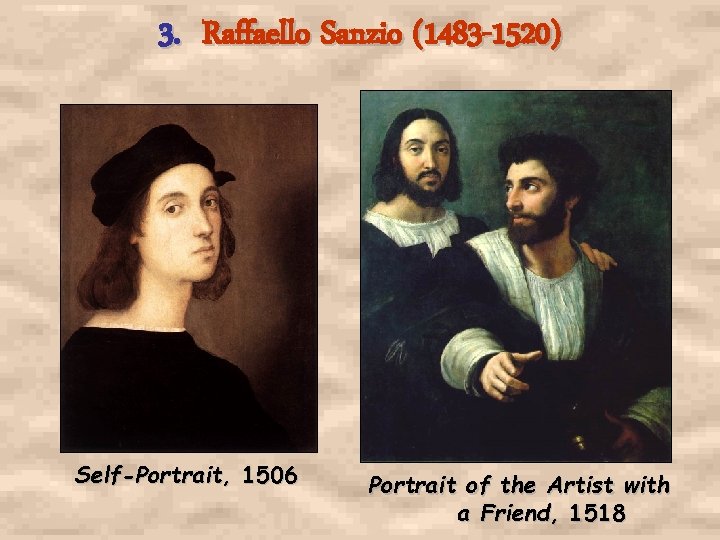
3. Raffaello Sanzio (1483 -1520) Self-Portrait, 1506 Portrait of the Artist with a Friend, 1518
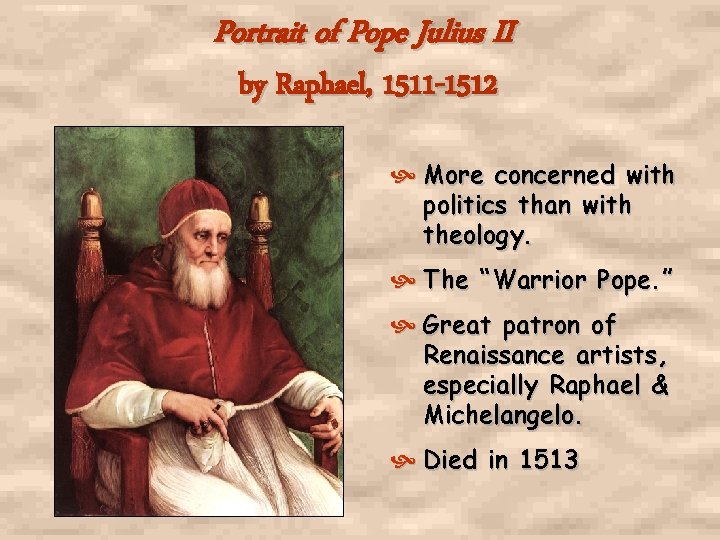
Portrait of Pope Julius II by Raphael, 1511 -1512 More concerned with politics than with theology. The “Warrior Pope. ” Great patron of Renaissance artists, especially Raphael & Michelangelo. Died in 1513
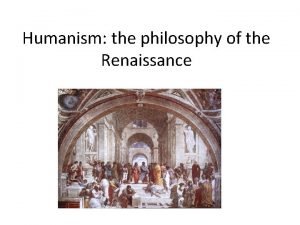
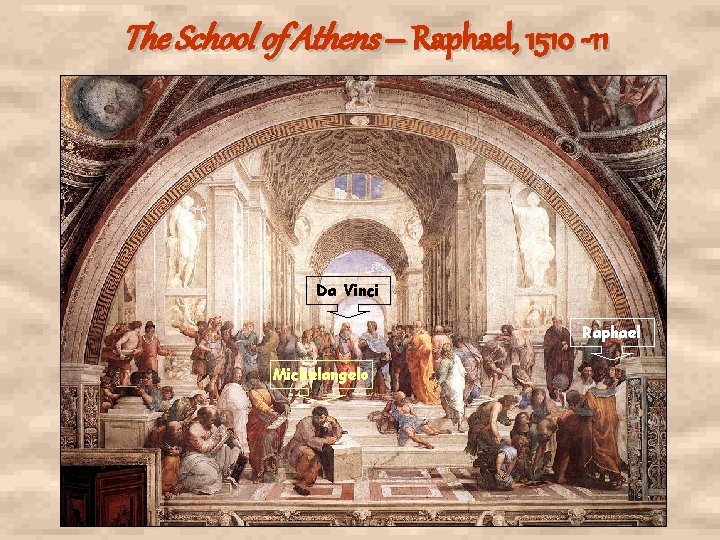
The School of Athens – Raphael, 1510 -11 One point perspective. All of the important Greek philosophers and thinkers are included all of the great personalities of the Seven Liberal Arts! A great variety of poses. Located in the papal apartments library. Raphael worked on this commission simultaneously as Michelangelo was doing the Sistine Chapel. No Christian themes here.
The School of Athens – Raphael, 1510 -11 Da Vinci Raphael Michelangelo
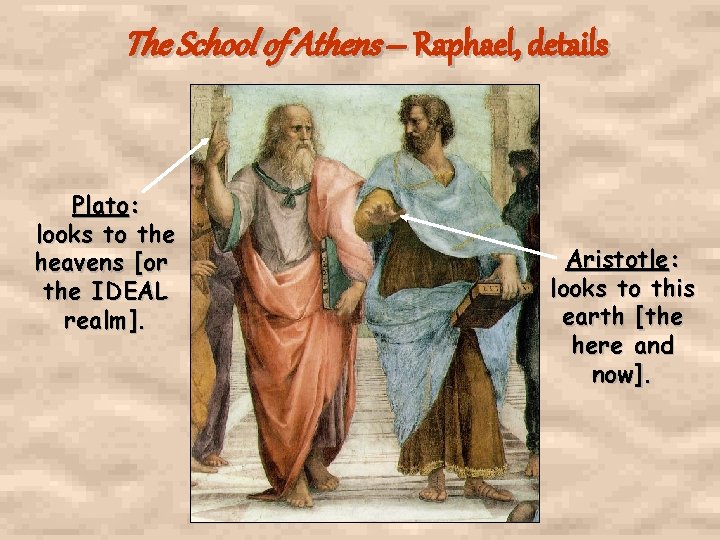
The School of Athens – Raphael, details Plato: looks to the heavens [or the IDEAL realm]. Aristotle: looks to this earth [the here and now].
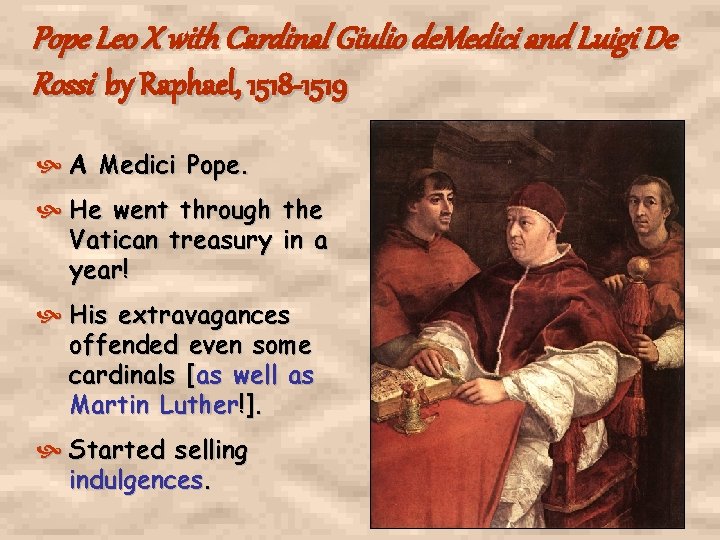
Pope Leo X with Cardinal Giulio de. Medici and Luigi De Rossi by Raphael, 1518 -1519 A Medici Pope. He went through the Vatican treasury in a year! His extravagances offended even some cardinals [as well as Martin Luther!]. Started selling indulgences.
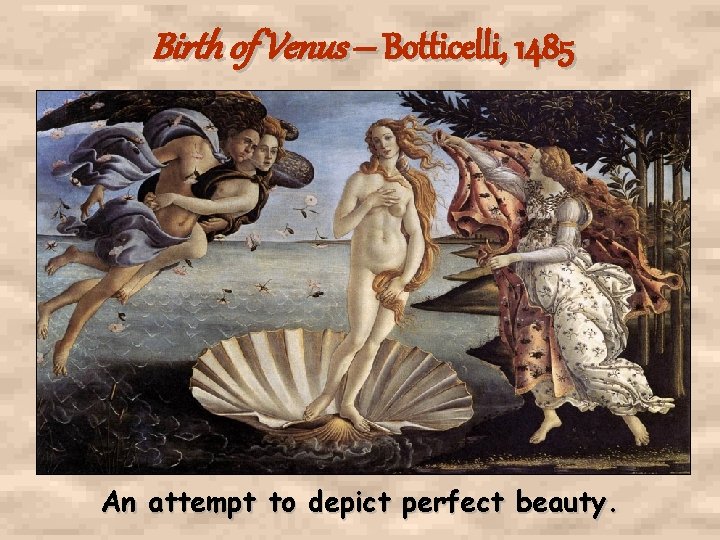
Birth of Venus – Botticelli, 1485 An attempt to depict perfect beauty.
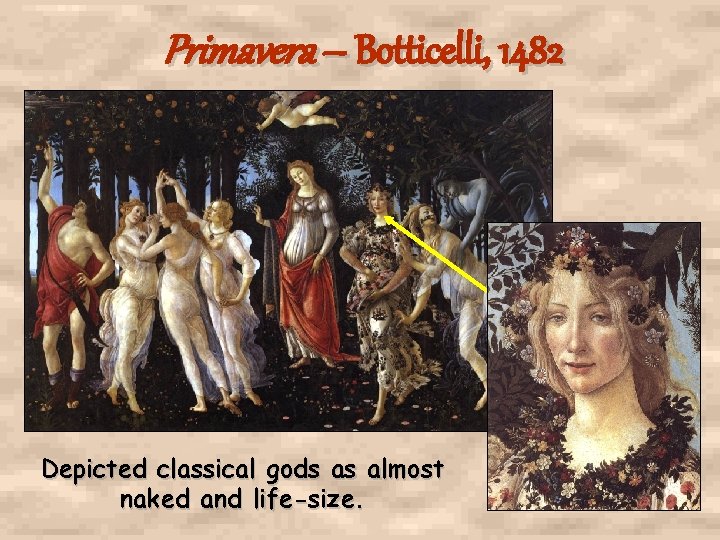
Primavera – Botticelli, 1482 Depicted classical gods as almost naked and life-size.
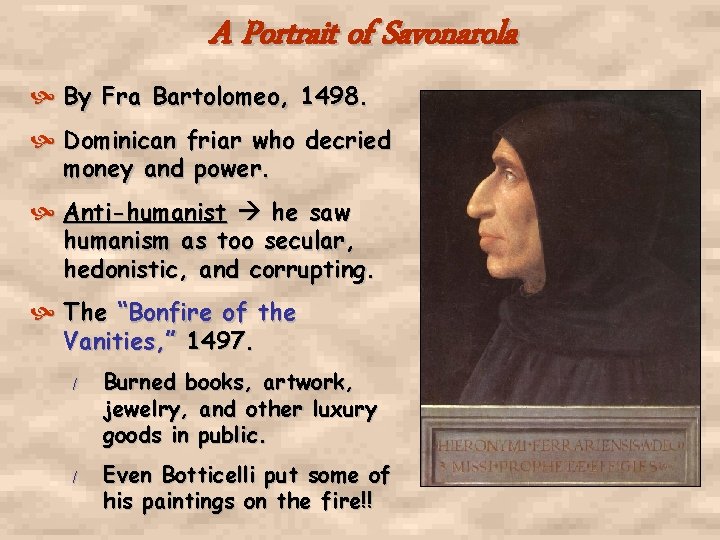
A Portrait of Savonarola By Fra Bartolomeo, 1498. Dominican friar who decried money and power. Anti-humanist he saw humanism as too secular, hedonistic, and corrupting. The “Bonfire of the Vanities, ” 1497. / Burned books, artwork, jewelry, and other luxury goods in public. / Even Botticelli put some of his paintings on the fire!!
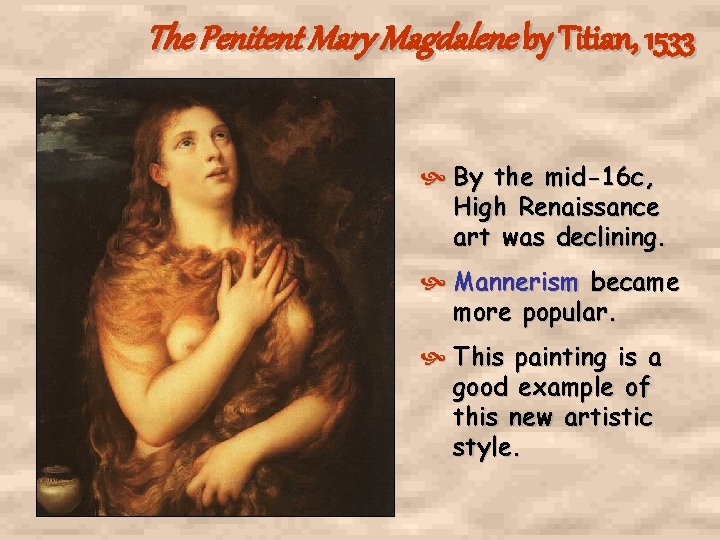
The Penitent Mary Magdalene by Titian, 1533 By the mid-16 c, High Renaissance art was declining. Mannerism became more popular. This painting is a good example of this new artistic style.
Renaissance art clearly depicts the philosophy of humanism in its emphasis on: INDIVIDUALISM CLASSICISM SECULARISM