IMPLEMENTING GMP AMONG PHARMACEUTICAL MANUFACTURERS IN NIGERIA COMMON





- Slides: 53
IMPLEMENTING GMP AMONG PHARMACEUTICAL MANUFACTURERS IN NIGERIA: COMMON CHALLENGES Titilope O. Owolabi Director, Drug Evaluation & Research, NAFDAC 19 -21 December, 2016
Outline • GMP Inspection System in Nigeria • The Pharma Industry in Nigeria: An Overview • Challenges in Implementing GMP ü NAFDAC ü Industry • Conclusion 2
GMP Inspection System in Nigeria • The National Agency for Food and Drug Administration and Control (NAFDAC) was established by the NAFDAC Act Cap. N 1 LFN 2004 (formerly Decree 19 of 1993 as amended) with the mandate to regulate and control the importation, exportation, manufacture, advertisement, distribution, sale and use of food, drugs, cosmetics, medical devices, chemicals, bottled water including all drinks (referred to as regulated products) 3
GMP Inspection System in Nigeria • Nigeria is divided into 36 states and the Federal Capital Territory across six geo-political zones. • This population is spread across the 923, 768 km² land mass of the country. • NAFDAC has offices in the 36 states of the Federation and the Federal Capital Territory. • About 2500 staff across the Agency including • 18 Lead Inspectors (includes 3 Laboratory Officers) & 30 ‘Others’ for inspections. 4
GMP Inspection System in Nigeria. . . • Drug Evaluation & Research Directorate (DER) is one of the compliance directorates of NAFDAC which ensures the quality, safety and efficacy of medicines, through inspections, monitoring and enforcement. • The officers have degrees in pharmacy, pharmaceutical or basic sciences, biostatistics etc. • On employment, officers posted to the directorate undergo orientation trainings on Introduction to GMP concepts, Roles and Ethics of an inspector called GMP Level 1 training. 5
GMP Inspection System in Nigeria. … • GMP Level 2 & 3 trainings are conducted for officers as they grow within the directorate. • Annual in-house training program on current trends in GMP is conducted on a regional basis for inspectors in the respective regions. • Inspectors also undergo international trainings conducted by various organizations e. g. PIC/S, WHO, USP (Ce. PAT etc. ), USFDA etc 6
GMP Inspection System in Nigeria. … • DER inspectors also participate in relevant international regulatory fora and workshops e. g. USFDA CDER Forum, Health Canada Forum, PIC/S meetings etc. • Uniformity of operations of DER is ensured through the following: • All applications for inspection of facilities are received by Heads of DER Units in NAFDAC state offices and the submissions are evaluated in line with the SOPs. • Inspections are led by officers not below the rank of Principal Regulatory Officer with a minimum of five (5) years Pharmaceutical GMP inspection experience. 7
GMP Inspection System in Nigeria. … • Types of GMP Inspection: ü Routine ü Pre-production ü Pre-registration ü Follow-up ü GMP Re-assessment ü Investigation ü Monitoring ü Special 8
GMP Inspection System in Nigeria. … • The inspections are conducted using the Six Systems Approach for Pharmaceutical GMP Inspections. • For comprehensive inspections e. g. Pre-Production, Pre-Registration, GMP Re-assessment and Routine inspections, the full inspection option (Quality + at least 3 other systems) is adopted based on a risk assessment of the operations of the facility. • For abbreviated inspections like Follow-up, and Investigation inspections, the Quality system is mandatorily audited in addition to at least one other system selected based on risk assessment and the focus of the inspection of the facility. 9
GMP Inspection System in Nigeria. … • There is an approved format for inspection report writing for all inspections to ensure uniformity of reports. • Inspectors are interchanged periodically to assess companies in other states. • Reports of inspections are routed through their respective Unit Heads to the Head of Compliance in the headquarters where the reports and recommendations by the inspectors are reviewed for appropriateness. 10
GMP Inspection System in Nigeria. … • Categorization of observed GMP non-conformances are reviewed and compliance directives on the observations are drafted. • A summary of the inspection report indicating the approval or otherwise of the reports, the recommendation and the compliance directives where applicable, are communicated to the Director for endorsement. • The Quality Management & Documentation Division randomly samples the reports to ensure compliance with SOPs. 11
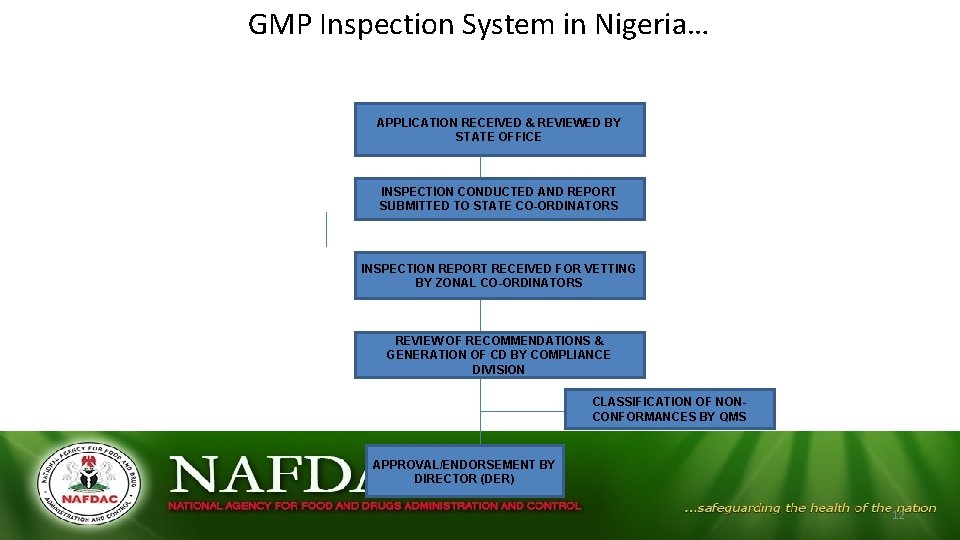
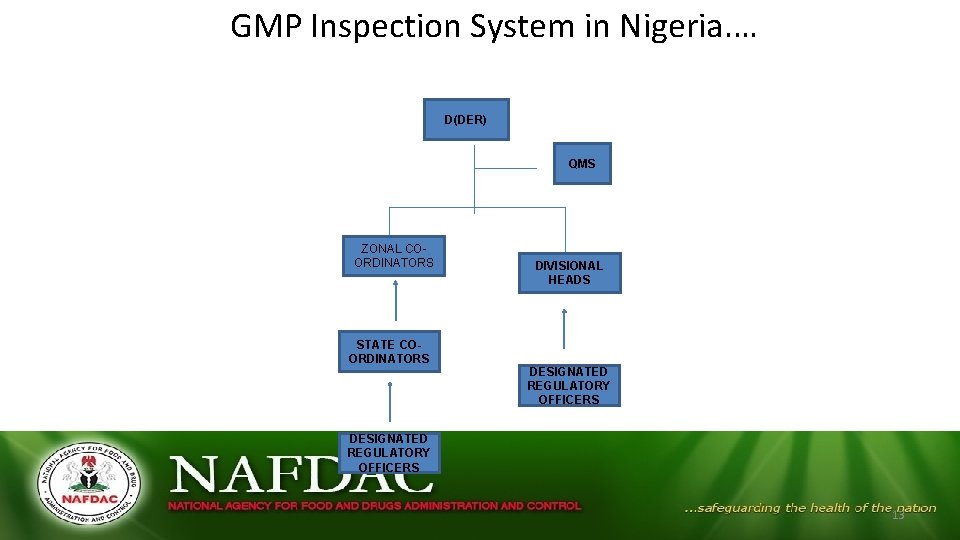
GMP Inspection System in Nigeria… APPLICATION RECEIVED & REVIEWED BY STATE OFFICE INSPECTION CONDUCTED AND REPORT SUBMITTED TO STATE CO-ORDINATORS INSPECTION REPORT RECEIVED FOR VETTING BY ZONAL CO-ORDINATORS REVIEW OF RECOMMENDATIONS & GENERATION OF CD BY COMPLIANCE DIVISION CLASSIFICATION OF NONCONFORMANCES BY QMS APPROVAL/ENDORSEMENT BY DIRECTOR (DER) 12
GMP Inspection System in Nigeria. … D(DER) QMS ZONAL COORDINATORS STATE COORDINATORS DIVISIONAL HEADS DESIGNATED REGULATORY OFFICERS 13
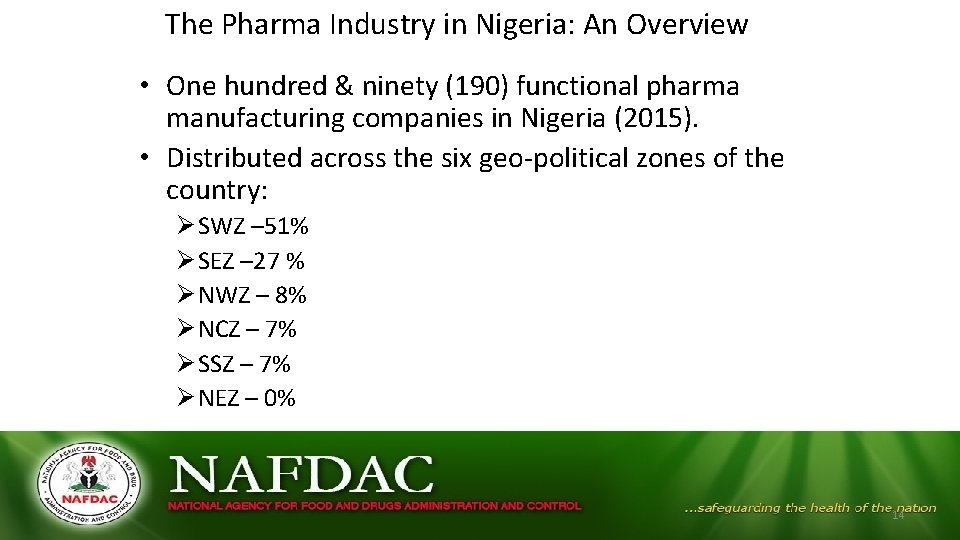
The Pharma Industry in Nigeria: An Overview • One hundred & ninety (190) functional pharma manufacturing companies in Nigeria (2015). • Distributed across the six geo-political zones of the country: Ø SWZ – 51% Ø SEZ – 27 % Ø NWZ – 8% Ø NCZ – 7% Ø SSZ – 7% Ø NEZ – 0% 14
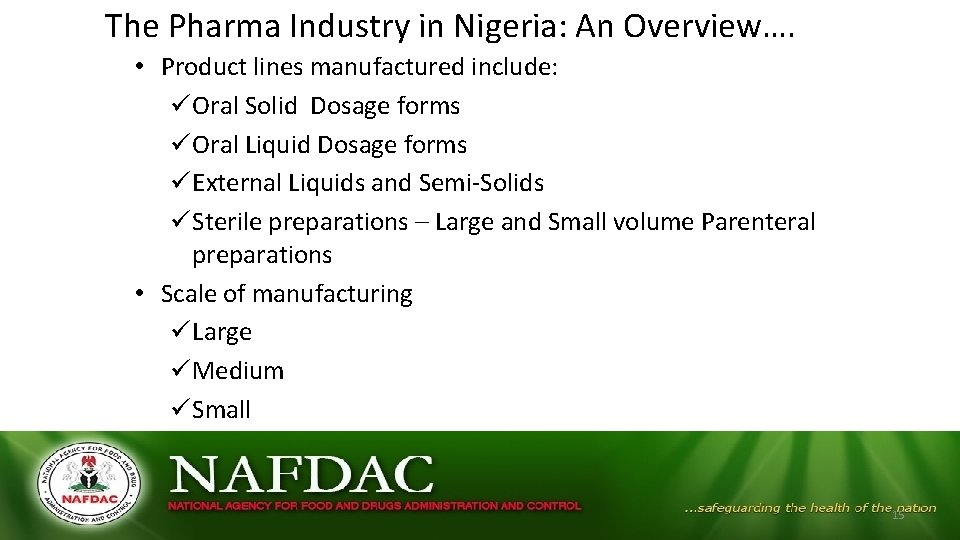
The Pharma Industry in Nigeria: An Overview…. • Product lines manufactured include: ü Oral Solid Dosage forms ü Oral Liquid Dosage forms ü External Liquids and Semi-Solids ü Sterile preparations – Large and Small volume Parenteral preparations • Scale of manufacturing ü Large ü Medium ü Small 15
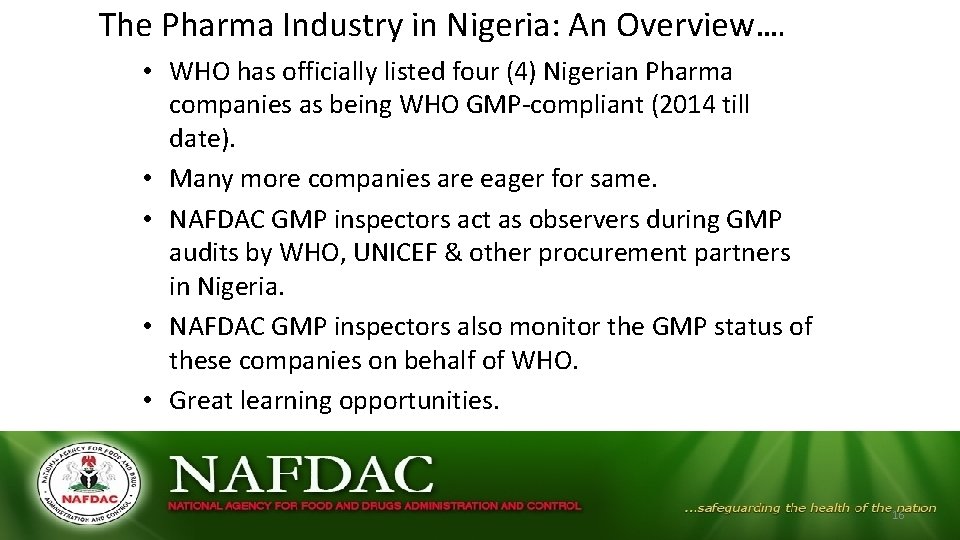
The Pharma Industry in Nigeria: An Overview…. • WHO has officially listed four (4) Nigerian Pharma companies as being WHO GMP-compliant (2014 till date). • Many more companies are eager for same. • NAFDAC GMP inspectors act as observers during GMP audits by WHO, UNICEF & other procurement partners in Nigeria. • NAFDAC GMP inspectors also monitor the GMP status of these companies on behalf of WHO. • Great learning opportunities. 16
The Pharma Industry in Nigeria: An Overview…. • Today's pharma industry is going through a period of major change that is characterized by increased competition, industry globalization, a wave of mergers and partnerships, increasing financial constraints & burden in addition to lack of access to foreign currency to procure much needed equipment & raw materials. • In addition, the industry is faced with multiple internal and external challenges such as high research and development costs, government regulatory actions, and extremely stringent manufacturing and distribution requirements.
The Pharma Industry in Nigeria: An Overview. … At all times, a pharma company faces challenges from all sides – • Pressure to reduce cost to the customer. • Heavy domestic & global market place pressure and competition. • The need to acquire new technology instead of developing new products. • Pressure to maintain long pipelines for development of new drugs and delivery systems. • Significant regulatory issues, in a global business. • The need to maximize (or integrate) IT applications to deal with variability. • As a result, pharmaceutical companies are especially concerned with quality, safety, good manufacturing practices, cost containment, new product introductions, inventory, change management and computer system validation.
The Pharma Industry in Nigeria: An Overview. … • Pharmaceutical processing involves tremendous exposure. If something goes wrong with one lot or if one package is tainted, the risk to public health and safety and the risk of negative publicity is quite significant. • Failure to manage quality, safety & efficacy is a catastrophic mistake. A drug contamination scare may ruin a company’s image for years, causing sales and/or market share to plummet. • Pharma safety is a concern of governments across the world.
The Pharma Industry in Nigeria: An Overview. … • Industry regulators are intensifying regulations for control materials, processes and pharma safety requirements amid growing concerns for public safety. • Pharma companies invest heavily in the identity, safety, purity, potency, quality and efficacy of their products. To this end, they invest in compliance, inspection and insurance. They also demand quality assurance and lot traceability at every step of the production process. • Today’s code of c. GMP as regulated by health ministries and governments place specific requirements on pharma manufacturers to implement manufacturing systems. • In the final analysis, pharma companies & regulators strive for the highest quality standards they can achieve.
Challenges in Implementing GMP • Today’s code of c. GMP as regulated by health departments and governments places specific requirements on pharma manufacturers to implement manufacturing systems. • GMP is a system for ensuring that products are consistently produced and controlled according to quality standards. It is designed to minimize the risks involve in any pharmaceutical production that cannot be eliminated through testing the final product. • It covers all aspects of production from the starting materials, premises and equipment to the training and personal hygiene of staff. • Its paramount at this point to state that in implementing GMP in pharma manufacturing, there are numerous challenges for both the regulators (NAFDAC) & the industry. 21
Challenges in Implementing GMP: NAFDAC • NAFDAC as an Agency has the usual constraints of funding. • Inadequate staffing-new graduates prefer to work for the private sector. • Communication between the state, zone and Director’s office is sometimes hampered - depends on internet, text messages, phone calls etc. • Due to the recent and still on-going capacity-building of inspectors by the Agency, an obvious knowledge gap is observed between the regulators and the regulated. 22
Challenges in Implementing GMP: NAFDAC. . • This is because there is a new breed of inspectors with knowledge of current trends in GMP requirements which is being implemented during audits of facilities and compliance with these requirements are a challenge to the industry. • Bureaucracy • Government legislation, restrictions etc. • Staff attrition - resignation, retirement, posting of trained officers out of the directorate etc. 23
Challenges in Implementing GMP: NAFDAC. . • Inadequate number of staff • Review of systems, procedures, legislations (laws, regulations etc), inspector’s guide etc. • Accession to the PIC/S to be in tandem with other NRAs is one of our main goals. 24
Challenges in Implementing GMP: NAFDAC? ? ? Industry? ? ? • Lack of access to funds and credit facilities by the industry to invest in facilities, equipment and training of personnel to enable compliance with GMP requirements highlighted during audits by inspectors. • Direct foreign investment in the pharmaceutical manufacturing sector which could facilitate technology transfer and enhance compliance with c. GMP is currently at a low ebb. 25
Challenges in Implementing GMP: Industry Quality Management Systems • Knowledge deficiency exists a lot in the industry especially among the key staff –Quality Assurance, Production and Warehouse Manager • QA-oversight is poor. • Top management involvement in key decision making in terms of quality and complying with GMP expectations is lacking. • Lack of understanding of a quality policy or what constitutes a Quality manual observed with some QA heads. 26
Challenges in Implementing GMP: Industry. . Quality Management System…. • QA heads don’t realize the enormous responsibility of their offices and so key decisions in quality management are often left unattended to. • QA heads appear not to be fully empowered to perform their duties. • JD which is key in the performance of duties are not robust and elaborate enough as to specify defined roles coupled with delegation of duties (deputation) in the absence of designated heads in the particular department or where cross function does occur. • Records of events are poorly handled. • Improper archiving of documents. • Document retrieval for inspection review is very slow. 27
Challenges in Implementing GMP: Industry. . Change Management • Lack of Understanding of what constitutes a change is mostly observed as majority do not have a clear understanding of what constitutes a change. • Change control procedures are poorly written. - What constitutes a change: - Change initiation - Change Review 28
Challenges in Implementing GMP: Industry. . Change Management…. - Change documentation - Change authorization/approval -Change implementation - Change review - Cross functional team deployed 29
Challenges in Implementing GMP: Industry. . Deviations • • • Knowledge deficiency Identification of the root cause for the deviations Inadequate documentation of investigations Deviations register or logs not provided SOP in handling Deviations as it relates to products/materials rejects are not properly investigated 30
Challenges in Implementing GMP: Industry. . Deviations…. • No corporate CAPA development in some companies to identify all CAPAs in the facility have been properly documented to permit tracking, trending and closing out. • Deficiency of knowledge and/or reluctance to use knowledge of root cause analysis tools to handle CAPA (corrective and preventive actions) 31
Challenges in Implementing GMP: Industry. . Complaints Handling Collection of complaints program not available Complaints forms are not developed Sensitization of consumers on product complaints reports Product complaints are not properly attended to Communication of outcomes to consumer/complainant where possible are not carried out • Under reporting of product complaints • • • 32
Challenges in Implementing GMP: Industry. . Recalls • • Product recalls are rare or non-existent Most times, it is the regulatory body carrying out recalls SOP/Program for recalls are not complied with Mock recalls are not conducted. 33
Challenges in Implementing GMP: Industry. . Product Quality Review • Virtually non-existent in most companies • May be attributed to knowledge deficiency and most do not envisage the benefits it will build into the quality system • Action plans are not developed • No SOP/Programme in place 34
Training • The essence of training and retraining is not properly enshrined in the QMS • QA Heads and Key staff in Production, Utilities, Warehouse heads do not receive advanced GMP trainings • On the job training not conducted, documented or tested for effectiveness. • Training facilitators sometimes are not adept at areas of coverage • There is a need for specialized training in critical areas – Validation, Utilities, HVAC monitoring • SOP – Training/Program is not robust enough 35
Challenges in Implementing GMP: Industry. . Stability • Stability monitoring program is rare or virtually non-existent • Where existent, programs are either contracted out or the stability chambers are not adequately qualified. • Stability of bulk products, reconstituted products conducted under ambient conditions. • Stability profile of intermediate and finished pharmaceutical products are often not provided • Summary of all data generated including evaluation and conclusion of study are not submitted • In some instances for companies asking for changes in packaging materials e. g. from glass bottles to PET bottles (submission of 3 months data vs 6 months mandatory data) 36
Challenges in Implementing GMP: Industry. . Sanitation and Hygiene • • • Small Change rooms Faulty or non-existent hand dryers Poor cleaning practices Difficult to clean areas are left to pile up dirt Cross over bench rules are not followed where cross over bench is available Laundry of clothing and apparels are not carried out properly Gowning areas are not properly controlled Absence of soaps for washing. Taps are sometimes not running 37
Challenges in Implementing GMP: Industry. . Air Handling Systems • Poor monitoring, tracking and trending of pressure differential readings • Defective HVAC in some instances not attended to with manufacturing on-going. • Product impact assessment not carried out • Inadequate dust containment • Inadequate monitoring and maintenance of filters 38
Challenges in Implementing GMP: Industry. . Premises and Equipment • Most of the buildings are adapted and not designed as fit-forpurpose i. e. not purpose built • Covings are not properly aligned in a concave shape • Cracks/holes in walls • Peeling epoxy covering of floors either out of bad construction or poor epoxy paint material 39
Challenges in Implementing GMP: Industry. . Vendor Qualification • Site audit of material vendor’s facilities practically non-existent • Written criteria/specifications for materials to be supplied is nonexistent • Not all companies generate approved vendor lists. • Where agreements exist between companies and vendors, they are not fully complied with 40
Challenges in Implementing GMP: Industry. . Laboratory Control • Inadequate labelling of reagent • Instrument (Critical) are not provided e. g. HPLC; may be one that is working • Lack of access controls into the laboratories especially the analytical laboratory • Analytical methods with respect to cleaning & process validation are not validated/verified. • Analyst Competency Test is not Documented. 41
Challenges in Implementing GMP: Industry. . Production In-process analyst presence on the manufacturing floor not adequate Incidents/deviations are not properly logged in Deviations and incidents are not investigated to determine root cause Poor status labelling of equipment especially equipment not in use Work in Progress (WIP) products and bulk products are not adequately stored and labelled. • Bulk hold times are not established. • • • 42
Challenges in Implementing GMP: Industry. . Warehouse • Overcrowded warehouses • Space limitations in some instances • Untreated wooden pallets used for released finished products 43
Challenges in Implementing GMP: Industry. . Documentation • Poor documentation of activities • Training, Investigations, production steps, equipment cleaning, line clearance • Use of documents not issued by QA (logbooks and notebooks) to document GMP activities, information and data • Some operational activities are not covered by SOPs 44
Challenges in Implementing GMP: Industry. . Management Responsibility • PQR’s do not adequately receive management inputs • Management more concerned with meeting production targets rather than drive c. GMP in line with compliance • Management intrusion in deciding technical matters when they lack technical knowledge that could influence c. GMP decisions • Non-escalation of critical matters to management and where it occurs, it is practically not dealt with 45
Challenges in Implementing GMP: Industry. . Self Audit • Observations from self-audits conducted are not given required attention before external auditors or regulatory bodies come for audit. No place of prominence • CAPA’s from audits are left unattended to • The import of self audit is not seen as part of quality improvement, most times they are jettisoned 46
Challenges in Implementing GMP: Industry. . Maintenance/Engineering • Over dependence on foreign personnel in the area of maintenance/engineering, sometimes on contracts which could adversely affect the operation once the personnel leaves. • Inadequate preventive maintenance programs with respect to tools. • Poor control, storage and maintenance of tools such as punches, dies, sieves etc. • Storage of tools are not done to according to SOP • Maintenance carried out are not documented accordingly. 47
Conclusion • The challenges are enormous but the collaboration, cooperation & co-ordination between NAFDAC & the Nigerian pharma industry ensures that safe, efficacious and good quality medicines are manufactured in the country. • In other to sustain this level of compliance NAFDAC entered into collaborative capacity building programmes with the PMGMAN. 48
Conclusion. . • This collaboration has continually encouraged training of NAFDAC Inspectors alongside key personnel in pharmaceutical companies (especially those in-charge of production and quality assurance) to enhance adequate understanding of the provisions of c. GMP. • This step has really empowered the key personnel to live up to their responsibilities in ensuring production of quality medicines which are acceptable, cost effective and efficacious and most importantly, produced under improved GMP conditions. 49
Conclusion. . • A major achievement for NAFDAC is that the pharmaceutical industry has improved tremendously across the nation, irrespective of whether companies were/are in the race for WHO Pre-Qualification (WHO PQ) or not. • The Nigerian Pharma industry has the capacity to produce good quality medicines & it’s one of Africa’s strongest pharmaceutical sector. • NIGERIA MUST BE A LEADING GLOBAL CONTENDER IN PRODUCING GOOD QUALITY PHARMACEUTICALS!!! 50
51
References • NAFDAC c. GMP Guidelines • GMP Reports by DER Inspectors (January 2014 -Nov. 2016) • Experience from Audits of Nigerian Manufacturing Facilities/Recommendations- Dr O. Chukwumerije (WHO TA) 2015 52
titilopeowolabi@gmail. com owolabi. t@nafdac. gov. ng +234 8033220727