IMMUNITY AND IMMUNOPATHOLOGY IN MALARIA Pthogenesis of Malaria

- Slides: 27
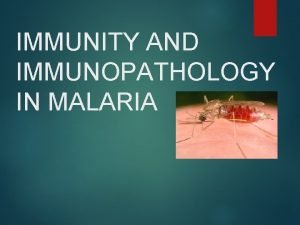
IMMUNITY AND IMMUNOPATHOLOGY IN MALARIA
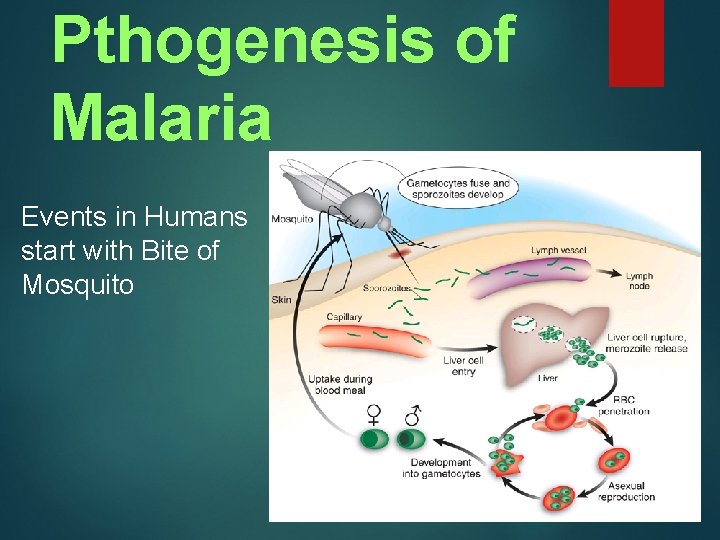
Pthogenesis of Malaria Events in Humans start with Bite of Mosquito
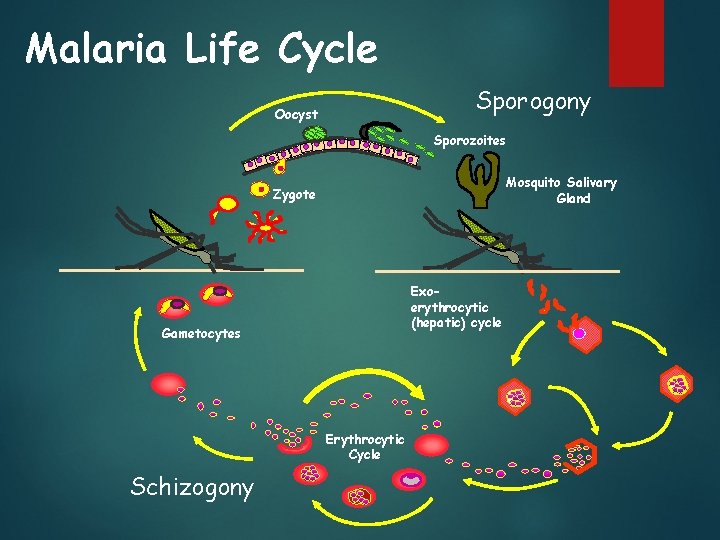
Malaria Life Cycle Sporogony Oocyst Sporozoites Mosquito Salivary Gland Zygote Exoerythrocytic (hepatic) cycle Gametocytes Erythrocytic Cycle Schizogony
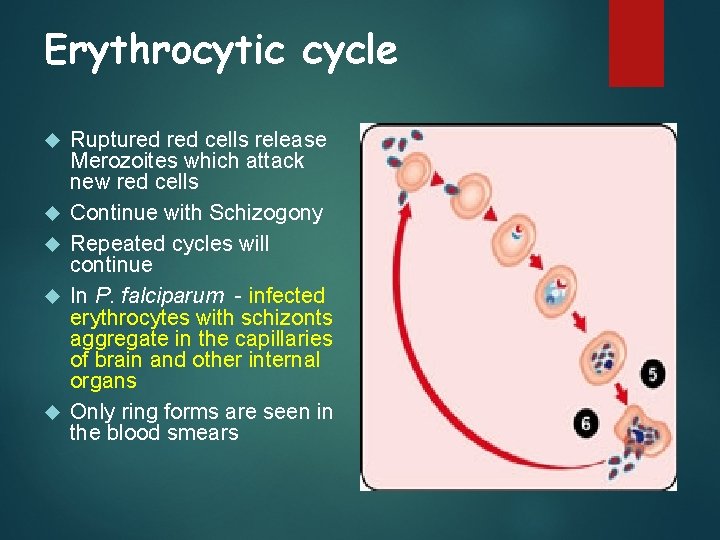
Erythrocytic cycle Ruptured cells release Merozoites which attack new red cells Continue with Schizogony Repeated cycles will continue In P. falciparum - infected erythrocytes with schizonts aggregate in the capillaries of brain and other internal organs Only ring forms are seen in the blood smears
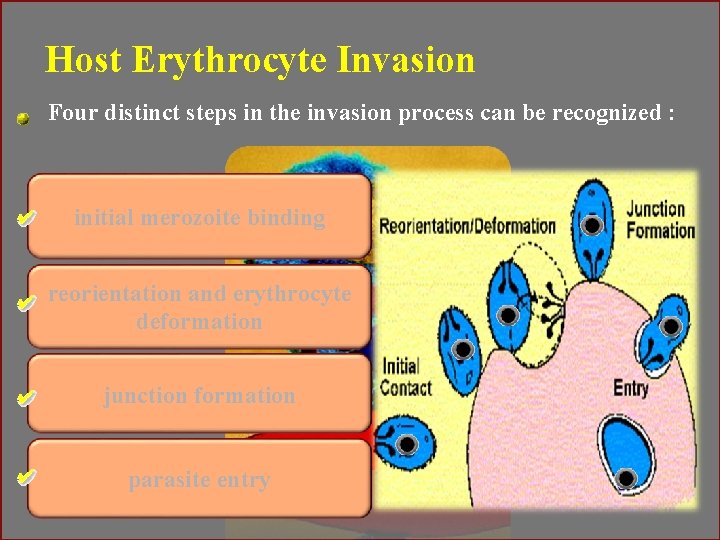
Host Erythrocyte Invasion Four distinct steps in the invasion process can be recognized : initial merozoite binding reorientation and erythrocyte deformation junction formation parasite entry
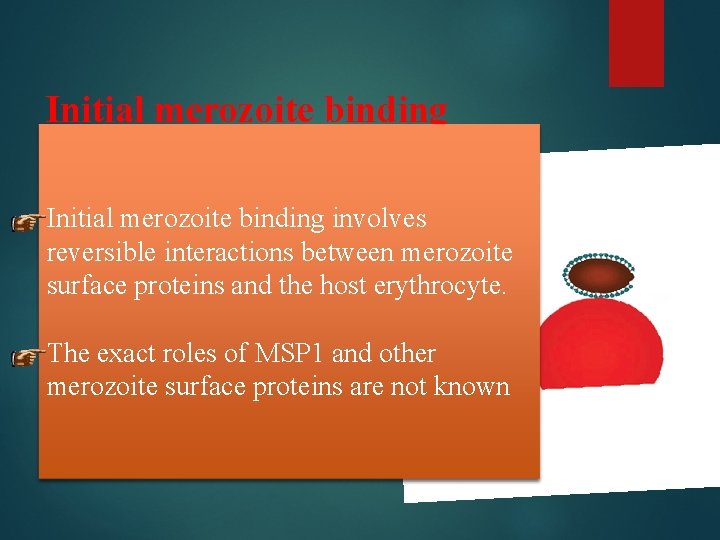
Initial merozoite binding involves reversible interactions between merozoite surface proteins and the host erythrocyte. The exact roles of MSP 1 and other merozoite surface proteins are not known
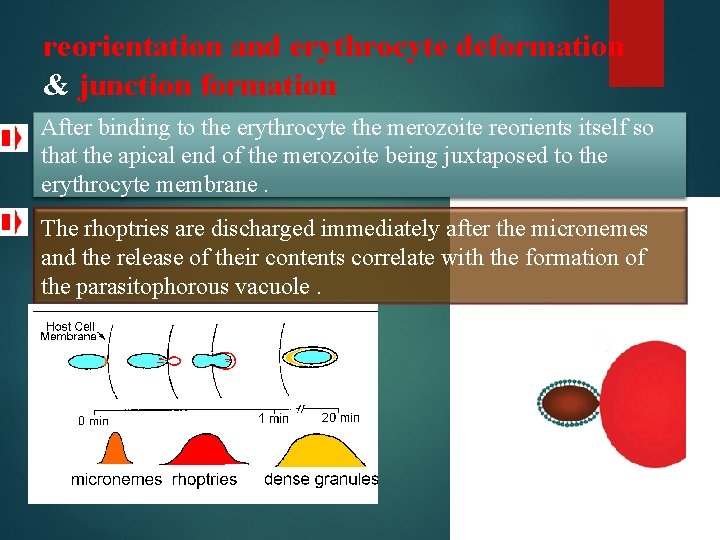
reorientation and erythrocyte deformation & junction formation After binding to the erythrocyte the merozoite reorients itself so that the apical end of the merozoite being juxtaposed to the erythrocyte membrane. The rhoptries are discharged immediately after the micronemes and the release of their contents correlate with the formation of the parasitophorous vacuole.
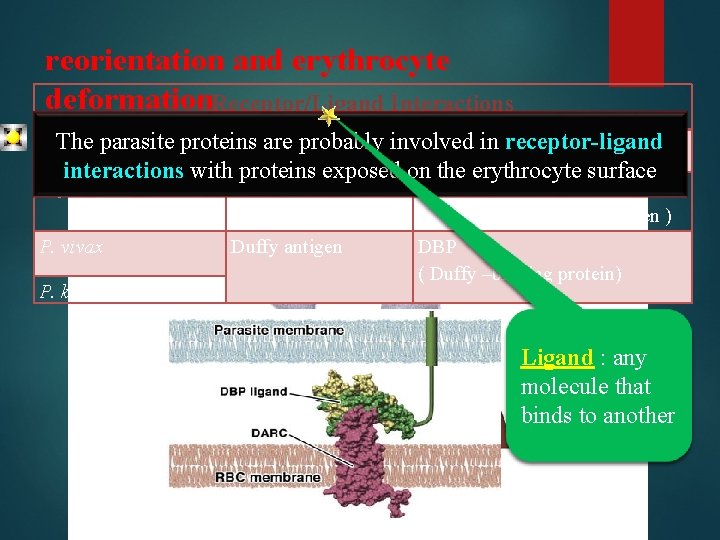
reorientation and erythrocyte deformation. Receptor/Ligand Interactions parasite proteins are probably in receptor-ligand Species Host Receptor involved Merozoite Ligand &Thejunction formation interactions with proteins exposed on the erythrocyte surface P. falciparum glycophorins (sialic acid) EBA-175 (erythrocyte – binding antigen ) P. vivax Duffy antigen DBP ( Duffy –binding protein) P. knowlesi Ligand : any molecule that binds to another
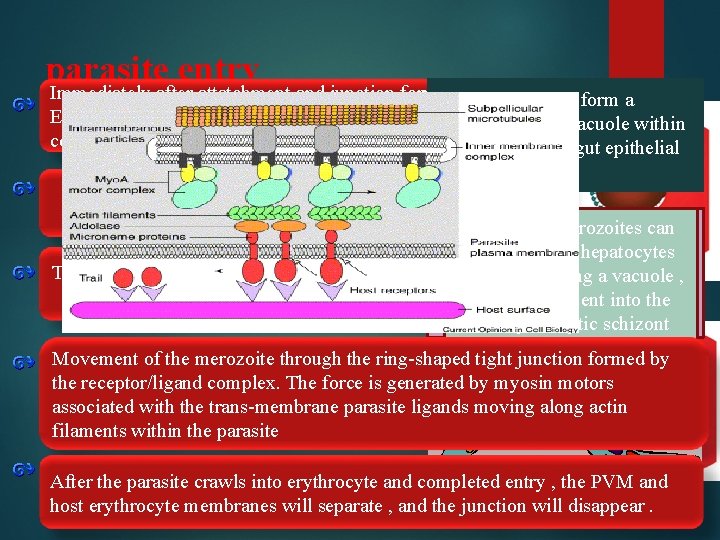
parasite entry Immediately after attatchment and junction formation , Ookinetes do not form a Erythrocyte membrane proteins are redistributedparasitophorous so that the vacuole within contact area is free of erythrocyte membrane proteins. the mosquito midgut epithelial cells (PVM) forms in this area , the junction between the parasite and host becomes ring-like Similarly, sporozoites can enter and hepatocytes Because theexit Ookinetes lack The rhoptries proteins plays important role in the formation of without forming a vacuole , rhoptries the PVM. but development into the exoerythrocytic schizont requires PVM formation Movement of the merozoite through the ring-shaped tight junction formed by the receptor/ligand complex. The force is generated by myosin motors associated with the trans-membrane parasite ligands moving along actin filaments within the parasite After the parasite crawls into erythrocyte and completed entry , the PVM and host erythrocyte membranes will separate , and the junction will disappear.
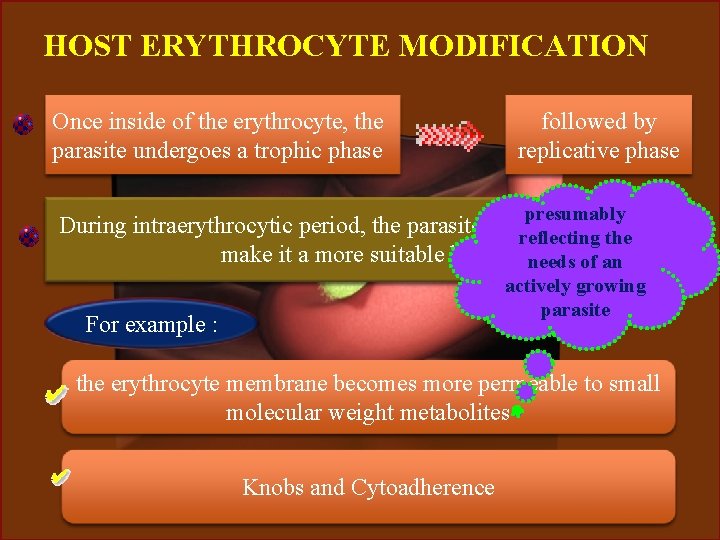
HOST ERYTHROCYTE MODIFICATION Once inside of the erythrocyte, the parasite undergoes a trophic phase During followed by replicative phase presumably intraerythrocytic period, the parasite modifies the host reflecting the make it a more suitable habitat needs of an actively growing parasite to For example : the erythrocyte membrane becomes more permeable to small molecular weight metabolites Knobs and Cytoadherence
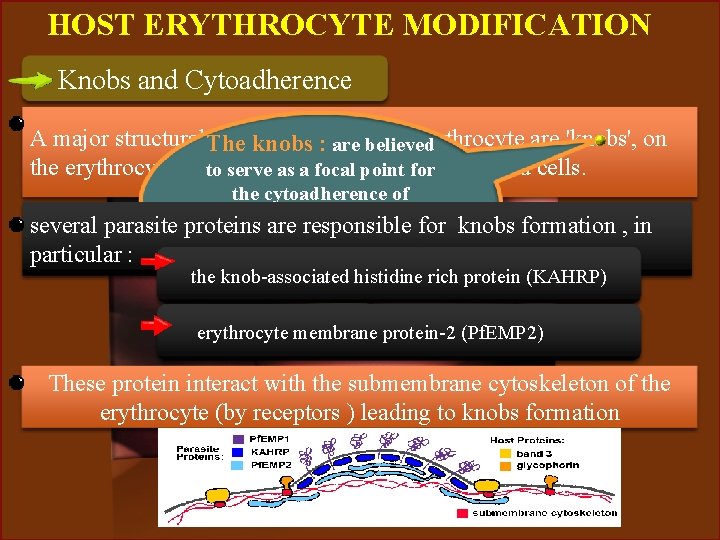
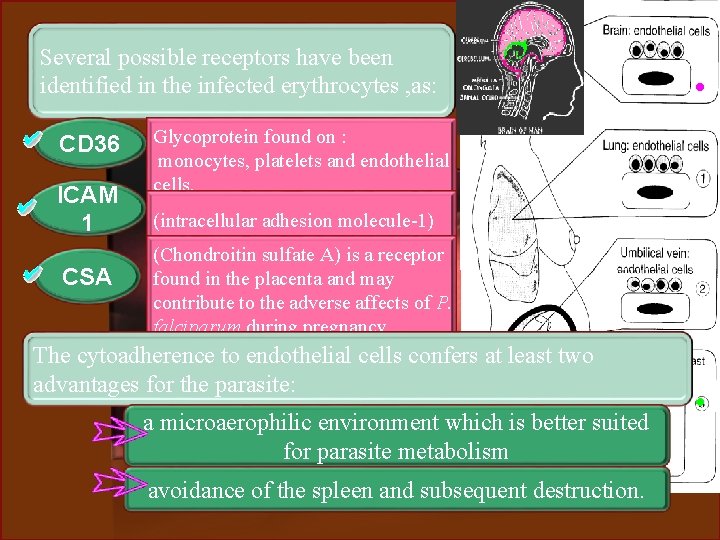
HOST ERYTHROCYTE MODIFICATION Knobs and Cytoadherence A major structural. The alteration the believed host erythrocyte are 'knobs', on knobsof: are the erythrocyte membrane falciparum-infected cells. to serve asofa P. focal point for several parasite particular : the cytoadherence of infected proteins areerythrocytes responsibletofor knobs formation endothelial cells ( lining blood vessels ) the knob-associated histidine rich protein (KAHRP) , in erythrocyte membrane protein-2 (Pf. EMP 2) These protein interact with the submembrane cytoskeleton of the erythrocyte (by receptors ) leading to knobs formation
Several possible receptors have been identified in the infected erythrocytes , as: CD 36 ICAM 1 CSA Glycoprotein found on : monocytes, platelets and endothelial cells. Infected erythrocytes from most (intracellular adhesion molecule-1) parasite isolates bind to CD 36. is expressed insulfate the brain (Chondroitin A)on iscapillaries a receptor CD 36 is not expressed the & correlated better with cerebral found in thecells placenta and capillaries may endothelial of brain. malaria contribute to the adverse affects of P. falciparum during pregnancy. The cytoadherence to endothelial cells confers at least two advantages for the parasite: a microaerophilic environment which is better suited for parasite metabolism avoidance of the spleen and subsequent destruction.
Cycles differs in Different species Cycle repeats every 48 hours in 1 P. falciparum 2 P. ovale 3 P. vivax Repeats every 72 hours In P. malariae
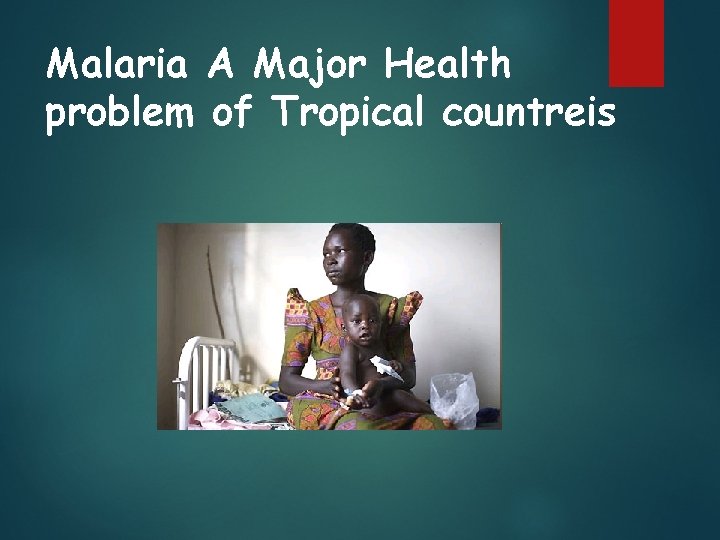
Malaria A Major Health problem of Tropical countreis
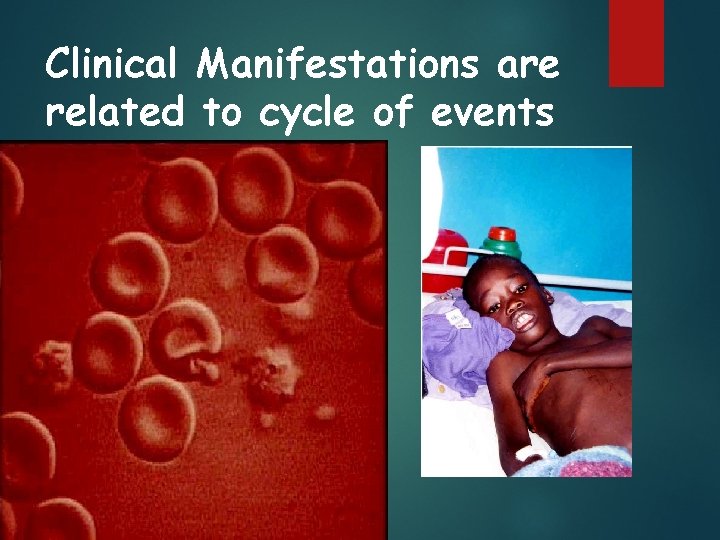
Clinical Manifestations are related to cycle of events in relation to RBC
Characteristics of a malaria attack Fever and shivering. The attack begins with fever, with the temperature rising as high as 40ºC and falling again over a period of several hours. A poor general condition, feeling unwell and having headaches like influenza. Diarrhea, nausea and vomiting often occur as well.
Clinical manifestations of Malaria Fever Sweating Anemia Splenomagaly (enlarged spleen) Irratability Coma, Retinal Hemorrages Algid Malaria ( a shocklike syndrome) Respiratory distress syndrome
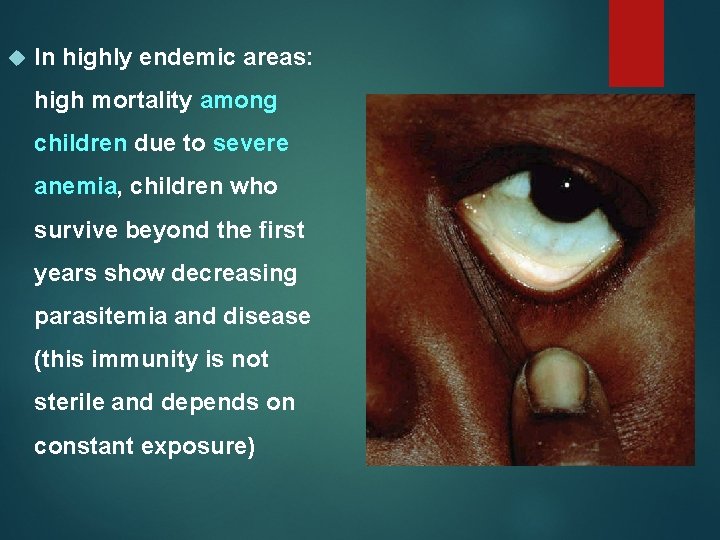
In highly endemic areas: high mortality among children due to severe anemia, children who survive beyond the first years show decreasing parasitemia and disease (this immunity is not sterile and depends on constant exposure)
Cytokines & toxins z Malaria produces a strong Th-1 type response z Elevated serum levels of IFNg and TNFa z Cytokines can induce (mimic) many of the symptoms and signs of malaria (shivering, headache, chills, spiking fever, sweating, vasodilation, hypoglycemia)
Pernicious, Malignant Malaria Is a life threatening complication in acute falciparum malaria It is due to heavy parasitization Manifests with: 1 - Cerebral malaria – it presents with hyperpyrexia, coma and paralysis. Brain is congested. 2 Algid malaria – presents with clammy (cold) skin due to peripheral circulatory failure.
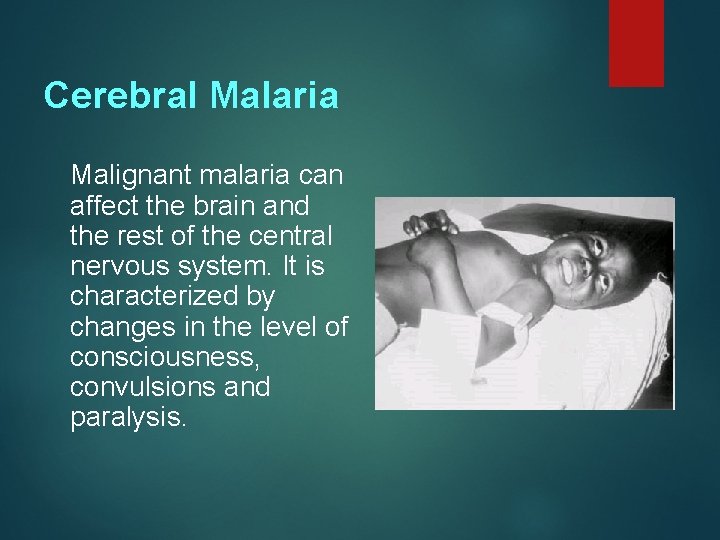
Cerebral Malaria Malignant malaria can affect the brain and the rest of the central nervous system. It is characterized by changes in the level of consciousness, convulsions and paralysis.
Cerebral Malaria Presents with Hyperpyrexia Can lead to coma Paralysis and other complications. Brain appears congested
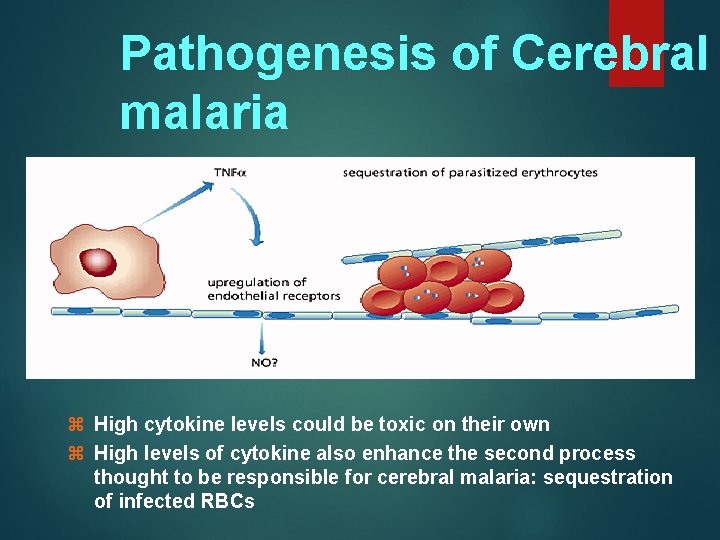
Pathogenesis of Cerebral malaria z High cytokine levels could be toxic on their own z High levels of cytokine also enhance the second process thought to be responsible for cerebral malaria: sequestration of infected RBCs
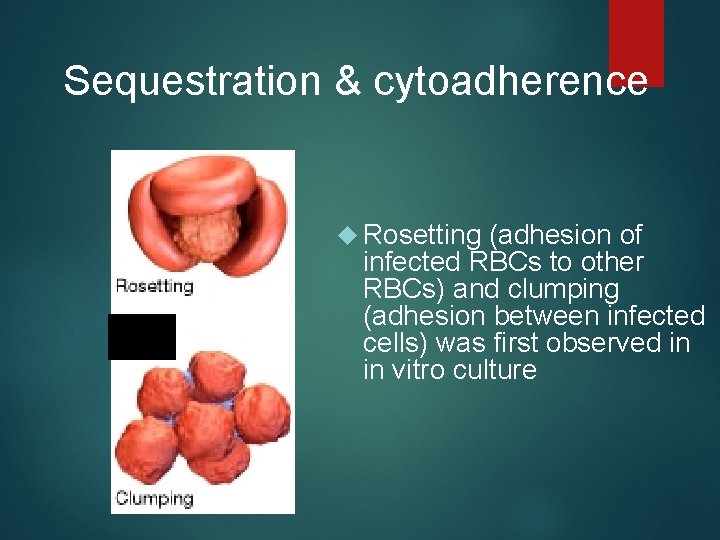
Sequestration & cytoadherence Rosetting (adhesion of infected RBCs to other RBCs) and clumping (adhesion between infected cells) was first observed in in vitro culture
Black water fever It is a manifestation of infection with P. falciparum (malignant malaria) A large number of the red blood corpuscles are destroyed. Hemoglobin from the blood corpuscles is excreted in the urine, which therefore is dark and almost the color of cola.
Why Falciparum Infections are Dangerous Can produce fatal complications, 1. Cerebral malaria 2. Malarial hyperpyrexia 3. Gastrointestinal disorders. 4. Algid malaria 5 Black water fever can lead to death
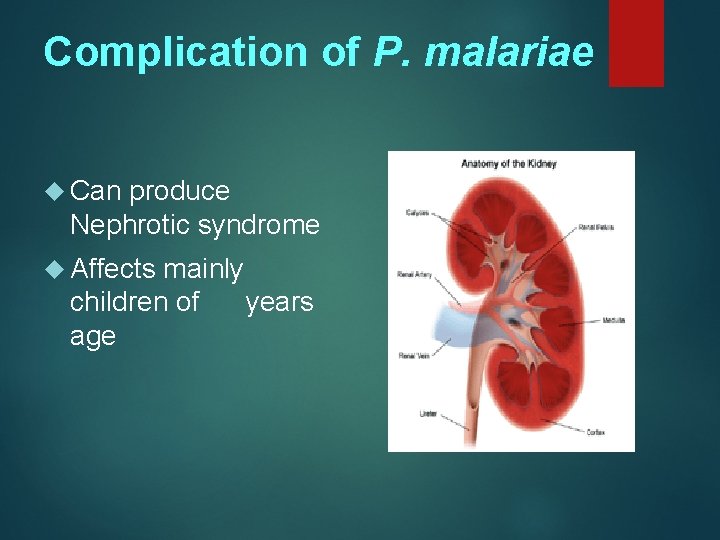
Complication of P. malariae Can produce Nephrotic syndrome Affects mainly children of years age