IFM Securities Pty Ltd AFSL 227051 02 9222

- Slides: 45
IFM (Securities) Pty Ltd AFSL 227051 (02) 9222 9579, Lionel Rodrigues 0416 208 227, Stephan Pfister 0410 584 021 18 th July 2018 IPA Group A look at Superannuation
Disclaimer IFM (Securities) Pty Ltd ABN 55 083 237 227 (IFM) is the holder of Australian Financial Services License No. 227051. This document is intended to provide general information only and is a summary based on IFM’s understanding of the relevant legislation at the date of publication. IFM has endeavored to ensure that the information contained in this document is accurate but to the maximum extent of the law, disclaims any liability for errors and omissions.
• The rules - Property • ASIC recent warnings to Trustees and Administrators • The rules - Collectables & Bullion • Transfer Balance Caps • Downsizing • Methods & Trends in response to new & pending rules, and access to funds • Dividend Imputation as a revenue stream particularly pensions
The rules – Property The property: Must meet the 'sole purpose test' of solely providing retirement benefits to fund members Must not be acquired from a related party of a member (exceptions to be shown below) Must not be lived in by a fund member or any fund members' related parties Must not be rented by a fund member or any fund members' related parties
If lending is involved A limited recourse borrowing arrangement is required. The lender has no recourse against other assets of the SMSF. Bare Trust > SMSF. Beneficiary has absolute rights to Capital, Assets and income generated from assets.
Business real property/purchasing from associated person Critical aspects: Does the property meet the ‘business real property’ (BRP) definition? Does the acquisition meet the fund’s investment strategy? Does the asset meet the sole purpose test?
Related party transactions Section 66 of the Superannuation Industry (Supervision) Act (SISA) general prohibition on this, the exceptions to this include: Listed securities Business real property, and Widely-held trusts (commonly referred to as managed funds). Acquisition at ‘market value’ or the market price of the asset. Property is generally valued by a qualified third party valuer.
Who is a ‘related party’ of an SMSF? A related party of an SMSF includes: Members and trustees of the fund Relatives of members and trustees of the fund Entities that are controlled by the members, trustees or their relatives Other person’s known as ‘Part 8 Associates’ of the SMSF members. This can cover a broad range of people and entities so care needs to be taken when a SMSF is dealing with a related party.
When is ‘Business Real Property’? ATO SMSFR 2009/1. The property must be used for commercial reasons. The use of the property and whether it’s generally regarded as residential or commercial is critical. For example, a residential property could be used as the business premises for a doctor or the office for an accountant or solicitor. The property must be also used ‘wholly and exclusively’ in one or more businesses.
Am I carrying on a property investment business? Remembering this is around BRP only; here are some examples for consideration. Let’s take a look at some examples.
Example 1 – Ms Hend with two holiday flats Ms Hend owns two holiday flats, which are let for short-term accommodation. Ms Hend and her partner manage the flats, including attending to cleaning and general maintenance. Whilst the ATO considers there to be a possibility of a rental property business being carried on, the scale of the operations (only two flats) means it is not considered a business. Consequently, the flats owned by Ms Hend are not considered BRP and cannot be acquired by her SMSF.
Example 2 – Mr Wood and his 20 residential units Mr Wood owns and leases 20 residential units to long-term tenants. He manages and maintains the flats himself and the units are not mortgaged. The ATO considers that Mr Wood is carrying on a property investment business. Consequently, his SMSF can acquire one or more of the units.
Example 3 – Ms Harrington has 10 residential units Ms Harrington owns 10 residential units that are leased to long-term tenants. She uses the services of an agent to manage the premises. The ATO considers the use of the agent as a crucial factor in determining that Ms Harrington is not carrying on a property investment business. Consequently, the residential units are not permitted to be acquired by her SMSF.
Other possible definitions Residential property could also satisfy the definition of BRP in a further three scenarios: Where the residential property is held as trading stock of a property development business. Where the residential property is leased to a business and used in that business’s short-term accommodation business. Where the residential property is situated on land which is used to conduct a primary production business, provided the area used for private purposes is not more than 2 hectares.
Other considerations when transferring to an SMSF Once ok, there are other considerations: The SMSF must acquire the property at ‘market value’, which needs to be substantiated. How the fund will pay for the acquisition of the property? Will it be cash, using the limited recourse borrowing rules or an ‘in-specie’ contribution within the relevant contribution caps? The transaction will be a disposal of the property by the member or related party and will be a capital gains tax event. Therefore, consider the personal tax liability arising from the disposal. Is the transaction subject to GST? In general, the sale of residential property, as defined under the GST Act, is input taxed, however, if the property is vacant land, for example, GST may apply. If GST does apply, is there a qualifying exemption or concession? Transaction costs will include legal fees and any applicable stamp duty.
ASIC warnings
In-house asset rules An in-house asset is any of the following: a loan to, or an investment in, a related party of your fund an investment in a related trust of your fund an asset of your fund that is leased to a related party. There are some exceptions, including: business real property that is leased between your fund a related party of your fund some investments in related non-geared trusts or companies most investments and loans entered into before 11 August 1999. In-house assets can't be more than 5% of your fund’s total assets.
The rules - Collectables & Bullion Collectables include: - Artwork - Wine - Cars - Musical instruments - Jewellery - Gold coins Gold bullion is not a collectable – but requires similar measures.
Considerations ‘Sole purpose test’ not to derive a benefit prior to retirement Major rule change in July 2016 Storage: not in private residence, formally documented details of storage. Storage: gold ingots must be stored in a safe. Lease: must have funds exchanged. Insurance: must be insured. Assets can be in-specie commutations out of the fund in retirement.
Transfer Balance Caps 2 rules and 2 sets of $1. 6 m Transfer balance cap: amount you can transfer and hold in retirement phase Total super balance: way to value your super interests on a given date to determine your eligibility for various super measures
Basics of Transfer Balance caps From 1 July 2017 Starting cap is $1, 600, 000. Indexed in $100, 000 components with CPI. Only entitled to indexation if you don’t use your whole cap at any stage.
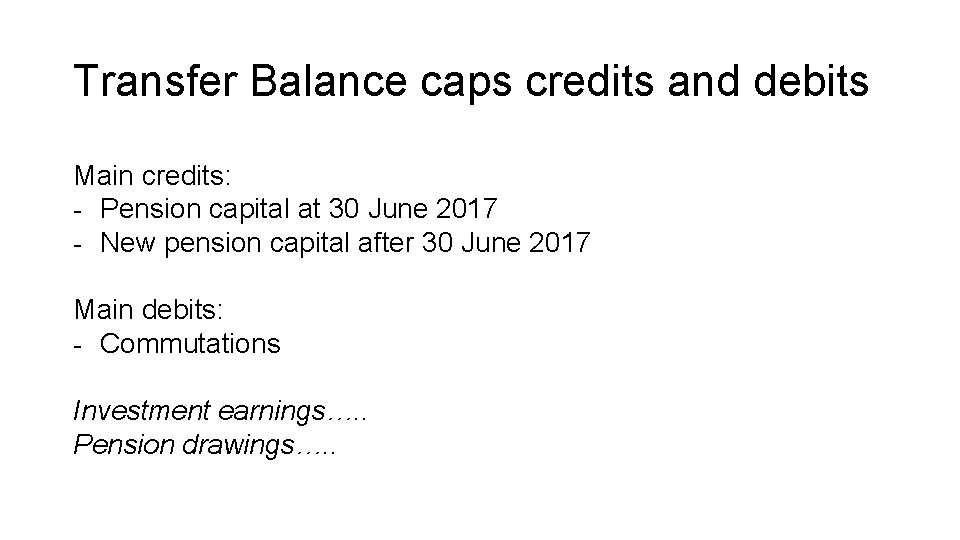
Transfer Balance caps credits and debits Main credits: - Pension capital at 30 June 2017 - New pension capital after 30 June 2017 Main debits: - Commutations Investment earnings…. . Pension drawings…. .
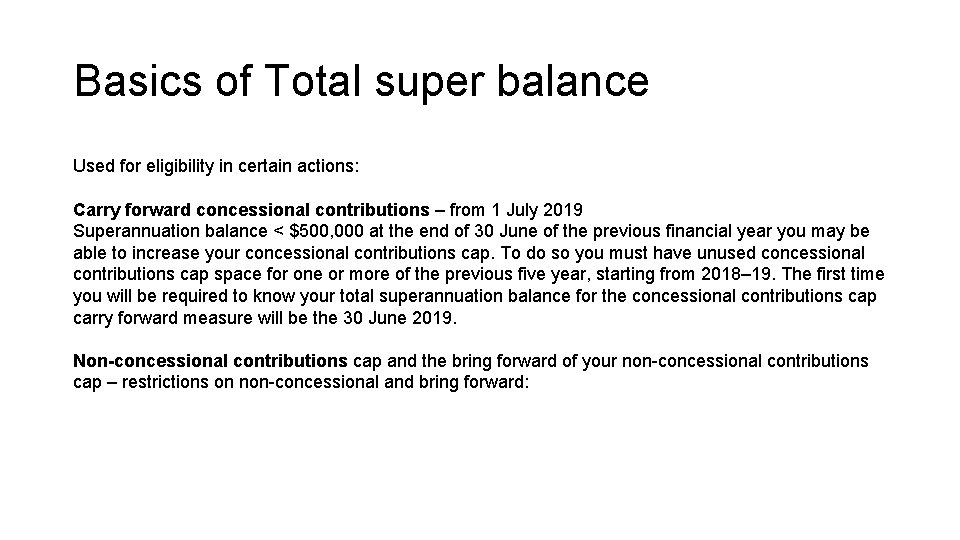
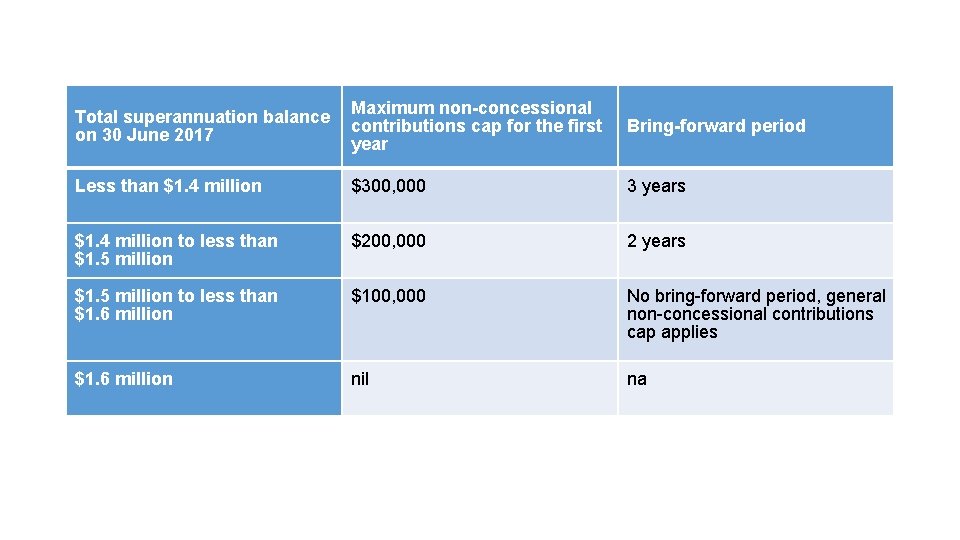
Basics of Total super balance Used for eligibility in certain actions: Carry forward concessional contributions – from 1 July 2019 Superannuation balance < $500, 000 at the end of 30 June of the previous financial year you may be able to increase your concessional contributions cap. To do so you must have unused concessional contributions cap space for one or more of the previous five year, starting from 2018– 19. The first time you will be required to know your total superannuation balance for the concessional contributions cap carry forward measure will be the 30 June 2019. Non-concessional contributions cap and the bring forward of your non-concessional contributions cap – restrictions on non-concessional and bring forward:
Total superannuation balance Maximum non-concessional contributions cap for the first on 30 June 2017 year Bring-forward period Less than $1. 4 million $300, 000 3 years $1. 4 million to less than $1. 5 million $200, 000 2 years $1. 5 million to less than $1. 6 million $100, 000 No bring-forward period, general non-concessional contributions cap applies $1. 6 million nil na
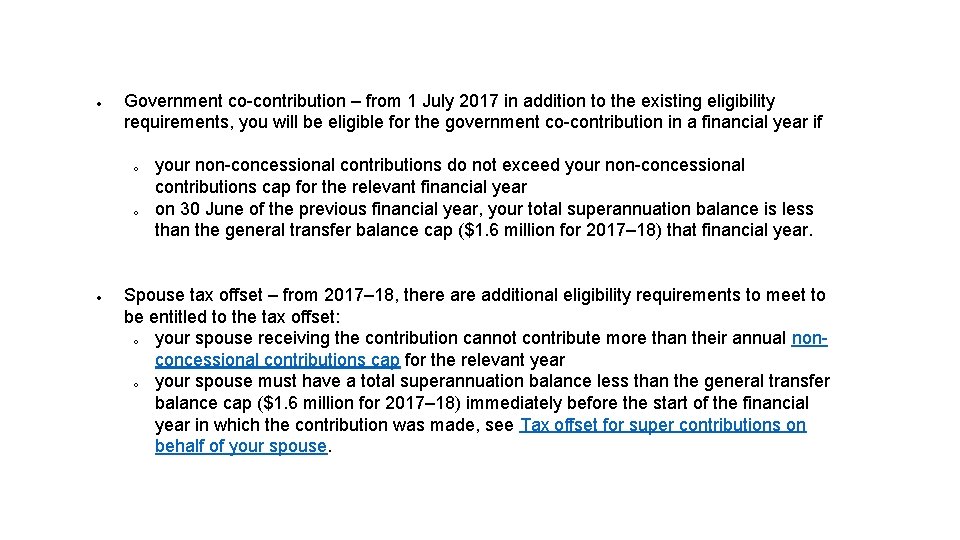
Government co-contribution – from 1 July 2017 in addition to the existing eligibility requirements, you will be eligible for the government co-contribution in a financial year if o your non-concessional contributions do not exceed your non-concessional contributions cap for the relevant financial year o on 30 June of the previous financial year, your total superannuation balance is less than the general transfer balance cap ($1. 6 million for 2017– 18) that financial year. Spouse tax offset – from 2017– 18, there additional eligibility requirements to meet to be entitled to the tax offset: o your spouse receiving the contribution cannot contribute more than their annual nonconcessional contributions cap for the relevant year o your spouse must have a total superannuation balance less than the general transfer balance cap ($1. 6 million for 2017– 18) immediately before the start of the financial year in which the contribution was made, see Tax offset for super contributions on behalf of your spouse.
Downsizing contributions into Superannuation Note: If you sign a contract before 1 July 2018 you will not be eligible. You can do this even if Superannuation greater than $1, 600, 000. Amount cap is $300, 000 person. It is not treated as non-concessional or concessional.
Requirements: you are 65 years old or older your home was owned by you or your spouse for 10 years or more prior to the sale your home is in Australia and is not a caravan, houseboat or other mobile home the proceeds (capital gain or loss) from the sale of the home are either exempt or partially exempt from capital gains tax (CGT) under the main residence exemption, or would be entitled to such an exemption if the home was a CGT rather than a pre-CGT (acquired before 20 September 1985) asset you have provided your super fund with the Downsizer contribution into super form you make your downsizer contribution within 90 days of receiving the proceeds of sale, which is usually at the date of settlement you have not previously made a downsizer contribution to your super from the sale of another home.
Methods & Trends in response to new & pending rules, and access to funds Traditional process: Accumulation > build up Superannuation as aggressively as possible Pension > move funds to low-risk assets and draw-down on capital We need to think about longevity risk.
Trends in Superannuation rules Over the years less can be contributed to Superannuation Concessional contribution limits are declining Non-concessional contribution limits are declining Downsizing is an increase but with consequences to Age pension access.
Government considering alternatives Treasury’s - Retirement Income Stream review Department of Human Services - Social Security Means testing of retirement income streams Treasury’s - Comprehensive Income Products discussion paper
Deferred Lifetime Annuity (DLA) Deferred lifetime annuities are a form of lifetime annuity where income payments are deferred for a set amount of time. For example, a 65 -year-old retiree may purchase a DLA that will provide a guaranteed income for life after the retiree turns 85. In order to encourage the use of these products, the Government extended the tax exemption on earnings in the retirement phase to deferred lifetime annuities.
Innovative retirement income streams A new set of superannuation income stream rules were introduced under Treasury Laws Amendment (2017 measures No 1) Regulations 2017 with effect from 1 July 2017. The objective of these new rules is to provide retirees access to a lifetime income stream, which is more flexible than could have been provided under the pension standards which applied from 1 July 2007. In order to meet the definition of an innovative income stream, the following criteria must apply: Income stream is required to be paid for life Deferred period for annual payments is permissible Commutations are possible subject to a declining capital access schedule and preservation rules
Comprehensive Income Products for Retirement (CIPR) A CIPR is a retirement income product which is designed to provide broadly constant income, manage longevity risk, and provide some access to capital. An allocation of 100% to an account based pension would not meet the definition of a CIPR. Included in this supporting principle are a number of key features: Ideas from a fund provider: Income should be provided for life. It would not be sufficient for the CIPR to provide income for life expectancy. An allocation to a deferred lifetime annuity or an immediate annuity would satisfy this requirement. Some access to capital should be provided. An allocation to an account based pension would satisfy this requirement.
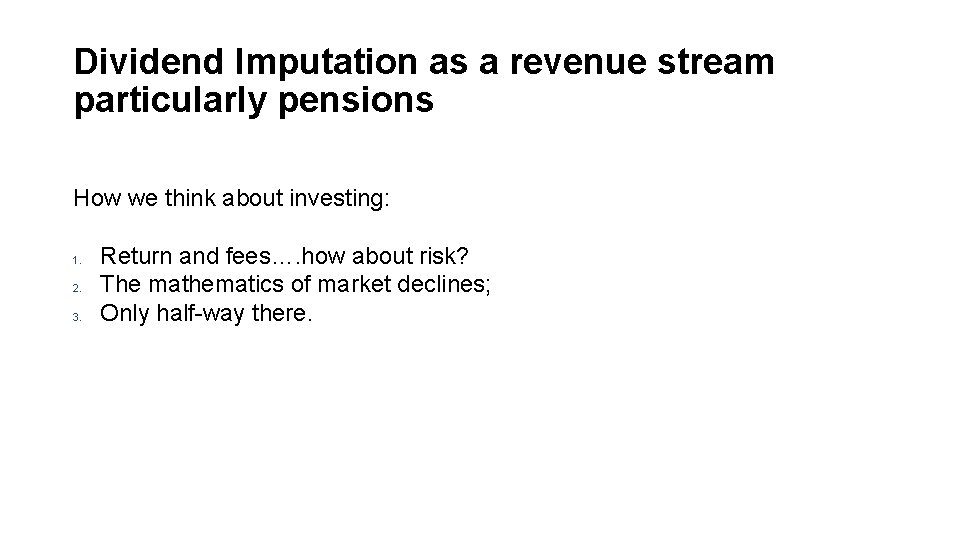
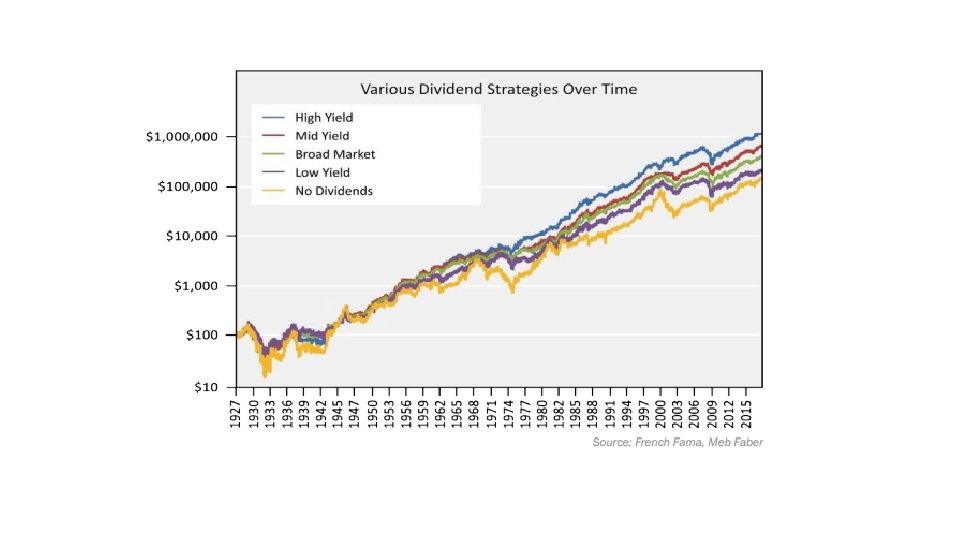
Dividend Imputation as a revenue stream particularly pensions How we think about investing: 1. Return and fees…. how about risk? 2. The mathematics of market declines; 3. Only half-way there.
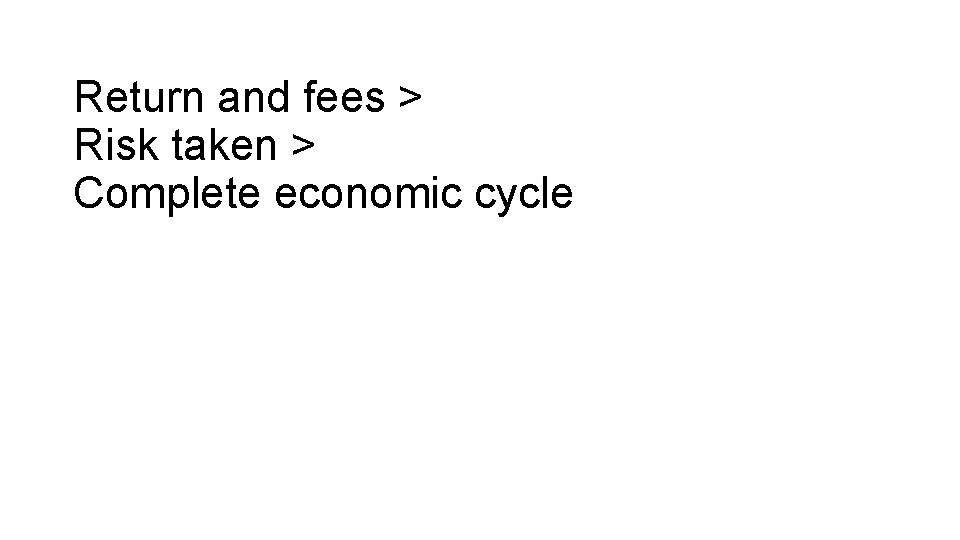
Return and fees > Risk taken > Complete economic cycle
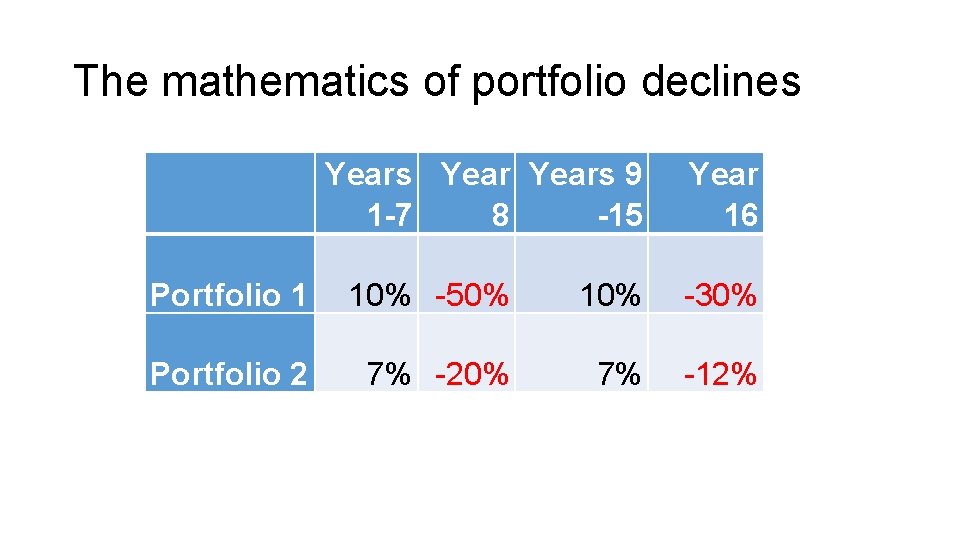
The mathematics of portfolio declines Years 9 1 -7 8 -15 Year 16 Portfolio 1 10% -50% 10% -30% Portfolio 2 7% -20% 7% -12%
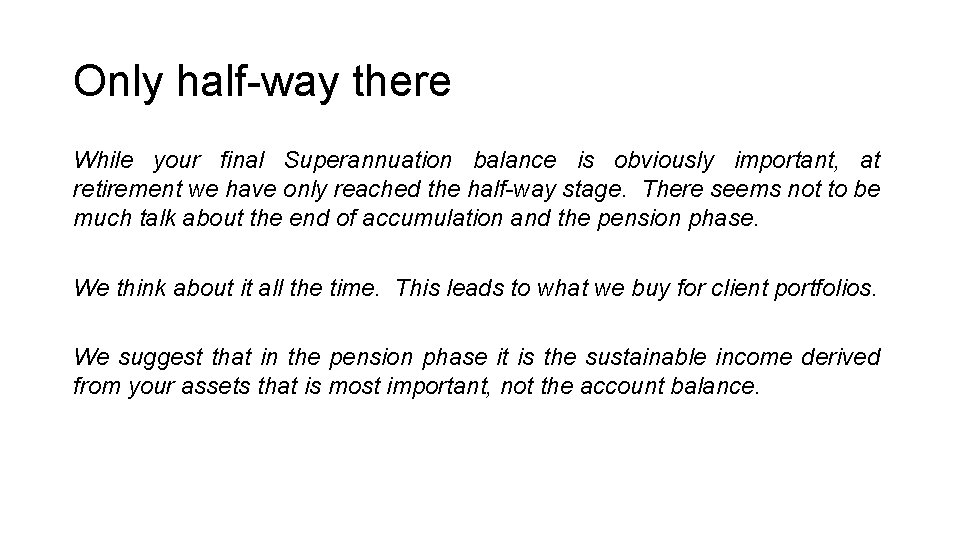
Only half-way there While your final Superannuation balance is obviously important, at retirement we have only reached the half-way stage. There seems not to be much talk about the end of accumulation and the pension phase. We think about it all the time. This leads to what we buy for client portfolios. We suggest that in the pension phase it is the sustainable income derived from your assets that is most important, not the account balance.
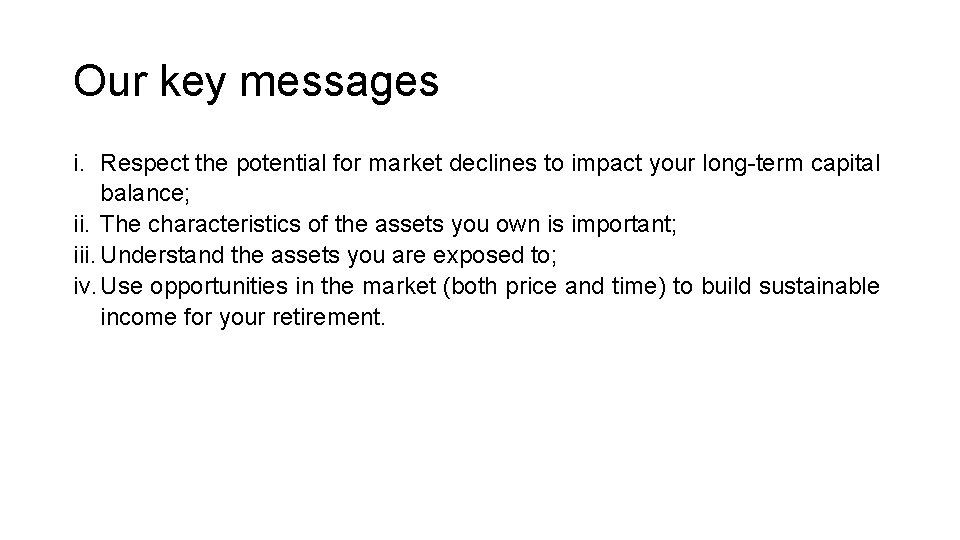
Our key messages i. Respect the potential for market declines to impact your long-term capital balance; ii. The characteristics of the assets you own is important; iii. Understand the assets you are exposed to; iv. Use opportunities in the market (both price and time) to build sustainable income for your retirement.
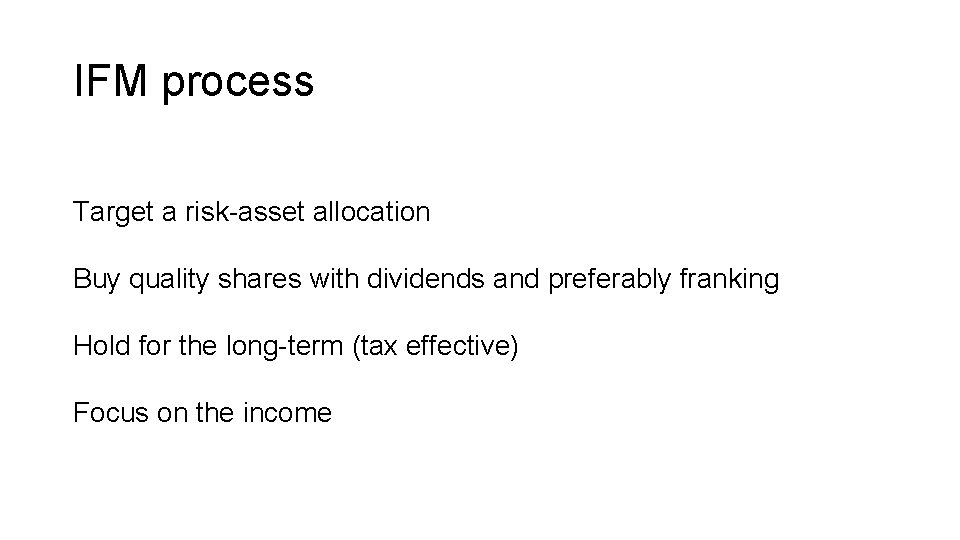
IFM process Target a risk-asset allocation Buy quality shares with dividends and preferably franking Hold for the long-term (tax effective) Focus on the income
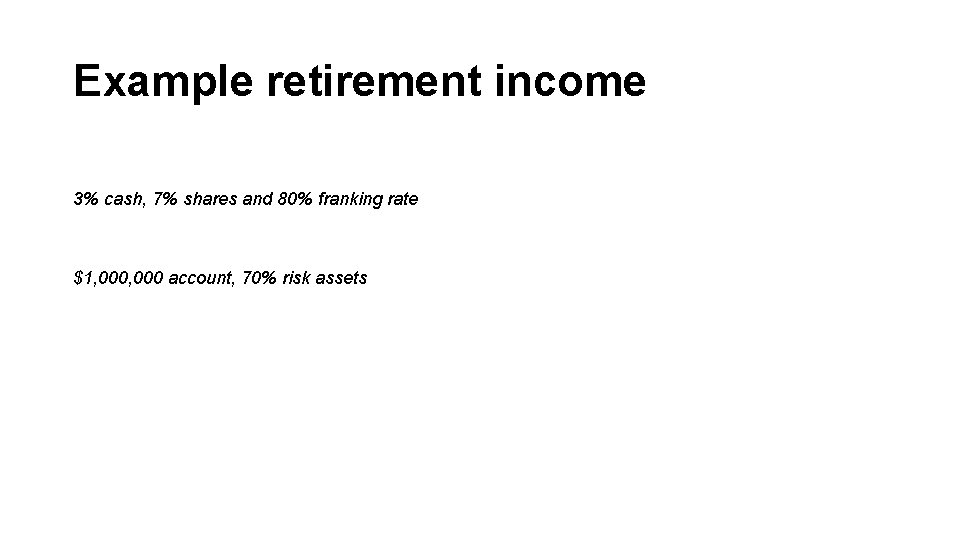
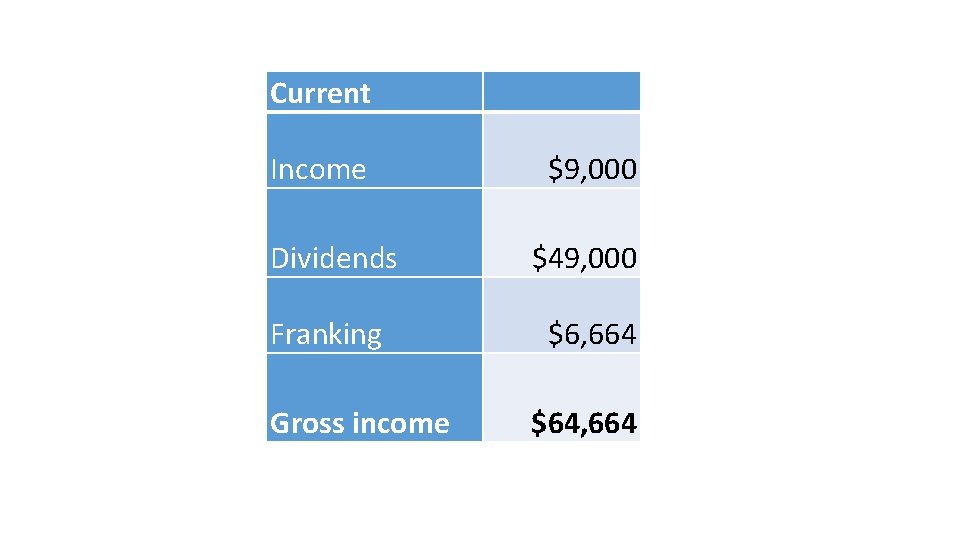
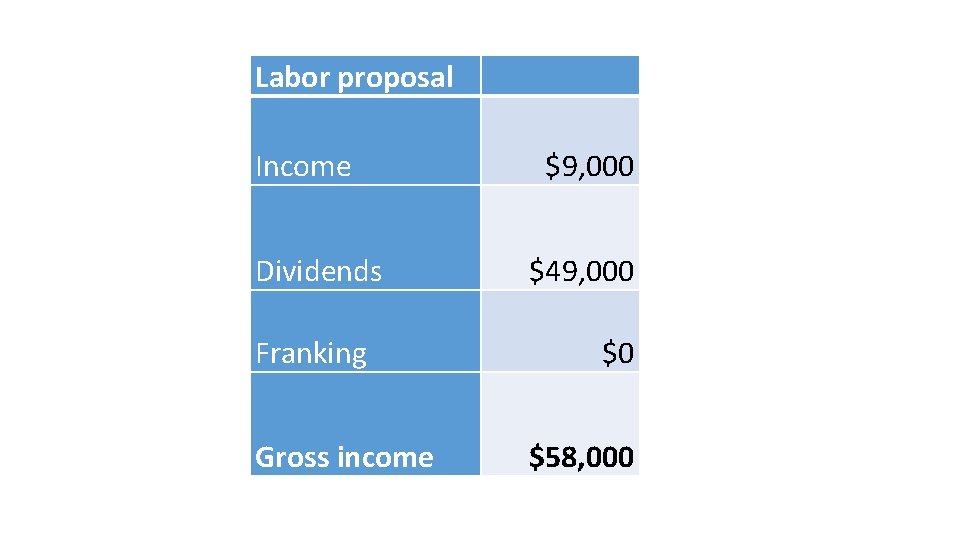
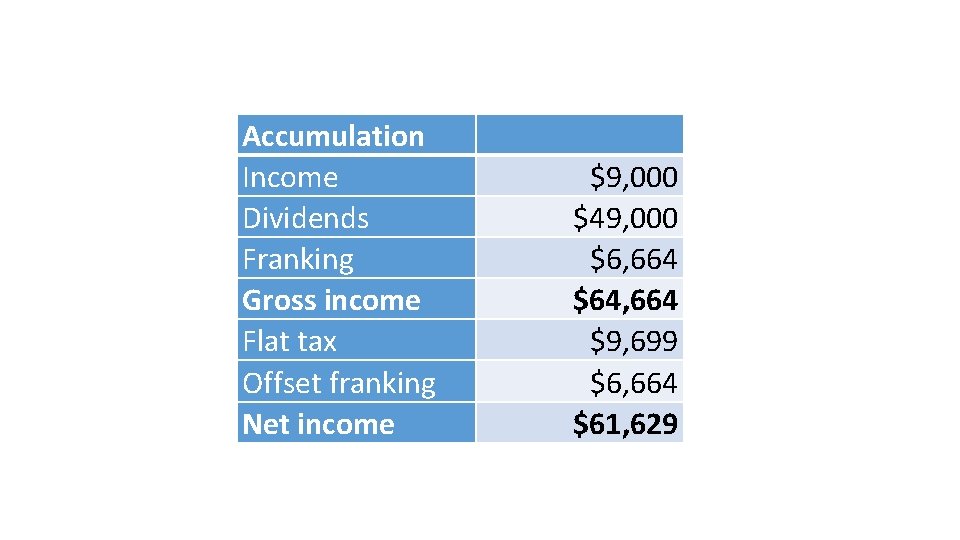
Example retirement income 3% cash, 7% shares and 80% franking rate $1, 000 account, 70% risk assets
Current Income $9, 000 Dividends $49, 000 Franking $6, 664 Gross income $64, 664
Labor proposal Income Dividends Franking Gross income $9, 000 $49, 000 $0 $58, 000
Accumulation Income Dividends Franking Gross income Flat tax Offset franking Net income $9, 000 $49, 000 $6, 664 $64, 664 $9, 699 $6, 664 $61, 629
IFM (Securities) Pty Ltd AFSL 227051 (02) 9222 9579 Lionel Rodrigues 0416 208 227 Stephan Pfister 0410 584 021