
10 Professional Ethics and practical aspects By Eish

10 Professional Ethics and practical aspects By Eish Taneja CA, CPA (USA), C-IFRS (ACCA, UK) Green Belt (6 sigma)-USA, DISA (ICAI), PGDBM, Certified Forex & Treasury 9818829677, eish@eishcaandcpa. com
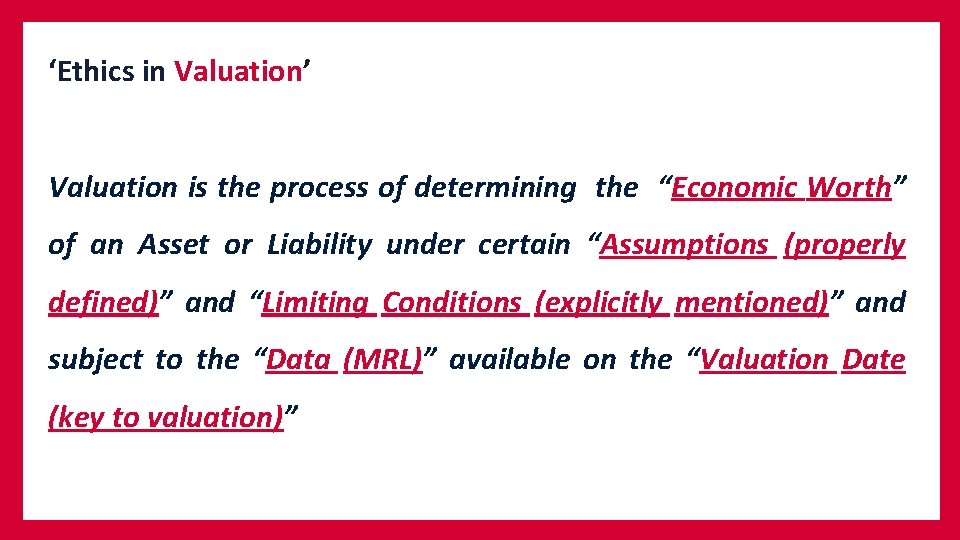
‘Ethics in Valuation’ Valuation is the process of determining the “Economic Worth” of an Asset or Liability under certain “Assumptions (properly defined)” and “Limiting Conditions (explicitly mentioned)” and subject to the “Data (MRL)” available on the “Valuation Date (key to valuation)”
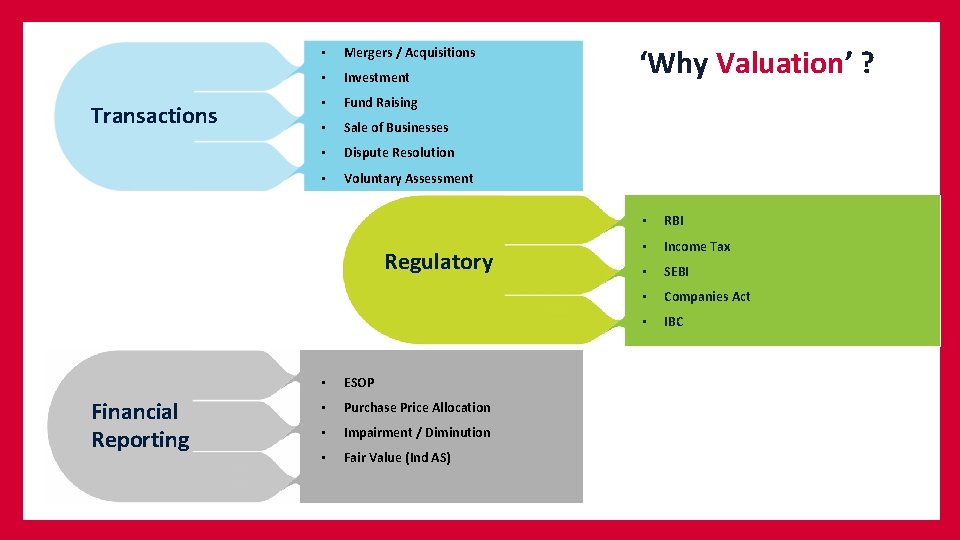
Transactions • Mergers / Acquisitions • Investment • Fund Raising • Sale of Businesses • Dispute Resolution • Voluntary Assessment Regulatory Financial Reporting • ESOP • Purchase Price Allocation • Impairment / Diminution • Fair Value (Ind AS) ‘Why Valuation’ ? • RBI • Income Tax • SEBI • Companies Act • IBC
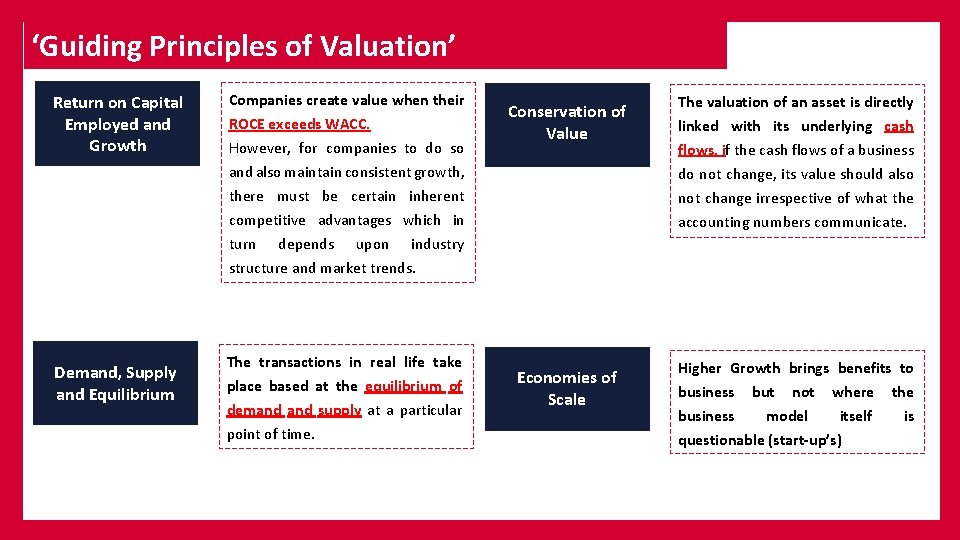
‘Guiding Principles of Valuation’ Return on Capital Employed and Growth Demand, Supply and Equilibrium Companies create value when their ROCE exceeds WACC. However, for companies to do so and also maintain consistent growth, there must be certain inherent competitive advantages which in turn depends upon industry structure and market trends. The transactions in real life take place based at the equilibrium of demand supply at a particular point of time. Competition Conservation of Value Economies of Scale The valuation of an asset is directly linked with its underlying cash flows. if the cash flows of a business do not change, its value should also not change irrespective of what the accounting numbers communicate. Higher Growth brings benefits to business but not where the business model itself is questionable (start-up’s)
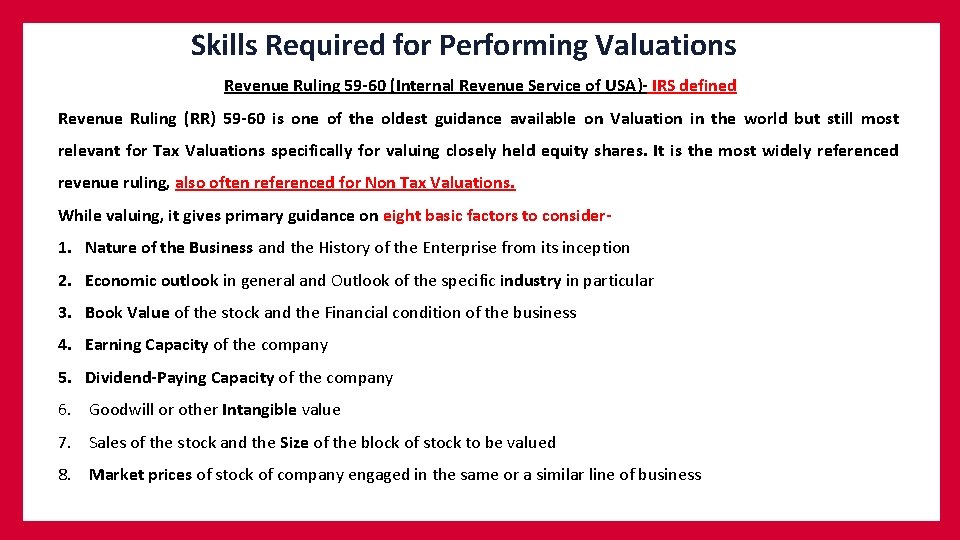
Skills Required for Performing Valuations Revenue Ruling 59 -60 (Internal Revenue Service of USA)- IRS defined Revenue Ruling (RR) 59 -60 is one of the oldest guidance available on Valuation in the world but still most relevant for Tax Valuations specifically for valuing closely held equity shares. It is the most widely referenced revenue ruling, also often referenced for Non Tax Valuations. While valuing, it gives primary guidance on eight basic factors to consider- 1. Nature of the Business and the History of the Enterprise from its inception 2. Economic outlook in general and Outlook of the specific industry in particular 3. Book Value of the stock and the Financial condition of the business 4. Earning Capacity of the company 5. Dividend-Paying Capacity of the company 6. Goodwill or other Intangible value 7. Sales of the stock and the Size of the block of stock to be valued 8. Market prices of stock of company engaged in the same or a similar line of business
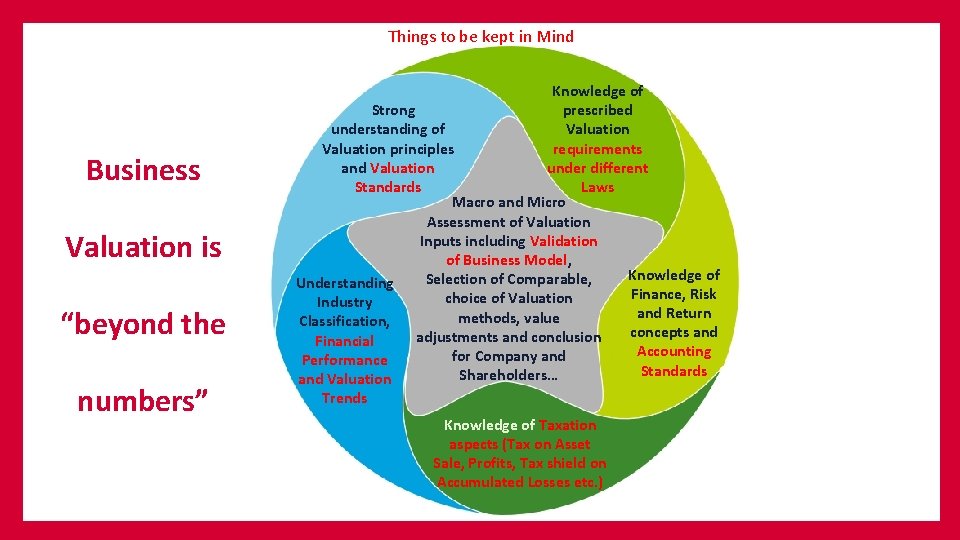
Things to be kept in Mind Business Valuation is “beyond the numbers” Knowledge of Strong prescribed understanding of Valuation principles requirements and Valuation under different Standards Laws Macro and Micro Assessment of Valuation Inputs including Validation of Business Model, Knowledge of Selection of Comparable, Understanding Finance, Risk choice of Valuation Industry and Return methods, value Classification, concepts and adjustments and conclusion Financial Accounting for Company and Performance Standards Shareholders… and Valuation Trends Knowledge of Taxation aspects (Tax on Asset Sale, Profits, Tax shield on Accumulated Losses etc. )
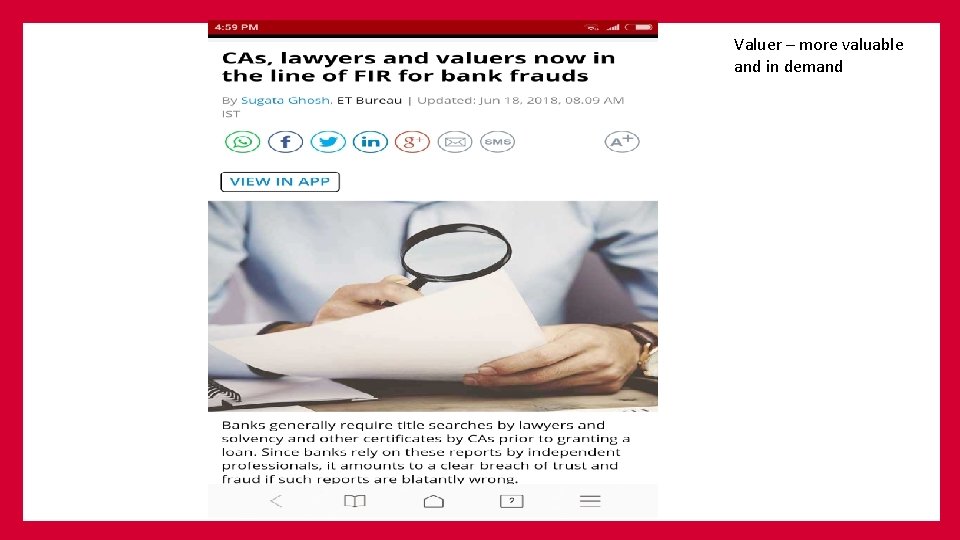
Valuer – more valuable and in demand Valuer
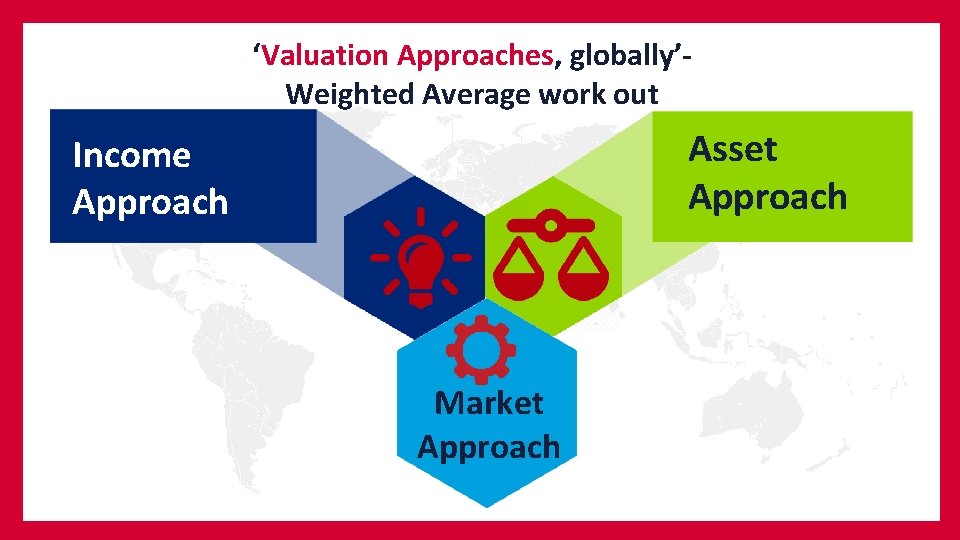
‘Valuation Approaches, globally’- Weighted Average work out Asset Approach Income Approach Market Approach
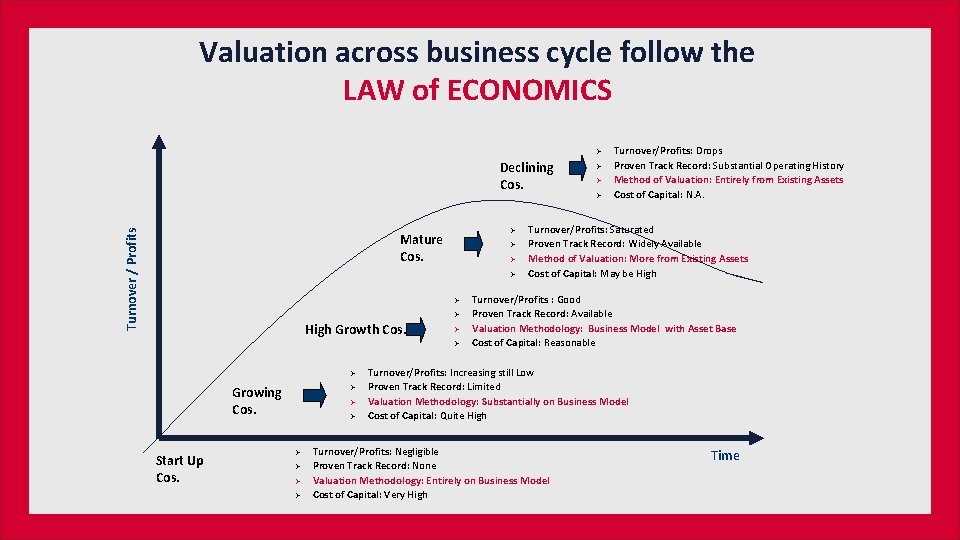
Valuation across business cycle follow the LAW of ECONOMICS Ø Turnover / Profits Declining Cos. Ø Mature Cos. Ø Ø Ø High Growth Cos. Ø Ø Growing Cos. Start Up Cos. Ø Ø Ø ` Ø Ø Ø Turnover/Profits: Drops Proven Track Record: Substantial Operating History Method of Valuation: Entirely from Existing Assets Cost of Capital: N. A. Turnover/Profits: Saturated Proven Track Record: Widely Available Method of Valuation: More from Existing Assets Cost of Capital: May be High Turnover/Profits : Good Proven Track Record: Available Valuation Methodology: Business Model with Asset Base Cost of Capital: Reasonable Turnover/Profits: Increasing still Low Proven Track Record: Limited Valuation Methodology: Substantially on Business Model Cost of Capital: Quite High Turnover/Profits: Negligible Proven Track Record: None Valuation Methodology: Entirely on Business Model Cost of Capital: Very High Time
Need for Uniformity • International Valuation Standards • Indian Valuation Standards • Ethical Standards • Minimum Performance Framework
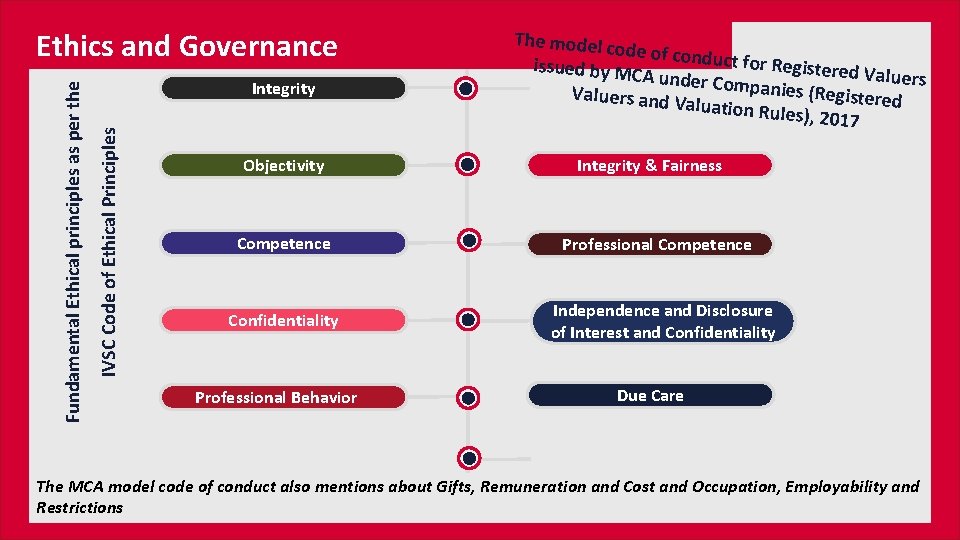
Integrity IVSC Code of Ethical Principles Fundamental Ethical principles as per the Ethics and Governance Objectivity Competence Confidentiality Professional Behavior The model c ode of condu ct for Registe issued by MC red Valuers A under Com panies (Regis Valuers and V tered aluation Rule s), 2017 Integrity & Fairness Professional Competence Independence and Disclosure of Interest and Confidentiality Due Care The MCA model code of conduct also mentions about Gifts, Remuneration and Cost and Occupation, Employability and Restrictions
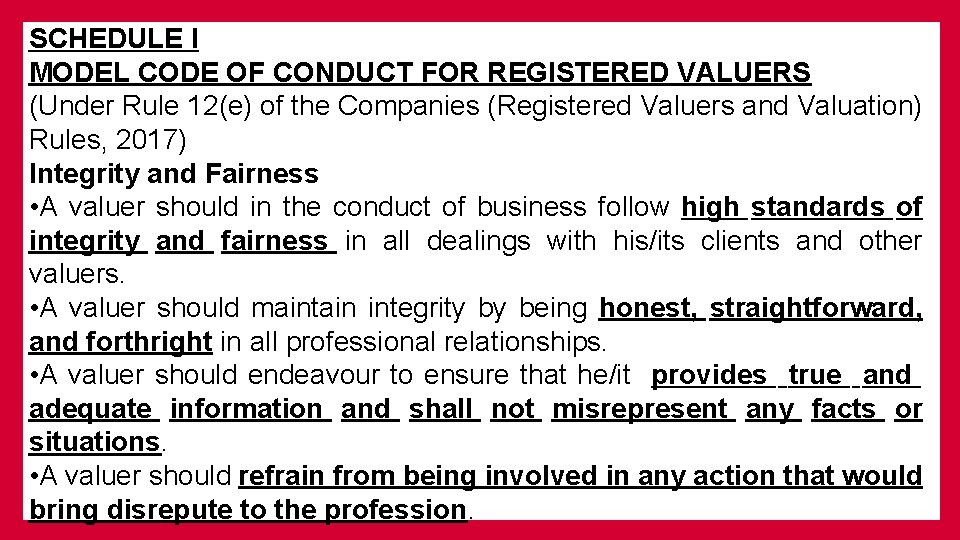
SCHEDULE I MODEL CODE OF CONDUCT FOR REGISTERED VALUERS (Under Rule 12(e) of the Companies (Registered Valuers and Valuation) Rules, 2017) Integrity and Fairness • A valuer should in the conduct of business follow high standards of integrity and fairness in all dealings with his/its clients and other valuers. • A valuer should maintain integrity by being honest, straightforward, and forthright in all professional relationships. • A valuer should endeavour to ensure that he/it provides true and adequate information and shall not misrepresent any facts or situations. • A valuer should refrain from being involved in any action that would bring disrepute to the profession.
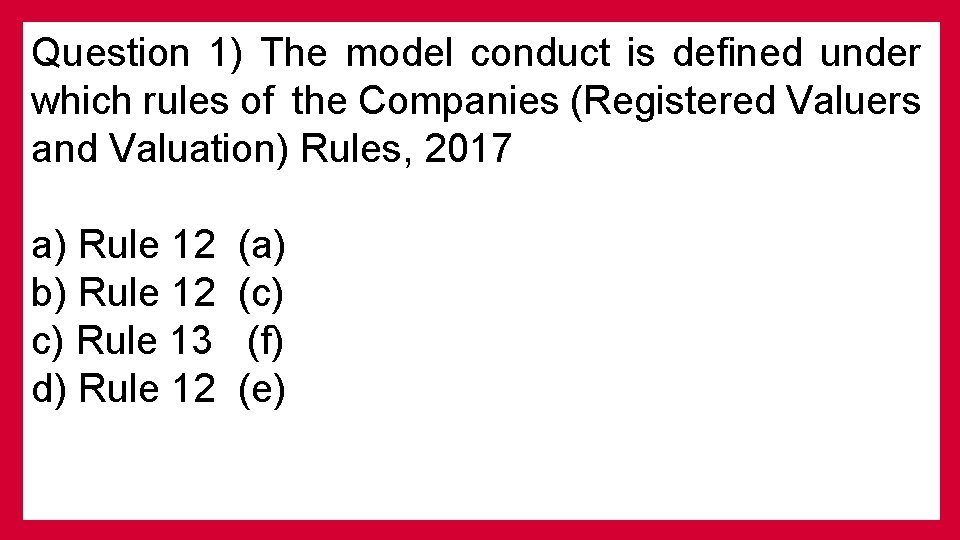
Question 1) The model conduct is defined under which rules of the Companies (Registered Valuers and Valuation) Rules, 2017 a) Rule 12 (a) b) Rule 12 (c) c) Rule 13 (f) d) Rule 12 (e)
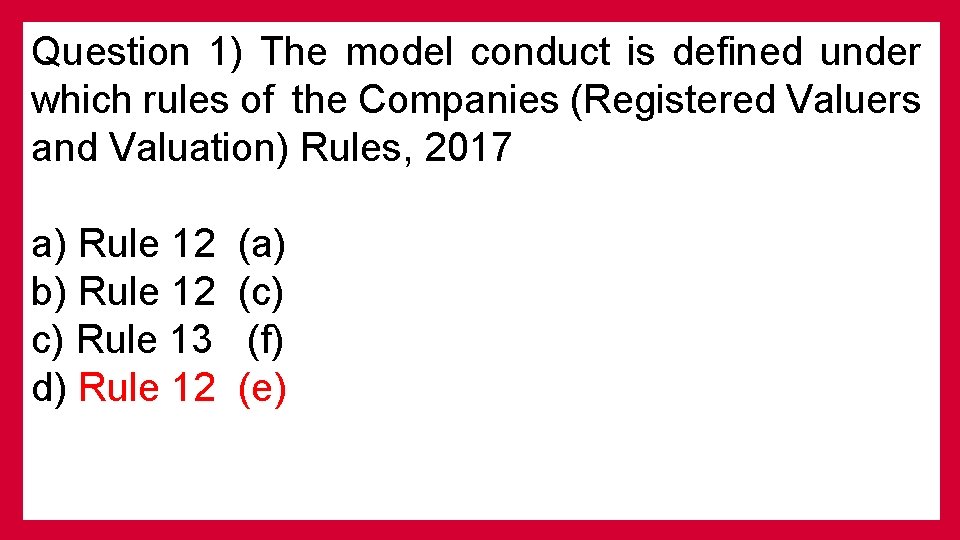
Question 1) The model conduct is defined under which rules of the Companies (Registered Valuers and Valuation) Rules, 2017 a) Rule 12 (a) b) Rule 12 (c) c) Rule 13 (f) d) Rule 12 (e)
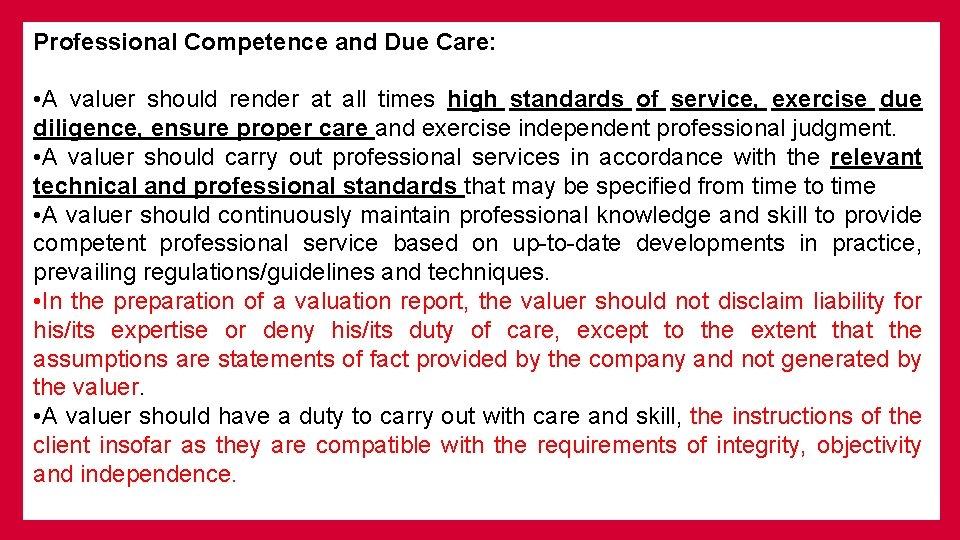
Professional Competence and Due Care: • A valuer should render at all times high standards of service, exercise due diligence, ensure proper care and exercise independent professional judgment. • A valuer should carry out professional services in accordance with the relevant technical and professional standards that may be specified from time to time • A valuer should continuously maintain professional knowledge and skill to provide competent professional service based on up-to-date developments in practice, prevailing regulations/guidelines and techniques. • In the preparation of a valuation report, the valuer should not disclaim liability for his/its expertise or deny his/its duty of care, except to the extent that the assumptions are statements of fact provided by the company and not generated by the valuer. • A valuer should have a duty to carry out with care and skill, the instructions of the client insofar as they are compatible with the requirements of integrity, objectivity and independence.
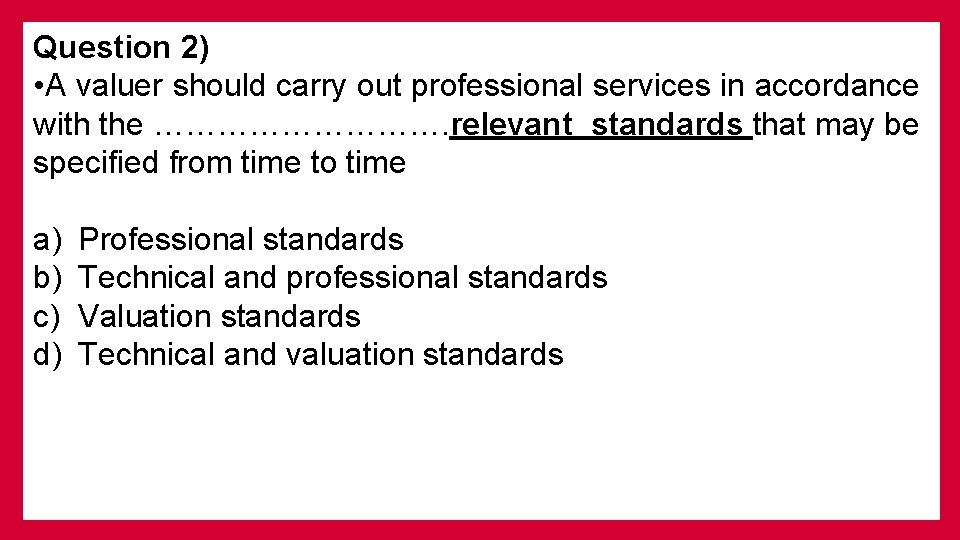
Question 2) • A valuer should carry out professional services in accordance with the ……………. relevant standards that may be specified from time to time a) Professional standards b) Technical and professional standards c) Valuation standards d) Technical and valuation standards
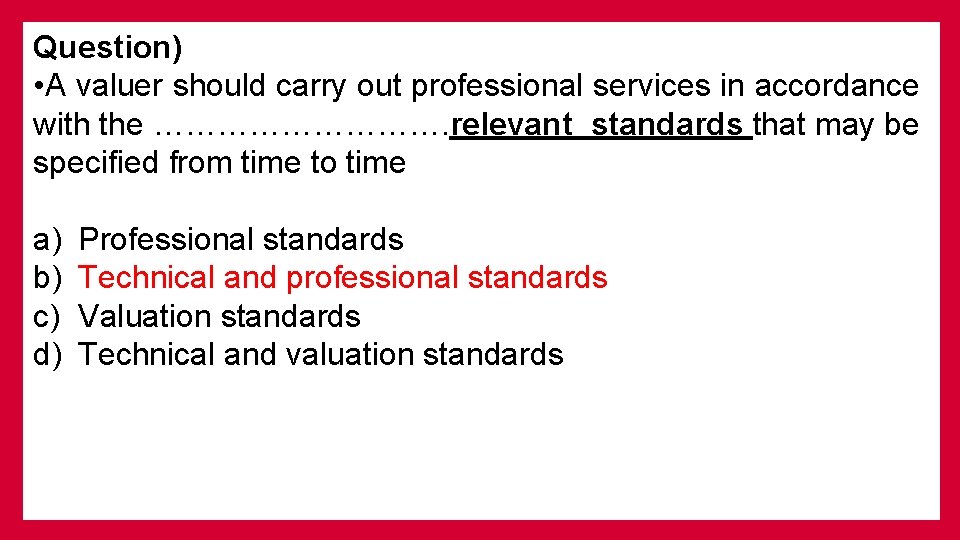
Question) • A valuer should carry out professional services in accordance with the ……………. relevant standards that may be specified from time to time a) Professional standards b) Technical and professional standards c) Valuation standards d) Technical and valuation standards
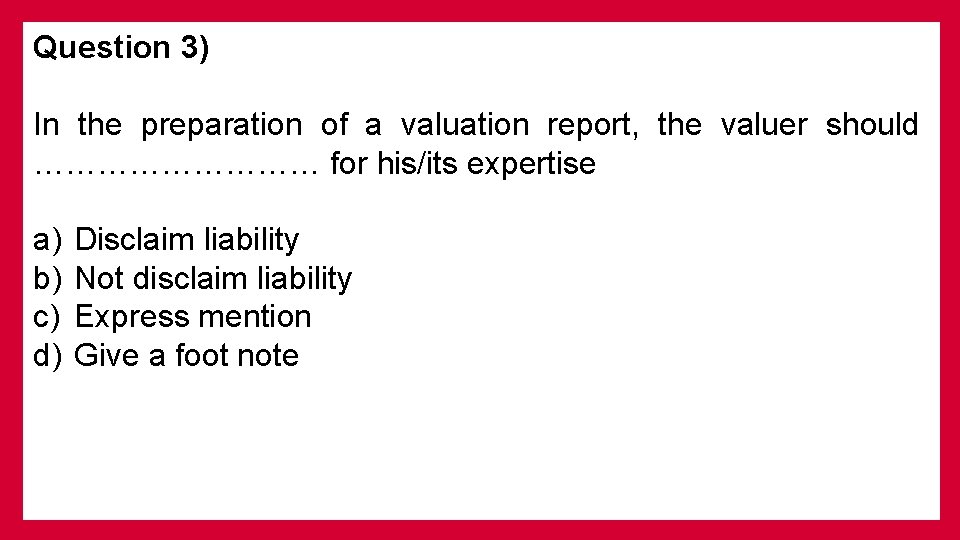
Question 3) In the preparation of a valuation report, the valuer should …………… for his/its expertise a) b) c) d) Disclaim liability Not disclaim liability Express mention Give a foot note
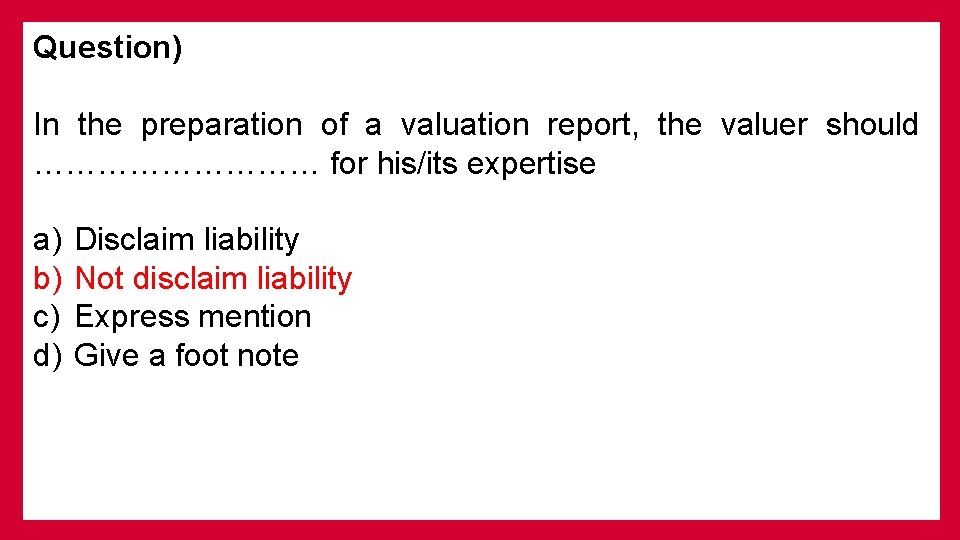
Question) In the preparation of a valuation report, the valuer should …………… for his/its expertise a) b) c) d) Disclaim liability Not disclaim liability Express mention Give a foot note
Independence and Disclosure of Interest • A valuer should act with objectivity in his/its professional dealings by ensuring that his/its decisions are made without the presence of any bias, conflict of interest, coercion, or undue influence of any party, whether directly connected to the valuation assignment or not. • A valuer should not take up an assignment under the Act/Rules if he/it or any of his/its relatives or associates is not independent in relation to the company and assets being valued. • A valuer should maintain complete independence in his/its professional relationships and shall conduct the valuation independent of external influences. • A valuer should wherever necessary disclose to the clients, possible sources of conflicts of duties and interests, while providing unbiased services.
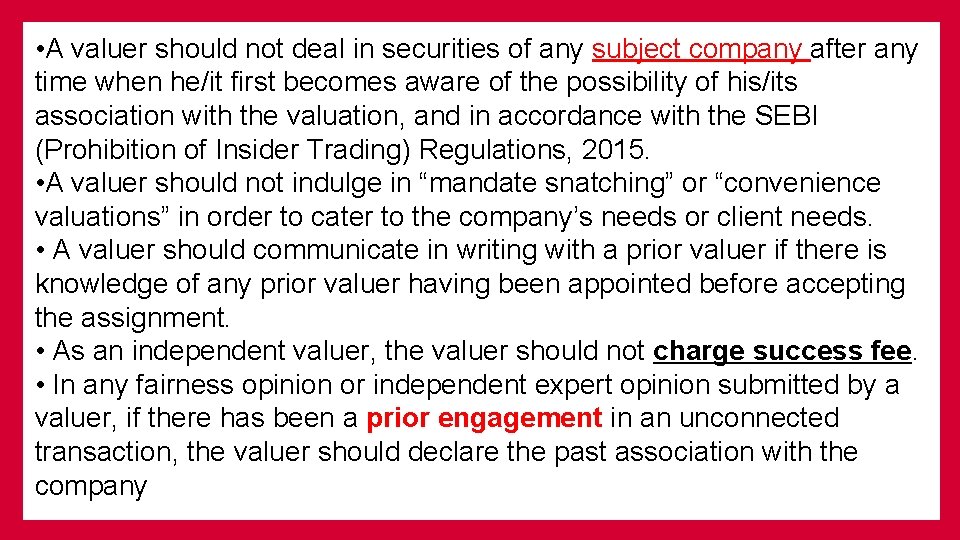
• A valuer should not deal in securities of any subject company after any time when he/it first becomes aware of the possibility of his/its association with the valuation, and in accordance with the SEBI (Prohibition of Insider Trading) Regulations, 2015. • A valuer should not indulge in “mandate snatching” or “convenience valuations” in order to cater to the company’s needs or client needs. • A valuer should communicate in writing with a prior valuer if there is knowledge of any prior valuer having been appointed before accepting the assignment. • As an independent valuer, the valuer should not charge success fee. • In any fairness opinion or independent expert opinion submitted by a valuer, if there has been a prior engagement in an unconnected transaction, the valuer should declare the past association with the company
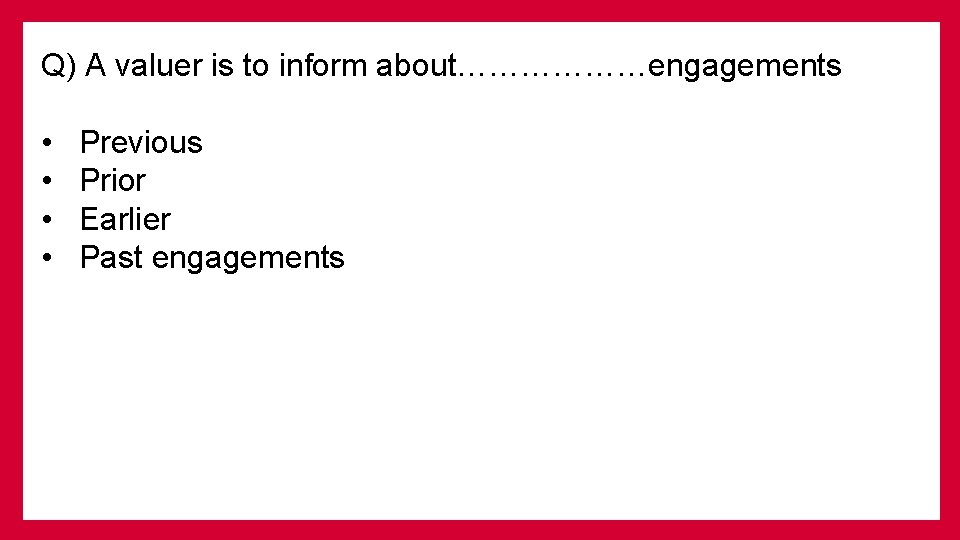
Q) A valuer is to inform about………………engagements • Previous • Prior • Earlier • Past engagements
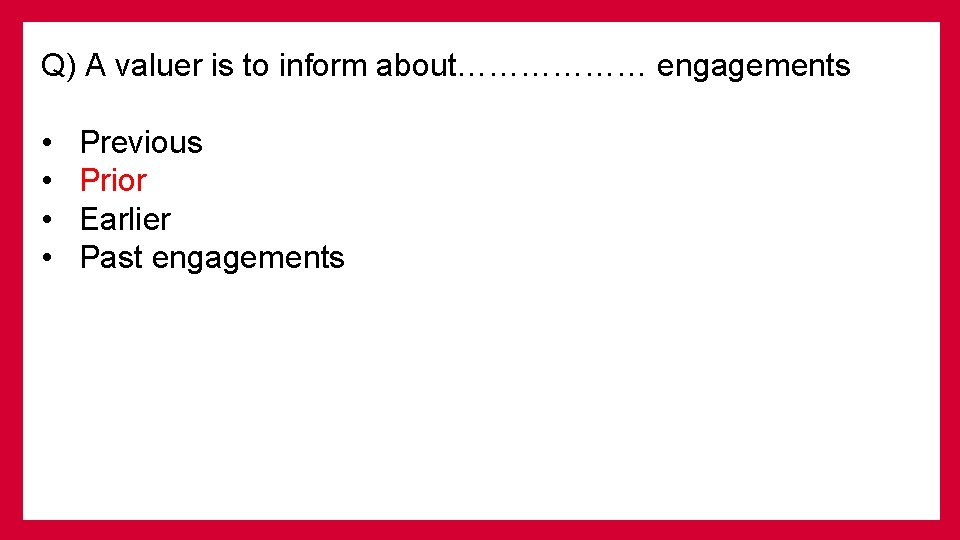
Q) A valuer is to inform about……………… engagements • Previous • Prior • Earlier • Past engagements
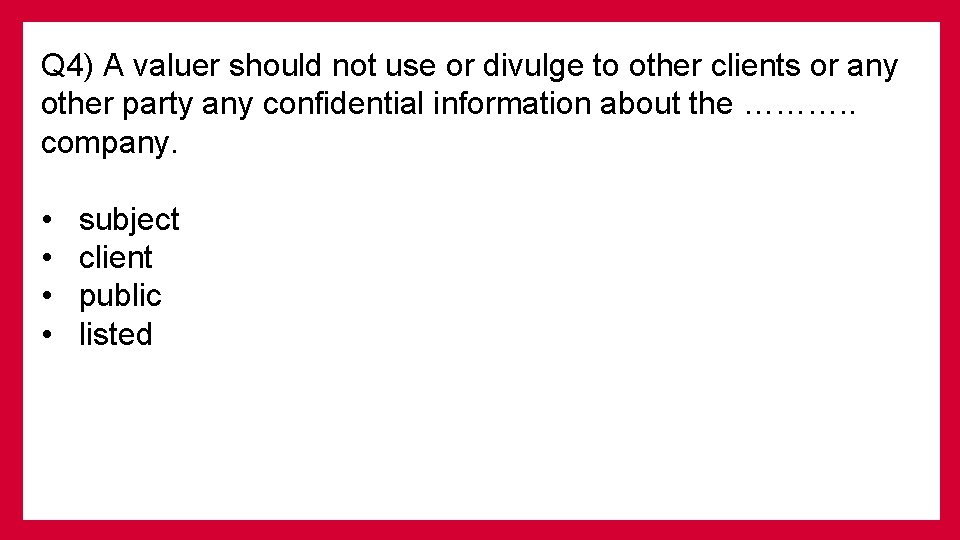
Q 4) A valuer should not use or divulge to other clients or any other party any confidential information about the ………. . company. • subject • client • public • listed
• A valuer should not use or divulge to other clients or any other party any confidential information about the company. • subject • client • public • listed
Q 5 ) As an independent valuer, the valuer should not charge fee. • professional • success • mandate • legal
Q) As an independent valuer, the valuer should not charge fee. • professional • success • mandate • legal
Q 6) A valuer should …………in order to cater to the company’s needs or client needs. a) not indulge in “mandate snatching” or “convenience valuations” b) may indulge in “mandate snatching” or “convenience valuations” c) indulge in valuations based on his knowledge only d) may not indulge in case there are certain issues in relation to the requirements of clients
Q) A valuer should …………in order to cater to the company’s needs or client needs. a) not indulge in “mandate snatching” or “convenience valuations” b) may indulge in “mandate snatching” or “convenience valuations” c) indulge in valuations based on his knowledge only d) may not indulge in case there are certain issues in relation to the requirements of clients
Confidentiality • A valuer should not use or divulge to other clients or any other party any confidential information about the subject company, which has come to his/its knowledge without proper and specific authority or unless there is a legal or professional right or duty to disclose. There can be question on : a) Circumstances where the confidential information can be disclosed b) Client company or subject company
Information Management : • A valuer should ensure that he/ it maintains written contemporaneous records for any decision taken, the reasons for taking the decision, and the information and evidence in support of such decision. This should be maintained so as to sufficiently enable a reasonable person to take a view on the appropriateness of his/its decisions and actions. • A valuer should appear, co-operate and be available for inspections and investigations carried out by the Registration Authority, any person authorised by the Registration Authority, the Valuation Professional Organisation with which he/it is registered or any other statutory regulatory body.
Information Management : • A valuer should provide all information and records as may be required by the Registration Authority, the Tribunal, Appellate Tribunal, the Valuation Professional Organisation with which he/it is registered, or any other statutory regulatory body. • A valuer while respecting the confidentiality of information acquired during the course of performing professional services, should maintain proper working papers for a period of three years, for production before a regulatory authority or for a peer review. • In the event of a pending case before the Tribunal or Appellate Tribunal, the record should be maintained till the disposal of the case.
Q 7) A valuer while respecting the confidentiality of information acquired during the course of performing professional services, should maintain proper working papers for a period of ……… years, for production before a regulatory authority or for a peer review. a) b) c) d) 1 8 3 5
Q 7) A valuer while respecting the confidentiality of information acquired during the course of performing professional services, should maintain proper working papers for a period of ……… years, for production before a regulatory authority or for a peer review. a) b) c) d) 1 8 3 5
Gifts and hospitality. • A valuer, or his/its relative should not accept gifts or hospitality which undermines or affects his independence as a valuer. • A valuer should not offer gifts or hospitality or a financial or any other advantage to a public servant or any other person, intending to obtain or retain work for himself/ itself, or to obtain or retain an advantage in the conduct of profession for himself/ itself. Remuneration and Costs: • A valuer should provide services for remuneration which is charged in a transparent manner, is a reasonable reflection of the work necessarily and properly undertaken, and is not inconsistent with the applicable rules. • A valuer should not accept any fees or charges other than those which are disclosed to and approved by the persons fixing his/ its remuneration.
Q 8) A valuer should provide services for remuneration which is charged in …………………. a) Negotiable Terms b) Transparent manner c) Market value oriented d) Fair value
Q 8) A valuer should provide services for remuneration which is charged in …………………. a) Negotiable Terms b) Transparent manner c) Market value oriented d) Fair value
Occupation, employability and restrictions: • A valuer should refrain from accepting too many assignments, if he/it is unlikely to be able to devote adequate time to each of his/ its assignments. • A valuer should not engage in any employment, except when he has temporarily surrendered his certificate of membership with the Valuation professional Organisation with which he is registered. • A valuer should not conduct business which in the opinion of the Registration Authority is inconsistent with the reputation of the profession.
Other Engagement Considerations
Engagement Letter: There should be an engagement letter for all valuations performed by a Valuer which categorically include the scope of work and the deliverables, use and restrictions on the valuation report and any specific limitations known at the time of engagement. Management Representation (MRL) : Management representations may be taken by the valuer on items which involve assumptions of the management. However it is the responsibility of the valuer to independently assess and validate the management assumptions. In case the valuer is not able to validate the management assumptions and agree to the business plan, he may decide not to issue the report. Point 9 of the model code of conduct pertaining to Professional Competence and due care state that “in the preparation of a valuation report, the valuer shall not disclaim liability for his/its expertise or deny his/its duty of care, except to the extent that the assumptions are based on the statements off act provided by the company or its auditors or consultants or information available in the public domain and not generated by the valuer”.
Guidance on use of Work of Experts: A valuer can rely upon the work of other experts and should specifically mention the same as part of the engagement letter as well as in the report. However he cannot disclaim the liabilities, if any irrespective of the nature of the inputs or valuation by the other registered valuer. It is worth noting that the rule 8(2)of the rules dealing with the Conduct of Valuation states that “the registered valuer may obtain inputs for his valuation report or get a separate valuation for an asset class conducted from another registered valuer. In which case he shall fully disclose the details of the inputs and the particulars etc of the other registered valuer in his report and the liabilities against the resultant valuation, irrespective of the nature of the inputs or valuation by the other registered valuer, shall remain of the first mentioned registered valuer”. Independence and conflict of interest A valuer shall maintain complete independence in his/its professional relationships and shall conduct the valuation independent of external influences.
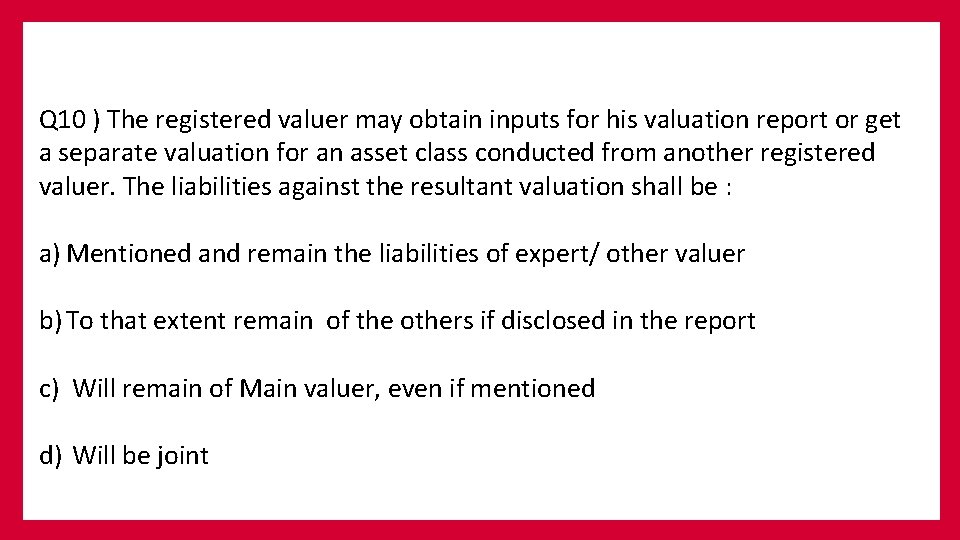
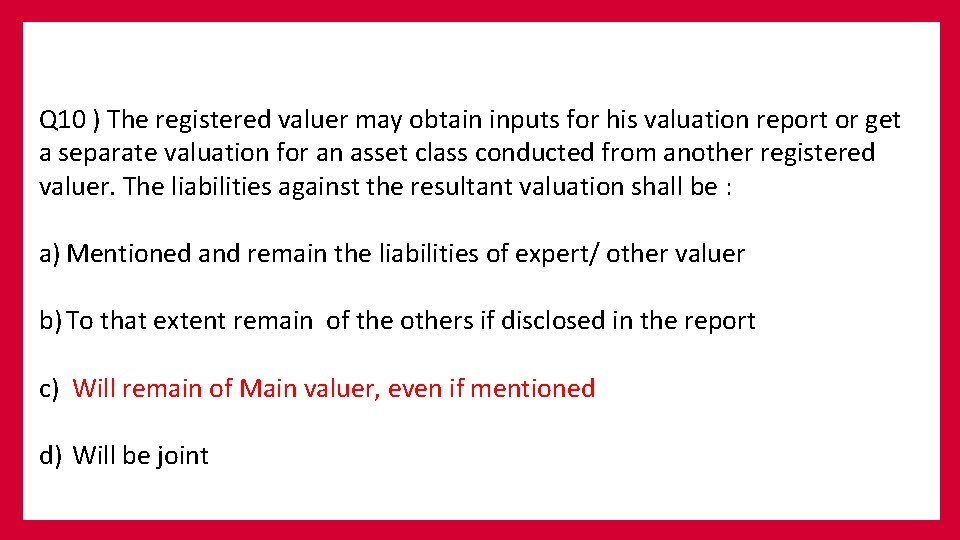
Q 10 ) The registered valuer may obtain inputs for his valuation report or get a separate valuation for an asset class conducted from another registered valuer. The liabilities against the resultant valuation shall be : a) Mentioned and remain the liabilities of expert/ other valuer b) To that extent remain of the others if disclosed in the report c) Will remain of Main valuer, even if mentioned d) Will be joint
Q 10 ) The registered valuer may obtain inputs for his valuation report or get a separate valuation for an asset class conducted from another registered valuer. The liabilities against the resultant valuation shall be : a) Mentioned and remain the liabilities of expert/ other valuer b) To that extent remain of the others if disclosed in the report c) Will remain of Main valuer, even if mentioned d) Will be joint

Break
Registered Valuers and Valuation Rules, 2017 • Valuation Standards • Registered Valuers Organisation • Registration of Valuers • Asset Classes
Valuation of Securities or Financial Assets
New Era of Valuation in India – Registered Valuers • Legal Recognition • Regulated Profession • Uniform Practice • Requires Skill set / Capacity Building
Registered Valuer • Starting Point – Section 247 of Companies Act, 2013 • Applicable Rules – Companies (Registered Valuers and Valuation)Rules 2017 • Regulating the profession of Valuation in India for Standardization and Transparency • As of now, covers Companies Act and Insolvency and Bankruptcy Code (IBC)
Registered Valuer – Section 247 of the Companies Act, 2103 states that a Registered Valuer would carry out valuation in respect of any property, stocks, shares, debentures, securities or goodwill or any other assets or net worth of a company or its liabilities and that the valuer shall have such qualifications and experience and being a member of an organisation recognised, on such terms and conditions as may be prescribed. The Registered Valuer shall be appointed by the audit committee or in its absence by the Board of Directors of that company. Regarding the functioning and duties of the Registered Valuer, it is stated that the registered valuer shall: • make an impartial, true and fair valuation of any assets that may be required to be valued; • exercise due diligence while performing the functions as valuer; • make the valuation in accordance with such rules as may be prescribed; and • not undertake valuation of any assets in which he has a direct or indirect interest or becomes so interested at any time during 3 years prior to his appointment as valuer or 3 years after valuation of assets was conducted by him.
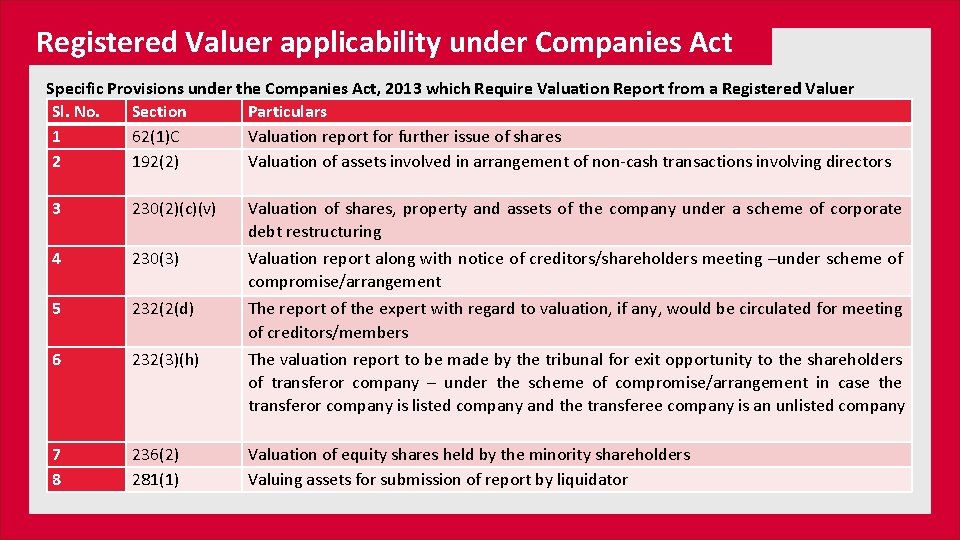
Registered Valuer applicability under Companies Act Specific Provisions under the Companies Act, 2013 which Require Valuation Report from a Registered Valuer Sl. No. Section Particulars 1 62(1)C Valuation report for further issue of shares 2 192(2) Valuation of assets involved in arrangement of non-cash transactions involving directors 3 230(2)(c)(v) Valuation of shares, property and assets of the company under a scheme of corporate debt restructuring 4 230(3) Valuation report along with notice of creditors/shareholders meeting –under scheme of compromise/arrangement 5 232(2(d) The report of the expert with regard to valuation, if any, would be circulated for meeting of creditors/members 6 232(3)(h) The valuation report to be made by the tribunal for exit opportunity to the shareholders of transferor company – under the scheme of compromise/arrangement in case the transferor company is listed company and the transferee company is an unlisted company 7 8 236(2) 281(1) Valuation of equity shares held by the minority shareholders Valuing assets for submission of report by liquidator
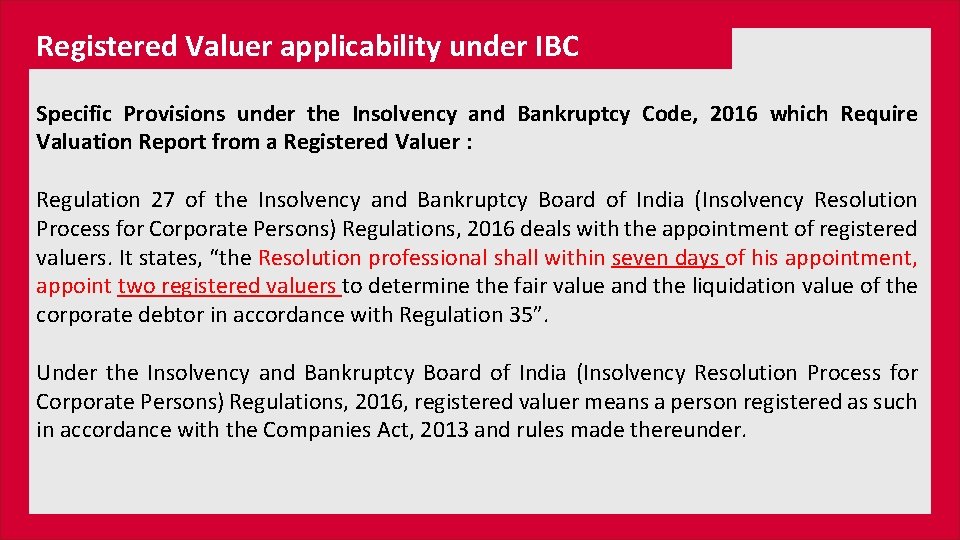
Registered Valuer applicability under IBC Specific Provisions under the Insolvency and Bankruptcy Code, 2016 which Require Valuation Report from a Registered Valuer : Regulation 27 of the Insolvency and Bankruptcy Board of India (Insolvency Resolution Process for Corporate Persons) Regulations, 2016 deals with the appointment of registered valuers. It states, “the Resolution professional shall within seven days of his appointment, appoint two registered valuers to determine the fair value and the liquidation value of the corporate debtor in accordance with Regulation 35”. Under the Insolvency and Bankruptcy Board of India (Insolvency Resolution Process for Corporate Persons) Regulations, 2016, registered valuer means a person registered as such in accordance with the Companies Act, 2013 and rules made thereunder.
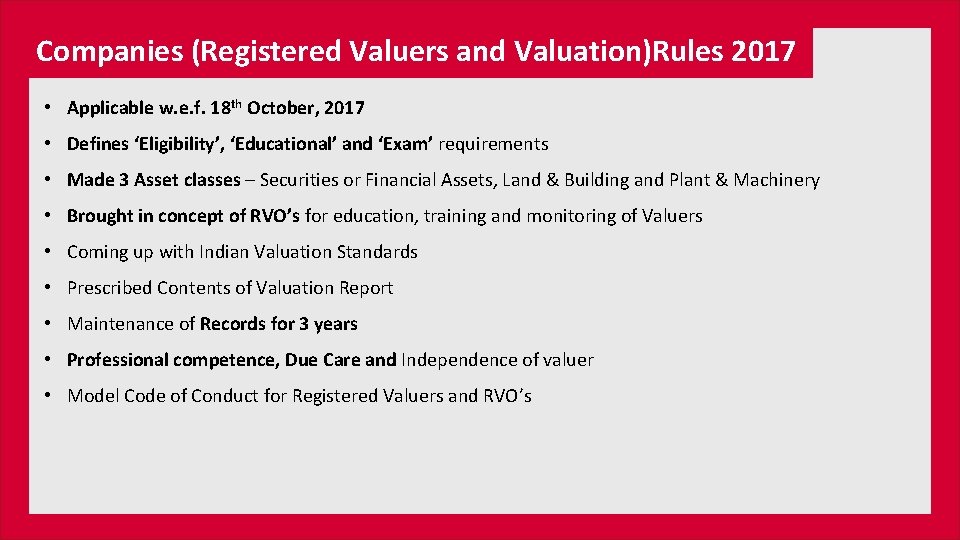
Companies (Registered Valuers and Valuation)Rules 2017 • Applicable w. e. f. 18 th October, 2017 • Defines ‘Eligibility’, ‘Educational’ and ‘Exam’ requirements • Made 3 Asset classes – Securities or Financial Assets, Land & Building and Plant & Machinery • Brought in concept of RVO’s for education, training and monitoring of Valuers • Coming up with Indian Valuation Standards • Prescribed Contents of Valuation Report • Maintenance of Records for 3 years • Professional competence, Due Care and Independence of valuer • Model Code of Conduct for Registered Valuers and RVO’s
Companies (Registered Valuers and Valuation)Rules 2017
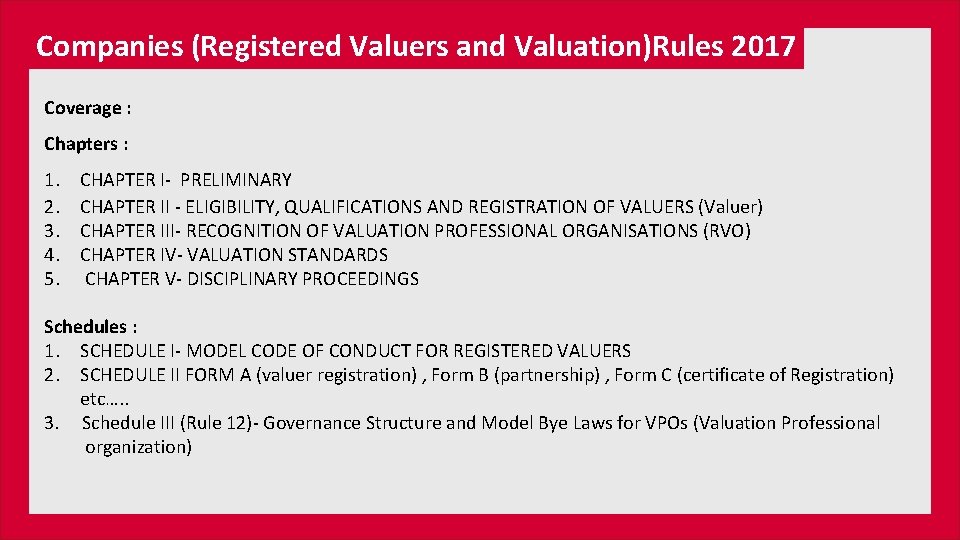
Companies (Registered Valuers and Valuation)Rules 2017 Coverage : Chapters : 1. 2. 3. 4. 5. CHAPTER I- PRELIMINARY CHAPTER II - ELIGIBILITY, QUALIFICATIONS AND REGISTRATION OF VALUERS (Valuer) CHAPTER III- RECOGNITION OF VALUATION PROFESSIONAL ORGANISATIONS (RVO) CHAPTER IV- VALUATION STANDARDS CHAPTER V- DISCIPLINARY PROCEEDINGS Schedules : 1. SCHEDULE I- MODEL CODE OF CONDUCT FOR REGISTERED VALUERS 2. SCHEDULE II FORM A (valuer registration) , Form B (partnership) , Form C (certificate of Registration) etc…. . 3. Schedule III (Rule 12)- Governance Structure and Model Bye Laws for VPOs (Valuation Professional organization)
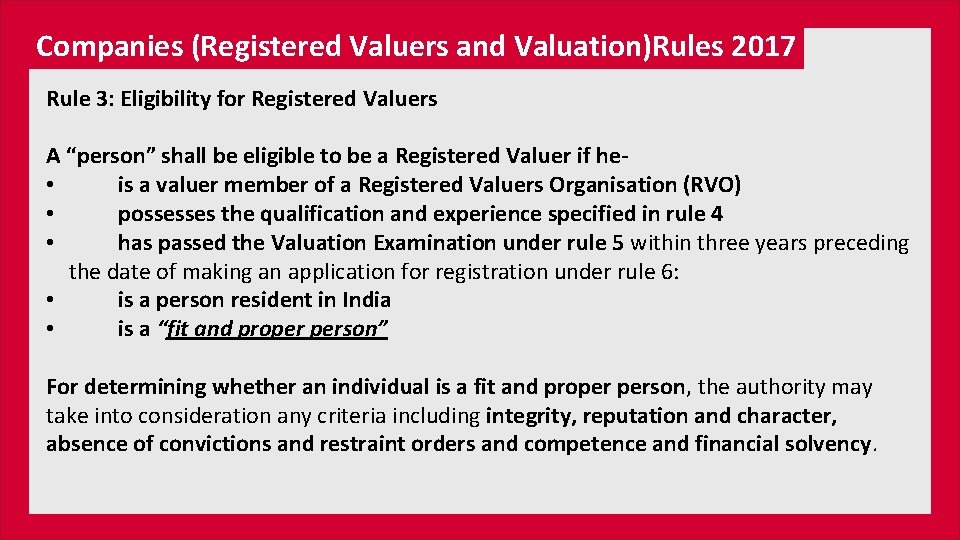
Companies (Registered Valuers and Valuation)Rules 2017 Rule 3: Eligibility for Registered Valuers A “person” shall be eligible to be a Registered Valuer if he • is a valuer member of a Registered Valuers Organisation (RVO) • possesses the qualification and experience specified in rule 4 • has passed the Valuation Examination under rule 5 within three years preceding the date of making an application for registration under rule 6: • is a person resident in India • is a “fit and proper person” For determining whether an individual is a fit and proper person, the authority may take into consideration any criteria including integrity, reputation and character, absence of convictions and restraint orders and competence and financial solvency.
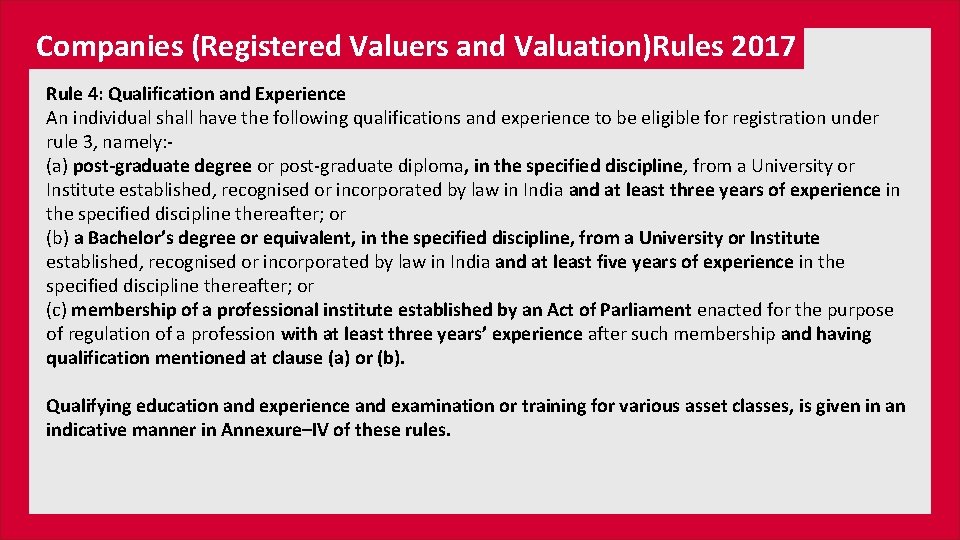
Companies (Registered Valuers and Valuation)Rules 2017 Rule 4: Qualification and Experience An individual shall have the following qualifications and experience to be eligible for registration under rule 3, namely: (a) post-graduate degree or post-graduate diploma, in the specified discipline, from a University or Institute established, recognised or incorporated by law in India and at least three years of experience in the specified discipline thereafter; or (b) a Bachelor’s degree or equivalent, in the specified discipline, from a University or Institute established, recognised or incorporated by law in India and at least five years of experience in the specified discipline thereafter; or (c) membership of a professional institute established by an Act of Parliament enacted for the purpose of regulation of a profession with at least three years’ experience after such membership and having qualification mentioned at clause (a) or (b). Qualifying education and experience and examination or training for various asset classes, is given in an indicative manner in Annexure–IV of these rules.
Companies (Registered Valuers and Valuation)Rules 2017 Rule 7 clarifies that the valuation report can be signed only by the Registered Valuer for the class of asset being valued.
Companies (Registered Valuers and Valuation)Rules 2017 Rule 8: Conduct of Valuation (1) The registered valuer shall, while conducting a valuation, comply with the valuation standards as notified or modified under rule 18: Provided that until the valuation standards are notified or modified by the Central Government, a valuer shall make valuations as per- (a) internationally accepted valuation standards; (b) valuation standards adopted by any registered valuers organisation. (2) The registered valuer may obtain inputs for his valuation report or get a separate valuation for an asset class conducted from another registered valuer, in which case he shall fully disclose the details of the inputs and the particulars etc. of the other registered valuer in his report and the liabilities against the resultant valuation, irrespective of the nature of inputs or valuation by the other registered valuer, shall remain of the first mentioned registered valuer. There are International Valuation Standards, 2017 issued by the International Valuation Standards Council (IVSC) which may be relied upon The ICAI has also recently approved Indian Valuation Standards, mandatory for its members for Valuations under Registered Valuer. The same are effective from 1 st July, 2018
Companies (Registered Valuers and Valuation)Rules 2017 Contents of Valuation Report The valuer shall in his report state the following: • Background information of the asset being valued; • Purpose of valuation and appointing authority • Identity of valuer and any other experts involved in valuation; • Disclosure of valuer interest/conflict, if any; • Date of appointment, valuation date and date of report; • Inspections and/or investigations undertaken; • Nature and sources of the information used or relied upon; • Procedures adopted in carrying out the valuation and the valuation standards followed; • Restrictions on use of the report, if any; • Major factors that were taken into account during the valuation; • Conclusion; and • Caveats, Limitations and Disclaimers to the extent they explain or elucidate the limitations faced by valuer, which shall not be for the purpose of limiting his responsibility for the valuation report.
Companies (Registered Valuers and Valuation)Rules 2017 • Which of the following is not a prescribed asset class under the Companies (Registered Valuers and Valuation) Rules, 2017? • Enterprise • Securities or Financial Assets • Plant and Machinery • Land Buildings
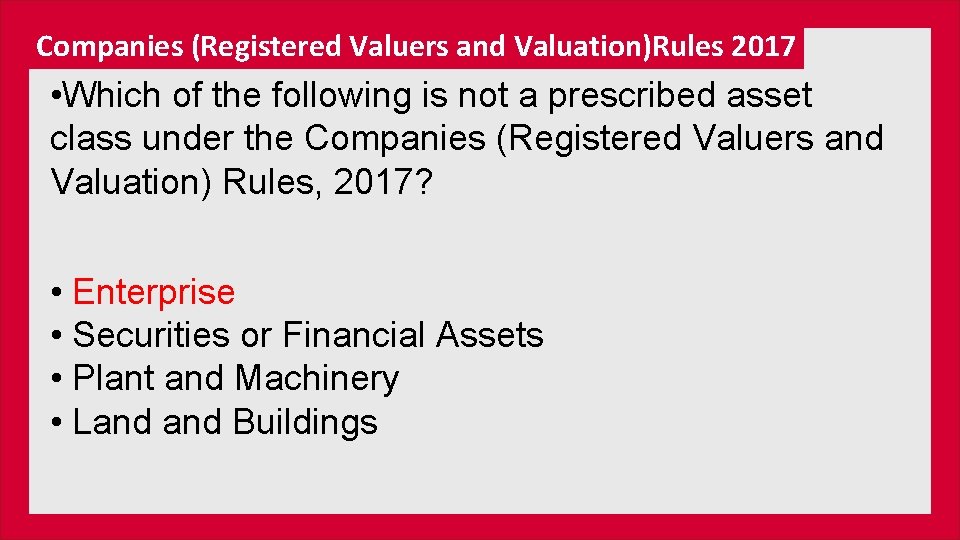
Companies (Registered Valuers and Valuation)Rules 2017 • Which of the following is not a prescribed asset class under the Companies (Registered Valuers and Valuation) Rules, 2017? • Enterprise • Securities or Financial Assets • Plant and Machinery • Land Buildings
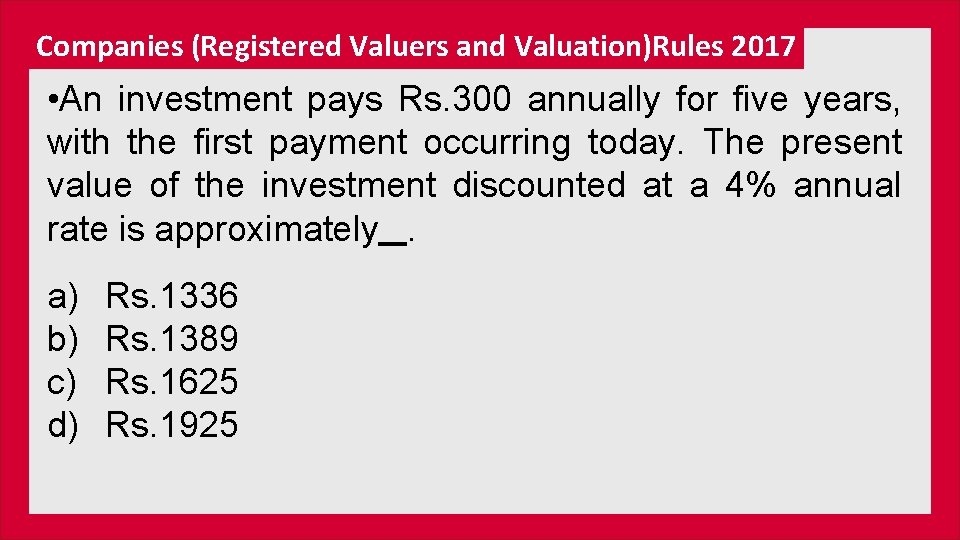
Companies (Registered Valuers and Valuation)Rules 2017 • An investment pays Rs. 300 annually for five years, with the first payment occurring today. The present value of the investment discounted at a 4% annual rate is approximately . a) b) c) d) Rs. 1336 Rs. 1389 Rs. 1625 Rs. 1925
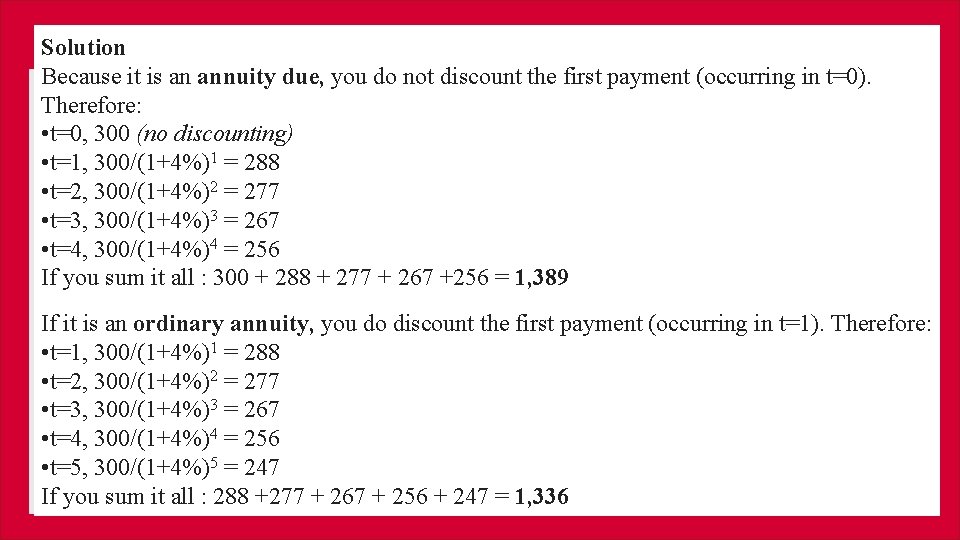
Solution Companies (Registered Valuers and Valuation)Rules 2017 Because it is an annuity due, you do not discount the first payment (occurring in t=0). Therefore: • t=0, 300 (no discounting) • t=1, 300/(1+4%)1 = 288 • t=2, 300/(1+4%)2 = 277 • t=3, 300/(1+4%)3 = 267 • t=4, 300/(1+4%)4 = 256 If you sum it all : 300 + 288 + 277 + 267 +256 = 1, 389 If it is an ordinary annuity, you do discount the first payment (occurring in t=1). Therefore: • t=1, 300/(1+4%)1 = 288 • t=2, 300/(1+4%)2 = 277 • t=3, 300/(1+4%)3 = 267 • t=4, 300/(1+4%)4 = 256 • t=5, 300/(1+4%)5 = 247 If you sum it all : 288 +277 + 267 + 256 + 247 = 1, 336
Companies (Registered Valuers and Valuation)Rules 2017 Some important areas of question from the valuation rules
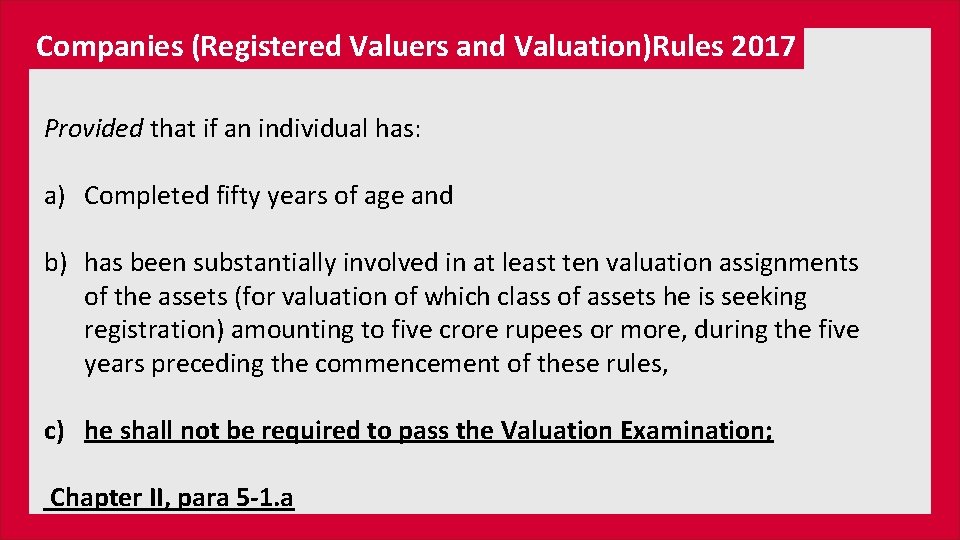
Companies (Registered Valuers and Valuation)Rules 2017 Provided that if an individual has: a) Completed fifty years of age and b) has been substantially involved in at least ten valuation assignments of the assets (for valuation of which class of assets he is seeking registration) amounting to five crore rupees or more, during the five years preceding the commencement of these rules, c) he shall not be required to pass the Valuation Examination; Chapter II, para 5 -1. a
Companies (Registered Valuers and Valuation)Rules 2017 • Refusal to grant certificate. ( 45 … 15…. . 30) 1. If, after considering an application made under Rule 7, the Registration Authority is of the prima facie opinion that the registration ought not be granted, it shall communicate the reasons forming such an opinion within forty-five days of receipt of the application, excluding the time given by it for removing the deficiencies, presenting additional documents or clarifications, or appearing in person, as the case may be. 2. The applicant shall submit an explanation as to why his/its application should be accepted within fifteen days of the receipt of the communication under sub- rule (1), to enable the Registration Authority to form a final opinion. 3. After considering the explanation, if any, given by the applicant under sub- rule (2), the Registration Authority shall communicate its decision to(1)accept the application, along with the certificate of registration, or (2)reject the application by an order, giving reasons thereof within thirty days of receipt of explanation.
Companies (Registered Valuers and Valuation)Rules 2017 The registration granted under Rule 7 or 8 shall be subject to the conditions that the valuer shall – 1. Maintain records of all assignments undertaken by him/it under the Act and these Rules for at least three years from the completion of such assignment; 2. Allow only the partner who is a registered valuer for the class of assets that are being valued to sign and act on behalf of it, where it is a partnership entity;
Companies (Registered Valuers and Valuation)Rules 2017 • Temporary surrender. A valuation professional organisation shall inform the Registration Authority if any valuer who is its member has temporarily surrendered his/its membership or revived his/ its membership after temporary surrender, not later than seven days from approval of the application for temporary surrender or revival, as the case may be. • Transitional Arrangement. A person who is allowed under any provision of the Act or rules made thereunder or under any other law to act as a registered valuer may continue to act as such, without getting registered under these Rules, for a period not exceeding six months from the commencement of these rules.
Companies (Registered Valuers and Valuation)Rules 2017 Eligibility for valuation professional organisations : An organisation may be recognised as a valuation professional organisation for valuation of a specific class/ classes of assets of valuation if it has been: a) set up under an Act of Parliament, or; b) registered under section 25 of Companies Act, 1956 or section 8 of Companies Act, 2013, or; c) registered as a society under the Societies Registration Act, 1860 or any relevant state law, or; d) set up as a trust governed by the Indian Trust Act, 1882; Provided that no organisation established after 1 st April, 2017 shall be recognised unless it is registered under section 8 of the Companies Act, 2013 and has bye laws, governance structure as specified in Schedule III.
Companies (Registered Valuers and Valuation)Rules 2017 Exam questions relevant
Companies (Registered Valuers and Valuation)Rules 2017 1. Until such time as the Valuation Standards are notified by the Central Government, a valuer shall make valuations as per(1) an internationally accepted valuation methodology; (2) valuation standards adopted by any valuation professional organisation; or (3) valuation standards specified by Reserve Bank of India, Securities and Exchange Board of India or any other statutory regulatory body.
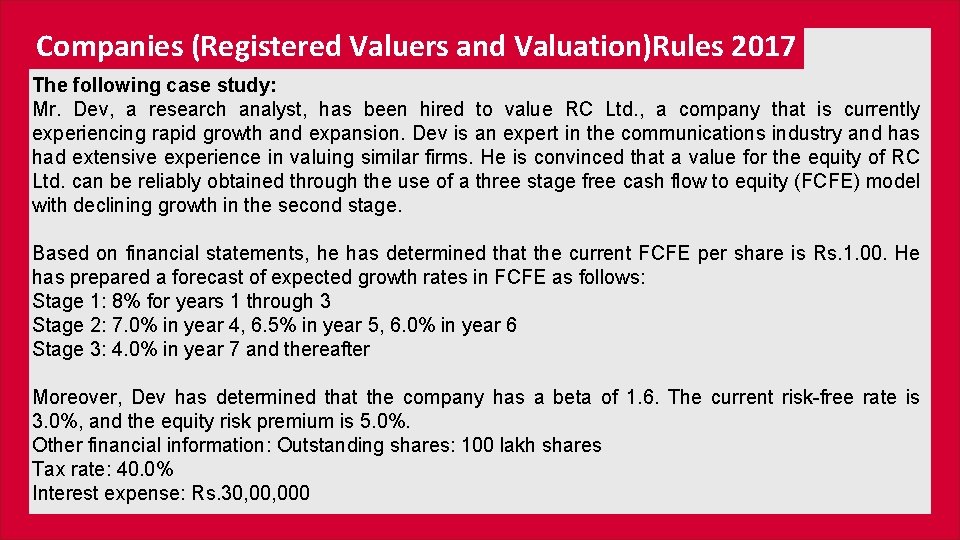
Companies (Registered Valuers and Valuation)Rules 2017 The following case study: Mr. Dev, a research analyst, has been hired to value RC Ltd. , a company that is currently experiencing rapid growth and expansion. Dev is an expert in the communications industry and has had extensive experience in valuing similar firms. He is convinced that a value for the equity of RC Ltd. can be reliably obtained through the use of a three stage free cash flow to equity (FCFE) model with declining growth in the second stage. Based on financial statements, he has determined that the current FCFE per share is Rs. 1. 00. He has prepared a forecast of expected growth rates in FCFE as follows: Stage 1: 8% for years 1 through 3 Stage 2: 7. 0% in year 4, 6. 5% in year 5, 6. 0% in year 6 Stage 3: 4. 0% in year 7 and thereafter Moreover, Dev has determined that the company has a beta of 1. 6. The current risk-free rate is 3. 0%, and the equity risk premium is 5. 0%. Other financial information: Outstanding shares: 100 lakh shares Tax rate: 40. 0% Interest expense: Rs. 30, 000
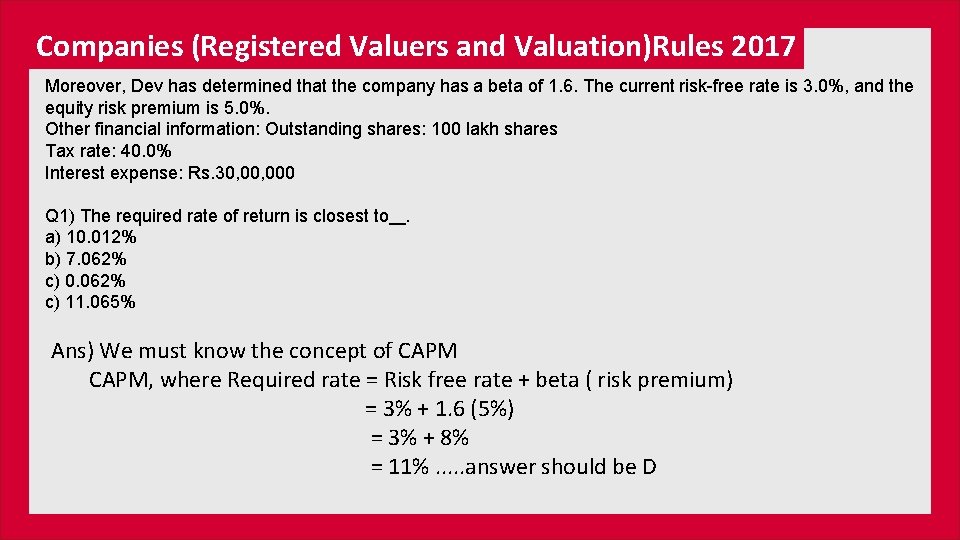
Companies (Registered Valuers and Valuation)Rules 2017 Moreover, Dev has determined that the company has a beta of 1. 6. The current risk-free rate is 3. 0%, and the equity risk premium is 5. 0%. Other financial information: Outstanding shares: 100 lakh shares Tax rate: 40. 0% Interest expense: Rs. 30, 000 Q 1) The required rate of return is closest to . a) 10. 012% b) 7. 062% c) 0. 062% c) 11. 065% Ans) We must know the concept of CAPM CAPM, where Required rate = Risk free rate + beta ( risk premium) = 3% + 1. 6 (5%) = 3% + 8% = 11%. . . answer should be D
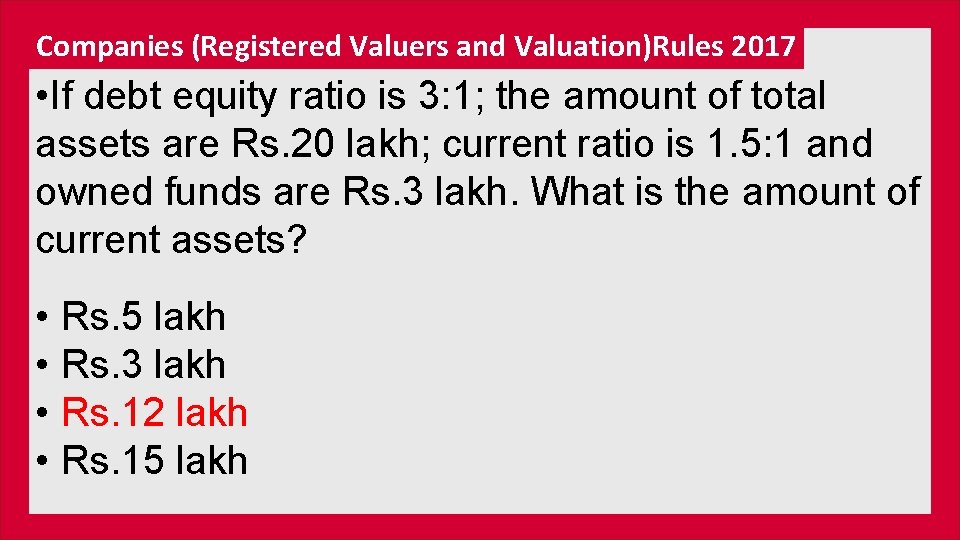
Companies (Registered Valuers and Valuation)Rules 2017 • If debt equity ratio is 3: 1; the amount of total assets are Rs. 20 lakh; current ratio is 1. 5: 1 and owned funds are Rs. 3 lakh. What is the amount of current assets? • Rs. 5 lakh • Rs. 3 lakh • Rs. 12 lakh • Rs. 15 lakh
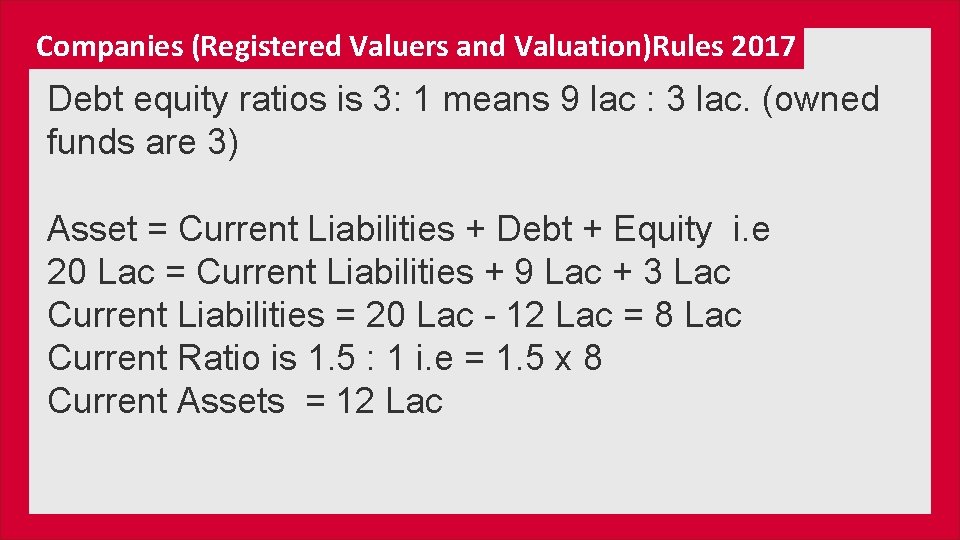
Companies (Registered Valuers and Valuation)Rules 2017 Debt equity ratios is 3: 1 means 9 lac : 3 lac. (owned funds are 3) Asset = Current Liabilities + Debt + Equity i. e 20 Lac = Current Liabilities + 9 Lac + 3 Lac Current Liabilities = 20 Lac - 12 Lac = 8 Lac Current Ratio is 1. 5 : 1 i. e = 1. 5 x 8 Current Assets = 12 Lac
New Regulations – Financial Reporting • Growing importance of Fair values in financial reporting globally and in India • Role of management in preparing financial statements according to recognized standards – IFRS/ Ind AS • Role of auditors and regulator • Need for qualified expert business valuer • Public Trust
Finance 1. Basic concepts in Finance 2. Decisions in Finance 3. Financial Markets and Securities Markets
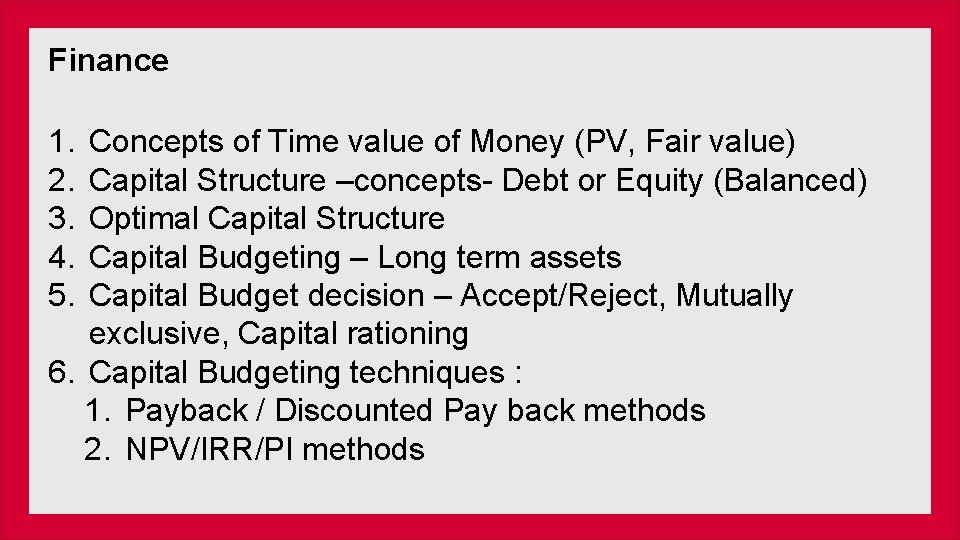
Finance 1. 2. 3. 4. 5. Concepts of Time value of Money (PV, Fair value) Capital Structure –concepts- Debt or Equity (Balanced) Optimal Capital Structure Capital Budgeting – Long term assets Capital Budget decision – Accept/Reject, Mutually exclusive, Capital rationing 6. Capital Budgeting techniques : 1. Payback / Discounted Pay back methods 2. NPV/IRR/PI methods
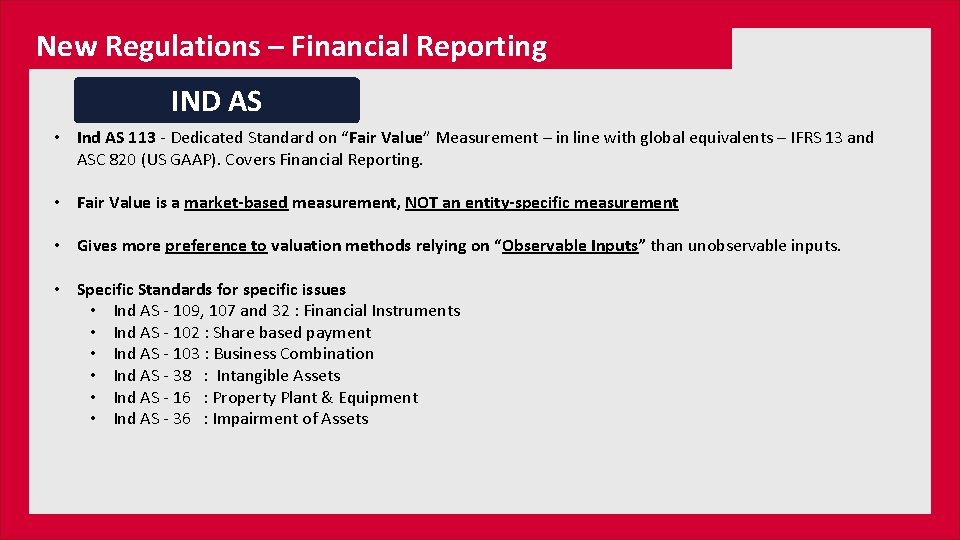
New Regulations – Financial Reporting IND AS • Ind AS 113 - Dedicated Standard on “Fair Value” Measurement – in line with global equivalents – IFRS 13 and ASC 820 (US GAAP). Covers Financial Reporting. • Fair Value is a market-based measurement, NOT an entity-specific measurement • Gives more preference to valuation methods relying on “Observable Inputs” than unobservable inputs. • Specific Standards for specific issues • Ind AS - 109, 107 and 32 : Financial Instruments • Ind AS - 102 : Share based payment • Ind AS - 103 : Business Combination • Ind AS - 38 : Intangible Assets • Ind AS - 16 : Property Plant & Equipment • Ind AS - 36 : Impairment of Assets
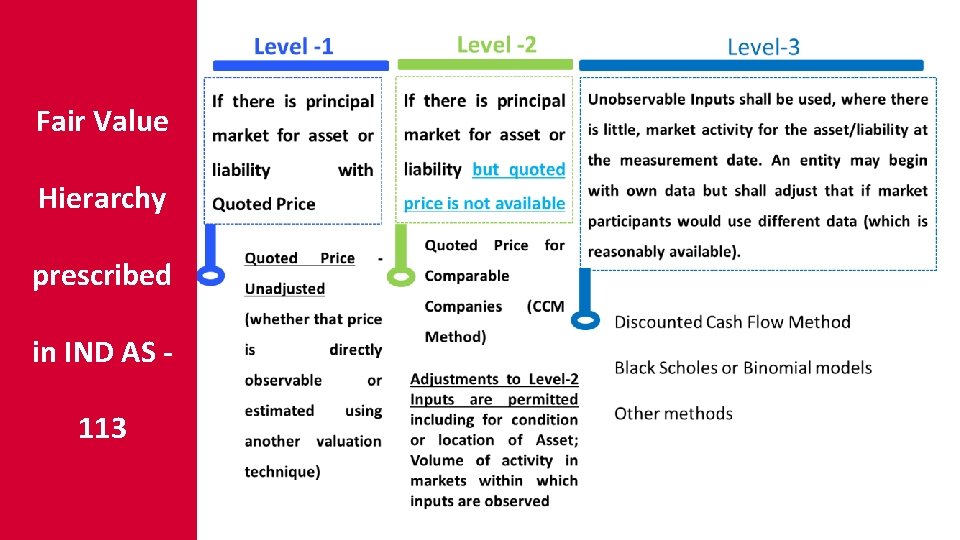
Fair Value Hierarchy prescribed in IND AS - 113
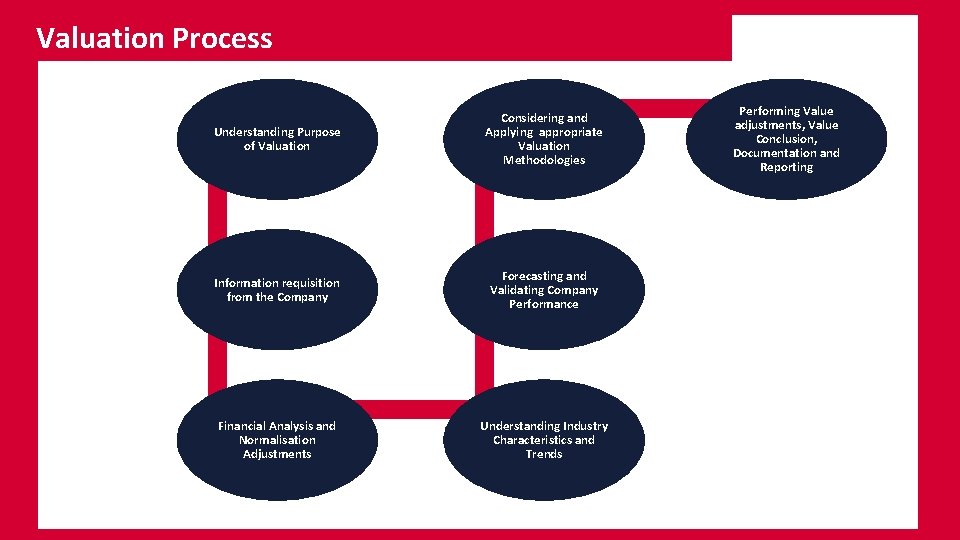
Valuation Process Understanding Purpose of Valuation Considering and Applying appropriate Valuation Methodologies Information requisition from the Company Forecasting and Validating Company Performance Financial Analysis and Normalisation Adjustments Understanding Industry Characteristics and Trends Performing Value adjustments, Value Conclusion, Documentation and Reporting
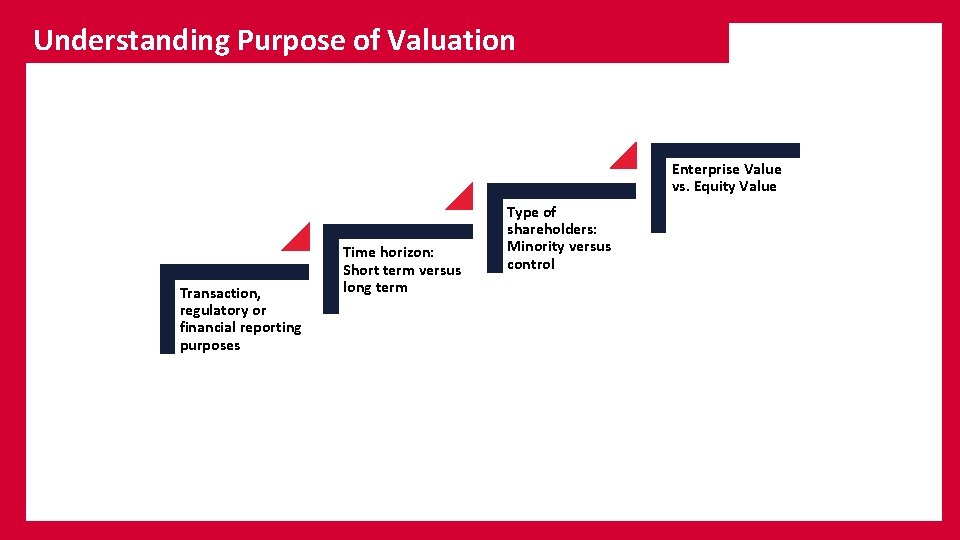
Understanding Purpose of Valuation Time horizon: Short term versus long term Enterprise Value vs. Equity Value Transaction, regulatory or financial reporting purposes Time horizon: Short term versus long term Type of shareholders: Minority versus control
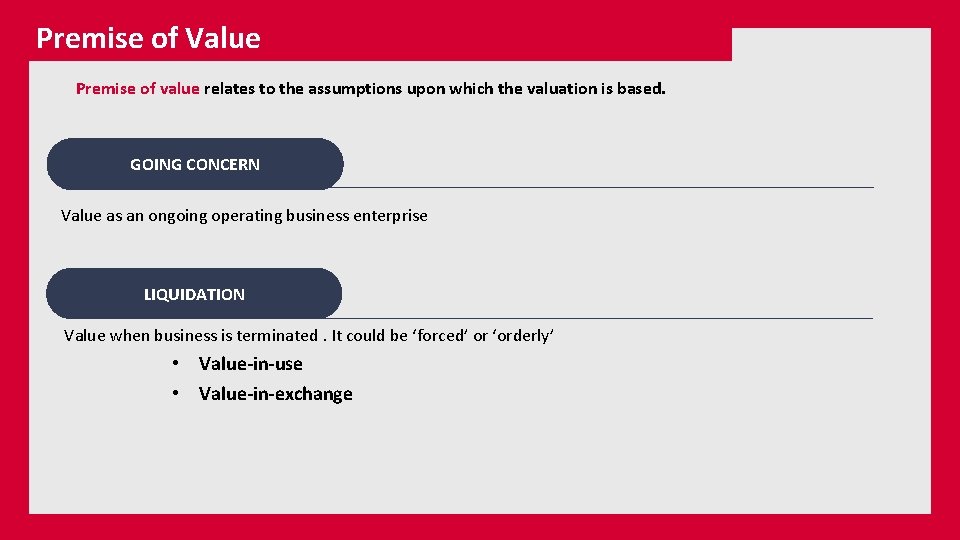
Premise of Value Premise of value relates to the assumptions upon which the valuation is based. GOING CONCERN Value as an ongoing operating business enterprise LIQUIDATION Value when business is terminated. It could be ‘forced’ or ‘orderly’ • Value-in-use • Value-in-exchange
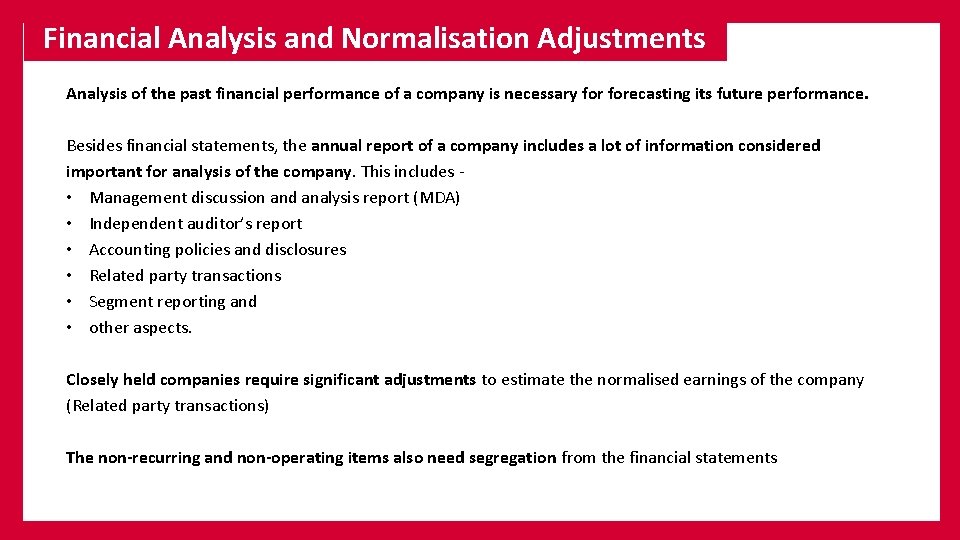
Financial Analysis and Normalisation Adjustments Analysis of the past financial performance of a company is necessary forecasting its future performance. Besides financial statements, the annual report of a company includes a lot of information considered important for analysis of the company. This includes • Management discussion and analysis report (MDA) • Independent auditor’s report • Accounting policies and disclosures • Related party transactions • Segment reporting and • other aspects. Closely held companies require significant adjustments to estimate the normalised earnings of the company (Related party transactions) The non-recurring and non-operating items also need segregation from the financial statements
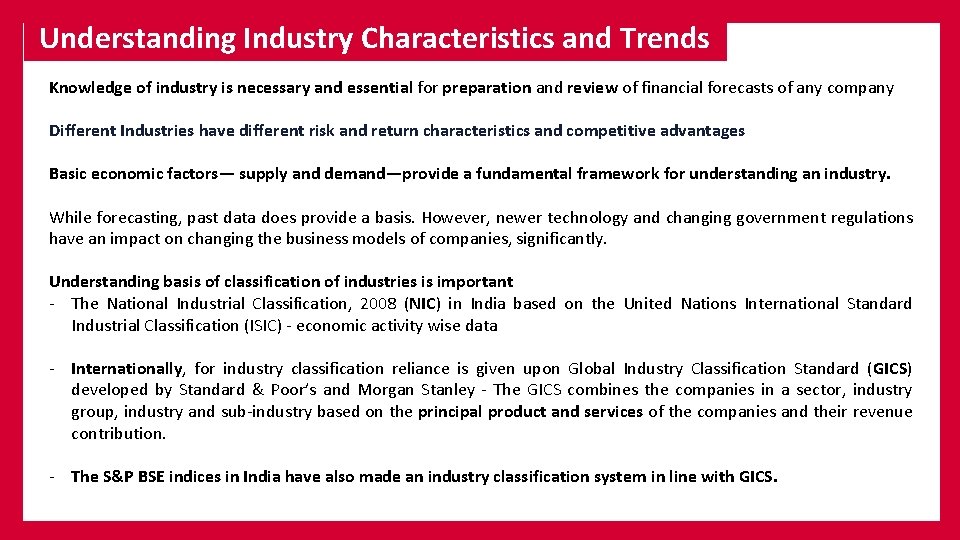
Understanding Industry Characteristics and Trends Knowledge of industry is necessary and essential for preparation and review of financial forecasts of any company Different Industries have different risk and return characteristics and competitive advantages Basic economic factors— supply and demand—provide a fundamental framework for understanding an industry. While forecasting, past data does provide a basis. However, newer technology and changing government regulations have an impact on changing the business models of companies, significantly. Understanding basis of classification of industries is important - The National Industrial Classification, 2008 (NIC) in India based on the United Nations International Standard Industrial Classification (ISIC) - economic activity wise data - Internationally, for industry classification reliance is given upon Global Industry Classification Standard (GICS) developed by Standard & Poor’s and Morgan Stanley - The GICS combines the companies in a sector, industry group, industry and sub-industry based on the principal product and services of the companies and their revenue contribution. - The S&P BSE indices in India have also made an industry classification system in line with GICS.
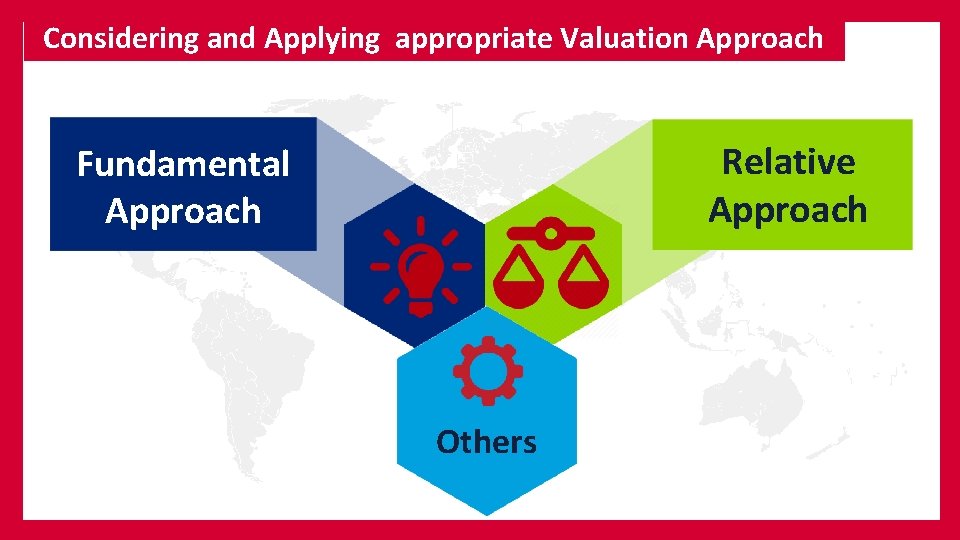
Considering and Applying appropriate Valuation Approach Relative Approach Fundamental Approach Others
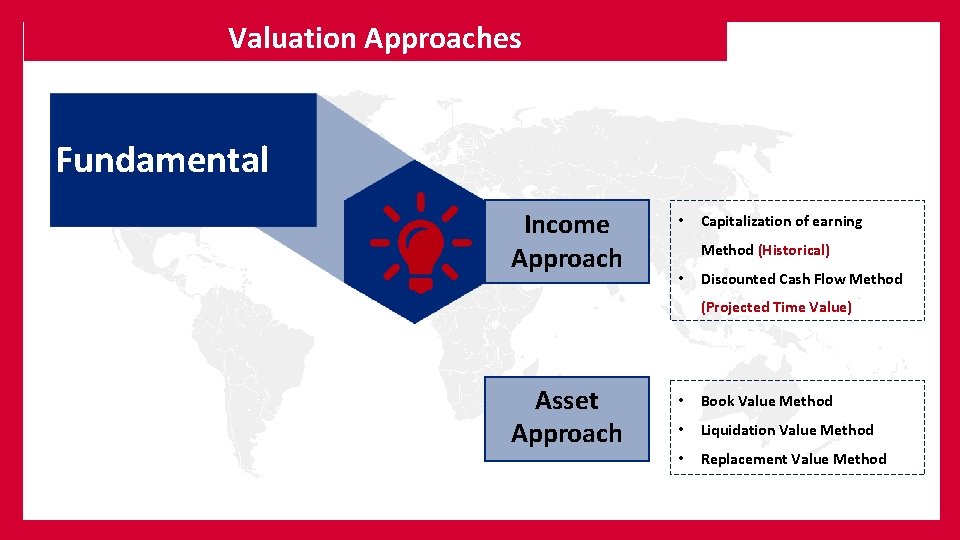
Valuation Approaches Fundamental Income Approach • Capitalization of earning Method (Historical) • Discounted Cash Flow Method (Projected Time Value) Asset Approach • Book Value Method • Liquidation Value Method • Replacement Value Method
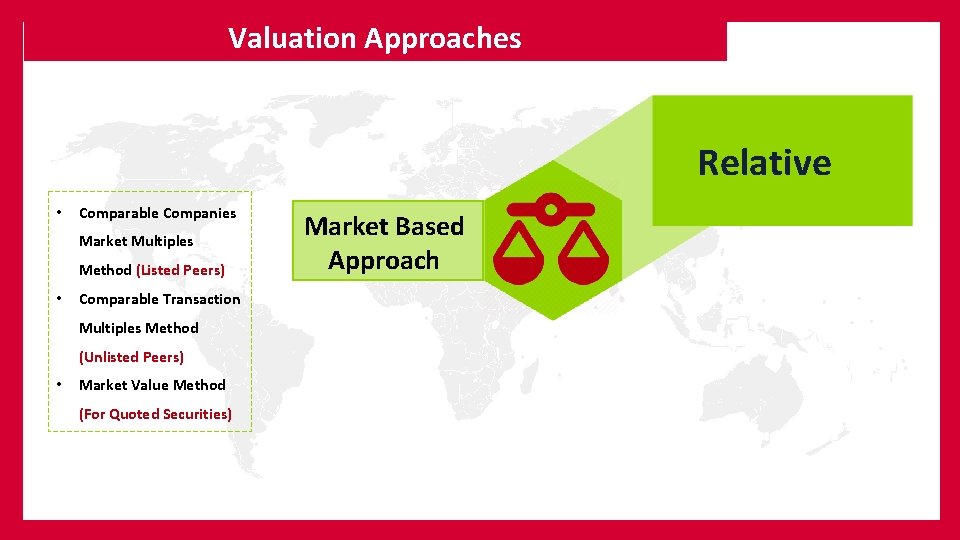
Valuation Approaches Relative • Comparable Companies Market Multiples Method (Listed Peers) • Comparable Transaction Multiples Method (Unlisted Peers) • Market Value Method (For Quoted Securities) Market Based Approach
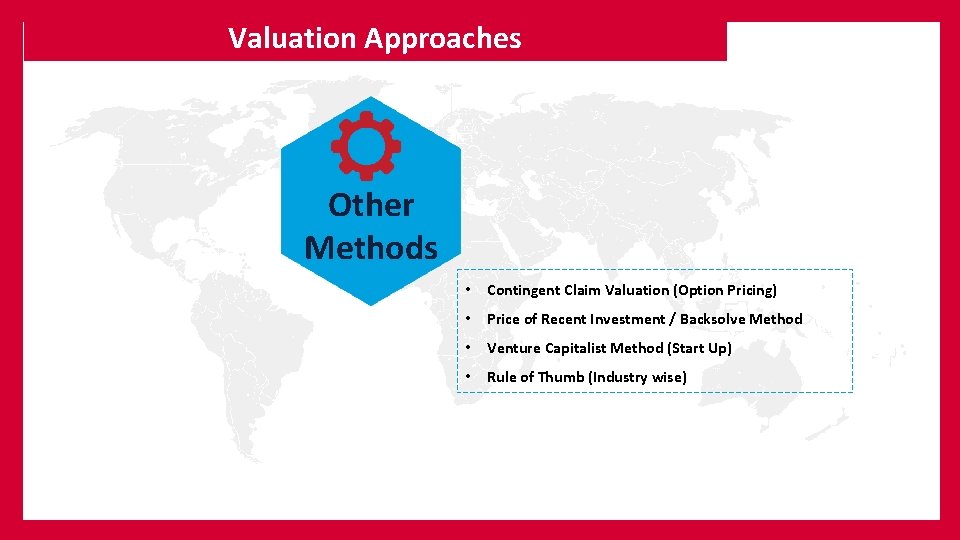
Valuation Approaches Other Methods • Contingent Claim Valuation (Option Pricing) • Price of Recent Investment / Backsolve Method • Venture Capitalist Method (Start Up) • Rule of Thumb (Industry wise)
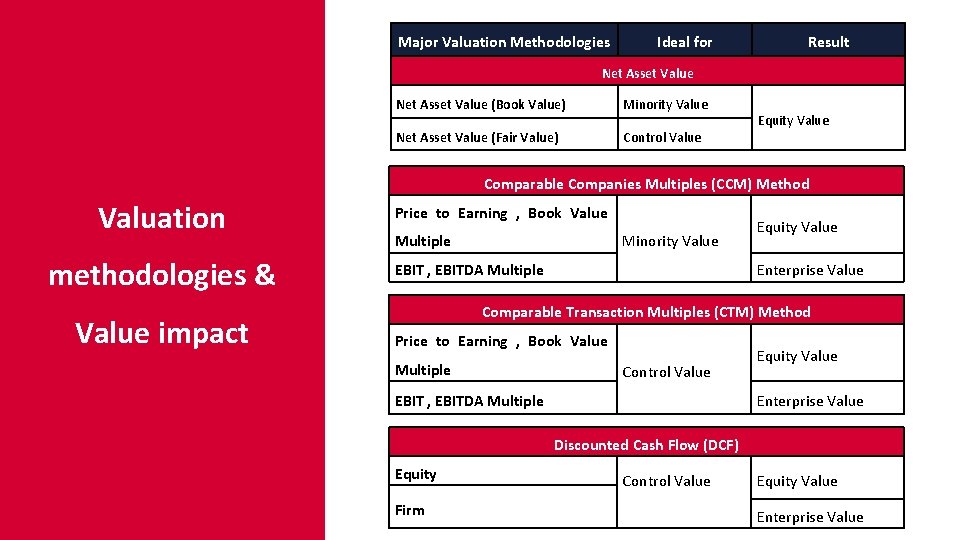
Major Valuation Methodologies Ideal for Result Net Asset Value (Book Value) Minority Value Net Asset Value (Fair Value) Control Value Equity Value Comparable Companies Multiples (CCM) Method Valuation methodologies & Value impact Price to Earning , Book Value Multiple Minority Value EBIT , EBITDA Multiple Equity Value Enterprise Value Comparable Transaction Multiples (CTM) Method Price to Earning , Book Value Multiple Control Value EBIT , EBITDA Multiple Equity Value Enterprise Value Discounted Cash Flow (DCF) Equity Firm Control Value Equity Value Enterprise Value
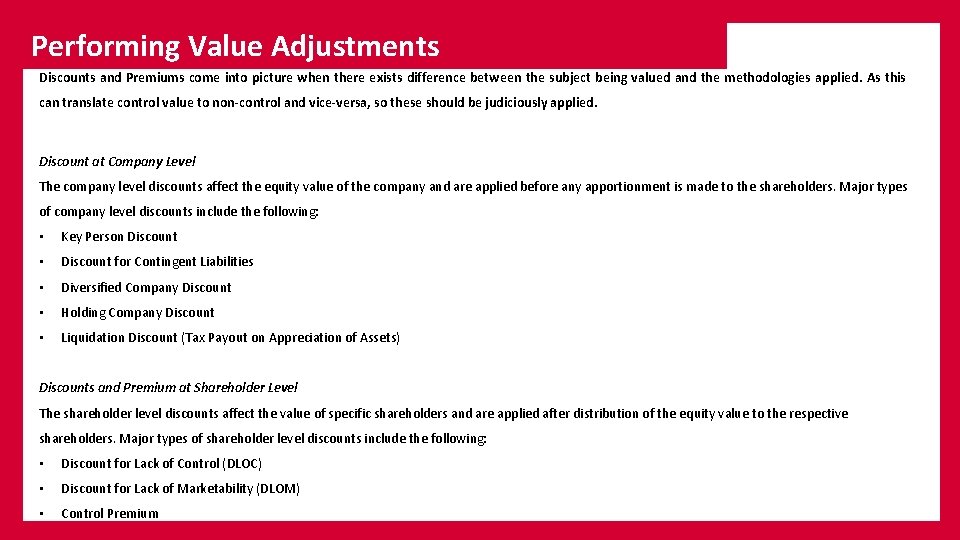
Performing Value Adjustments Discounts and Premiums come into picture when there exists difference between the subject being valued and the methodologies applied. As this can translate control value to non-control and vice-versa, so these should be judiciously applied. Discount at Company Level The company level discounts affect the equity value of the company and are applied before any apportionment is made to the shareholders. Major types of company level discounts include the following: • Key Person Discount • Discount for Contingent Liabilities • Diversified Company Discount • Holding Company Discount • Liquidation Discount (Tax Payout on Appreciation of Assets) Discounts and Premium at Shareholder Level The shareholder level discounts affect the value of specific shareholders and are applied after distribution of the equity value to the respective shareholders. Major types of shareholder level discounts include the following: • Discount for Lack of Control (DLOC) • Discount for Lack of Marketability (DLOM) • Control Premium
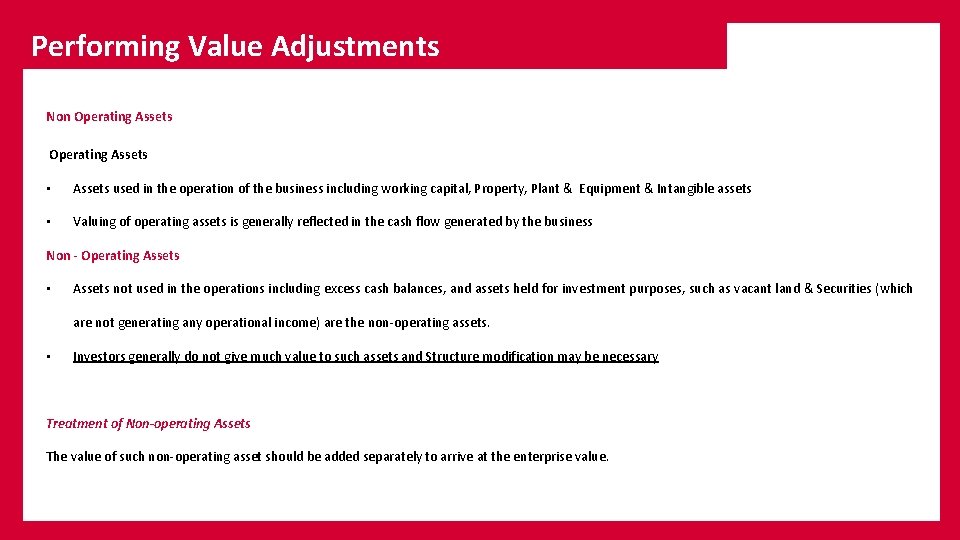
Performing Value Adjustments Non Operating Assets • Assets used in the operation of the business including working capital, Property, Plant & Equipment & Intangible assets • Valuing of operating assets is generally reflected in the cash flow generated by the business Non - Operating Assets • Assets not used in the operations including excess cash balances, and assets held for investment purposes, such as vacant land & Securities (which are not generating any operational income) are the non-operating assets. • Investors generally do not give much value to such assets and Structure modification may be necessary Treatment of Non-operating Assets The value of such non-operating asset should be added separately to arrive at the enterprise value.
Regulatory Valuation in India

Discounted Cash Flow Valuation
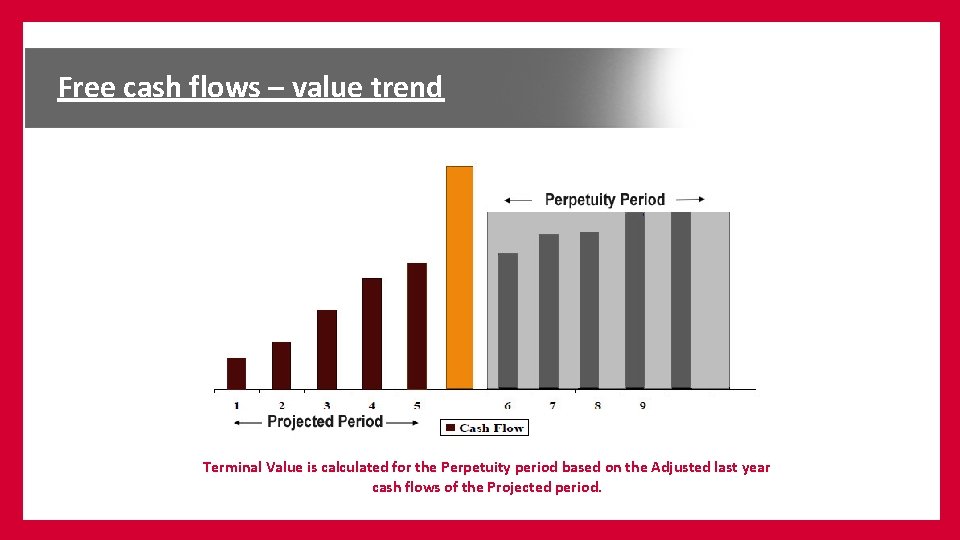
Free cash flows – value trend Terminal Value is calculated for the Perpetuity period based on the Adjusted last year cash flows of the Projected period.
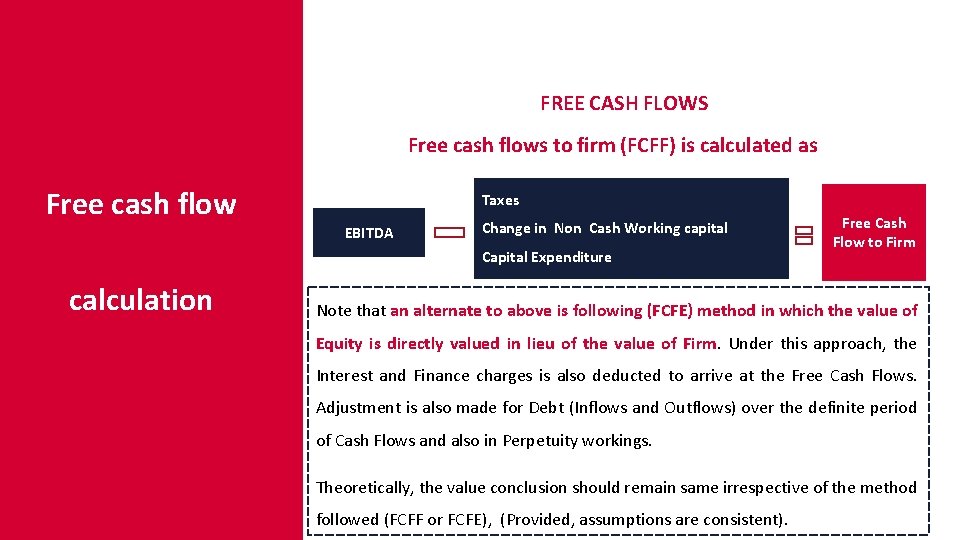
FREE CASH FLOWS Free cash flows to firm (FCFF) is calculated as Free cash flow Taxes EBITDA Change in Non Cash Working capital Capital Expenditure calculation Free Cash Flow to Firm Note that an alternate to above is following (FCFE) method in which the value of Equity is directly valued in lieu of the value of Firm. Under this approach, the Interest and Finance charges is also deducted to arrive at the Free Cash Flows. Adjustment is also made for Debt (Inflows and Outflows) over the definite period of Cash Flows and also in Perpetuity workings. Theoretically, the value conclusion should remain same irrespective of the method followed (FCFF or FCFE), (Provided, assumptions are consistent).
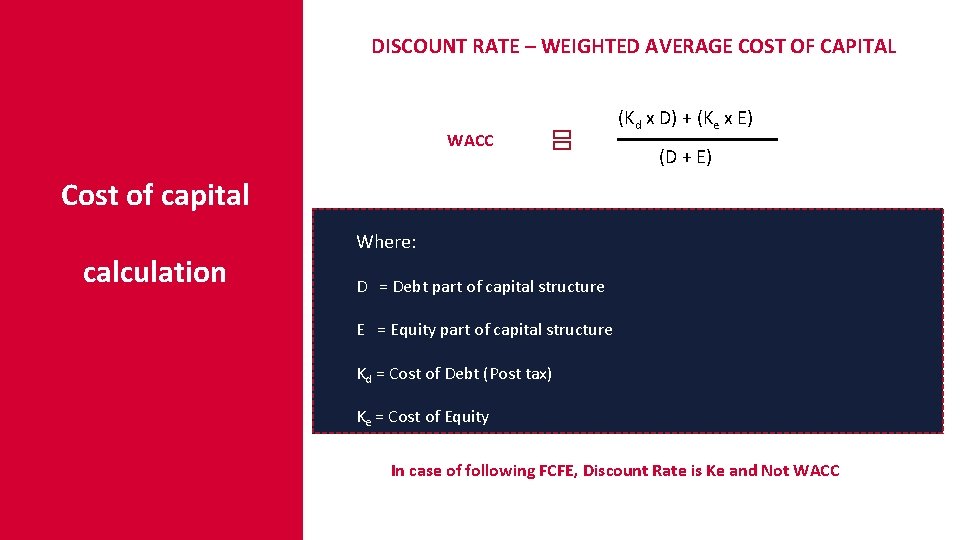
DISCOUNT RATE – WEIGHTED AVERAGE COST OF CAPITAL WACC (Kd x D) + (Ke x E) (D + E) Cost of capital calculation Where: D = Debt part of capital structure E = Equity part of capital structure Kd = Cost of Debt (Post tax) Ke = Cost of Equity In case of following FCFE, Discount Rate is Ke and Not WACC
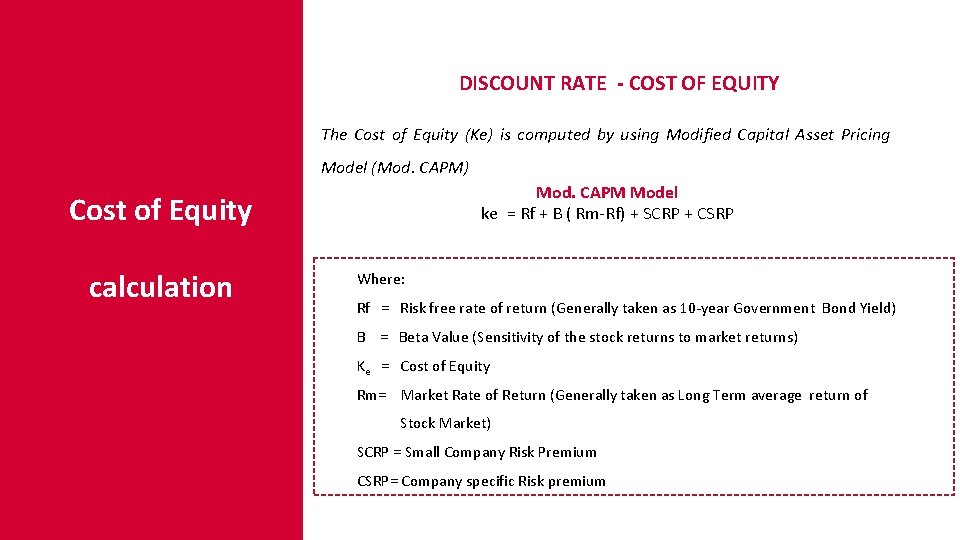
DISCOUNT RATE - COST OF EQUITY The Cost of Equity (Ke) is computed by using Modified Capital Asset Pricing Model (Mod. CAPM) Mod. CAPM Model ke = Rf + B ( Rm-Rf) + SCRP + CSRP Cost of Equity calculation Where: Rf = Risk free rate of return (Generally taken as 10 -year Government Bond Yield) B = Beta Value (Sensitivity of the stock returns to market returns) Ke = Cost of Equity Rm= Market Rate of Return (Generally taken as Long Term average return of Stock Market) SCRP = Small Company Risk Premium CSRP= Company specific Risk premium
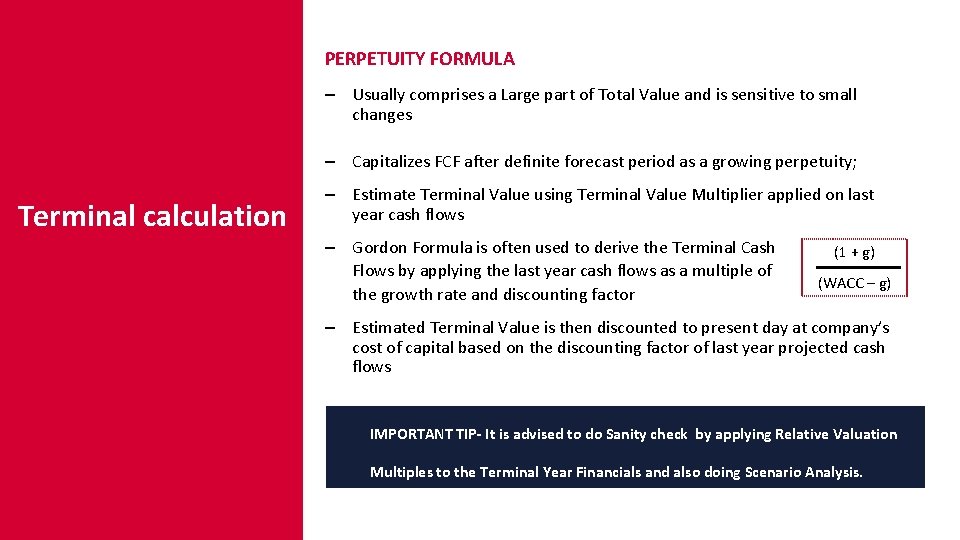
PERPETUITY FORMULA – Usually comprises a Large part of Total Value and is sensitive to small changes – Capitalizes FCF after definite forecast period as a growing perpetuity; Terminal calculation – Estimate Terminal Value using Terminal Value Multiplier applied on last year cash flows – Gordon Formula is often used to derive the Terminal Cash Flows by applying the last year cash flows as a multiple of the growth rate and discounting factor (1 + g) (WACC – g) – Estimated Terminal Value is then discounted to present day at company’s cost of capital based on the discounting factor of last year projected cash flows IMPORTANT TIP- It is advised to do Sanity check by applying Relative Valuation Multiples to the Terminal Year Financials and also doing Scenario Analysis.
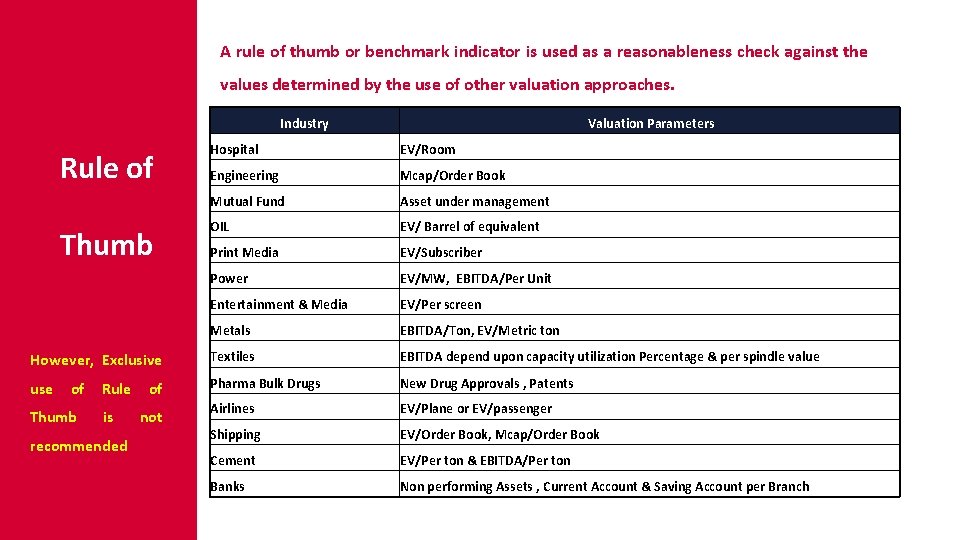
A rule of thumb or benchmark indicator is used as a reasonableness check against the values determined by the use of other valuation approaches. Industry Valuation Parameters Hospital EV/Room Engineering Mcap/Order Book Mutual Fund Asset under management OIL EV/ Barrel of equivalent Print Media EV/Subscriber Power EV/MW, EBITDA/Per Unit Entertainment & Media EV/Per screen Metals EBITDA/Ton, EV/Metric ton However, Exclusive Textiles EBITDA depend upon capacity utilization Percentage & per spindle value use of Rule of Pharma Bulk Drugs New Drug Approvals , Patents Thumb Airlines EV/Plane or EV/passenger Shipping EV/Order Book, Mcap/Order Book Cement EV/Per ton & EBITDA/Per ton Banks Non performing Assets , Current Account & Saving Account per Branch Rule of Thumb is recommended not
Relative Valuation
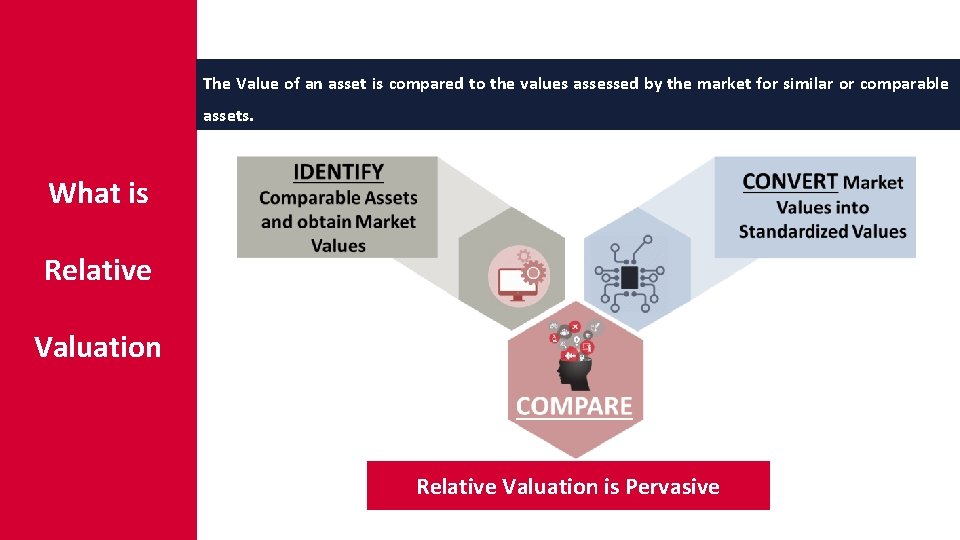
The Value of an asset is compared to the values assessed by the market for similar or comparable assets. What is Relative Valuation is Pervasive
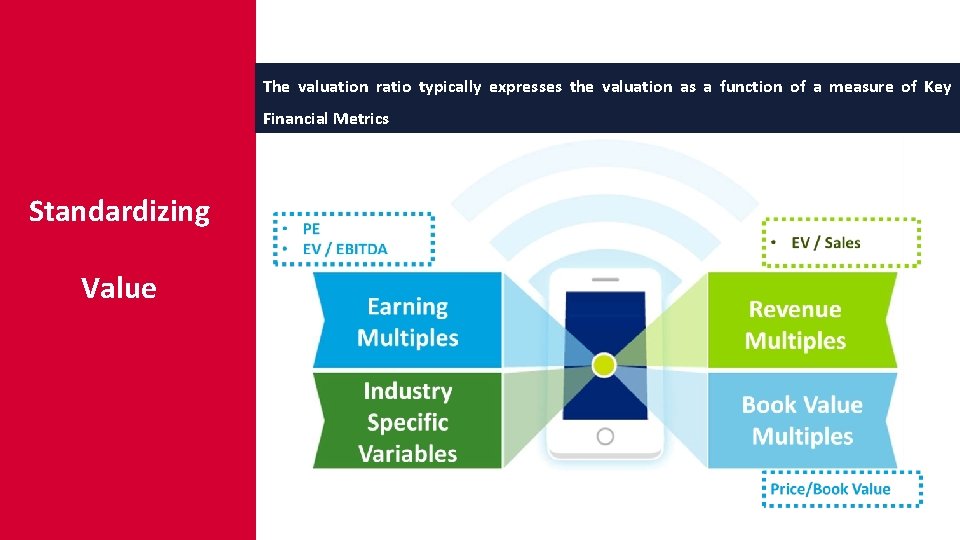
The valuation ratio typically expresses the valuation as a function of a measure of Key Financial Metrics Standardizing Value
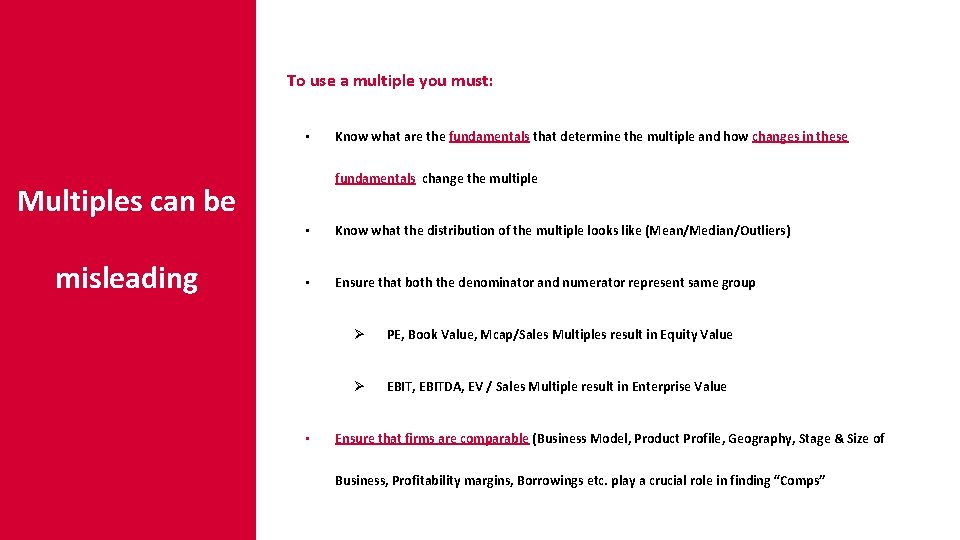
To use a multiple you must: • fundamentals change the multiple Multiples can be misleading Know what are the fundamentals that determine the multiple and how changes in these • Know what the distribution of the multiple looks like (Mean/Median/Outliers) • Ensure that both the denominator and numerator represent same group • Ø PE, Book Value, Mcap/Sales Multiples result in Equity Value Ø EBIT, EBITDA, EV / Sales Multiple result in Enterprise Value Ensure that firms are comparable (Business Model, Product Profile, Geography, Stage & Size of Business, Profitability margins, Borrowings etc. play a crucial role in finding “Comps”
“We must analyze all Corporate Actions and take necessary steps to Align them with new Regulatory Valuation requirements” Let’s Learn…Unlearn…Relearn
- Slides: 106