
Price determination of Equity linked securities ELS 2015160035
- Slides: 1
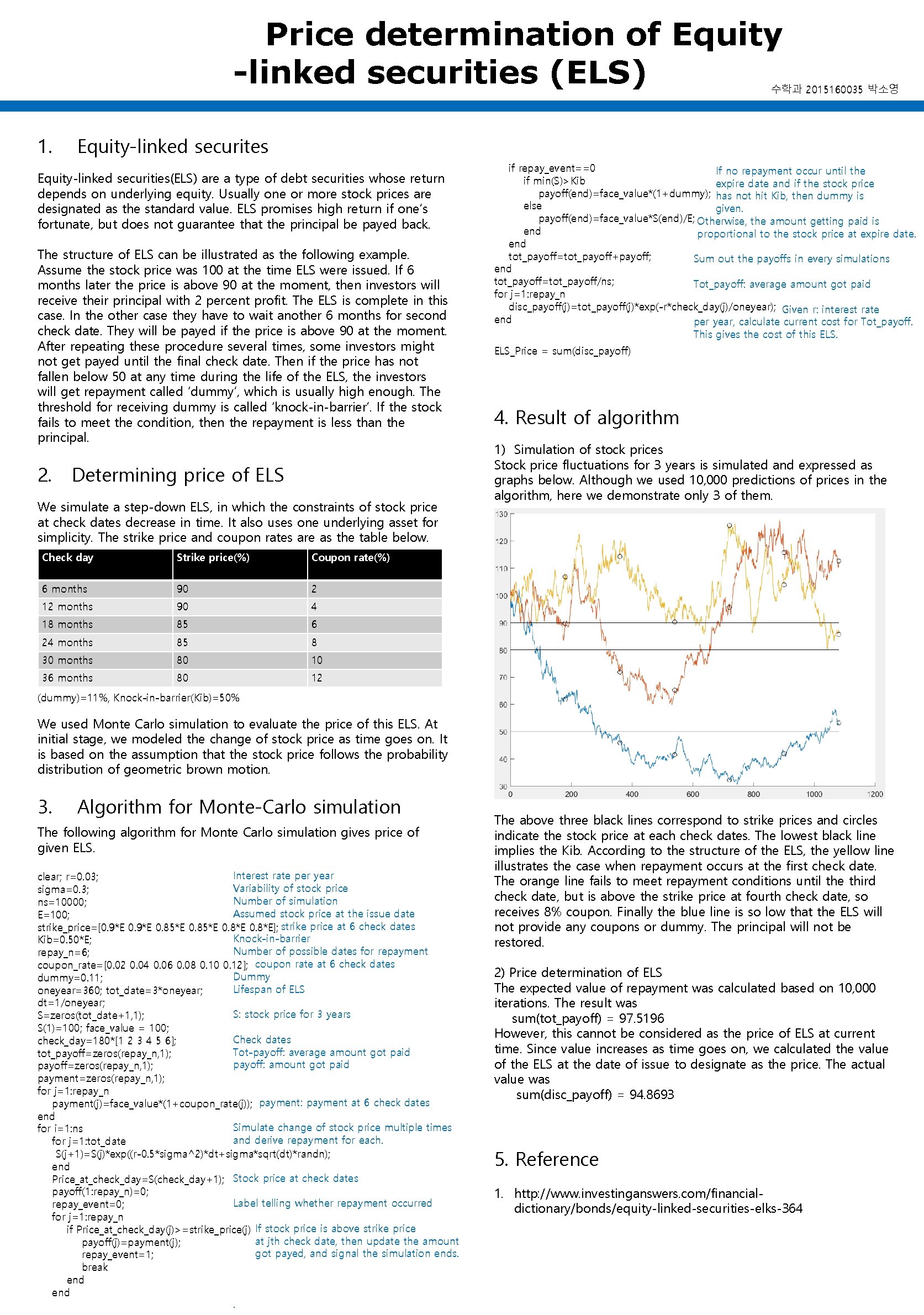
Price determination of Equity -linked securities (ELS) 수학과 2015160035 박소영 1. Equity-linked securites Equity-linked securities(ELS) are a type of debt securities whose return depends on underlying equity. Usually one or more stock prices are designated as the standard value. ELS promises high return if one’s fortunate, but does not guarantee that the principal be payed back. The structure of ELS can be illustrated as the following example. Assume the stock price was 100 at the time ELS were issued. If 6 months later the price is above 90 at the moment, then investors will receive their principal with 2 percent profit. The ELS is complete in this case. In the other case they have to wait another 6 months for second check date. They will be payed if the price is above 90 at the moment. After repeating these procedure several times, some investors might not get payed until the final check date. Then if the price has not fallen below 50 at any time during the life of the ELS, the investors will get repayment called ‘dummy’, which is usually high enough. The threshold for receiving dummy is called ‘knock-in-barrier’. If the stock fails to meet the condition, then the repayment is less than the principal. 2. Determining price of ELS We simulate a step-down ELS, in which the constraints of stock price at check dates decrease in time. It also uses one underlying asset for simplicity. The strike price and coupon rates are as the table below. Check day Strike price(%) Coupon rate(%) 6 months 90 2 12 months 90 4 18 months 85 6 24 months 85 8 30 months 80 10 36 months 80 12 if repay_event==0 If no repayment occur until the if min(S)>Kib expire date and if the stock price payoff(end)=face_value*(1+dummy); has not hit Kib, then dummy is else given. payoff(end)=face_value*S(end)/E; Otherwise, the amount getting paid is end proportional to the stock price at expire date. end tot_payoff=tot_payoff+payoff; Sum out the payoffs in every simulations end tot_payoff=tot_payoff/ns; Tot_payoff: average amount got paid for j=1: repay_n disc_payoff(j)=tot_payoff(j)*exp(-r*check_day(j)/oneyear); Given r: interest rate end per year, calculate current cost for Tot_payoff. This gives the cost of this ELS_Price = sum(disc_payoff) 4. Result of algorithm 1) Simulation of stock prices Stock price fluctuations for 3 years is simulated and expressed as graphs below. Although we used 10, 000 predictions of prices in the algorithm, here we demonstrate only 3 of them. Original image (dummy)=11%, Knock-in-barrier(Kib)=50% We used Monte Carlo simulation to evaluate the price of this ELS. At initial stage, we modeled the change of stock price as time goes on. It is based on the assumption that the stock price follows the probability distribution of geometric brown motion. 3. Algorithm for Monte-Carlo simulation The following algorithm for Monte Carlo simulation gives price of given ELS. Interest rate per year clear; r=0. 03; Variability of stock price sigma=0. 3; Number of simulation ns=10000; Assumed stock price at the issue date E=100; strike_price=[0. 9*E 0. 85*E 0. 8*E]; strike price at 6 check dates Knock-in-barrier Kib=0. 50*E; Number of possible dates for repayment repay_n=6; coupon_rate=[0. 02 0. 04 0. 06 0. 08 0. 10 0. 12]; coupon rate at 6 check dates Dummy dummy=0. 11; Lifespan of ELS oneyear=360; tot_date=3*oneyear; dt=1/oneyear; S: stock price for 3 years S=zeros(tot_date+1, 1); S(1)=100; face_value = 100; Check dates check_day=180*[1 2 3 4 5 6]; Tot-payoff: average amount got paid tot_payoff=zeros(repay_n, 1); payoff: amount got paid payoff=zeros(repay_n, 1); payment=zeros(repay_n, 1); for j=1: repay_n payment(j)=face_value*(1+coupon_rate(j)); payment: payment at 6 check dates end Simulate change of stock price multiple times for i=1: ns and derive repayment for each. for j=1: tot_date S(j+1)=S(j)*exp((r-0. 5*sigma^2)*dt+sigma*sqrt(dt)*randn); end Price_at_check_day=S(check_day+1); Stock price at check dates payoff(1: repay_n)=0; Label telling whether repayment occurred repay_event=0; for j=1: repay_n if Price_at_check_day(j)>=strike_price(j) If stock price is above strike price at jth check date, then update the amount payoff(j)=payment(j); got payed, and signal the simulation ends. repay_event=1; break end. The above three black lines correspond to strike prices and circles indicate the stock price at each check dates. The lowest black line implies the Kib. According to the structure of the ELS, the yellow line illustrates the case when repayment occurs at the first check date. The orange line fails to meet repayment conditions until the third check date, but is above the strike price at fourth check date, so receives 8% coupon. Finally the blue line is so low that the ELS will not provide any coupons or dummy. The principal will not be restored. 2) Price determination of ELS The expected value of repayment was calculated based on 10, 000 iterations. The result was sum(tot_payoff) = 97. 5196 However, this cannot be considered as the price of ELS at current time. Since value increases as time goes on, we calculated the value of the ELS at the date of issue to designate as the price. The actual value was sum(disc_payoff) = 94. 8693 5. Reference 1. http: //www. investinganswers. com/financialdictionary/bonds/equity-linked-securities-elks-364