IEX 8175 RF Electronics Avo Ots telekommunikatsiooni ppetool
- Slides: 12
IEX 8175 RF Electronics Avo Ots telekommunikatsiooni õppetool, TTÜ raadio- ja sidetehnika inst. avo. ots@ttu. ee 1
Service Level Agreements A good service level agreement (SLA) should contain the following: • Identify and describe the service • Describe how it is to be measured • Identify acceptable levels of service • Describe reporting relationships • Describe actions to be taken when service is unsatisfactory • Identify the expiration date, if any • Affix the signatures of the responsible parties 2
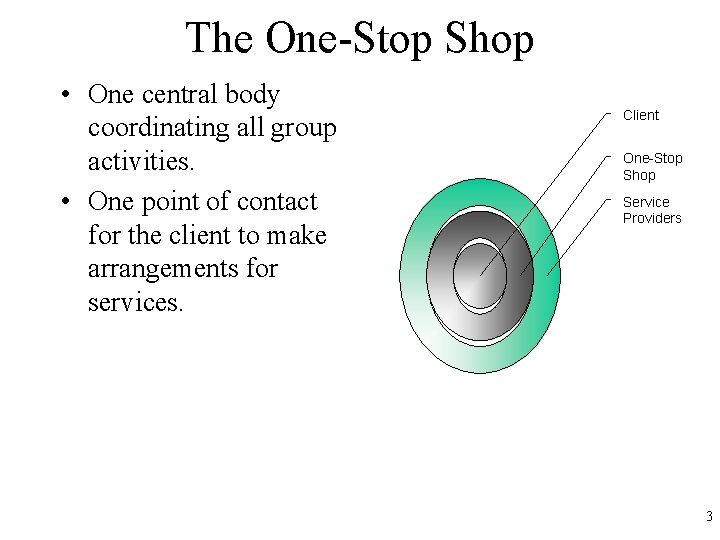
The One-Stop Shop • One central body coordinating all group activities. • One point of contact for the client to make arrangements for services. Client One-Stop Shop Service Providers 3
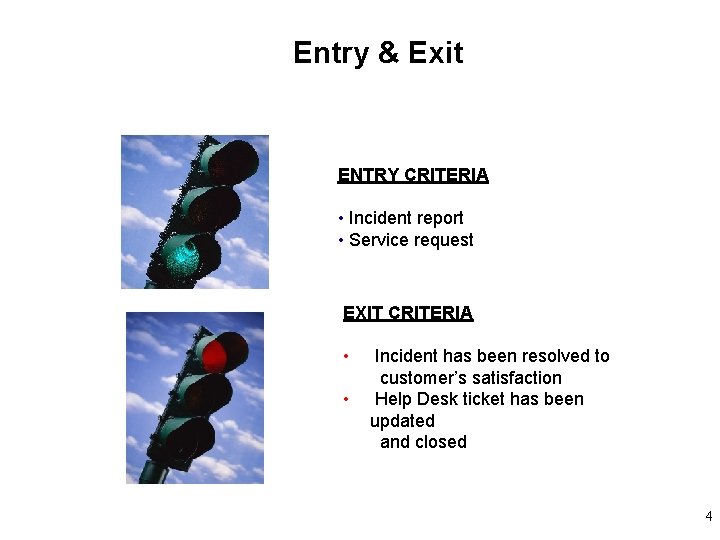
Entry & Exit ENTRY CRITERIA • Incident report • Service request EXIT CRITERIA • • Incident has been resolved to customer’s satisfaction Help Desk ticket has been updated and closed 4
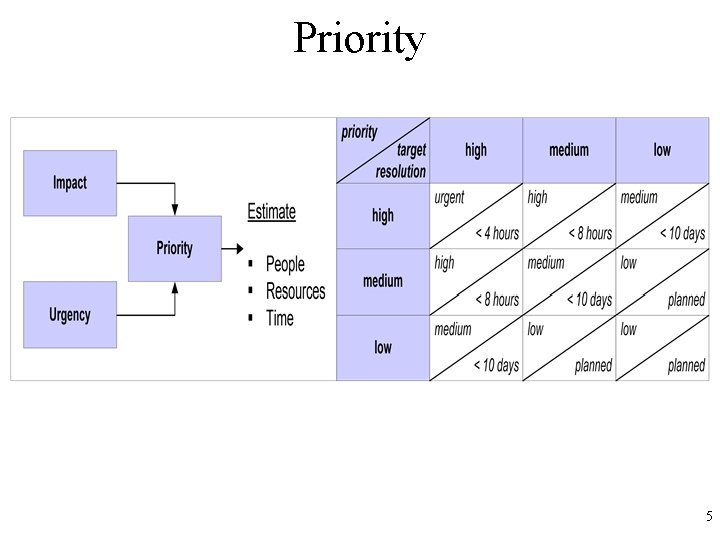
Priority 5
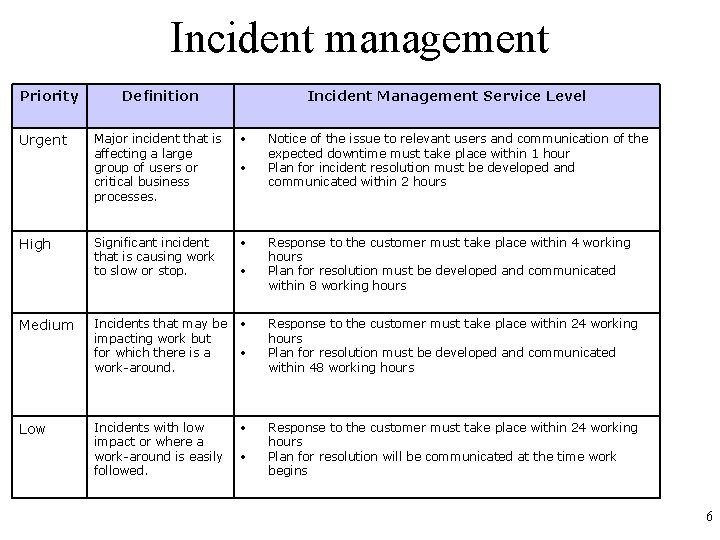
Incident management Priority Urgent High Medium Low Definition Incident Management Service Level Major incident that is affecting a large group of users or critical business processes. Significant incident that is causing work to slow or stop. Incidents that may be impacting work but for which there is a work-around. Incidents with low impact or where a work-around is easily followed. Notice of the issue to relevant users and communication of the expected downtime must take place within 1 hour Plan for incident resolution must be developed and communicated within 2 hours Response to the customer must take place within 4 working hours Plan for resolution must be developed and communicated within 8 working hours Response to the customer must take place within 24 working hours Plan for resolution must be developed and communicated within 48 working hours Response to the customer must take place within 24 working hours Plan for resolution will be communicated at the time work begins 6
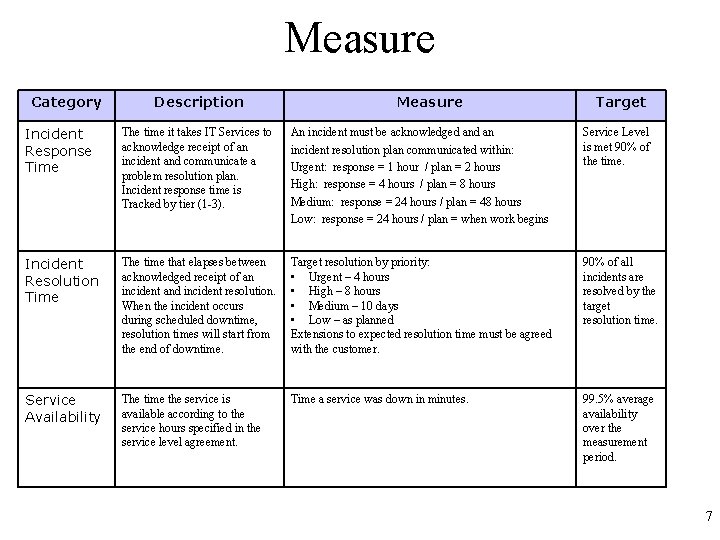
Measure Category Description Measure Target Incident Response Time The time it takes IT Services to acknowledge receipt of an incident and communicate a problem resolution plan. Incident response time is Tracked by tier (1 -3). An incident must be acknowledged an incident resolution plan communicated within: Urgent: response = 1 hour / plan = 2 hours High: response = 4 hours / plan = 8 hours Medium: response = 24 hours / plan = 48 hours Low: response = 24 hours / plan = when work begins Service Level is met 90% of the time. Incident Resolution Time The time that elapses between acknowledged receipt of an incident and incident resolution. When the incident occurs during scheduled downtime, resolution times will start from the end of downtime. Target resolution by priority: • Urgent – 4 hours • High – 8 hours • Medium – 10 days • Low – as planned Extensions to expected resolution time must be agreed with the customer. 90% of all incidents are resolved by the target resolution time. Service Availability The time the service is available according to the service hours specified in the service level agreement. Time a service was down in minutes. 99. 5% average availability over the measurement period. 7
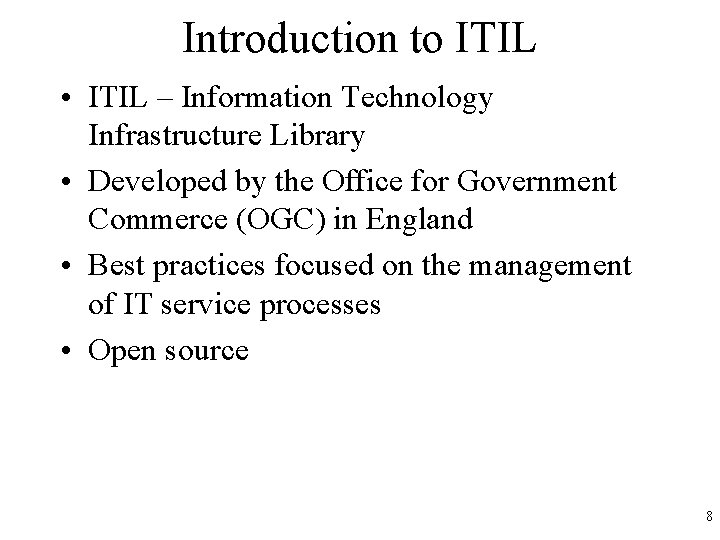
Introduction to ITIL • ITIL – Information Technology Infrastructure Library • Developed by the Office for Government Commerce (OGC) in England • Best practices focused on the management of IT service processes • Open source 8
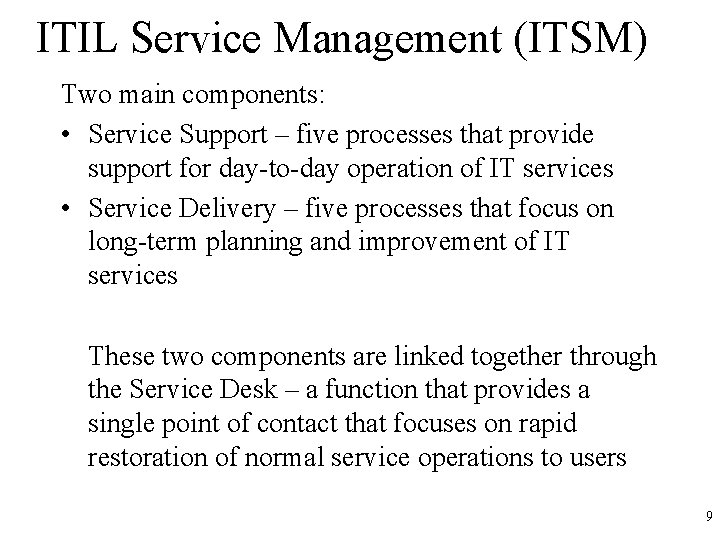
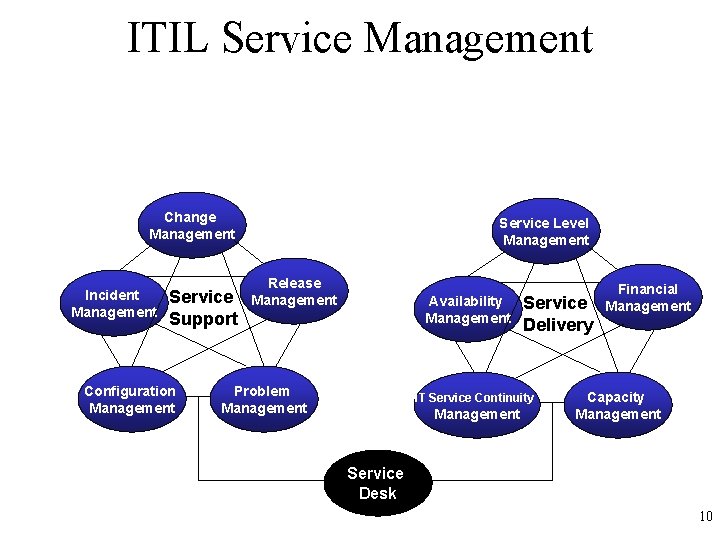
ITIL Service Management (ITSM) Two main components: • Service Support – five processes that provide support for day-to-day operation of IT services • Service Delivery – five processes that focus on long-term planning and improvement of IT services These two components are linked together through the Service Desk – a function that provides a single point of contact that focuses on rapid restoration of normal service operations to users 9
ITIL Service Management Change Management Incident Management Service Support Configuration Management Service Level Management Release Management Availability Management Problem Management Service Delivery IT Service Continuity Management Financial Management Capacity Management Service Desk 10
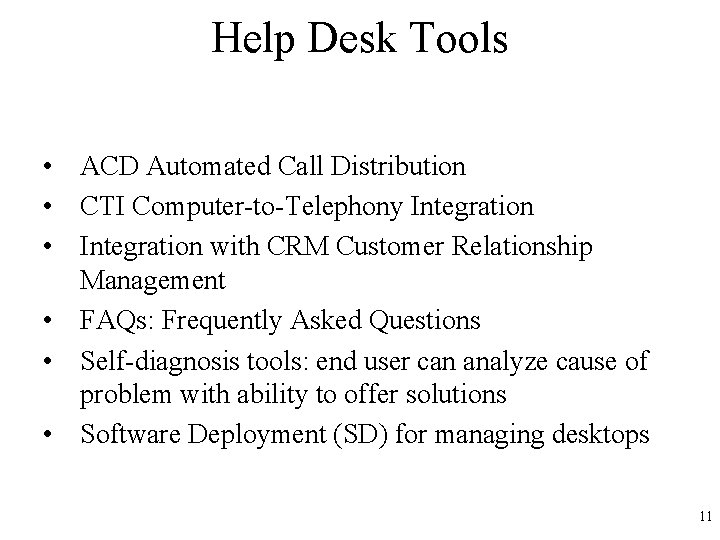
Help Desk Tools • ACD Automated Call Distribution • CTI Computer-to-Telephony Integration • Integration with CRM Customer Relationship Management • FAQs: Frequently Asked Questions • Self-diagnosis tools: end user can analyze cause of problem with ability to offer solutions • Software Deployment (SD) for managing desktops 11
Links http: //oaais. ucsf. edu/OAAIS/1061 -DSY. html http: //www. itsmf. ee/ 12