
OTS 501 OLD TESTAMENT INTRO AND LITEARTURE Dr

- Slides: 29
OTS 501 OLD TESTAMENT INTRO AND LITEARTURE Dr. Esa Autero
Joel, Amos, Obadiah, Jonah 1. 1 Introduction to Joel � Who was Joel? � What do we know about Joel? � When and where did he prophecy? � Have you heard a sermon on Joel that did not refer to NT passages?
Joel, Amos, Obadiah, Jonah 1. 2 Historical and Critical Issues �Author, date, composition � Who is Joel? Joel, son of Pethuel � Date Joel was written clouded in mystery �Suggestions from 800 s-100 s. BC �Why is the date of a biblical book important? Historical context influences the interpretation � Some issues to consider in the dating of Joel �Assumes the ongoing Temple operations (1: 9, 13 -16; 2: 15 -17) �Elders and priests as leaders (1: 2, 13; 2: 16) 7 -year Joash on the throne (2 Kgs 11)
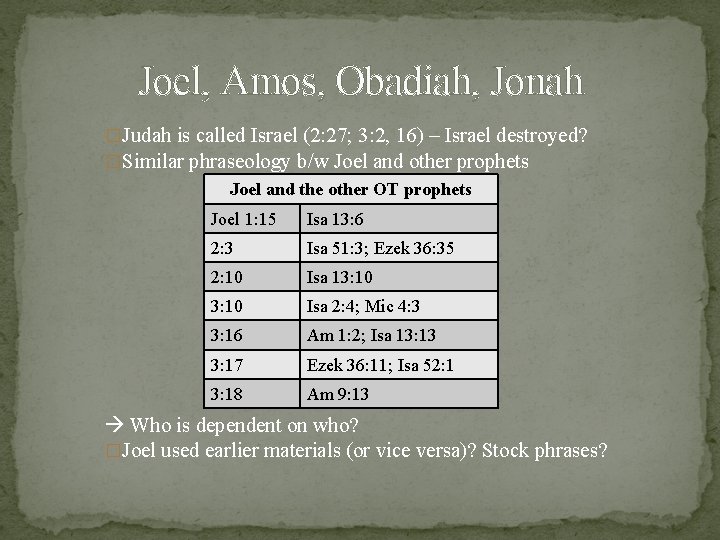
Joel, Amos, Obadiah, Jonah �Judah is called Israel (2: 27; 3: 2, 16) – Israel destroyed? �Similar phraseology b/w Joel and other prophets Joel and the other OT prophets Joel 1: 15 Isa 13: 6 2: 3 Isa 51: 3; Ezek 36: 35 2: 10 Isa 13: 10 Isa 2: 4; Mic 4: 3 3: 16 Am 1: 2; Isa 13: 13 3: 17 Ezek 36: 11; Isa 52: 1 3: 18 Am 9: 13 Who is dependent on who? �Joel used earlier materials (or vice versa)? Stock phrases?
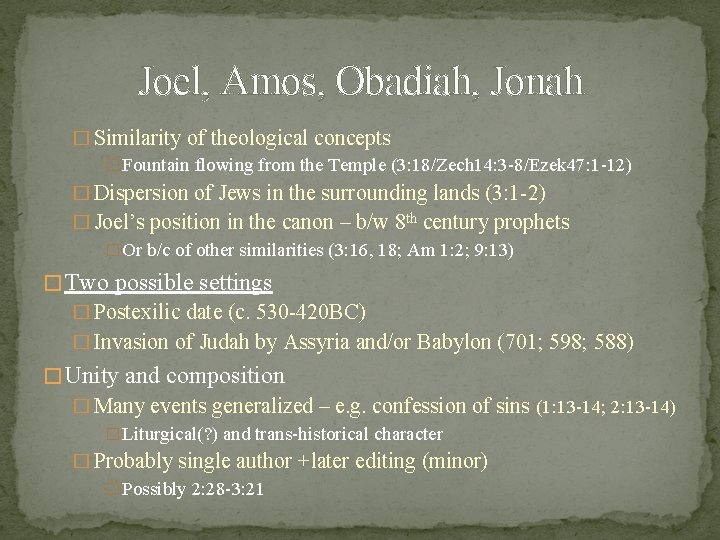
Joel, Amos, Obadiah, Jonah � Similarity of theological concepts � Fountain flowing from the Temple (3: 18/Zech 14: 3 -8/Ezek 47: 1 -12) � Dispersion of Jews in the surrounding lands (3: 1 -2) � Joel’s position in the canon – b/w 8 th century prophets � Or b/c of other similarities (3: 16, 18; Am 1: 2; 9: 13) � Two possible settings � Postexilic date (c. 530 -420 BC) � Invasion of Judah by Assyria and/or Babylon (701; 598; 588) � Unity and composition � Many events generalized – e. g. confession of sins (1: 13 -14; 2: 13 -14) � Liturgical(? ) and trans-historical character � Probably single author +later editing (minor) � Possibly 2: 28 -3: 21
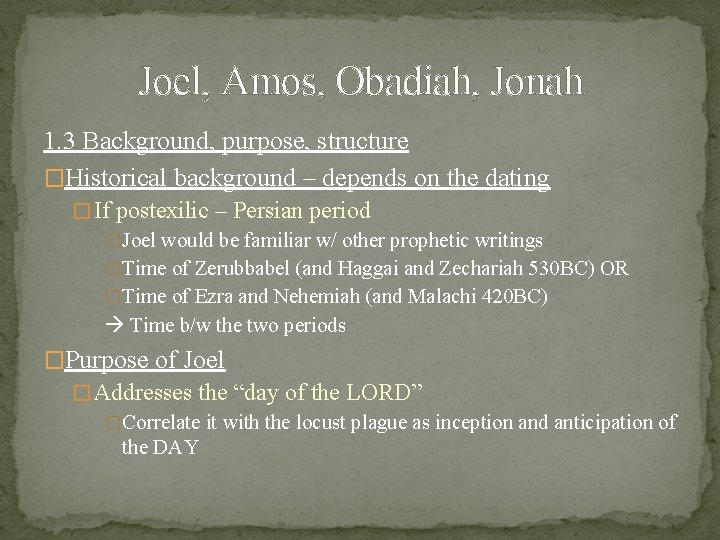
Joel, Amos, Obadiah, Jonah 1. 3 Background, purpose, structure �Historical background – depends on the dating � If postexilic – Persian period �Joel would be familiar w/ other prophetic writings �Time of Zerubbabel (and Haggai and Zechariah 530 BC) OR �Time of Ezra and Nehemiah (and Malachi 420 BC) Time b/w the two periods �Purpose of Joel � Addresses the “day of the LORD” �Correlate it with the locust plague as inception and anticipation of the DAY
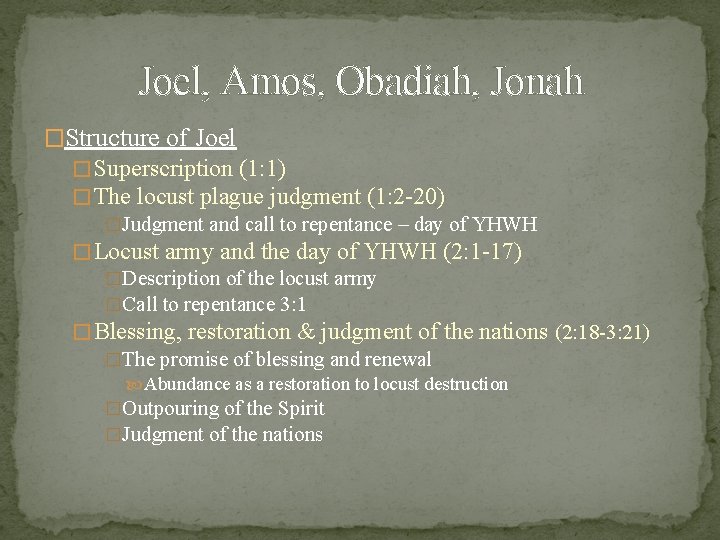
Joel, Amos, Obadiah, Jonah �Structure of Joel � Superscription (1: 1) � The locust plague judgment (1: 2 -20) �Judgment and call to repentance – day of YHWH � Locust army and the day of YHWH (2: 1 -17) �Description of the locust army �Call to repentance 3: 1 � Blessing, restoration & judgment of the nations (2: 18 -3: 21) �The promise of blessing and renewal Abundance as a restoration to locust destruction �Outpouring of the Spirit �Judgment of the nations
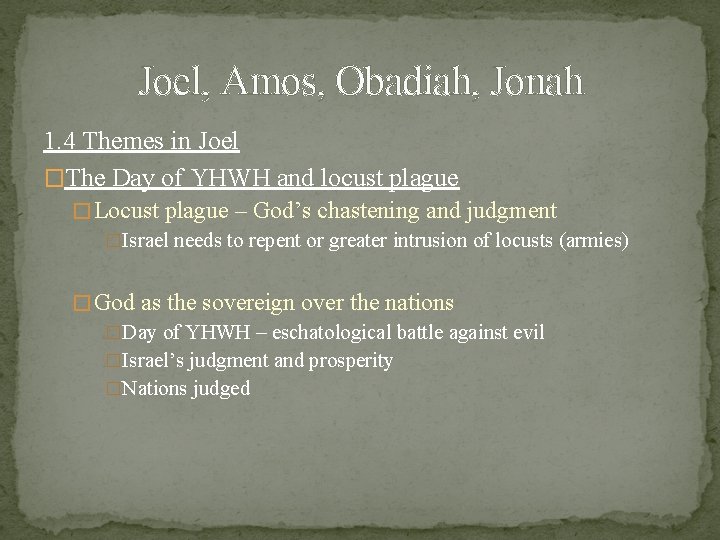
Joel, Amos, Obadiah, Jonah 1. 4 Themes in Joel �The Day of YHWH and locust plague � Locust plague – God’s chastening and judgment �Israel needs to repent or greater intrusion of locusts (armies) � God as the sovereign over the nations �Day of YHWH – eschatological battle against evil �Israel’s judgment and prosperity �Nations judged
Joel, Amos, Obadiah, Jonah 2. 1 Introduction to Amos � What do you know about Amos? � Familiar sections or sayings? �NT quotes? �Am 9: 11 -12//Acts 15: 16 -17 � Heard sermons on Amos?
Joel, Amos, Obadiah, Jonah 2. 2 Historical and Critical Issues � Author, date, composition � Amos as the traditional author � Unified work by Amos the prophet � Critical views and authorship/composition � Amos the prophet behind some of the traditions � Possible later sections or editing � 3 rd person narrative & intrusion into the section of visions (7: 10 -17) � Oracles against the foreign nations – slightly diff. in form (Am 1 -2) � “Hymn fragments” (1: 2; 4: 13; 5: 8 -9; 8: 8; 9: 5 -6) � Salvation promises (9: 11 -15) pro-Judahite and postexilic � Further editing (3: 7; 5: 13) “piece-meal” approach – more recent scholarship – general unity
Joel, Amos, Obadiah, Jonah �More likely scenario for the composition � Amos wrote or committed to writing most oracles � 1 st person oracles �Written some time after the actual preaching event �Writing perhaps prompted by the earthquake (1: 1; cf. 9: 1; Zech 14: 4 -5 --- major earthquake dated to 760 BC) Possible minor editing later on � Amos written around 750 -760 BC
Joel, Amos, Obadiah, Jonah 2. 3 Background, purpose, structure �Historical background � Prophet Amos – from Tekoa (in Judah near Bethlehem) �Poor and humble shepherd, mid-level manager OR elite? Humble shepherd still most viable option (7: 15) �Amos – as a prophet or not a prophet? (7: 14 -15; 7: 12) � Prophesied during the reigns of Uzziah and Jeroboam II �First of the classical prophets – against Israel (north) �For how long did Amos prophecy? 1/2 hr to years! (750 -748 BC) Prophesied in royal sanctuary in Bethel (7: 12 -13) �Historical setting (2 Kgs 14: 17 -15: 7; 2 Chr 26) [c. 791 -746 BC] Prosperity and geographical expansion Good relations b/w Israel and Judah
Joel, Amos, Obadiah, Jonah �Purpose � “the end has come to my people” (8: 2) �Social and moral corruption of Israel (north) �Prophecy of judgment and doom – w/ some rays of hope �The Day of the LORD – a day of disaster, not of blessing (5: 18) �Structure � Four basic sections �Eight oracles against the nations (1: 3 -2: 16) �Five prophetic words (3 -6) �Five prophetic visions (7: 1 -9: 10) �Epilogue – blessing and renewal for Israel (9: 11 -15)
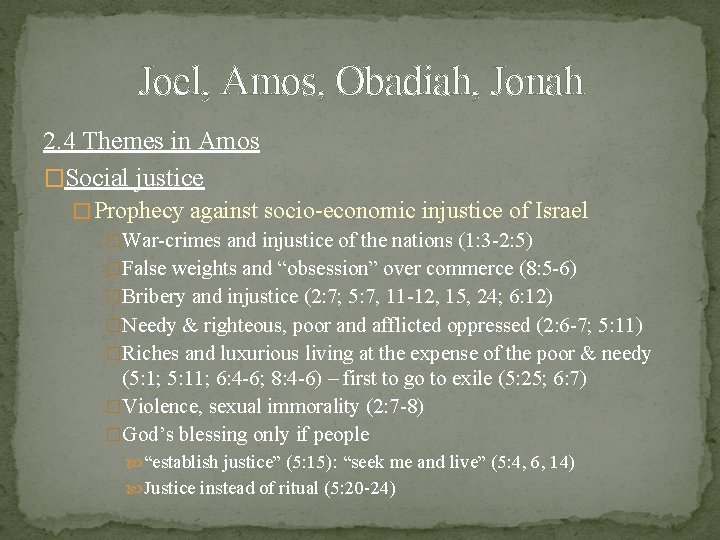
Joel, Amos, Obadiah, Jonah 2. 4 Themes in Amos �Social justice � Prophecy against socio-economic injustice of Israel �War-crimes and injustice of the nations (1: 3 -2: 5) �False weights and “obsession” over commerce (8: 5 -6) �Bribery and injustice (2: 7; 5: 7, 11 -12, 15, 24; 6: 12) �Needy & righteous, poor and afflicted oppressed (2: 6 -7; 5: 11) �Riches and luxurious living at the expense of the poor & needy (5: 1; 5: 11; 6: 4 -6; 8: 4 -6) – first to go to exile (5: 25; 6: 7) �Violence, sexual immorality (2: 7 -8) �God’s blessing only if people “establish justice” (5: 15): “seek me and live” (5: 4, 6, 14) Justice instead of ritual (5: 20 -24)
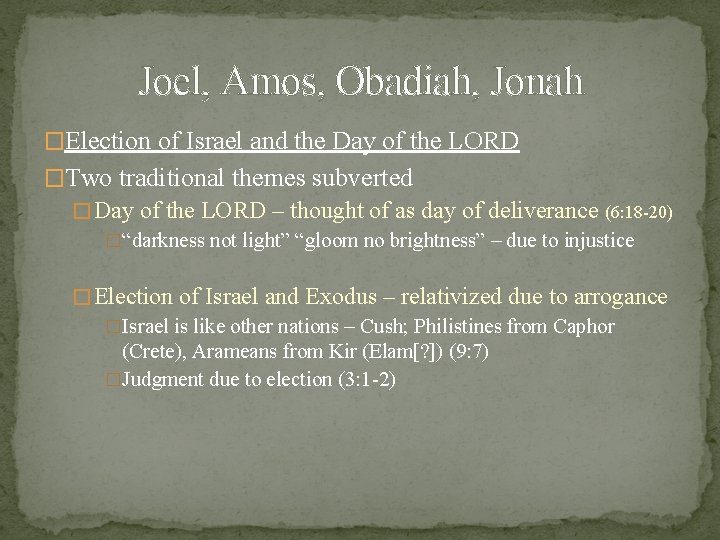
Joel, Amos, Obadiah, Jonah �Election of Israel and the Day of the LORD �Two traditional themes subverted � Day of the LORD – thought of as day of deliverance (6: 18 -20) �“darkness not light” “gloom no brightness” – due to injustice � Election of Israel and Exodus – relativized due to arrogance �Israel is like other nations – Cush; Philistines from Caphor (Crete), Arameans from Kir (Elam[? ]) (9: 7) �Judgment due to election (3: 1 -2)
Joel, Amos, Obadiah, Jonah 3. 1 Introduction to Obadiah � Who was Obadiah? � Have you ever heard a sermon on Obadiah? �What theme? � What is the point of the 21 verses of Obadiah in the OT?
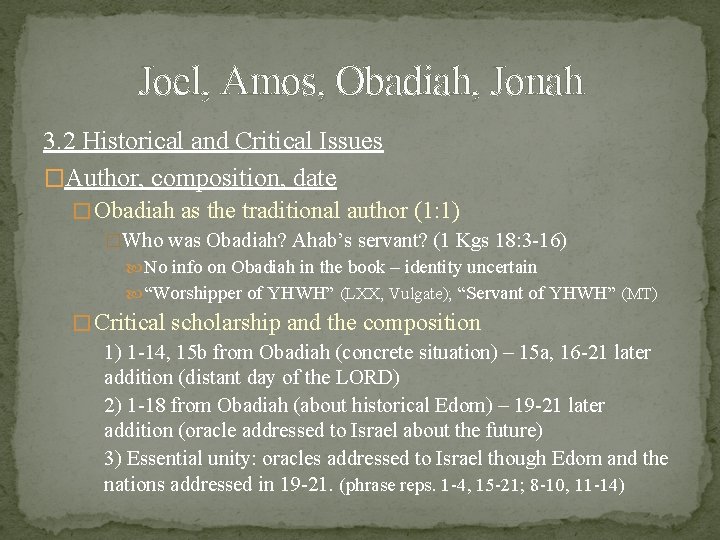
Joel, Amos, Obadiah, Jonah 3. 2 Historical and Critical Issues �Author, composition, date � Obadiah as the traditional author (1: 1) �Who was Obadiah? Ahab’s servant? (1 Kgs 18: 3 -16) No info on Obadiah in the book – identity uncertain “Worshipper of YHWH” (LXX, Vulgate); “Servant of YHWH” (MT) � Critical scholarship and the composition 1) 1 -14, 15 b from Obadiah (concrete situation) – 15 a, 16 -21 later addition (distant day of the LORD) 2) 1 -18 from Obadiah (about historical Edom) – 19 -21 later addition (oracle addressed to Israel about the future) 3) Essential unity: oracles addressed to Israel though Edom and the nations addressed in 19 -21. (phrase reps. 1 -4, 15 -21; 8 -10, 11 -14)
Joel, Amos, Obadiah, Jonah � Obadiah and Jeremiah – near verbatim parallels � 1 b-4//Jer 49: 14 -16 and 5 -6//Jer 49: 9 -10 �Which came first? Literary dependence? Common source? Obadiah’s or Jeremiah’s priority? Common anti-Edomite source adapted by both �Date � Date range from 850 BC to 400 BC based on vv. 11 -14 �Attack on Jerusalem by Philistines and Arabs during the reign of Jehoram in 844 BC (2 Chr 21: 16 -17; 2 Kgs 8: 16 -20) OR �Destruction Jerusalem by Babylonians in 587 BC (2 Kgs 25: 1 -12) Most likely written in the 6 th century BC
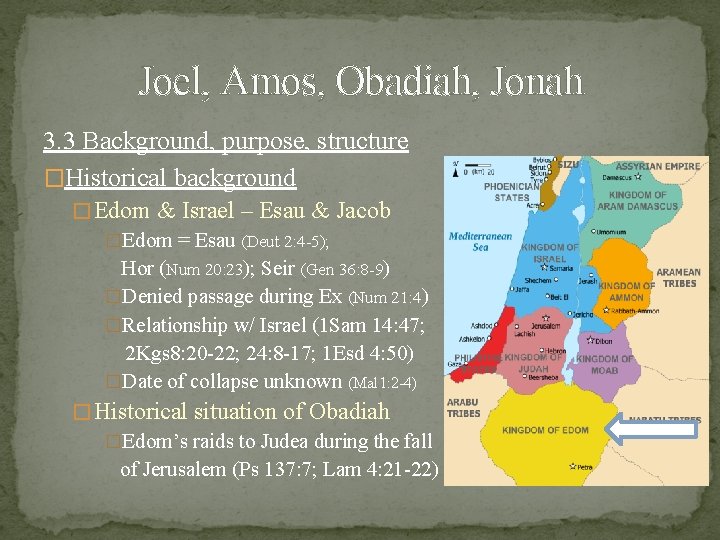
Joel, Amos, Obadiah, Jonah 3. 3 Background, purpose, structure �Historical background � Edom & Israel – Esau & Jacob �Edom = Esau (Deut 2: 4 -5); Hor (Num 20: 23); Seir (Gen 36: 8 -9) �Denied passage during Ex (Num 21: 4) �Relationship w/ Israel (1 Sam 14: 47; 2 Kgs 8: 20 -22; 24: 8 -17; 1 Esd 4: 50) �Date of collapse unknown (Mal 1: 2 -4) � Historical situation of Obadiah �Edom’s raids to Judea during the fall of Jerusalem (Ps 137: 7; Lam 4: 21 -22)
Joel, Amos, Obadiah, Jonah �Purpose and structure � Condemnation of Edom for cruelty over sacking Jerusalem (2 -9) �YHWH’s ultimate triumph and judgment of nations (10 -14) �Salvation of Israel (15 -16) � Structure of Obadiah �Superscription (1 a) �YHWH’s message against Edom (1 b-14) �The Day of the LORD (15 -21)
Joel, Amos, Obadiah, Jonah 3. 4 Themes of Obadiah �Pride, retribution, judgment, and restoration � Message of the prophets in a nutshell �Pride (and violence) of Edom and other nations (1 -14) �Judgment of God due to arrogance (15) Retribution - “As you have done…shall be done to you” (15) �Deliverance and salvation of Israel (17, 21)
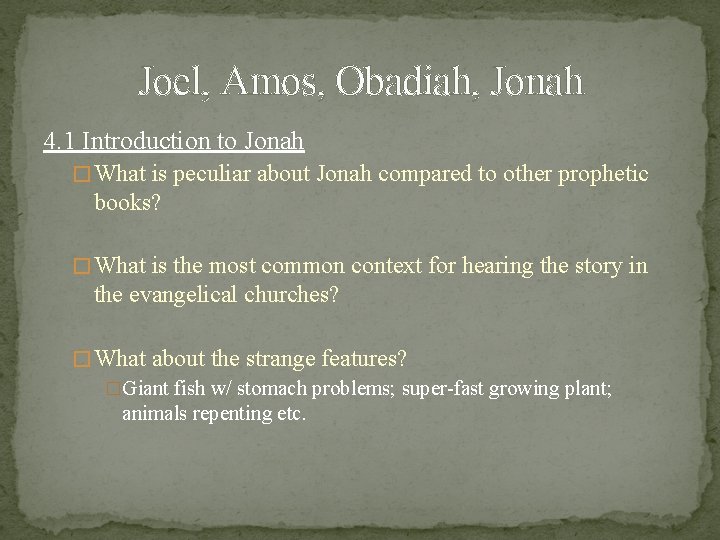
Joel, Amos, Obadiah, Jonah 4. 1 Introduction to Jonah � What is peculiar about Jonah compared to other prophetic books? � What is the most common context for hearing the story in the evangelical churches? � What about the strange features? �Giant fish w/ stomach problems; super-fast growing plant; animals repenting etc.
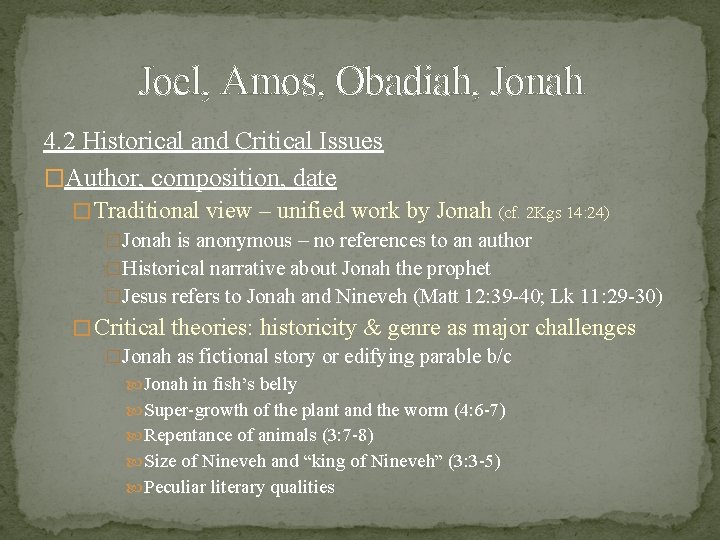
Joel, Amos, Obadiah, Jonah 4. 2 Historical and Critical Issues �Author, composition, date � Traditional view – unified work by Jonah (cf. 2 Kgs 14: 24) �Jonah is anonymous – no references to an author �Historical narrative about Jonah the prophet �Jesus refers to Jonah and Nineveh (Matt 12: 39 -40; Lk 11: 29 -30) � Critical theories: historicity & genre as major challenges �Jonah as fictional story or edifying parable b/c Jonah in fish’s belly Super-growth of the plant and the worm (4: 6 -7) Repentance of animals (3: 7 -8) Size of Nineveh and “king of Nineveh” (3: 3 -5) Peculiar literary qualities
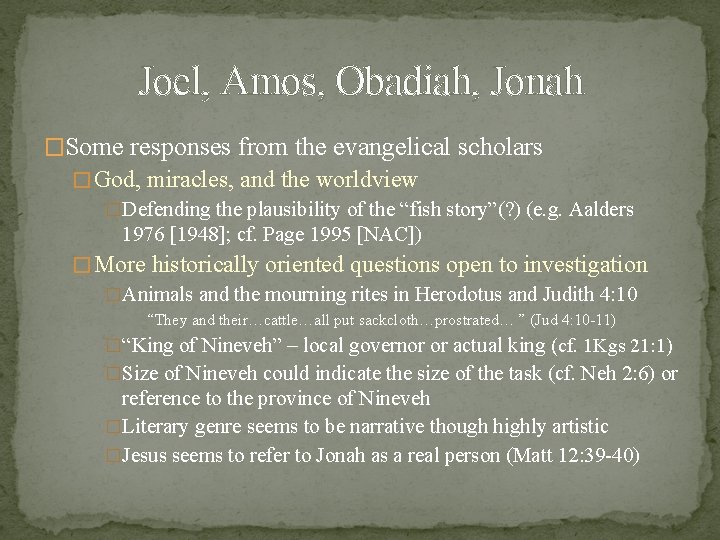
Joel, Amos, Obadiah, Jonah �Some responses from the evangelical scholars � God, miracles, and the worldview �Defending the plausibility of the “fish story”(? ) (e. g. Aalders 1976 [1948]; cf. Page 1995 [NAC]) � More historically oriented questions open to investigation �Animals and the mourning rites in Herodotus and Judith 4: 10 “They and their…cattle…all put sackcloth…prostrated… ” (Jud 4: 10 -11) �“King of Nineveh” – local governor or actual king (cf. 1 Kgs 21: 1) �Size of Nineveh could indicate the size of the task (cf. Neh 2: 6) or reference to the province of Nineveh �Literary genre seems to be narrative though highly artistic �Jesus seems to refer to Jonah as a real person (Matt 12: 39 -40)
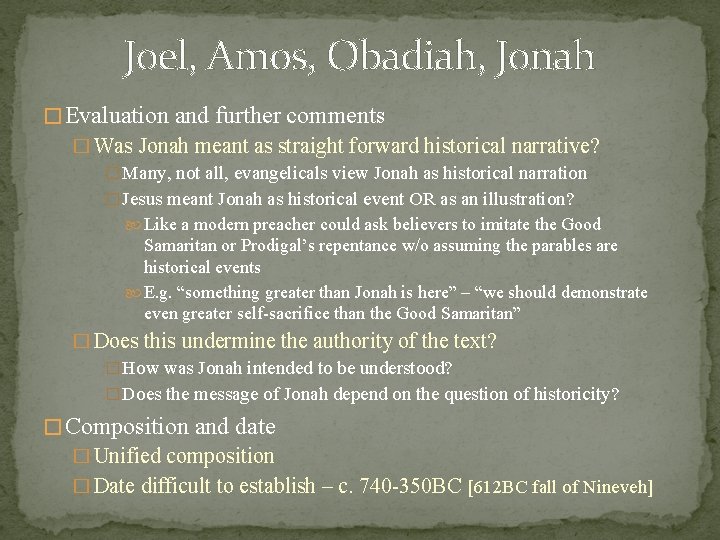
Joel, Amos, Obadiah, Jonah � Evaluation and further comments � Was Jonah meant as straight forward historical narrative? � Many, not all, evangelicals view Jonah as historical narration � Jesus meant Jonah as historical event OR as an illustration? Like a modern preacher could ask believers to imitate the Good Samaritan or Prodigal’s repentance w/o assuming the parables are historical events E. g. “something greater than Jonah is here” – “we should demonstrate even greater self-sacrifice than the Good Samaritan” � Does this undermine the authority of the text? � How was Jonah intended to be understood? � Does the message of Jonah depend on the question of historicity? � Composition and date � Unified composition � Date difficult to establish – c. 740 -350 BC [612 BC fall of Nineveh]
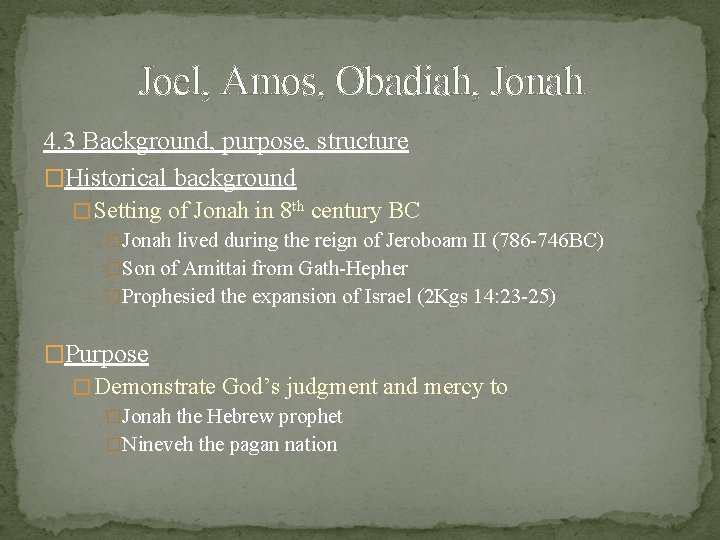
Joel, Amos, Obadiah, Jonah 4. 3 Background, purpose, structure �Historical background � Setting of Jonah in 8 th century BC �Jonah lived during the reign of Jeroboam II (786 -746 BC) �Son of Amittai from Gath-Hepher �Prophesied the expansion of Israel (2 Kgs 14: 23 -25) �Purpose � Demonstrate God’s judgment and mercy to �Jonah the Hebrew prophet �Nineveh the pagan nation
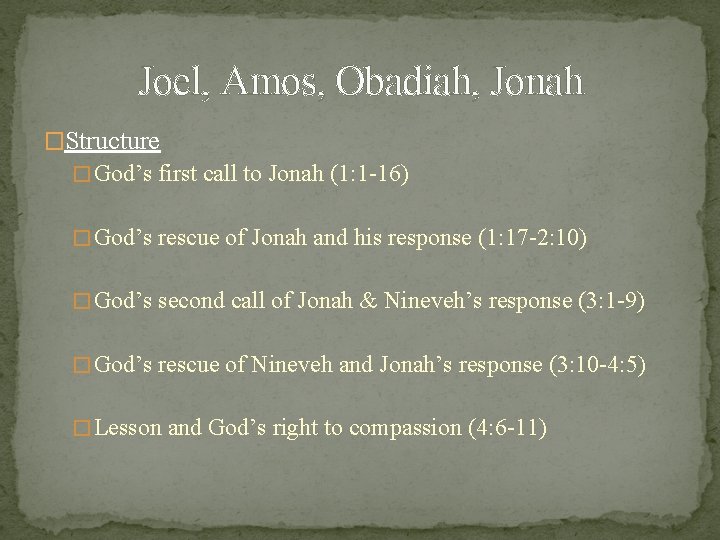
Joel, Amos, Obadiah, Jonah �Structure � God’s first call to Jonah (1: 1 -16) � God’s rescue of Jonah and his response (1: 17 -2: 10) � God’s second call of Jonah & Nineveh’s response (3: 1 -9) � God’s rescue of Nineveh and Jonah’s response (3: 10 -4: 5) � Lesson and God’s right to compassion (4: 6 -11)
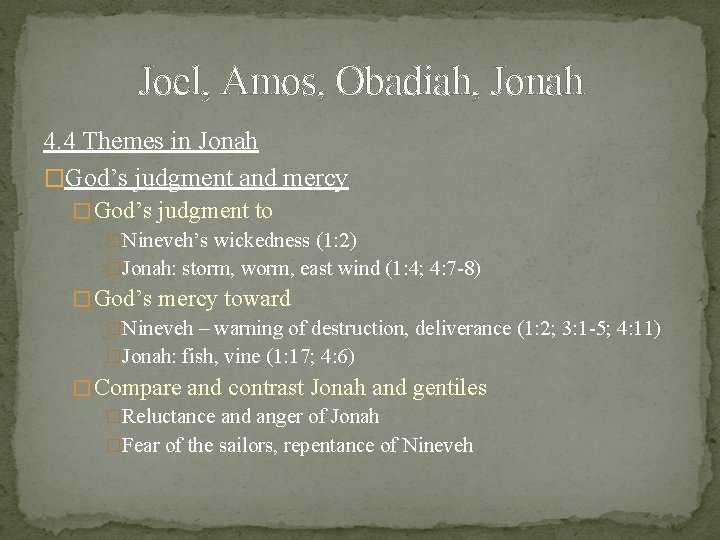
Joel, Amos, Obadiah, Jonah 4. 4 Themes in Jonah �God’s judgment and mercy � God’s judgment to �Nineveh’s wickedness (1: 2) �Jonah: storm, worm, east wind (1: 4; 4: 7 -8) � God’s mercy toward �Nineveh – warning of destruction, deliverance (1: 2; 3: 1 -5; 4: 11) �Jonah: fish, vine (1: 17; 4: 6) � Compare and contrast Jonah and gentiles �Reluctance and anger of Jonah �Fear of the sailors, repentance of Nineveh
Joel, Amos, Obadiah, Jonah �e