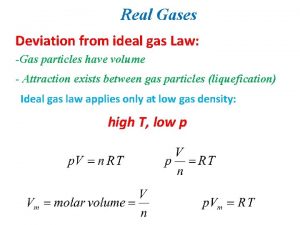
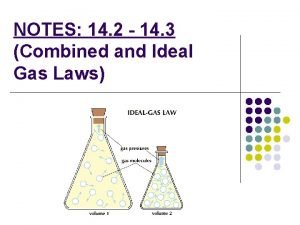
Ideal Gas Law PV n RT R 0


- Slides: 11
Ideal Gas Law PV = n. RT R = 0. 08206 L* atm mol * K P= pressure (atm) V= volume (L) n= Mole Gas (mol) T= temperature (K) R= universal gas constant Ex: H 2 has a volume of 8. 56 L at 0 o. C and 1. 5 atm. Calculate the moles of H 2 present. Given V= 8. 56 L n = PV ____ RT n = (1. 5 atm)(8. 56 L) ____________ (0. 08206 atm L/mol K)(273 K) T = 0 o. C + 273 = 273 K P = 1. 5 atm n = ? R = 0. 08206 atm L/mol K n = 0. 57 mol
Learning Check • • • Ideal Gas Law formula: Unit for P: Unit for V: Unit for n: Value & unit of R: Unit for T:
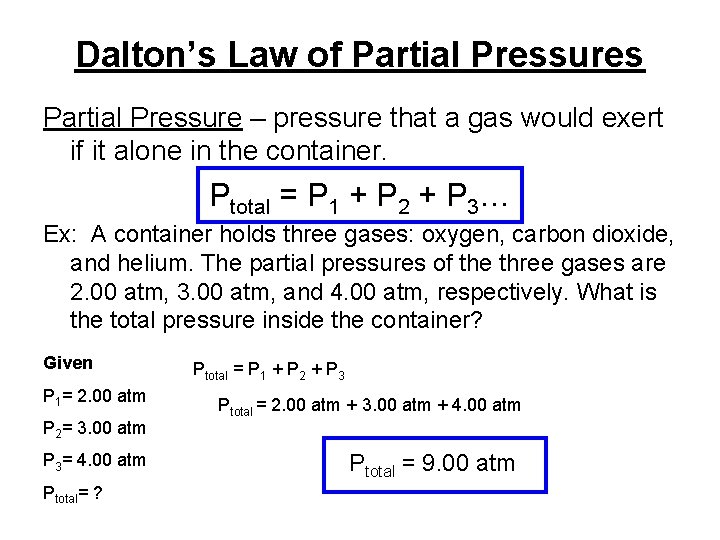
Dalton’s Law of Partial Pressures Partial Pressure – pressure that a gas would exert if it alone in the container. Ptotal = P 1 + P 2 + P 3… Ex: A container holds three gases: oxygen, carbon dioxide, and helium. The partial pressures of the three gases are 2. 00 atm, 3. 00 atm, and 4. 00 atm, respectively. What is the total pressure inside the container? Given P 1= 2. 00 atm P 2= 3. 00 atm P 3= 4. 00 atm Ptotal= ? Ptotal = P 1 + P 2 + P 3 Ptotal = 2. 00 atm + 3. 00 atm + 4. 00 atm Ptotal = 9. 00 atm
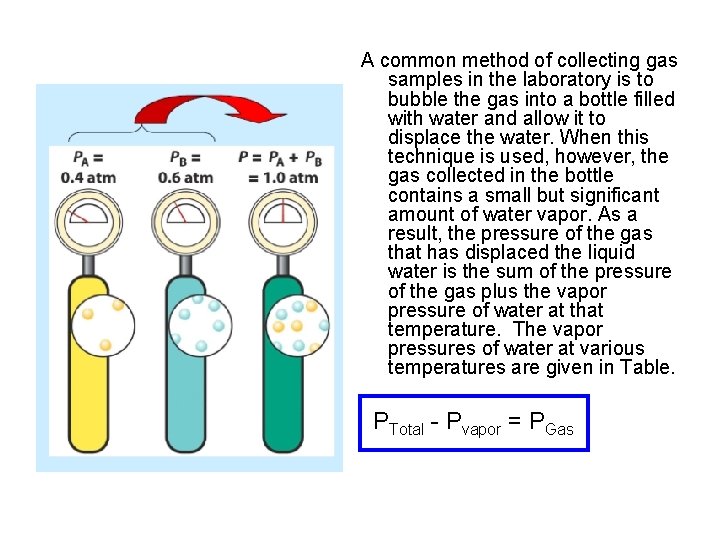
A common method of collecting gas samples in the laboratory is to bubble the gas into a bottle filled with water and allow it to displace the water. When this technique is used, however, the gas collected in the bottle contains a small but significant amount of water vapor. As a result, the pressure of the gas that has displaced the liquid water is the sum of the pressure of the gas plus the vapor pressure of water at that temperature. The vapor pressures of water at various temperatures are given in Table. PTotal - Pvapor = PGas
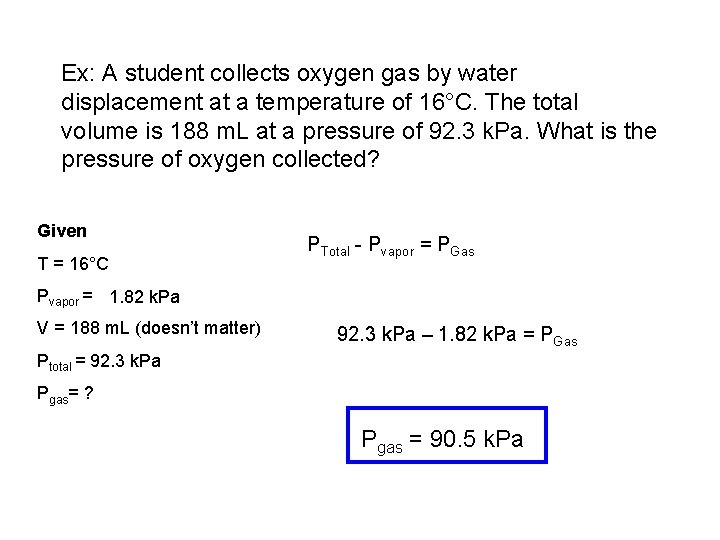
Ex: A student collects oxygen gas by water displacement at a temperature of 16°C. The total volume is 188 m. L at a pressure of 92. 3 k. Pa. What is the pressure of oxygen collected? Given T = 16°C PTotal - Pvapor = PGas Pvapor = 1. 82 k. Pa V = 188 m. L (doesn’t matter) 92. 3 k. Pa – 1. 82 k. Pa = PGas Ptotal = 92. 3 k. Pa Pgas= ? Pgas = 90. 5 k. Pa
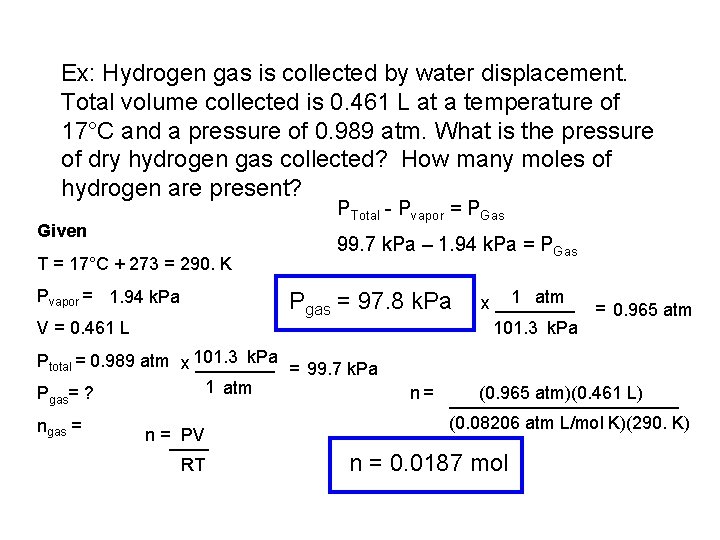
Ex: Hydrogen gas is collected by water displacement. Total volume collected is 0. 461 L at a temperature of 17°C and a pressure of 0. 989 atm. What is the pressure of dry hydrogen gas collected? How many moles of hydrogen are present? PTotal - Pvapor = PGas Given T = 17°C + 273 = 290. K Pvapor = 1. 94 k. Pa V = 0. 461 L 99. 7 k. Pa – 1. 94 k. Pa = PGas Pgas = 97. 8 k. Pa 1 atm x ____ = 0. 965 atm 101. 3 k. Pa Ptotal = 0. 989 atm x ____ = 99. 7 k. Pa 1 atm n = (0. 965 atm)(0. 461 L) Pgas= ? ____________ ngas = n = PV ____ RT (0. 08206 atm L/mol K)(290. K) n = 0. 0187 mol
Learning Check • Dalton’s Law formula: • In a sentence summarize how Dalton’s Law works. • What does it mean to collect gas over water?
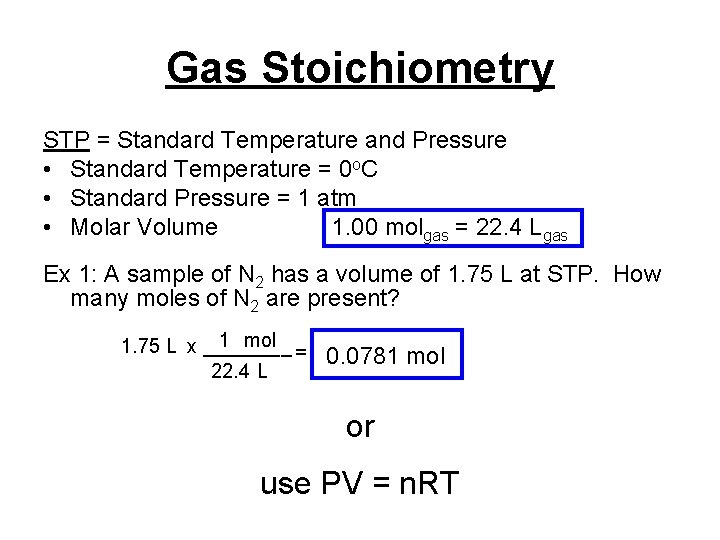
Gas Stoichiometry STP = Standard Temperature and Pressure • Standard Temperature = 0 o. C • Standard Pressure = 1 atm • Molar Volume 1. 00 molgas = 22. 4 Lgas Ex 1: A sample of N 2 has a volume of 1. 75 L at STP. How many moles of N 2 are present? 1 mol 1. 75 L x ____ = 22. 4 L 0. 0781 mol or use PV = n. RT
Ex 2: Calculate the volume of O 2 produced at 1. 00 atm and 25 o. C by the decomposition of 10. 5 g KCl. O 3. 2 KCl. O 3 2 KCl + 3 O 2 Given V= ? T = 25 o. C + 273 = 298 K P = 1. 00 atm V = n. RT ____ P V = (0. 128 mol) (0. 08206 atm L/mol K)(298 K) ________________ 1. 00 atm R = 0. 08206 atm L/mol K 1 mol KCl. O 3 x _____ 3 mol O 2 n = 10. 5 g KCl. O 3 x ______ = 0. 128 mol 122. 6 g KCl. O 3 2 mol KCl. O 3 V = 3. 13 L
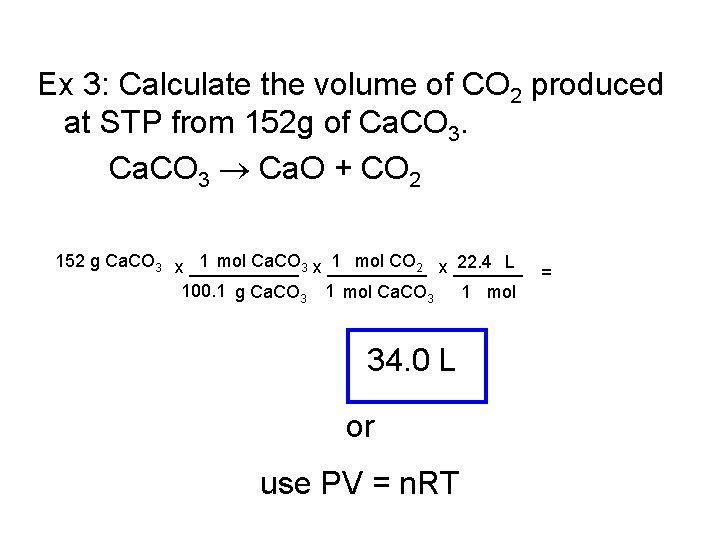
Ex 3: Calculate the volume of CO 2 produced at STP from 152 g of Ca. CO 3 Ca. O + CO 2 152 g Ca. CO 3 x ______ 1 mol Ca. CO 3 x _____ 1 mol CO 2 x _______ 22. 4 L = 100. 1 g Ca. CO 3 1 mol 34. 0 L or use PV = n. RT
Learning Check • • • • What does STP mean? STP Temperature = STP Pressure = 1 mole of gas = ______ L of gas