ICT AND PRINCIPLES OF DATA ANALYSIS PROF UZOMA

- Slides: 25
ICT AND PRINCIPLES OF DATA ANALYSIS PROF. UZOMA ODERA OKOYE Department of Social Work University of Nigeria, Nsukka
INTRODUCTION �To have a good data to analyze you must first of all collect quality data �In order to collect quality data, you must have a good instrument
Qualities of a good questionnaire �Every questionnaire must have a covering letter that will tell your respondents who you are and the purpose of the questionnaire �The questionnaire should be divided into section �Each section must have general and specific guidelines to respondents �Remember the data will be coded so put the coding into consideration when developing the questionnaire
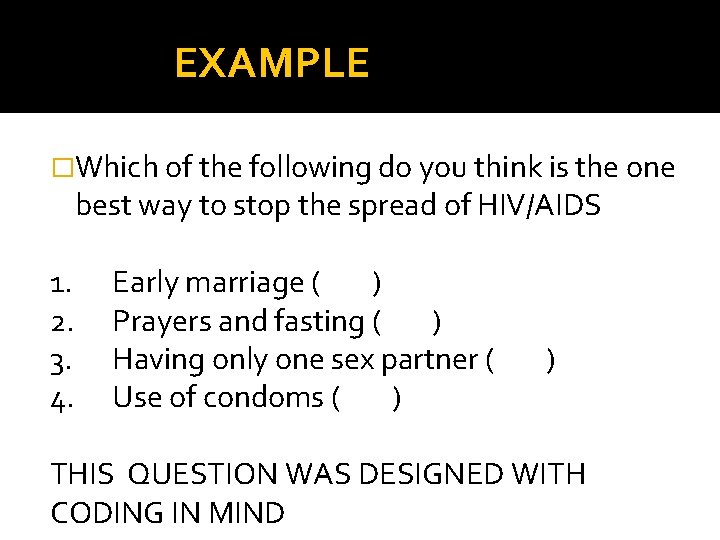
EXAMPLE �Which of the following do you think is the one best way to stop the spread of HIV/AIDS 1. 2. 3. 4. Early marriage ( ) Prayers and fasting ( ) Having only one sex partner ( Use of condoms ( ) ) THIS QUESTION WAS DESIGNED WITH CODING IN MIND
Ordering of questions in the questionnaire �Do not ask sensitive questions first. Eg Age should not be the first question. �Arrange the questions in content areas �Embarrassing questions should come last
Wording of questions in the questionnaire �You must make the questions to be simple �The questions should be short. �Avoid the use of scientific abbreviations, jargon and slang unless you are using a specialized population as your respondents. �Avoid leading questions.
Wording of questions in the questionnaire (2) � Avoid ambiguous questions. � Avoid emotional language and prestige bias. � Avoid asking questions that are beyond the capabilities of respondents. � Know when to ask direct and indirect questions � In using close ended, make sure that there response categories are exhaustive and also mutually exclusive � Avoid double barrel questions.
POPULAR OF ANALYTICAL PACKAGES �Statistical Package for Social Sciences (SPSS), �Epidemiological Information (Epi Info), �Microsoft Excel �STATA �SAS
ADVANTAGES OF USING DATA ANALYSIS SOFTWARE �Reduce/eliminate errors in calculation �Data management, e. g. , add variables & observations, recode variables, etc. �Graphical utilities � Multiple users can work with the same data file � Faster, more efficient
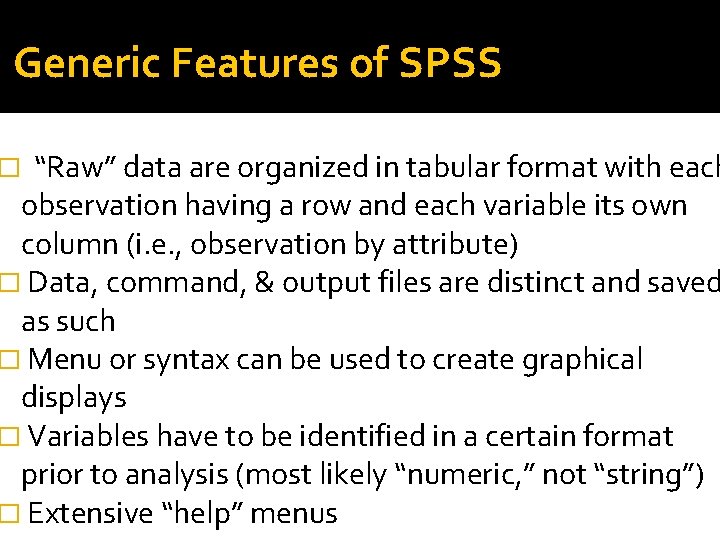
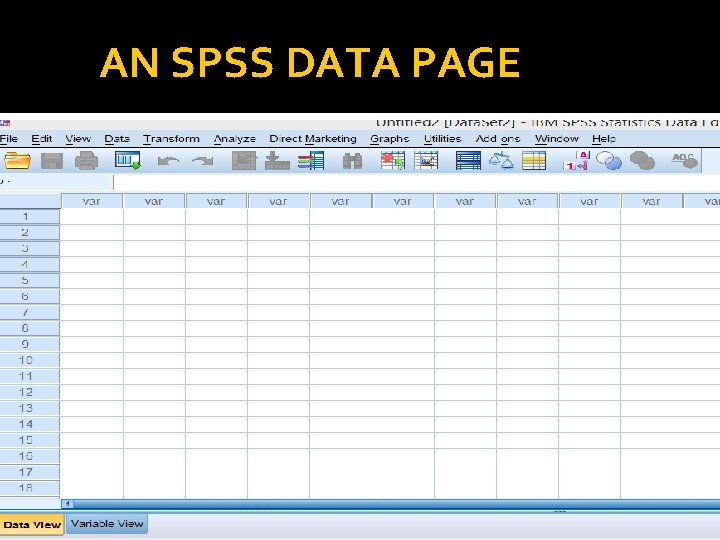
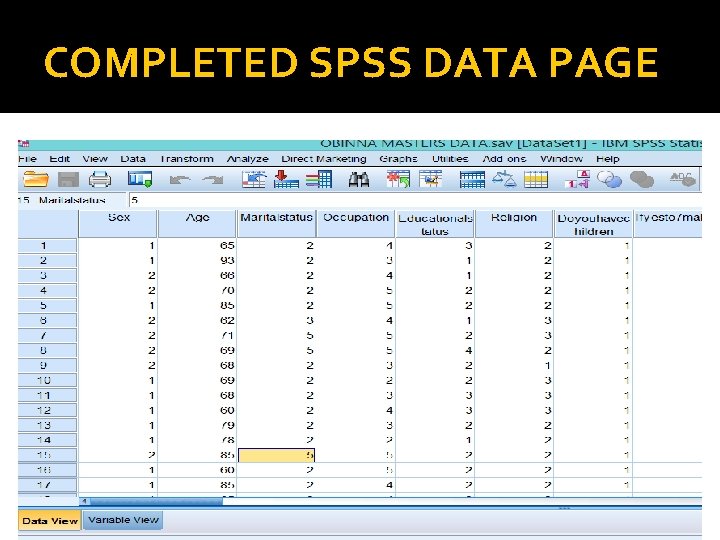
Generic Features of SPSS “Raw” data are organized in tabular format with each observation having a row and each variable its own column (i. e. , observation by attribute) � Data, command, & output files are distinct and saved as such � Menu or syntax can be used to create graphical displays � Variables have to be identified in a certain format prior to analysis (most likely “numeric, ” not “string”) � Extensive “help” menus �
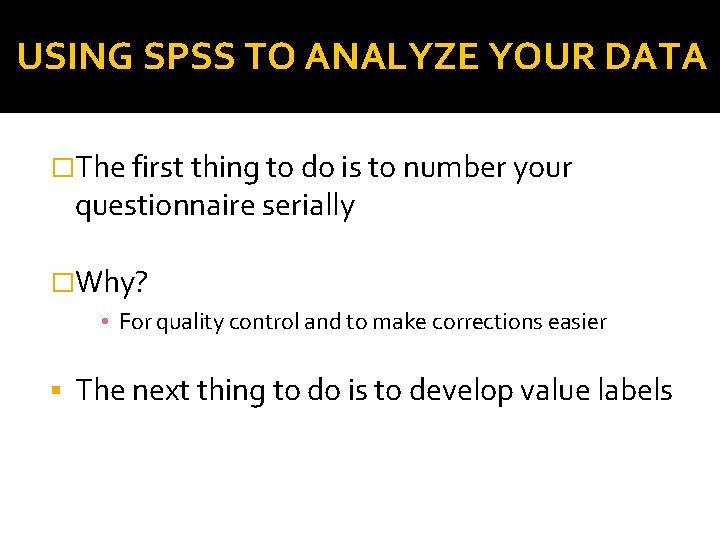
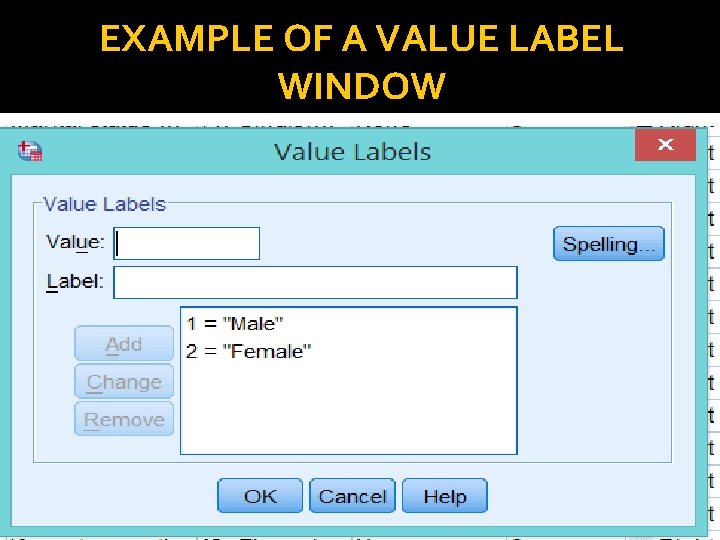
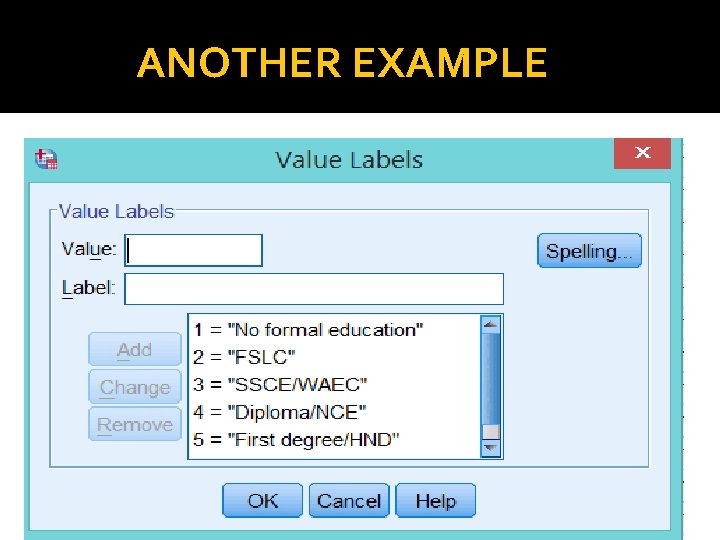
USING SPSS TO ANALYZE YOUR DATA �The first thing to do is to number your questionnaire serially �Why? • For quality control and to make corrections easier The next thing to do is to develop value labels
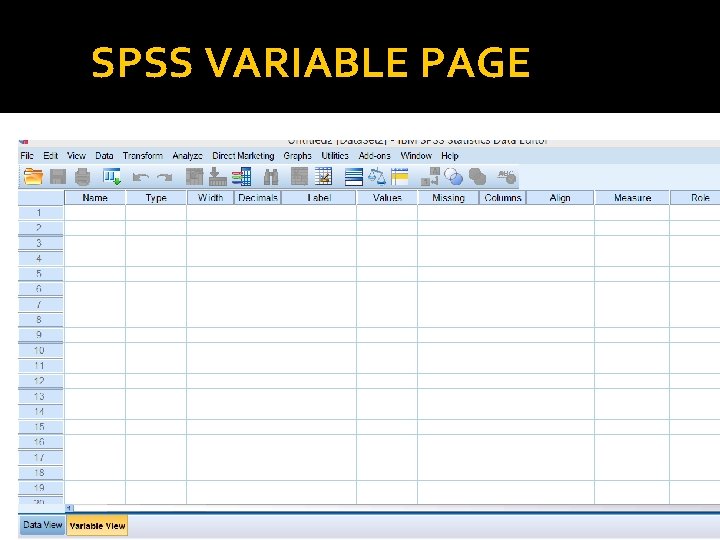
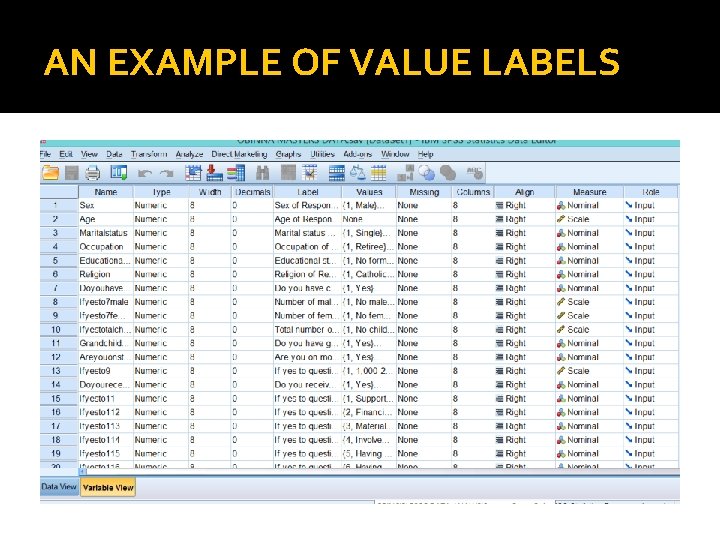
SPSS VARIABLE PAGE
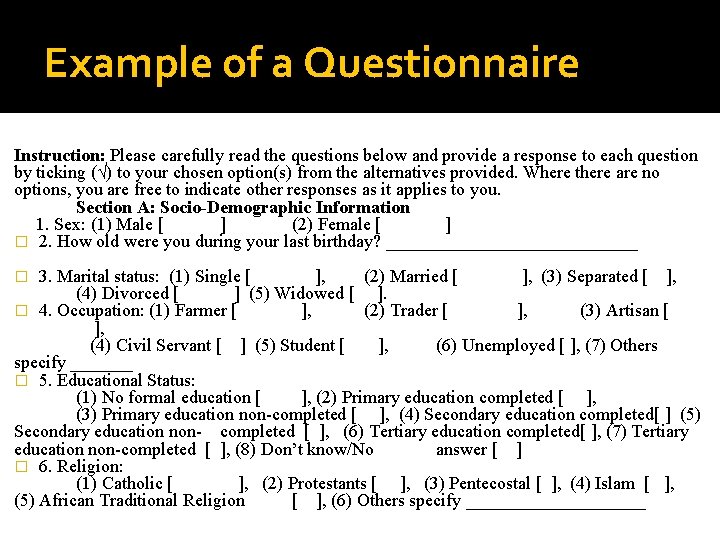
Example of a Questionnaire Instruction: Please carefully read the questions below and provide a response to each question by ticking (√) to your chosen option(s) from the alternatives provided. Where there are no options, you are free to indicate other responses as it applies to you. Section A: Socio-Demographic Information 1. Sex: (1) Male [ ] (2) Female [ ] � 2. How old were you during your last birthday? ______________ 3. Marital status: (1) Single [ ], (2) Married [ ], (3) Separated [ ], (4) Divorced [ ] (5) Widowed [ ]. � 4. Occupation: (1) Farmer [ ], (2) Trader [ ], (3) Artisan [ ], (4) Civil Servant [ ] (5) Student [ ], (6) Unemployed [ ], (7) Others specify _______ � 5. Educational Status: (1) No formal education [ ], (2) Primary education completed [ ], (3) Primary education non-completed [ ], (4) Secondary education completed[ ] (5) Secondary education non- completed [ ], (6) Tertiary education completed[ ], (7) Tertiary education non-completed [ ], (8) Don’t know/No answer [ ] � 6. Religion: (1) Catholic [ ], (2) Protestants [ ], (3) Pentecostal [ ], (4) Islam [ ], (5) African Traditional Religion [ ], (6) Others specify __________ �
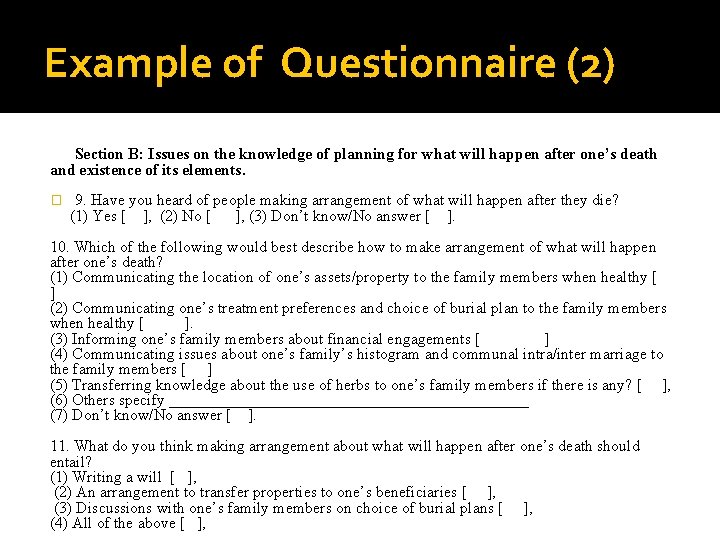
Example of Questionnaire (2) Section B: Issues on the knowledge of planning for what will happen after one’s death and existence of its elements. � 9. Have you heard of people making arrangement of what will happen after they die? (1) Yes [ ], (2) No [ ], (3) Don’t know/No answer [ ]. 10. Which of the following would best describe how to make arrangement of what will happen after one’s death? (1) Communicating the location of one’s assets/property to the family members when healthy [ ] (2) Communicating one’s treatment preferences and choice of burial plan to the family members when healthy [ ]. (3) Informing one’s family members about financial engagements [ ] (4) Communicating issues about one’s family’s histogram and communal intra/inter marriage to the family members [ ] (5) Transferring knowledge about the use of herbs to one’s family members if there is any? [ ], (6) Others specify _______________________ (7) Don’t know/No answer [ ]. 11. What do you think making arrangement about what will happen after one’s death should entail? (1) Writing a will [ ], (2) An arrangement to transfer properties to one’s beneficiaries [ ], (3) Discussions with one’s family members on choice of burial plans [ ], (4) All of the above [ ],
EXAMPLE OF A VALUE LABEL WINDOW
ANOTHER EXAMPLE
AN EXAMPLE OF VALUE LABELS
AN SPSS DATA PAGE
COMPLETED SPSS DATA PAGE
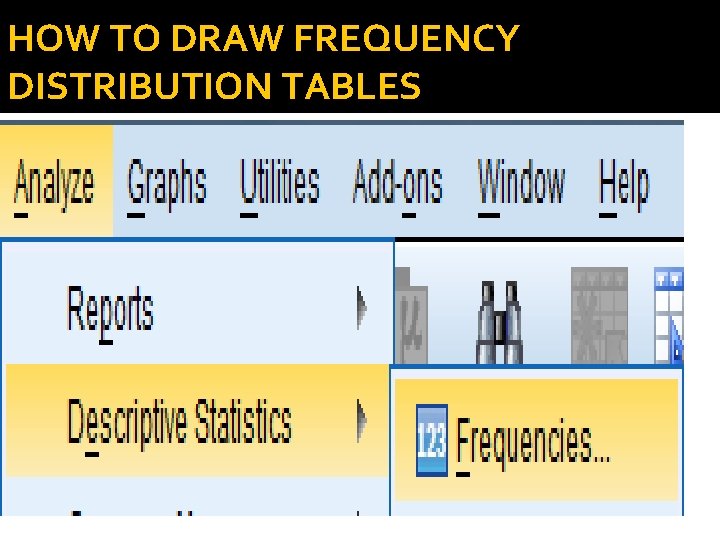
HOW TO DRAW FREQUENCY DISTRIBUTION TABLES
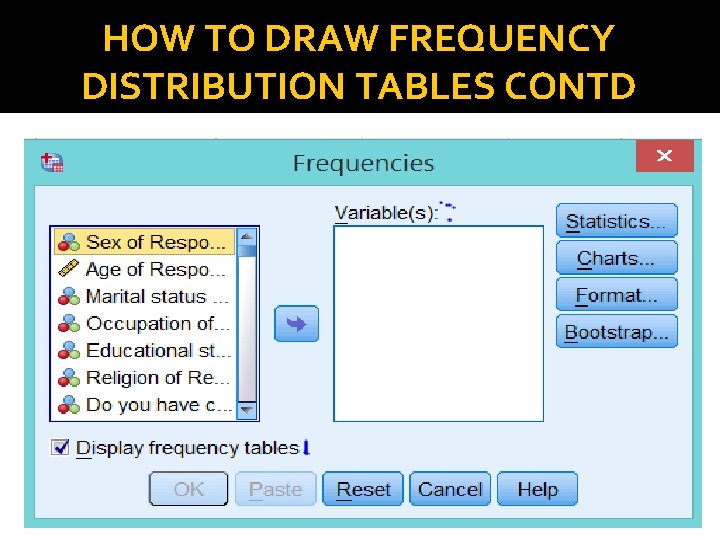
HOW TO DRAW FREQUENCY DISTRIBUTION TABLES CONTD
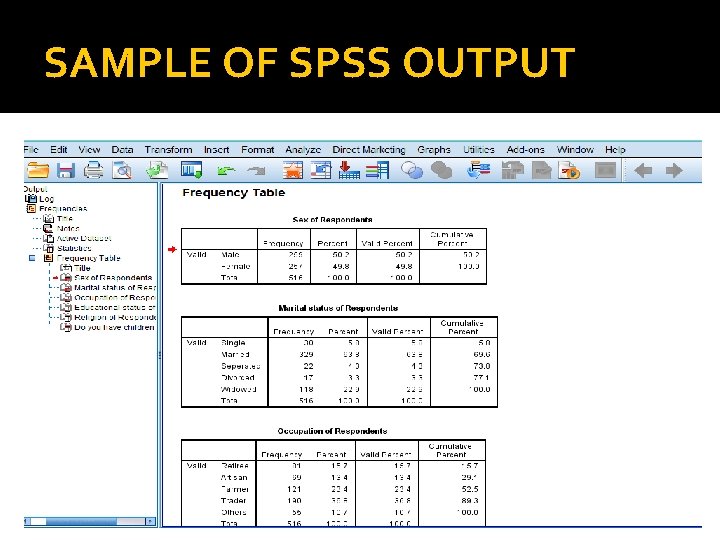
SAMPLE OF SPSS OUTPUT
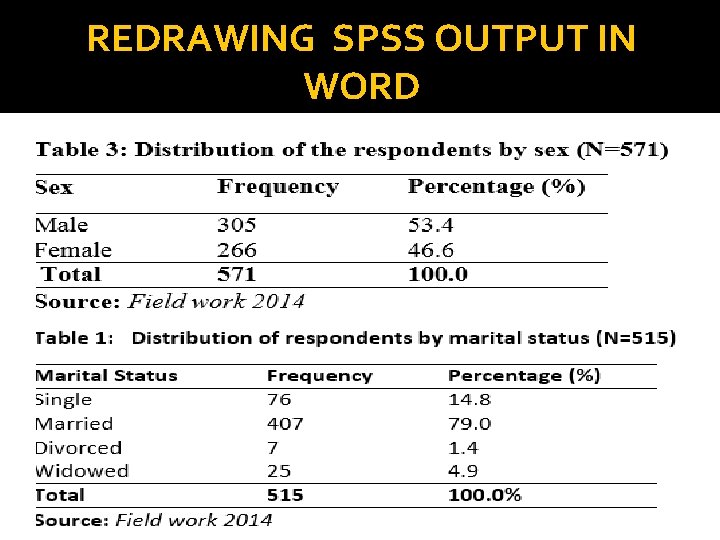
REDRAWING SPSS OUTPUT IN WORD
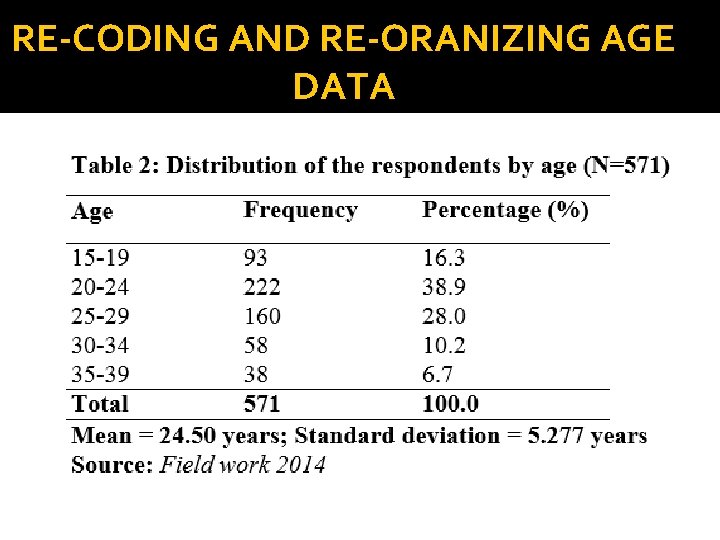
RE-CODING AND RE-ORANIZING AGE DATA
THANK YOU FOR LISTENING QUESTIONS PLEASE